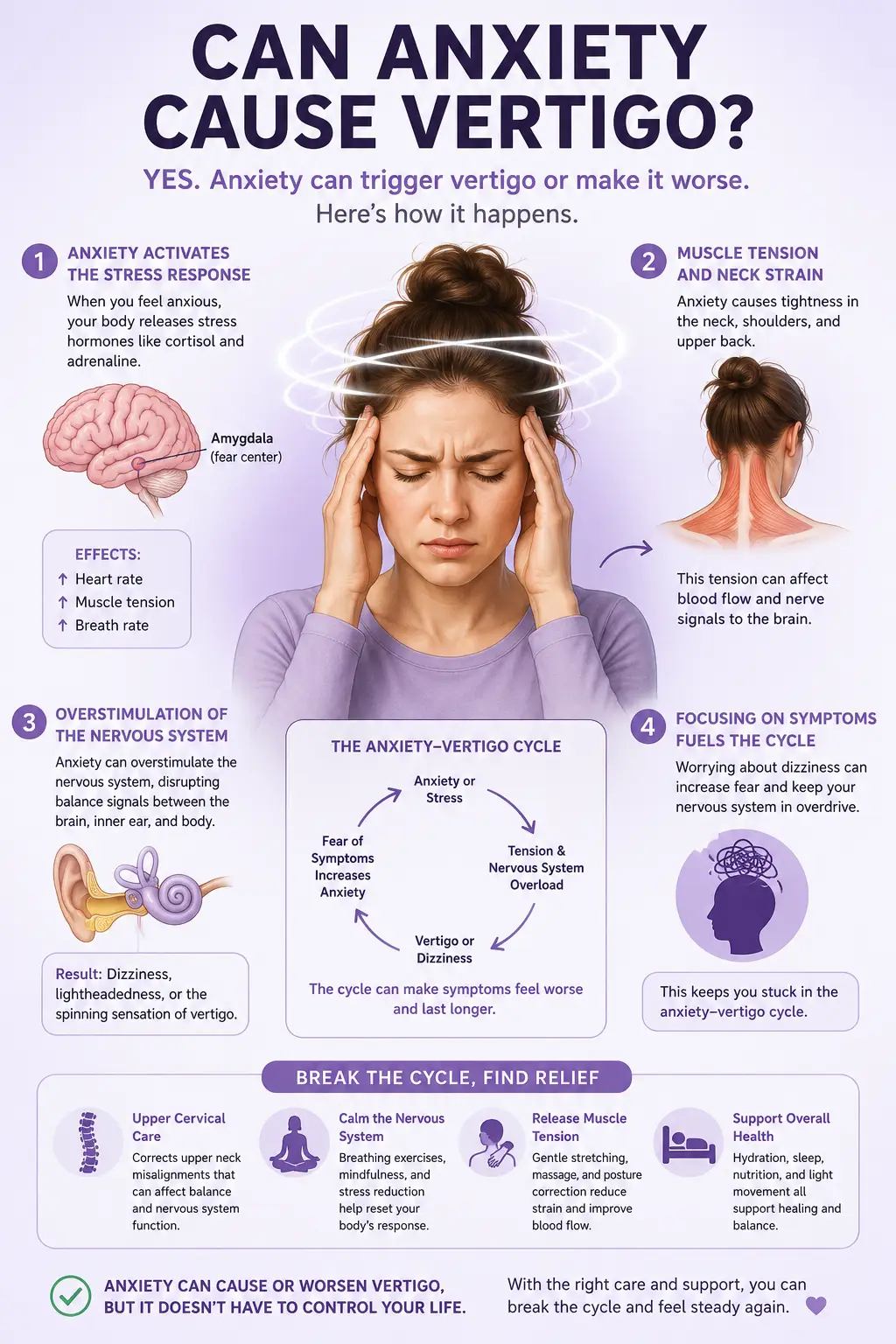
Can Anxiety Cause Vertigo? The Anxiety–Balance Loop and How Upper Cervical Care at Lavender Family Chiropractic May Help in Sarasota, Florida
By Dr. Rusty Lavender, D.C. — upper cervical chiropractor, Lavender Family Chiropractic, Sarasota, FL. Reviewed and updated October 2026.
Can anxiety cause vertigo? If your heart races and the room seems to tilt when you are anxious — or if a wave of dizziness sends you straight into panic — you have probably wondered which came first. Is anxiety making you dizzy, or is dizziness making you anxious? It is one of the most common and most misunderstood questions we hear at Lavender Family Chiropractic in Sarasota. The honest answer is that the two are deeply intertwined, and understanding how they feed one another is the first step toward breaking the cycle.
Anxiety and vertigo share wiring in the brain, and each can trigger and amplify the other. For many people, what looks like a purely psychological problem has a physical component in the balance system and the upper neck — and what looks like a purely physical problem is being magnified by an overactive stress response. This guide explains the anxiety–balance connection, what the research shows, and how natural vertigo relief through upper cervical chiropractic care may fit into a comprehensive plan.
Can anxiety cause vertigo? What Is Vertigo, and How Does It Relate to Anxiety?
Vertigo is a false sensation of movement — most often spinning, swaying, or tilting — that occurs when your brain receives conflicting information about your position in space. It is distinct from the general lightheadedness or “faint” feeling people sometimes call dizziness, though the two can overlap and both are strongly linked to anxiety.
Your balance depends on three information streams arriving together in the brainstem and cerebellum: the inner ear, which senses head motion and gravity; the eyes, which report what is moving around you; and the neck and body, which signal the position of your head relative to your torso. The brain fuses these inputs into a single, stable sense of where you are. When the inputs disagree, or when the brain’s own processing is over-aroused, the result can be dizziness or vertigo.
Here is the key insight: the brain regions that process balance and the brain regions that process fear and anxiety are anatomically connected. The vestibular system shares pathways with the areas that govern the “fight or flight” response. That overlap is why a rush of anxiety can make you feel unsteady, and why an unexpected spinning episode can instantly trigger fear. The systems talk to each other constantly, and in some people that conversation gets stuck in a loop.
Can Anxiety Cause Vertigo? Understanding Both Directions
The relationship runs both ways, and recognizing which direction dominates for you is important.
Anxiety amplifying dizziness. When you are anxious, your sympathetic nervous system floods your body with stress chemistry. Your breathing quickens and shallows, which can lower carbon dioxide levels and produce lightheadedness, tingling, and a floating sensation. Muscle tension rises — particularly through the neck, jaw, and shoulders — which can distort the position signals your upper neck sends to the balance centers. Your brain also becomes hypervigilant, scanning for threat, which lowers the threshold at which normal sensations get interpreted as alarming. In this state, minor balance signals that you would normally ignore get amplified into full dizziness.
Dizziness triggering anxiety. Vertigo is inherently threatening to the nervous system. Losing your sense of stability sets off an alarm reaction — a spike of fear, a racing heart, sweating, and the urge to grab onto something. If you have had frightening episodes, your brain begins to anticipate them, and the anticipation itself becomes a source of chronic anxiety. People start avoiding places and activities where an episode might happen, which shrinks their world and deepens the anxiety.
The self-reinforcing loop. Over time, these two directions merge into a cycle. A physical trigger causes dizziness, dizziness causes anxiety, anxiety amplifies the dizziness, and the heightened vigilance makes the next episode more likely. This is the pattern behind chronic conditions in which dizziness and anxiety become inseparable, and it is why treating only one half of the loop often falls short.
The Nerve and Vascular Mechanisms Connecting Anxiety and Balance
Several concrete physiological mechanisms explain why anxiety and vertigo travel together.
Shared neural pathways. The vestibular nuclei in the brainstem have direct connections to the limbic system and the regions that regulate emotional and autonomic responses. This means balance signals and fear signals are processed in overlapping circuitry, so activity in one system readily spills into the other.
The autonomic nervous system and the vagus nerve. Your autonomic nervous system controls the unconscious functions — heart rate, blood pressure, digestion — that shift dramatically during both anxiety and dizziness. When this system is dysregulated, you can experience a mix of racing heart, nausea, lightheadedness, and unsteadiness that blurs the line between a panic episode and a vertigo episode. The upper neck sits near critical structures involved in autonomic regulation, which is one reason upper cervical function is relevant. You can learn more on our page about vagus nerve dysfunction.
Hyperventilation and blood flow. Anxious, rapid breathing changes blood chemistry and can transiently reduce blood flow to the brain, producing lightheadedness and a sense of unreality that people often describe as dizziness. This is a common driver of anxiety-related dizzy spells.
Muscle guarding and neck proprioception. Chronic anxiety keeps the muscles of the neck and shoulders tense and guarded. Because roughly half of the body’s cervical position-sensing receptors sit in the joints of the upper neck, sustained tension and misalignment there can distort the head-position signals reaching the balance centers — adding a genuine physical source of dizziness on top of the anxiety itself.
The Upper Neck Connection
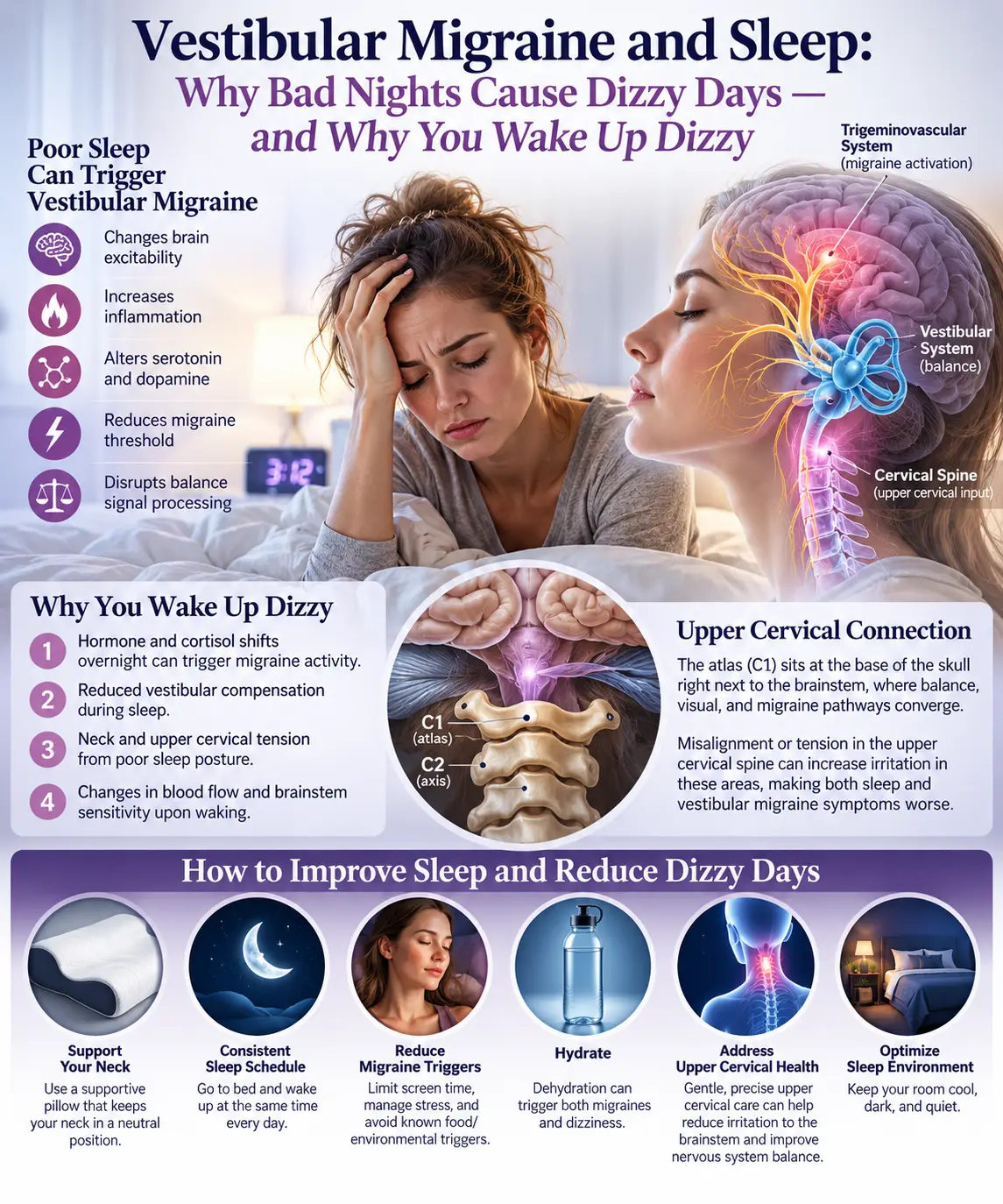
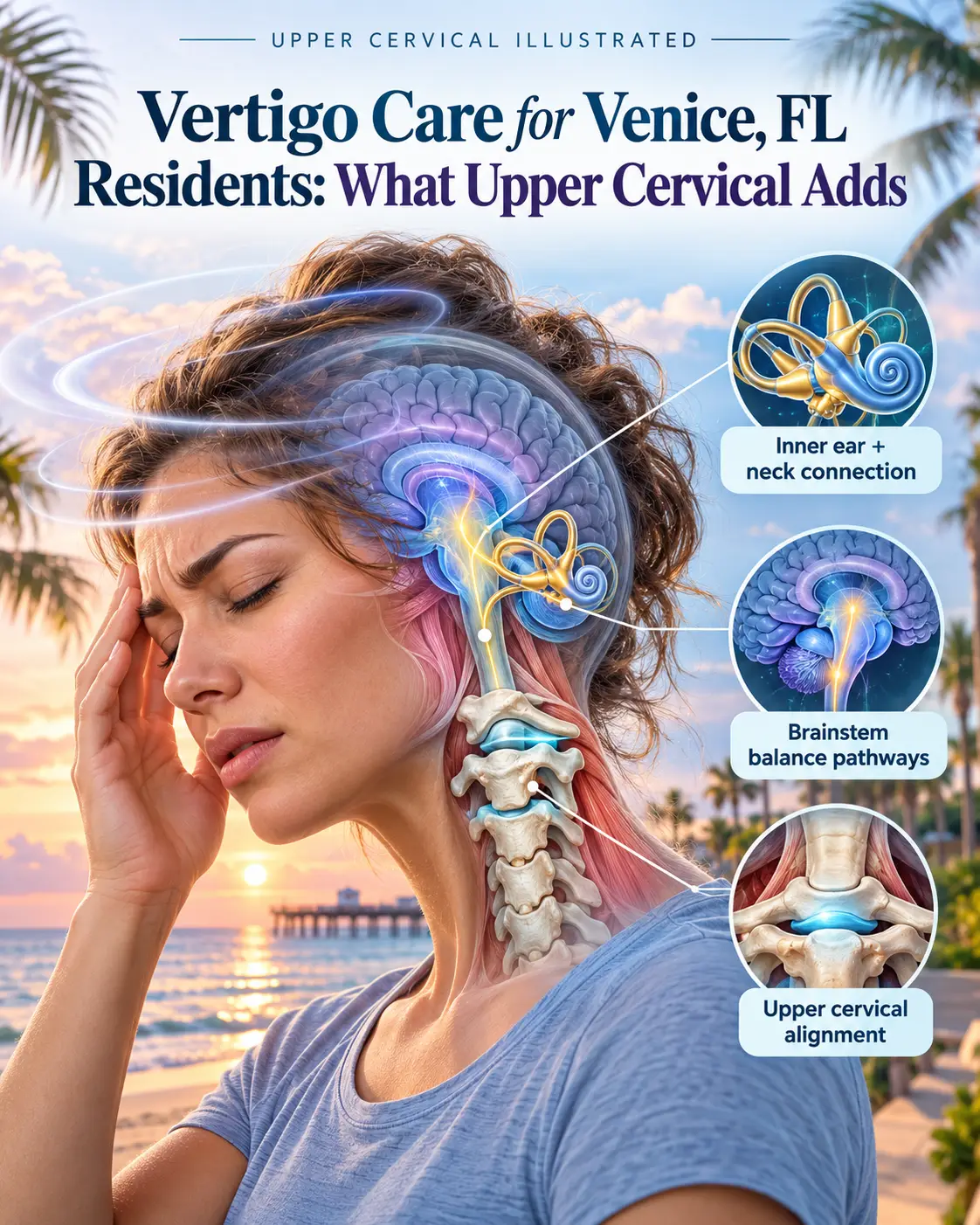
The upper cervical spine — the atlas (C1) and axis (C2) at the very top of the neck — plays a quietly important role in both balance and the stress response. This region sits just below the brainstem, cradles the skull, and houses one of the densest concentrations of proprioceptive receptors in the body. It is also anatomically close to structures that influence autonomic function.
When the upper cervical spine is misaligned or chronically tense, two things can happen at once. First, the faulty position information it sends can create or worsen a genuine sense of unsteadiness, which the anxious brain then amplifies. Second, irritation in this region can contribute to autonomic dysregulation — the very system that governs the fight-or-flight response tied to anxiety. In this way, an upper neck problem can sit at the intersection of the physical and emotional sides of the dizziness–anxiety loop.
This helps explain why some people with anxiety-related dizziness also report neck tightness, tension headaches at the base of the skull, jaw clenching, and a persistent “on edge” feeling. These are not unrelated coincidences; they can be different expressions of the same upper cervical and autonomic picture. Our article on whether neck pain can cause dizziness explores this mechanism in more depth.
Conditions Where Anxiety and Vertigo Commonly Overlap
Several recognized conditions sit squarely at the intersection of anxiety and dizziness, and understanding them can help you make sense of your own experience.
Persistent postural-perceptual dizziness (PPPD) is a chronic condition in which a person feels ongoing unsteadiness and heightened sensitivity to motion, often after an initial vertigo episode has passed. Anxiety and hypervigilance are central to how PPPD develops and persists, making it a textbook example of the dizziness–anxiety loop becoming self-sustaining.
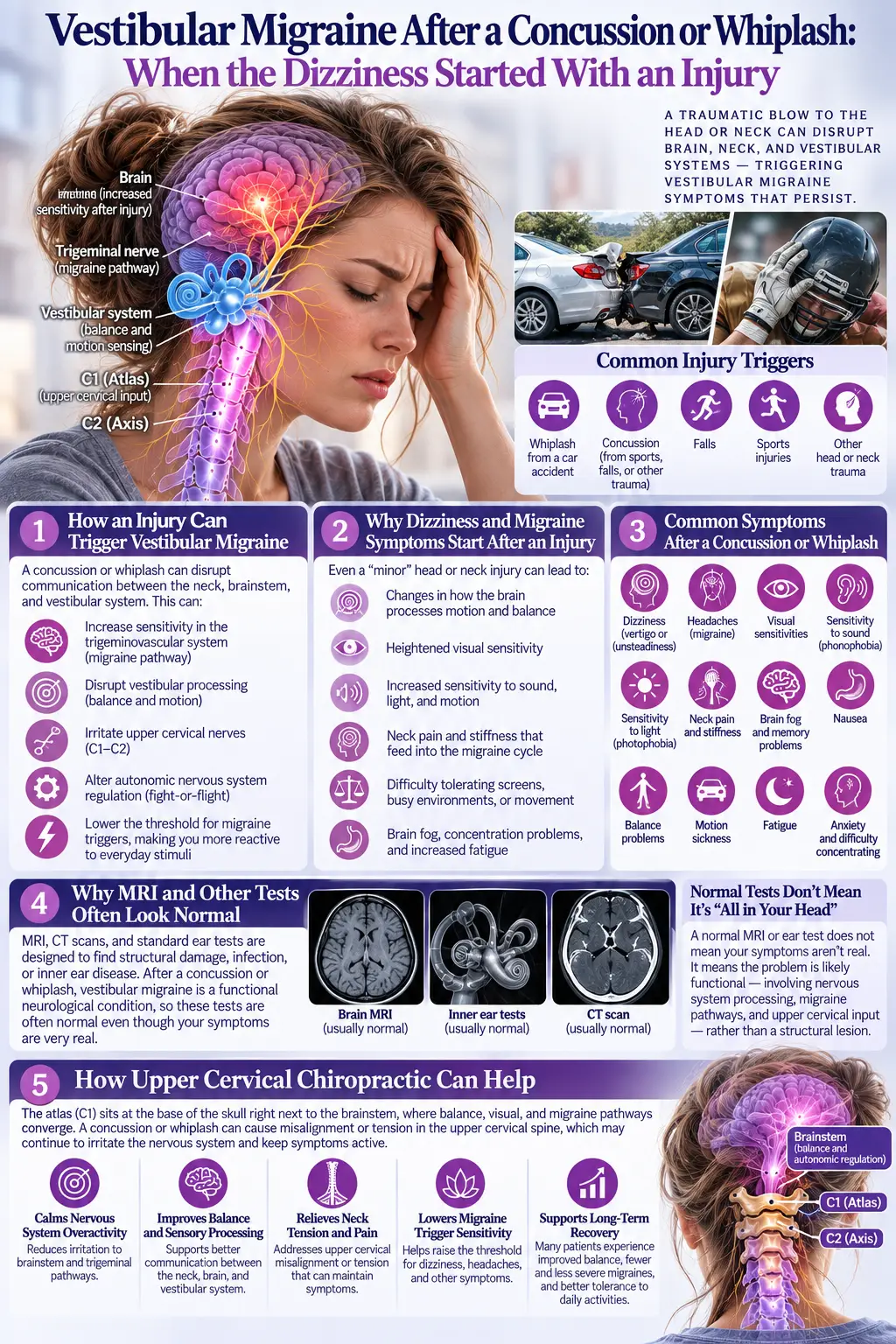
Vestibular migraine frequently pairs vertigo with anxiety, light and sound sensitivity, and a sense of disorientation. The unpredictability of episodes tends to fuel anticipatory anxiety. You can learn more on our vestibular migraine page.
Benign paroxysmal positional vertigo (BPPV) is a mechanical inner-ear condition, yet research consistently finds elevated anxiety among people who have it — a reminder of how quickly even a purely physical cause of vertigo becomes entangled with the stress response.
POTS and dysautonomia involve dysregulation of the autonomic nervous system, producing a blend of dizziness, racing heart, and anxiety-like sensations that can be hard to tell apart. Our page on POTS and our article on why you feel lightheaded go deeper.
Vestibular hypofunction, in which the inner ear’s balance input is reduced, can push the brain to over-rely on vision and neck sensation, producing unsteadiness that anxiety then magnifies. Our article on vestibular hypofunction explains this pattern.
Across all of these, the common thread is a nervous system that has become over-reactive — and that is where addressing the physical contributors, including upper cervical function and autonomic regulation, can play a supporting role.
Upper Cervical Care at Lavender Family Chiropractic
At Lavender Family Chiropractic in Sarasota, we take a root-cause approach to dizziness rather than simply chasing the symptom. When anxiety and vertigo are tangled together, our focus is on the physical contributors we can objectively measure and address — particularly the alignment and function of the upper cervical spine and its influence on the nervous system.
Our evaluation is detailed and individualized. We use 3D CBCT imaging to precisely assess the position of your atlas and axis, and paraspinal infrared thermography to evaluate how your nervous system is functioning. Because the autonomic nervous system is so central to the anxiety–dizziness loop, this objective look at nervous-system function is especially valuable.
When a correction is indicated, we use the Knee Chest Upper Cervical technique to restore upper cervical alignmentgently and precisely, without forceful twisting or cracking. The aim is to help the upper neck send accurate position signals to the balance centers and to support healthier autonomic regulation. From there we develop customized treatment plans around your specific goals.
We are also clear about scope. Upper cervical care addresses the physical and nervous-system contributors to dizziness; it is not a substitute for mental-health treatment when anxiety is significant. For many people, the most effective path combines care for the body’s balance system with appropriate support for the anxiety itself, and we are glad to work alongside your other providers.
Take the First Step Toward Steadier, Calmer Days
If dizziness and anxiety have been feeding each other and shrinking your life, we would like to help you understand the physical side of the picture. Call Lavender Family Chiropractic at (941) 243-3729 to schedule a consultation, or book online here: https://intake.chirohd.com/new-patient-scheduling/724/lavender-family-chiropractic. We will examine your upper cervical spine and explain whether it may be contributing to your symptoms.
What the Research Says About Anxiety and Vertigo
The link between anxiety and balance disorders is one of the most consistently documented relationships in the dizziness literature. Here are five studies that illuminate the connection.
A comprehensive systematic review and meta-analysis of anxiety and depression in adults with vestibular disorderspooled data across many studies and found that people with vestibular (balance-system) disorders were significantly more likely to experience anxiety than the general population, with a relative risk of roughly 1.5. This large-scale synthesis establishes that heightened anxiety is not incidental to dizziness — it is a robust, measurable pattern across the vestibular population.
Research examining the reverse direction is captured in the work Anxiety in the Elderly Can be a Vestibular Problem, which explores how balance dysfunction can present as, and be mistaken for, primary anxiety. It underscores that in some people the “anxiety” is actually driven by an underlying vestibular disturbance — a crucial reminder that dizziness deserves a physical evaluation, not just a psychological one.
A study on the effect of accompanying anxiety and depression on patients with different vestibular syndromes examined how mood and anxiety symptoms influence people across a range of balance diagnoses. It found that accompanying anxiety and depression meaningfully worsen the burden and perceived severity of vestibular symptoms, highlighting why addressing the emotional component alongside the physical one improves the overall picture.
Zeroing in on a specific, common form of vertigo, research on anxiety, mood, and personality disorders in patients with benign paroxysmal positional vertigo found notably elevated rates of anxiety — around 30 percent — in people with BPPV, a mechanical inner-ear condition. Because BPPV is a physical, positional problem, the high anxiety rate demonstrates how readily even a “mechanical” cause of vertigo becomes entangled with the stress response.
Finally, connecting the neck to this picture, a review of cervicogenic dizziness explains how dysfunction in the upper cervical spine can generate dizziness through faulty proprioceptive input to the balance centers. This is relevant to the anxiety–vertigo loop because neck tension is a hallmark of chronic anxiety, and the resulting proprioceptive disturbance can add a genuine physical source of dizziness to the emotional one.
How the Anxiety–Vertigo Loop Shrinks Daily Life
One of the reasons the anxiety–vertigo cycle is so difficult is that it tends to expand quietly. It often begins with a single frightening episode. To avoid a repeat, a person starts steering clear of the situation where it happened — a busy grocery store, a highway, a crowded event. Avoidance brings short-term relief, so the brain learns to rely on it, and the list of avoided situations grows. What started as one bad moment gradually becomes a smaller and more guarded life.
The physical and emotional threads reinforce each other along the way. Anticipating dizziness keeps the nervous system on high alert, and a nervous system on high alert is more likely to produce the very symptoms being feared. Sleep suffers, which lowers tolerance for both anxiety and dizziness. Muscle tension through the neck and shoulders becomes chronic, adding a genuine physical source of unsteadiness on top of the emotional one. Each element feeds the others.
Recognizing this pattern is empowering, because it reveals where the cycle can be interrupted. Addressing the physical contributors — including upper cervical function and autonomic regulation — can reduce the real sensory disturbances that keep triggering the alarm. Calming the stress response through breathing, gradual re-exposure, and, when needed, professional mental-health support reduces the amplification. Because the loop is built from multiple reinforcing parts, progress on any one part tends to ease the whole. You do not have to fix everything at once; you have to start loosening the cycle’s grip. Our overview of why vertigo happens can help you understand the physical side as you begin.
Lifestyle Strategies to Calm the Anxiety–Vertigo Cycle
Alongside professional care, daily habits can help settle both the balance system and the stress response that amplifies it.
Practice slow, diaphragmatic breathing. Because rapid, shallow breathing is a direct driver of anxiety-related dizziness, learning to breathe slowly through the diaphragm can interrupt an episode before it escalates. A simple pattern — a slow inhale, a brief hold, and a longer exhale — helps reset blood chemistry and calm the nervous system.
Release upper-neck and jaw tension. Gentle mobility work, warm compresses at the base of the skull, and awareness of jaw clenching can reduce the muscle guarding that distorts neck proprioception. Being mindful of your head posture during long stretches at a screen or phone helps too.
Prioritize sleep and hydration. Poor sleep and dehydration both lower your threshold for dizziness and heighten anxiety. In Florida’s heat, staying hydrated matters even on ordinary days; our guide on why you feel lightheaded covers related contributors like blood pressure and dysautonomia.
Reduce stimulants when symptoms flare. Caffeine and other stimulants can heighten both anxiety and the sensation of dizziness in sensitive individuals. Noticing whether your episodes cluster around high-caffeine days can be informative.
Reintroduce avoided activities gradually. Avoidance feels protective but tends to deepen the anxiety loop over time. Slowly and safely re-engaging with situations you have been avoiding — with support — helps retrain both your balance system and your confidence.
Consider support for the anxiety itself. When anxiety is significant, working with a qualified mental-health professional is an important part of breaking the cycle. Physical care and psychological care complement, rather than replace, one another.
What to Expect at Your First Visit
If dizziness and anxiety have made you cautious about new places, it helps to know exactly what your first visit involves so there are no surprises.
We start with an unhurried conversation about your history. We want to understand how your dizziness and anxiety relate — which tends to come first for you, what triggers episodes, how long you have been in the cycle, and what you have already tried. Because the two are so intertwined, this careful listening is an important part of sorting out the physical contributors from the emotional ones.
Next, we gather objective data. The 3D CBCT imaging shows us the precise position of your atlas and axis, while paraspinal infrared thermography helps us evaluate nervous-system function — particularly relevant given how central the autonomic nervous system is to the anxiety–dizziness loop. These findings guide whether an upper cervical correction is appropriate for you.
If care is indicated, we explain what we found in clear terms and outline a customized treatment plan built around your goals. We practice on a cash-pay basis and review the details with you in advance. We will also be candid about where upper cervical care fits and where dedicated mental-health support belongs, because the most durable results usually come from addressing both sides of the loop. If you would like to talk through anything before scheduling, call us any time at (941) 243-3729.
Areas We Serve Around Sarasota
Lavender Family Chiropractic is located at 5899 Whitfield Avenue, Suite 107, in Sarasota, at the corner of University and Whitfield. We care for patients seeking natural vertigo relief from throughout the region, including Bradenton, Lakewood Ranch, Palmetto, Ellenton, Ruskin, Venice, Osprey, Myakka, Tampa, and St. Pete. If anxiety about dizziness makes leaving home difficult, tell us when you call and we will help you plan a comfortable first visit.
Top 15 Frequently Asked Questions About Anxiety and Vertigo
1. Can anxiety really cause vertigo, or is it all in my head? Anxiety can produce very real dizziness through hyperventilation, muscle tension, and heightened nervous-system arousal. It is not imaginary — the physical mechanisms are well documented, and the sensation is genuine.
2. Which comes first, the anxiety or the dizziness? It varies. For some people a physical balance problem triggers anxiety; for others anxiety drives the dizziness. Often the two become a self-reinforcing loop, which is why evaluating both the physical and emotional sides is valuable.
3. How do I know if my dizziness is from anxiety or a physical problem? You often cannot tell on your own, because the two overlap so much. That is exactly why a physical evaluation of the balance system and upper neck is worthwhile — it clarifies whether a treatable physical contributor is present.
4. Can a panic attack feel like vertigo? Yes. Panic attacks frequently include lightheadedness, unsteadiness, a floating sensation, and a racing heart, which can closely resemble or trigger vertigo.
5. Can upper cervical chiropractic care help anxiety-related dizziness? It can address the physical and nervous-system contributors — upper cervical alignment and autonomic function — that may be feeding the loop. It is not a treatment for anxiety itself, and works best as part of a comprehensive approach.
6. Will treating my neck get rid of my anxiety? We do not make that claim. Correcting an upper cervical issue may reduce a physical source of dizziness, which can ease the anxiety that dizziness provokes, but significant anxiety usually also benefits from dedicated mental-health support.
7. Why does my neck feel tight when I am anxious and dizzy? Chronic anxiety keeps the neck and shoulder muscles guarded and tense. Because the upper neck is rich in balance-related sensors, that tension can distort position signals and contribute to dizziness, linking the two symptoms.
8. Is this related to POTS or dysautonomia? It can be. Autonomic dysregulation underlies many overlapping symptoms of dizziness, racing heart, and anxiety. Our page on POTS and article on lightheadedness and dysautonomia explain more.
9. Can vestibular migraine cause both dizziness and anxiety? Yes, vestibular migraine commonly involves vertigo and is frequently accompanied by heightened anxiety. You can learn more on our vestibular migraine page.
10. What testing do you perform? We use 3D CBCT imaging to assess upper cervical alignment and paraspinal infrared thermography to evaluate nervous-system function, giving us objective information to guide care.
11. Could my dizziness be something more serious? Dizziness has many causes, and some require medical evaluation. Sudden, severe vertigo with symptoms such as slurred speech, weakness, double vision, or a severe headache warrants emergency care. We are happy to coordinate with your medical team.
12. Does breathing really affect vertigo? Yes. Rapid, shallow breathing during anxiety changes blood chemistry and can produce lightheadedness. Slow diaphragmatic breathing is one of the most effective ways to interrupt an anxiety-related dizzy spell.
13. How long does anxiety-related dizziness last? It ranges from brief moments during a stressful episode to a persistent background unsteadiness in chronic cases. Breaking the loop typically involves addressing both the physical and emotional contributors over time.
14. Do you work with mental-health providers? Yes. We view physical care and psychological care as complementary. When anxiety is significant, we encourage working with a qualified mental-health professional alongside upper cervical care.
15. Where are you located and who do you serve? We are at 5899 Whitfield Avenue, Suite 107, in Sarasota, serving patients from Bradenton, Lakewood Ranch, Venice, Palmetto, Ellenton, and the surrounding area.
Ready to Break the Cycle?
When anxiety and vertigo are locked together, addressing the physical side of the loop can be a meaningful part of finding steadier, calmer days. If you are ready to understand whether your upper cervical spine is contributing to your dizziness, call Lavender Family Chiropractic at (941) 243-3729 or book your consultation online at https://intake.chirohd.com/new-patient-scheduling/724/lavender-family-chiropractic. Our Sarasota team is here to help you pursue natural vertigo relief as part of a comprehensive plan.
If you are struggling with anxiety or your mental health, please know that support is available, and speaking with a qualified professional or someone you trust can make a real difference.
Related Articles
Related Posts


Get our upper cervical articles first.
Patients Experience