Vertigo While Driving in Sarasota, Florida: Why the Road Starts Spinning — and How Upper Cervical Care at Lavender Family Chiropractic May Help
By Dr. Rusty Lavender, D.C. — upper cervical chiropractor, Lavender Family Chiropractic, Sarasota, FL. Reviewed and updated October 2026.
Vertigo while driving: Few things are as unnerving as feeling the world tilt or spin while you are behind the wheel. One moment you are merging onto I-75 or turning off University Parkway, and the next the horizon seems to slide, the car feels like it is drifting, and your stomach drops. Vertigo while driving is frightening not only because of the sensation itself, but because of what is at stake — your safety and the safety of everyone else on the road. If you have started avoiding highways, left turns, or long drives because of dizziness, you are not imagining the problem, and you are not alone.
At Lavender Family Chiropractic in Sarasota, we work with people every week who describe dizziness that shows up specifically when they drive. For many of them, the missing piece is not the inner ear alone — it is the relationship between the upper neck, the balance system, and the visual demands of driving. This guide explains why vertigo happens behind the wheel, what the research shows, and how natural vertigo relief through upper cervical chiropractic care may fit into your recovery.
Vertigo While Driving: What Is Vertigo, and Why Does It Show Up When You Drive?
Vertigo is not the same as general lightheadedness. Vertigo is a false sensation of movement — usually spinning, tilting, swaying, or the feeling that the car or the road is moving when it is not. It is a symptom, not a diagnosis, and it happens when the brain receives conflicting or inaccurate information about where your head and body are in space.
Your sense of balance depends on three streams of information arriving in the brainstem and cerebellum at the same time and agreeing with one another:
- The inner ear (vestibular system), which senses head rotation, acceleration, and the pull of gravity.
- The eyes (visual system), which tell the brain what is moving in the environment.
- The neck and body (proprioception), especially the joints and muscles of the upper cervical spine, which report the position of your head relative to your torso.
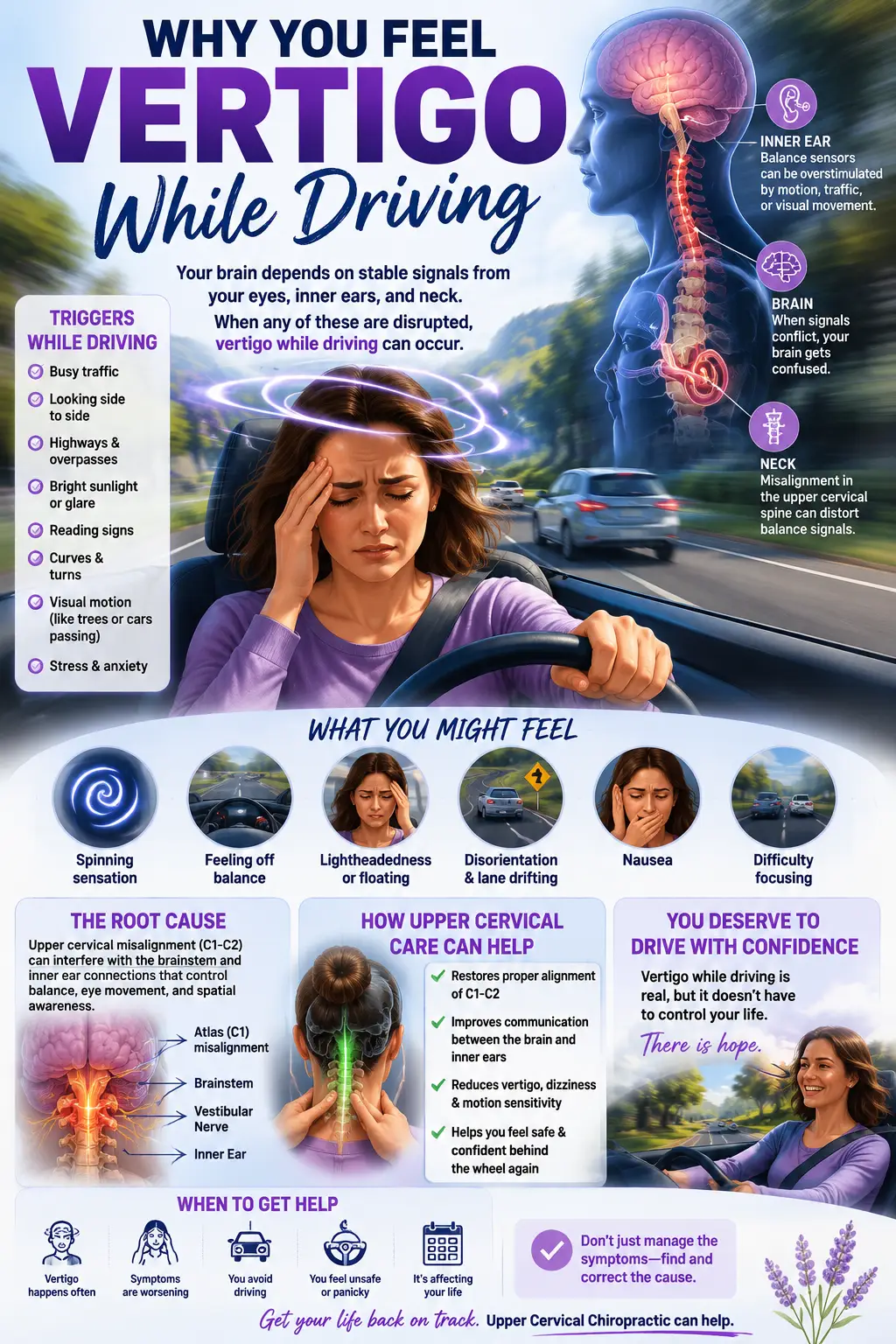
Driving is uniquely demanding on all three systems at once. Your eyes track fast-moving scenery, oncoming cars, mirrors, and dashboard instruments. Your inner ear registers acceleration, braking, and the sway of the vehicle through curves and roundabouts. And your neck constantly rotates as you shoulder-check, scan intersections, and glance between the road and your mirrors. When these signals stop matching — when the eyes say one thing, the inner ear says another, and the neck adds a third conflicting report — the brain interprets the mismatch as motion. That is the spin.
This is why vertigo behind the wheel often feels different from vertigo at home. The environment is moving, your head is moving, and there is very little for the visual system to lock onto as a stable reference. A wide-open highway with sparse scenery, a curving overpass, or heavy stop-and-go traffic can each provoke symptoms in a susceptible nervous system.
The Nerve and Vascular Mechanisms Behind Driving-Related Dizziness
To understand why driving provokes vertigo, it helps to look at what is happening at the level of nerves and blood flow.
Sensory conflict and the vestibulo-ocular reflex. When you turn your head to check a blind spot, a reflex called the vestibulo-ocular reflex (VOR) instantly moves your eyes in the opposite direction so your gaze stays stable. If the inner ear or the neck is sending faulty signals, this reflex misfires, and the visual world appears to jump or slide. Repeated over a drive full of head turns and eye movements, that mismatch fatigues the system and builds into frank vertigo and nausea.
Neck proprioception feeding the balance centers. The upper cervical spine is one of the richest sources of position sense in the entire body. Roughly half of all cervical proprioceptors sit in the joint capsules of the top three vertebrae, and their input travels directly to the vestibular nuclei, the visual system, and the cerebellum. When the atlas (C1) and axis (C2) are misaligned or the surrounding muscles are chronically tight and guarded, they transmit a distorted stream of head-position data. During driving — an activity built around head rotation — that faulty stream collides with inner-ear and visual input and produces dizziness.
Blood flow and brainstem sensitivity. The brainstem houses the balance-integrating centers and depends on steady blood flow. Sustained forward-head posture at the wheel, tension through the suboccipital muscles, and the vibration and micro-jostling of a long drive can all irritate the structures at the base of the skull. In an already sensitized nervous system, this lowers the threshold at which symptoms appear.
The role of the autonomic nervous system. Driving with dizziness is stressful, and stress activates the sympathetic “fight or flight” response. That heightened arousal amplifies the perception of dizziness and nausea, which in turn increases anxiety about driving — a self-reinforcing loop that can make each subsequent drive feel worse than the last.
The Upper Neck Connection
The top of the neck is where the head meets the spine, and it is arguably the most important junction for balance in the body. The atlas vertebra cradles the skull, and the atlas–axis complex allows the majority of your head’s rotation — precisely the motion driving demands most.
Because the upper cervical spine sits so close to the brainstem and carries such a dense concentration of position-sensing receptors, even a small misalignment here can have an outsized effect on how your brain interprets movement. When the head is not sitting squarely on the neck, or when one side of the upper cervical spine is restricted, the position signals sent to the balance centers are subtly wrong. Your brain then has to reconcile that error with what your eyes and inner ear are reporting — and during the sensory-rich, motion-heavy task of driving, it often cannot.
This is the mechanism behind what clinicians call cervicogenic dizziness: dizziness that originates from dysfunction in the neck rather than the inner ear itself. People with this pattern frequently report neck tightness, headaches at the base of the skull, a “floaty” or “wobbly” feeling, and — tellingly — symptoms that worsen with head movement and sustained postures, both of which are constant during driving. If you have ever noticed that your dizziness eases when your neck is supported and relaxed but flares when you are craning to see around traffic, the neck connection is worth taking seriously.
Different Causes of Vertigo Behind the Wheel
Not all driving-related dizziness is the same, and distinguishing the patterns helps clarify why a neck-focused evaluation is worthwhile.
Cervicogenic dizziness originates in the neck. People with this pattern tend to notice that their dizziness tracks with neck tightness and head movement, and that it eases when the neck is supported and relaxed. Because driving is built around head rotation and sustained forward posture, this is one of the most common patterns we see in drivers.
Inner-ear (vestibular) vertigo, such as benign paroxysmal positional vertigo, tends to produce brief, intense spinning tied to specific head positions. You can read more in our guide to understanding BPPV. While the trigger is positional, driving can still provoke it because of the head movements involved.
Vestibular migraine can cause dizziness, visual sensitivity, and disorientation that a busy, high-contrast driving environment readily aggravates — bright sun off the water on the Ringling Bridge, flickering shadows through tree-lined stretches, or the visual overload of heavy traffic.
Visual-vestibular mismatch is the pure sensory-conflict pattern: wide-open highways with few visual anchors, or fast-moving nearby scenery, overwhelm the brain’s ability to reconcile what the eyes, ears, and neck are reporting.
Many people have more than one of these operating at once, which is why a careful, individualized evaluation matters more than assuming a single cause. Identifying whether the upper neck is contributing lets us address a root factor rather than simply managing symptoms.
Upper Cervical Care at Lavender Family Chiropractic
At Lavender Family Chiropractic, we focus on the upper cervical spine because of its central role in balance and nervous-system function. Rather than chasing the symptom of dizziness alone, our approach is to identify whether a misalignment at the top of the neck is contributing to the sensory conflict that produces your vertigo, and then to correct it precisely.
Our process is thorough and individualized. We use 3D CBCT imaging to see the exact orientation of your atlas and axis, and paraspinal infrared thermography to assess how your nervous system is functioning along the spine. This objective information lets us tailor care to your specific anatomy rather than applying a generic adjustment.
The corrections themselves use the Knee Chest Upper Cervical technique, a gentle, precise method of restoring upper cervical alignment without the twisting or forceful cracking many people associate with chiropractic. Because the goal is to help the joints of the upper neck send accurate position information to the balance centers again, precision matters far more than force.
From there, we build customized treatment plans designed around your goals — whether that is getting back to your commute, feeling confident on long drives to visit family, or simply making a left turn without bracing for the spin. Upper cervical care is natural, non-invasive, and focused on the root of the problem rather than masking it.
Take the First Step Toward Steadier Driving
If dizziness has been keeping you off the road or making every drive an ordeal, we would love to help you understand why. Call Lavender Family Chiropractic at (941) 243-3729 to schedule a consultation, or book online here: https://intake.chirohd.com/new-patient-scheduling/724/lavender-family-chiropractic. We will take the time to examine your upper cervical spine and explain whether it may be part of your vertigo picture.
What the Research Says About Driving, the Neck, and Dizziness
The connection between vestibular function, neck proprioception, and driving difficulty is supported by a growing body of peer-reviewed research. Here are five studies that help explain why the road can start spinning.
A large population study drawing on national health survey data found that people with vestibular (balance-system) dysfunction had roughly double the odds of reporting difficulty with driving, and that those with clinically symptomatic vestibular dysfunction had more than a fourfold increase in driving difficulty compared with people who had normal balance function. This research, Vestibular Dysfunction and Difficulty with Driving, establishes that dizziness and balance problems translate directly into real-world trouble behind the wheel.
A dedicated clinical description of driving-provoked dizziness comes from research proposing diagnostic criteria for Motorist’s Vestibular Disorientation Syndrome, published in the Journal of Personalized Medicine in 2023. This work documents that dizziness and disorientation occurring specifically while driving is under-recognized in clinical practice, describes its typical features, and notes a strong association with migraine history and anxiety — reinforcing that driving dizziness is a distinct, real phenomenon deserving careful evaluation.
On the neck side, a 2024 study in the Journal of Neurology, Impact of proprioceptive cervical dizziness in chronic neck pain syndromes on gait and stance during active head-turn challenges, is especially relevant to driving. Researchers found that patients with chronic neck pain reported seconds-long dizziness triggered by rapid head turns — not slow ones — and showed measurably increased postural sway and a cautious, slowed gait during those rapid turns. Because driving demands frequent, quick head rotations to check mirrors and blind spots, this study offers a direct window into why the activity provokes symptoms.
A narrative review titled Proprioceptive Cervicogenic Dizziness synthesizes the mechanisms by which faulty neck position sense produces dizziness, explaining how abnormal proprioceptive input from the upper cervical joints and muscles disrupts the balance system’s integration of head and body position. It provides the mechanistic foundation for understanding cervicogenic dizziness as a genuine cause of vertigo.
Finally, on the question of what helps, a 2022 systematic review and meta-analysis of the therapeutic management of patients with cervicogenic dizziness in the Journal of Manual & Manipulative Therapy pooled thirteen randomized controlled trials involving nearly 900 patients. It found moderate-quality evidence that manual therapy directed at the neck reduces cervicogenic dizziness and improves balance-related symptoms, with effects that appear stronger when manual care is combined with targeted exercise. This supports a neck-focused, natural approach to vertigo treatment for the right candidates.
Why Driving Vertigo Deserves a Real Answer
It is tempting to work around driving-related vertigo rather than address it. People stop taking the highway, ask others to drive, avoid night trips, or simply endure the white-knuckle discomfort of each drive. Over time, though, these workarounds carry a real cost. Driving is tied to independence — getting to work, running errands, seeing family, and keeping medical and social commitments. When vertigo quietly narrows what you feel able to do behind the wheel, it narrows your life along with it.
There is also a safety dimension that makes this more than a quality-of-life issue. Research linking vestibular dysfunction to a several-fold increase in driving difficulty underscores that this is not merely an anxious feeling; balance disturbances can genuinely affect how well a person manages the road. Taking the symptom seriously — getting it evaluated rather than adapting around it indefinitely — is the responsible choice for you and for everyone you share the road with.
The encouraging part is that driving vertigo often has identifiable, addressable contributors. When the upper cervical spine is feeding faulty position information into the balance system, that is a root factor that can be assessed with objective imaging and, when appropriate, corrected. Rather than resigning yourself to a smaller driving radius, it is worth finding out whether the neck is part of your picture. Understanding the cause is what turns a frightening, seemingly random symptom into a problem you can actually work on. Our overview of why vertigo happens is a helpful companion read as you sort through the possibilities.
Lifestyle Strategies to Reduce Vertigo Behind the Wheel
While professional care addresses the root, day-to-day habits can meaningfully lower how often and how intensely driving-related vertigo strikes. Consider the following:
Fix your driving posture. Sit tall with your head balanced over your shoulders rather than jutting forward toward the windshield. Adjust your seat so your elbows rest at a comfortable angle and your headrest supports the base of your skull. Steering with your hands too high forces your shoulders up and strains the upper neck, so keep your grip relaxed and lower.
Give your eyes a stable anchor. When symptoms begin, fix your gaze on the distant horizon or a fixed point far down the road rather than on fast-moving nearby scenery or the dashboard. A steady visual anchor reduces the sensory conflict that drives the spin.
Turn your whole body, not just your eyes and head, when possible. Rapid, isolated head turns are the biggest provocateur. Checking mirrors with smoother, more deliberate movements — and relying on properly adjusted mirrors to minimize blind-spot craning — reduces the number of quick rotations your neck has to make.
Stay hydrated and avoid driving overtired. Dehydration and fatigue both lower your threshold for dizziness. In Florida’s heat, this matters even for short trips. Dehydration and fatigue are common contributors worth ruling out.
Manage the anxiety loop. Slow, diaphragmatic breathing at stoplights and before you start the car can calm the sympathetic arousal that amplifies dizziness. Building confidence with short, familiar routes before tackling highways helps retrain both your balance system and your nervous system.
Pull over when you need to. If vertigo becomes intense, safely pull over, park, and let the sensation settle before continuing. No trip is worth driving through a full spinning episode.
What to Expect at Your First Visit
If you have never seen an upper cervical chiropractor, it helps to know what the process looks like — especially if the idea of a drive to a new office already feels daunting.
Your first visit begins with a thorough conversation. We want to understand exactly when your dizziness appears, what it feels like, which driving situations provoke it, and how long you have been dealing with it. This history often reveals patterns — for example, symptoms that spike with blind-spot checks or on sparse stretches of highway — that point toward the sensory and neck-related mechanisms described above.
From there, we gather objective information. The 3D CBCT imaging shows us the precise orientation of your atlas and axis, and the paraspinal infrared thermography gives us a picture of how your nervous system is functioning along the spine. We use these findings, not guesswork, to decide whether an upper cervical correction is appropriate and, if so, exactly how to deliver it.
If care is indicated, we explain what we found in plain language and walk you through a customized treatment plan built around your goals. We practice on a cash-pay basis and are happy to review the details with you up front so there are no surprises. Our aim throughout is for you to leave each visit understanding your own situation better than when you arrived. If you have questions before booking, you are always welcome to call us at (941) 243-3729.
Areas We Serve Around Sarasota
Lavender Family Chiropractic is located at 5899 Whitfield Avenue, Suite 107, in Sarasota, at the corner of University and Whitfield. We welcome patients from across the region who are looking for natural vertigo relief, including those traveling from Bradenton, Lakewood Ranch, Palmetto, Ellenton, Ruskin, Venice, Osprey, Myakka, Tampa, and St. Pete. If driving to us feels daunting because of your dizziness, let us know when you call — we understand, and we will help you plan a comfortable first visit.
Top 15 Frequently Asked Questions About Vertigo While Driving
1. Is it dangerous to drive if I get vertigo? Vertigo behind the wheel can compromise your ability to react and steer, so it should be taken seriously. If you experience true spinning episodes while driving, it is wise to have the cause evaluated and to avoid driving during active episodes until you understand what is happening.
2. Why do I only feel dizzy when I drive and not at home? Driving loads your visual, inner-ear, and neck-position systems all at once, with fast-moving scenery and constant head turns. That combination provokes sensory conflict that quieter environments at home do not, which is why symptoms can appear specifically on the road.
3. Can my neck really cause dizziness while driving? Yes. The upper neck is a major source of head-position information for the balance centers, and driving demands near-constant head rotation. When the upper cervical spine sends faulty signals, the result can be dizziness that flares with the head turns driving requires. Our article on whether neck pain can cause dizziness explores this further.
4. Is this the same thing as motion sickness? They overlap but are not identical. Motion sickness is a form of sensory conflict from movement, while vertigo is a false sense of spinning that can have many causes. 5. What is Motorist’s Vestibular Disorientation Syndrome? It is a described condition in which people experience dizziness or disorientation specifically while driving. Research suggests it is under-recognized and is often linked with migraine and anxiety, which is why a careful, individualized evaluation matters.
6. Why does checking my blind spot make me dizzy? Rapid head turns provoke the vestibulo-ocular reflex and stress neck proprioception at the same time. If either system is sending faulty signals, that quick rotation can trigger a brief spin. Research shows rapid — not slow — head turns are the strongest provocateur.
7. Does highway driving make vertigo worse than city driving? It can, for different reasons. Highways offer sparse visual anchors and sustained speed, while city driving demands frequent stops, turns, and scanning. Which one bothers you more depends on your particular pattern.
8. Will upper cervical chiropractic care cure my vertigo? We avoid promises of cures. Our goal is to identify and correct upper cervical misalignments that may be contributing to your dizziness so your balance system can integrate information more accurately. Many people experience meaningful improvement, but every case is individual.
9. How is upper cervical care different from regular chiropractic? It focuses specifically on the atlas and axis at the very top of the neck, using precise, gentle corrections rather than general twisting or forceful cracking. The Knee Chest Upper Cervical technique we use is tailored to your imaging.
10. What testing will you do to find the cause? We use 3D CBCT imaging to assess the alignment of your upper cervical spine and paraspinal infrared thermography to evaluate nervous-system function, giving us objective information to guide your care.
11. Could my dizziness be from something more serious? Dizziness has many possible causes, some of which require medical evaluation. If your vertigo is sudden, severe, accompanied by symptoms like slurred speech, weakness, double vision, or a severe headache, seek emergency care. We are glad to work alongside your medical providers.
12. Can anxiety about driving make my vertigo worse? Yes. Anxiety heightens the sympathetic nervous system, which amplifies dizziness and nausea, creating a loop where fear of an episode makes episodes more likely. Addressing both the physical and the nervous-system components helps.
13. Should I stop driving until this is resolved? Use your judgment and prioritize safety. If episodes are frequent or intense, limit driving and avoid situations that reliably trigger you until you have been evaluated. Discuss your specific situation with your healthcare provider.
14. Do you treat patients who travel from outside Sarasota? Absolutely. We serve patients from Bradenton, Lakewood Ranch, Venice, Palmetto, Ellenton, and beyond. Let us know your situation when scheduling so we can make your visit comfortable.
15. How soon might I notice a difference? This varies from person to person depending on how long the issue has been present and how your nervous system responds. Some people notice changes early, while others need more time. We will track your progress objectively throughout your care.
Ready to Feel Steady on the Road Again?
You do not have to rearrange your life around the fear of spinning behind the wheel. If driving-related vertigo has become part of your daily reality, the upper cervical spine is worth investigating as a root cause. Call Lavender Family Chiropractic at (941) 243-3729 or book your consultation online at https://intake.chirohd.com/new-patient-scheduling/724/lavender-family-chiropractic. Our team in Sarasota is here to help you understand your dizziness and pursue natural vertigo relief so you can get back to driving with confidence.
Related Articles
Related Posts


Get our upper cervical articles first.
Patients Experience