Cervicogenic Vertigo in Sarasota, Florida: How Upper Cervical Chiropractic Care Resolves the Dizziness That Actually Starts in Your Neck
Cervicogenic Vertigo: If you’ve been struggling with dizziness, imbalance, and a sense of disorientation that just won’t go away — and you’ve also noticed that your neck feels stiff, tender, or painful — you may not be dealing with a “regular” inner ear problem at all. You may be dealing with cervicogenic vertigo, one of the most underdiagnosed forms of dizziness in modern healthcare.
Here in Sarasota, Florida, we meet patients almost every week who have been bounced between ENT specialists, neurologists, primary care doctors, and physical therapists — only to be told their vestibular tests came back “normal.” They’ve tried Epley maneuvers, vestibular rehab, motion sickness medication, anti-anxiety prescriptions, and even MRI scans that show nothing structurally wrong. And yet the dizziness continues. The frustrating reality is that for many of these patients, the problem was never in their inner ear — it was in their upper neck the entire time.
At Lavender Family Chiropractic, located at 5899 Whitfield Avenue, Suite 107, right at the corner of University and Whitfield in Sarasota, Dr. Rusty Lavender and Dr. Jacob Temple specialize in identifying and correcting the upper cervical misalignments that drive cervicogenic vertigo. This blog will walk you through exactly what cervicogenic vertigo is, why your neck plays such a powerful role in your sense of balance, what the latest research says, and how upper cervical chiropractic care can help you finally find lasting relief.
This article is part of our broader vertigo resource hub. If you’d like the full picture of how we approach dizziness as a whole, we recommend reading our main resource on vertigo care in Sarasota with Dr. Jacob Temple.
What Is Cervicogenic Vertigo?
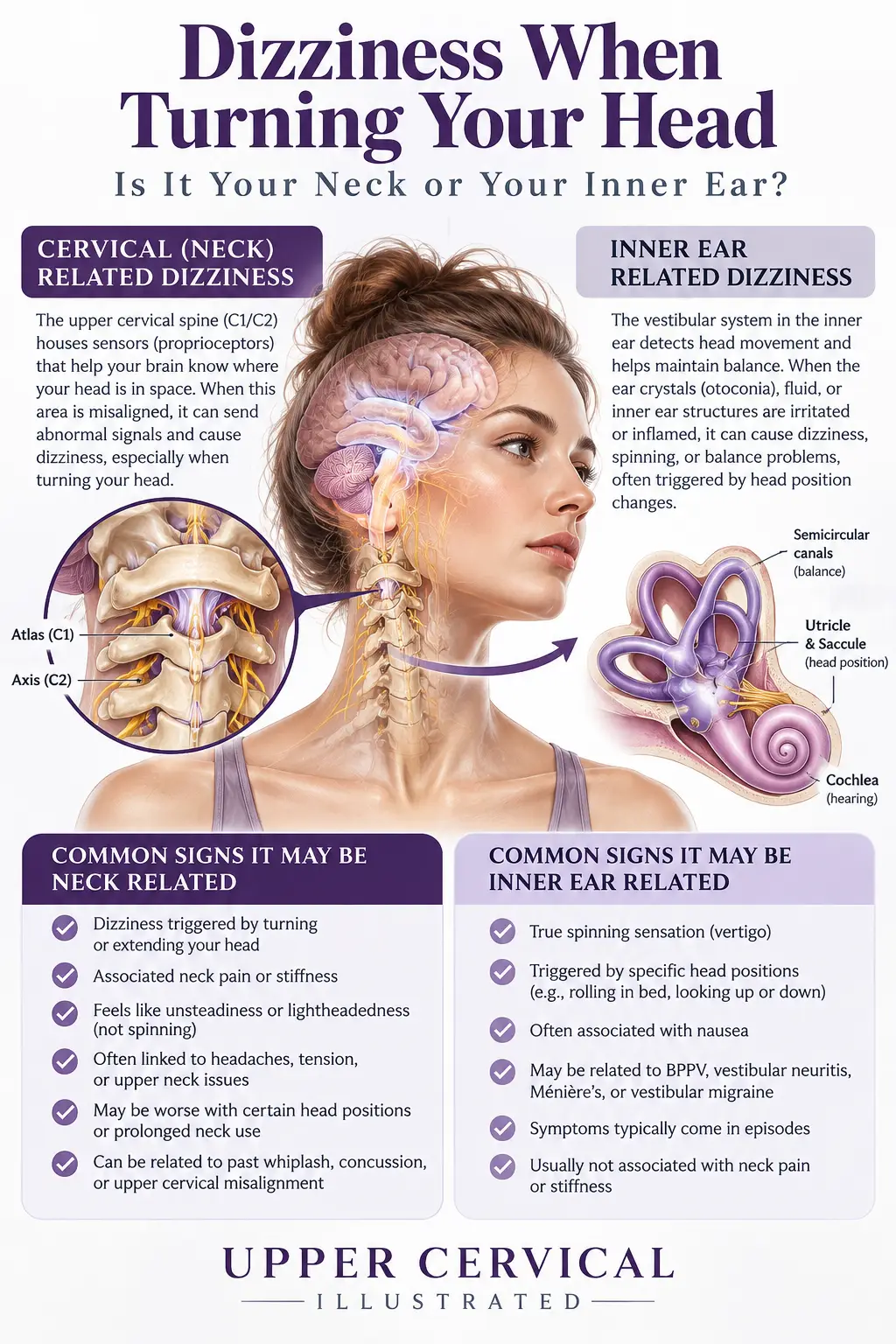
Cervicogenic vertigo — also called cervical vertigo, cervicogenic dizziness, or neck-related dizziness — is a form of dizziness and imbalance that originates from dysfunction in the cervical spine, particularly the upper neck. Unlike vertigo caused by inner ear problems, cervicogenic vertigo is driven by faulty sensory signals coming from the joints, muscles, and ligaments of the neck.
Patients with cervicogenic vertigo typically describe their symptoms differently from someone with BPPV or vestibular neuritis. Instead of the room “spinning” violently, they tend to feel:
- A floating, swimming, or rocking sensation
- Lightheadedness or a feeling of being “off”
- Disorientation, especially when turning the head
- Imbalance when walking or standing
- A sense that they might fall, even when standing still
- Dizziness that gets worse with prolonged neck positions (looking at a phone, working at a computer)
- Symptoms that worsen with neck movement and improve when the neck rests
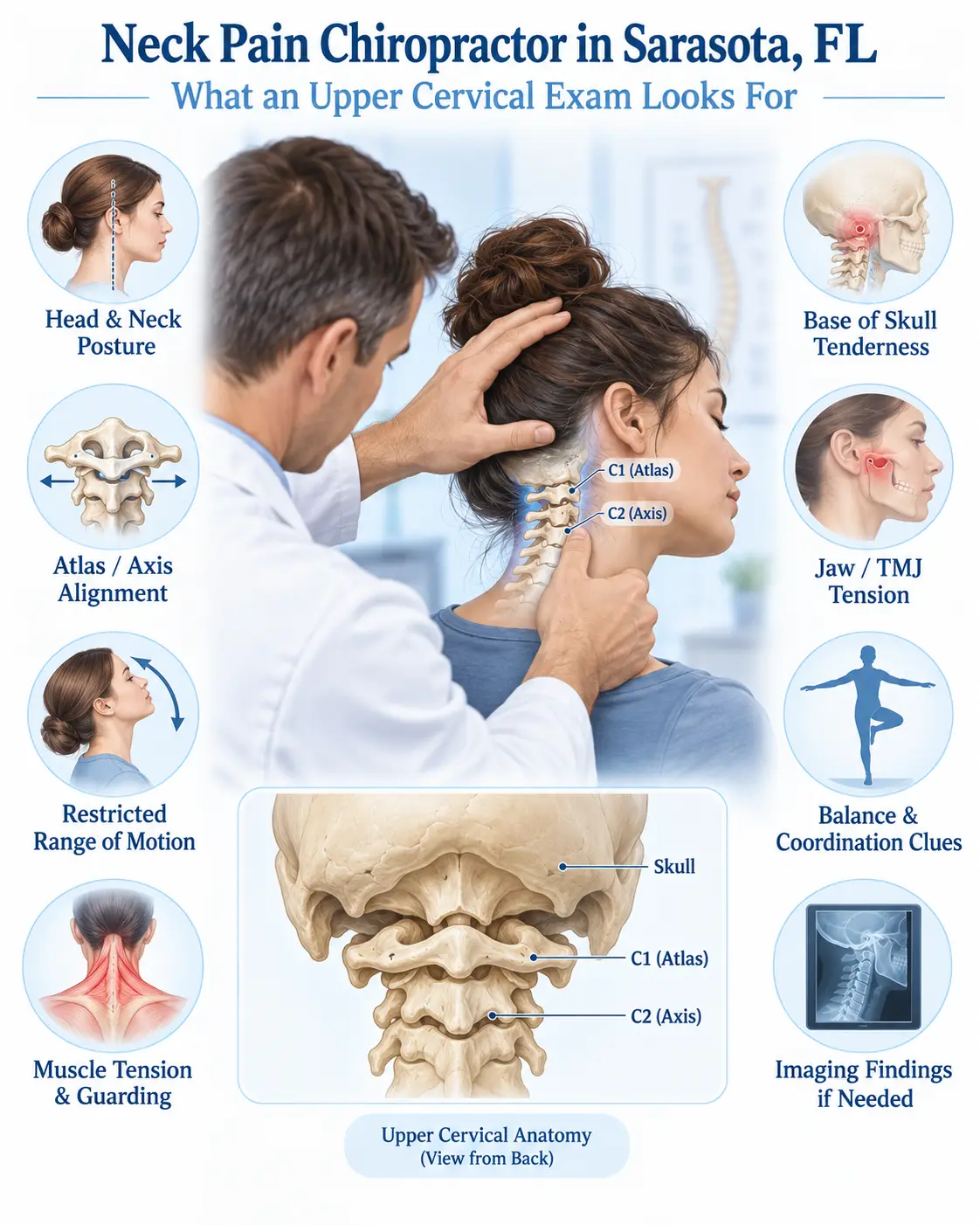
Crucially, cervicogenic vertigo almost always comes with neck involvement. That might mean neck pain, stiffness, headaches at the base of the skull, tightness in the upper shoulders, or a history of neck injury (whiplash, concussion, sports trauma, falls). The neck and the dizziness travel together — and that’s the diagnostic key.
According to the Vestibular Disorders Association (VeDA), cervicogenic dizziness is officially defined as a syndrome of neck pain accompanied by dizziness, diagnosed only after other causes have been ruled out. It is most commonly triggered by neck injury (such as whiplash) or head trauma (such as concussion), both of which can also injure the brain or inner ear at the same time.
That dual-injury reality is why cervicogenic vertigo is so often missed. Doctors evaluate the inner ear, find a minor abnormality, and stop looking. Meanwhile, the upper cervical injury that’s actually driving the symptoms goes unaddressed for months or years.
How Your Neck Controls Balance: The Nerve and Vascular Connection
To understand why a neck problem can produce dizziness this severe, you need to understand just how much of your balance system runs through your upper cervical spine.
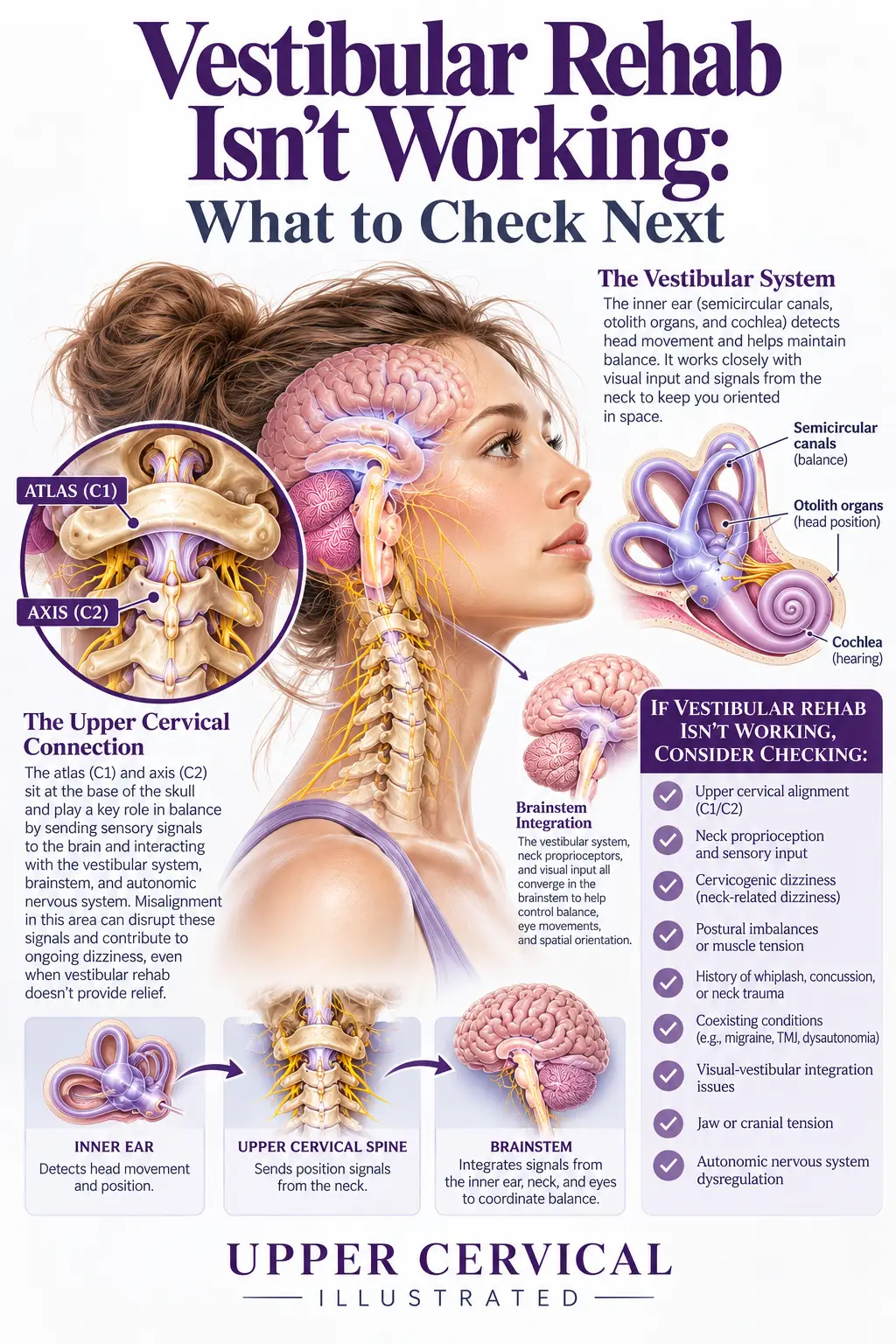
Your brain figures out where your body is in space using three main sensory inputs:
- The vestibular system (inner ear) — tells your brain about head position and motion
- The visual system (eyes) — tells your brain what you’re seeing and where
- The proprioceptive system (joints and muscles, especially in the neck) — tells your brain where your head sits on top of your body
The neck contributes more proprioceptive input to your balance system than almost any other part of your body. The upper cervical spine — the C1 (atlas) and C2 (axis) vertebrae especially — is densely packed with mechanoreceptors that feed positional data directly to the vestibular nuclei in the brainstem. When this data is accurate, your brain integrates all three sensory inputs smoothly and you feel balanced. When it’s inaccurate — because of a misalignment, an old injury, joint dysfunction, or muscle tension — your brain receives conflicting signals.
The result is dizziness.
Think of it like this: your eyes are telling your brain “we’re sitting still,” your inner ear is confirming “yes, we’re not moving,” but your neck is sending the wrong signal — “the head is tilted and rotating.” Your brain doesn’t know which input to trust, so it generates the sensation of disorientation, imbalance, and dizziness.
But neural signaling isn’t the only factor. The upper cervical spine also plays a critical role in vascular flow to the brain. The vertebral arteries — major blood vessels that supply the brainstem, cerebellum, and inner ear — pass directly through the bones of your upper neck before entering the skull. When the upper cervical spine is misaligned or there is significant muscle tension, blood flow through these arteries can be subtly compromised. Reduced flow to the vestibular centers and inner ear can amplify dizziness and create symptoms that mimic other forms of vertigo.
Add to this the role of the vagus nerve, which exits the skull right next to the atlas and helps regulate autonomic balance, heart rate, and blood pressure. Upper cervical dysfunction can irritate the vagus nerve, contributing to the lightheaded, foggy, nauseous feeling that often accompanies cervicogenic vertigo.
In short: the upper neck is where your nervous system, vascular system, and proprioceptive system all converge. Dysfunction here doesn’t cause one symptom. It cascades.
Why the Upper Neck Is the Epicenter of Cervicogenic Vertigo
Not all cervical dysfunction is created equal. Research consistently shows that the upper cervical spine — C1 and C2 — is the most dizziness-relevant region of the neck. There are several reasons why.
The atlas and axis sit closest to the brainstem. Misalignment here can produce more neurological symptoms than misalignments lower in the spine. Even a small shift in the position of the atlas can create disproportionate effects on the brainstem, vestibular nuclei, and surrounding cranial nerves.
The upper cervical region has the highest density of proprioceptors in the spine. Animal and human studies have consistently shown that the small suboccipital muscles and joints of the upper neck contain dramatically more positional sensors per square millimeter than any other vertebral region. When this area is injured or misaligned, the brain gets bombarded with faulty data.
It’s also the most commonly injured region after head and neck trauma. A 2025 review published in Frontiers in Neurology highlighted that cervicogenic dizziness most often follows whiplash injuries, concussions, sports-related trauma, and falls — all of which disproportionately damage the upper cervical structures.
Postural strain accumulates here too. Modern life — phones, laptops, desk work, driving — pulls the head forward and loads the upper neck. Over time, this chronic loading creates joint dysfunction, muscle imbalance, and altered proprioceptive input, even in people who’ve never had a “major” injury.
This is why traditional approaches — vestibular rehabilitation alone, generalized neck stretching, or full-spine chiropractic adjustments — often produce limited results in cervicogenic vertigo cases. They aren’t precisely addressing the source. Upper cervical care is built specifically for this problem.
Upper Cervical Chiropractic Care for Cervicogenic Vertigo: What to Expect
At Lavender Family Chiropractic, we approach cervicogenic vertigo differently than most offices. Our care is centered around precision: identifying the exact misalignment of C1 and C2, measuring it with advanced imaging, and correcting it with gentle, specific adjustments that don’t involve any twisting, popping, or cracking.
Here’s what your journey with us looks like.
Step One: Comprehensive Consultation
Your first visit begins with an in-depth conversation. Dr. Lavender or Dr. Temple will sit down with you and listen to your story — when the dizziness started, what triggers it, what makes it better or worse, any history of injuries, medications you’ve tried, and what other specialists have told you. This isn’t a five-minute interview. Cervicogenic vertigo is a complex condition, and the details matter.
Step Two: 3D CBCT Imaging and Neurological Scanning
Once we have your history, we use our 3D CBCT X-ray technology to take precise, three-dimensional images of your upper cervical spine. This isn’t a standard chiropractic X-ray. CBCT imaging gives us a millimeter-accurate view of the position of your atlas and axis, allowing us to calculate the exact corrective vector your spine needs.
We also use paraspinal infrared thermography to assess how your nervous system is functioning along your spine. Thermographic patterns reveal areas of neurological stress and help us track your progress over time.
Step Three: A Specific, Gentle Correction
Once we have a clear picture of what’s misaligned, we deliver a precise upper cervical correction. This is not the forceful neck-cracking some people associate with chiropractic. It’s a light, calculated, custom-tailored adjustment based on your imaging — often so gentle that patients ask, “Is that it?”
We use the Advanced HIO Knee Chest Upper Cervical Technique (AHKC), one of the most precise and gentle methods of upper cervical correction available.
Step Four: Monitoring and Holding Your Correction
The goal of upper cervical care isn’t to adjust you over and over again. The goal is to hold your correction — meaning, your spine learns to stay in its corrected position. We track your alignment, your symptoms, and your nervous system function at every visit. As your spine stabilizes, you need fewer corrections, not more.
Most cervicogenic vertigo patients begin noticing changes within the first few weeks of care — clearer thinking, less imbalance, fewer dizzy episodes, and improved neck mobility. More complex cases (those involving years of chronic symptoms or prior trauma) may take longer to fully resolve, but the trajectory is almost always positive.
Ready to find out if cervicogenic vertigo is what’s behind your symptoms? Call us at (941) 243-3729 or book a complimentary consultation online. We’ll walk you through your options with zero pressure.
What the Research Says About Cervicogenic Vertigo
The science behind cervicogenic dizziness has advanced significantly in recent years. Here are some of the most important findings:
A 2025 narrative review in Frontiers in Neurology concluded that cervicogenic dizziness arises from “altered proprioceptive input from the cervical spine,” and that targeted manual therapy aimed at the cervical region is one of the most effective interventions, especially when combined with vestibular rehabilitation when needed.
A 2025 randomized controlled trial published in the Journal of Orthopaedic Surgery and Research found that manual therapy directed at the cervical spine produced significant improvements in dizziness intensity, frequency, and quality of life compared to control groups.
A 2022 study in the Journal of Clinical Medicine on proprioceptive cervicogenic dizziness emphasized that the upper cervical region (C1–C3) is the primary source of dizziness-relevant proprioceptive input — and that correcting dysfunction in this region produces more reliable symptom improvement than treating the lower cervical spine.
Earlier systematic reviews — including a landmark 2011 review in Chiropractic & Manual Therapies — concluded that manual therapy with or without vestibular rehabilitation is effective for cervicogenic dizziness in most patients, with most experiencing meaningful improvements in balance, headaches, and quality of life.
The takeaway from the research is consistent: when dizziness is driven by the neck, addressing the neck is what works. And the more precise the correction, the better the outcome — which is exactly why upper cervical chiropractic care is so well-suited to this condition.
Lifestyle Habits That Support Recovery from Cervicogenic Vertigo
While upper cervical correction is the central piece of recovery, daily habits play a huge role in how quickly you stabilize and how well you stay symptom-free. Here are the most important lifestyle adjustments we recommend to our cervicogenic vertigo patients.
Watch your screen posture. The single biggest contributor to ongoing neck-related dizziness in modern life is forward head posture. Every inch your head juts forward adds roughly ten pounds of effective load to your neck. Set up your monitor at eye level, hold your phone at face height rather than chest height, and take posture breaks every 30 minutes.
Sleep on a supportive pillow. Stomach sleeping is the worst position for cervicogenic vertigo because it forces your head into rotation for hours at a time. Side or back sleeping with a properly contoured pillow is far better. Your pillow should support the natural curve of your neck — not bend it forward or push it backward.
Stay hydrated. The discs and soft tissues of your spine are heavily dependent on hydration. Florida heat and humidity make dehydration a constant concern, and dehydration directly amplifies dizziness symptoms. Aim for at least half your body weight in ounces of water per day.
Move regularly. A locked-up neck is a dizzy neck. Gentle daily movement — walks, stretching, controlled range-of-motion exercises — helps maintain the joint mobility your nervous system needs to feel oriented.
Manage stress. Chronic stress drives muscle tension into the upper neck and shoulders, which feeds right back into the cervicogenic vertigo cycle. Breathing exercises, meditation, and adequate sleep all help.
Address related conditions. Cervicogenic vertigo often coexists with other upper cervical issues like TMJ dysfunction, Eustachian tube problems, and tension headaches. For a deeper look at how the upper neck connects to jaw symptoms, our blog on TMJ pain in Sarasota and why your jaw issues might actually start in your neck is a great companion read to this one.
Serving Sarasota and Surrounding Areas
Lavender Family Chiropractic is located at 5899 Whitfield Avenue, Suite 107, Sarasota, FL 34243 — right at the corner of University and Whitfield. We are easy to reach from anywhere in the greater Sarasota region.
We proudly serve patients dealing with cervicogenic vertigo and other dizziness conditions from across the area, including:
- Sarasota, FL
- Bradenton, FL
- Lakewood Ranch, FL
- Venice, FL
- Osprey, FL
- Parrish, FL
- Ellenton, FL
- Siesta Key, FL
- Longboat Key, FL
- St. Pete, FL
- Tampa, FL
To learn more about the broader region we serve, visit our areas we service page. No matter where you’re driving from, we’re set up to help.
Top 15 FAQs About Cervicogenic Vertigo
What is cervicogenic vertigo in simple terms?
Cervicogenic vertigo is dizziness caused by a problem in your neck, not your inner ear. It happens when the joints and muscles of your upper neck send incorrect positional signals to your brain, making you feel imbalanced, foggy, or disoriented. It almost always comes with some form of neck pain, stiffness, or history of neck injury.
How is cervicogenic vertigo different from BPPV?
BPPV is caused by displaced crystals in the inner ear, and it produces short, intense spinning episodes triggered by specific head positions like rolling over in bed. Cervicogenic vertigo, by contrast, produces longer-lasting unsteadiness, swimming sensations, and dizziness that’s tied to neck movement and neck symptoms rather than ear crystals.
Can cervicogenic vertigo show up on an MRI?
Usually not. Cervicogenic vertigo is a functional and proprioceptive disorder, meaning it shows up in how the neck is moving and signaling, not in structural damage that an MRI typically detects. That’s part of why so many patients are told “nothing is wrong” even when they clearly aren’t well.
Why does my dizziness get worse when I look at my phone?
Looking at your phone places your head in a forward, downward position that loads the upper cervical spine and overstimulates the proprioceptors in your neck. If those signals are already faulty due to misalignment, prolonged phone use amplifies the dysfunction and worsens your dizziness.
Can a car accident from years ago still be causing my dizziness now?
Yes — and it’s incredibly common. Whiplash and concussion injuries often damage the upper cervical spine in subtle ways that don’t fully heal on their own. Many patients trace their cervicogenic vertigo back to an accident months or years before their symptoms began.
Is cervicogenic vertigo dangerous?
The dizziness itself is not life-threatening, but it can dramatically reduce quality of life — affecting driving, work, exercise, and even basic daily tasks. It can also increase fall risk, particularly in older adults. The good news is that it usually responds well to the right care.
How long does cervicogenic vertigo last without treatment?
Without addressing the underlying neck dysfunction, cervicogenic vertigo often persists for months or years, sometimes indefinitely. Many patients have lived with it for a decade or more before finding the right care.
Can stress make cervicogenic vertigo worse?
Absolutely. Stress drives muscle tension into the upper neck and shoulders, increases sympathetic nervous system activity, and amplifies the faulty signals the neck is already sending. Patients often notice their cervicogenic vertigo worsens during high-stress periods.
Will medication help cervicogenic vertigo?
Medications like meclizine or anti-anxiety prescriptions may reduce the intensity of symptoms but do not address the underlying cause. They tend to be short-term aids at best, and many patients find the side effects (drowsiness, brain fog) worse than the dizziness itself.
Is upper cervical chiropractic safe for cervicogenic vertigo?
Yes. Upper cervical chiropractic is one of the gentlest and most precise forms of chiropractic care available. There is no twisting, popping, or cracking involved. Adjustments are calculated from 3D imaging and delivered with extremely light pressure — making it appropriate even for patients with significant neck sensitivity.
How is upper cervical care different from regular chiropractic?
Standard chiropractic often involves full-spine manipulation using general techniques. Upper cervical chiropractic focuses specifically on the C1 and C2 vertebrae, uses advanced imaging to calculate exact corrective vectors, and delivers gentle, specific adjustments without forceful movement. It’s a precision-based approach.
How long until I notice improvement in my dizziness?
Every patient is different, but many begin noticing changes within the first two to four weeks of care. Patients with chronic, long-standing cases may take several months to fully stabilize, while patients with more recent or less complicated dysfunction often respond faster.
Do I need vestibular rehab too?
Some patients benefit from combining upper cervical care with vestibular rehabilitation, especially if the inner ear was also injured in the original event (such as in a concussion). However, many cervicogenic vertigo patients improve dramatically with upper cervical care alone, because the neck was the missing piece all along.
Can cervicogenic vertigo come back after treatment?
It can, especially if the original cause — poor posture, ongoing stress, repeated micro-trauma — isn’t addressed. That’s why ongoing posture work, lifestyle support, and periodic check-ins matter for long-term stability. Once your upper cervical correction is held, recurrences become far less likely.
How do I know if I should come to Lavender Family Chiropractic?
If you’ve been told your inner ear is “fine” but you’re still dizzy, if your symptoms started after a neck injury or concussion, if your dizziness comes with neck pain or stiffness, or if traditional treatments haven’t worked — you are a strong candidate for an evaluation with us. Call (941) 243-3729 to schedule a complimentary consultation and we’ll help you figure out the next step.
You Don’t Have to Live with Dizziness Anymore
Cervicogenic vertigo is one of the most frustrating conditions to live with — not just because of the symptoms, but because so many sufferers spend years being told nothing is wrong with them. If your dizziness has roots in your neck, no amount of inner ear treatment will solve it. The good news is that the right care, applied to the right area, can produce dramatic and lasting results.
At Lavender Family Chiropractic, Dr. Rusty Lavender and Dr. Jacob Temple are committed to helping you understand your case, identify the root cause, and finally move forward. We have decades of combined experience working with vertigo and dizziness patients across Sarasota and surrounding communities.
📞 Call us today at (941) 243-3729 📅 Or book your complimentary consultation online
Your relief might be closer than you think. Let’s find out together.
Related Articles
- Vertigo Sarasota: Dr. Jake’s #1 Way to Resolve Dizziness
- Orthostatic Hypotension in Sarasota, Florida: How Upper Cervical Chiropractic Care Helps Resolve the Dizziness, Lightheadedness, and Faintness That Drops Your Blood Pressure Every Time You Stand
- TMJ Pain in Sarasota: Why Your Jaw Issues Might Actually Start in Your Neck