Neurological Chiropractor Sarasota: Natural Care for 20+ Complex Neurological Conditions at Lavender Family Chiropractic
By Dr. Rusty Lavender, Lavender Family Chiropractic — Sarasota, Florida
If you’ve been living with seizures, tics, vertigo, migraines, dysautonomia, unexplained numbness, or any of the dozens of “complex” neurological conditions that modern medicine struggles to explain, you already know the routine. Scan after scan comes back normal. Specialist after specialist passes you to the next one. You leave appointments with more prescriptions, more questions, and the same exhausting symptoms you walked in with.
At Lavender Family Chiropractic in Sarasota, Florida, we take a different approach. We’re not trying to chase symptoms across a dozen body systems. We start by looking at one small, often-overlooked area at the top of your neck — the upper cervical spine — because that’s where the brainstem lives, where blood flow to the brain is regulated, and where the nervous system either communicates clearly or doesn’t. When that communication breaks down, neurological symptoms appear in places that seem completely unrelated to your neck.
This pillar page is your roadmap to the 20+ neurological conditions we help people with right here in Sarasota and the surrounding Manatee County region. Each condition below links to a deeper article so you can explore exactly how upper cervical chiropractic care may help with your specific situation. Whether you’re searching for a natural seizure doctor in Sarasota, a POTS specialist, a vertigo doctor, or simply a chiropractor who understands hEDS and craniocervical instability — you’re in the right place.
What Makes a Chiropractor a “Neurological Chiropractor”?
Most chiropractors focus on biomechanics — back pain, neck pain, posture, range of motion. A neurological chiropractor focuses on the nervous system itself, using the spine as the gateway to influence it.
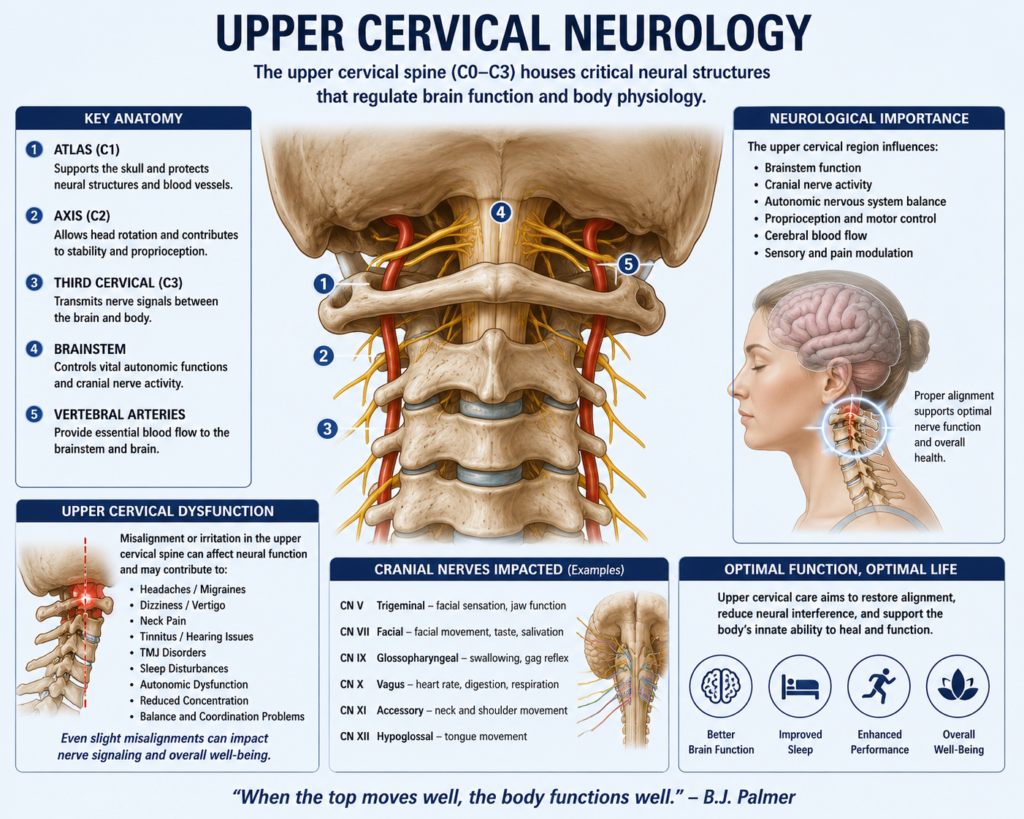
At Lavender Family Chiropractic, our doctors — Dr. Rusty Lavender and Dr. Jacob Temple — practice a highly specialized branch called upper cervical chiropractic. Rather than adjusting the whole spine, we focus exclusively on the top two vertebrae: the atlas (C1) and axis (C2). These two small bones cradle the brainstem, surround the vertebral arteries, and serve as the passageway for cerebrospinal fluid leaving the skull. Even a millimeter of misalignment in this region can disrupt nerve signaling, blood flow, and CSF dynamics in ways that ripple throughout the entire body.
We use 3D CBCT (Cone Beam Computed Tomography) imaging and paraspinal infrared thermography to identify exactly where and how your atlas has shifted. Then we use the Knee Chest Upper Cervical technique — a gentle, precise correction that involves no twisting, cracking, popping, or yanking — to restore alignment. The adjustment is so light it feels like a quick touch behind the ear, but the neurological effect can be profound.
The Upper Neck and the Nervous System: Why This Matters for Neurological Conditions
The craniocervical junction is the most neurologically dense, mechanically complex, and clinically important region of the spine — and it’s almost always missed in standard medical workups.
Here’s why it matters so much: the craniocervical junction is a recognized “choke point” for both blood and cerebrospinal fluid flow between the cranial vault and spinal canal, and malformations or misalignments here have been implicated in a wide range of neurological conditions including migraines, seizures, hydrocephalus, idiopathic intracranial hypertension, and neurodegenerative diseases. When the atlas shifts, several things can happen simultaneously:
The brainstem — which controls heart rate, blood pressure, breathing, balance, swallowing, and the autonomic nervous system — can experience mechanical irritation. The vertebral arteries, which thread through holes in the C1 and C2 vertebrae before entering the skull, can have their flow subtly altered. The vagus nerve, the longest cranial nerve and the master regulator of parasympathetic (“rest and digest”) function, runs directly through this region. And cerebrospinal fluid drainage from the brain can be impeded, causing pressure changes that drive headaches, brain fog, and dizziness.
This is the mechanical foundation underneath conditions that, on the surface, seem to have nothing to do with the neck.
The 20+ Neurological Conditions We Help in Sarasota
The conditions below are grouped by clinical category. Click each one to read the in-depth article on how upper cervical chiropractic at Lavender Family Chiropractic may help.
Seizure and Movement Disorders
1. Natural Seizure Treatment Sarasota: Epilepsy and Seizure Disorders — For families exhausted by medication side effects and unpredictable episodes, atlas-focused care offers a non-drug avenue that addresses brainstem irritation, which can play a role in seizure threshold.
2. Tics and Tourette’s Syndrome — Motor and vocal tics often correlate with overactivation of certain brain circuits. Restoring upper cervical alignment may help calm the autonomic and motor systems that drive tic activity.
3. Torticollis (Cervical Dystonia and Wry Neck) — Whether it appeared in infancy or after a whiplash injury, torticollis frequently traces back to C1/C2 misalignment irritating the nerves that control neck musculature.
4. Essential Tremor — Tremor that’s worsened by stress, fatigue, or movement often has a brainstem and cerebellar component. Upper cervical care addresses the structural and neurological inputs to these regions.
Dysautonomia and Autonomic Nervous System Disorders
5. POTS (Postural Orthostatic Tachycardia Syndrome) — The hallmark heart-rate spike on standing reflects autonomic dysregulation. Because the brainstem and vagus nerve both run through the upper neck, atlas misalignment is increasingly recognized as a contributor.
6. Hyperadrenergic POTS — The “wired and tired” form of POTS, with surges of adrenaline, racing heart, and tremor. We help patients address the underlying sympathetic overdrive at its neurological root.
7. Dysautonomia (General Autonomic Dysfunction) — The umbrella diagnosis covering temperature dysregulation, blood pressure swings, digestive chaos, and exercise intolerance.
8. Vagus Nerve Dysfunction — Poor heart rate variability, digestive sluggishness, anxiety that won’t quit — when the vagus nerve is irritated at its exit from the skull, every system it touches suffers.
Headache, Migraine, and Facial Nerve Conditions
9. Migraines — A peer-reviewed clinical trial found that upper cervical manual therapy can normalize central sensitization and alter brainstem auditory evoked potentials in people with migraine and neck pain, helping to explain why so many of our patients see dramatic reductions in migraine frequency.
10. Vestibular Migraine — When migraine circuits hijack balance pathways, dizziness becomes the dominant symptom. Atlas alignment matters here more than most patients realize.
11. Trigeminal Neuralgia — The “suicide disease” of nerve pain. The trigeminal nerve nucleus extends into the upper cervical spinal cord, which is why neck-based interventions can help.
12. Occipital Neuralgia — Stabbing pain behind the eyes and at the base of the skull, often triggered by C1/C2 irritation of the occipital nerves.
13. Barometric Pressure Headaches — Florida storms shouldn’t dictate your week. Weather-sensitive headaches often have a venous drainage and CSF pressure component that atlas correction addresses.
Vestibular and Balance Disorders
14. Vertigo — A peer-reviewed narrative review in the Journal of Clinical Medicine found that the cervical spine has highly developed proprioceptive receptors whose input is integrated with visual and vestibular systems, and that mismatched input between these systems is a recognized driver of cervicogenic dizziness, with manual therapy among the most widely recommended treatments.
15. Meniere’s Disease — Episodes of vertigo, tinnitus, ear fullness, and hearing changes are often misdiagnosed when the true source is upper cervical dysfunction affecting inner ear circulation and drainage.
16. Post-Concussion Syndrome — Headaches, brain fog, light sensitivity, and balance issues that linger long after the original head injury. The same forces that concussed your brain almost always disrupted your upper neck.
Connective Tissue and Structural Instability
17. Craniocervical Instability (CCI) — When the ligaments holding the skull onto the spine are lax or damaged, the symptoms can be life-altering: headaches, brain fog, cervical medullary symptoms, and more.
18. Hypermobile Ehlers-Danlos Syndrome (hEDS) — Patients with hEDS face a uniquely high risk of upper cervical problems. A 2024 study published through PubMed documents that hEDS patients commonly experience cervico-medullary symptoms from craniocervical and cervical instability due to ligament laxity, with symptoms including headaches, vertigo, tinnitus, vision changes, syncope, and dysphagia. We work carefully and gently with hEDS patients using our Knee Chest technique.
19. Thoracic Outlet Syndrome (TOS) — Nerve and vascular compression in the space between collarbone and first rib. The neurogenic form often has cervical contributors that need to be addressed for lasting relief.
Sensory, Nerve Compression, and Chronic Pain Conditions
20. Fibromyalgia — Widespread pain, fatigue, and sensory amplification driven by a hypersensitized nervous system. Restoring upper cervical alignment can help calm the pain-amplification loops.
21. Peripheral Neuropathy and Numb Hands/Feet — Tingling, burning, and numbness often blamed on the wrists or feet but originating in the cervical spine.
22. Brachioradial Pruritus — Maddening, unexplained itching of the forearms with a known cervical spine link.
Ready to See If Upper Cervical Care Could Help Your Neurological Condition?
You don’t have to keep wondering whether the neck connection is real for your case. Our complimentary consultation at Lavender Family Chiropractic in Sarasota gives you a chance to sit down with one of our doctors, review your history, and find out whether we believe we can help — before any imaging or care begins. Call (941) 243-3729 or schedule online at chiropractorsarasotaflorida.com.
What the Research Says: The Science Behind Upper Cervical Care for Neurological Conditions
This is a clinical field with growing peer-reviewed support. Here are five studies that help explain why our patients see the results they do.
A 2024 study published in the journal Musculoskeletal Science and Practice found that upper cervical manual therapy combined with medication produced beneficial effects in migraine patients by normalizing central sensitization, with measurable neurophysiological changes in brainstem auditory pathways. This is exactly the mechanism we’re aiming for with our atlas corrections.
A 2022 narrative review in the Journal of Clinical Medicine documented that the cervical spine has highly developed proprioceptive receptors integrated with visual and vestibular systems, and that mismatched input from these systems produces cervicogenic dizziness — with manual therapy directed at the upper cervical spine being the most widely recommended treatment.
A 2024 PubMed-indexed paper on hEDS and upper cervical instability reported that patients with hypermobile EDS commonly experience cervico-medullary symptoms arising from craniocervical and cervical instability due to ligament laxity, including headaches, vertigo, tinnitus, vision changes, syncope, and dysphagia — clinically validating what we see daily in our hEDS patients.
A landmark anatomical chapter on craniocervical junction syndrome demonstrates that malformations and misalignments of the craniocervical junction cause deformation and obstruction of blood and cerebrospinal fluid pathways, with the CCJ acting as a “choke point” implicated in migraine, seizures, idiopathic intracranial hypertension, and multiple neurodegenerative conditions.
Finally, the 2024 Global Burden of Disease analysis published in Pain and Therapy documents that migraine prevalence has risen 58% globally from 1990 to 2021, affecting 1.16 billion people, with disability-adjusted life years climbing in parallel — underscoring why effective, non-pharmaceutical migraine care is more important than ever.
Lifestyle Habits That Support Neurological Recovery
While upper cervical care does the structural and neurological “heavy lifting,” your daily habits accelerate or stall recovery. A few areas matter most for neurological patients:
Sleep posture. Side-sleeping with a pillow that keeps your neck neutral protects your correction. Stomach sleeping is the single worst habit for upper cervical patients — it forces the head into rotation for hours.
Hydration and electrolytes. Especially for POTS, dysautonomia, and vestibular patients. The Florida heat compounds the issue.
Screen and phone posture. “Tech neck” is real and it constantly stresses the very ligaments we’re trying to help heal. Bring screens up to eye level rather than dropping your head down to them.
Stress regulation. Chronic sympathetic activation slows neurological healing. Even ten minutes of slow nasal breathing daily helps shift toward parasympathetic recovery.
For a deeper dive into supportive habits, read our blog on how to resolve dysautonomia naturally.
Serving Sarasota and the Surrounding Communities
Lavender Family Chiropractic is located at 5899 Whitfield Avenue, Suite 107, Sarasota, FL 34243 — at the corner of University and Whitfield. We’re easy to reach from across the region and proudly serve patients from Sarasota, Bradenton, Lakewood Ranch, Parrish, Ellenton, Venice, Osprey, Punta Gorda, St. Petersburg, Siesta Key, Longboat Key, Lido Key, and Myakka City. Many of our neurological patients travel an hour or more to see us because of how few clinics in Florida focus specifically on the upper cervical spine and its role in complex neurological conditions.
Top 15 FAQs: Neurological Chiropractor in Sarasota
1. Is upper cervical chiropractic safe for someone with a serious neurological condition? Yes. Because the Knee Chest Upper Cervical technique uses no twisting, popping, or cracking — and because we image with 3D CBCT before adjusting — it’s one of the most precise and gentle forms of chiropractic available. This is especially important for patients with hEDS, CCI, post-concussion syndrome, or any condition where forceful adjustment would be inappropriate.
2. How is a neurological chiropractor different from a regular chiropractor? A neurological chiropractor focuses on how the spine influences the nervous system — brainstem function, autonomic regulation, blood flow, CSF dynamics — rather than just musculoskeletal pain. Our entire practice is built around this focus.
3. Will you adjust me if I have a diagnosis of Ehlers-Danlos or CCI? Often, yes — but only after thorough imaging and only with our gentle Knee Chest technique. We’ve helped many hEDS and CCI patients. We’ll be honest with you in your consultation about whether we believe we can help in your specific case.
4. What does the first visit look like? A complimentary consultation with the doctor to review your history and symptoms, followed (if appropriate) by 3D CBCT imaging and functional nervous system scans on a separate visit before any care begins.
5. How quickly will I see results? This varies by condition. Some patients notice changes within the first week; others take several months of consistent care. Neurological conditions that have been present for years generally take longer to resolve than recent ones.
6. Do you treat children with neurological conditions like tics or torticollis? Yes. We see children regularly. Our technique is gentle enough for infants with torticollis and effective for kids with tics, headaches, and post-concussion symptoms.
7. I’ve been told my MRI is “normal.” Why would my neck still be the problem? Standard MRI doesn’t measure alignment, motion, or autonomic function. A misaligned atlas can disrupt nerve signaling and blood flow without showing up as a “lesion” on a routine scan. That’s exactly why we use 3D CBCT and thermography instead.
8. Do you take insurance? We’re out of network with most insurance plans because the kind of detailed, individualized care we provide doesn’t fit standard chiropractic billing codes. We offer transparent care plans to make care accessible.
9. Do I need a referral? No. You can schedule a complimentary consultation directly with our office.
10. How does upper cervical care help with POTS specifically? The vagus nerve and brainstem — both critical for autonomic regulation — run directly through the upper neck. When the atlas is misaligned, signaling through these structures can be disrupted, contributing to the heart-rate dysregulation seen in POTS. Restoring alignment supports normal autonomic balance.
11. Can upper cervical care help with seizures? Many of our seizure patients report fewer or less intense episodes after care. We don’t claim to cure epilepsy, and we always work alongside your neurologist — but the brainstem connection is real and clinically meaningful for many patients.
12. What if my condition isn’t on your list of 20? Call us. The conditions listed are common ones we see — but the underlying mechanism (brainstem, vagus nerve, blood flow, CSF dynamics) applies to many more conditions than we can list. We’ll honestly tell you whether we think we can help.
13. Will I have to come forever? No. Once your atlas is holding stably, visit frequency decreases dramatically. Many long-term patients only come in for periodic check-ups.
14. Is the adjustment painful? No. Most patients describe it as lighter than checking a pulse. There’s no cracking, popping, or twisting at all.
15. How do I get started? Call (941) 243-3729 or visit chiropractorsarasotaflorida.com to schedule your complimentary consultation.
You Don’t Have to Keep Searching
If you’ve been bouncing from neurologist to ENT to cardiologist to rheumatologist looking for someone who can connect the dots between all your symptoms — we’d like to meet you. We’ve spent our careers studying the one structural region where most of those dots actually connect.
Call Lavender Family Chiropractic at (941) 243-3729 or schedule your complimentary consultation online. We’re located at 5899 Whitfield Avenue, Suite 107, Sarasota, FL 34243, and we’d be honored to help you find the answers you’ve been looking for.
Related Articles
Natural Doctor for Seizures, Tics, and Tourette’s: How Upper Cervical Chiropractic Can Help