
Eustachian Tube Doctor Sarasota: How Lavender Family Chiropractic’s Upper Cervical Care Addresses Eustachian Tube Dysfunction at the Root Cause. Hope For those Suffering
By Dr. Rusty Lavender, D.C. — upper cervical chiropractor, Lavender Family Chiropractic, Sarasota, FL. Reviewed and updated October 2026.
Our complete guide to Eustachian tube dysfunction care in Sarasota covers the causes we see, the imaging we use, and what to expect at an evaluation.
Eustachian Tube Doctor: If you’ve been struggling with ear fullness, crackling sounds in your ears, hearing loss, or recurring ear infections, you might be dealing with Eustachian Tube Dysfunction (ETD). This common yet often misunderstood condition can significantly impact your quality of life, causing frustration, discomfort, and sometimes chronic issues like tinnitus.
At Lavender Family Chiropractic in Sarasota, Florida, we specialize in upper cervical chiropractic care, a gentle and highly specific approach that addresses the root cause of many health concerns, including ETD. Our team, led by Dr. Rusty Lavender, Dr. Jacob Temple, and Dr. Will Guzinski, uses state-of-the-art technology, including 3D CBCT imaging and functional nervous system scans, to accurately detect and correct misalignments in the upper cervical spine that may contribute to Eustachian Tube Dysfunction.
In this comprehensive blog post, we’ll explore what ETD is, its symptoms, how upper cervical misalignments can cause or worsen ETD, why Lavender Family Chiropractic is the trusted upper cervical chiropractor near you in Sarasota, Bradenton, Lakewood Ranch, and surrounding areas, and how we can help you live a life free from chronic ear problems.
As a Eustachian Tube Doctor Understanding Eustachian Tube Dysfunction (ETD)
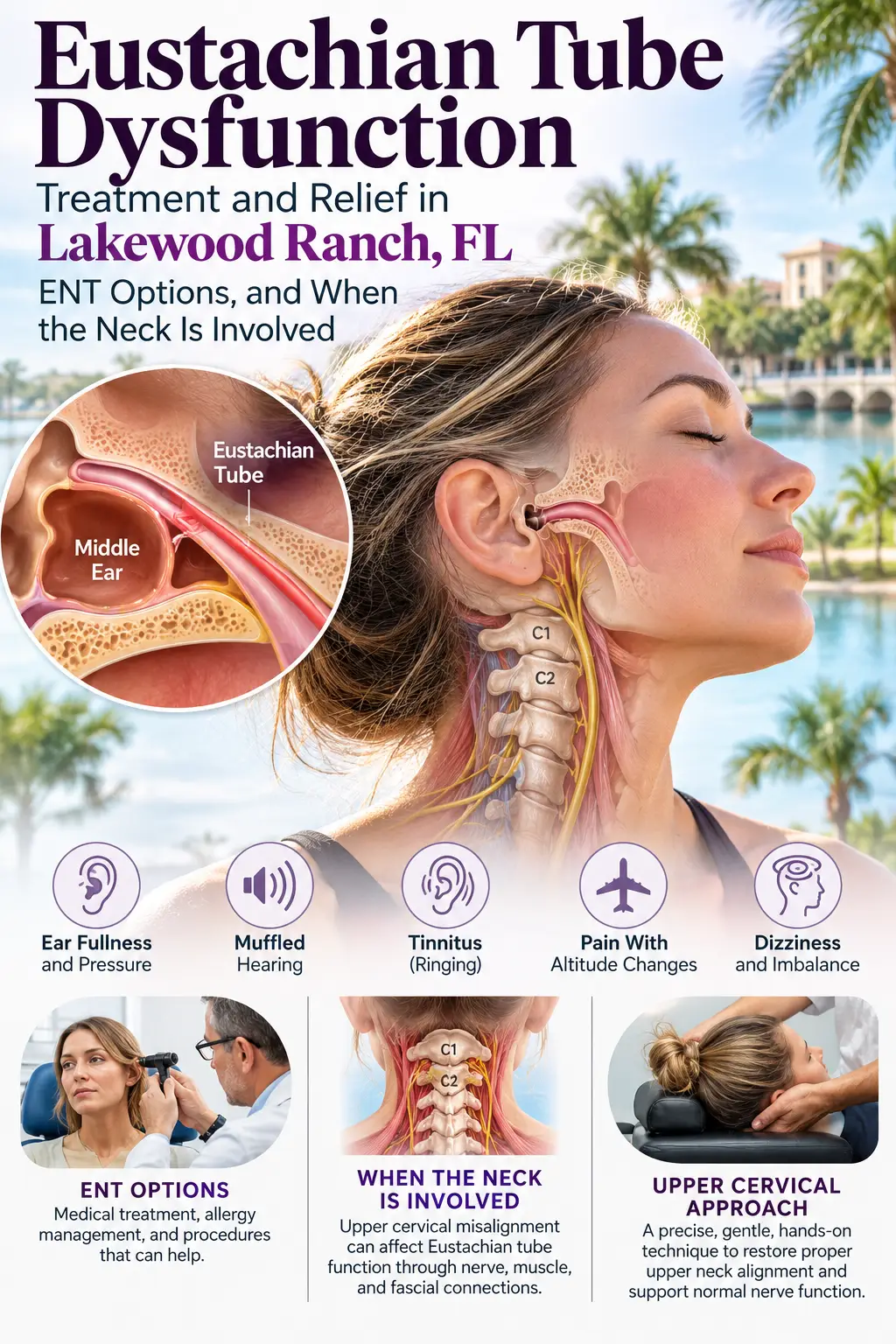
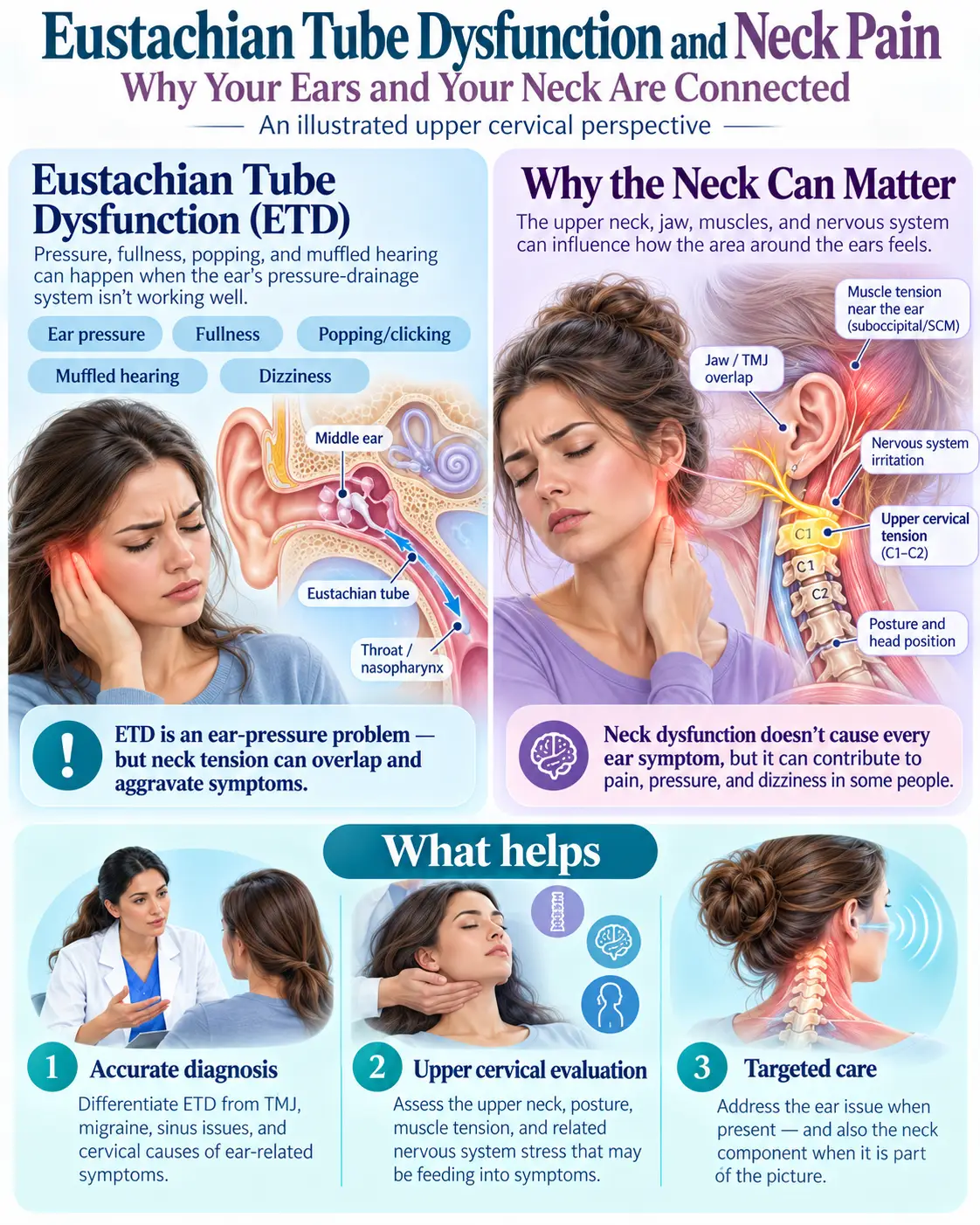
The Eustachian tubes are small passageways that connect the middle ear to the back of the nose and upper throat. These tubes help regulate pressure in the ear, drain fluid, and keep the ears healthy. They open briefly when you swallow, yawn, or chew, allowing air to flow into the middle ear and equalize pressure.
When the Eustachian tubes become blocked or fail to open properly, this can lead to Eustachian Tube Dysfunction. ETD can be acute, lasting a short time, or chronic, persisting for weeks, months, or even years. It affects both adults and children and can seriously interfere with daily life.
Common Symptoms of Eustachian Tube Dysfunction
Ear Fullness or Pressure
One of the most common complaints among people with ETD is a persistent sensation of fullness or pressure in the ears. This can feel similar to the sensation you experience when ascending in an airplane or driving up a mountain. Unlike temporary altitude changes, the pressure from ETD often lingers and can fluctuate throughout the day.
Hearing Loss
ETD can impair your ability to hear clearly. Sounds may seem muffled, distant, or distorted. This is especially concerning for children as it can interfere with language development and learning. Adults may find themselves asking others to repeat themselves or increasing the volume on electronic devices.
Crackling or Popping Sounds
Many individuals with ETD experience crackling or popping sounds in their ears, particularly when they swallow, yawn, or move their jaw. These sounds are the Eustachian tubes attempting to open and equalize pressure but not functioning properly.
Tinnitus
Tinnitus is a persistent ringing, buzzing, or hissing noise in the ears that has no external source. While tinnitus can have multiple causes, ETD is a significant contributor, especially when fluid buildup or pressure imbalances affect the middle ear.
Ear Pain
Blocked Eustachian tubes can cause pressure to build up, leading to sharp or dull ear pain. This can become particularly intense during altitude changes or when dealing with sinus congestion or allergies.
Dizziness or Balance Issues
Your ears play a crucial role in maintaining balance. When Eustachian tube function is compromised, it can lead to dizziness, unsteadiness, or even vertigo episodes. Many people report feeling lightheaded or off-balance as a result.
Recurring Ear Infections
When the Eustachian tubes cannot drain fluid properly, it creates a perfect environment for bacteria to grow, leading to chronic ear infections. This is especially common in children but can also persist into adulthood if the underlying issue is not corrected.
The Link Between Upper Cervical Misalignment and Eustachian Tube Dysfunction
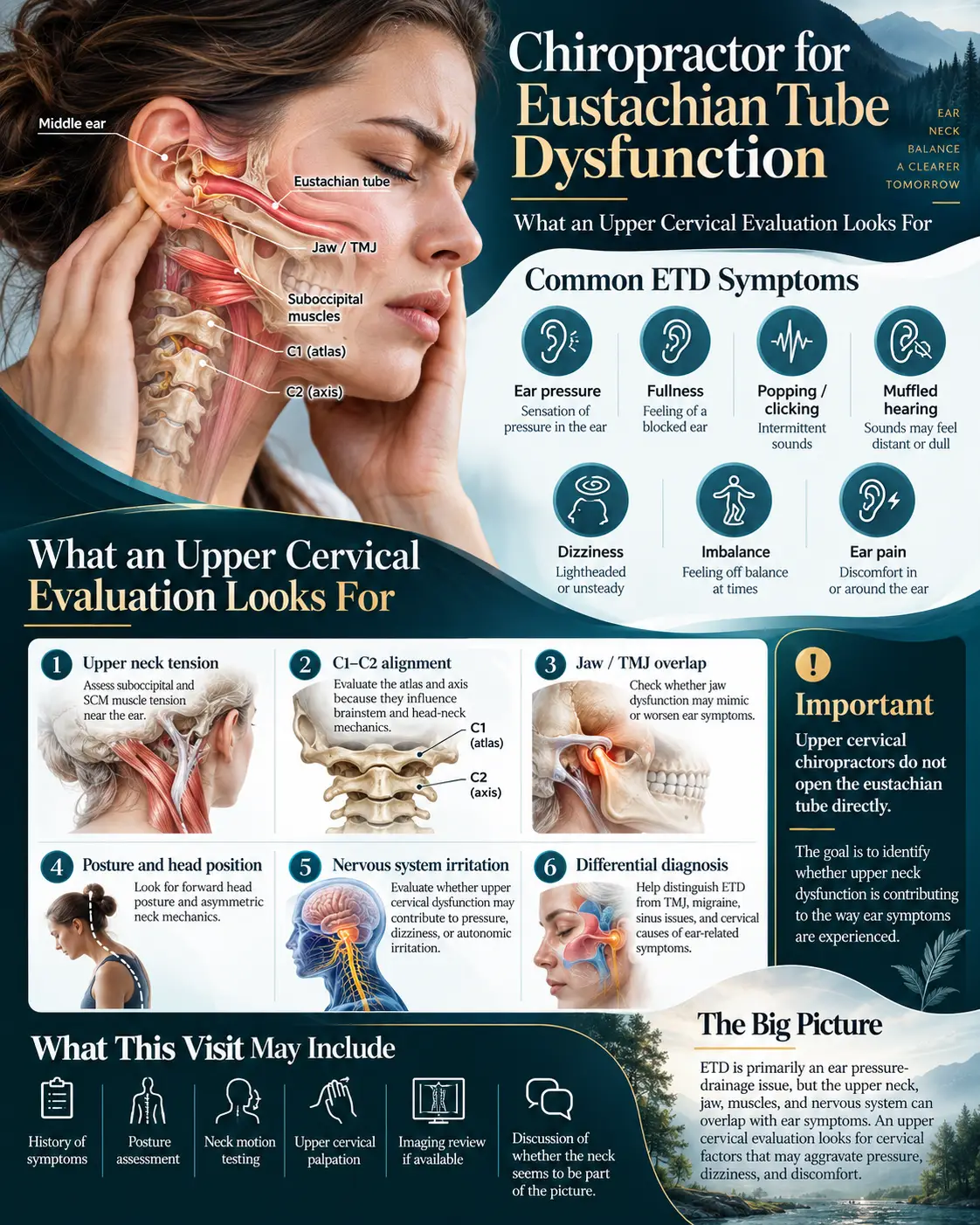
While most people associate ETD with sinus problems or allergies, few realize that the alignment of the upper cervical spine, particularly the atlas vertebra (C1), can have a profound impact on ear function.
The upper cervical spine houses the brainstem, which is responsible for coordinating many vital functions, including muscle control and autonomic processes. The atlas and axis (C1 and C2 vertebrae) are uniquely structured and incredibly mobile, but this also makes them susceptible to misalignment.
How Atlas Misalignment Affects the Eustachian Tubes
When the atlas shifts out of its proper position, several things can occur:
- Neurological interference: The misalignment can irritate or compress nerves that control the muscles involved in opening the Eustachian tubes.
- Muscle dysfunction: The tensor veli palatini muscle, which helps open the Eustachian tubes, may not receive proper nerve signals, leading to improper tube function.
- Impaired drainage: The lymphatic system and venous drainage from the head and neck can become congested, making it harder for fluid to clear from the middle ear.
- Structural asymmetry: A misaligned atlas can cause imbalances in head and neck posture, increasing the likelihood of chronic ear problems.
These factors can perpetuate Eustachian Tube Dysfunction and may even explain why some people suffer from recurring ETD despite traditional treatments.
Causes of Upper Cervical Misalignment
- Car accidents
- Falls
- Sports injuries
- Poor posture
- Birth trauma in infants
- Repetitive daily activities
Even subtle misalignments can create long-term dysfunction if left uncorrected.
How Upper Cervical Chiropractic Care Can Correct ETD at the Root Cause
Upper cervical chiropractic care is a highly specialized approach that focuses exclusively on correcting misalignments of the atlas and axis vertebrae. This is a gentle, precise method designed to restore normal neurological communication and musculoskeletal balance.
Lavender Family Chiropractic’s Detailed Process
At Lavender Family Chiropractic in Sarasota, Florida, our process begins with an in-depth consultation and examination.
Comprehensive Assessment
- 3D CBCT Imaging: This advanced imaging technology gives us a highly detailed, three-dimensional view of your upper cervical spine, allowing us to detect even the smallest misalignments that may be affecting your Eustachian tubes.
- Functional Nervous System Scans: Using the Tytron infrared thermography system, we assess the nerve function and detect areas of inflammation, which helps us understand how your nervous system is being impacted.
- Postural Analysis: We carefully evaluate your posture to identify any head tilts or asymmetries that may be contributing to your symptoms.
Precise Corrections
Our adjustments are performed with incredible precision and are extremely gentle. There is no popping, cracking, or twisting. Instead, we use controlled, minimal-force adjustments that gently guide the atlas back into alignment.
This correction allows the nervous system to begin functioning optimally, restoring proper communication between the brain and the muscles that control Eustachian tube opening and closing.
Benefits of Upper Cervical Care for ETD
- Improved Eustachian tube drainage
- Reduced ear pressure and fullness
- Fewer or no crackling/popping sounds
- Potential relief from tinnitus
- Better hearing
- Fewer recurring ear infections
- Enhanced balance and decreased dizziness
Long-Term Solutions
Many people suffering from chronic ETD seek short-term fixes such as medications, nasal sprays, or ear tube surgeries. While these may provide temporary relief, they rarely address the underlying cause.
Upper cervical chiropractic care aims to correct the problem at its source, leading to long-lasting results without invasive procedures or medications.
Upper Cervical Chiropractic Care in Sarasota, Lakewood Ranch, and Bradenton at Lavender Family Chiropractic
At Lavender Family Chiropractic, we specialize in upper cervical chiropractic care — a gentle, precise, and highly effective form of chiropractic that focuses on correcting misalignments at the very top of the spine. Unlike traditional chiropractic methods that often involve twisting, popping, or cracking, upper cervical chiropractic uses a specific, non-invasive approach to realign the uppermost vertebrae, particularly the atlas (C1) and axis (C2).
Our clinic is proud to serve the communities of Sarasota, Lakewood Ranch, Bradenton, Parrish, Ellenton, Venice, Osprey, Punta Gorda, St. Petersburg, Siesta Key, Longboat Key, Lido Key, and Myakka City, providing life-changing care to patients struggling with conditions like migraines, vertigo, dizziness, POTS, TMJ, fibromyalgia, low back pain, sciatica, post-concussion syndrome, Eustachian tube dysfunction, and more.
What is Upper Cervical Chiropractic Care?
Upper cervical chiropractic care focuses exclusively on the relationship between the top two bones in the neck (the atlas and the axis) and how their alignment impacts the brainstem, spinal cord, and entire nervous system. These vertebrae are uniquely important because they support the head, allow for its wide range of motion, and directly influence neurological function. When these vertebrae become misaligned — often due to accidents, poor posture, repetitive stress, or even birth trauma — they can cause interference in the nervous system, disrupting the body’s ability to heal and function properly.
At Lavender Family Chiropractic, our doctors use state-of-the-art 3D Cone Beam CT (CBCT) imaging and functional nervous system scans with the Tytron infrared thermography system to precisely identify upper cervical misalignments. These advanced tools allow us to develop a highly customized, gentle correction plan without guessing, twisting, or forceful manipulation.
Conditions We Commonly Help in Sarasota, Lakewood Ranch, and Bradenton
Many people who come to Lavender Family Chiropractic are dealing with complex health conditions that haven’t responded well to conventional treatments. Often, patients tell us they’ve been from doctor to doctor without getting clear answers. Common conditions that we address through upper cervical care include:
- Migraines and chronic headaches
- Vertigo and dizziness
- Postural Orthostatic Tachycardia Syndrome (POTS)
- Temporomandibular Joint Disorder (TMJ)
- Trigeminal Neuralgia
- Occipital Neuralgia
- Low back pain and sciatica
- Post-concussion syndrome
- Fibromyalgia
- Eustachian Tube Dysfunction (ETD)
- Balance disorders
- Tinnitus and ear pressure
- Jaw pain and clicking
- Neck pain and stiffness
Many of these conditions are rooted in nervous system dysfunction caused by upper cervical misalignment. By restoring balance to the upper neck, we can help the body return to its natural state of healing.
Our Process at Lavender Family Chiropractic
When you visit our Sarasota office, located at 5899 Whitfield Ave Ste 107, Sarasota, FL 34243, our three highly trained upper cervical chiropractors — Dr. Rusty Lavender, Dr. Jacob Temple, and Dr. Will Guzinski — will walk you through a comprehensive evaluation. Here’s what you can expect:
1. In-Depth Consultation
We take the time to truly listen to your story. Many of our patients have been searching for answers for years, and we believe you deserve to be heard. We want to understand your symptoms, history, and how your health challenges are impacting your life.
2. Advanced Diagnostic Imaging
Our 3D CBCT imaging gives us a detailed look at your unique upper cervical anatomy. Unlike traditional X-rays, CBCT scans provide incredibly precise, three-dimensional views that help us see even the slightest misalignments that could be impacting your nervous system.
3. Nervous System Function Scans
We use Tytron paraspinal infrared thermography to measure heat imbalances along your spine, which indicates neurological stress. This scan is non-invasive and helps us track your progress throughout care.
4. Customized Upper Cervical Corrections
Our upper cervical adjustments are gentle, specific, and tailored exactly to your anatomy. There is no twisting, popping, or cracking. Many patients are surprised by how light the adjustment feels — yet the results can be profound and life-changing.
5. Ongoing Progress Assessments
We continually monitor your nervous system function and alignment to ensure that your body is healing as expected. As your spine stabilizes, the frequency of your visits will naturally decrease.
Why Choose Lavender Family Chiropractic?
We are not just a typical chiropractor in Sarasota, Lakewood Ranch, or Bradenton. Our dedication to precision upper cervical chiropractic care sets us apart. Patients from across the region choose us because we offer:
- A caring, patient-focused environment
- Advanced 3D CBCT imaging for accurate diagnosis
- Functional nervous system scans for tailored care
- Gentle, non-invasive corrections with no cracking or twisting
- A team of highly trained upper cervical specialists
- Hope for people who have tried everything else
If you are searching for a “chiropractor near me,” “upper cervical chiropractor near me,” “vertigo doctor near me,” or “migraine doctor near me,” Lavender Family Chiropractic is your trusted local choice in Sarasota, Lakewood Ranch, and Bradenton.
Serving Sarasota and Beyond
Our team at Lavender Family Chiropractic proudly serves Sarasota, Lakewood Ranch, Bradenton, Parrish, Ellenton, Venice, Osprey, Punta Gorda, St. Petersburg, Siesta Key, Longboat Key, Lido Key, and Myakka City. We are honored to be recognized as the best upper cervical chiropractic office in the area for people looking for natural, effective relief from complex health issues.
If you or someone you love is searching for answers to chronic migraines, vertigo, dizziness, TMJ, POTS, fibromyalgia, or unexplained health challenges, we encourage you to contact us today. Call (941) 243-3729 or visit our website at www.chiropractorsarasotaflorida.com to schedule your consultation.
Real Stories: Patients Who Found Relief at Lavender Family Chiropractic
We have been privileged to help countless patients who have tried everything else with little to no success.
Testimonial – Sarah M., Sarasota, FL:
“After years of struggling with ear fullness and crackling sounds, I felt like I would never find relief. I had seen multiple ENT doctors, taken medications, and even tried home remedies, but the problem kept coming back. After starting care at Lavender Family Chiropractic, my ears started to clear, and the crackling significantly reduced within a few weeks. I can’t thank Dr. Rusty and the team enough for their expertise and kindness. It’s life-changing.”
Testimonial – David T., Bradenton, FL:
“I had chronic ear infections, occasional hearing loss, and an annoying buzzing sound in my ears that my doctors couldn’t fully explain. It wasn’t until I visited Lavender Family Chiropractic that I learned my upper neck was out of alignment. After a few weeks of gentle adjustments, my hearing improved, the infections stopped recurring, and the buzzing disappeared. The care here has been life-changing, and the entire staff genuinely cares about their patients.”
Testimonial – Lisa K., Lakewood Ranch, FL:
“I had lived with tinnitus and ear pressure for over five years. I saw multiple specialists, but no one could find a lasting solution. The team at Lavender Family Chiropractic not only pinpointed the problem with their advanced scans, but they also corrected it with gentle, specific adjustments. The ringing in my ears has diminished, and I feel more balanced and clear-headed than I have in years.”
Service Areas
If you’re searching for a chiropractor near me, upper cervical chiropractor Sarasota, vertigo doctor near me, or migraine doctor near me, we proudly serve the following areas:
- Sarasota, FL
- Bradenton, FL
- Lakewood Ranch, FL
- Parrish, FL
- Ellenton, FL
- Venice, FL
- Osprey, FL
- Punta Gorda, FL
- St. Petersburg, FL
- Siesta Key, FL
- Longboat Key, FL
- Lido Key, FL
- Myakka City, FL
We are known throughout the Sarasota area as the best upper cervical chiropractic office, providing compassionate and cutting-edge care that gets to the root cause of many complex health issues.
Call us today at (941) 243-3729 or visit www.chiropractorsarasotaflorida.com to schedule your consultation and start your path to better health.
What the Research Says About Eustachian Tube Dysfunction
Eustachian tube dysfunction has a formal definition from an international consensus group: a condition in which the tube fails to open or close properly, producing fullness, pressure, popping or muffled hearing. The group separates three types, dilatory (obstructive), baro-challenge-induced, which shows up only with flying or diving, and patulous, in which the tube stays open, and it describes diagnosis as clinical, supported by tympanometry and otoscopy (Schilder et al., Clin Otolaryngol 2015). The right first doctor is an ear, nose and throat specialist who can examine the eardrum, test middle ear pressure and rule out infection or hearing loss, because those findings decide whether medical treatment is needed before anything else is considered.
We want to be clear about our role: research on upper cervical chiropractic for this condition is limited to case reports, and no trial compares it with standard ENT care. Patients with ear symptoms still find their way to our office because neck and ear complaints often travel together. The upper cervical nerves converge with the trigeminal system in the brainstem, so upper neck irritation can be felt as head and facial symptoms (Bogduk & Govind, Lancet Neurol 2009), and consensus criteria for somatosensory tinnitus recognize ear noise that can be modulated by neck or jaw movement or that began alongside a neck problem (Michiels et al., Trends Hear 2018). A Cochrane review of 51 trials supports manipulation and mobilization for the neck pain itself (Gross et al., Cochrane 2015). We image the atlas in 3D, correct it, and re-measure.
Top 15 FAQs About Eustachian Tube Dysfunction and Upper Cervical Chiropractic Care
1. What causes Eustachian Tube Dysfunction?
ETD can result from sinus infections, allergies, upper respiratory illnesses, structural issues like upper cervical misalignment, or inflammation that blocks the Eustachian tubes. Addressing the root cause is crucial for long-term relief.
2. Can upper cervical chiropractic care help with tinnitus?
Yes. Many patients with tinnitus linked to ETD have found significant relief after correcting upper cervical misalignments, as this helps improve nerve function and drainage.
3. How is upper cervical chiropractic care different from regular chiropractic care?
Upper cervical chiropractic care focuses exclusively on the top two vertebrae (atlas and axis) using precise, gentle corrections. There is no cracking or twisting involved.
4. Is upper cervical chiropractic care safe?
Yes. It is one of the safest forms of chiropractic care because of its gentle and specific approach, making it ideal for patients of all ages, including infants.
5. How does misalignment of the atlas affect the Eustachian tubes?
The atlas vertebra can compress nerves and muscles that control Eustachian tube function. Correcting the misalignment restores normal drainage and pressure regulation.
6. What technology does Lavender Family Chiropractic use?
We use 3D CBCT imaging, functional nervous system scans (Tytron), and posture analysis to identify and monitor upper cervical misalignments accurately.
7. Can ETD cause hearing loss?
Yes, Eustachian Tube Dysfunction can lead to temporary or chronic hearing loss due to improper pressure regulation and fluid buildup in the middle ear.
8. How many visits will I need?
The number of visits depends on your unique misalignment and how your body responds to care. Some patients experience improvement quickly, while others require more consistent care over time.
9. Does insurance cover upper cervical chiropractic care?
Our office is out of network with insurance. Many of our patients receive a superbill to submit to their insurance for reimbursement based on their coverage. We offer many different payment options as well as finance options.
10. How soon will I feel relief?
Some patients notice improvement after their first few adjustments, while others require several weeks to experience full relief. Healing timelines vary based on the individual.
11. What other conditions can upper cervical chiropractic care help with?
Upper cervical care can help with migraines, vertigo, TMJ, neck pain, low back pain, sciatica, POTS, fibromyalgia, post-concussion syndrome, and more.
12. Can children with ETD benefit from upper cervical care?
Absolutely. We provide safe, gentle upper cervical care for children, especially those with chronic ear infections, as proper drainage can be restored naturally.
13. Is the adjustment painful?
No. Most patients describe the adjustment as gentle and often relaxing. There is no aggressive manipulation involved.
14. Why choose Lavender Family Chiropractic?
We are Sarasota, Bradenton, and Lakewood Ranch’s best upper cervical chiropractors, known for our expertise, compassionate care, advanced imaging, and our commitment to getting to the root cause of health issues.
15. How do I schedule a consultation?
Call us at (941) 243-3729 or visit www.chiropractorsarasotaflorida.com to schedule your first appointment. We’re here to help you find relief.
Take the Next Step Toward Healing
If you’ve been searching for a Eustachian tube doctor in Sarasota or trying to find long-term relief from ETD, tinnitus, or chronic ear infections, it may be time to explore upper cervical chiropractic care as the solution you’ve been missing.
At Lavender Family Chiropractic, we are passionate about helping our Sarasota, Bradenton, Lakewood Ranch, and surrounding community members find answers and real healing.
We understand how frustrating it is to go from doctor to doctor without real answers or relief. You deserve a solution that gets to the root cause and helps you reclaim your health.
Schedule With Us!
Lavender Family Chiropractic in Sarasota Florida offers complimentary consultations to learn more about you. Click the link below!
https://intake.chirohd.com/new-patient-scheduling/724/lavender-family-chiropractic
Follow us on Instagram: @lavenderfamilysrq
Follow us on TikTok: @drrustylavender
Get our upper cervical articles first.
Patients Experience