Neuropathy Treatment in Sarasota, Florida
Are you struggling with the numb/tingling symptoms of neuropathy? At Lavender Family Chiropractic, we know how overwhelming numbness and weakness in the hands can feel—and we’re here to help you reclaim your life. As a leading upper cervical chiropractic practice in Sarasota, Florida, we specialize in pinpointing misalignments in the top two vertebrae that interfere with your body’s ability to regulate blood flow and nervous system function.
Neuropathy in Sarasota: An Honest Guide to Nerve Symptoms, the Neck, and Precise Upper Cervical Care
By Dr. Rusty Lavender — Lavender Family Chiropractic, Sarasota, FL
Few sensations are as unsettling as numbness that will not go away, a burning that flares at night, or tingling that creeps up an arm or into the fingers. If you have searched for answers about neuropathy here in Sarasota, you already know how confusing the subject can be. The word gets used for many different problems, the causes are numerous, and the advice you find online often overpromises. My goal with this guide is different. I want to give you an honest, clear picture of what neuropathy is, when nerve symptoms may actually be coming from the neck, and where careful, precise upper cervical chiropractic care fits — and, just as importantly, where it does not.
Let me be direct from the start, because honesty matters more than marketing when nerves are involved. Most peripheral neuropathy — the kind driven by diabetes, alcohol or other toxins, chemotherapy, hereditary conditions, nutritional deficiency, or autoimmune disease — is a medical condition, and it is not caused by your neck. Those forms of neuropathy need a proper medical workup and ongoing medical management. No chiropractic technique changes your blood sugar, reverses a genetic condition, or rebuilds a nerve damaged by a systemic disease. I will say that plainly throughout this article, and I mean it.
So why would a Sarasota upper cervical practice write a detailed pillar on neuropathy at all? Because there are two legitimate, well-documented places where the neck genuinely intersects with nerve symptoms. First, some of what people call “neuropathy” in the arm or hand is actually cervical-origin nerve irritation — a nerve root in the neck being pinched or inflamed, producing numbness, tingling, burning, or pain that travels down the limb. This is called cervical radiculopathy, and the symptom that feels like it is “in the hand” actually starts in the neck. Second, the nervous system’s own pain-control machinery — the descending pathways that dampen or amplify pain — runs from the brainstem through the upper cervical cord, which is relevant to how neuropathic pain gets turned up or down. In both of these specific areas, precise, low-force upper cervical care may be supportive. That is the honest scope of this guide, and everything that follows is built around it.
What Is Neuropathy?
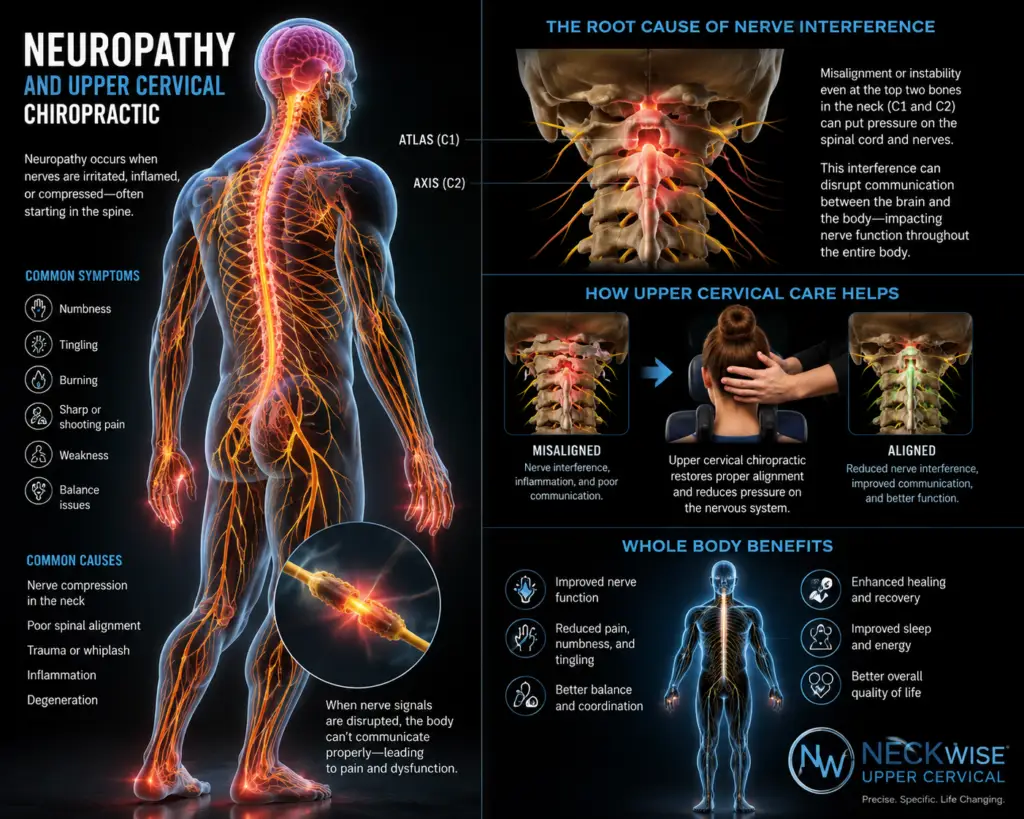
Neuropathy simply means a problem with the nerves. Most often, when people use the word, they are describing peripheral neuropathy — damage or dysfunction affecting the peripheral nerves that carry signals between your brain and spinal cord and the rest of your body. When these nerves misfire, the messages get scrambled. That is why neuropathy can feel like numbness in one moment and burning in the next.
The classic symptoms are numbness, tingling (“pins and needles”), burning, sharp or electric pain, and sometimes weakness or a feeling of clumsiness. Many people first notice it in the feet or hands, often in a “stocking and glove” pattern that starts at the toes and fingers and gradually moves inward over months or years. Some people experience heightened sensitivity, where even a bedsheet feels painful, while others lose sensation and cannot feel a pebble in their shoe. Balance can suffer when the feet stop sending reliable information to the brain. For a thorough medical overview of the condition, its many causes, and how it is evaluated, the StatPearls reference on neuropathy overview, causes, and diagnosis is a well-organized place to start.
The causes are genuinely numerous, and this is where honesty is essential. Diabetes is one of the most common drivers of peripheral neuropathy worldwide; chronically elevated blood sugar damages the small nerves over time. Alcohol use and various toxins can injure nerves. Chemotherapy is a frequent cause of nerve damage in cancer survivors. Some neuropathies are hereditary, written into a person’s genetics. Others stem from nutritional deficiencies — a lack of vitamin B12, for example — or from autoimmune conditions where the body attacks its own nerves. Infections, kidney disease, thyroid problems, and certain medications round out a long list. And in a meaningful fraction of cases, no clear cause is ever identified; this is called idiopathic neuropathy.
None of those causes are treated by adjusting the neck. I want that to be unmistakable. If you have diabetic neuropathy, alcohol-related neuropathy, chemotherapy-induced neuropathy, a hereditary neuropathy, or a nutritional or autoimmune neuropathy, the foundation of your care belongs with your physician, who can address the underlying condition — managing blood sugar, correcting a deficiency, adjusting medications, or treating the disease itself.
Because the causes are so varied, diagnosis is a medical process, and it should be. A proper workup often includes a detailed history and physical exam, blood tests to look for diabetes, vitamin levels, thyroid function, and other systemic clues, and sometimes nerve conduction studies or electromyography (EMG) to measure how well the nerves are actually carrying signals. In some cases imaging or a nerve biopsy is warranted. A helpful, practical review of how clinicians work through this puzzle is available in this article on the diagnosis of peripheral neuropathy. The point of a workup is not just to name the problem but to find causes that are treatable or reversible — which is exactly why seeing a physician first matters so much.
When Neuropathy Symptoms Actually Come From the Neck
Here is where the story becomes directly relevant to what we do. Not every case of numbness, tingling, or burning in an arm or hand is a true peripheral neuropathy of the systemic kind. Sometimes the symptom that feels like it lives in the hand is actually being generated much higher up — in the neck, where the nerve roots exit the cervical spine. When a cervical nerve root is compressed or irritated, it can send numbness, tingling, burning, or shooting pain down the pathway that nerve serves, all the way into the shoulder, arm, or fingers. This is called cervical radiculopathy.
The distinction is important because the treatment logic is completely different. In systemic neuropathy, the nerve itself is damaged along its length by a disease process. In cervical radiculopathy, the nerve may be perfectly healthy along the arm — the trouble is at the root, in the neck, where it is being pinched or inflamed by a disc bulge, bony changes, or mechanical irritation. Relieve the source in the neck, and the downstream symptoms often calm. A widely cited clinical summary, this review of cervical radiculopathy, describes how nerve-root irritation in the neck produces these arm and hand symptoms and how the condition is generally evaluated and managed.
How might you suspect that your “neuropathy” is actually cervical in origin? There are some clues, though only a proper examination can sort it out. Cervical radiculopathy tends to follow a specific nerve’s pattern — a stripe of symptoms down one particular part of the arm into specific fingers, rather than a symmetric “both feet, both hands” pattern. Neck movements, certain postures, coughing, or sneezing may worsen the arm symptoms. There may be neck stiffness or pain alongside the arm complaint, though not always. The symptoms are frequently one-sided. By contrast, a symmetric numbness that started in both feet and crept upward over years points much more toward a systemic peripheral neuropathy and away from the neck.
Because these patterns overlap and can even coexist, distinguishing them is genuinely a clinical task — not something to self-diagnose from an article. A thoughtful resource on this exact challenge is this discussion of cervical radiculopathy characteristics and differential diagnosis, which walks through how clinicians tell nerve-root problems apart from other causes of arm and hand symptoms. The practical takeaway for you is this: if your nerve symptoms are in the arms or hands, follow a nerve’s pathway, are worse with neck positions, or are lopsided from side to side, a cervical origin is worth investigating. That is precisely the situation where careful upper cervical assessment can add real value.
Why the Upper Cervical Spine Is Central
If the neck can be the true source of arm and hand nerve symptoms, then the top of the neck — the upper cervical spine — deserves special attention. This is the heart of what we focus on at Lavender Family Chiropractic, and there are two distinct, honest mechanisms that explain the connection. I want to walk through both carefully, because understanding them helps you see exactly where our care may help and where it cannot.
Mechanism one is structural and involves the cervical nerve roots. The upper cervical spine — the first two vertebrae, the atlas and axis, sitting directly beneath the skull — is the most mobile and, in some ways, the most influential region of the entire spinal column. It is where the head balances on the neck, and it strongly influences the posture and alignment of everything below it. When the upper cervical spine is misaligned, the body compensates. The head shifts, the neck curves to rebalance, and muscles down the cervical chain tighten and adapt to hold the head level. Over time, that pattern of compensation can contribute to mechanical stress and irritation lower in the neck, in the very region where the nerve roots that feed the arms and hands exit. In other words, an upper cervical misalignment can be an upstream driver of the compensation and irritation that shows up as cervical radiculopathy symptoms further down. Addressing the alignment at the top may help reduce that downstream mechanical burden. This is why we treat the arm-and-hand, cervical-origin component of “neuropathy” symptoms as something upper cervical care may legitimately support.
Mechanism two is neurological and involves how pain itself is regulated. Your nervous system does not passively report pain; it actively modulates it. There are descending pain-control pathways that travel from the brainstem down through the spinal cord, and these pathways can either dampen pain signals or amplify them. The upper cervical cord sits at the very junction where the brainstem meets the spinal cord — the gateway through which these descending pathways pass. When neuropathic pain becomes chronic, part of what makes it so persistent and intense is central amplification: the nervous system turning the volume up on pain rather than down. The science of these descending systems is reviewed in this article on descending pain modulation, which describes how the central nervous system can amplify or inhibit pain. Because the upper cervical region is anatomically central to these pathways, there is a reasonable rationale that a calmer, better-aligned upper cervical spine may be supportive of healthy central pain modulation. I am careful with my words here on purpose: this is a supportive role in how pain is processed, not a treatment that repairs damaged peripheral nerves.
Now the honest boundary, stated plainly. These two mechanisms explain why upper cervical care may help with the cervical-origin component of arm and hand symptoms and may be supportive of the nervous system’s pain modulation. They do not mean that upper cervical care treats diabetic neuropathy, chemotherapy neuropathy, hereditary neuropathy, or any other systemic neuropathy. We do not adjust the neck to lower blood sugar or to reverse nerve damage caused by disease. When someone comes to us with nerve symptoms, our job is to determine whether a cervical or central component is present and, if so, to address it with precise, low-force correction — always alongside the medical care that manages the underlying cause. You can read more about our overall approach on our upper cervical chiropractic carepage.
How Precise Upper Cervical Care Works at Lavender Family Chiropractic
If you decide to explore whether the neck is contributing to your symptoms, here is what care actually looks like at our office at the corner of University and Whitfield in Sarasota. Everything begins with a thorough consultation. I want to hear the full story: where your symptoms are, when they started, what makes them better or worse, whether they follow one side or both, and — critically — what your physician has already found. If you have had bloodwork, nerve conduction studies, or a diagnosis of a systemic neuropathy, that information shapes everything. It tells me what part of your picture belongs to medical management and what part, if any, might be cervical in origin.
From there, we gather objective information rather than guessing. We use 3D CBCT imaging, a cone-beam scan that lets us see the precise three-dimensional alignment of the upper cervical spine. Every neck is unique, and this detailed imaging allows any correction to be tailored to your specific anatomy rather than a generic template. We also use Tytron paraspinal infrared thermography, a completely non-contact scan that reads the heat patterns along the spine as a window into how the nervous system is regulating the tissues on either side of it. Together, these tools help me understand both the structure and the function of your upper cervical region before anything is ever done.
When a correction is warranted, we use the Knee Chest Upper Cervical technique. This is a precise, low-force method. It is not high-velocity twisting manipulation of the neck. It is a specific, gentle correction calculated from your imaging and designed to restore alignment to the upper cervical spine with as little force as possible. For people who are already dealing with nerve symptoms, the gentleness of this approach matters — the goal is to reduce mechanical irritation and support the nervous system, not to add stress to it.
Care is delivered through customized care plans built around your findings, your goals, and how your body responds. There is no one-size-fits-all schedule. And because your neuropathy may well have a systemic cause that lives outside our scope, we are glad to coordinate with your physician. Upper cervical care, when it is appropriate for you, is meant to work alongside your medical care, not to replace it. If your workup points entirely to a systemic neuropathy with no cervical component, I will tell you that honestly — the most valuable thing I can offer some people is a clear answer about what will and will not help.
If you want to know who you would be working with, you can meet our team, including Dr. Jacob Temple, on our meet the team page. And to be completely clear about scope: we do not cure neuropathy, and we do not claim to. What we offer is careful, gentle, natural relief aimed at the cervical and central components of nerve symptoms, delivered with precision and honesty.
Ready to Find Out If Your Neck Is Involved?
If your nerve symptoms are in your arms or hands, follow a nerve’s pathway, feel worse with certain neck positions, or are worse on one side, it may be worth finding out whether the neck is part of your picture. We would be glad to help you sort it out.
Call us at (941) 243-3729 or book directly through our new patient scheduling page. You will find us at 5899 Whitfield Avenue, Suite 107, Sarasota, FL 34243 — at the corner of University and Whitfield. If your symptoms turn out to be entirely systemic, we will point you back toward the right medical care. If the neck is involved, we can help you address that part gently and precisely.
What the Research Says
I try to keep my claims tethered to what the evidence actually supports, so here are the key references behind this article, described honestly.
First, for a broad, reliable overview of neuropathy — what it is, its many causes, and how it is diagnosed — the StatPearls chapter on neuropathy lays out the landscape, including the systemic causes (diabetes, toxins, hereditary and autoimmune conditions, and more) that fall squarely within medical management. It is a useful reminder of how varied neuropathy really is.
Second, on how clinicians actually work through a case, this review of the diagnosis of peripheral neuropathy describes the history, examination, blood testing, and nerve studies used to identify a cause. It underscores why a medical workup comes first — the goal is to find causes that can be treated or reversed.
Third, on the neck’s role in arm and hand symptoms, this review of cervical radiculopathy explains how irritation of a nerve root in the neck produces numbness, tingling, burning, and pain that radiate down the limb — the cervical-origin picture that is central to this article.
Fourth, because telling cervical radiculopathy apart from other causes is a real clinical challenge, this discussion of cervical radiculopathy characteristics and differential diagnosis walks through the features that help distinguish nerve-root problems from other sources of arm and hand symptoms.
Fifth, on how the nervous system regulates pain, this review of descending pain modulation describes the pathways that can amplify or inhibit pain within the central nervous system — the mechanism behind the central-modulation rationale discussed above. It supports a supportive framing, not a claim that any nerve damage is repaired.
Taken together, these sources support exactly what I have described: neuropathy is largely a medical condition requiring medical care, the neck can genuinely be the source of some arm and hand nerve symptoms, and the upper cervical region is anatomically relevant to pain modulation. They do not support treating systemic neuropathy with chiropractic, and I do not.
Lifestyle and Self-Care
Whether or not the neck plays a role in your symptoms, several habits genuinely matter for anyone living with neuropathy. None of these replace medical care — think of them as ways to support your nervous system while your physician manages the underlying cause.
Blood sugar control is the single most important lever for anyone with diabetic neuropathy, and it belongs firmly with your physician. Steady, well-managed blood sugar, guided by your medical doctor’s plan, is foundational to protecting the nerves over time. If you have diabetes or prediabetes, keeping those appointments and following your MD’s guidance is not optional — it is the core of your care.
Foot care deserves particular attention when sensation is reduced. If your feet do not feel a blister, a cut, or a pebble, small problems can escalate quietly. Check your feet daily, wear well-fitted shoes, keep the skin moisturized but dry between the toes, and bring any sore that is slow to heal to your doctor’s attention promptly. This simple routine prevents a great deal of trouble.
Posture and movement support the whole system, and they matter especially if there is a cervical component to your symptoms. Long hours hunched over a phone or screen load the neck in ways that can aggravate nerve-root irritation. Setting your screen at eye level, taking frequent breaks to move, and being mindful of how you hold your head throughout the day all help. If you would like to go deeper on neck health specifically, our article on neck pain covers posture and everyday habits in more detail.
Gentle, regular movement — walking, stretching, and activity approved by your care team — supports circulation and overall nerve health. Balance-focused exercises can be valuable if numb feet have made you unsteady. As always, run any new exercise plan past your physician, particularly if you have diabetes, cardiovascular concerns, or significant loss of sensation.
Serving Sarasota and Surrounding Communities
Our office sits at the corner of University and Whitfield in Sarasota, and we are glad to welcome patients from across the region who are looking for precise, honest upper cervical care. We regularly serve people from:
- Sarasota
- Bradenton
- Lakewood Ranch
- Venice
- Palmer Ranch
- Osprey
- Siesta Key
- Longboat Key
- Lido Key
- University Park
- Parrish
- Ellenton
- Myakka City
- Punta Gorda
- St. Petersburg
Wherever you are coming from along the Suncoast, we are easy to reach at 5899 Whitfield Avenue, Suite 107, Sarasota, FL 34243.
Top 15 Questions About Neuropathy and the Neck
Is my neuropathy from my neck or from something systemic? Honestly, it could be either, and sometimes both. If your symptoms are in the arms or hands, follow a single nerve’s pathway, worsen with certain neck positions, or are lopsided from side to side, a cervical origin is worth investigating. If your symptoms started symmetrically in both feet and crept upward over months or years, they point much more toward a systemic peripheral neuropathy that belongs with your physician. A proper evaluation is the only way to sort it out with confidence.
Can you cure neuropathy? No. We do not cure neuropathy, and we do not claim to. What we may offer is gentle, precise care aimed at the cervical-origin component of nerve symptoms and support for how the nervous system modulates pain — always alongside the medical care that addresses the underlying cause.
Should I still see my doctor? Yes, absolutely. Because most neuropathy is a medical condition with many possible causes — some of them treatable or reversible — a medical workup should come first or happen in parallel. We coordinate with your physician rather than replacing them.
What are the red flags that mean I should seek medical care promptly? Rapidly worsening weakness, symptoms that spread quickly, loss of bladder or bowel control, difficulty walking or a sudden change in balance, severe unrelenting pain, or numbness following an injury all warrant prompt medical attention. If you experience these, contact your physician or seek urgent care rather than waiting.
What is cervical radiculopathy? It is irritation or compression of a nerve root where it exits the neck. Even though the nerve is being pinched at the neck, the symptoms — numbness, tingling, burning, or pain — are often felt down the arm or in the hand along that nerve’s pathway.
How is that different from diabetic neuropathy? Diabetic neuropathy is damage to the nerves along their length, driven by chronically elevated blood sugar, and it typically affects both feet and hands symmetrically. Cervical radiculopathy is a mechanical problem at a nerve root in the neck, usually affecting one arm along a specific pattern. The two are managed very differently.
Does upper cervical care treat diabetic neuropathy? No. Adjusting the neck does not affect blood sugar or reverse nerve damage caused by diabetes. That care belongs with your physician. We only address a cervical or central component if one is present.
What imaging do you use? We use 3D CBCT cone-beam imaging to see the precise three-dimensional alignment of the upper cervical spine, along with Tytron paraspinal infrared thermography, a non-contact scan that reads how your nervous system is regulating the tissues alongside the spine.
Is the Knee Chest technique safe and gentle? It is a precise, low-force correction — not high-velocity twisting manipulation. It is calculated from your own imaging and designed to restore upper cervical alignment with as little force as possible, which is especially important when nerve symptoms are already present.
Do you take insurance? We are a cash-pay, out-of-network practice. We provide superbills that you can submit to your insurance company for possible reimbursement, depending on your individual plan and benefits.
What are superbills? A superbill is an itemized receipt of the care you received, coded so you can submit it to your insurer for potential out-of-network reimbursement. We provide these so you can pursue whatever benefits your plan allows.
How long will care take? It depends entirely on your findings, your goals, and how your body responds. We build customized care plans rather than fixed packages, and we reassess as we go using objective measures.
Can the neck cause tingling in the hands even without neck pain? Yes, it can. Some people with cervical nerve-root irritation feel the symptoms mainly in the arm or hand with little or no neck pain. This is one reason a careful evaluation matters rather than assuming based on where it hurts.
What if my evaluation shows the neck is not involved? Then I will tell you honestly, and point you back toward the medical care that fits your situation. A clear answer about what will not help is genuinely valuable, and I would rather give you that than start care that is not right for you.
How do I get started? Call us at (941) 243-3729 or book online through our scheduling page. We will begin with a thorough consultation, review anything your physician has already found, and determine together whether upper cervical care makes sense for your situation.
Closing CTA
Living with numbness, tingling, or burning is exhausting, and getting a straight answer about it should not be. If your nerve symptoms may be connected to your neck, we would be honored to help you find out — gently, precisely, and honestly. And if the answer lies with medical management, we will help point you in the right direction.
Call (941) 243-3729 or book your visit through our new patient scheduling page. You will find Lavender Family Chiropractic at 5899 Whitfield Avenue, Suite 107, Sarasota, FL 34243, at the corner of University and Whitfield. You are also welcome to reach us through our contact page. Whatever the source of your symptoms, our goal is to give you clarity and gentle, natural relief where it is genuinely possible.
Related Articles