

What to Expect at a Vestibular Migraine Evaluation in Sarasota
By Dr. Rusty Lavender, D.C. — upper cervical chiropractor, Lavender Family Chiropractic, Sarasota, FL. Reviewed and updated October 2026.
Most people who book a vestibular migraine evaluation with us have already been dizzy for a long time. They have usually seen an ENT, often a neurologist, sometimes a vestibular therapist. Many have a diagnosis. What they do not have is an answer to the question that brought them to our page: is the top of my neck part of this, and how would anyone know?
This post walks through exactly what happens at that first visit in our Sarasota office, what we measure, what the measurements can and cannot tell you, and what we recommend depending on what we find. If you want the full picture of the condition itself, our complete guide to vestibular migraine in Sarasota covers the causes we see, the imaging we use, and what to expect at an evaluation in more depth.
Before you come in: what we ask you to bring
Vestibular migraine is a diagnosis made on criteria, not on a scan. The Bárány Society and International Headache Society criteria require recurrent vestibular episodes of moderate or severe intensity lasting five minutes to seventy-two hours, a history of migraine, migraine features during at least half the episodes, and the exclusion of other causes (Lempert et al., J Vestib Res 2022). That last requirement is why we want to see what your other doctors have already ruled out. Bring any ENT or neurology notes, hearing test results, and any imaging reports. If you keep a dizziness diary, bring that too; if you do not, start one now, even a few days of notes helps.
We also ask you to think back further than the dizziness. A fall, a rear-end collision, a concussion in sport, even years before the first attack, is relevant to us in a way it may not have been to your other providers.
The history: the part that takes longest
The first half of the visit is conversation. We want to know what an attack feels like for you, how long episodes last, whether they come with light or sound sensitivity, visual aura, nausea or head pain, and what seems to set them off. We ask how you feel between attacks, because many people with vestibular migraine carry a low-grade unsteadiness or motion sensitivity that never fully clears, and that pattern matters for how we interpret the examination.
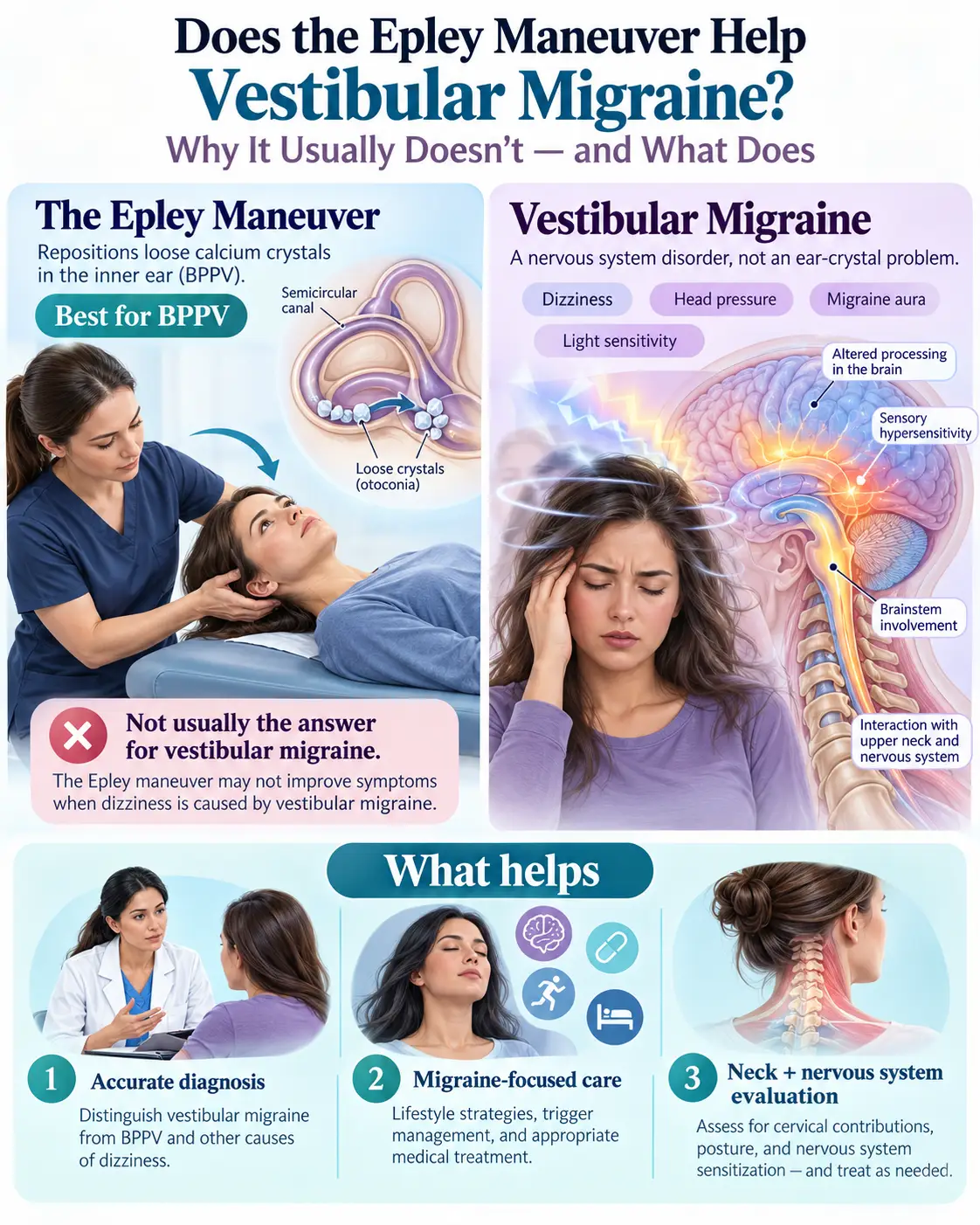
Then we ask about the neck directly: stiffness, pain at the base of the skull, headaches that start in the neck and move forward, a feeling that the head is heavy or not sitting right. Neck pain is one of the most common companions of migraine of any type, and disturbed input from the upper cervical joints can produce dizziness on its own, which is why neurologists describe cervicogenic dizziness as a distinct entity worth distinguishing from inner-ear causes (Yacovino & Hain, Semin Neurol 2013).
The examination
We screen first. If anything in your history or a brief neurological check suggests a central cause, we stop and refer; that is rare, but it comes before anything else. Then we examine the upper neck: range of motion in each direction, the position of the head relative to the shoulders, tenderness and tone in the small muscles at the base of the skull, and how the top two vertebrae move relative to each other.
The two measurements
What makes our evaluation different from a general chiropractic visit is that the decision to correct the atlas is made from measurements, not from feel.
The first is 3D cone-beam CT imaging of the upper cervical spine. It shows the position of the atlas and axis relative to the skull in three planes, with a fraction of the radiation of a conventional CT. A standard two-view neck X-ray cannot show rotation of the atlas, and rotation is usually the finding that matters. If you have had a cervical MRI, bring the report, but understand it was almost certainly read for discs and cord, not for atlas position.
The second is paraspinal infrared thermography. It reads skin-temperature asymmetry along the spine, which reflects nervous system activity in the small vessels under the skin. We take a baseline at the first visit and repeat it at every visit afterward, because a changing pattern is how we tell whether a correction is holding without re-imaging you each time.
What the results can mean
There are three broad outcomes, and we tell you which one you are in before you leave.
The atlas is in a normal position and the thermography pattern is unremarkable. In that case we say so, we do not recommend care, and we send you back to your neurologist or ENT with a copy of the imaging. The neck is probably not your driver, and the most useful thing we can do is close that question.
The atlas shows a measurable misalignment and the pattern is asymmetric. We explain exactly what we found, show you the images, and recommend a short trial of care with a defined review point. Vestibular migraine is managed with a layered plan, so we ask you to keep every medication your prescribing doctor has you on and to continue vestibular therapy if you are in it.
The findings are mixed or borderline. We say that too, and usually recommend a shorter trial with a clear stopping rule.
What a correction involves if we recommend one
The correction is a precise, low-force adjustment to the atlas calculated from your imaging. You lie on your side; there is no twisting of the neck and no cracking. The correction takes seconds and is followed by a rest period. Visits are closer together at first and are spaced out as the correction holds. We re-scan each visit and re-image only when the scans suggest the position has changed.
What the research supports, and what it does not
We want to be exact about this. Randomized trials of a targeted upper cervical technique in cervicogenic dizziness have shown reductions in dizziness intensity and frequency, with benefit still present at twelve months in the larger trial (Reid et al., Phys Ther 2014). For vestibular migraine specifically, the upper cervical evidence is a case series: three patients with diagnosed vestibular migraine who received manual therapy to the upper cervical spine, with reduced attack frequency and inter-attack dizziness sustained at six months (O’Toole et al., Health Open Res 2023). The atlas correction itself has been studied in a small observational pilot in migraine, reporting fewer migraine days at eight weeks with no control group (Woodfield et al., Biomed Res Int 2015). None of this is a trial of upper cervical care for vestibular migraine, and we will not tell you it is. It is enough to make the neck worth measuring, and the measurement is what the evaluation is for.
Frequently Asked Questions
Do I need a diagnosis of vestibular migraine before I come in?
No, but it helps. If you have not been evaluated by an ENT or neurologist we will encourage that step and can coordinate with them. Our evaluation looks at the neck’s contribution; it does not replace the medical diagnosis.
Will the evaluation make me dizzy?
We keep head movement slow and minimal, and the imaging and thermography involve no movement at all. Tell us if positional changes trigger you and we will pace the visit accordingly.
How long does the first visit take?
Plan on about an hour. The history is the longest part.
What if the imaging shows my atlas is fine?
We tell you that, we do not recommend care, and we send the imaging to your other doctors. Closing the question is a useful result.
Do I stop my migraine medication if I start care?
No. Any change to medication is between you and your prescribing doctor, ideally after your dizziness diary shows a sustained change.
Schedule a Vestibular Migraine Evaluation in Sarasota
If your dizziness travels with neck pain, followed a neck or head injury, or has not responded to the plan you are on, an upper cervical evaluation will tell you whether the top of your neck is part of the picture. Call (941) 243-3729 or book online. We are at 5899 Whitfield Avenue, Suite 107, Sarasota, FL 34243.

Get our upper cervical articles first.