Occipital Pain: Why Do I Have Pain and Pressure at the Base of My Skull? Upper Cervical Care for the Sarasota Area
Understanding the Real Cause of Occipital Pain, Head Pressure, and Upper Neck Dysfunction
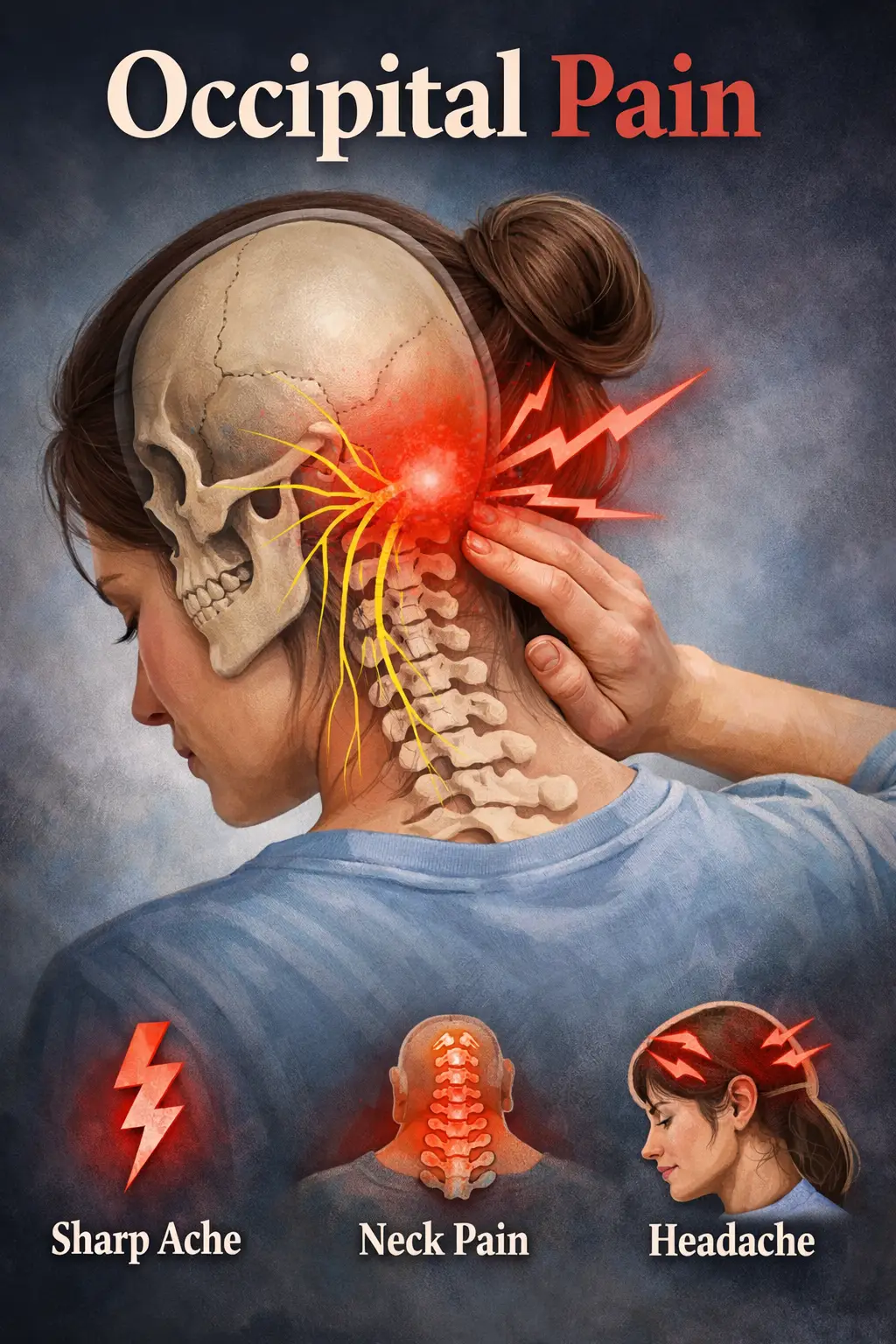
If you’ve ever felt a deep ache, tightness, or pressure right at the base of your skull, you know how distracting and exhausting it can be. Some people describe it as a dull, constant pressure. Others feel sharp, stabbing pain that radiates upward into the head or outward into the shoulders. For many, it comes with migraines, dizziness, sinus pressure, brain fog, or even numbness in the hands.
So the question becomes: why is this happening?
The area at the base of your skull is one of the most neurologically important regions in the entire body. It is where your head meets your neck. It is where your brainstem transitions into your spinal cord. It is where delicate nerves, blood vessels, muscles, and connective tissues converge in a compact and highly sensitive space.
When that region becomes irritated, inflamed, or mechanically stressed, the symptoms can extend far beyond simple neck pain.
In this article, we will explore:
- The anatomy of the upper cervical spine
- How misalignment at the base of the skull creates pressure and irritation
- Why this can trigger migraines, vertigo, dizziness, sinus congestion, and numb hands
- How chronic tension patterns develop
- And what can be done to correct the underlying cause rather than masking symptoms
Let’s begin by understanding the structure of this critical area.
Occipital Pain and The Anatomy of the Base of the Skull
The base of the skull connects directly to the top two bones of the neck: the atlas (C1) and the axis (C2). These two vertebrae form the upper cervical spine.
The atlas supports the weight of the head. The axis allows rotation. Together, they create a highly mobile yet delicate joint system that protects the brainstem and allows smooth head movement.
Unlike the lower neck, the atlas does not have a disc above it. It sits directly beneath the skull. This means that even a small misalignment in this area can create significant mechanical stress.
Important structures located here include:
- The brainstem
- Upper cervical spinal nerves
- Vertebral arteries
- Venous drainage pathways
- Suboccipital muscles
- The greater and lesser occipital nerves
Because so many structures pass through such a small space, precision alignment is critical.
When the atlas shifts out of optimal alignment—even slightly—it can create abnormal tension patterns and neurological irritation.
What Is Upper Cervical Misalignment?
Upper cervical misalignment occurs when the atlas (C1) and sometimes the axis (C2) lose their normal position relative to the skull.
This does not require a dramatic injury. It can happen from:
- Car accidents (even minor ones)
- Sports impacts
- Falls
- Poor posture over time
- Repetitive stress
- Birth trauma
- Long-term desk work and forward head posture
Because the atlas is designed for mobility rather than stability, it is particularly vulnerable.
When it misaligns, several things can happen:
- Muscles at the base of the skull tighten to compensate.
- Occipital nerves become irritated.
- Brainstem communication can be disrupted.
- Cerebrospinal fluid and blood flow may be affected.
- The head may tilt subtly, creating whole-body imbalance.
Over time, this creates chronic pressure and inflammation at the base of the skull.
Why It Feels Like Pressure
Many patients don’t describe this as “pain” at first. They describe it as pressure.
That pressure sensation often comes from:
- Muscle hypertonicity in the suboccipital muscles
- Fascial tension pulling upward
- Venous congestion
- Nerve irritation
- Inflammatory buildup
The suboccipital muscles are small but powerful stabilizers. When the atlas shifts, these muscles contract constantly in an attempt to stabilize the head.
Imagine holding a bowling ball slightly off center all day long. The muscles at the base of your skull would fatigue and tighten. That tension builds into pressure.
Now imagine that pattern repeating every day for years.
How Upper Cervical Misalignment Triggers Migraines
The trigeminocervical nucleus is a critical neurological hub in the upper cervical spine. It is where sensory input from the upper neck meets sensory input from the trigeminal nerve, which supplies much of the head and face.
When the upper cervical spine is irritated, it can stimulate this nucleus and trigger migraine pathways.
This explains why many people experience:
- Pain starting at the base of the skull and moving forward
- Light sensitivity
- Nausea
- Visual disturbances
- One-sided throbbing
If the atlas is misaligned, the irritation can be constant, making migraines more frequent and harder to control.
Addressing the mechanical irritation at its source often reduces the frequency and intensity of migraine episodes.
Vertigo, Dizziness, and the Upper Neck
The upper cervical spine plays a direct role in balance.
Proprioceptive input from the muscles and joints at the base of the skull feeds directly into the brainstem and cerebellum. If those signals are distorted due to misalignment, the brain receives conflicting information about head position.
This sensory mismatch can produce:
- Spinning sensations
- Rocking or swaying feelings
- Disequilibrium
- Motion sensitivity
- Brain fog
Even if the inner ear is functioning normally, distorted cervical input alone can create dizziness.
This condition is sometimes referred to as cervicogenic dizziness.
Correcting upper cervical alignment helps normalize proprioceptive input and reduce balance disturbances.
Why You Might Have Sinus Pressure or Congestion
Many people are surprised to learn that sinus pressure can originate from the upper neck.
The brainstem regulates autonomic function. When irritated, it can disrupt normal parasympathetic and sympathetic balance.
This imbalance may affect:
- Nasal drainage
- Mucous production
- Vascular tone in sinus cavities
Additionally, tension in the suboccipital region can refer pain into the forehead and behind the eyes, mimicking sinus pressure.
If you have chronic “sinus headaches” that don’t respond to typical treatments, the base of your skull may be involved.
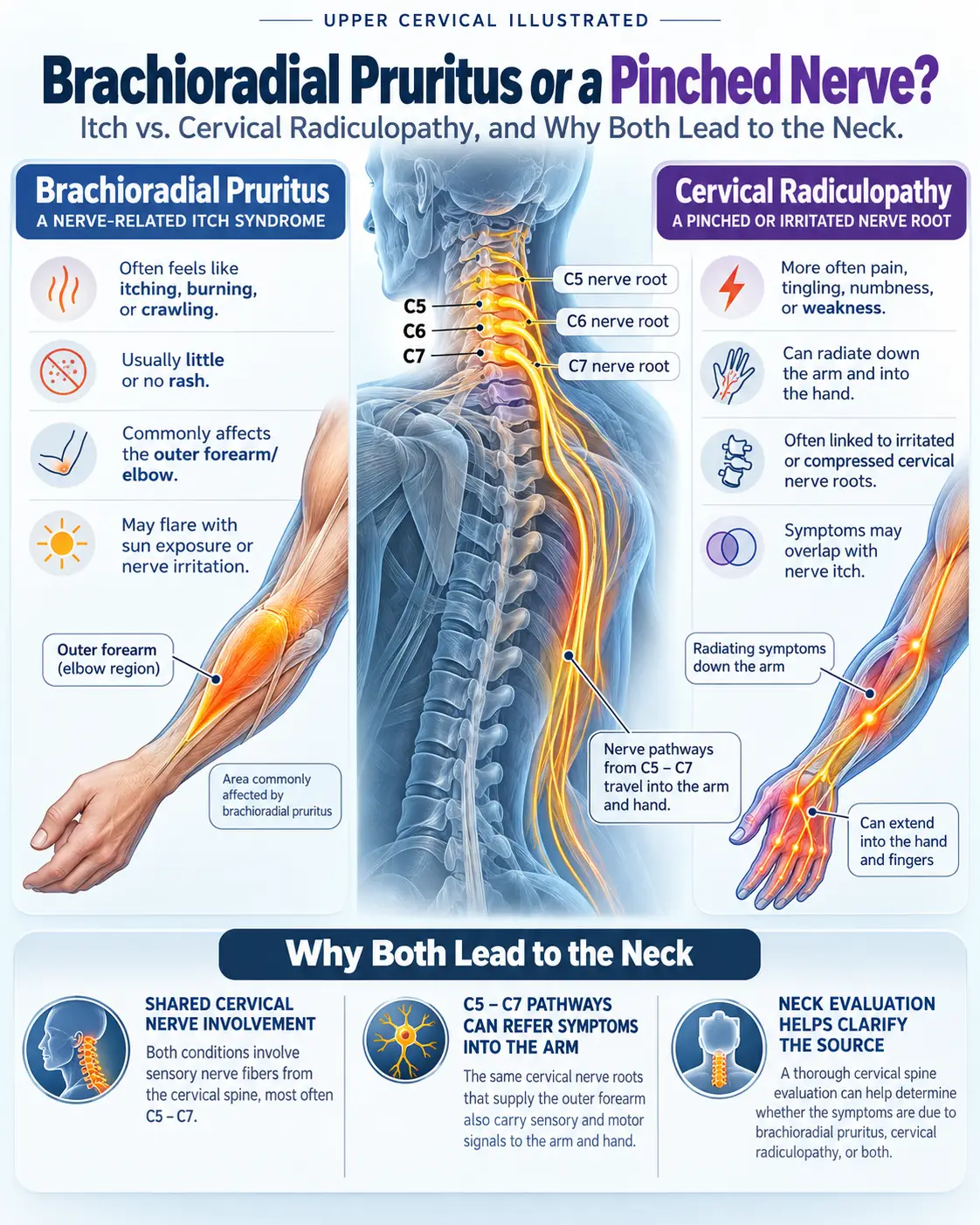
Numb Hands and Tingling Sensations
Upper cervical misalignment can also create downstream nerve tension.
When the head tilts or rotates abnormally due to atlas misalignment, the entire spine compensates. This compensation may create:
- Shoulder elevation
- Clavicle imbalance
- Thoracic rotation
- Brachial plexus tension
Over time, this can contribute to:
- Numbness in the hands
- Tingling in the fingers
- Weak grip strength
- Radiating arm discomfort
While lower cervical issues can certainly cause these symptoms, the root imbalance often begins at the top.
The Role of Posture and Modern Lifestyle
Forward head posture dramatically increases stress on the upper cervical spine.
For every inch the head moves forward, the load on the neck increases significantly. This added weight strains the suboccipital muscles and places the atlas under chronic stress.
Hours spent on:
- Phones
- Laptops
- Driving
- Desk work
can gradually pull the upper cervical spine out of optimal alignment.
The result is persistent pressure at the base of the skull that never fully resolves.
Why Pain Medications Often Don’t Fix It
Pain medications reduce inflammation and block pain signals.
They do not correct:
- Structural misalignment
- Mechanical irritation
- Muscle compensation patterns
- Neurological distortion
This is why many people experience temporary relief but ongoing recurrence.
Unless the underlying alignment issue is addressed, the irritation remains.
How Upper Cervical Care Addresses the Root Cause
Upper cervical chiropractic focuses specifically on the atlas and axis.
Rather than general twisting or cracking of the neck, this approach uses precise measurements and gentle corrections.
The goal is not force. The goal is accuracy.
When the atlas is restored to a more balanced position:
- Suboccipital muscle tension decreases
- Occipital nerve irritation reduces
- Brainstem pressure normalizes
- Proprioceptive signaling improves
- Whole-body compensation patterns unwind
Patients often report that the deep pressure at the base of the skull begins to ease gradually rather than disappearing instantly. This is because tissues need time to remodel and stabilize.
The Healing Process
Healing from upper cervical dysfunction is not simply about one adjustment.
It involves:
- Restoring alignment
- Allowing muscles to reset
- Reducing inflammation
- Supporting nervous system regulation
- Maintaining stability over time
As the upper neck stabilizes, symptoms like migraines, vertigo, dizziness, sinus congestion, and numb hands frequently decrease in intensity and frequency.
Could This Be Occipital Neuralgia?
Occipital neuralgia is characterized by sharp, electric-like pain that begins at the base of the skull and travels upward.
It is often caused by irritation of the greater or lesser occipital nerves.
Upper cervical misalignment can compress or irritate these nerves directly or indirectly through muscle tension.
Correcting the structural imbalance may reduce nerve irritation and calm neural hypersensitivity.
Other Conditions Linked to Upper Cervical Dysfunction
Pain and pressure at the base of the skull may also be associated with:
- Tension headaches
- Post-concussion symptoms
- Whiplash injuries
- Craniocervical instability
- TMJ dysfunction
- Chronic fatigue
- Brain fog
Because the upper cervical spine influences both mechanical and neurological systems, its impact is far-reaching.
Signs the Base of Your Skull Is the Root Problem
You may suspect upper cervical involvement if:
- Pain starts at the base of the skull
- Headaches begin in the neck and move forward
- You feel worse after prolonged screen time
- Dizziness increases with neck movement
- You hear popping or grinding when turning your head
- One shoulder sits higher than the other
- You have a history of trauma
These signs suggest mechanical imbalance rather than purely chemical inflammation.
Upper Cervical Chiropractic Care at NeckWise North Sarasota / Lavender Family Chiropractic
At NeckWise North Sarasota, powered by Lavender Family Chiropractic, upper cervical care is not a generalized, high-force, twisting approach. It is a precise, imaging-guided, neurologically focused method designed specifically to address misalignment of the atlas (C1) and axis (C2) — the very region responsible for pain and pressure at the base of the skull.
Advanced 3D CBCT Imaging
One of the most important differences in upper cervical care at our office is the use of state-of-the-art 3D CBCT imaging. Rather than guessing at alignment or relying solely on palpation, we take highly detailed 3D images of the upper cervical spine.
This allows us to:
- Measure the exact direction and degree of atlas misalignment
- Assess rotation, laterality, and angular distortion
- Evaluate spacing and joint integrity
- Identify structural abnormalities or past trauma patterns
- Create a completely individualized correction plan
No two misalignments are the same. Because of that, no two corrections should be the same. The precision of 3D imaging allows for customized adjustments rather than generalized manipulation.
Functional Nervous System Scanning
In addition to structural imaging, we perform functional nervous system scans to evaluate how the upper cervical misalignment may be affecting neurological regulation.
These scans help us assess:
- Symmetry of autonomic function
- Paraspinal nerve tension patterns
- Inflammatory stress responses
- Nervous system adaptability
When the brainstem is irritated due to atlas misalignment, it can alter how the body regulates balance, circulation, digestion, and muscle tone. By measuring nervous system function before and after correction, we can objectively track improvement.
Gentle, Precise Corrections — No Twisting or Cracking
Upper cervical adjustments at our office are extremely gentle.
There is:
- No aggressive twisting
- No forceful yanking
- No rapid rotational cracking
Instead, the correction is delivered with precise vector-specific positioning based on your imaging measurements. The goal is to nudge the atlas back toward optimal alignment using minimal force.
Many patients are surprised at how light the correction feels. However, because it is targeted specifically to the misalignment, the neurological impact can be significant.
Why Precision Matters for Base of Skull Pressure
When the atlas is even slightly misaligned, the suboccipital muscles must compensate constantly. This creates chronic contraction and pressure at the base of the skull.
By restoring structural balance:
- Suboccipital tension decreases
- Occipital nerve irritation calms
- Brainstem pressure reduces
- Proprioceptive input normalizes
- Whole-body compensation patterns begin to unwind
As alignment stabilizes over time, many patients report:
- Reduced head pressure
- Fewer migraines
- Improved balance
- Decreased dizziness
- Less neck tightness
- Improved sinus drainage
- Better sleep
A Focus on Stability, Not Frequency
Another distinguishing factor is that upper cervical care focuses on holding corrections rather than adjusting repeatedly.
The objective is to:
- Deliver a precise correction
- Allow the body to stabilize
- Monitor alignment through objective measurements
- Only adjust when necessary
This encourages long-term structural correction rather than temporary relief.
Conditions Commonly Seen in Our Office
Patients experiencing pain and pressure at the base of the skull often also struggle with:
- Migraines
- Vertigo and balance disorders
- Cervicogenic dizziness
- Occipital neuralgia
- Post-concussion symptoms
- TMJ dysfunction
- Chronic neck pain
- Numbness or tingling in the hands
- Brain fog
Because the upper cervical spine influences both structural and neurological systems, correcting misalignment often produces improvements beyond just localized neck discomfort.
What to Expect as a New Patient
The process typically includes:
- A detailed health history
- Structural and postural analysis
- 3D CBCT imaging of the upper cervical spine
- Functional nervous system scanning
- Customized correction plan
- Ongoing progress monitoring
Healing is not rushed. The focus is restoring stability, reducing neurological stress, and allowing the body to recover naturally.
Why Patients Choose This Approach
Many individuals who come to NeckWise North Sarasota have already tried medications, physical therapy, massage, or traditional chiropractic care.
They are often searching for answers because their symptoms keep returning.
Upper cervical chiropractic care addresses a frequently overlooked region — the precise junction where the skull meets the spine. When this area is corrected accurately and allowed to stabilize, the body often responds in powerful ways.
For individuals experiencing persistent pressure at the base of the skull, this focused and advanced approach may be the missing piece. If your occipital pain fits the neuralgia pattern, our full guide to occipital neuralgia in Sarasota covers evaluation and care.
Top 15 FAQs About Pain at the Base of Your Skull
1. What causes pain at the base of the skull?
Pain at the base of the skull is commonly caused by upper cervical misalignment, muscle tension in the suboccipital region, occipital nerve irritation, poor posture, previous trauma, or chronic stress patterns. Structural imbalance in the atlas (C1) is one of the most overlooked contributors.
2. Is pain at the base of the skull the same as a headache?
Not always. While it can trigger headaches, especially tension headaches or migraines, base-of-skull pain may exist independently due to muscular or joint dysfunction in the upper cervical spine.
3. Can upper cervical misalignment cause migraines?
Yes. Irritation in the upper cervical spine can stimulate the trigeminocervical nucleus, which plays a major role in migraine development. Correcting alignment may reduce frequency and severity.
4. Why does the pain travel from my neck into my head?
The upper cervical nerves share pathways with cranial sensory nerves. When irritated, pain can radiate upward into the scalp, temples, forehead, or behind the eyes.
5. Can this cause dizziness or vertigo?
Yes. The upper neck provides essential balance input to the brain. Misalignment may distort proprioceptive signals, leading to spinning sensations, rocking, or disequilibrium.
6. Why do I feel pressure instead of sharp pain?
Pressure sensations are often caused by chronic muscle contraction, fascial tightness, or mild nerve irritation rather than acute inflammation.
7. Can poor posture cause base-of-skull pain?
Absolutely. Forward head posture increases strain on the suboccipital muscles and stresses the atlas, often leading to chronic tightness and pressure.
8. Is this the same as occipital neuralgia?
Occipital neuralgia is a specific condition involving irritation of the occipital nerves, often producing sharp, electric-like pain. Upper cervical misalignment can be a contributing factor.
9. Can sinus pressure actually start in my neck?
Yes. Brainstem irritation and muscle referral patterns can mimic sinus pressure. Some chronic “sinus headaches” originate from upper cervical dysfunction.
10. Why do my hands sometimes go numb along with neck pain?
Atlas misalignment can trigger whole-spine compensation patterns, potentially contributing to nerve tension that affects the shoulders and arms.
11. Will medication fix the problem?
Medication may temporarily reduce inflammation or block pain signals, but it does not correct structural misalignment or mechanical irritation.
12. Is upper cervical chiropractic safe?
When performed with proper imaging and precision, upper cervical care is gentle and highly specific, focusing on minimal force rather than aggressive manipulation.
13. How long does it take to feel improvement?
Some patients notice changes quickly, while others improve gradually as muscles reset and alignment stabilizes. Healing depends on the duration and severity of the misalignment.
14. Do I need ongoing adjustments forever?
The goal of upper cervical care is stability. Adjustments are delivered only when necessary, allowing the body to hold corrections rather than requiring constant treatment.
15. When should I get evaluated?
If you experience persistent base-of-skull pressure, recurring headaches, dizziness, migraines, or symptoms that worsen with posture or stress, a detailed upper cervical evaluation may help determine if misalignment is contributing.
Final Thoughts: Your Body Is Not Random
Pain and pressure at the base of your skull are not random events.
They are signals.
Signals that something in the structural and neurological system may be out of balance.
When the upper cervical spine is aligned and stable, the body often functions more efficiently. Tension decreases. Circulation improves. Neurological signaling normalizes.
If you’ve been chasing symptoms without lasting results, it may be time to look at the very top of the spine.
Because sometimes, the smallest shift in the right place can make the biggest difference.
Schedule with us!
Lavender Family Chiropractic (NeckWise North Sarasota)
5899 Whitfield Ave Ste 107, Sarasota, FL 34243
www.chiropractorsarasotaflorida.com
(941)243-3729
To learn more about us go to http://www.chiropractorsarasotaflorida.com
We also service Bradenton, Parrish, Ellenton, Ruskin, Venice, Tampa, St. Pete, Osprey, Longboat, Lakewood Ranch, Myakka City.
If you are in Tampa, Land O Lakes, Fort Myers, or Salt Lake City, you can visit my other locations! NeckWise Upper Cervical. Visit, www.neckwise.com
If you are not local, visit www.uccnearme.com to find a doctor in your area
Serving Sarasota, Bradenton, Lakewood Ranch, Parrish, Ellenton, Venice, Osprey, Siesta Key, Longboat Key, Lido Key, Myakka City, Punta Gorda, and St. Petersburg.