Vertigo Treatment in Sarasota, Florida — Upper Cervical Chiropractic Care at Lavender Family Chiropractic
If the room spins when you sit up in bed, if walking down the aisle at Publix makes you feel like you’re on a boat, if you’ve stopped driving certain routes because you’re afraid an episode will hit — vertigo is more than a symptom. It’s a daily limitation that shrinks your life. And if you live in Sarasota, Bradenton, or Lakewood Ranch and you’ve already cycled through ENT visits, Epley maneuvers, vestibular rehab, anti-nausea medications, and diuretics without lasting relief, you’ve probably started wondering whether anyone is actually going to find the cause.
At Lavender Family Chiropractic, located at 5899 Whitfield Avenue in Sarasota, we approach vertigo differently. Drs. Rusty Lavender and Jacob Temple specialize in upper cervical chiropractic care — a precise, gentle technique that addresses one of the most overlooked drivers of chronic vertigo: misalignment of the top two vertebrae in your neck, the atlas (C1) and axis (C2). For thousands of vertigo sufferers across Southwest Florida, correcting this single area has been the missing piece.
This page is your complete guide to vertigo and the upper cervical spine — what vertigo actually is, why conventional treatment so often fails to resolve it, and how upper cervical care offers a root-cause path forward.
What Is Vertigo?
Vertigo is the false sensation of movement. You feel like you, or the world around you, is spinning, rocking, swaying, or tilting — when nothing is actually moving. It is not a diagnosis. It’s a symptom, and finding the right cause is the entire game.
Common vertigo symptoms include:
- A spinning or whirling sensation, often triggered by head movement
- Feeling like you’re on a boat or floating
- Dizziness, lightheadedness, or unsteadiness when standing
- Nausea and vomiting during episodes
- Difficulty focusing the eyes or tracking objects
- Trouble walking in a straight line
- Hearing changes, ear fullness, or tinnitus (ringing)
- Headaches or neck pain alongside dizziness
- Brain fog, fatigue, and difficulty concentrating
- Anxiety about when the next episode will strike
The brain decides where you are in space by combining three streams of information: your inner ear (vestibular system), your eyes (vision), and your neck and joints (proprioception). When those three streams agree, you feel grounded. When they disagree — even slightly — your brain interprets the mismatch as motion that isn’t there. That’s vertigo. And the most overlooked source of mismatch lives in the upper neck.
Common Types of Vertigo
Vertigo isn’t one condition. It’s a category, and each subtype has different drivers — but most share a common thread of upper cervical involvement.
Benign Paroxysmal Positional Vertigo (BPPV) — the most common form. Brief, intense spinning triggered by head movements like rolling over in bed, looking up, or tipping the head back. Caused by displaced calcium crystals (otoconia) in the inner ear’s semicircular canals.
Vestibular migraine — vertigo combined with migraine features like head pain, light sensitivity, or aura. Read our dedicated vestibular migraine page for more.
Ménière’s disease — a chronic inner ear disorder marked by episodes of vertigo, tinnitus, hearing loss, and ear fullness. Visit our Ménière’s disease page for a full breakdown.
Vestibular neuritis and labyrinthitis — inflammation of the vestibular nerve or inner ear, often following a viral infection, producing sudden, severe vertigo that can last days to weeks.
Cervicogenic vertigo — dizziness driven directly by the cervical spine, particularly the upper neck. Often misdiagnosed as inner ear vertigo when imaging shows nothing wrong with the ear.
Post-traumatic vertigo — vertigo that begins after a car accident, fall, concussion, or whiplash injury. Almost always involves the upper cervical spine.
Persistent Postural-Perceptual Dizziness (PPPD) — chronic, daily dizziness that lingers long after an initial vertigo episode has resolved. Often tied to upper cervical dysfunction and autonomic dysregulation.
Eustachian tube dysfunction — pressure imbalance in the middle ear that can mimic or trigger vertigo, frequently associated with upper cervical misalignment.
The common thread? Each of these conditions involves systems that route through, or are influenced by, the upper cervical spine.
The Nerve and Vascular Anatomy of Vertigo
To understand why the upper cervical spine matters so much, you have to understand what sits there.
The atlas (C1) is the topmost vertebra in your spine. It cradles the base of your skull. Just below it is the axis (C2). Together, these two bones form the upper cervical complex — and this complex is unlike any other joint in the body. It has no intervertebral disc, allows roughly 50% of your head’s rotation, and surrounds some of the most critical neurological and vascular structures you have:
- The brainstem — the control center for balance, equilibrium, eye-tracking, and autonomic regulation
- The vertebral arteries — major blood vessels carrying oxygen to the back of the brain, the cerebellum, and the vestibular nuclei
- The vestibular nuclei — the brainstem hubs that process every signal from your inner ear
- The cervical proprioceptors — dense sensors in the upper neck muscles and joints that tell your brain where your head is in space
- The vagus nerve — the master regulator of your parasympathetic nervous system, deeply tied to nausea and dizziness
When the atlas or axis shifts even a fraction of a millimeter out of optimal alignment, every one of these structures can be affected. A small bony misalignment becomes a large neurological disturbance — and that disturbance plays out as the spinning, swaying, off-balance sensation we call vertigo.
Why the Upper Cervical Spine Is the Most Important Area for Vertigo Sufferers
Most vertigo workups focus on the inner ear. That’s understandable — the inner ear is one important input. But the upper cervical spine influences vertigo through four powerful mechanisms that conventional treatment rarely addresses.
1. Proprioceptive mismatch. The upper neck is one of the densest concentrations of position-sensing nerve receptors in the entire body. Your brain relies on these receptors to know where your head is relative to your body. When the atlas is misaligned, those signals become distorted — and your brain receives faulty information about your head’s position. The result: balance disruption, even when your inner ear is perfectly healthy.
2. Vertebral artery blood flow. The vertebral arteries pass through small openings in the C1 and C2 vertebrae before entering the skull to supply the brainstem, cerebellum, and vestibular nuclei. When these bones rotate or shift, blood flow can be subtly restricted. Reduced oxygen delivery to the balance centers of the brainstem is a direct contributor to dizziness and vertigo.
3. Brainstem and vestibular nuclei irritation. The vestibular nuclei sit in the brainstem — directly above the atlas. Misalignment in this region can create mechanical and neurological stress on the very structures responsible for processing balance signals. The result is a hypersensitive vestibular system that overreacts to normal head movement.
4. Autonomic and vagus nerve dysfunction. The nausea, sweating, and lightheadedness that accompany vertigo are autonomic responses — driven by the vagus nerve and the autonomic centers in the brainstem. Upper cervical misalignment irritates these regions, amplifying every dizzy spell into a full-body event. Read more on vagus nerve dysfunction.
This is why upper cervical care often succeeds where other vertigo treatments stall. It addresses the structural, vascular, neurological, and autonomic drivers all at once — at the physical source where they converge.
The Cervicogenic Vertigo Connection
This is the piece conventional vertigo treatment often misses entirely.
Cervicogenic vertigo — vertigo driven by the cervical spine — is widely underdiagnosed. ENT exams find nothing. MRIs of the brain are clean. Epley maneuvers don’t work, or work briefly and then the vertigo returns. Patients are told their inner ear is fine and that they should “learn to live with it” or that the problem is anxiety.
But the upper cervical spine sends massive volumes of sensory input into the same brainstem regions that process inner ear signals. If those upper cervical signals are distorted by a misalignment, the brain perceives motion that isn’t there — and no amount of inner ear treatment will fix it, because the inner ear isn’t the problem.
For patients who have done everything for their inner ear and seen no lasting improvement, cervicogenic involvement is not a fringe theory. It’s often the answer hiding in plain sight.
Conventional Vertigo Treatment — and Where It Falls Short
Conventional vertigo treatment usually includes some combination of:
Canalith repositioning maneuvers (Epley, Semont, Brandt-Daroff) — designed for BPPV, these can be highly effective when the diagnosis is correct, but offer no benefit for vertigo from other causes.
Vestibular rehabilitation therapy (VRT) — exercises that help the brain compensate for vestibular dysfunction. Helpful for some, but it teaches the brain to work around the problem rather than resolve it.
Medications — meclizine, diazepam, anti-nausea drugs, diuretics for Ménière’s. Most are symptom-suppressing and often cause drowsiness, fatigue, or rebound symptoms.
Surgery or injections — used in advanced Ménière’s or severe cases. Invasive, irreversible, and reserved as a last resort.
These approaches help some patients, and we never tell patients to abandon treatments that are working. But they share a common limitation: they manage the symptom; they don’t address why the vertigo started in the first place.
Common patient frustrations we hear in our Sarasota office:
- Epley maneuvers worked once but the vertigo keeps coming back
- Vestibular rehab helped for a while, then plateaued
- Medications cause as much fatigue as the vertigo itself
- ENTs say everything looks normal but the dizziness is daily
- Symptoms started after a car accident, fall, or whiplash and never fully resolved
For these patients, the next question isn’t “how do I better cope with vertigo?” It’s “what’s actually causing this, and can that be corrected?” That’s where upper cervical care enters the conversation.
How Upper Cervical Chiropractic Care Treats Vertigo
Upper cervical chiropractic isn’t general chiropractic. There’s no twisting, popping, or forceful manipulation of the neck — a critical distinction for vertigo patients, whose nervous systems are already hypersensitive and would not tolerate aggressive adjustments. Instead, we use a highly specific, precisely measured correction — a gentle, sustained contact applied at a calculated vector to the atlas vertebra.
At Lavender Family Chiropractic, our process for vertigo patients involves:
Detailed history and examination. We map your vertigo pattern — triggers, frequency, duration, accompanying symptoms, and any history of trauma like whiplash or concussion.
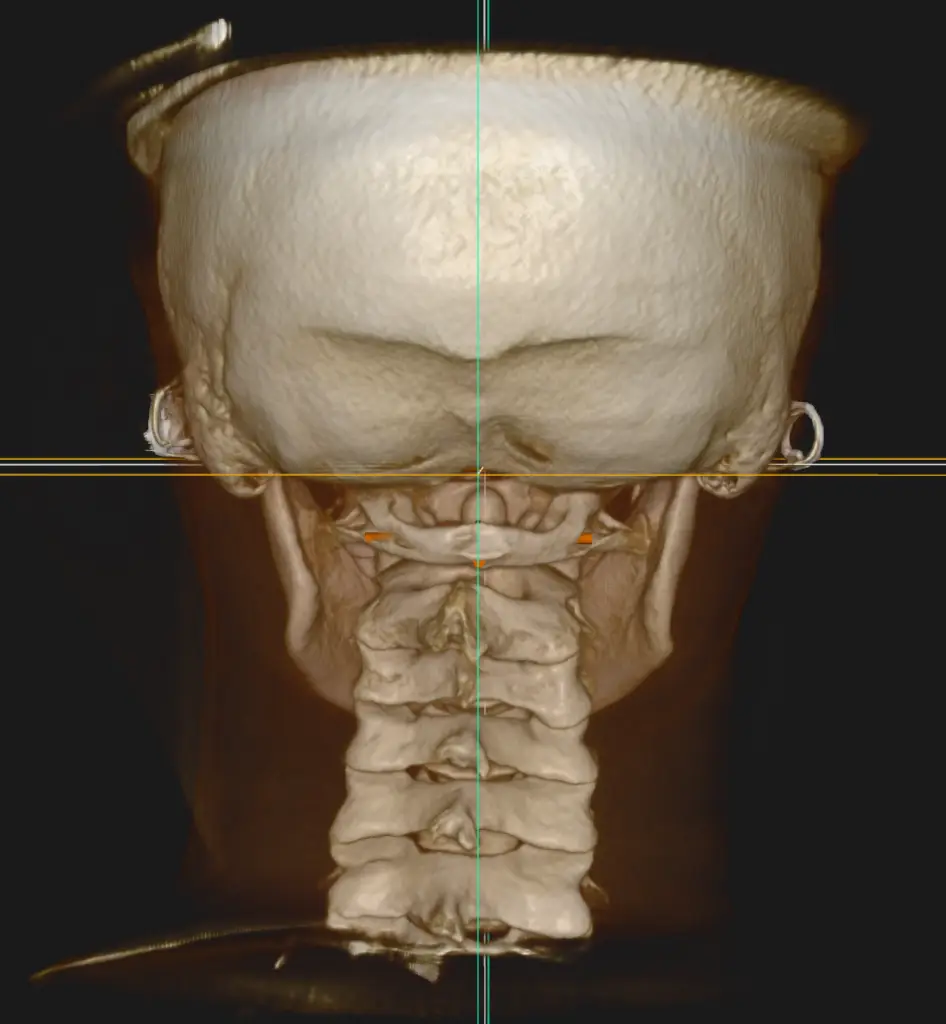
3D CBCT imaging. We use cone-beam computed tomography to measure your upper cervical spine to within one hundredth of a millimeter. No guessing. No generic adjustments. We see exactly how your atlas and axis are positioned.
Paraspinal infrared thermography. This non-invasive scan reads autonomic nervous system function along your spine, helping us track how your nervous system is responding to care over time.
The Knee Chest Upper Cervical technique. This is the gentle, no-force technique Drs. Lavender and Temple specialize in. The correction is precise, calculated from your imaging, and designed to hold so your nervous system can begin recalibrating without repeated forceful intervention — particularly important for sensitive vertigo patients.
Personalized care plans. Every vertigo case is different. Acute vertigo from a recent whiplash injury responds differently than chronic, decade-long dizziness. We design a comprehensive care plan tailored to your specific case — and we tell you honestly what to expect from day one.
What to Expect as a New Patient
Patients often ask what their first visits will look like. Here’s the honest breakdown.
Visit 1 — Consultation and exam. We sit down with you, hear your full story, and perform a neurological and structural evaluation. If you’re not a good candidate for upper cervical care, we tell you. We don’t accept patients into care we don’t believe we can help.
Visit 2 — Imaging review and first correction. We review your 3D CBCT scans and explain exactly what we found. We’ll walk you through a customized care plan built specifically for your condition, your spine, and your goals. Then we deliver your first upper cervical correction, calculated specifically for your spine.
Care plan visits. Each vertigo patient at Lavender Family Chiropractic is placed on a structured care plan designed to bring your atlas into alignment and — just as importantly — keep it there long enough for your vestibular system, brainstem, and proprioceptive system to fully recalibrate. Chronic vertigo doesn’t develop overnight, and it doesn’t fully resolve overnight either. The care plan gives your body the consistent input it needs to make lasting changes.
You can read more about what to expect at our office.
The Research Behind Upper Cervical Care for Vertigo
Several peer-reviewed studies have examined upper cervical chiropractic for vertigo, dizziness, and balance disorders. Notable findings include:
- Research published in the Journal of Vertebral Subluxation Research documented significant improvements in vertigo symptoms following upper cervical specific care, particularly in patients with post-traumatic vertigo.
- Studies in Brain Injury and related journals have linked upper cervical dysfunction to persistent dizziness following whiplash and concussion.
- Case series on cervicogenic dizziness have shown meaningful reductions in symptom intensity and frequency following targeted upper cervical correction.
- Anatomical and neurophysiological research consistently confirms the dense proprioceptive input from the upper cervical spine into the vestibular nuclei of the brainstem.
We’re transparent: large-scale randomized controlled trials specifically on upper cervical chiropractic for vertigo are still limited, and we never promise outcomes. What we offer is a clinically reasoned, anatomically grounded approach with a long track record of patient-reported improvement — particularly for vertigo sufferers who have exhausted conventional options.
Lifestyle Strategies That Support Vertigo Recovery
Upper cervical care addresses the structural and neurological root, but several lifestyle factors can support — or sabotage — your recovery.
Hydration. Dehydration worsens dizziness and amplifies inner ear sensitivity, especially in Florida’s heat. Aim for at least half your body weight in ounces of water daily.
Sleep position. Sleeping on your stomach forces your neck into rotation for hours at a time, repeatedly stressing the upper cervical spine. Side sleeping with a properly contoured pillow protects your correction.
Slow, deliberate head movements. During acute vertigo phases, avoid quick rotations and sudden positional changes. Move your whole body together rather than whipping your head.
Sodium and caffeine awareness. For Ménière’s-type vertigo, lower-sodium diets often help. Excess caffeine can also amplify inner ear sensitivity in some patients.
Vision and screen habits. Long hours on phones and computers reduce eye movement variety, which the brain uses to calibrate balance. Take regular breaks and look at varied distances throughout the day.
Posture and ergonomics. Forward head posture loads the atlas and axis. Set your monitor at eye level and avoid prolonged “tech neck” positioning.
Stress regulation. Vertigo and anxiety feed each other. Breathwork, daily walks, and consistent gentle exercise calm the autonomic nervous system and reduce the frequency and intensity of episodes.
For a related look at how the upper cervical spine influences another commonly co-occurring condition, read our article on POTS (Postural Orthostatic Tachycardia Syndrome)— a condition often tangled up with vertigo and dizziness.
Serving Sarasota, Bradenton, Lakewood Ranch, and Surrounding Areas
Lavender Family Chiropractic is located at 5899 Whitfield Avenue, Suite 107, Sarasota, FL 34243 — at the corner of University and Whitfield, just minutes from downtown Sarasota, Lakewood Ranch, Bradenton, University Park, Palmer Ranch, and Siesta Key. We see vertigo patients from throughout Manatee and Sarasota counties, including Bradenton, Lakewood Ranch, Parrish, Ellenton, Palmetto, Venice, Osprey, Nokomis, and Longboat Key. Read more about the areas we service.
If you’ve searched “vertigo doctor near me,” “natural vertigo treatment Sarasota,” or “upper cervical chiropractor Lakewood Ranch” — you’re in the right place. Our entire practice is built around upper cervical care for conditions like yours.
Top 15 FAQs About Vertigo and Upper Cervical Care
1. Can chiropractic care really help vertigo, or is that a stretch?
Upper cervical chiropractic specifically — not general chiropractic — has a strong mechanistic basis for vertigo relief through the vestibular nuclei, vertebral artery blood flow, cervical proprioception, and autonomic nervous system. Many vertigo sufferers experience meaningful improvement when the upper cervical spine is corrected, particularly those whose inner ear workups have come back clean.
2. Is upper cervical chiropractic safe for someone with vertigo?
Yes. The Knee Chest Upper Cervical technique involves no twisting, popping, or forceful movement — making it one of the few chiropractic approaches specifically appropriate for sensitive vertigo patients. There is no rotational manipulation of the neck.
3. How long until I notice a difference?
It varies. Some patients notice changes within the first one to three weeks. Others — particularly those with chronic vertigo of many years or significant prior trauma — require longer. We’re honest about timelines during your care plan consultation based on your specific case.
4. My ENT said my ears are fine. So why am I still dizzy?
Because the ears aren’t the only input to your balance system. The upper cervical spine sends massive proprioceptive input into the brainstem balance centers. If that input is distorted by a misalignment, you’ll feel dizzy regardless of how healthy your inner ears are.
5. I have BPPV — can upper cervical care help?
BPPV is technically caused by displaced inner ear crystals, and the Epley maneuver is the standard treatment. However, many BPPV sufferers find their episodes recur frequently — often because the underlying upper cervical instability keeps disturbing the inner ear. Upper cervical care addresses that root layer.
6. My vertigo started after a car accident. Is that meaningful?
Extremely. Whiplash and concussion injuries are leading causes of upper cervical misalignment, and post-traumatic vertigo is one of the conditions upper cervical care addresses most effectively. If your vertigo started after an accident, the upper cervical spine should be evaluated. See our car accident chiropractic page for more.
7. Do you treat Ménière’s disease?
We don’t claim to cure Ménière’s, but many Ménière’s patients experience significant reduction in episode frequency and intensity with upper cervical care. Visit our Ménière’s disease page for the full breakdown.
8. Will the Epley maneuver still work if I also do upper cervical care?
Yes, the two approaches address different layers and are fully compatible. Upper cervical care addresses the underlying instability while the Epley addresses any displaced crystals.
9. Do I need a referral?
No. You can schedule a consultation directly.
10. Do you take insurance and how does payment work?
We offer customized care plans designed around your specific condition and goals. During your report of findings, we walk you through the full plan and the investment involved, so there are no surprises. We accept HSA and FSA, and we provide detailed receipts for out-of-network reimbursement when applicable.
11. What’s the difference between vertigo and dizziness?
Vertigo is the false sensation of spinning or movement. Dizziness is a broader term that can include lightheadedness, unsteadiness, or feeling faint. Both can stem from upper cervical involvement, though the underlying mechanisms differ slightly.
12. Can a misalignment really cause vertigo?
The upper cervical spine doesn’t single-handedly cause every case of vertigo — but in many people, it’s a major contributing factor that triggers or amplifies dizziness. Correcting it removes one of the largest physical drivers, particularly for patients whose ear exams come back normal.
13. What if I have other conditions like migraines, POTS, or TMJ?
Many of our vertigo patients also have related conditions like migraines, POTS, TMJ dysfunction, or craniocervical instability. These conditions often share upper cervical involvement and frequently improve alongside vertigo.
14. How is the Knee Chest Upper Cervical technique different from other chiropractic?
It’s a knee-chest technique applied with no force and a precisely calculated vector based on your CBCT imaging. There’s no rotational movement of your neck, no popping, no audible release. It’s one of the most specific and gentlest techniques available — and one of the few specifically appropriate for vertigo patients.
15. How do I get started?
Call us at (941) 243-3729 or book online for a consultation. We’ll go through your history, examine you, and tell you honestly whether we believe upper cervical care can help.
Ready to Find Out If Your Vertigo Starts in Your Neck?
For many of our patients in Sarasota, Bradenton, and Lakewood Ranch, the answer to years of unexplained dizziness was hiding one inch below the base of their skull. The atlas vertebra is small — but its influence on the brainstem, the vestibular system, and the proprioceptive feedback that keeps you balanced is enormous.
If you’ve tried Epley maneuvers, vestibular rehab, medications, and ENT workups without lasting results — it may be time to investigate the structural and neurological root of your vertigo. We’d be honored to help.
Call (941) 243-3729 or book your consultation online.
Lavender Family Chiropractic 5899 Whitfield Avenue, Suite 107 Sarasota, FL 34243 At the corner of University and Whitfield
Related Articles