Vertigo, Sinus Issues, and Eustachian Tube Dysfunction: The Upper Cervical Connection
By Dr. Rusty Lavender, D.C. and Dr. Jacob Temple, D.C. — upper cervical chiropractors, Lavender Family Chiropractic, Sarasota, FL. Reviewed and updated October 2026.
Understanding the Frustration of Vertigo and Sinus Issues
Sinus Issues: Vertigo is one of the most unsettling and disruptive symptoms a person can experience. Patients often describe it as a spinning sensation, a feeling of being off-balance, or a constant sense of motion even when they are completely still. For many people in Sarasota, Bradenton, and Lakewood Ranch, vertigo is not just an occasional inconvenience—it becomes a daily obstacle that interferes with work, family life, and overall well-being.
If you’ve ever experienced vertigo, you know how quickly it can take over your day. Walking through a grocery store can feel overwhelming. Driving may feel unsafe. Even turning your head in bed can trigger intense spinning. Many patients begin to avoid activities they once loved, not because they want to—but because they are afraid of triggering symptoms.
What makes vertigo even more frustrating is that many people are told their symptoms are “normal,” “just stress,” or something they have to live with. They are often given medications or told to wait it out, without ever getting a clear explanation of why it’s happening.
But what if vertigo is actually a signal from your body that something deeper is going on?
At Lavender Family Chiropractic, powered by NeckWise Clinics in North Sarasota, we take a completely different approach. Instead of chasing symptoms, we focus on identifying and correcting the root cause—most commonly found in the upper cervical spine.
What Is Vertigo?
Vertigo is not a condition itself—it is a symptom of dysfunction within your body’s balance system. That system is incredibly complex and relies on three key components working together seamlessly:
- The inner ear (vestibular system)
- The eyes (visual system)
- The brain (central processing system)
When these systems communicate properly, your body maintains balance effortlessly. However, when there is a breakdown in communication—especially involving the inner ear or brainstem—vertigo can occur.
Vertigo can present in several ways:
- Spinning sensation
- Swaying or rocking (common in MdDS)
- Feeling pulled to one side
- Lightheadedness
- Disorientation
Many people are diagnosed with conditions like BPPV, vestibular migraines, or Meniere’s disease. While these labels describe symptoms, they often do not explain why the problem started in the first place.
The Role of the Eustachian Tube
One of the most overlooked contributors to vertigo is the Eustachian tube.
The Eustachian tube connects the middle ear to the back of the throat. Its primary role is to regulate pressure within the ear and allow proper drainage of fluid.
When functioning correctly, it keeps pressure equalized so your inner ear can accurately detect motion and position.
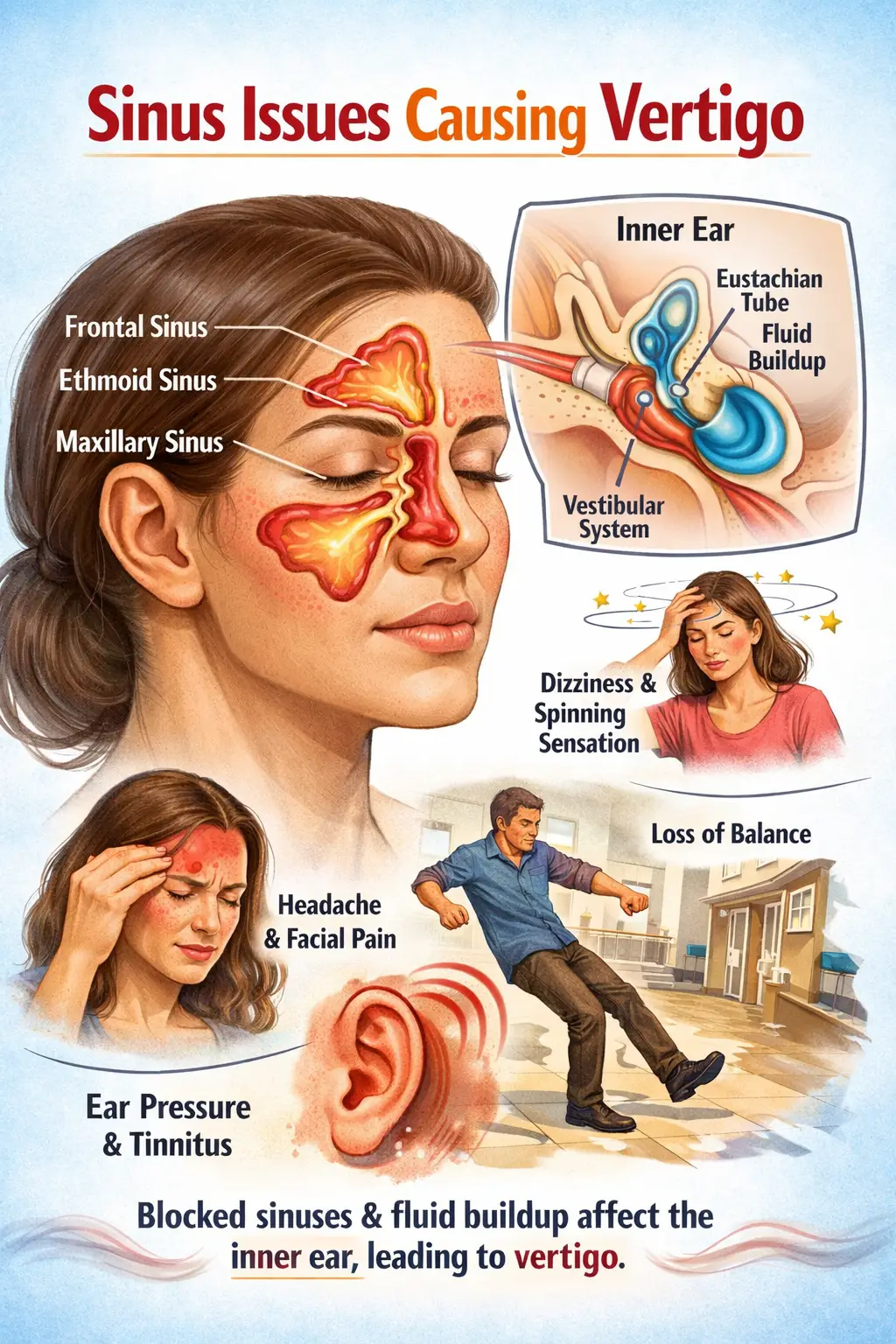
However, when the Eustachian tube becomes dysfunctional (Eustachian Tube Dysfunction or ETD), it can lead to:
- Ear fullness or pressure
- Popping or crackling
- Muffled hearing
- Fluid buildup
- Dizziness or vertigo
This pressure imbalance disrupts the vestibular system, which can trigger or worsen vertigo symptoms.
Sinus Issues and Their Connection to Vertigo
Your sinuses are closely connected to your ears. When sinus pressure builds up, it can directly affect the Eustachian tube and inner ear.
Common sinus-related causes include:
- Chronic sinusitis
- Allergies
- Environmental irritants
- Infections
When your sinuses are inflamed, they can block proper drainage and increase pressure in the head. This pressure can:
- Compress surrounding structures
- Affect ear pressure regulation
- Disrupt balance signals
This is why many patients notice their vertigo worsens with weather changes, allergies, or sinus flare-ups.
The reason this matters so much is because the inner ear does not function in isolation. The middle ear, Eustachian tube, sinus passages, and surrounding cranial structures all influence pressure balance in the head. If sinus swelling is present, the tissues around the opening of the Eustachian tube can become irritated and narrowed. That can make the ear feel blocked, create crackling or popping sounds, and alter the pressure environment that your vestibular system depends on.
Many people describe this as feeling like they are underwater, like their ears will not clear, or like their head is stuffed with pressure. Others say they feel lightheaded during allergy season, when flying, when the weather changes, or when they wake up congested in the morning. Those experiences are not random. Pressure changes in the sinuses and middle ear can absolutely contribute to dizziness and vertigo.
This is also why so many patients bounce between different explanations without getting a satisfying answer. One provider may focus on allergies. Another may focus on the ear. Another may focus on anxiety. But if the problem is truly recurring, the question becomes: why does the body keep failing to regulate pressure and drainage in the first place?
That is where a root-cause approach becomes important. At Lavender Family Chiropractic, powered by NeckWise Clinics in North Sarasota, we look deeper at the neurological and structural factors that may be making a person more vulnerable to repeated sinus pressure, Eustachian tube dysfunction, and vertigo.
Why Vertigo Often Feels Worse With Pressure Changes and Inflammation
Many patients say their symptoms flare when they travel, when a storm rolls in, when pollen counts rise, or when they are fighting off a cold. That pattern makes sense. The body is constantly adapting to changes in air pressure, inflammation, and fluid balance.
If your nervous system is regulating well, those changes may be noticeable but manageable. If your system is already stressed, those same changes can push you over the edge.
A person with upper cervical instability or misalignment may already have altered tension patterns in the head and neck, poorer drainage mechanics, heightened cranial nerve irritation, and a reduced ability to adapt to environmental change. Then something like sinus swelling, allergy congestion, or barometric pressure change gets added on top of it. Suddenly the patient feels dizzy, off-balance, full in the ears, foggy, nauseated, or like the room is moving.
This helps explain why some people have chronic cycles of symptoms instead of one isolated episode. Their body never fully resets. They improve a little, then another trigger arrives and the same pattern starts again.
Why ENTs and Traditional Approaches May Miss the Neck Component
Ear, nose, and throat specialists play an important role in ruling out infection, structural blockages, severe disease, hearing loss issues, and other medical problems. But many patients are told that everything looks normal even though they still have pressure, dizziness, and recurring vertigo.
That can be incredibly discouraging.
The reason this happens is because the dysfunction may not be due to a tumor, major infection, or obvious pathology. It may be due to altered neurological regulation and upper cervical mechanical stress that is not being evaluated.
A patient may be told:
- Their ears look clear
- Their sinuses are not severely infected
- Their hearing test is mostly normal
- Their scans do not show a major problem
And yet they still feel terrible.
That does not mean the problem is imaginary. It means the root cause may be functional rather than grossly structural. The body can be out of balance without something dramatic showing up on routine testing.
This is where NeckWise Care becomes a unique option. Rather than only asking whether disease is present, we ask whether the upper cervical spine is creating abnormal neurological stress that is contributing to recurring symptoms.
The Missing Link: The Upper Cervical Spine
Your sinuses are closely connected to your ears. When sinus pressure builds up, it can directly affect the Eustachian tube and inner ear.
Common sinus-related causes include:
- Chronic sinusitis
- Allergies
- Environmental irritants
- Infections
When your sinuses are inflamed, they can block proper drainage and increase pressure in the head. This pressure can:
- Compress surrounding structures
- Affect ear pressure regulation
- Disrupt balance signals
This is why many patients notice their vertigo worsens with weather changes, allergies, or sinus flare-ups.
The Missing Link: The Upper Cervical Spine
Here is where most people—and even many healthcare providers—miss the bigger picture.
The upper cervical spine (the top two bones in your neck: C1 and C2) plays a critical role in how your brain and body communicate.
The atlas (C1) sits directly beneath the skull and surrounds the brainstem. The brainstem controls:
- Balance and coordination
- Cranial nerve function
- Autonomic nervous system regulation
When the atlas becomes misaligned, even slightly, it can create dysfunction in the brainstem and nervous system.
This can lead to:
- Altered vestibular signaling
- Irritation of cranial nerves
- Disruption in Eustachian tube function
- Increased sinus congestion
- Poor adaptation to pressure changes
The Neurological Connection: Brainstem, Cranial Nerves, and the Vagus Nerve
The brainstem is the control center for many of the systems involved in vertigo and sinus function.
Cranial nerves that influence the ears, sinuses, and balance originate here. When the upper cervical spine is misaligned, it can irritate these pathways.
This includes:
- Trigeminal nerve (facial sensation and sinus involvement)
- Vestibulocochlear nerve (balance and hearing)
- Vagus nerve (autonomic regulation)
When these nerves are not functioning properly, symptoms like vertigo, ear pressure, sinus congestion, and headaches can occur.
This is why addressing the neck—not just the ear—is critical.
How the Neck Causes Eustachian Tube and Sinus Dysfunction
The muscles that open and close the Eustachian tube rely on proper nerve signaling from the brainstem.
When there is interference in the upper cervical spine, those signals can become disrupted.
This can cause:
- Improper opening of the Eustachian tube
- Poor drainage
- Chronic pressure buildup
- Recurring sinus congestion
In other words, the neck can be the root cause of both Eustachian tube dysfunction AND sinus problems.
What Is NeckWise Care?
At Lavender Family Chiropractic, we call our approach NeckWise Care.
NeckWise Care is a specialized form of upper cervical chiropractic that focuses exclusively on correcting misalignments in the top of the neck.
This is not traditional chiropractic.
NeckWise Care is:
- Extremely precise
- Customized to your anatomy
- Gentle and specific
- Focused on neurological correction
We do not twist, crack, or pop your neck.
In-Depth: The Science of the Upper Cervical Spine and Why It Matters (NeckWise Care)
To fully understand why NeckWise Care can have such a profound effect on vertigo, sinus pressure, and Eustachian tube dysfunction, it’s important to go deeper into the anatomy and physiology of the upper cervical spine.
The upper cervical region is made up of the atlas (C1) and axis (C2). These two vertebrae are unlike any other bones in the spine. They are uniquely designed to support the weight of the head, allow a wide range of motion, and most importantly, protect the brainstem.
The atlas does not have a typical disc like the rest of the spine. Instead, it is a ring-shaped structure that cradles the base of the skull. This design allows for mobility—but it also makes the atlas more susceptible to misalignment.
Even a slight misalignment in this region can have significant neurological consequences.
The Brainstem: Your Body’s Control Center
The brainstem sits directly above the atlas and acts as a relay station between the brain and the body. It regulates vital functions such as:
- Balance and coordination
- Heart rate and breathing
- Blood pressure
- Cranial nerve activity
- Autonomic nervous system balance
When the atlas is misaligned, it can place stress on the brainstem and disrupt these functions.
This is not about bones being “out of place” in a dramatic way. It is about subtle shifts that alter how the nervous system communicates.
Proprioception and Balance
One of the most critical roles of the upper cervical spine is providing proprioceptive input to the brain.
Proprioception is your body’s awareness of where it is in space.
The upper neck contains one of the highest concentrations of proprioceptive receptors in the entire body. These receptors constantly send information to the cerebellum and vestibular nuclei to help maintain balance.
When the atlas is misaligned, this input becomes distorted.
The brain receives conflicting information from:
- The inner ear
- The eyes
- The upper cervical spine
This mismatch is a major driver of vertigo.
The Trigeminocervical Connection
There is a powerful neurological link between the upper cervical spine and the trigeminal nerve known as the trigeminocervical nucleus.
This connection explains why patients with upper cervical misalignment often experience:
- Headaches
- Migraines
- Facial pressure
- Sinus symptoms
When the upper cervical spine is irritated, it can sensitize this pathway, leading to amplified pain and pressure sensations in the head and face.
Blood Flow and Fluid Dynamics
The upper cervical region also plays a role in blood flow and cerebrospinal fluid (CSF) dynamics.
Misalignment in this area can contribute to:
- Altered venous drainage from the brain
- Changes in CSF flow
- Increased intracranial pressure sensations
These factors can influence symptoms such as:
- Brain fog
- Head pressure
- Dizziness
- Sensitivity to barometric pressure
The Autonomic Nervous System and the Vagus Nerve
The autonomic nervous system controls your body’s automatic functions, including digestion, heart rate, and inflammation.
The vagus nerve—one of the most important components of this system—originates in the brainstem and travels through the neck.
When upper cervical misalignment is present, it can disrupt vagal tone and autonomic balance.
This can contribute to:
- Chronic inflammation
- Sinus congestion
- Poor drainage
- Increased sensitivity to environmental triggers
Why Precision Matters
Because of the sensitivity of this region, precision is everything.
General spinal manipulation is not designed to address the unique biomechanics of the atlas.
NeckWise Care uses:
- Detailed CBCT imaging
- Specific vector analysis
- Customized correction angles
This ensures that each adjustment is tailored to the individual.
Holding the Correction
One of the most important aspects of NeckWise Care is not just making the correction—but helping the body hold it.
When the atlas is properly aligned and stabilized:
- The nervous system begins to regulate
- Inflammation decreases
- Muscles relax
- The body starts to heal
This is why many patients report progressive improvements over time rather than temporary relief.
Long-Term Neurological Healing
The goal of NeckWise Care is not just symptom relief—it is neurological restoration.
Over time, consistent correction and stabilization of the upper cervical spine can lead to:
- Improved balance and coordination
- Reduced vertigo episodes
- Better sinus drainage
- Normalized Eustachian tube function
- Increased energy and mental clarity
This is what makes upper cervical care fundamentally different.
It is not about chasing symptoms—it is about restoring the body’s ability to function the way it was designed to.
Advanced Technology: CBCT and Tytron Scans
To get to the root cause, we use advanced diagnostics, including:
- 3D CBCT imaging to analyze alignment
- Paraspinal infrared thermography (Tytron scans) to measure nervous system function
These tools allow us to:
- Identify exact misalignments
- Track progress objectively
- Customize your correction
A major reason people get frustrated with healthcare is because they feel like they are being guessed at. They are told to try a medication, wait it out, or come back later if things get worse. NeckWise Care is different because it is measurement-based.
CBCT imaging gives us a much more detailed understanding of the upper cervical spine than generic imaging alone. It helps us evaluate the atlas and axis in three dimensions and see how your anatomy is actually set up. This is especially important because no two patients are exactly alike. A correction that is right for one person may not be right for another. Precision requires specificity.
Tytron scans add another layer by helping us assess changes in paraspinal heat patterns that may reflect nervous system imbalance. While no single test tells the whole story, using objective tools together helps us create a far more individualized plan than simply feeling around the neck and making a general adjustment.
For patients with vertigo, sinus pressure, ear fullness, or chronic headaches, this matters. If the goal is to reduce pressure, improve balance signaling, and restore neurological function, then precision is not optional. It is essential.
The NeckWise Adjustment
To get to the root cause, we use advanced diagnostics, including:
- 3D CBCT imaging to analyze alignment
- Paraspinal infrared thermography (Tytron scans) to measure nervous system function
These tools allow us to:
- Identify exact misalignments
- Track progress objectively
- Customize your correction
The NeckWise Adjustment
The adjustment is incredibly gentle.
We use a specific angle (called the S-angle) to deliver a precise correction to the atlas.
There is:
- No cracking
- No twisting
- No forceful movements
Patients are often surprised at how subtle it feels.
This is one of the biggest misconceptions people have about upper cervical care. Many assume that if an adjustment is going to help, it has to involve strong force, loud popping, or aggressive movement. NeckWise Care is the opposite.
Because the upper cervical spine is such a delicate and neurologically important area, the goal is not to overpower the body. The goal is to work with the body using as little force as necessary and as much precision as possible.
At Lavender Family Chiropractic, we analyze your imaging, your scans, your posture, and your specific pattern. Then we determine whether you need an adjustment, how to deliver it, and when to leave it alone. That last part is important. Good upper cervical care is not about adjusting you every time just because you showed up. It is about knowing when the correction is holding and allowing the body to continue stabilizing.
Patients often report that the adjustment feels surprisingly light, but the changes afterward can be significant. Some notice less head pressure. Others notice that their ears begin clearing more easily. Some feel more stable when walking. Others report less swaying, clearer thinking, or improved tolerance to motion.
The reason a gentle correction can matter so much is because the nervous system responds to prec
The adjustment is incredibly gentle.
We use a specific angle (called the S-angle) to deliver a precise correction to the atlas.
There is:
- No cracking
- No twisting
- No forceful movements
Patients are often surprised at how subtle it feels.
How NeckWise Care Helps Vertigo and Sinus Issues
By restoring proper alignment to the upper cervical spine, we help:
- Normalize brainstem function
- Improve Eustachian tube drainage
- Reduce sinus pressure
- Restore balance signaling
This allows the body to heal naturally.
Why Traditional Treatments Often Fail
Most treatments focus on symptoms:
- Medications
- Decongestants
- Vestibular therapy
While helpful temporarily, they do not address the underlying neurological dysfunction.
Patient Testimonials
Many of our patients in Sarasota, Bradenton, and Lakewood Ranch come to us after trying everything else.
“I had constant vertigo and ear pressure for years. After starting NeckWise Care, I finally feel stable again.”
“My sinuses were always clogged, and I felt off-balance daily. Now I can function normally again.”
“I was told nothing was wrong, but I knew something was off. This was the first place that actually found the cause.”
Conditions We Commonly Help
- Vertigo
- BPPV
- MdDS
- Vestibular migraines
- Eustachian tube dysfunction
- Chronic sinus issues
- Headaches and migraines
- Neck pain
What to Expect on Your First Visit
Your first visit includes:
- Consultation
- 3D imaging
- Nervous system scans
We then create a personalized plan.
Our complete guide to Eustachian tube dysfunction and the upper cervical spine covers the types of ETD, why the ear and the neck are connected, and how we evaluate it in Sarasota.
Top 15 FAQs About Vertigo, Sinus Issues, and NeckWise Care
1. Can sinus pressure really cause vertigo?
Yes, increased sinus pressure can affect inner ear balance.
2. What is Eustachian Tube Dysfunction?
A condition where the ear cannot regulate pressure properly.
3. How does the neck affect vertigo?
The upper neck influences the brainstem and balance system.
4. Is NeckWise Care safe?
Yes, it is extremely gentle and precise.
5. Do adjustments hurt?
No, they are very light and comfortable.
6. How long until I see results?
Many patients notice changes within weeks.
7. Can this help migraines?
Yes, many patients see improvement in migraines.
8. Is this different from regular chiropractic?
Yes, it is focused only on the upper neck.
9. Do you take insurance?
Our office is out of network with insurance. Many of our patients receive a superbill to submit to their insurance for reimbursement based on their coverage. We offer many different payment options as well as finance options.
10. Can this help ear pressure?
Yes, improving Eustachian tube function can relieve pressure.
11. What causes atlas misalignment?
Injuries, posture, and repetitive stress.
12. Can vertigo go away naturally?
Sometimes, but underlying issues often remain.
13. Do you use X-rays?
We use advanced CBCT imaging.
14. Is this good for chronic issues?
Yes, especially long-standing problems.
15. How do I get started?
Schedule a consultation below.
Serving Sarasota and Surrounding Areas
We proudly serve Sarasota, Bradenton, Lakewood Ranch, Parrish, Ellenton, Venice, Osprey, Siesta Key, Longboat Key, Lido Key, Myakka City, Punta Gorda, and St. Petersburg.
A Path Forward
Vertigo, sinus pressure, and Eustachian tube dysfunction are not random. They are signals.
When you correct the root cause—often in the upper cervical spine—you give your body the opportunity to heal.
Schedule a Consultation
Lavender Family Chiropractic in Sarasota Florida offers complimentary consultations to learn more about you. Click the link below!
Visit our Website!
To learn more about us go to http://www.chiropractorsarasotaflorida.com
(941)243-3729
We also service Bradenton, Parrish, Ellenton, Ruskin, Venice, Tampa, St. Pete, Osprey, Longboat, Lakewood Ranch, Myakka City.
If you are not local, visit www.uccnearme.com to find a doctor in your area.