My Ear Still Won’t Unclog Weeks After a Cold: Why It Lingers and What Helps
By Dr. Rusty Lavender
My Ear Still Won’t Unclog: The cold itself is long gone. The cough faded, the congestion cleared, and you feel like yourself again — except for one thing. Your ear is still plugged. It has been a week, maybe three, and that muffled, underwater, full feeling just will not let go. You have tried yawning, chewing gum, and pinching your nose to pop it, and nothing sticks. If this sounds familiar, you are dealing with one of the most common and frustrating aftereffects of an upper respiratory infection: eustachian tube dysfunction that lingers long after the virus has moved on.
This article explains why an ear stays clogged after a cold, when a lingering plugged ear needs medical evaluation, and where upper cervical chiropractic care may fit as part of the picture. At Lavender Family Chiropractic in Sarasota, we help people understand what is keeping their ear from clearing so they can pursue the right kind of relief.
My Ear Still Won’t Unclog: What the Eustachian Tube Does — and Why a Cold Disrupts It
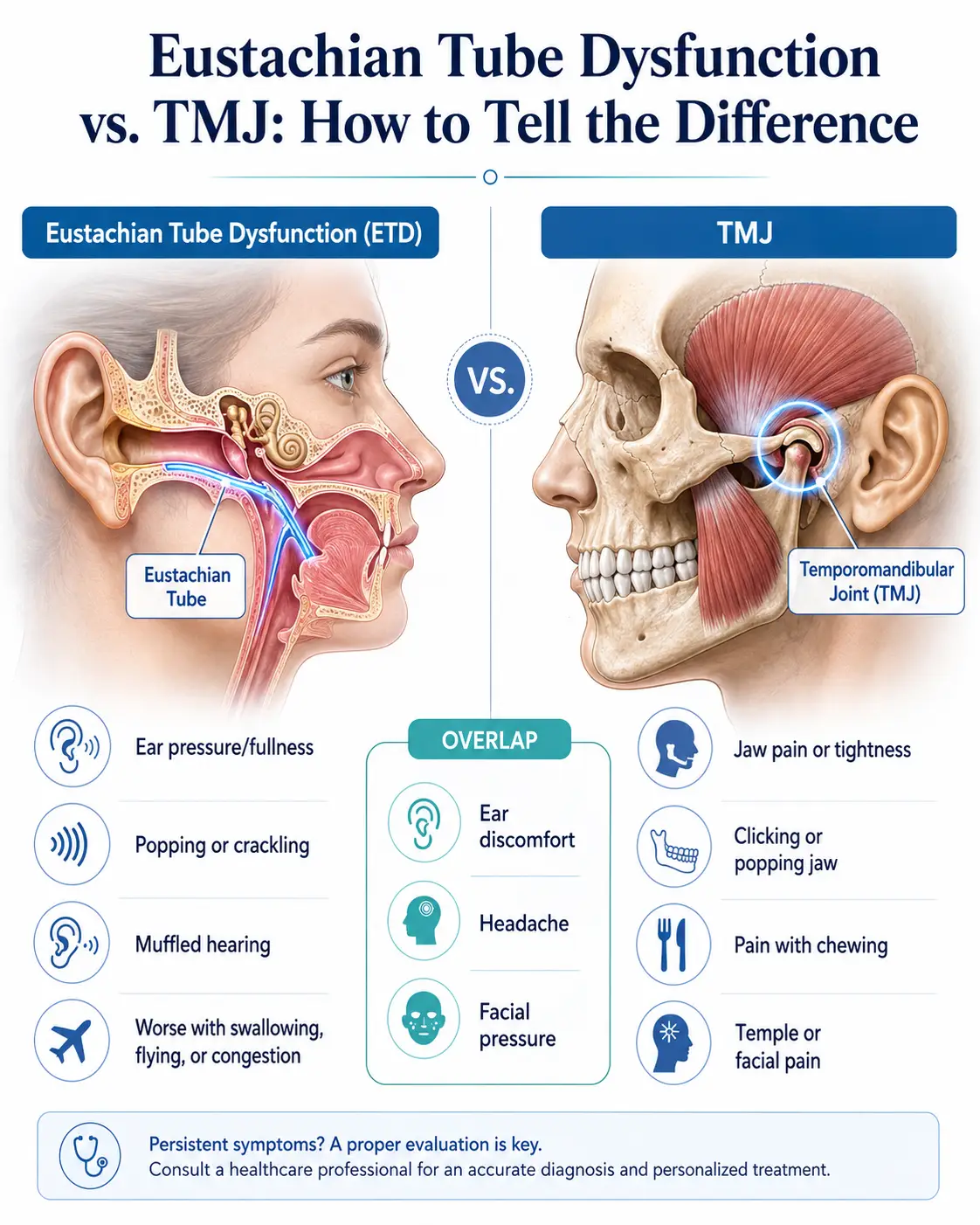
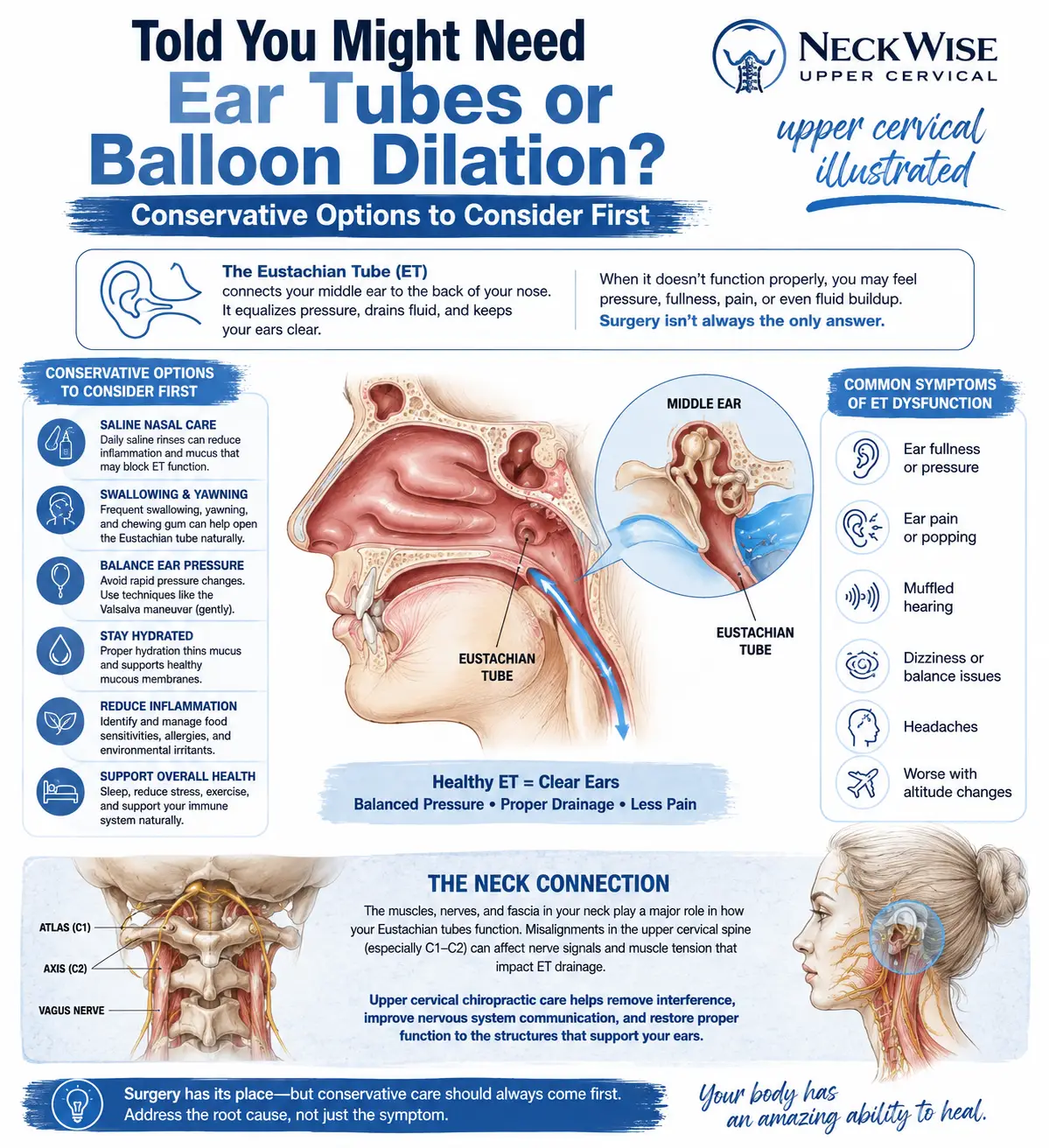
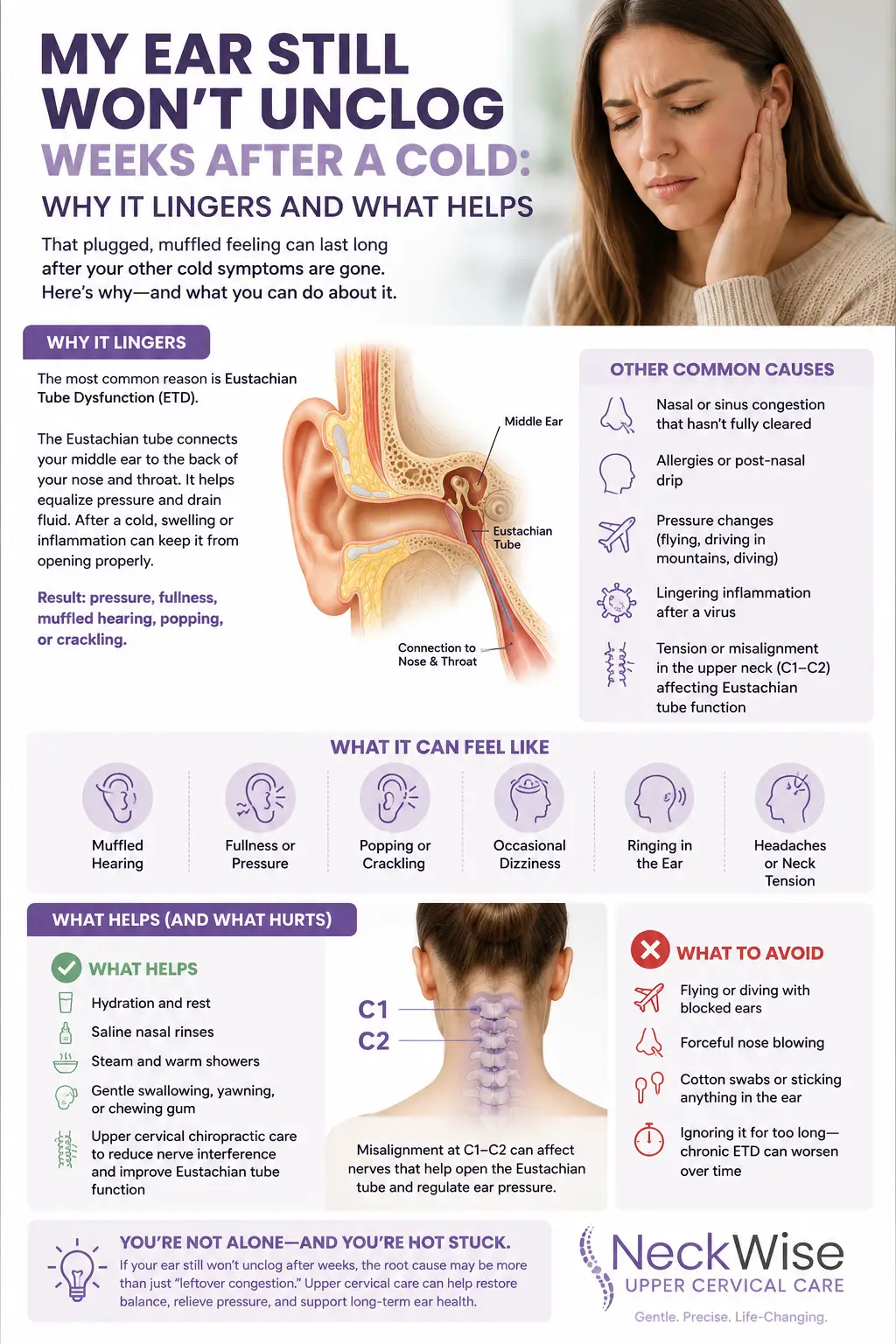
The eustachian tube is a narrow canal that connects the middle ear to the back of the nose and throat. Most of the time it stays closed, opening briefly when you swallow, yawn, or chew to equalize the air pressure behind your eardrum and let any fluid drain away. When it works, you never notice it. When it does not, you feel it constantly.
A cold throws this system into disarray. The same viral inflammation that swells your nasal passages also swells the lining of the eustachian tube and the tissues around its opening. The tube becomes narrowed or sticks closed, so it can no longer equalize pressure or drain properly. Air trapped behind the eardrum is slowly absorbed, creating a vacuum that pulls the eardrum inward, and fluid can seep into the middle ear space. The result is the plugged, muffled, full sensation you know all too well. This obstructive pattern is the most common form of eustachian tube dysfunction, and you can read our broader overview on our eustachian tube dysfunction page.
Why It Lingers Long After You Feel Better
Here is the part that surprises people: the cold can be completely gone while the ear stays clogged. There are a few reasons the ear lags behind the rest of your recovery.
The tissue takes longer to settle. The lining of the eustachian tube and middle ear can stay inflamed and swollen even after your nose clears. Until that swelling fully subsides, the tube may not open efficiently.
Fluid can get stuck. If fluid collected in the middle ear during the infection, it does not always drain the moment the virus leaves. This trapped fluid — sometimes called middle ear effusion or otitis media with effusion — can persist for weeks and keeps hearing muffled and the ear feeling full.
The tube’s opening mechanism is off. The eustachian tube does not open passively; small muscles pull it open when you swallow or yawn. Post-cold inflammation, congestion, and the general disruption of the surrounding tissues can leave that opening mechanism sluggish, so pressure does not equalize the way it should.
For most people, this gradually improves over days to a few weeks as the inflammation resolves and the fluid drains. But when it drags on, or keeps coming back, it is worth understanding both when to seek medical care and what other contributors — including the upper neck — might be involved.
Reading Your Own Recovery Timeline
Not every lingering clogged ear behaves the same way, and paying attention to the pattern of yours can tell you a lot about what is happening and what to do next.
The slow-but-steady thaw. The most reassuring pattern is one where the fullness is gradually lifting — even if it is maddeningly slow. Maybe your hearing was completely muffled the week the cold ended, and now it clears for a few hours after you yawn or swallow before creeping back. That kind of partial, improving relief usually means the inflammation is settling and the tube is slowly regaining its rhythm. This is the pattern that most often resolves on its own with a little patience and the practical steps below.
The plateau. Some people improve for the first week or two and then simply stall. The ear is not getting worse, but it is not getting better either — it has been stuck at the same level of fullness for weeks. A plateau like this often points to trapped middle-ear fluid that has not drained, or to an opening mechanism that has stayed sluggish. This is the pattern where it is worth looking beyond the ear itself, including at the upper neck, and where a medical check is reasonable if it has been more than a few weeks.
The comeback loop. Other people clear completely, feel normal for a stretch, and then plug up again — sometimes with the next round of allergies, a weather swing, or a flight. A repeating loop suggests the tube’s function is not fully robust, and it is one of the patterns where evaluating underlying contributors, rather than just waiting out each episode, tends to pay off.
The one-sided holdout. If every pattern above applies to just one ear while the other recovered normally, treat that as its own signal. One-sided fullness that will not clear in an adult is the pattern that most warrants an ENT evaluation, as the next section explains.
When a Lingering Clogged Ear Needs Medical Attention
Most post-cold ear congestion is benign and self-limited, but some patterns call for prompt evaluation rather than continued waiting. See a physician or ENT if your ear stays clogged or your hearing stays muffled for more than a few weeks, if you develop ear pain, fever, or drainage that could signal an infection, or if you have sudden hearing loss, severe or one-sided pain, ringing that will not quit, or true spinning dizziness. One point deserves emphasis: persistent fluid or fullness in only one ear in an adult, especially if it does not clear, should always be evaluated by an ENT, because on rare occasions a blockage at the back of the nose can produce one-sided eustachian tube problems and needs to be ruled out. Being honest about this comes first — upper cervical chiropractic care is appropriate only once a physician has ruled out infection, structural blockage, and other medical causes. If you are weighing whether your symptoms warrant a closer look, our article on why your ears feel full can help you think it through.
The Upper Neck Connection People Overlook
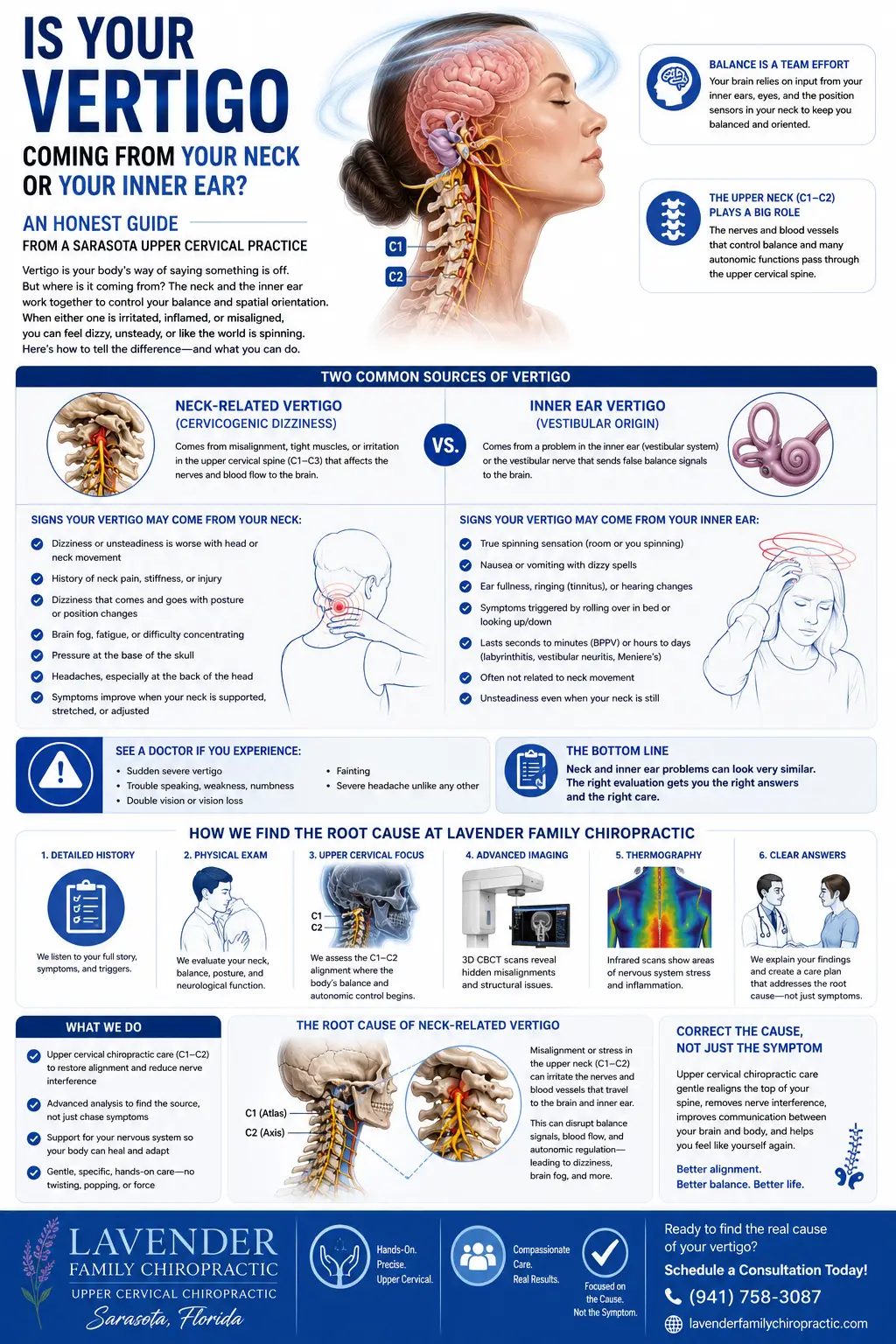
When a clogged ear will not clear, most people focus entirely on the ear and nose — and understandably so. But there is a contributor that is easy to miss: the upper neck. The muscles that open and time the eustachian tube, and the nerves that coordinate them, are influenced by the region where the head meets the neck. The top two vertebrae, the atlas and axis, sit directly beneath the base of the skull, near the muscles of the palate and the pathways that regulate the tube’s function.
When the upper neck is misaligned, it can affect the nerve and muscle coordination around the eustachian tube and alter tension in the surrounding tissues. The idea is not that the neck causes the cold, but that a pre-existing upper-neck problem can leave the eustachian tube less able to recover its normal opening rhythm after the inflammation of an infection — one reason two people can catch the same cold and only one is left with a plugged ear that drags on for a month. Research exploring how cervical spine input reaches ear-related pathways, such as work on cervicogenic contributions to ear symptoms, supports the idea that the neck and the ear are more connected than they first appear. Our page on ear pressure and the upper cervical connection explores this in more detail.
How Upper Cervical Chiropractic Care May Help
Upper cervical chiropractic focuses specifically on the alignment of the atlas and axis and their influence on the nervous system. If a misalignment in the upper neck is affecting the nerve and muscle coordination that governs the eustachian tube, correcting that alignment may support the tube’s ability to open and drain more normally — which can matter most when an ear has been slow to recover after a cold.
At Lavender Family Chiropractic, we practice a precise, gentle approach called the Knee Chest Upper Cervical technique. It uses a specific, low-force correction rather than the twisting or cracking many people associate with chiropractic. Before any correction, we map your alignment with 3D CBCT imaging and evaluate nervous-system function with paraspinal infrared thermography, so our care is guided by objective findings rather than guesswork.
It is important to be candid: upper cervical care does not treat a viral infection, and it is not a substitute for medical management of ear infection or persistent middle-ear fluid. What it addresses is a different, frequently overlooked contributor — the neck’s role in the nerve and muscle coordination around the eustachian tube. For some people, a plugged ear that will not clear has more than one contributor, and the neck is one piece worth evaluating. You can learn more about our overall approach on our upper cervical chiropractic care page.
If your ear has stayed clogged for weeks after a cold, call Lavender Family Chiropractic at (941) 243-3729 to talk through whether an upper cervical evaluation makes sense for you.
What the Research Says
Research helps explain why an ear stays clogged after a cold and how the eustachian tube, middle ear, and neck are involved.
An international expert consensus on eustachian tube dysfunction defines the condition, its subtypes, and how it is diagnosed — the authoritative reference for understanding obstructive ETD.
A review of otitis media with effusion details how middle-ear fluid collects and persists, including after upper respiratory infection when eustachian tube function is impaired.
Research on the role of respiratory viruses in ear disease describes how a viral upper respiratory infection triggers eustachian tube dysfunction and the mucosal inflammation that drives middle-ear problems.
A clinical review of the management of eustachian tube dysfunction summarizes the diagnostic tools and treatment options used when ETD does not resolve on its own.
Finally, a review of cervicogenic contributions to ear symptoms describes how cervical-spine input can influence ear symptoms through shared nerve pathways, supporting the rationale for evaluating the upper neck.
Practical Steps While Your Ear Recovers
Alongside appropriate care, several habits can support a clogged ear as the inflammation settles.
Keep the nose clear. Because the eustachian tube opens at the back of the nose, reducing nasal congestion helps. Saline sprays or rinses can be gentle, effective options; ask your physician before using medicated decongestant sprays, which are not meant for prolonged use.
Encourage the tube to open — gently. Swallowing, yawning, and chewing gum prompt the tube to open. A gentle, careful attempt to equalize pressure by pinching the nose and softly exhaling can help some people, but it should never be forceful.
Stay well hydrated. Thin mucus drains more easily than thick mucus, and steady hydration supports that — something that matters year-round in Florida’s heat.
Manage allergies and irritants. If allergies or sinus irritation are keeping the tissues inflamed, addressing them removes one of the things prolonging the problem.
Be patient with pressure changes. Flying, diving, or fast elevation changes are harder on a recovering tube. If you must fly, swallow and yawn frequently during takeoff and descent.
Give it time — but not unlimited time. Gradual improvement over a couple of weeks is reassuring. A lack of progress, or symptoms in only one ear, is your cue to see a physician.
What to Expect at Your First Visit
If a lingering clogged ear has you wondering whether your neck is involved, it helps to know what a first visit looks like.
We begin with an unhurried conversation about your history. We want to understand when your ear first plugged up, whether it followed a cold or sinus infection, whether it is one ear or both, how your hearing has been affected, and what else you are noticing. These details help us understand your situation and recognize when something belongs with a physician or ENT first.
Next, we gather objective data. The 3D CBCT imaging shows us the precise position of your atlas and axis, and paraspinal infrared thermography helps us evaluate nervous-system function. Together they guide whether an upper cervical correction is appropriate or whether we should refer you for further evaluation.
If care is indicated, we explain our findings in plain language and outline a customized treatment plan built around your goals. We practice on a cash-pay basis and review the details with you in advance. We will always be candid about where upper cervical care fits and where medical care belongs. If you would like to talk anything through before scheduling, call us any time at (941) 243-3729.
Areas We Serve Around Sarasota
Lavender Family Chiropractic is located at 5899 Whitfield Avenue, Suite 107, in Sarasota, at the corner of University and Whitfield. We care for people seeking natural relief from ear and eustachian tube symptoms across the region, including Bradenton, Lakewood Ranch, Palmetto, Ellenton, Ruskin, Venice, Osprey, Myakka, Tampa, and St. Pete.
Top 15 Frequently Asked Questions About an Ear That Won’t Unclog After a Cold
1. Why is my ear still clogged when my cold is gone? The virus can clear while the lining of the eustachian tube and middle ear stays inflamed, and any fluid that collected during the cold may not have drained yet. The ear often lags behind the rest of your recovery.
2. How long should a clogged ear last after a cold? It commonly improves over several days to a few weeks as the swelling settles and fluid drains. Congestion that lasts longer, or that only affects one ear, deserves a medical evaluation.
3. What is that fluid behind my eardrum? It is middle-ear effusion — fluid that collects when the eustachian tube cannot ventilate and drain the space properly. It can keep hearing muffled until it clears.
4. Why won’t my ear pop no matter what I try? Post-cold inflammation can leave the eustachian tube sluggish, so the usual tricks do not equalize pressure. Forceful attempts can irritate things further, so keep any effort gentle.
5. Is a clogged ear after a cold dangerous? Usually not, but see a physician for pain, fever, drainage, sudden hearing loss, symptoms lasting more than a few weeks, or fullness in only one ear that does not clear.
6. Why does only one ear stay clogged? Sometimes one side is simply more inflamed. But persistent one-sided fullness in an adult should always be checked by an ENT to rule out a blockage at the back of the nose.
7. Can a chiropractor unclog my ear? Upper cervical care does not drain fluid or treat infection. It addresses a different contributor — the nerve and muscle coordination around the eustachian tube — which for some people is part of why the ear is slow to recover.
8. How does my neck relate to my ear? The muscles and nerves that open and time the eustachian tube are influenced by the upper neck. A misalignment there may leave the tube less able to regain its normal opening rhythm after a cold.
9. Should I use decongestants? Short-term use may help some people, but medicated nasal decongestant sprays are not meant for prolonged use. Ask your physician, and consider gentle saline options in the meantime.
10. Will flying make it worse? Pressure changes are harder on a recovering tube. If you must fly, swallow and yawn frequently during takeoff and descent, and talk to your doctor if symptoms are significant.
11. Does hydration really help? Yes. Thin mucus drains more easily than thick mucus, so staying well hydrated supports the process, especially in Florida’s heat.
12. What testing do you perform? We use 3D CBCT imaging to assess upper cervical alignment and paraspinal infrared thermography to evaluate nervous-system function, alongside a history and screening to help recognize when medical care is needed first.
13. Could allergies be prolonging this? Yes. Ongoing allergic or sinus inflammation keeps the tissues around the tube swollen, which can extend how long the ear stays clogged. Addressing allergies removes one contributor.
14. When should I finally see a doctor? If it has been more than a few weeks, if it is only one ear, or if you have pain, fever, drainage, or hearing loss, see a physician or ENT rather than continuing to wait.
15. Where are you located and who do you serve? We are at 5899 Whitfield Avenue, Suite 107, in Sarasota, serving patients from Bradenton, Lakewood Ranch, Venice, Palmetto, Ellenton, and the surrounding area.
Ready to Find Out What’s Keeping Your Ear Clogged?
A plugged ear that lingers for weeks after a cold is frustrating, but it is not something you simply have to wait out blindly. Understanding whether inflammation, trapped fluid, your upper neck, or some combination is behind it is the first step toward the right relief. If you are ready to find out, call Lavender Family Chiropractic at (941) 243-3729 or book your consultation online at https://intake.chirohd.com/new-patient-scheduling/724/lavender-family-chiropractic. Our Sarasota team is here to help you pursue natural relief as part of a comprehensive plan.