Why Does Vertigo Make Me Nauseous? The Balance–Stomach Connection
By Dr. Rusty Lavender, D.C. — upper cervical chiropractor, Lavender Family Chiropractic, Sarasota, FL. Reviewed and updated October 2026.
Why Does Vertigo Make Me Nauseous? For many people, the spinning is only half the ordeal. The other half is the wave of queasiness that rides in with it — the cold sweat, the loss of appetite, sometimes the vomiting. If vertigo reliably leaves you nauseous, there is a real reason: the balance system and the part of the brain that controls nausea and vomiting are wired together. When your sense of balance is thrown off, that same circuitry can turn your stomach.
This article explains why vertigo and nausea travel together, what the vagus nerve and brainstem have to do with it, how to tell ordinary vertigo-related nausea from causes that need medical attention, and where upper cervical chiropractic care may fit for the right person. At Lavender Family Chiropractic in Sarasota, we help people understand the full picture of their dizziness — including the nausea that so often comes with it — so they can find steadier ground.
Why Does Vertigo Make Me Nauseous? Why Vertigo and Nausea Are Linked
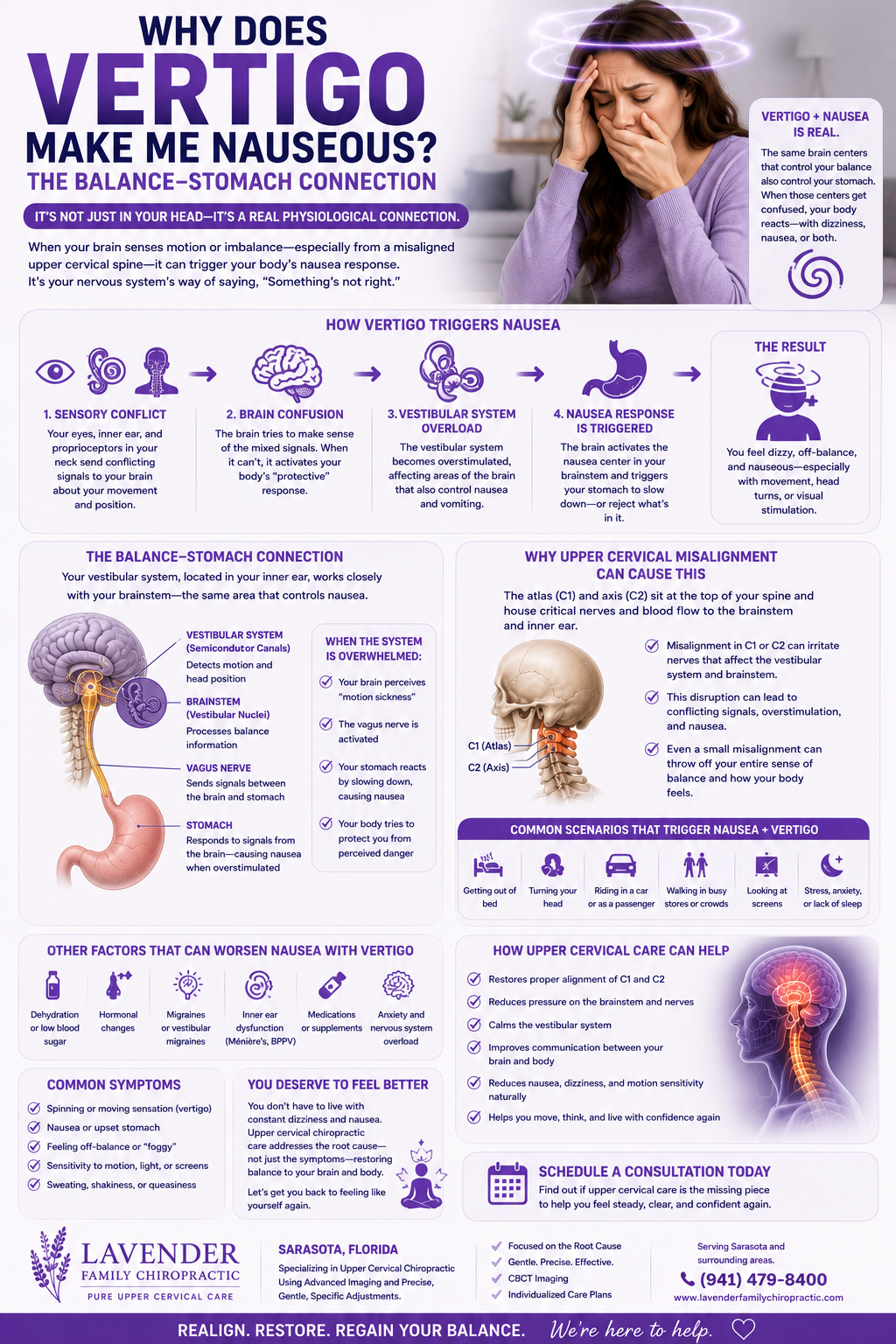
Your sense of balance is built from three streams of information: the inner ears, the eyes, and the position sensors in your neck. The brain blends them into a single, stable picture. When those streams disagree — as they do during vertigo — the brain receives a strong signal that something is wrong. Deep in the brainstem, the same region that processes balance information sits right beside the circuits that trigger nausea and vomiting, and the two are richly interconnected.
This is not an accident of anatomy. One long-standing theory holds that the brain interprets a serious mismatch between the balance senses as a sign of possible poisoning, since certain toxins disturb coordination and perception. Nausea and vomiting are the body’s protective response to suspected poison. So when your inner ear sends spinning signals that your eyes and body do not confirm, the brain can respond as though you have been poisoned — and the result is queasiness. It is an ancient safeguard misfiring in the setting of vertigo.
The Vagus Nerve and the Autonomic Response
The bridge between your spinning head and your churning stomach is largely the autonomic nervous system, and the vagus nerve in particular. The vagus is the body’s major parasympathetic highway, connecting the brainstem to the heart, stomach, and gut. When the balance-and-nausea circuitry in the brainstem is activated by vertigo, it drives a cascade of vagal and autonomic responses: the stomach’s normal rhythm is disrupted, saliva production increases, the skin goes pale and clammy, the heart rate and blood pressure shift, and a cold sweat breaks out. These are the familiar companions of motion sickness and of a bad vertigo attack alike, because they share the same underlying pathway.
This autonomic involvement also explains why vertigo can leave you feeling wrung out well after the spinning stops. Activating that stress-and-nausea cascade is physically taxing, and the nervous system can take time to settle. It is also why anxiety and vertigo can feed each other: the autonomic arousal of a vertigo attack overlaps heavily with the body’s alarm response, so a spinning episode can trigger anxiety, and anxiety can heighten the perception of both the dizziness and the nausea.
Which Vertigo Conditions Bring the Most Nausea
Not every kind of vertigo produces the same amount of nausea, and the pattern can offer clues about the cause.
BPPV. The brief, intense spinning of benign paroxysmal positional vertigo — set off by rolling over or tipping the head — is often accompanied by a jolt of nausea, though because episodes are short, the nausea may pass quickly once you hold still.
Vestibular neuritis and labyrinthitis. These inflammatory inner-ear conditions can produce severe, sustained vertigo lasting hours to days, and the nausea and vomiting that come with them can be intense and prolonged.
Meniere’s disease. Attacks of Meniere’s often bring strong vertigo with significant nausea, alongside ear fullness, ringing, and fluctuating hearing.
Vestibular migraine. When the balance system is drawn into the migraine process, nausea is a prominent feature — unsurprising, given how central nausea is to migraine in general.
Motion sickness. The queasiness of a moving car, boat, or plane is the same balance–nausea pathway triggered by conflicting motion signals. If this is your main concern, our article on whether vertigo and motion sickness are the same thing looks at the overlap in detail.
When Vertigo With Nausea Is a Red Flag
Most vertigo-related nausea, while miserable, is not dangerous. But certain patterns need prompt medical evaluation. Seek urgent care if vertigo and nausea come with slurred speech, double or lost vision, weakness or numbness on one side, a severe or unusual headache, trouble swallowing or speaking, difficulty walking, fainting, or chest pain. Relentless vomiting that prevents you from keeping down fluids is itself a reason to seek care, because dehydration compounds dizziness. Vertigo that is constant rather than tied to movement, that steadily worsens, or that arrives with new one-sided hearing loss also warrants a medical workup. Being honest about these possibilities comes first; upper cervical chiropractic care is appropriate only once serious causes have been ruled out. If you are unsure whether your symptoms warrant imaging, our overview of when to get an MRI for dizziness can help you think it through.
The Upper Neck’s Role in the Whole Picture
The top two vertebrae of the neck, the atlas and axis, are densely packed with position sensors that tell the brain where your head is, and they sit close to the brainstem structures that govern both balance and autonomic function. The brain blends neck signals with input from the inner ears and eyes to build a stable sense of balance. When the upper neck is misaligned, it sends distorted position signals, and the resulting mismatch can be felt as dizziness — and, through the same balance–nausea circuitry, as queasiness. Research on cervicogenic dizziness describes how disturbed neck input can produce dizziness, unsteadiness, and associated autonomic symptoms even when the inner ear is structurally normal. Our article on whether neck pain can cause dizziness explores this connection in more depth.
Because the neck’s position sensors and the autonomic pathways sit so close together, a persistent upper-neck problem can keep the balance system on edge and, with it, the nausea circuitry. Addressing the neck does not switch off the vagus nerve, but for the right person it can remove one of the inputs keeping the whole system unsettled.
How Upper Cervical Chiropractic Care May Help
Upper cervical chiropractic focuses specifically on the alignment of the atlas and axis and their influence on the nervous system. If a misalignment in the upper neck is feeding the brain unreliable position information — and thereby keeping the balance-and-nausea circuitry activated — correcting that alignment may allow the system to settle.
At Lavender Family Chiropractic, we practice a precise, gentle approach called the Knee Chest Upper Cervical technique. It uses a specific, low-force correction rather than the twisting or cracking many people associate with chiropractic — an approach that tends to reassure patients who are already nauseated and wary of moving their heads. Before any correction, we map your alignment with 3D CBCT imaging and evaluate nervous-system function with paraspinal infrared thermography, so our care is guided by objective findings.
It is important to be candid: upper cervical care does not reposition inner-ear crystals — the repositioning maneuvers that treat BPPV do that — and it is not an anti-nausea treatment. What it addresses is a different, frequently overlooked contributor: the neck’s role in balance, and through it, the mismatch that drives the nausea. For many people, vertigo with nausea has more than one cause, and the neck is one piece worth evaluating. You can learn more about our overall approach on our upper cervical chiropractic care page.
If vertigo and nausea have become a recurring part of your life, call Lavender Family Chiropractic at (941) 243-3729 to talk through whether an upper cervical evaluation makes sense for you.
What the Research Says
Research clarifies how the balance system and the nausea-and-vomiting circuitry are connected.
A study on the integration of vestibular and gastrointestinal signaling examines how the balance system and emetic (vomiting) pathways interact, helping explain why disturbances in balance produce nausea.
Research on the vagal neurocircuitry of nausea and vomiting details how the vagus nerve and brainstem drive the autonomic and gastrointestinal responses that accompany vertigo.
A review of the current understanding of motion sickness summarizes the sensory-conflict basis of the balance–nausea link and its familiar autonomic symptoms.
Further research on the neurophysiology and treatment of motion sickness describes the pathways connecting balance disturbance to nausea and the strategies used to manage it.
Finally, research on cervicogenic dizziness and autonomic symptoms describes how disturbed neck input can generate dizziness and related symptoms, supporting the rationale for evaluating the upper neck.
Practical Steps to Ease Vertigo-Related Nausea
Alongside professional care, several strategies can take the edge off the nausea that comes with vertigo.
Hold still and fix your gaze. During an attack, stopping movement and focusing your eyes on a single stationary point reduces the sensory conflict driving the nausea. Lying still in a quiet, dimly lit room often helps.
Protect your hydration. Nausea and vomiting can quickly leave you dehydrated, which worsens dizziness. Sip water or an electrolyte drink as you are able; this matters year-round in Florida’s heat.
Get fresh, cool air. A cool breeze or an open window can settle queasiness, which is why the balance–nausea response often eases with airflow.
Eat light and bland when you can. Small amounts of plain, easy-to-digest food, and ginger in tea or candied form, are gentle options many people tolerate when nausea lingers.
Move slowly through position changes. Deliberate, unhurried transitions give the balance system time to update and reduce the intensity of both the spinning and the nausea.
Calm the nervous system. Slow breathing lowers the autonomic arousal that amplifies nausea, and because anxiety and vertigo feed each other, easing one often eases the other.
What the Nausea Pattern Can Tell You
The way your nausea behaves alongside the spinning is more than a source of misery — it is a clue. Because different vertigo conditions engage the balance–nausea pathway differently, the details are worth noticing before an appointment.
How long the nausea lasts. A sharp jolt of queasiness that passes within a minute of holding still fits the brief, position-triggered spinning of BPPV. Nausea and vomiting that grind on for hours or days point instead toward an inflammatory inner-ear condition like vestibular neuritis or an attack of Meniere’s disease. The duration is one of the most telling features.
What sets it off. If your nausea reliably follows a specific head movement — rolling over, tipping your head back, looking up — the inner ear or neck is implicated. If it builds in busy visual environments or in a moving vehicle, the same balance–nausea pathway is being driven by sensory conflict rather than a single trigger position.
What comes with it. Note whether the nausea travels with ear fullness and ringing, with migraine-type headache and light sensitivity, or with a stiff, achy upper neck and tension at the base of the skull. Each pattern leaves a different fingerprint: Meniere’s, vestibular migraine, and a cervical contribution respectively.
How your body reacts. Cold sweat, pallor, and a wrung-out feeling afterward reflect how strongly the autonomic system — the vagus nerve in particular — has been activated. A very strong autonomic response often accompanies the more sustained inner-ear conditions.
Whether stillness rescues you. Nausea that eases quickly once you stop moving and fix your gaze suggests the sensory conflict is the main driver. Nausea that persists regardless of how still you are, especially with neurological symptoms, is a reason to seek medical evaluation.
A brief log — what you were doing, whether it spun or swayed, how long both the spinning and the nausea lasted, and what came with them — turns an overwhelming experience into information we can actually use to help pinpoint the source.
What to Expect at Your First Visit
If vertigo and nausea have made you cautious, knowing what a first visit involves can ease the decision to come in.
We begin with an unhurried conversation about your history. We want to understand whether your dizziness truly spins or simply sways, how long it lasts, how much nausea comes with it, what triggers it, and what else accompanies it. These details help us separate inner-ear conditions and vestibular migraine from a cervical contribution or a red-flag pattern that belongs in a medical setting.
Next, we gather objective data. The 3D CBCT imaging shows us the precise position of your atlas and axis, and paraspinal infrared thermography helps us assess nervous-system function. Together they guide whether an upper cervical correction is appropriate or whether we should refer you for further evaluation first.
If care is indicated, we explain our findings in plain language and outline a customized treatment plan built around your goals. We practice on a cash-pay basis and review the details with you in advance. We will always be clear about where upper cervical care fits and where inner-ear repositioning or medical evaluation belongs. If you would like to talk anything through before scheduling, call us any time at (941) 243-3729.
Areas We Serve Around Sarasota
Lavender Family Chiropractic is located at 5899 Whitfield Avenue, Suite 107, in Sarasota, at the corner of University and Whitfield. We care for people seeking natural vertigo relief from across the region, including Bradenton, Lakewood Ranch, Palmetto, Ellenton, Ruskin, Venice, Osprey, Myakka, Tampa, and St. Pete.
Top 15 Frequently Asked Questions About Vertigo and Nausea
1. Why does vertigo make me nauseous? The part of the brainstem that processes balance sits right beside the circuits that trigger nausea and vomiting, and the two are richly connected. When your balance senses disagree, that circuitry can turn your stomach.
2. What does the vagus nerve have to do with it? The vagus nerve carries signals from the brainstem to the stomach and gut. When vertigo activates the balance-and-nausea circuitry, it drives vagal responses that disrupt the stomach and produce sweating, pallor, and queasiness.
3. Why do I feel wrung out after the spinning stops? Activating the autonomic nausea cascade is physically taxing, and the nervous system can take time to settle, so fatigue and lingering queasiness are common after an attack.
4. Which types of vertigo cause the most nausea? Vestibular neuritis, labyrinthitis, Meniere’s disease, and vestibular migraine tend to bring sustained, intense nausea. BPPV brings sharp but usually briefer nausea because its episodes are short.
5. Is vertigo with nausea dangerous? Usually not, but vertigo and nausea with slurred speech, double vision, one-sided weakness or numbness, a severe headache, difficulty walking, or chest pain is a red flag that warrants urgent care.
6. When should I worry about vomiting? If you cannot keep down fluids, seek care — dehydration worsens dizziness. Relentless vomiting alongside neurological symptoms is especially concerning.
7. Can a chiropractor stop my nausea? Upper cervical care is not an anti-nausea treatment. It addresses a contributor to the underlying balance mismatch — the neck’s position signals — which for the right person can help the whole system settle.
8. How does my neck fit in? The upper neck supplies a large share of your head-position sense and sits close to the brainstem’s balance and autonomic centers. A misaligned neck can keep the balance system, and the nausea circuitry with it, on edge.
9. Can a chiropractor fix inner-ear crystals? No. Repositioning maneuvers, not chiropractic adjustments, move the crystals of BPPV. Upper cervical care addresses a different contributor and can be part of a coordinated approach.
10. Why does fresh air help my nausea? Cool airflow tends to calm the autonomic nausea response, which is why an open window or a breeze often takes the edge off during an episode.
11. Does anxiety make the nausea worse? Yes. The autonomic arousal of a vertigo attack overlaps with the body’s alarm response, so anxiety can heighten both the dizziness and the nausea, and each can feed the other.
12. What testing do you perform? We use 3D CBCT imaging to assess upper cervical alignment and paraspinal infrared thermography to evaluate nervous-system function, alongside a history and screening to help distinguish cervical from inner-ear and other causes.
13. Does hydration matter? Very much. Nausea and vomiting can quickly dehydrate you, which worsens dizziness. Sipping water or electrolytes as tolerated is important, especially in Florida’s heat.
14. Will ginger or anti-nausea remedies help? Many people find ginger and simple bland foods helpful for the nausea itself. For frequent or severe symptoms, discuss anti-nausea options with your physician.
15. Where are you located and who do you serve? We are at 5899 Whitfield Avenue, Suite 107, in Sarasota, serving patients from Bradenton, Lakewood Ranch, Venice, Palmetto, Ellenton, and the surrounding area.
Ready to Get to the Bottom of Your Vertigo and Nausea?
The queasiness that comes with vertigo is real and has a real mechanism — and understanding whether your inner ear, your upper neck, or both are behind it is the first step toward steadier, settled days. If you are ready to find out, call Lavender Family Chiropractic at (941) 243-3729 or book your consultation online at https://intake.chirohd.com/new-patient-scheduling/724/lavender-family-chiropractic. Our Sarasota team is here to help you pursue natural vertigo relief as part of a comprehensive plan.
Related Articles
Related Posts


Get our upper cervical articles first.
Patients Experience