Why Can I Hear My Own Voice and Breathing in My Ear? Understanding Patulous Eustachian Tube
By Dr. Rusty Lavender
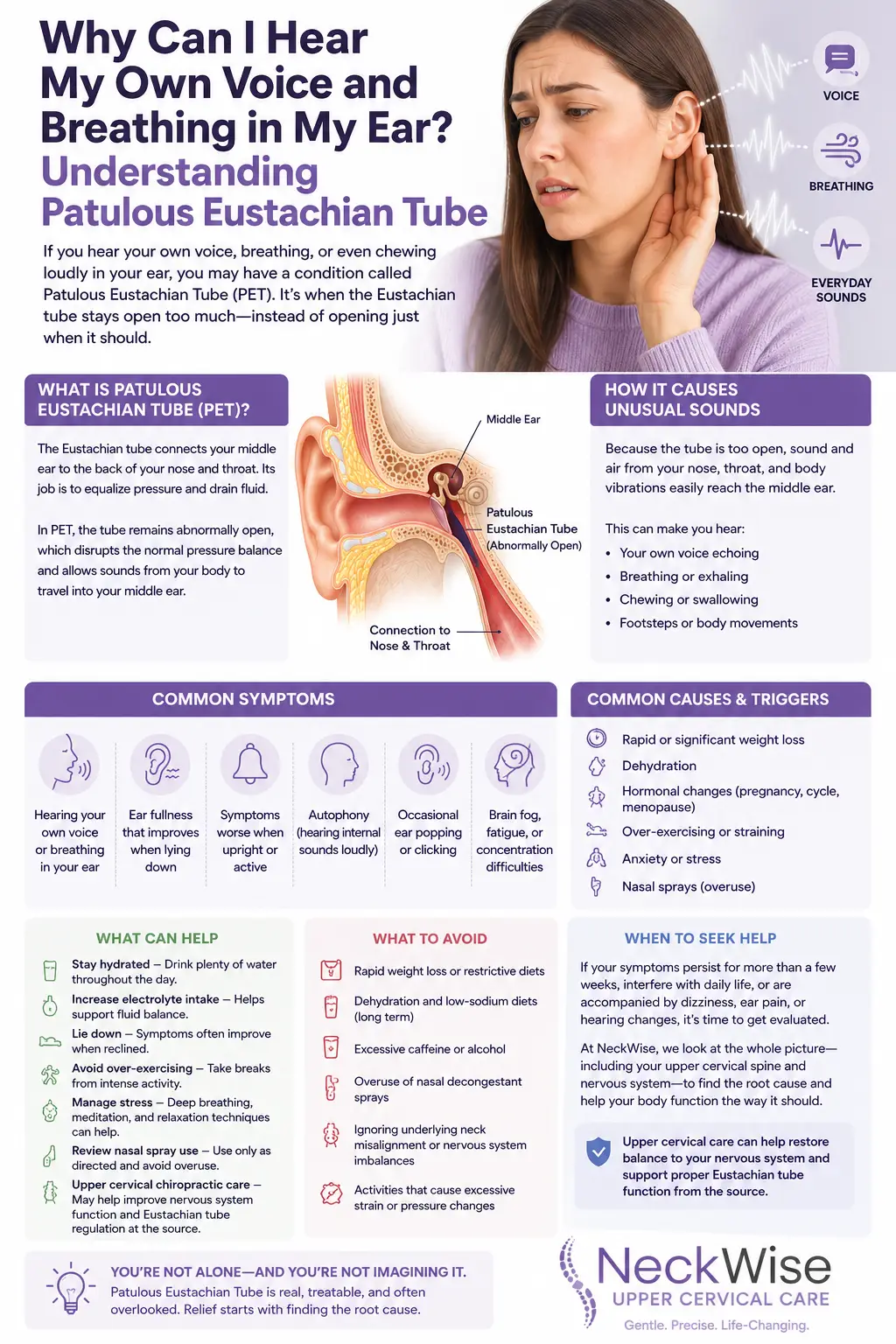
I Hear My Own Voice: Most people with ear trouble describe a clogged, plugged, underwater feeling. But some describe something stranger and, in its own way, more maddening: they can hear their own voice booming inside their head, hear themselves breathing with every breath, and feel a hollow fullness in the ear — and oddly, it often improves the moment they lie down or tuck their chin. If that describes you, you may be dealing with a less common but very real condition called patulous eustachian tube.
This is essentially the opposite of the eustachian tube dysfunction most people know. In the common form, the tube is stuck closed. In a patulous eustachian tube, the tube stays abnormally open. This article explains what a patulous eustachian tube is, why it produces those unsettling symptoms, when it needs medical evaluation, and where upper cervical chiropractic care may fit as part of the picture. At Lavender Family Chiropractic in Sarasota, we help people understand what is behind their ear symptoms so they can pursue the right kind of relief.
I Hear My Own Voice: The Eustachian Tube — and Two Ways It Can Fail
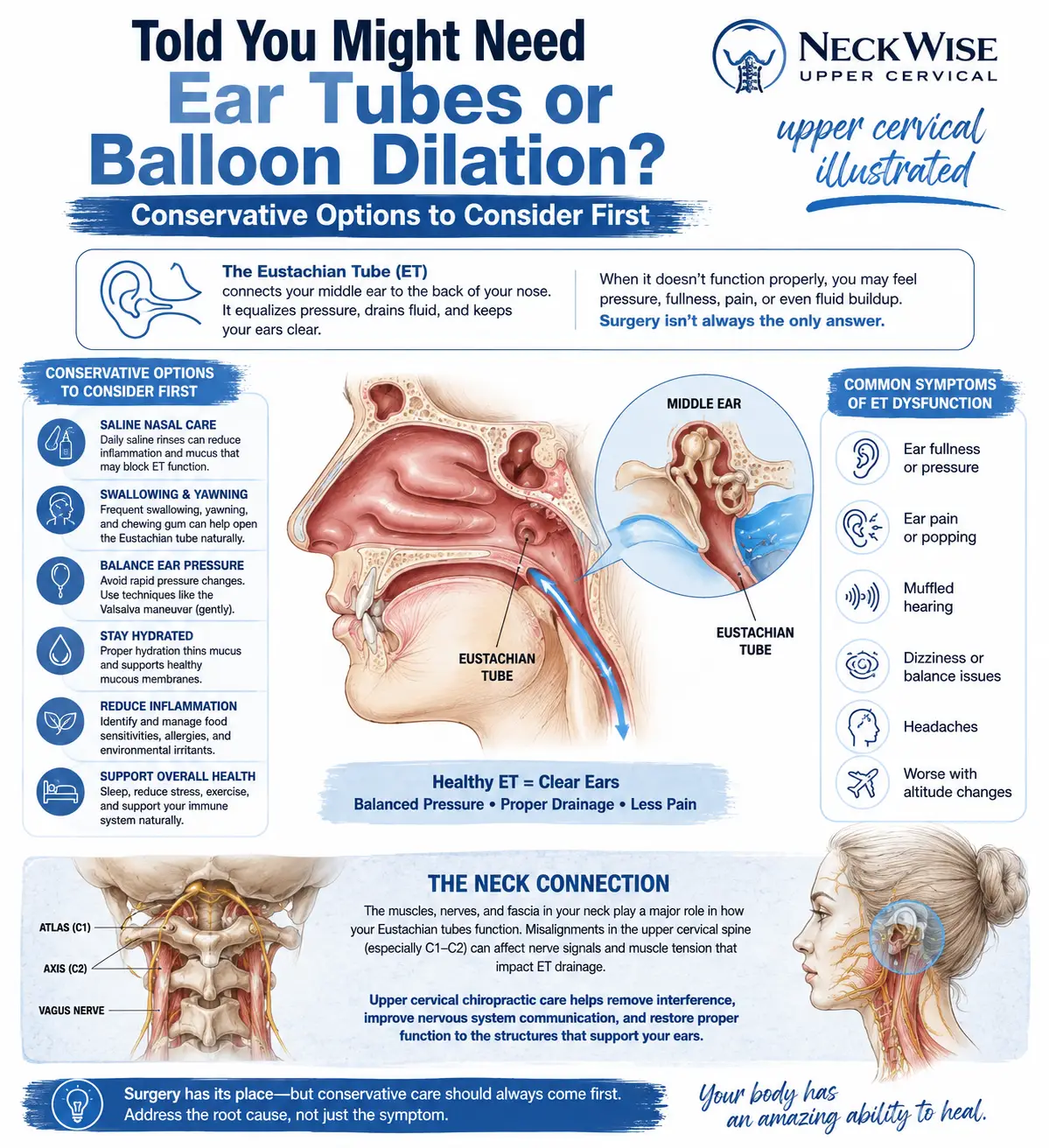
The eustachian tube is a narrow canal connecting the middle ear to the back of the nose and throat. Its job is to equalize the air pressure behind the eardrum and let fluid drain. Crucially, it is supposed to stay closed most of the time, opening only briefly when you swallow, yawn, or chew.
That resting closure matters more than people realize. When the tube is closed, the middle ear is sealed off from the pressure swings and sounds of your own breathing and voice. The eustachian tube can fail in two very different ways. In the familiar, obstructive form, it stays stuck closed and cannot open to equalize pressure, producing the classic clogged, muffled feeling covered on our eustachian tube dysfunction page. In a patulous eustachian tube, the problem is the reverse: the tube fails to stay closed at rest and remains abnormally open, leaving a direct, open channel between your throat and your middle ear.
Why an Open Tube Causes Such Strange Symptoms
When the tube stays open, that seal is gone, and the middle ear is suddenly connected to the airflow and sound of your own breathing and speech. This produces a distinctive set of symptoms.
Autophony. This is the hallmark. Your own voice sounds unusually loud, hollow, or booming inside your head, as though you are speaking into a barrel. It can make talking on the phone or in conversation genuinely unpleasant.
Hearing your own breathing. With an open channel to the middle ear, each breath is transmitted directly to the eardrum, so you hear your breathing in rhythm — a sensation many people find deeply distracting.
Aural fullness. Despite the tube being open, many people still describe a fullness or blocked feeling, which is one reason a patulous tube is so often mistaken for the more common clogged-ear type.
Fluctuation with position and activity. A telling feature: symptoms often ease when you lie down, bend forward, or tuck your chin, because those positions increase blood flow and tissue volume around the tube and help it close. Symptoms may also worsen with exercise, dehydration, or significant weight loss.
That last pattern — feeling better lying down and worse when upright or after weight loss — is one of the clearest clues that distinguishes a patulous tube from ordinary obstructive dysfunction. If your ear symptoms improve rather than worsen when you put your head down, that is worth mentioning to your provider.
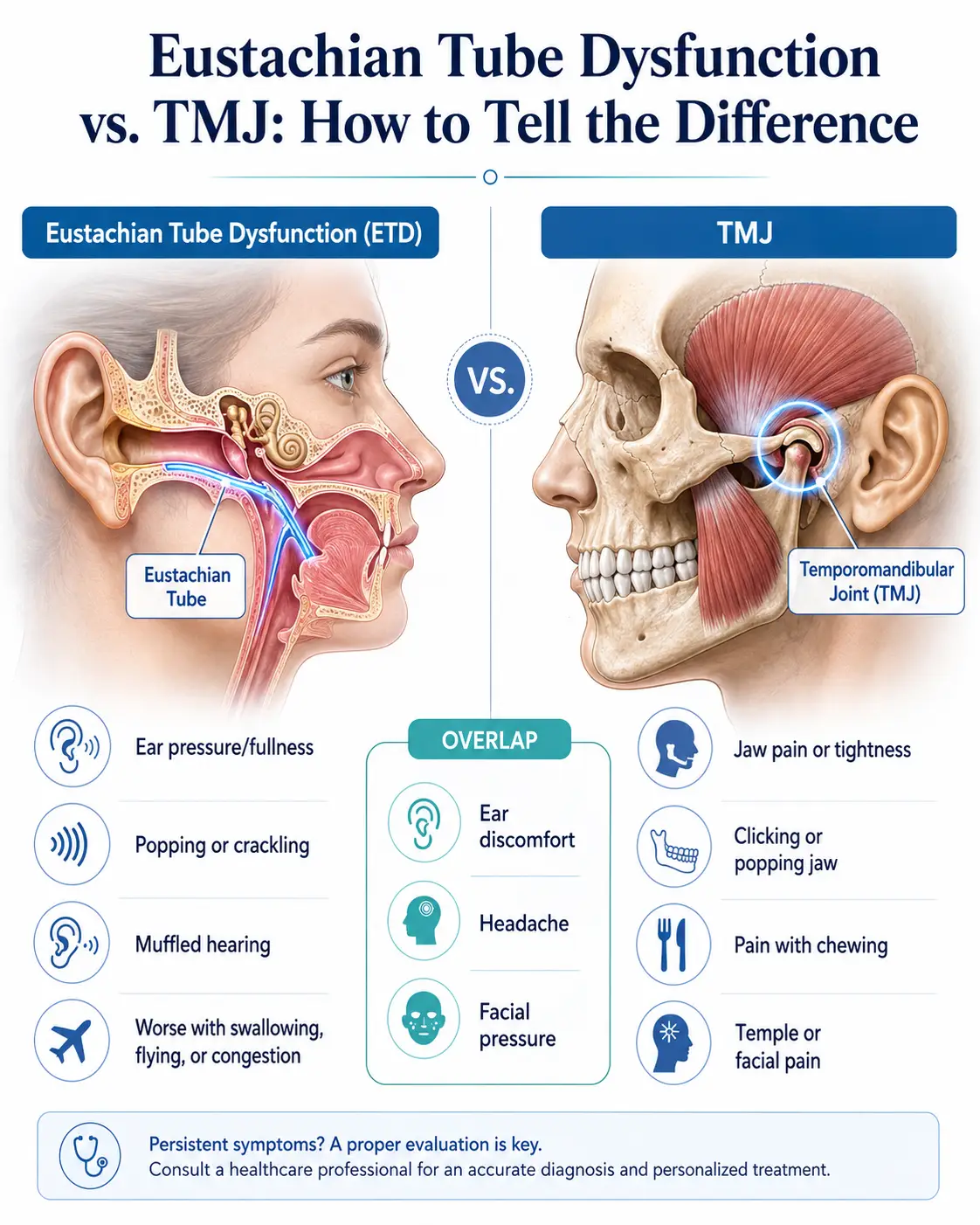
Patulous Tube or Clogged Ear? Telling Them Apart
Because both conditions can feel like fullness, people often assume they have the ordinary clogged ear and treat it that way — sometimes making a patulous tube worse. A few contrasts help you tell which one you are dealing with.
Which way do positions push it? This is the single most useful question. A patulous tube usually eases when you lie flat, bend forward, or tuck your chin, because those positions swell the tissue and help the tube close. An obstructive, clogged ear tends to do the opposite — lying down and congestion often make it feel worse. If putting your head down brings relief, lean toward the patulous side.
What does your own voice sound like? With a patulous tube, your voice booms, echoes, or sounds hollow inside your head, and you may hear your breathing with every breath. A clogged ear muffles sound instead, as though your head is wrapped in cotton. Loud, resonant autophony points to an open tube; muffling points to a closed one.
What made it start? A patulous tube commonly follows weight loss, dehydration, pregnancy, or a medication change. A clogged ear more often follows a cold, sinus infection, allergy flare, or air-pressure change like a flight. Retracing what preceded your symptoms is a strong clue.
How do decongestants affect it? This one is important for safety. Decongestants shrink tissue, which can relieve a clogged ear but tends to worsen a patulous tube by making it even more open. If nasal sprays or decongestants have made your symptoms worse rather than better, that reaction itself suggests a patulous tube.
Does breathing move the fullness? People with a patulous tube often notice the fullness or sound pulsing in time with their breathing, since the open channel transmits airflow to the eardrum. A clogged ear stays steadily blocked regardless of your breath.
None of these replace a proper diagnosis, but noticing your own pattern helps you describe it accurately — and steers you away from treatments that could make the wrong condition worse.
What Causes a Patulous Eustachian Tube
A patulous eustachian tube develops when the tissues that normally keep the tube closed at rest lose some of their bulk or tone. The most commonly recognized trigger is weight loss, because the fatty tissue around the tube helps hold it closed. Dehydration, pregnancy and hormonal changes, certain medications, neurological conditions affecting the palate muscles, and simply the natural variation in people’s anatomy can all play a role. Sometimes no clear cause is found. Whatever the trigger, the common thread is a tube that no longer seals the way it should.
When Patulous Ear Symptoms Need Medical Attention
Patulous eustachian tube is not dangerous in itself, but the symptoms overlap with other conditions, so an accurate diagnosis matters. See a physician or ENT if you have persistent autophony or hear your own breathing, if your symptoms are affecting your daily life, or especially if you also have sudden or one-sided hearing loss, ringing, true spinning dizziness, pain, or drainage, which point toward other conditions that need to be ruled out. An ENT can distinguish a patulous tube from obstructive dysfunction and other causes, sometimes using specialized tests that watch the eardrum move with breathing. Being honest about this comes first — upper cervical chiropractic care is appropriate only once a physician has confirmed the diagnosis and ruled out other causes. Our article on why your ear feels full can help you think through how your symptoms compare.
The Upper Neck Connection People Overlook
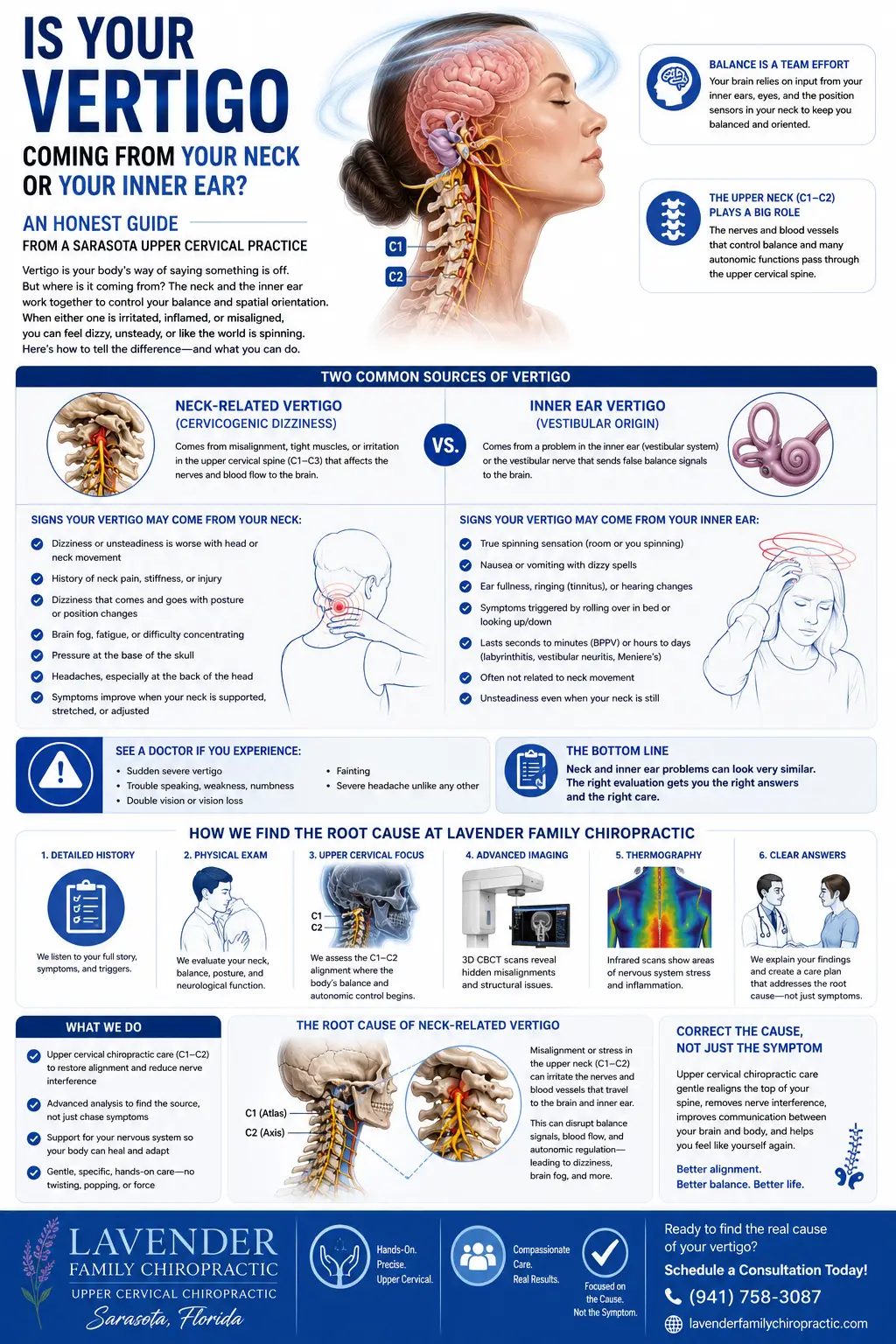
Because a patulous eustachian tube involves the tone and behavior of the muscles and tissues that open and close the tube, the nervous system that coordinates them is worth considering — and that coordination is influenced by the upper neck. The top two vertebrae, the atlas and axis, sit just beneath the base of the skull, near the palate muscles and the autonomic pathways that help regulate blood flow and tissue tone in the head. The tube’s ability to close at rest depends partly on this delicate balance of muscle tone and local blood volume.
When the upper neck is misaligned, it can affect the nerve coordination and the autonomic regulation of the tissues around the eustachian tube. The idea is not that the neck is the sole cause of a patulous tube — weight, hydration, and anatomy are usually central — but that the nervous-system input governing muscle tone and blood flow around the tube passes through a region influenced by the upper neck. Research mapping the autonomic nerve supply to the ear shows how closely nervous-system regulation and ear function are linked, which is part of why we consider the neck when ear symptoms are stubborn. Our page on inner ear pressure explores related connections.
How Upper Cervical Chiropractic Care May Help
Upper cervical chiropractic focuses specifically on the alignment of the atlas and axis and their influence on the nervous system. If a misalignment in the upper neck is affecting the nerve coordination and autonomic regulation of the tissues around the eustachian tube, correcting that alignment may support more normal muscle tone and blood flow in that region.
At Lavender Family Chiropractic, we practice a precise, gentle approach called the Knee Chest Upper Cervical technique. It uses a specific, low-force correction rather than the twisting or cracking many people associate with chiropractic. Before any correction, we map your alignment with 3D CBCT imaging and evaluate nervous-system function with paraspinal infrared thermography, so our care is guided by objective findings rather than guesswork.
It is important to be candid: upper cervical care is not a specific treatment for patulous eustachian tube, and hydration, weight, and the medical or surgical options an ENT can offer are central to managing this condition. What upper cervical care addresses is a different, sometimes overlooked contributor — the neck’s role in the nerve and autonomic coordination of the tissues around the tube. For some people, stubborn ear symptoms have more than one contributor, and the neck is one piece worth evaluating alongside medical care. You can learn more about our overall approach on our upper cervical chiropractic care page.
If you are hearing your own voice or breathing in your ear, call Lavender Family Chiropractic at (941) 243-3729 to talk through whether an upper cervical evaluation makes sense alongside your medical care.
What the Research Says
Research helps clarify what a patulous eustachian tube is and how it is understood and managed.
A practical overview of the patulous eustachian tube describes how the condition is defined, diagnosed, and worked up — a helpful foundation for understanding the diagnosis.
A review of the management of patulous eustachian tube explains the mechanism behind autophony and aural fullness when the tube fails to close, along with the symptom profile.
A systematic review of diagnostic approaches to and management options for patulous eustachian tube summarizes the conservative and surgical strategies used to treat the condition.
An international expert consensus on eustachian tube dysfunction classifies the disorder into its subtypes, establishing that a patulous tube is distinct from — indeed the opposite of — the common obstructive form.
Finally, research on the relationship between the cervical spine, autonomic function, and ear symptoms supports the rationale for considering the upper neck when ear symptoms involve nervous-system regulation.
Practical Steps That May Help
Alongside medical care, several habits can ease the symptoms of a patulous eustachian tube.
Stay well hydrated. Dehydration is a common trigger, since it reduces the tissue volume that helps the tube close. Steady hydration is one of the simplest and most effective steps, and it matters year-round in Florida’s heat.
Use position to your advantage. When symptoms flare, lying down, bending forward, or tucking your chin often helps the tube close by increasing local blood flow. This can be a useful short-term relief strategy.
Address rapid weight loss. Because the tissue around the tube helps hold it closed, significant weight loss can trigger symptoms. If you are losing weight quickly, discuss it with your physician.
Review medications. Some medications can reduce the tissue tone around the tube. If your symptoms started after a medication change, mention it to your prescriber.
Avoid overusing decongestants. Because decongestants shrink tissue, they can actually worsen a patulous tube — the opposite of what helps a clogged one. This is another reason accurate diagnosis matters before treating.
Manage stress and fatigue. A calmer nervous system supports steadier regulation of the tissues involved, and rest helps you cope with a distracting symptom.
What to Expect at Your First Visit
If you are hearing your own voice or breathing and wondering whether your neck is part of the picture, it helps to know what a first visit looks like.
We begin with an unhurried conversation about your history. We want to understand exactly what you are hearing, whether your voice or breathing sounds loud in your ear, whether symptoms ease when you lie down, and whether anything like weight loss, dehydration, or a medication change preceded them. These details help us understand your situation and recognize when a diagnosis or treatment belongs with an ENT first.
Next, we gather objective data. The 3D CBCT imaging shows us the precise position of your atlas and axis, and paraspinal infrared thermography helps us evaluate nervous-system function. Together they guide whether an upper cervical correction is appropriate or whether we should refer you for further evaluation.
If care is indicated, we explain our findings in plain language and outline a customized treatment plan built around your goals. We practice on a cash-pay basis and review the details with you in advance. We will always be candid about where upper cervical care fits and where ENT care belongs. If you would like to talk anything through before scheduling, call us any time at (941) 243-3729.
Areas We Serve Around Sarasota
Lavender Family Chiropractic is located at 5899 Whitfield Avenue, Suite 107, in Sarasota, at the corner of University and Whitfield. We care for people seeking natural relief from ear and eustachian tube symptoms across the region, including Bradenton, Lakewood Ranch, Palmetto, Ellenton, Ruskin, Venice, Osprey, Myakka, Tampa, and St. Pete.
Top 15 Frequently Asked Questions About Patulous Eustachian Tube
1. Why can I hear my own voice so loudly in my ear? This symptom, called autophony, happens when the eustachian tube stays open and connects your throat directly to your middle ear, so your voice is transmitted straight to the eardrum.
2. Why can I hear myself breathing? With the tube open, each breath moves air through the channel to the middle ear, so you hear your breathing in rhythm. It is a hallmark of a patulous eustachian tube.
3. Is this the same as a clogged ear? No — it is essentially the opposite. A clogged ear comes from a tube stuck closed; a patulous tube stays abnormally open. Both can feel like fullness, which is why they are often confused.
4. Why do my symptoms ease when I lie down? Lying down, bending forward, or tucking your chin increases blood flow and tissue volume around the tube, helping it close. This position-dependent relief is a telltale sign of a patulous tube.
5. What causes a patulous eustachian tube? Common triggers include weight loss, dehydration, pregnancy and hormonal changes, some medications, and natural anatomical variation. Sometimes no clear cause is found.
6. Is it dangerous? It is not dangerous in itself, but the symptoms overlap with other conditions, so an ENT diagnosis matters, especially if you also have hearing loss, ringing, dizziness, pain, or drainage.
7. Can a chiropractor treat a patulous eustachian tube? Upper cervical care is not a specific treatment for it. It addresses a different contributor — the nerve and autonomic coordination of the tissues around the tube — which for some people is one piece alongside medical care.
8. How does my neck relate to this? The muscle tone and blood flow that help the tube close at rest are influenced by nervous-system input from a region near the upper neck. A misalignment there may affect that regulation.
9. Will decongestants help? Usually not — and they can make it worse, because they shrink the very tissue that helps the tube stay closed. This is why accurate diagnosis is important before treating.
10. Does hydration really matter? Yes, significantly. Dehydration is a common trigger, so staying well hydrated is one of the most effective simple steps, especially in Florida’s heat.
11. Could weight loss have caused this? It can. The fatty tissue around the tube helps hold it closed, so significant weight loss is a recognized trigger. Mention any rapid weight change to your physician.
12. What testing do you perform? We use 3D CBCT imaging to assess upper cervical alignment and paraspinal infrared thermography to evaluate nervous-system function, alongside a history and screening to help recognize when ENT care is needed first.
13. Will it go away on its own? Sometimes it improves when a trigger like dehydration or a medication is addressed. Persistent symptoms deserve ENT evaluation, which can offer conservative and surgical options.
14. Why is it so hard to diagnose? Because it can feel like fullness, it is often mistaken for the common clogged-ear type. An ENT can distinguish them, sometimes by watching the eardrum move with your breathing.
15. Where are you located and who do you serve? We are at 5899 Whitfield Avenue, Suite 107, in Sarasota, serving patients from Bradenton, Lakewood Ranch, Venice, Palmetto, Ellenton, and the surrounding area.
Ready to Understand What’s Behind Your Ear Symptoms?
Hearing your own voice and breathing in your ear is disorienting, but it has a real explanation — and understanding whether a patulous eustachian tube, its common triggers, your upper neck, or some combination is involved is the first step toward relief. If you are ready to find out, call Lavender Family Chiropractic at (941) 243-3729 or book your consultation online at https://intake.chirohd.com/new-patient-scheduling/724/lavender-family-chiropractic. Our Sarasota team is here to help you pursue natural relief as part of a comprehensive plan.