Can TMJ Cause Clogged or Full Ears? The Jaw–Ear Connection
By Dr. Rusty Lavender, D.C. — upper cervical chiropractor, Lavender Family Chiropractic, Sarasota, FL. Reviewed and updated October 2026.
Our complete guide to TMJ treatment in Sarasota covers the jaw–neck connection, who treats TMJ, and how we evaluate the upper neck.
TMJ Cause Clogged or Full Ears: You have been to the doctor, maybe even the ENT. Your ears look clean, there is no infection, and yet one or both ears feel constantly full, clogged, or achy. If your jaw also clicks, pops, or gets sore — especially when you chew, yawn, or wake up in the morning — there may be a connection your ear exam missed. The temporomandibular joint, or TMJ, sits directly against the ear, and problems with it are a surprisingly common and frequently overlooked cause of clogged, full ears.
This article explains how a jaw problem produces ear symptoms, how to tell TMJ-related ear fullness from other causes, when to seek medical care, and where upper cervical chiropractic care may fit as part of the picture. At Lavender Family Chiropractic in Sarasota, we help people understand the connections behind their ear fullness so they can pursue the right kind of relief.
TMJ Cause Clogged or Full Ears: Why the Jaw and the Ear Are So Closely Linked
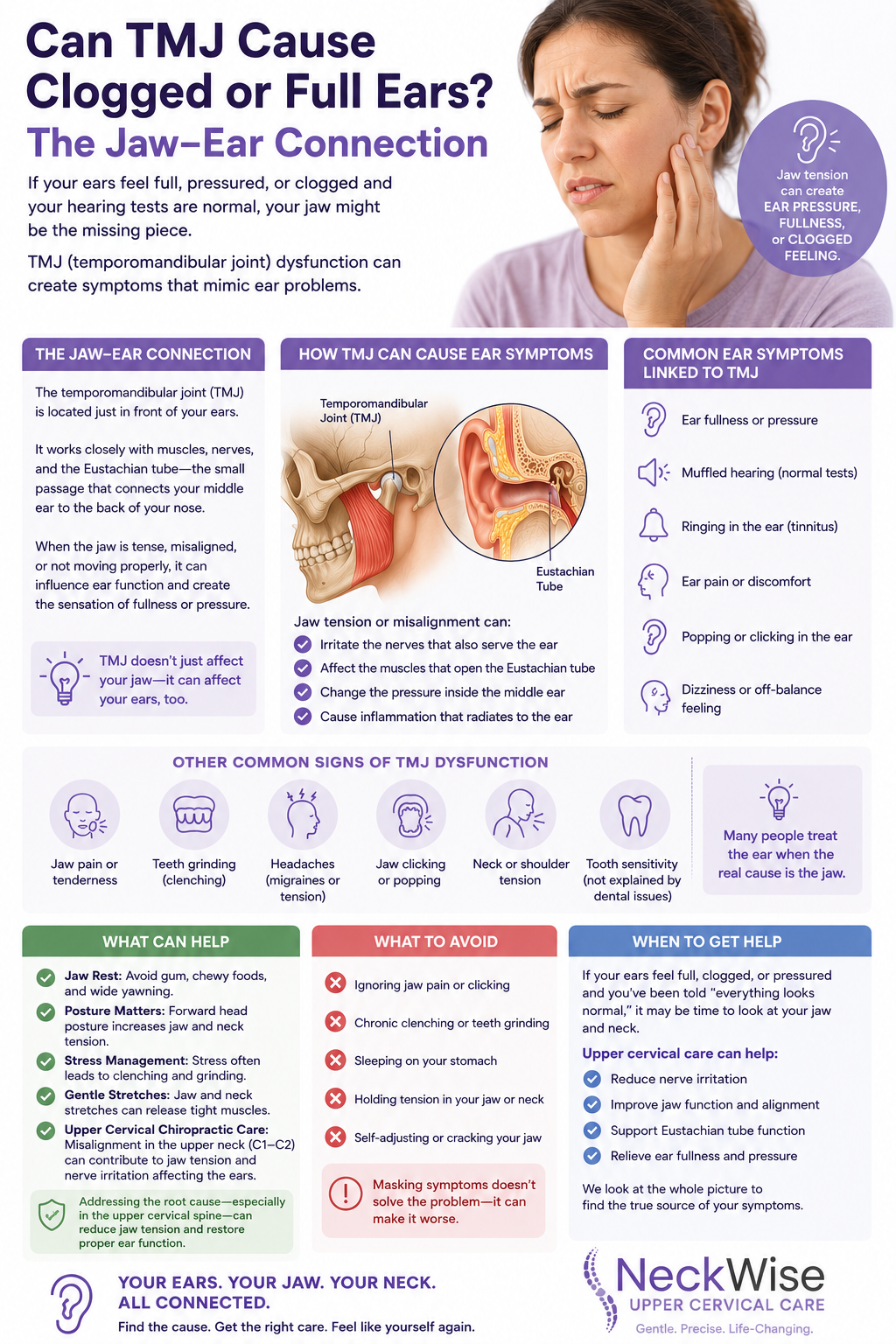
The temporomandibular joint is where your lower jaw meets your skull, and its location is the whole story: it sits immediately in front of the ear canal, sharing walls, nerves, and muscles with the ear region. This tight anatomical relationship means a problem in one is easily felt in the other.
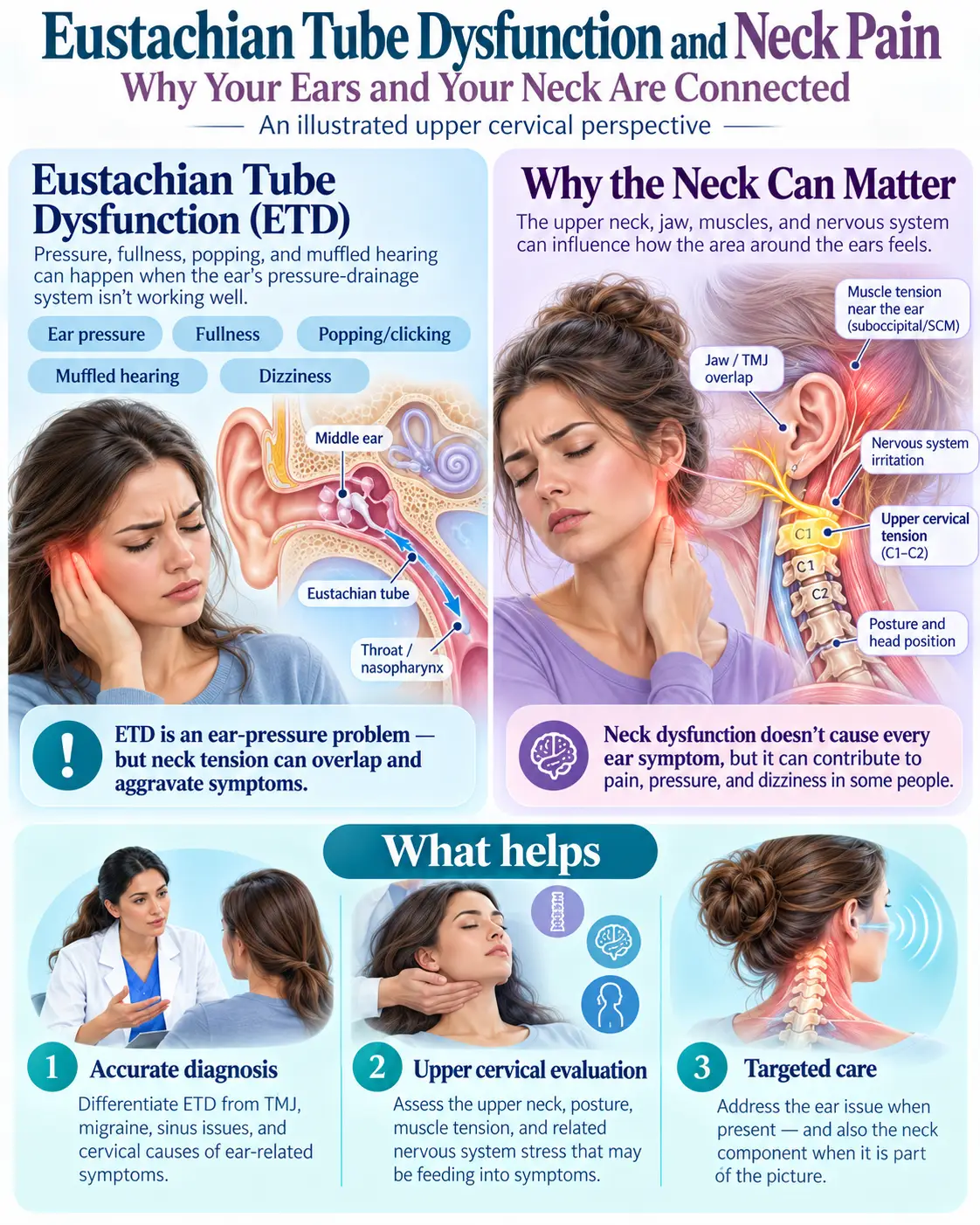
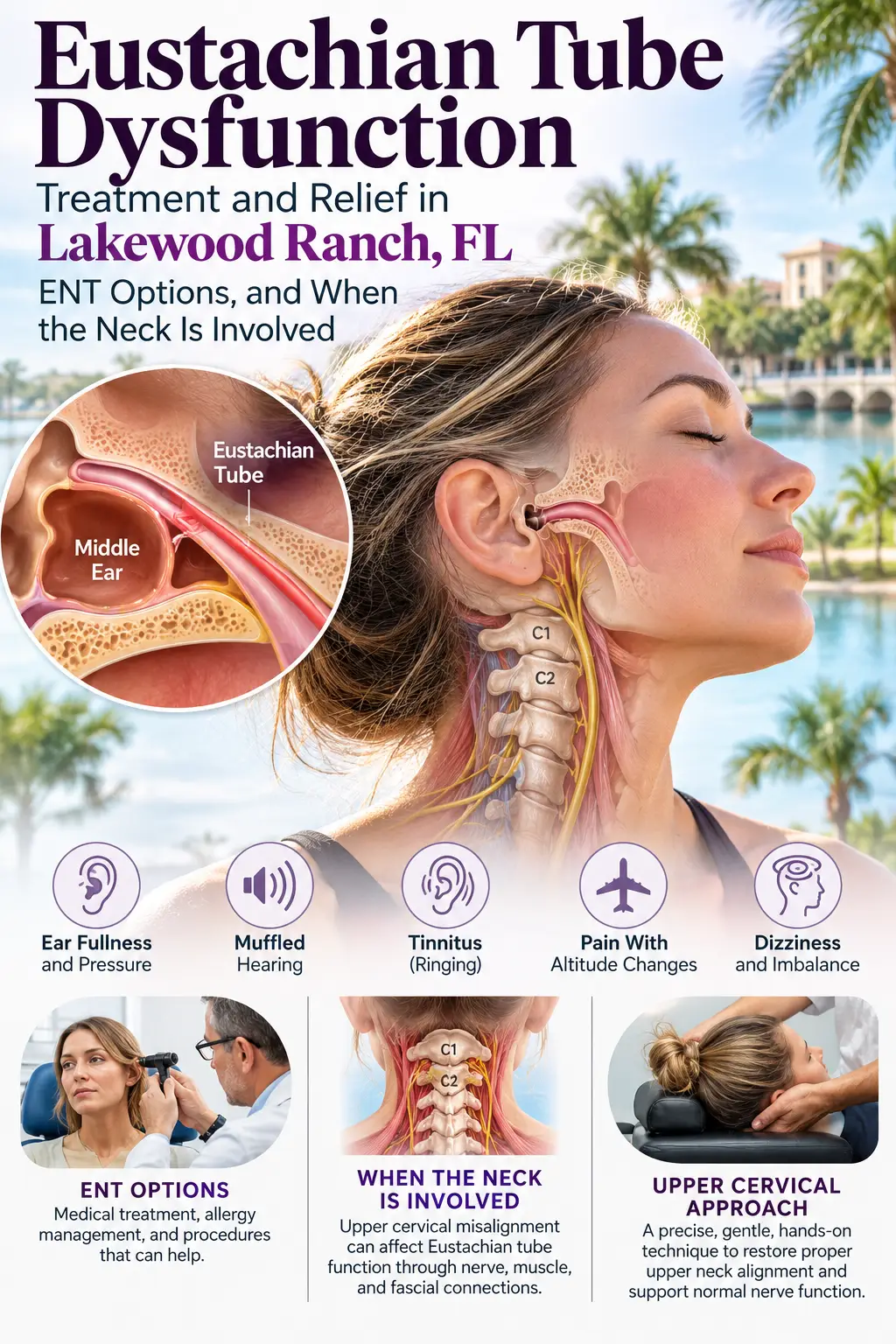
Several connections make this happen. The joint itself is separated from the ear canal by only a thin layer of tissue, so inflammation and pressure in the joint are felt as ear symptoms. The nerves that supply the jaw and the ear overlap, so the brain can interpret jaw signals as coming from the ear. And critically, one of the muscles that opens the eustachian tube — the tensor veli palatini — works alongside the jaw and palate muscles, while a tiny muscle in the middle ear, the tensor tympani, shares the same nerve supply as a jaw muscle. When the jaw system is strained, this shared machinery can be pulled off balance. Our overview on our eustachian tube dysfunction page explains how the tube normally works.
How TMJ Problems Produce Clogged, Full Ears
When the temporomandibular joint is dysfunctional — whether from clenching, grinding, an uneven bite, arthritis, or muscle tension — it can generate a cluster of ear symptoms in several ways.
Muscle tension disrupts the eustachian tube. Chronic tension in the jaw and palate muscles can affect the muscles responsible for opening and timing the eustachian tube, so the tube does not open efficiently. The result is a plugged, full feeling and difficulty equalizing pressure.
Joint inflammation is felt as ear fullness. Because the joint sits right against the ear, inflammation and pressure there are commonly perceived as fullness, pressure, or an ache deep in the ear.
Referred pain and nerve overlap. The shared nerve supply means jaw dysfunction can be felt as ear pain, aching, or fullness even when the ear itself is entirely healthy.
Associated symptoms. People with TMJ-related ear complaints often also notice clicking, ringing, mild dizziness, or a sense that the ear needs to pop — a symptom cluster our page on why your ears feel full explores in more detail.
The telltale sign is the pairing: ear fullness that travels with jaw clicking, jaw soreness, clenching or grinding, or pain when chewing. When your ears and your jaw act up together, the jaw is very likely part of the story.
Signs That Point to the Jaw Rather Than the Ear
Since a clogged ear can come from so many directions, it helps to know which clues specifically implicate the jaw. A few patterns tend to separate TMJ-driven ear fullness from an ear or eustachian tube problem on its own.
Your ears flare when your jaw works hardest. If the fullness intensifies during or after chewing a tough meal, a long conversation, a wide yawn, or a night of grinding, that timing points at the jaw. Ear symptoms that rise and fall with jaw activity rather than with colds or congestion are a strong signal.
You feel it in front of or below the ear. TMJ symptoms often center just in front of the ear canal, right over the joint, and may spread into the cheek, temple, or along the jawline. A deep, achy fullness anchored to that spot — rather than the diffuse underwater feeling of a congested ear — leans toward the joint.
There is sound or tenderness in the joint. Clicking, popping, or grating when you open and close, or tenderness when you press just in front of the ear, are direct jaw findings. An ear problem alone does not produce those.
Morning is the worst. If you wake with full ears, a tight jaw, or sore teeth, overnight clenching or grinding is a likely driver. Ear fullness that is heaviest first thing and eases as the day goes on fits a jaw pattern more than an allergy or infection pattern.
Congestion measures do nothing. When decongestants, antihistamines, and nose-clearing tricks leave the fullness untouched, that lack of response argues against a simple congested tube and toward a mechanical, jaw-driven cause.
It moves with stress. Because stress fuels clenching, TMJ-related ear symptoms often worsen during tense stretches and ease when you relax. A congestion-based clogged ear does not track your stress level that way.
None of these confirm a diagnosis on their own, but the more of them you recognize, the more likely your jaw is feeding your ear symptoms — and the more sense it makes to look at the jaw, the neck, and the ear together rather than at the ear alone.
When Ear Symptoms Need Medical Attention
Even when the jaw seems the likely culprit, some patterns call for medical evaluation to rule out other causes. See a physician or ENT if you have ear pain with fever or drainage that could signal infection, sudden or noticeable hearing loss, persistent fullness in only one ear that does not clear, true spinning dizziness, or ringing that will not quit. An ear exam that comes back clean is useful information — it points away from infection and toward causes like the jaw or the eustachian tube — but new or one-sided symptoms still deserve a proper workup. Being honest about this comes first: upper cervical chiropractic care is appropriate only once a physician has ruled out infection and other medical causes. Our article on ear pressure and eustachian tube dysfunction can help you think through your symptoms.
The Upper Neck: The Third Piece of the Puzzle
The jaw and the ear get most of the attention, but there is a third structure woven into the same system: the upper neck. The jaw, the skull, and the top of the neck function together as a coordinated unit. The muscles and joints of the upper neck share nerve pathways with the jaw and the ear, and the top two vertebrae — the atlas and axis — sit directly beneath the base of the skull, near the muscles that influence both jaw position and eustachian tube function.
This is why jaw problems, neck problems, and ear symptoms so often travel together. When the upper neck is misaligned, it can alter the balance of muscle tension across the jaw and skull, increase strain on the temporomandibular joint, and affect the nerve coordination around the eustachian tube. Research documents a strong relationship between cervical spine impairments and temporomandibular disorders, reflecting how tightly the neck and jaw are linked. Addressing the upper neck may reduce some of the mechanical strain feeding into both the jaw and the ear. Our page on ear pressure and the upper cervical connection explores this relationship further.
How Upper Cervical Chiropractic Care May Help
Upper cervical chiropractic focuses specifically on the alignment of the atlas and axis and their influence on the nervous system and the surrounding muscles. If a misalignment in the upper neck is increasing strain on the jaw and affecting the muscle and nerve coordination around the eustachian tube, correcting that alignment may reduce that strain and support more normal function — which can matter when the jaw and ear are caught in the same pattern.
At Lavender Family Chiropractic, we practice a precise, gentle approach called the Knee Chest Upper Cervical technique. It uses a specific, low-force correction rather than the twisting or cracking many people associate with chiropractic. Before any correction, we map your alignment with 3D CBCT imaging and evaluate nervous-system function with paraspinal infrared thermography, so our care is guided by objective findings rather than guesswork.
It is important to be candid: upper cervical care is not a stand-alone treatment for TMJ disorders, and dental care, bite evaluation, and management of clenching or grinding are often central. What upper cervical care addresses is the neck’s role in the shared muscle and nerve system that ties the jaw and the ear together. For many people, TMJ-related ear fullness has more than one contributor, and the upper neck is one piece worth evaluating alongside dental and medical care. You can learn more about our overall approach on our upper cervical chiropractic care page.
If your ears feel clogged and your jaw is part of the picture, call Lavender Family Chiropractic at (941) 243-3729 to talk through whether an upper cervical evaluation makes sense for you.
What the Research Says
Research supports the connection between temporomandibular disorders and ear symptoms.
A study on temporomandibular joint disorders as a cause of aural fullness directly establishes TMD as a cause of the clogged-ear sensation, linking jaw dysfunction to ear congestion.
A narrative review of the temporomandibular joint and otitis media examines the shared anatomical and developmental connections between the TMJ, middle ear, and eustachian tube.
Research investigating dizziness, tinnitus, and ear fullness in patients with temporomandibular disorders quantifies how common these ear symptoms are among people with TMD.
A clinical study found that temporomandibular treatments significantly improved otologic symptoms such as earache, ear fullness, and tinnitus in patients whose ear symptoms had no primary ear cause.
Finally, research on cervical musculoskeletal impairments and temporomandibular disorders documents the strong relationship between the neck and the jaw, supporting the rationale for evaluating the upper neck.
Practical Steps That May Help
Alongside professional care, several habits can ease TMJ-related ear symptoms.
Rest the jaw. Soft foods, smaller bites, and avoiding gum and wide yawns give an irritated joint a chance to settle.
Address clenching and grinding. Daytime awareness of clenching and, where appropriate, a dentist-fitted night guard can reduce the strain driving both the jaw and the ear symptoms.
Apply warmth and gentle relaxation. Warm compresses over the jaw muscles and gentle relaxation of the face and jaw can ease the muscle tension that pulls on the shared machinery.
Mind your posture. Forward-head posture and long hours at a screen load the neck and jaw together. Keeping the head balanced over the shoulders eases strain on both.
Manage stress. Stress fuels clenching and muscle tension, so stress management is genuinely part of jaw and ear care.
Loop in your dentist. Because bite issues and grinding are so often central, your dentist is an important partner. Upper cervical care works best alongside, not instead of, appropriate dental care.
What to Expect at Your First Visit
If clogged ears and a troublesome jaw have you wondering whether your neck is involved, it helps to know what a first visit looks like.
We begin with an unhurried conversation about your history. We want to understand whether your ear fullness travels with jaw clicking, soreness, clenching, or pain when chewing, whether it is one ear or both, how your hearing is affected, and what else you are noticing. These details help us understand your situation and recognize when something belongs with a physician, ENT, or dentist first.
Next, we gather objective data. The 3D CBCT imaging shows us the precise position of your atlas and axis, and paraspinal infrared thermography helps us evaluate nervous-system function. Together they guide whether an upper cervical correction is appropriate or whether we should refer you for further evaluation.
If care is indicated, we explain our findings in plain language and outline a customized treatment plan built around your goals. We practice on a cash-pay basis and review the details with you in advance. We will always be candid about where upper cervical care fits and where dental and medical care belong. If you would like to talk anything through before scheduling, call us any time at (941) 243-3729.
Areas We Serve Around Sarasota
Lavender Family Chiropractic is located at 5899 Whitfield Avenue, Suite 107, in Sarasota, at the corner of University and Whitfield. We care for people seeking natural relief from ear and jaw-related symptoms across the region, including Bradenton, Lakewood Ranch, Palmetto, Ellenton, Ruskin, Venice, Osprey, Myakka, Tampa, and St. Pete.
Top 15 Frequently Asked Questions About TMJ and Clogged Ears
1. Can TMJ really cause clogged ears? Yes. The temporomandibular joint sits right against the ear and shares muscles and nerves with the ear region, so jaw dysfunction commonly produces ear fullness, pressure, or an ache — even when the ear itself is healthy.
2. Why do my ears feel full but my ear exam is normal? A clean ear exam points away from infection and toward causes like the jaw or the eustachian tube. TMJ-related fullness comes from muscle tension and joint inflammation, not from something visible in the ear canal.
3. How do I know if my jaw is the cause? The telltale sign is pairing: ear fullness that travels with jaw clicking, soreness, clenching, grinding, or pain when chewing. When the ears and jaw act up together, the jaw is likely involved.
4. How does the jaw affect the eustachian tube? A muscle that helps open the eustachian tube works alongside the jaw and palate muscles. Chronic jaw tension can affect how well the tube opens, leaving the ear plugged.
5. Can TMJ cause ear pain? Yes. Because the jaw and ear share nerve pathways, jaw dysfunction is often felt as ear pain or aching even when the ear is healthy — this is called referred pain.
6. Is TMJ-related ear fullness dangerous? Usually not, but see a physician for ear pain with fever or drainage, sudden hearing loss, one-sided fullness that does not clear, true spinning dizziness, or persistent ringing.
7. Can a chiropractor help TMJ ear symptoms? Upper cervical care is not a stand-alone TMJ treatment, but it addresses the neck’s role in the shared muscle and nerve system linking the jaw and ear, which for many people is one contributing piece.
8. How does my neck fit in? The jaw, skull, and upper neck work as a unit and share nerve pathways. A misaligned upper neck can increase strain on the jaw and affect the coordination around the eustachian tube.
9. Should I see a dentist too? Often yes. Bite issues, clenching, and grinding are frequently central, so your dentist is an important partner. A night guard can help many people.
10. Will a night guard fix my ears? For those whose symptoms stem from grinding, reducing that strain can ease ear fullness. It is one tool among several, and results vary by person.
11. Does stress make it worse? Yes. Stress fuels clenching and muscle tension, which drives both the jaw and ear symptoms, so stress management is genuinely part of care.
12. What testing do you perform? We use 3D CBCT imaging to assess upper cervical alignment and paraspinal infrared thermography to evaluate nervous-system function, alongside a history and screening to help recognize when other care is needed first.
13. Can posture affect this? Yes. Forward-head posture loads the neck and jaw together, so improving posture eases strain on both, which can help the ear symptoms.
14. How long until I notice a difference? It varies by person and cause. Jaw rest, stress and grinding management, and addressing the neck are typically worked through gradually over a plan of care.
15. Where are you located and who do you serve? We are at 5899 Whitfield Avenue, Suite 107, in Sarasota, serving patients from Bradenton, Lakewood Ranch, Venice, Palmetto, Ellenton, and the surrounding area.
Ready to Connect the Dots Between Your Jaw and Your Ears?
When your ears feel clogged and your jaw is unhappy, the two are often part of the same story — and understanding whether your temporomandibular joint, your upper neck, or both are involved is the first step toward relief. If you are ready to find out, call Lavender Family Chiropractic at (941) 243-3729 or book your consultation online at https://intake.chirohd.com/new-patient-scheduling/724/lavender-family-chiropractic. Our Sarasota team is here to help you pursue natural relief as part of a comprehensive plan.
Related Articles
Related Posts


Get our upper cervical articles first.
Patients Experience