By Dr. Rusty Lavender
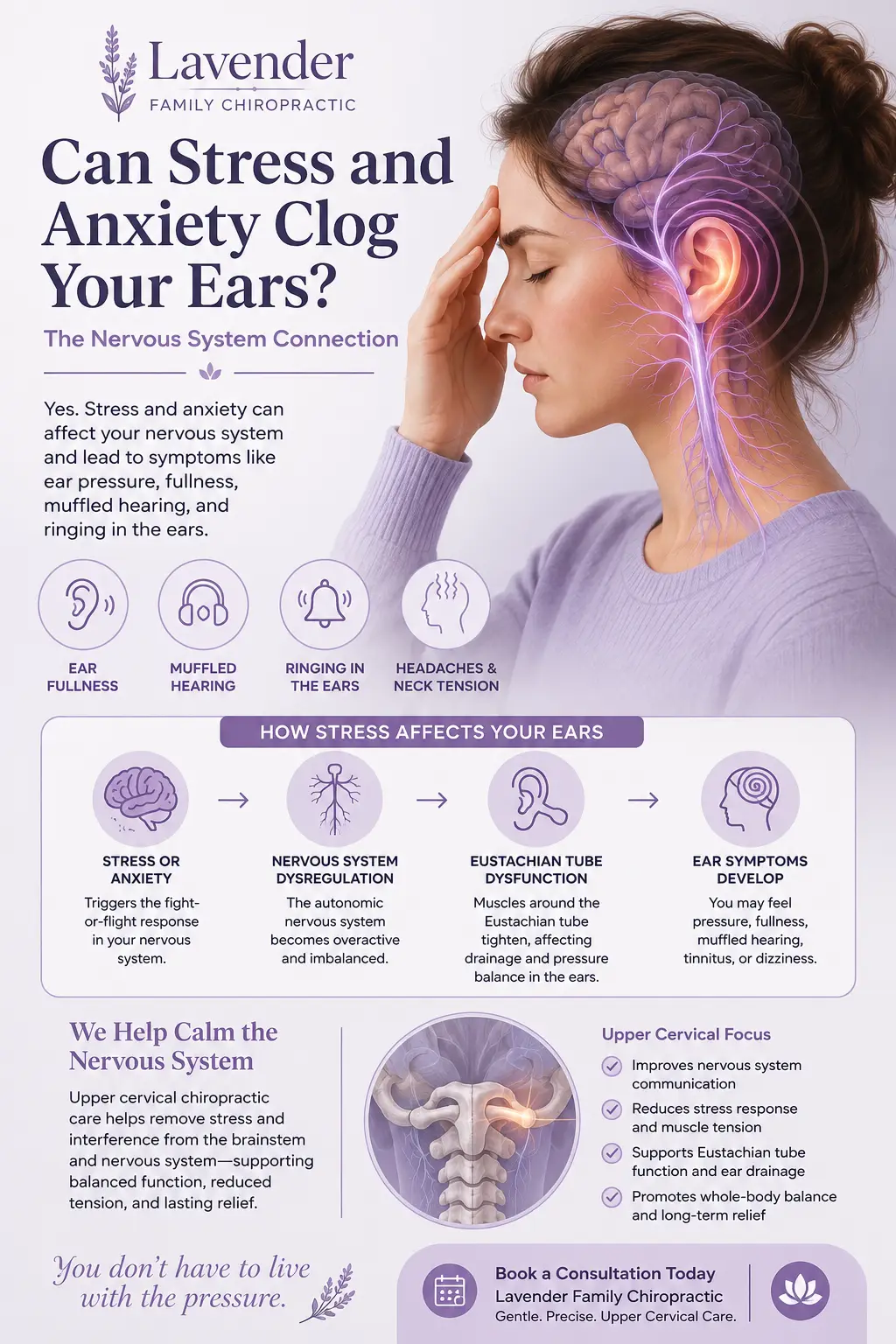
Stress and Anxiety Clog Your Ears: You have been under pressure for weeks — deadlines, worry, nights of poor sleep — and now your ears feel full, plugged, or muffled, sometimes with a faint fluttering or a sense that they need to pop. You have checked for wax, there is no cold, no infection, and yet the fullness tracks your stress so closely that you have started to wonder if the two are connected. They very well may be. Stress and anxiety can absolutely produce and amplify a clogged, full feeling in the ears, and the reason lies in the tight relationship between your nervous system, the small muscles around the ear, and the way your brain processes what you feel.
This article explains how stress and anxiety clog the ears, when stress-related ear fullness needs medical evaluation, and where upper cervical chiropractic care may fit as part of the picture. At Lavender Family Chiropractic in Sarasota, we help people understand what is behind their ear symptoms so they can pursue the right kind of relief.
Stress and Anxiety Clog Your Ears: The Nervous System, the Ear, and the Stress Response
To see how stress reaches the ears, it helps to know that the ear is not a sealed-off mechanical box. It is richly supplied by the nervous system, including the autonomic nervous system — the automatic branch that governs your fight-or-flight response, regulates blood flow, and sets muscle tone throughout the body. When you are stressed or anxious, that system shifts into a heightened, activated state. Your muscles tense, your blood vessels constrict, and your whole body becomes more reactive. The ear region is not exempt.
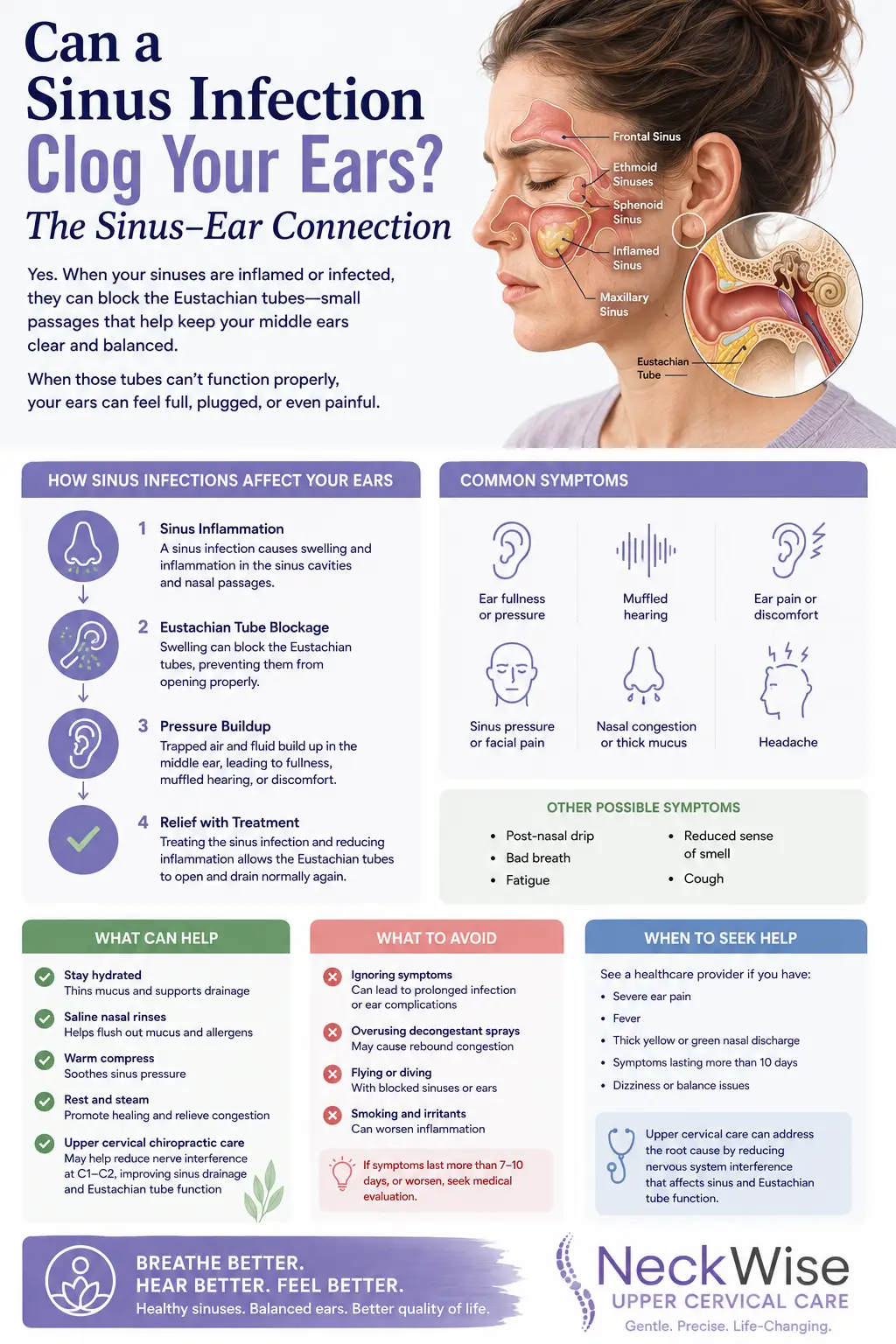
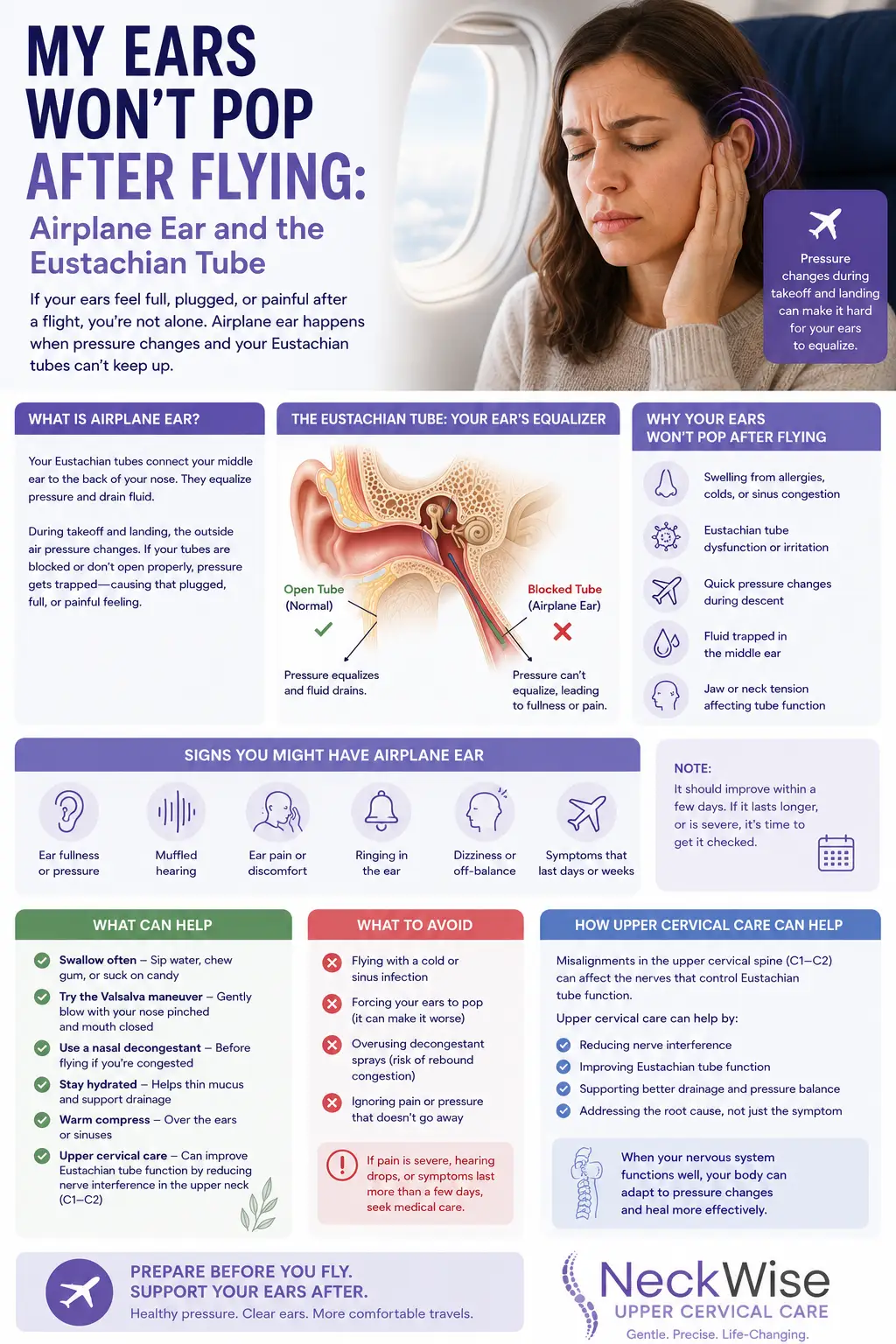
Two small muscles matter here. The eustachian tube, the narrow canal that equalizes pressure behind the eardrum, is opened and timed by tiny muscles that respond to nervous-system signals. And inside the middle ear sits an even smaller muscle, the tensor tympani, which tenses the eardrum. Both are sensitive to the state of your nervous system, and both can be pulled off their normal rhythm when you are running on high alert. Our overview on our eustachian tube dysfunctionpage explains how the tube normally regulates pressure.
How Stress and Anxiety Produce a Clogged Feeling
When the nervous system stays in a heightened state, several things can converge to make the ears feel full.
Middle-ear muscle tension. Chronic stress can cause the tensor tympani muscle to contract repeatedly or stay abnormally tense. This is associated with a cluster of sensations — ear fullness, a fluttering or thumping, muffled hearing, and a feeling of tension or pressure deep in the ear — even when the ear itself is structurally normal. It is one of the clearest ways a nervous, activated state translates into a physical ear symptom.
Eustachian tube tension. The muscles that open the eustachian tube can also be affected by generalized muscle tension and autonomic activation, leaving the tube slower to open on cue. When it does not open efficiently, pressure does not equalize as smoothly and the ear feels plugged.
Changes in blood flow and mucous membranes. The autonomic nervous system regulates blood flow and the mucous membranes throughout the head. When it is dysregulated by ongoing stress, the tissues around the tube and middle ear may not behave normally, adding to the sense of fullness.
Heightened perception. Anxiety also changes how the brain monitors the body. A minor, normally ignored sensation in the ear can become loud, persistent, and hard to tune out when you are anxious and scanning for what is wrong. This does not mean the feeling is imaginary — the sensation is real — but a stressed brain amplifies it, which can turn a small fullness into a preoccupying symptom. Our page on why your ears feel full explores the sensation in more detail.
The result is a real, often bilateral fullness or pressure, sometimes with fluttering, muffled hearing, or ringing, that rises and falls with your stress level.
Reading the Pattern: Is Stress Really the Driver?
Because so many things can plug an ear, it helps to look at whether yours truly tracks with stress or whether something else is behind it. A few patterns tend to sort this out.
It rises and falls with your stress. The clearest signature is fullness that intensifies during tense, anxious, or exhausted stretches and eases when you genuinely relax, sleep well, or take a real break. If your ears calm down on vacation and flare during a hard week, stress is very likely part of the story.
It comes with the rest of the stress picture. Stress-related ear fullness rarely travels alone. Jaw clenching, tension headaches, a tight neck and shoulders, disrupted sleep, and a racing mind often show up alongside it. When the ear symptom is one thread in that larger fabric, the nervous system is a likely common cause.
There is no infection or wax. Stress-driven fullness comes with a clean ear exam — no wax plug, no visible infection, no fluid your doctor can see. A normal exam points away from a mechanical blockage and toward causes like muscle tension and nervous-system state.
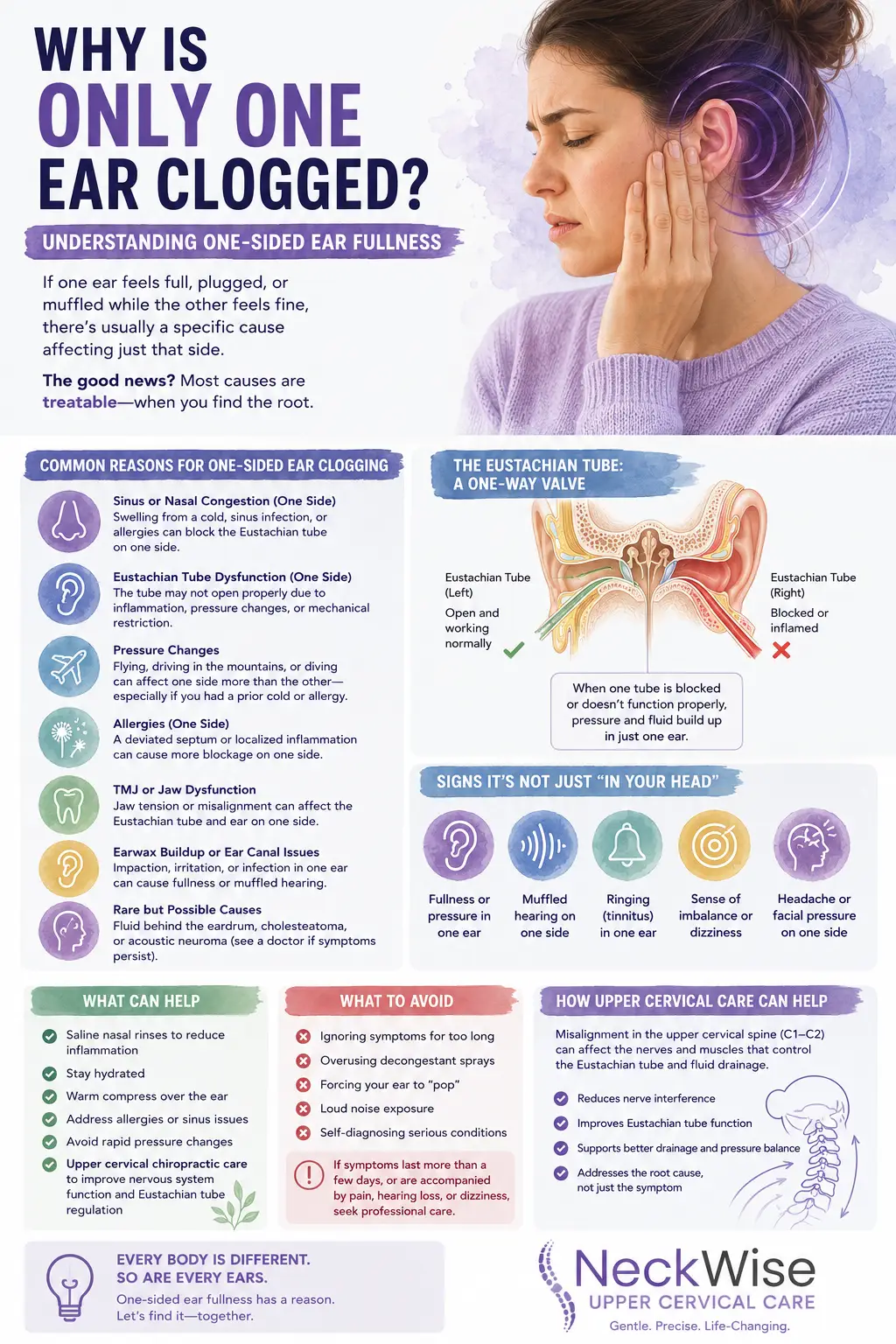
It affects both ears fairly evenly. Because stress activates the whole system, its ear symptoms often show up in both ears, even if one is worse. Stubborn fullness in only one ear is less typical of stress and is the pattern that most warrants an ENT check, as the next section explains.
Congestion measures do nothing. When decongestants, antihistamines, and nose-clearing tricks leave the fullness untouched, that lack of response argues against a simple congested tube and fits a tension- or nervous-system-driven cause.
When Stress-Related Ear Symptoms Need Medical Attention
Attributing ear fullness to stress should never be the first move — it is a conclusion reached after other causes are ruled out. See a physician or ENT if you have ear pain, fever, or drainage that could signal infection, if your hearing drops suddenly or noticeably, if fullness persists in only one ear and does not clear, if you have true spinning dizziness, or if ringing is new, one-sided, or persistent. Sudden hearing loss in particular is a medical urgency, not something to wait out. Persistent one-sided ear fullness in an adult should always be checked by an ENT. Being honest about this comes first — upper cervical chiropractic care is appropriate only once a physician has ruled out infection, hearing loss, and other medical causes. Our article on ear pressure and the upper cervical connection can help you think through your symptoms.
The Upper Neck Connection People Overlook
Stress gets much of the attention in the story of clogged ears, and rightly so. But there is a structure that sits right in the middle of the stress-and-ear relationship and often goes unnoticed: the upper neck. The autonomic pathways that carry the stress response, the muscles that hold tension when you are anxious, and the nerves that coordinate the ear all pass through or near the region where the head meets the neck. The top two vertebrae, the atlas and axis, sit just beneath the base of the skull, close to these pathways.
When the upper neck is misaligned, it can add to the load on this system — increasing muscle tension across the head and neck and affecting the nerve and autonomic coordination around the ear. The idea is not that the neck is the sole cause of stress-related ear fullness, but that a pre-existing upper-neck problem can leave the ear more reactive when you are already stressed, and can keep the surrounding muscles tighter than they should be. Because the upper neck is so involved in both the physical tension of stress and the nerve supply to the ear, it is a reasonable place to look when ear fullness tracks with a stressed, tense state. Our page on inner ear pressure explores related connections.
How Upper Cervical Chiropractic Care May Help
Upper cervical chiropractic focuses specifically on the alignment of the atlas and axis and their influence on the nervous system and the surrounding muscles. If a misalignment in the upper neck is contributing to muscle tension and affecting the nerve and autonomic coordination around the ear, correcting that alignment may reduce some of that strain and support more normal function — which can matter when a stressed nervous system is already taxing the system.
At Lavender Family Chiropractic, we practice a precise, gentle approach called the Knee Chest Upper Cervical technique. It uses a specific, low-force correction rather than the twisting or cracking many people associate with chiropractic. Before any correction, we map your alignment with 3D CBCT imaging and evaluate nervous-system function with paraspinal infrared thermography, so our care is guided by objective findings rather than guesswork.
It is important to be candid: upper cervical care is not a treatment for anxiety, and managing stress with appropriate support — which may include counseling, lifestyle change, and medical care — is central to this picture. What upper cervical care addresses is a different, sometimes overlooked contributor: the neck’s role in the muscle tension and nerve coordination that tie a stressed state to the ear. For some people, stress-related ear fullness has more than one contributor, and the upper neck is one piece worth evaluating alongside good stress management. You can learn more about our overall approach on our upper cervical chiropractic care page.
If your ears clog up when you are stressed, call Lavender Family Chiropractic at (941) 243-3729 to talk through whether an upper cervical evaluation makes sense for you.
What the Research Says
Research increasingly documents the links between the nervous system, stress, and ear symptoms.
An integrative model of the symptom cluster involving the tensor tympani muscle describes how this small middle-ear muscle can overcontract and produce ear fullness, fluttering, tension, and muffled hearing.
A review of the association between stress, emotional states, and ear symptoms examines how psychological stress contributes to the onset and worsening of tinnitus and related ear complaints.
Research identifying autonomic signatures of ear and sound-sensitivity symptoms shows measurable autonomic-nervous-system involvement in ear symptoms, tying nervous-system regulation to what people feel in their ears.
A study on eustachian tube dysfunction phenotypes classifies the ways the tube can fail to regulate middle-ear pressure and produce aural fullness.
Finally, research on cervical spine involvement in ear symptoms links neck pathology to ear complaints, supporting the rationale for evaluating the upper neck.
Practical Steps That May Help
Alongside professional care, several habits can ease stress-related ear symptoms.
Address the stress at the source. This is the foundation. Whatever genuinely lowers your stress load — counseling, boundaries, exercise, time outdoors, or professional support — tends to calm the ears along with everything else.
Practice slowing the nervous system. Slow breathing, gentle stretching, and relaxation practices shift the autonomic system out of high alert, which can ease the muscle tension feeding the ear symptom.
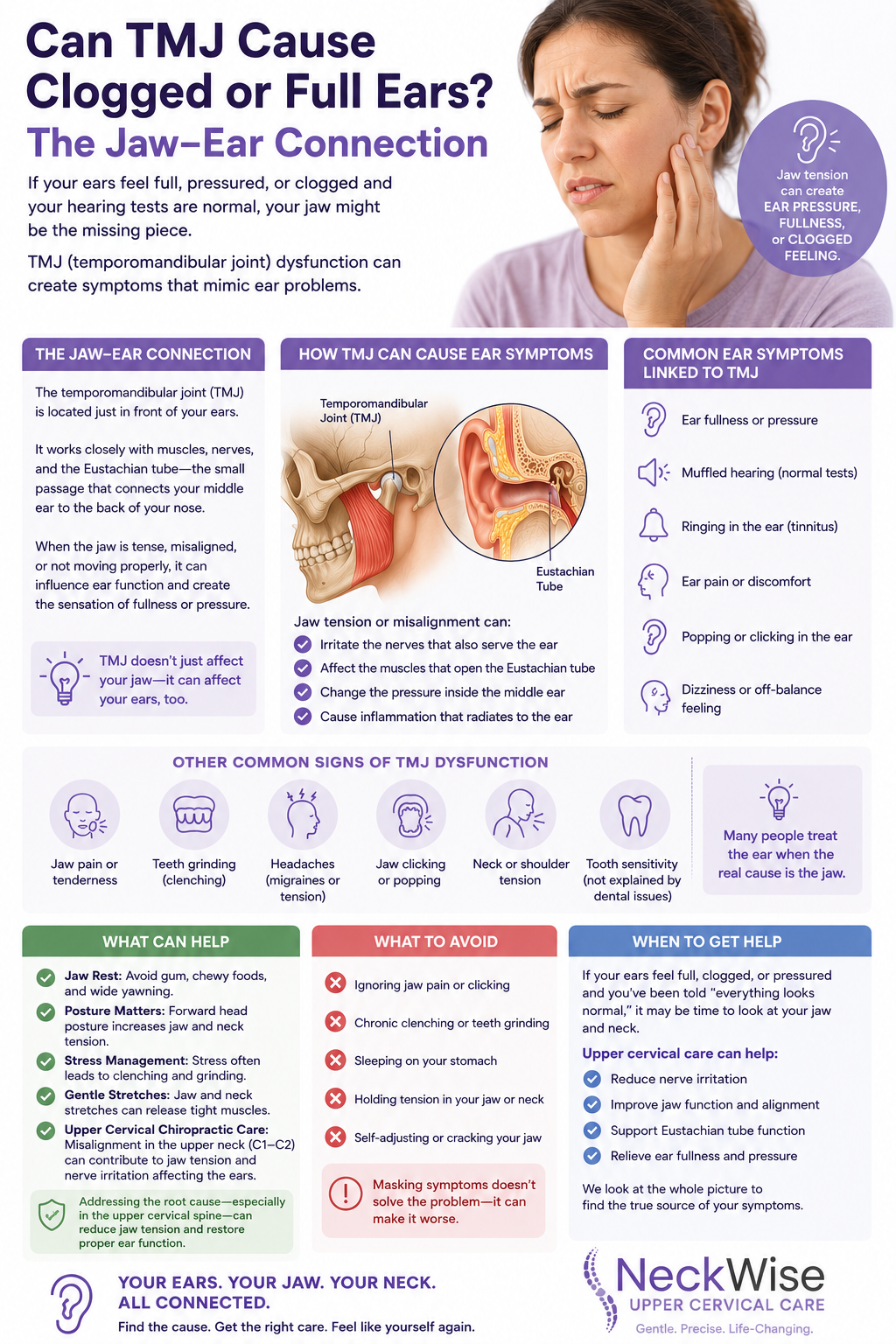
Unclench the jaw and relax the face. Because jaw clenching and facial tension travel with stress and pull on the same machinery, consciously softening the jaw and face throughout the day can help. A dentist can advise if you grind at night.
Protect your sleep. Poor sleep amplifies both stress and symptom perception. Steady, sufficient sleep gives the nervous system a chance to reset.
Ease off the caffeine and stimulants. For some people, high caffeine intake heightens the anxious, activated state that drives the symptom. Cutting back is worth a try.
Do not fixate on the ear. Easier said than done, but constant checking and worry amplify the sensation. Redirecting attention, ideally as part of broader stress management, often turns the volume down over time.
What to Expect at Your First Visit
If stress-related ear fullness has you wondering whether your neck is part of the picture, it helps to know what a first visit looks like.
We begin with an unhurried conversation about your history. We want to understand when your ears feel full, how it tracks with your stress and sleep, whether it comes with jaw or neck tension, whether it is one ear or both, how your hearing is affected, and what else you are noticing. These details help us understand your situation and recognize when something belongs with a physician or ENT first.
Next, we gather objective data. The 3D CBCT imaging shows us the precise position of your atlas and axis, and paraspinal infrared thermography helps us evaluate nervous-system function. Together they guide whether an upper cervical correction is appropriate or whether we should refer you for further evaluation.
If care is indicated, we explain our findings in plain language and outline a customized treatment plan built around your goals. We practice on a cash-pay basis and review the details with you in advance. We will always be candid about where upper cervical care fits and where medical and mental-health care belong. If you would like to talk anything through before scheduling, call us any time at (941) 243-3729.
Areas We Serve Around Sarasota
Lavender Family Chiropractic is located at 5899 Whitfield Avenue, Suite 107, in Sarasota, at the corner of University and Whitfield. We care for people seeking natural relief from ear and eustachian tube symptoms across the region, including Bradenton, Lakewood Ranch, Palmetto, Ellenton, Ruskin, Venice, Osprey, Myakka, Tampa, and St. Pete.
Top 15 Frequently Asked Questions About Stress, Anxiety, and Clogged Ears
1. Can stress and anxiety really clog my ears? Yes. A heightened nervous-system state can tense the small muscles around the ear, affect how the eustachian tube opens, and amplify how strongly you feel the sensation, producing a real full or plugged feeling.
2. Why do my ears feel full but my exam is normal? A clean exam points away from wax, infection, or visible fluid and toward causes like muscle tension and nervous-system state. Stress-related fullness does not show up as something visible in the ear canal.
3. What is that fluttering or thumping in my ear? That sensation is often linked to the tensor tympani, a tiny middle-ear muscle that can contract with stress. It can produce fluttering, fullness, and a feeling of tension deep in the ear.
4. Why do my ears clog when I am anxious but clear when I relax? The symptom tracks your nervous-system state. When you are anxious, muscle tension and heightened perception peak; when you genuinely relax, both ease, and so does the fullness.
5. Is stress-related ear fullness dangerous? Usually not, but stress should be a conclusion reached after ruling out other causes. See a physician for pain, fever, drainage, sudden hearing loss, spinning dizziness, or one-sided fullness that does not clear.
6. Why does it affect both ears? Because stress activates the whole nervous system, the ear symptoms often show up in both ears. One-sided fullness is less typical of stress and deserves an ENT evaluation.
7. Can a chiropractor help stress-related ear symptoms? Upper cervical care does not treat anxiety, but it addresses the neck’s role in the muscle tension and nerve coordination that link a stressed state to the ear, which for some people is one contributing piece.
8. How does my neck fit in? The autonomic pathways of the stress response, the muscles that tense with anxiety, and the nerves to the ear all pass near the upper neck. A misalignment there may leave the ear more reactive when you are stressed.
9. Will managing my anxiety fix my ears? For many people, genuinely lowering the stress load eases the ear symptoms along with everything else. It is the foundation, and it works best combined with attention to other contributors.
10. Could this be tinnitus instead? Stress can drive both fullness and ringing, and they often occur together. New, one-sided, or persistent ringing should be evaluated to rule out other causes.
11. Does caffeine make it worse? It can. High caffeine intake heightens the activated, anxious state that drives the symptom for some people, so cutting back is worth trying.
12. What testing do you perform? We use 3D CBCT imaging to assess upper cervical alignment and paraspinal infrared thermography to evaluate nervous-system function, alongside a history and screening to help recognize when medical care is needed first.
13. Can poor sleep contribute? Yes. Poor sleep amplifies both stress and how strongly you perceive symptoms, so protecting your sleep genuinely helps.
14. When should I see a doctor instead of assuming it is stress? Right away if you have pain, fever, drainage, sudden or one-sided hearing loss, spinning dizziness, or one-sided fullness. Stress is a diagnosis of exclusion, not a first guess.
15. Where are you located and who do you serve? We are at 5899 Whitfield Avenue, Suite 107, in Sarasota, serving patients from Bradenton, Lakewood Ranch, Venice, Palmetto, Ellenton, and the surrounding area.
Ready to Understand the Link Between Your Stress and Your Ears?
Clogged ears that track your stress are real, and they are not something you simply have to live with or worry over alone. Understanding whether muscle tension, your nervous system, your upper neck, or some combination is behind the fullness is the first step toward relief. If you are ready to find out, call Lavender Family Chiropractic at (941) 243-3729 or book your consultation online at https://intake.chirohd.com/new-patient-scheduling/724/lavender-family-chiropractic. Our Sarasota team is here to help you pursue natural relief as part of a comprehensive plan.