My Ears Won’t Pop After Flying: Airplane Ear and the Eustachian Tube
By Dr. Rusty Lavender, D.C. — upper cervical chiropractor, Lavender Family Chiropractic, Sarasota, FL. Reviewed and updated October 2026.
My Ears Won’t Pop After Flying: You landed hours ago, but your ears never got the memo. That plugged, muffled, underwater feeling that set in during the descent has not budged. You have chewed gum, yawned until your jaw ached, and pinched your nose to force a pop — and still your hearing sounds like it is coming through a pillow. If you are a day or two past a flight and your ears simply will not clear, you are dealing with one of the most common travel complaints there is: airplane ear, and the lingering eustachian tube trouble it can leave behind.
This article explains why your ears clog on a plane, why they sometimes refuse to pop long after you land, when a stuck ear after flying needs medical attention, and where upper cervical chiropractic care may fit as part of the picture. At Lavender Family Chiropractic in Sarasota, we help people understand what is keeping their ears from clearing so they can pursue the right kind of relief.
My Ears Won’t Pop After Flying: Why Your Ears Clog on a Plane in the First Place
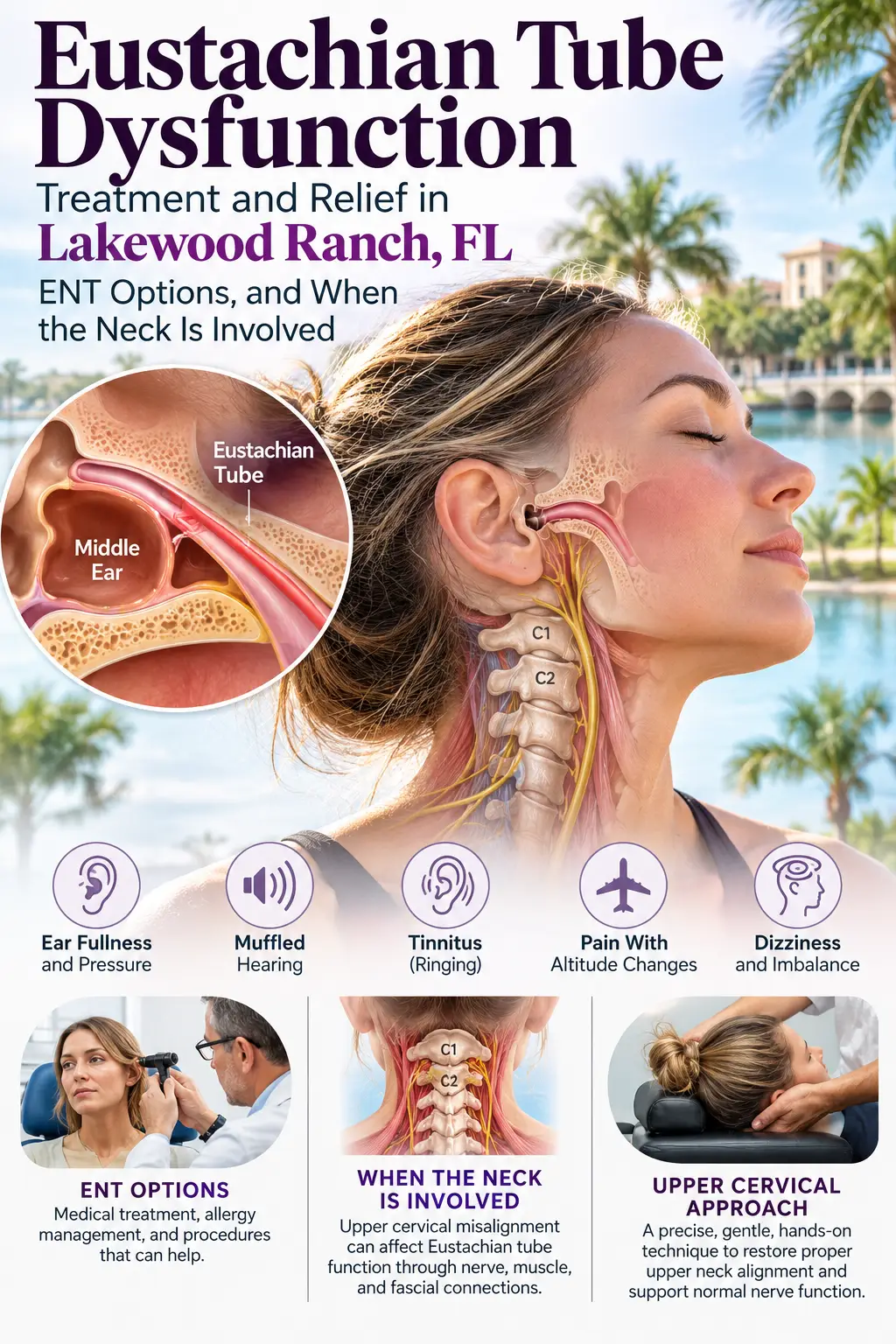
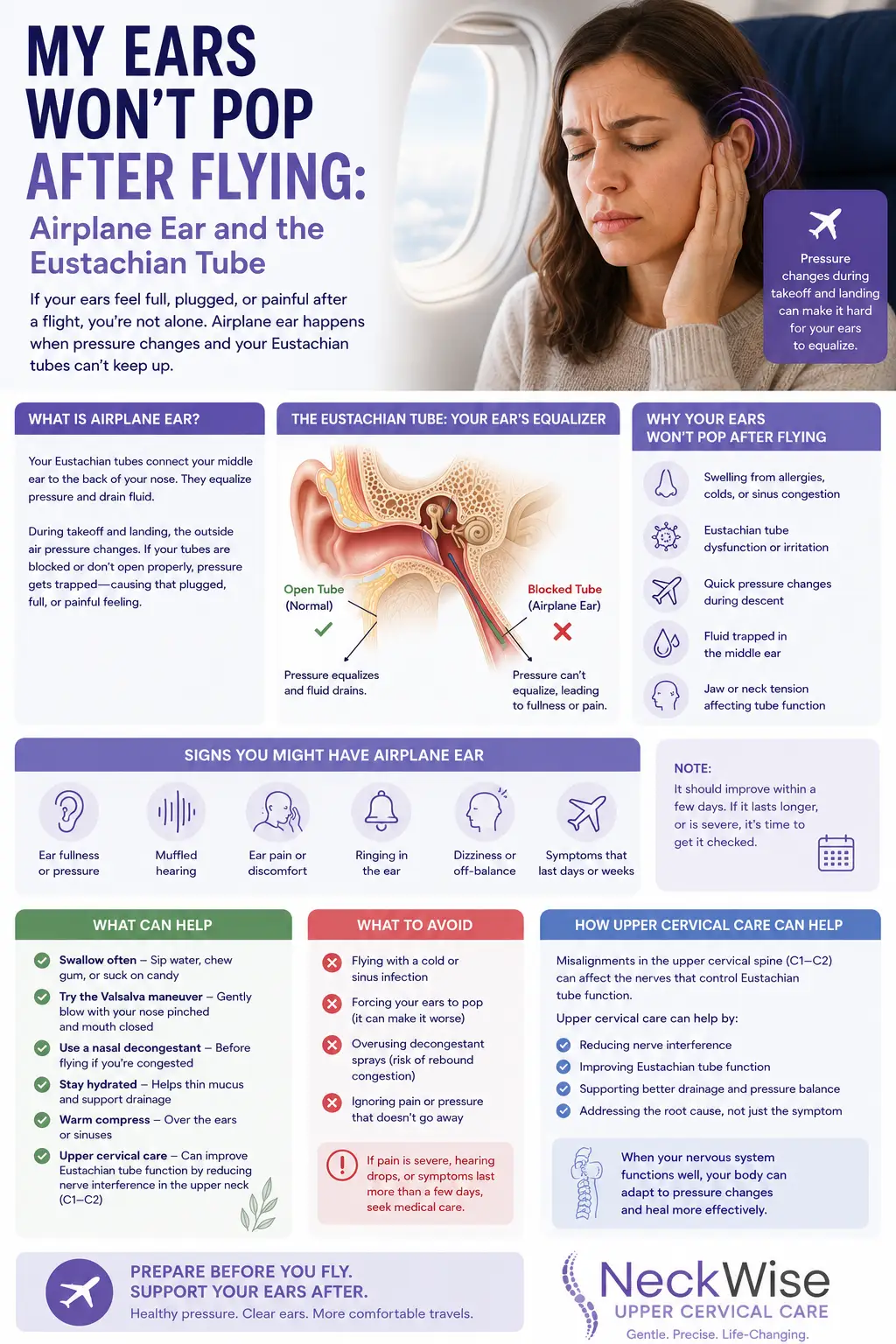
The key to the whole problem is a narrow canal called the eustachian tube, which connects the middle ear to the back of the nose and throat. Its job is to equalize the air pressure behind your eardrum with the pressure around you, and to do that it opens briefly when you swallow, yawn, or chew. When the pressure on both sides of the eardrum matches, your ears feel normal. When it does not, you feel it immediately.
Flying puts this system under stress. As the plane climbs and especially as it descends, the cabin pressure changes faster than your middle ear can keep up with on its own. During descent, the outside pressure rises quickly while the pressure inside your middle ear lags behind, and the difference pushes the eardrum inward. To catch up, the eustachian tube has to open and let air in — but under a rapid pressure change, it can get squeezed shut instead, effectively locking. Air cannot get in to equalize, the eardrum stays pulled tight, and you get the pain, fullness, and muffled hearing of airplane ear. Our overview on our eustachian tube dysfunction page explains how the tube is supposed to work.
Why They Sometimes Won’t Pop After You Land
For most travelers, the ears equalize within minutes to hours of landing. But sometimes the plugged feeling drags on for a day, several days, or longer. A few things explain why.
The tissue got irritated. The forceful pressure difference during descent can inflame and swell the lining of the eustachian tube and middle ear. Until that swelling settles, the tube stays sluggish and will not open the way it should.
You flew congested. Flying with a cold, allergies, or sinus congestion stacks the odds against you. The tube is already swollen before you board, so it handles the pressure change poorly and takes longer to recover afterward. This is why the same flight leaves one person fine and another plugged for a week.
Fluid moved in. When the middle ear stays under negative pressure, fluid can seep into the space — a condition called middle ear effusion. That fluid muffles hearing and keeps the ear feeling full until it drains, which does not always happen quickly.
The tube is stuck in a vacuum. Once the eardrum has been pulled inward and the tube has locked shut, the trapped low pressure can make it even harder for the tube to pop back open on its own, creating a frustrating loop.
For most people this gradually improves as the inflammation calms and the tube regains its rhythm. But when it lingers, it is worth understanding both when to seek medical care and what other contributors — including the upper neck — might be involved.
Reading Your Own Post-Flight Pattern
Not every stuck-after-flying ear behaves the same way, and noticing your pattern helps you judge what to do next.
The slow fade. The most reassuring pattern is fullness that is gradually lifting — clearer for a while after you swallow or yawn, then creeping back, but overall improving day by day. This usually means the tube is recovering and typically resolves with a little time and the gentle steps below.
The hard plateau. Some people improve for a day and then stall completely, stuck at the same muffled level for a week or more. A plateau like this often points to trapped middle-ear fluid or a tube that has stayed locked, and it is a reasonable cue to have it checked, especially past the two-week mark.
The repeat offender. If your ears plug up on every flight and are slow to clear each time, that pattern suggests your tube’s function is not fully robust — and it is worth evaluating the underlying contributors rather than just riding out each trip.
The painful or one-sided holdout. Significant pain during or after the flight, or fullness that will not clear in just one ear, deserves closer attention. One-sided fullness in particular is the pattern that most warrants an ENT evaluation, as the next section explains.
When a Stuck Ear After Flying Needs Medical Attention
Most airplane ear is uncomfortable but self-limited. Still, some patterns call for prompt evaluation rather than continued waiting. See a physician or ENT if your ear stays plugged or your hearing stays muffled for more than a couple of weeks, if you have severe or persistent ear pain, if you notice bleeding or drainage from the ear, if you develop sudden or significant hearing loss, if you have true spinning dizziness, or if ringing will not quit. Intense pressure during descent can occasionally injure the eardrum, which needs to be looked at. One point deserves emphasis: persistent fullness or fluid in only one ear in an adult should always be evaluated by an ENT, because on rare occasions a blockage at the back of the nose can cause one-sided eustachian tube problems and needs to be ruled out. Being honest about this comes first — upper cervical chiropractic care is appropriate only once a physician has ruled out eardrum injury, infection, and other medical causes. Our article on why your ears won’t pop can help you think it through.
The Upper Neck Connection People Overlook
When an ear will not pop after a flight, most people focus entirely on the ear and nose — understandably. But there is a contributor that is easy to miss: the upper neck. The small muscles that open and time the eustachian tube, and the nerves that coordinate them, are influenced by the region where the head meets the neck. The top two vertebrae, the atlas and axis, sit directly beneath the base of the skull, near the muscles of the palate and the pathways that regulate the tube’s function.
When the upper neck is misaligned, it can affect the nerve and muscle coordination around the eustachian tube and alter the tension in the surrounding tissues. The idea is not that the neck causes the pressure change of a flight, but that a pre-existing upper-neck problem can leave the eustachian tube less able to open efficiently under stress and slower to recover afterward — one reason two people on the same flight can have very different outcomes. Research on how cervical-spine input reaches ear-related pathways supports the idea that the neck and the ear are more connected than they first appear. Our page on ear pressure and eustachian tube dysfunction explores this in more detail.
How Upper Cervical Chiropractic Care May Help
Upper cervical chiropractic focuses specifically on the alignment of the atlas and axis and their influence on the nervous system. If a misalignment in the upper neck is affecting the nerve and muscle coordination that governs the eustachian tube, correcting that alignment may support the tube’s ability to open and equalize more normally — which can matter most for someone whose ears are slow to recover after the stress of flying.
At Lavender Family Chiropractic, we practice a precise, gentle approach called the Knee Chest Upper Cervical technique. It uses a specific, low-force correction rather than the twisting or cracking many people associate with chiropractic. Before any correction, we map your alignment with 3D CBCT imaging and evaluate nervous-system function with paraspinal infrared thermography, so our care is guided by objective findings rather than guesswork.
It is important to be candid: upper cervical care does not undo a pressure injury and is not a substitute for medical management of a damaged eardrum or persistent middle-ear fluid. What it addresses is a different, frequently overlooked contributor — the neck’s role in the nerve and muscle coordination around the eustachian tube. For some people, an ear that will not pop after flying has more than one contributor, and the neck is one piece worth evaluating. You can learn more about our overall approach on our upper cervical chiropractic care page.
If your ears have stayed plugged since a flight, call Lavender Family Chiropractic at (941) 243-3729 to talk through whether an upper cervical evaluation makes sense for you.
What the Research Says
Research helps explain why ears clog when flying and how the eustachian tube, middle ear, and neck are involved.
An overview of airplane ear as a neglected yet preventable problem describes how a failure to equalize middle-ear pressure during descent produces the ear pain and fullness travelers know.
Research on the pathophysiology of middle ear barotrauma explains how eustachian tube dysfunction drives the failure of pressure regulation that leads to barotrauma.
A prospective study of eustachian tube function during equalization maneuvers in a pressure chamber measures how the tube opens during techniques like Valsalva, Frenzel, and Toynbee under controlled pressure change.
An expert consensus on eustachian tube dysfunction defines the condition and its subtypes, including the pressure-challenge form directly relevant to flying.
Finally, a systematic review of the association between ear symptoms and the cervical spine documents how cervical-spine input relates to ear symptoms, supporting the rationale for evaluating the upper neck.
Practical Steps While Your Ears Recover
Alongside appropriate care, several habits can support a stuck ear after flying and help prevent the problem next time.
Encourage the tube to open — gently. Swallowing, yawning, and chewing gum prompt the tube to open. A careful attempt to equalize by pinching the nose and softly exhaling can help some people, but it should always be gentle, never forceful, since hard blowing can make things worse.
Keep the nose clear. Because the tube opens at the back of the nose, reducing congestion helps. Saline sprays or rinses are gentle options; ask your physician before using medicated decongestant sprays, which are not meant for prolonged use.
Stay well hydrated. Thin mucus drains and moves more easily than thick mucus, and steady hydration supports that — something that matters year-round in Florida’s heat.
Plan ahead for the next flight. If you are prone to this, swallow and yawn frequently during takeoff and descent, stay awake for the descent so you can actively equalize, and talk to your physician about timing travel around colds and allergy flares.
Do not fly congested if you can avoid it. Flying with a cold, sinus infection, or allergy flare is the single biggest risk factor for a stuck ear. When you can, wait until the congestion clears.
Give it time — but not unlimited time. Gradual improvement over a couple of weeks is reassuring. A lack of progress, one-sided symptoms, or significant pain is your cue to see a physician.
What to Expect at Your First Visit
If a stuck ear after flying has you wondering whether your neck is involved, it helps to know what a first visit looks like.
We begin with an unhurried conversation about your history. We want to understand when your ear first plugged up, whether it followed a specific flight, whether it happens every time you fly, whether it is one ear or both, how your hearing has been affected, and what else you are noticing. These details help us understand your situation and recognize when something belongs with a physician or ENT first.
Next, we gather objective data. The 3D CBCT imaging shows us the precise position of your atlas and axis, and paraspinal infrared thermography helps us evaluate nervous-system function. Together they guide whether an upper cervical correction is appropriate or whether we should refer you for further evaluation.
If care is indicated, we explain our findings in plain language and outline a customized treatment plan built around your goals. We practice on a cash-pay basis and review the details with you in advance. We will always be candid about where upper cervical care fits and where medical care belongs. If you would like to talk anything through before scheduling, call us any time at (941) 243-3729.
Areas We Serve Around Sarasota
Lavender Family Chiropractic is located at 5899 Whitfield Avenue, Suite 107, in Sarasota, at the corner of University and Whitfield. We care for people seeking natural relief from ear and eustachian tube symptoms across the region, including Bradenton, Lakewood Ranch, Palmetto, Ellenton, Ruskin, Venice, Osprey, Myakka, Tampa, and St. Pete.
Top 15 Frequently Asked Questions About Ears That Won’t Pop After Flying
1. Why won’t my ears pop after a flight? The pressure change during descent can leave the eustachian tube swollen and sluggish, so it will not open to equalize the pressure. Until the tissue settles and any trapped fluid drains, the ear stays plugged.
2. How long should a plugged ear last after flying? It usually clears within minutes to hours, but irritation can keep it plugged for a day or several. Fullness lasting more than a couple of weeks, or in only one ear, deserves a medical evaluation.
3. What is airplane ear? Airplane ear, or ear barotrauma, is the pain, fullness, and muffled hearing that happen when the middle ear cannot equalize pressure quickly enough during a flight, usually on descent.
4. Why does it happen more when I fly with a cold? A cold or allergy flare already swells the eustachian tube before you board, so it handles the pressure change poorly and recovers more slowly. Flying congested is the biggest risk factor.
5. Is it safe to force my ears to pop? Gentle equalizing is fine, but forceful blowing can injure the ear. Keep any nose-pinching attempt soft, and stop if it hurts.
6. Why is only one ear affected? Sometimes one side is simply more inflamed. But persistent one-sided fullness in an adult should always be checked by an ENT to rule out a blockage at the back of the nose.
7. Can a chiropractor help an ear that won’t pop after flying? Upper cervical care does not treat an eardrum injury or drain fluid. It addresses a different contributor — the nerve and muscle coordination around the eustachian tube — which for some people is part of why the ear is slow to recover.
8. How does my neck relate to my ears? The muscles and nerves that open and time the eustachian tube are influenced by the upper neck. A misalignment there may leave the tube less able to equalize under stress and slower to bounce back.
9. Should I use decongestants before flying? Some travelers find short-term use helpful, but medicated sprays are not meant for prolonged use and are not right for everyone. Ask your physician before your trip.
10. Could the flight have damaged my eardrum? Intense pressure can occasionally injure the eardrum, especially with severe pain, bleeding, or sudden hearing loss. Those symptoms warrant prompt medical evaluation.
11. Does hydration really help? Yes. Thin mucus drains more easily than thick mucus, so staying well hydrated supports recovery, especially in Florida’s heat.
12. What testing do you perform? We use 3D CBCT imaging to assess upper cervical alignment and paraspinal infrared thermography to evaluate nervous-system function, alongside a history and screening to help recognize when medical care is needed first.
13. How can I prevent this on future flights? Swallow and yawn often during takeoff and descent, stay awake for the descent, avoid flying congested when possible, and stay hydrated. Frequent gentle equalizing helps many people.
14. When should I finally see a doctor? If it has been more than a couple of weeks, if it is only one ear, or if you have severe pain, drainage, or hearing loss, see a physician or ENT rather than continuing to wait.
15. Where are you located and who do you serve? We are at 5899 Whitfield Avenue, Suite 107, in Sarasota, serving patients from Bradenton, Lakewood Ranch, Venice, Palmetto, Ellenton, and the surrounding area.
Ready to Find Out What’s Keeping Your Ears Plugged?
An ear that will not pop after a flight is frustrating, but it is not something you simply have to wait out blindly. Understanding whether inflammation, trapped fluid, your upper neck, or some combination is behind it is the first step toward the right relief. If you are ready to find out, call Lavender Family Chiropractic at (941) 243-3729 or book your consultation online at https://intake.chirohd.com/new-patient-scheduling/724/lavender-family-chiropractic. Our Sarasota team is here to help you pursue natural relief as part of a comprehensive plan.
Related Articles
Related Posts


Get our upper cervical articles first.
Patients Experience