By Dr. Rusty Lavender
What Does an Upper Cervical Adjustment Feel Like? For a lot of people, the single biggest thing standing between them and their first chiropractic visit is a simple, very human worry: what is it going to feel like? Maybe you have seen videos of necks being twisted and cracked, or a friend described an adjustment that made them wince just retelling it. Maybe you have a sensitive neck, past trauma, or you just do not like the idea of anyone applying force near your spine. Whatever the reason, wondering “will this hurt?” is one of the most common and reasonable questions we hear.
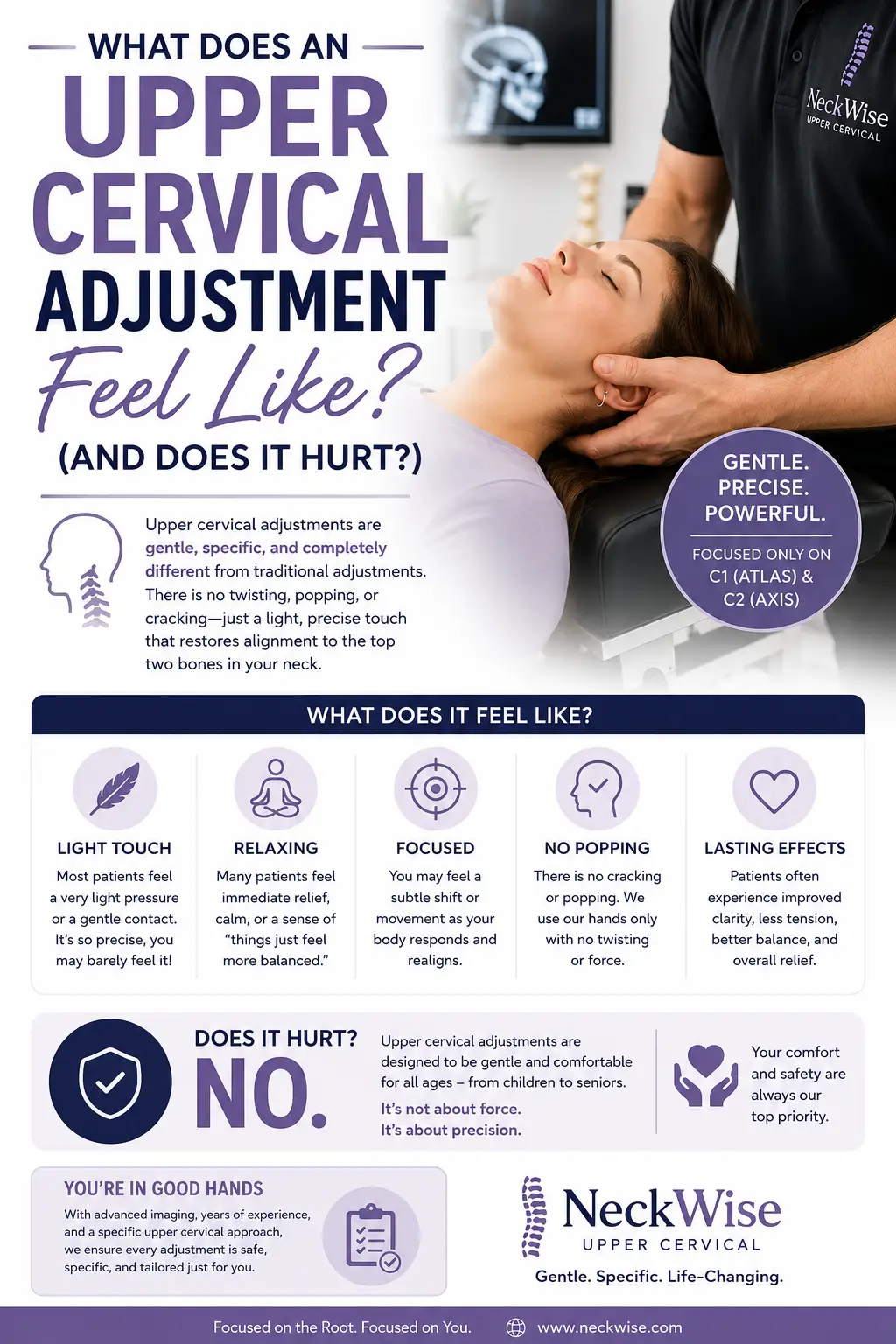
The good news is that an upper cervical correction feels nothing like the dramatic neck-cracking many people picture. It is one of the gentlest things done in all of manual health care. In this article, we want to describe honestly and in detail what an upper cervical adjustment actually feels like — before, during, and after — so that the mystery disappears and you can walk in knowing what to expect. We will also explain why it feels the way it does, what sensations are completely normal afterward, and what the research says about how patients actually experience this style of care. No hype, just a clear picture.
What Does an Upper Cervical Adjustment Feel Like? First, What an Upper Cervical Adjustment Is Not
To understand what the correction feels like, it helps to first clear away what it is not. Upper cervical chiropractic is not the forceful, twisting, “crack the whole neck” maneuver that dominates people’s mental images. There is no rotating your head sharply to one side, no cranking, no sudden yank, and typically no loud popping sound at all.
That popping sound, by the way, is not the adjustment “working” — it is simply gas releasing from a joint capsule when a joint is moved quickly to its end range, the same sound you make when you crack your knuckles. Upper cervical care does not chase that sound and does not require it. Instead, the entire approach is built around a small, specific, low-force input to a single misaligned segment at the very top of the neck. When force and rotation are removed from the equation, so is most of the discomfort people fear.
What the Correction Actually Feels Like
Here is the honest, plain-language description most patients give. As you lie comfortably on your side, the doctor makes a light contact just behind your ear, over the atlas (C1) bone. The correction itself is quick and gentle — most people describe it as a light tap, a soft pressure, or a small impulse. It is over in an instant. Many patients are genuinely surprised, saying some version of “wait, that was it?”
There is no pain in a typical correction. There is no straining, no deep pressure, and no sensation of your neck being forced anywhere it does not want to go. Some people feel a subtle sense of release or relaxation immediately afterward — a feeling of things “settling” or the head sitting more evenly on the shoulders. Others feel a wave of calm or warmth, which reflects the nervous system relaxing. And some people feel very little in the moment at all, which is completely normal and does not mean nothing happened; the effect of an upper cervical correction unfolds over the hours and days that follow, not just in the second it is delivered.
At our Sarasota practice, we use the Knee Chest Upper Cervical technique, a method specifically designed to deliver a precise correction with minimal force. The gentleness is not a compromise — it is the entire design philosophy. Precision replaces power.
Why It Feels So Gentle: The Science of the Thrust
It is natural to assume that “adjusting” a bone must require significant force. In reality, the input used in a specific spinal correction is small, extremely brief, and short in distance. A 2023 scoping review in Chiropractic & Manual Therapiesthat examined the force-time characteristics of spinal manipulation across many studies found that these thrusts are remarkably quick and short-amplitude, with the force applied over a very brief window of milliseconds (force-time characteristics of spinal manipulation). In upper cervical work, the force is at the very low end of that range and the movement is tiny.
This is why the sensation is so mild. The correction happens faster than your muscles can tense up in response, and it moves the segment only the small amount needed to release the misalignment. There is no prolonged pressure to brace against and no large movement to feel. Your body barely has time to register it before it is done. Combined with the fact that we target only one specific segment rather than manipulating the whole neck, the result is an input so refined that many people describe it as almost anticlimactic — in the best possible way.
How Patients Actually Rate the Experience
We do not just want you to take our word for it. When researchers have formally studied how patients experience upper cervical and chiropractic care, the results are consistently positive.
A large prospective, multicenter cohort study published in BMC Musculoskeletal Disorders followed more than a thousand upper cervical patients and measured both their reactions and their satisfaction. Patient satisfaction averaged around 9 out of 10 — an exceptionally high mark — and the symptomatic reactions people did experience were mostly mild and short-lived (upper cervical care: symptomatic reactions and satisfaction). A 2024 systematic review in the Journal of Patient Experience synthesized 43 studies and likewise found consistently high patient satisfaction with chiropractic care, noting that a patient’s experience is shaped heavily by the quality of interaction and communication with the clinician, not just by outcomes (patient experience and satisfaction with chiropractic care).
In short, when people are asked directly, they tend to describe upper cervical care as comfortable and their overall experience as very good. That aligns closely with what we hear in our own office every week.
What’s Normal to Feel Afterward
One of the most reassuring things you can know going in is what a normal response looks like in the hours and days after a correction, so that ordinary adaptation does not catch you off guard. As your body begins to settle into a more balanced position, it is common — and completely benign — to feel some mild, temporary sensations.
Some people feel a little tired or notice they sleep especially deeply the night after a correction. Some feel mild soreness or a sensation of movement in the neck, shoulders, or upper back as posture rebalances. Occasionally people notice brief lightheadedness or an awareness of the area that was corrected. These reactions are typically short and self-resolving.
This pattern is well documented in the research. In the large upper cervical cohort study mentioned above, roughly a third of patients reported some symptomatic reaction, but these were predominantly mild and often lasted less than 24 hours (PMC3204272). A national cross-sectional survey published in Chiropractic & Manual Therapies found that when patients did report an unexpected reaction to care, the most common were benign — most often tiredness or a temporary increase in some symptoms — and that patients generally regarded these with low concern (patients’ experiences of chiropractic care). Think of these sensations less as side effects and more as signs that your body is adapting to a new, more balanced alignment. If anything ever feels significant or lasts longer than expected, we always want you to tell us, but the overwhelming majority of what people feel afterward is mild and passing.
What About Instrument-Based Adjustments?
Some patients specifically ask whether a correction can be delivered without any manual “thrust” at all, especially if they are particularly anxious or have a very sensitive neck. Low-force instrument-assisted methods exist for exactly this reason. A systematic review in the Journal of the Canadian Chiropractic Association examined the Activator adjusting instrument — a small handheld tool that delivers a controlled, light impulse — and found it produced benefits comparable to manual techniques while applying very gentle force (clinical effectiveness of the Activator instrument). The takeaway for a nervous patient is encouraging: gentle, low-force approaches are not a lesser form of care, and there is real flexibility to match the method to your comfort level and clinical needs.
Telling Normal Adaptation From Something to Report
Because we always want you to feel informed rather than worried, here is a simple way to think about the difference between normal adaptation and something worth flagging. Mild, brief sensations — a bit of tiredness, some soreness that eases within a day or two, a feeling of change in your posture or a settling in the neck — are the ordinary, expected response and reflect your body adjusting.
On the other hand, you should always contact us, or seek medical care, if you experience anything sudden and severe, such as a severe or unusual headache, new vision changes, slurred speech, facial drooping, difficulty swallowing, or weakness or numbness on one side of the body. These are not typical reactions to gentle upper cervical care and warrant prompt evaluation. This is not because such events are expected — they are very rare — but because we would always rather you know the difference and never hesitate to reach out. You can call us anytime at (941) 243-3729 with any question about how you are feeling after a visit.
The Nervous System Reason It Feels Calming
Many patients are surprised that a correction to the neck can leave them feeling not just fine but noticeably relaxed. There is a good reason for this. The upper cervical spine is surrounded by an unusually rich concentration of nerve receptors and sits right at the junction of the brainstem, a hub for the body’s automatic regulation. When a precise, gentle correction restores better alignment in this region, it can reduce irritation to the nervous system and shift the body toward a calmer, more balanced state.
That is why the sensation people describe is so often one of release, ease, or quiet rather than the tension you might brace for. The gentleness of the input and the calming of the nervous system go hand in hand. If you want to understand more about how this region influences the whole body, our overview of what an upper cervical chiropractor does explains the connection in depth, and if safety is still on your mind, our article on whether upper cervical chiropractic is safe walks through the evidence.
Nervous About Your First Visit? Let’s Talk First
If you are the kind of person who likes to know exactly what will happen before it happens, we completely understand — and we would rather you call and ask than sit at home wondering. You are welcome to reach our Sarasota office at (941) 243-3729 to talk through what your first correction would involve and to raise any concern, big or small. There is no pressure, and no question is too minor.
What the Research Says at a Glance
To summarize the five studies referenced above: a 2023 scoping review documented that spinal manipulative thrusts are quick and short-amplitude, delivered over mere milliseconds, which explains why the sensation is so brief and mild (PMC10500795). A large upper cervical cohort study found high patient satisfaction (around 9/10) and that reactions to care were mostly mild and short (PMC3204272). A national survey found that unexpected reactions, when they occur, are usually benign — most often tiredness — and viewed with low concern (PMC4307916). A 2024 systematic review of 43 studies confirmed consistently high satisfaction with chiropractic care (PMC11683822). And a review of the Activator instrument showed that gentle, low-force methods deliver benefits comparable to manual techniques (PMC3280118).
Practical Tips for a Comfortable First Correction
You can do a few simple things to make your first experience as relaxed as possible. Try to arrive a little early so you are not rushed. Wear comfortable clothing. Let your doctor know if you are feeling anxious — a good practitioner will slow down and explain each step. Ask to have the technique described or demonstrated before it is performed. Breathe normally and try to let your neck muscles stay soft; there is no need to brace, since the correction is faster and gentler than any bracing could account for. And afterward, drink some water, take it easy for the rest of the day, and let your body settle. These small steps help you feel in control and let you experience just how gentle the process really is.
What to Expect at Your First Visit
Your first visit is unhurried and centered on understanding you before anything is done to your spine. We begin with a thorough consultation and health history. If you are a candidate for care, we take precise 3D CBCT imaging and paraspinal infrared thermography readings so we understand your unique anatomy and nervous system function. We then explain what we found in plain language, and only if it is appropriate do we deliver a gentle correction using the Knee Chest technique. You will always know what is about to happen and why, and nothing proceeds without your understanding and comfort.
Areas We Serve
Our office is located at 5899 Whitfield Avenue, Suite 107, in Sarasota, Florida, at the corner of University Parkway and Whitfield Avenue. We serve families throughout the region, including Bradenton, Lakewood Ranch, Palmetto, Ellenton, Ruskin, Venice, Osprey, Myakka, Tampa, and St. Petersburg. Wherever you are coming from, we are happy to make your first experience an easy one.
Top 15 Questions About How an Adjustment Feels
1. Does an upper cervical adjustment hurt? For the large majority of people, no. Most describe it as a light tap or gentle pressure behind the ear that is over in an instant, with no pain.
2. Will my neck be twisted or cracked? No. Upper cervical care in a low-force practice does not use forceful twisting, and there is typically no popping sound at all.
3. Why don’t I hear a pop? Because the correction does not move a joint to its end range the way knuckle-cracking does. The absence of a pop is normal and does not mean the correction did not work.
4. What will I feel during the correction? Most people feel a brief, light impulse and little else. Some feel an immediate sense of release or relaxation; some feel very little in the moment.
5. Is it normal to feel nothing? Yes. The effect of an upper cervical correction unfolds over hours and days, so feeling little in the moment is completely normal.
6. What might I feel afterward? Mild, temporary sensations such as tiredness, deep sleep, mild soreness, or a feeling of postural change are common and benign, usually resolving within a day or two.
7. Is soreness after an adjustment normal? Yes, mild and brief soreness can occur as your body adapts. Research shows such reactions are common, mild, and short-lived.
8. Could I feel more relaxed after? Many patients do. Restoring alignment in this nerve-rich region can calm the nervous system, leaving people feeling eased rather than tense.
9. How long does the correction itself take? The actual correction takes a fraction of a second. The visit includes time for assessment, but the input to your spine is extremely brief.
10. Is it gentle enough for a sensitive or injured neck? Upper cervical care is specifically low-force, and instrument-assisted options exist for especially sensitive patients. Share your history so we can tailor the approach.
11. What if I’m very anxious about it? Tell us. We will explain and demonstrate each step, go at your pace, and answer every question before proceeding.
12. Do children feel it the same way? Corrections for children use even lighter force and are generally well tolerated. The sensation is similarly mild.
13. When should I call about how I feel afterward? Mild, brief reactions are expected. Contact us or seek medical care for anything sudden or severe, such as a severe headache, vision changes, slurred speech, or one-sided weakness.
14. Will one correction feel different from the next? It can. As your alignment stabilizes, you may need fewer corrections over time, and each may feel slightly different depending on your body’s state that day.
15. How will I know it “worked” if it was so gentle? We use objective measurements, including imaging and thermography, to confirm changes — so you do not have to rely on the sensation of the correction to know whether it was effective.
Come See How Gentle It Really Is
The best way to replace worry with confidence is to experience just how mild an upper cervical correction is for yourself. If you are ready, or if you simply want your questions answered first, call our Sarasota office at (941) 243-3729, or schedule online through our new patient scheduling page. We will make sure you feel informed, comfortable, and in control every step of the way.