Is Upper Cervical Chiropractic Safe? What Every New Patient Should Know
By Dr. Rusty Lavender, D.C. — upper cervical chiropractor, Lavender Family Chiropractic, Sarasota, FL. Reviewed and updated October 2026.
Our complete guide to upper cervical chiropractic care in Sarasota covers the conditions we see, the imaging we use, and what to expect at an evaluation.
Is Upper Cervical Chiropractic Safe? If you have been thinking about upper cervical chiropractic care but a small voice in the back of your mind keeps asking, “Is it actually safe to have someone work on my neck?” — you are asking exactly the right question. The upper neck is where your skull meets your spine, where the brainstem transitions into the spinal cord, and where the vertebral arteries wind their way toward the brain. It is a region that deserves respect and caution. So it makes complete sense that anyone considering care would want to understand the safety of what they are signing up for before they ever lie down on the table.
The short answer is that upper cervical chiropractic, as practiced with modern imaging and low-force correction methods, is considered one of the gentlest and lowest-risk forms of spinal care available. But that answer deserves a real explanation, not just reassurance. In this article, we want to walk you through what makes upper cervical care different from the forceful neck “cracking” you may be picturing, what the research actually says about the risks of cervical care, who should and should not receive it, and how a careful, imaging-guided practice reduces risk even further. Our goal is not to talk you into anything. It is to give you an honest, complete picture so you can make an informed decision for yourself and your family.
Is Upper Cervical Chiropractic Safe? What “Upper Cervical” Actually Means
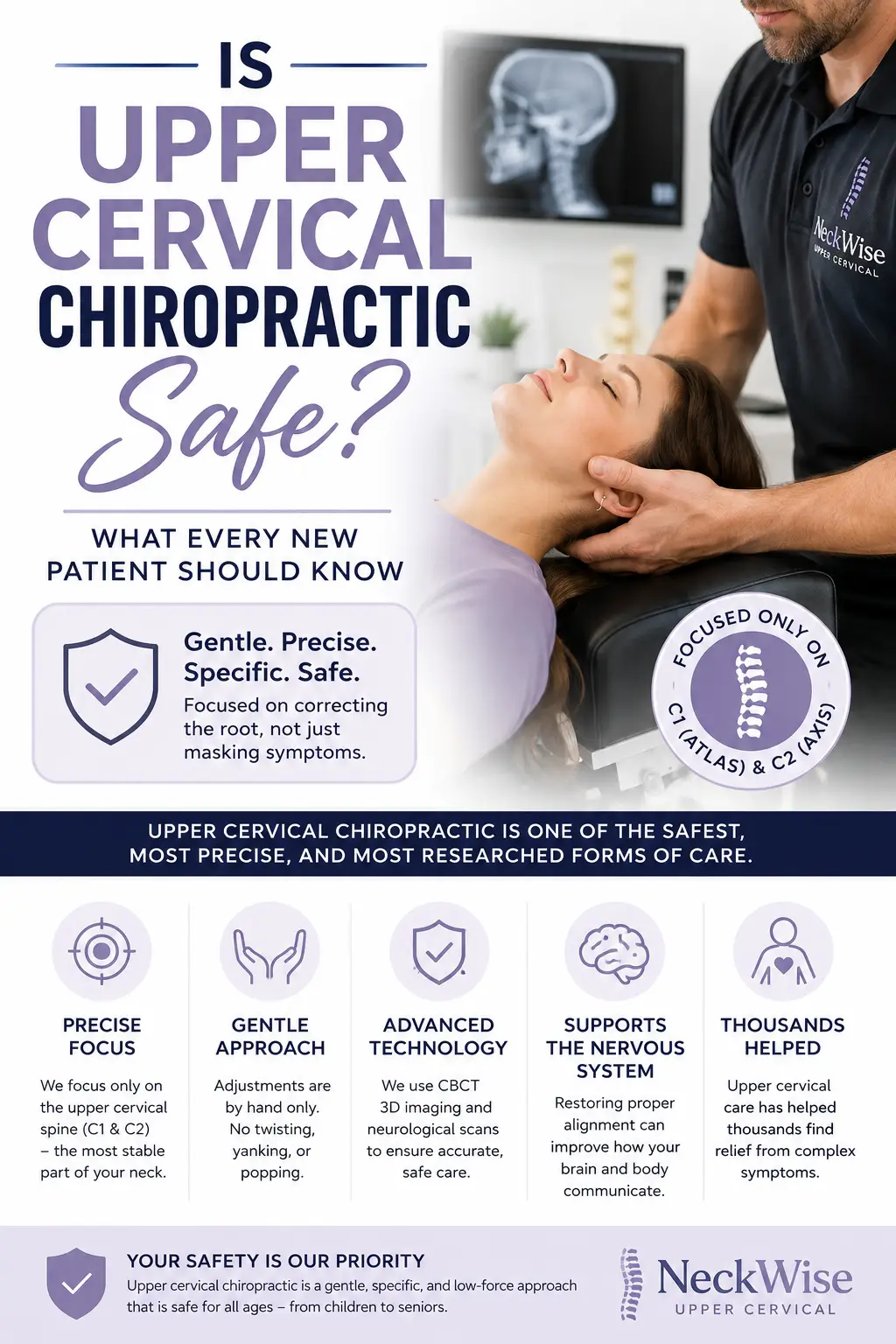
When most people picture a chiropractic visit, they imagine a practitioner twisting the head sharply to one side until it produces a loud pop. That mental image is understandable, but it does not describe upper cervical care. Upper cervical chiropractic focuses on the top two bones of the neck — the atlas (C1) and the axis (C2) — which sit directly beneath the skull and cradle the brainstem. Rather than adjusting the whole spine with broad, forceful movements, an upper cervical correction is a small, precise, low-force input aimed at a single misaligned segment.
Because the atlas and axis are the most freely moving vertebrae in the entire spine and because they sit so close to the brainstem, small misalignments here can have outsized effects on posture, nervous system function, and how the head balances on the neck. The upper cervical approach is built around the idea that a tiny, well-targeted correction to this region is safer and often more effective than repeatedly manipulating many segments at once. The precision is the point. When you know exactly which bone has shifted, in which direction, and by how much, you do not need force — you need accuracy.
At our Sarasota practice, we use the Knee Chest Upper Cervical technique, a specific method that allows a very light, controlled correction without any twisting, cracking, or “popping” of the neck. For many patients, the sensation is little more than a brief, light contact behind the ear.
Why Low-Force Care Changes the Safety Conversation
Much of the public anxiety about neck adjustments comes from the high-velocity, high-amplitude “cracking” style of manipulation, where the joint is rapidly rotated to end range. Upper cervical work in a low-force practice is a fundamentally different act. There is no rotation to end range, no sudden wrenching movement, and no attempt to move many joints at once. Instead, the correction is a small, specific impulse delivered along a pre-calculated vector.
This distinction matters enormously for safety. The concerns people have most often heard about — the very rare reports of injury following neck manipulation — are almost entirely associated with forceful rotational techniques, not gentle, straight-line, imaging-guided corrections. By removing the rotation and the force from the equation, upper cervical care removes much of the theoretical mechanism of harm along with it.
It is also worth understanding that the goal of upper cervical care is not to adjust you over and over indefinitely. The intention is to restore stability so that the correction “holds,” meaning fewer corrections over time, not more. Fewer inputs to a delicate region is, by definition, a more conservative approach.
What the Research Says About the Risks of Cervical Care
Honesty requires acknowledging that no health intervention — from taking an over-the-counter pain reliever to getting a massage — carries literally zero risk. What matters is the size and nature of the risk, and how it compares to the alternatives. Here, the published research is genuinely reassuring.
One of the most important studies on this topic was a large population-based investigation published in Spine in 2008, examining more than 100 million person-years of data and 818 cases of vertebrobasilar stroke. The researchers found that people who had a stroke were no more likely to have seen a chiropractor beforehand than they were to have seen their primary care physician. In other words, the association appeared to reflect the fact that people in the early stages of a stroke often seek care for neck pain and headache — not that the care caused the stroke. You can read that study here: Risk of Vertebrobasilar Stroke and Chiropractic Care.
A 2016 systematic review and meta-analysis published in Cureus, led by a neurosurgeon, examined the proposed link between chiropractic manipulation and cervical artery dissection. The authors rated the overall quality of the evidence as “very low” and concluded that there was no convincing evidence that chiropractic manipulation causes cervical artery dissection, which is itself a rare condition (systematic review and meta-analysis).
A broader 2017 scoping review in Chiropractic & Manual Therapies looked at the risks of manual treatment of the spine across 250 articles. Its balanced conclusion was that benign, temporary side effects — such as short-term soreness or stiffness — are relatively common, while serious adverse events are rare (scoping review of the risks of spinal manual therapy). A 2007 systematic review in the Journal of the Royal Society of Medicine reached a similar conclusion, documenting that serious adverse events are uncommon and that mild, self-limiting reactions are the typical outcome of spinal manipulation (adverse effects of spinal manipulation).
Perhaps most usefully for a safety-minded reader, a 2013 review of 134 case reports of cervical adverse events found that nearly half could potentially have been prevented by appropriate screening for contraindications (safety of cervical spine manipulation). This is a crucial point: much of the risk that does exist is tied to inadequate screening, which is precisely why a careful, imaging-based practice matters so much. When a doctor takes the time to understand your anatomy, your history, and your risk factors before ever touching your neck, the already-low risk drops further still.
How a Careful Practice Reduces Risk Even Further
Safety in upper cervical care is not just about using a gentle technique. It is about the entire process that surrounds the correction. Three elements stand out.
First, imaging. Before we deliver a single correction, we take detailed 3D CBCT (cone beam) imaging of your upper neck. This lets us see your unique anatomy — the exact shape and orientation of your atlas and axis, any anomalies, and the precise nature of the misalignment — down to a fraction of a millimeter. We are not guessing. We are working from a map of your individual spine. This is the opposite of a one-size-fits-all approach, and it directly addresses the screening gap that the research identified as the main preventable source of risk.
Second, objective measurement. We use paraspinal infrared thermography to assess how your nervous system is functioning along the spine. This gives us an objective, non-invasive way to determine whether a correction is even indicated on a given day, so we only work when the data supports it. If your readings show your correction is holding, we do not adjust you just for the sake of it.
Third, clinical judgment about who is and is not a candidate. A responsible upper cervical doctor screens for the conditions and histories that would make any spinal intervention inappropriate. This careful gatekeeping is a core part of what makes the care safe.
Who Should Be Cautious or Seek Medical Evaluation First
Being honest about safety means being clear about when upper cervical care is not the right first step. You should speak with a physician, and let us know your full history, if any of the following apply. Sudden, severe, “worst headache of my life” pain; a new neurological change such as slurred speech, facial drooping, sudden vision loss, difficulty swallowing, or weakness or numbness on one side of the body; a recent significant head or neck trauma that has not been medically evaluated; or symptoms that suggest a stroke in progress are all reasons to seek emergency medical care immediately rather than chiropractic care.
Certain underlying conditions — including some connective tissue disorders, active infection or inflammatory disease of the spine, bone-weakening conditions, certain vascular abnormalities, or a known unstable cervical spine — call for medical clearance and careful evaluation before any spinal care. None of this is meant to alarm you. The vast majority of people are excellent candidates for gentle upper cervical care. But a doctor who takes safety seriously will always want to identify the small number of situations that require a different path, and will refer you appropriately rather than proceed. If you are ever unsure, a conversation costs nothing — you can reach our office at (941) 243-3729 to talk it through before booking anything.
The Upper Neck, the Nervous System, and Why Gentleness Works
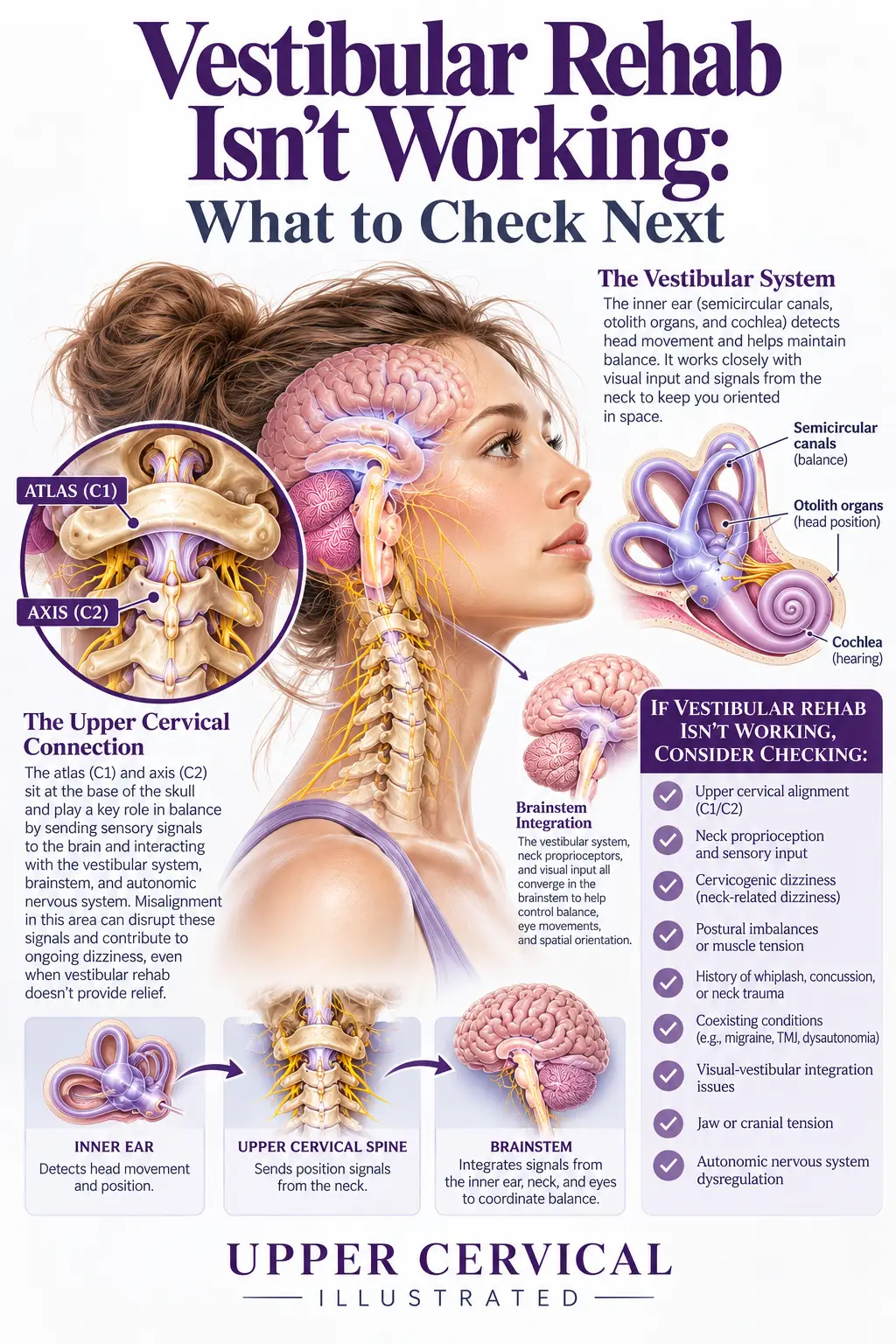
It may seem counterintuitive that a lighter correction could be more effective than a forceful one, but it makes sense when you consider what the upper cervical spine actually does. The atlas and axis surround the brainstem and are surrounded by an unusually dense concentration of nerve receptors that feed information about head position into the brain. This region is not just structural; it is deeply wired into how your nervous system orients and regulates the body.
When a correction is small, specific, and delivered along the right vector, it works with this sensitive system rather than overwhelming it. A forceful, non-specific manipulation floods the region with input and moves structures that did not need moving. A precise, low-force correction gives the nervous system exactly the information it needs to release a misalignment and hold a more stable position. This is why upper cervical practitioners often find that less is more — and why gentleness and effectiveness are not in tension but actually reinforce each other.
If you would like to understand the broader evidence base and reasoning behind this style of care, we cover it in depth in our companion article on whether upper cervical chiropractic is legitimate, and in our overview of what an upper cervical chiropractor does.
Ready to Ask Your Questions? Let’s Talk
If you have made it this far, you clearly care about doing this thoughtfully — and so do we. The best way to find out whether upper cervical care is safe and appropriate for your specific situation is a conversation with a doctor who will look at your history honestly. You are welcome to call our Sarasota office at (941) 243-3729 to ask any question you have, with no pressure and no obligation. We would rather answer ten careful questions up front than have you wonder about a single one.
What the Research Says at a Glance
To summarize the five key studies referenced above, all of which are peer-reviewed and publicly available:
A large 2008 population-based study in Spine found no evidence that chiropractic visits increase stroke risk beyond what is seen with ordinary physician visits, pointing to reverse causation rather than harm (PMC2271108). A neurosurgeon-led 2016 meta-analysis in Cureus found no convincing evidence that manipulation causes cervical artery dissection (PMC4794386). A 2017 scoping review concluded that benign, temporary reactions are common while serious events are rare (PMC5719861). A 2007 systematic review documented that serious adverse events are uncommon and mild reactions are the norm (PMC1905885). And a 2013 review of case reports found that much of the risk that does exist is tied to inadequate screening — reinforcing the value of an imaging-based, carefully screened approach (PMC3360486).
Read together, these studies support a consistent picture: cervical care carries a small risk of temporary, mild side effects and a very rare risk of serious events, and that rare risk is further minimized by careful screening and gentle, precise technique.
Practical Steps to Make Your Care as Safe as Possible
If you decide to explore upper cervical care, there are simple things you can do to make the process as safe and smooth as possible. Share your complete health history, including any medications, past surgeries, imaging, and diagnoses, even if they seem unrelated. Mention any family history of connective tissue or vascular conditions. Tell your doctor about any recent trauma, no matter how minor it seemed. Ask questions about the technique being used and why it is appropriate for you. And pay attention to how you feel after your first correction, reporting anything unusual promptly. A good upper cervical doctor will welcome all of this — thorough communication is part of what makes care safe.
What to Expect at Your First Visit
Your first visit with us is built around understanding your situation before doing anything to your spine. We begin with a thorough consultation and health history, where we listen to your concerns and screen for anything that would change our recommendations. If you are a candidate, we take precise 3D CBCT imaging and thermography readings so we understand your unique anatomy and nervous system function. Only then do we discuss findings and, if appropriate, deliver a gentle, specific correction using the Knee Chest technique. Nothing is rushed, and nothing happens without your understanding and consent. You will leave knowing what we found, what it means, and what a sensible path forward looks like.
Areas We Serve
Our office is located at 5899 Whitfield Avenue, Suite 107, in Sarasota, Florida, at the corner of University Parkway and Whitfield Avenue. We are proud to serve families throughout the region, including Bradenton, Lakewood Ranch, Palmetto, Ellenton, Ruskin, Venice, Osprey, Myakka, Tampa, and St. Petersburg. Whether you are local to Sarasota or traveling in from a neighboring community, we are happy to answer your questions about the safety of upper cervical care.
Top 15 Questions About Upper Cervical Safety
1. Is upper cervical chiropractic safe for the neck? For appropriate candidates, gentle, imaging-guided upper cervical care is considered one of the lowest-risk forms of spinal care, because it uses low force and avoids the forceful twisting associated with most safety concerns.
2. Does an upper cervical correction hurt? Most patients feel little more than a light contact behind the ear. There is no cracking, twisting, or forceful movement involved.
3. Can neck adjustments cause a stroke? Large studies have found no evidence that chiropractic visits raise stroke risk beyond ordinary physician visits, and gentle, non-rotational techniques avoid the mechanisms of concern. Serious events are very rare.
4. What are the most common side effects? The most common reactions are mild and temporary, such as brief soreness, tiredness, or a sensation of change as your body adapts. These typically resolve on their own quickly.
5. Is it safe for children? Because the corrections are extremely light, upper cervical care is often used across the lifespan, including for children, with technique and force adjusted appropriately. Always discuss your child’s specific history with the doctor first.
6. Is it safe for seniors or people with arthritis? Low-force upper cervical care is frequently appropriate for older adults, including many with arthritis, precisely because it does not rely on force. Imaging helps us tailor the approach to your bone health.
7. What makes upper cervical safer than regular neck cracking? The absence of forceful end-range rotation, the focus on a single precise segment, and the use of imaging to guide the correction all reduce risk compared to broad, forceful manipulation.
8. How do you screen for safety before treating me? We take a detailed health history, screen for contraindications, and use 3D CBCT imaging and thermography to understand your anatomy and nervous system before delivering any correction.
9. Are there people who should not receive this care? Yes. Certain vascular, connective tissue, inflammatory, or bone-weakening conditions, recent unevaluated trauma, or signs of a stroke in progress call for medical evaluation first. We screen for these carefully.
10. Does imaging make care safer? Yes. Imaging removes guesswork, letting us see your individual anatomy and misalignment precisely, which directly addresses the screening gap research has identified as the main preventable source of risk.
11. Is the correction the same for everyone? No. Each correction is calculated from your individual imaging and measurements, which is a core part of what makes the care both safe and effective.
12. How often will I need to be adjusted? The goal is stability, so corrections are delivered only when needed and often become less frequent over time as your alignment holds. Fewer inputs to the region is a more conservative approach.
13. What should I tell my doctor before starting? Share your full health history, medications, past imaging, surgeries, any recent trauma, and any family history of vascular or connective tissue conditions.
14. What should I do if I feel unwell after a correction? Report anything unusual to your doctor promptly. Mild, brief reactions are normal, but sudden or significant symptoms should be communicated right away and, if severe, treated as a medical emergency.
15. How do I know if I’m a good candidate? The best way is a consultation. We will review your history, screen for any concerns, and give you an honest answer about whether upper cervical care is appropriate for you.
Take the Next Step With Confidence
Choosing to care for your health is a decision that deserves good information and a doctor who will be straight with you. Upper cervical chiropractic, delivered gently and guided by imaging, offers a conservative, low-risk path for many people — and the only way to know if it is right for you is to ask. Call our Sarasota office at (941) 243-3729, or schedule your first visit online through our new patient scheduling page. We look forward to answering every question you have.
Related Articles
Related Posts


Get our upper cervical articles first.