POTS and Exercise Intolerance: Why Standing and Activity Are So Hard — and the Cause Behind It
By Dr. Rusty Lavender — Lavender Family Chiropractic, Sarasota, FL
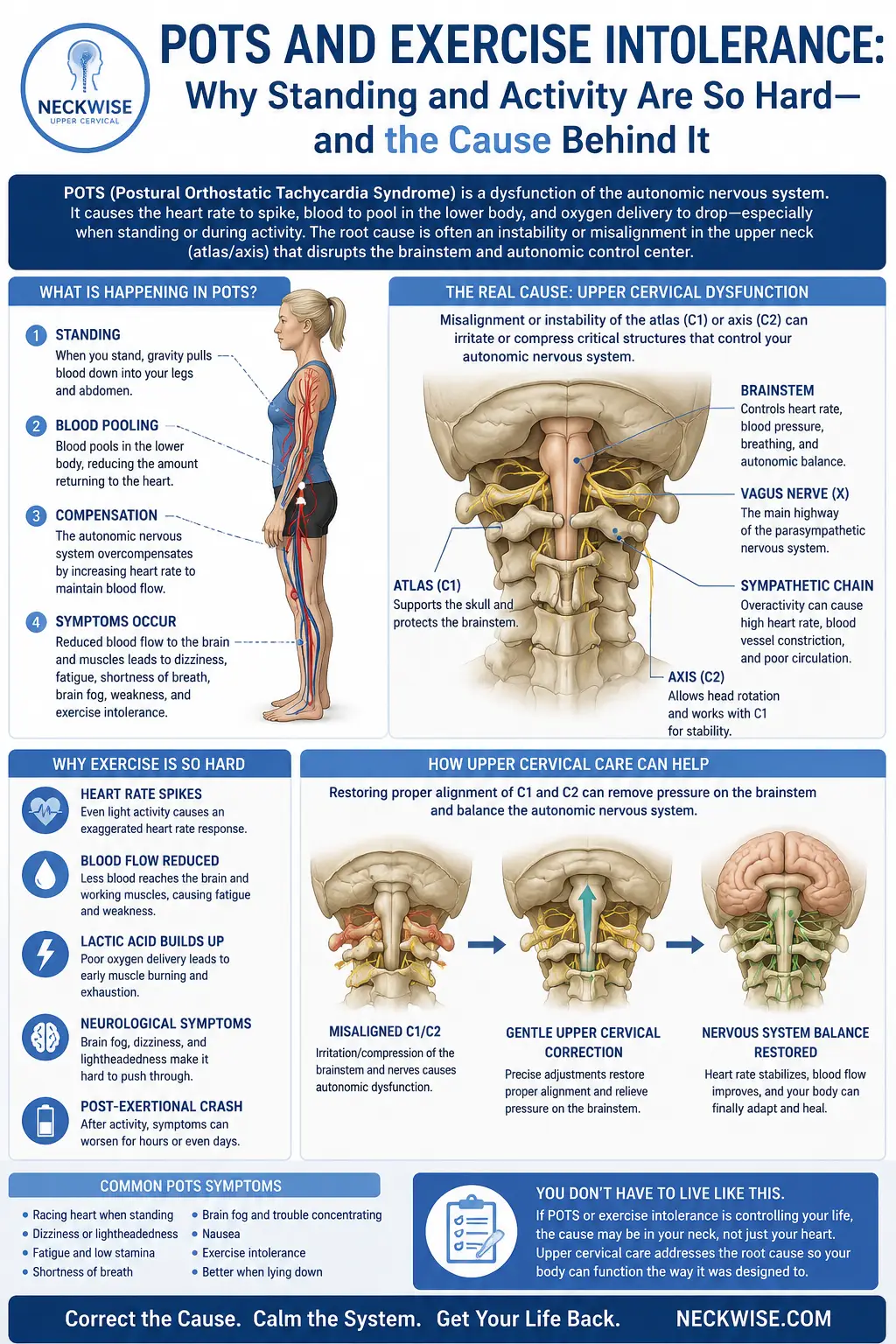
If you have POTS, you already know the cruelty of “just move more.” You stand up and your heart races, your head swims, your legs fill with wet sand — and if you push through a workout, you pay for it with two days flat on the couch. Your exercise intolerance is real, it’s physical, and it has a cause. The question worth asking is what’s driving the broken system in the first place — and for a lot of people, that trail leads straight to the top of the neck.
Here’s the truth this article is built on: your body isn’t broken, and activity isn’t off the table for you. POTS is a genuine disorder of the autonomic nervous system — the automatic network that’s supposed to keep blood flowing to your brain when you stand. When it misfires, upright activity becomes punishing. But two of the biggest reasons standing is so hard are things you can actually change, and there’s an overlooked driver of the whole autonomic failure that almost no one evaluates. We’ll cover both.
What POTS Actually Is
POTS — postural orthostatic tachycardia syndrome — is defined by a measurable pattern: when you stand, your heart rate climbs at least 30 beats per minute (40 in adolescents) within ten minutes, without a big drop in blood pressure, and it comes with a cluster of disabling symptoms — lightheadedness, palpitations, brain fog, crushing fatigue, shakiness, nausea, exercise intolerance, sometimes near-fainting. It hits women far more than men, usually in the teens through the forties, and it very often begins after a specific trigger: a viral illness, mononucleosis, a concussion, a whiplash or car accident, surgery, or pregnancy. That “I got sick or hurt and never bounced back” story is extremely common — and, as you’ll see, it’s a major clue about where the problem is coming from.
POTS is a form of dysautonomia — a failure of automatic regulation. The racing heart you feel is the visible tip of a circulatory control problem happening underneath. Two pieces of that problem explain exercise intolerance directly, and both respond to the right kind of training.
Mechanism One: Deconditioning and the Smaller Heart
When a healthy person stands, gravity drops roughly a pint of blood into the legs and belly, and the body instantly compensates — vessels tighten, blood keeps returning to the heart, and you barely notice. In POTS that compensation fails, less blood returns with each beat, and the heart races to keep any blood moving to the brain. That runaway heart rate is an emergency workaround for a plumbing problem, not the root defect.
A landmark line of research from the Institute for Exercise and Environmental Medicine in Dallas reframed this. In Cardiac origins of the postural orthostatic tachycardia syndrome, published in the Journal of the American College of Cardiology, investigators measured POTS patients’ hearts and blood volumes and found many had smaller, less muscular left ventricles along with reduced blood volume and a lower exercise ceiling. The heart itself had become deconditioned, and a smaller heart pumps less blood per beat — so it has to beat faster to do a normal job.
Why does the heart shrink? The same mechanism that affects astronauts and patients after long hospital stays: the heart is a muscle, and it remodels to the demand placed on it. When standing feels awful, you avoid being upright — and less upright activity means less blood volume for the heart to handle, so it adapts by getting smaller and stiffer. Now the trap is obvious: symptoms make activity miserable, so you move less, which deconditions the heart and the leg muscles that pump blood back up, which makes standing feel worse, which drives more rest. Each turn tightens the spiral. It’s not a character flaw — it’s predictable physiology. And critically, a spiral can be run in reverse.
It’s worth pausing on the leg muscles specifically, because they’re the part patients most often overlook. Your calf and thigh muscles function as a “second heart” — when they contract, they squeeze the deep veins and push pooled blood back up toward your chest against gravity. In a healthy body, the simple act of standing and shifting your weight keeps that muscle pump working in the background. But in POTS, when you spend weeks mostly sitting and lying down, those muscles weaken and the pump falters. Now even more blood pools in your legs when you stand, less returns to the heart, and the tachycardia gets worse. This is why the crash isn’t only about the heart — it’s about an entire lower-body pumping system that’s gone quiet from disuse, and it’s why rebuilding leg strength is not optional accessory work but a core lever of recovery.
Mechanism Two: Low Blood Volume
The second mechanism works with the first. Many people with POTS are running on less circulating blood than they should — hypovolemia. Studies measuring plasma and red-cell volume repeatedly find a large share of POTS patients below normal. Start with a low tank, then let gravity yank a big share of it into your legs on standing, and even less returns to the heart — so it races harder. Low volume also means less reserve for exercise, when working muscles demand a huge jump in blood flow; there simply isn’t enough to supply the muscles and the brain at once, so activity triggers dizziness, breathlessness, and the post-exertional crash.
There’s a hormonal twist: many POTS patients have a blunted salt-and-water-retaining response, so the body fails to defend its own blood volume. That’s why drinking water alone often isn’t enough — without enough sodium to hold that water in the bloodstream, it’s quickly lost. It’s the rationale behind the fluid-and-salt strategies your physician may recommend, and behind waist-high compression garments that limit pooling from the outside. One firm caution: aggressive salt loading is harmful for people with certain blood-pressure, kidney, or heart conditions, so the targets belong to your physician, not an internet forum.
Deconditioning and low volume reinforce each other — and, encouragingly, they respond to overlapping treatment. Endurance training expands plasma volume over weeks; salt and fluid supply the raw material. That’s why the leading non-drug approach attacks both at once.
Why “Just Exercise More” Backfires — and What Works
If reconditioning is so valuable, why does telling a POTS patient to exercise so often make them worse? Because the formmatters, and conventional advice ignores the one feature that decides everything: body position.
Standard advice assumes you can tolerate being upright — go for a walk, hop on a treadmill. For a POTS body, upright exercise is the hardest possible starting point: it stacks exertion on top of fighting gravity at the exact moment your circulation is least able to handle either. Start a deconditioned POTS patient on a treadmill and they crash, conclude exercise is impossible, and retreat into more rest — deepening the very deconditioning that needs reversing.
The fix the Dallas group developed is elegantly simple: start where gravity isn’t the enemy. Recumbent and horizontal modes — a lie-back (recumbent) bike, a rowing machine, swimming or pool work — let you build real cardiovascular fitness while blood returns to the heart easily and the reflex tachycardia stays mild. You accumulate genuine training minutes without provoking the standing-up catastrophe. Then, over months, the program shifts gradually toward upright — recumbent bike to upright bike, then walking or an elliptical — while adding lower-body and core strength, because strong legs act as a “second heart,” squeezing blood back upward and directly countering the pooling that drives symptoms. Progress is measured by heart rate, not speed, and in months, not days. This is the “Levine protocol” (after Dr. Benjamin Levine), also called the Dallas or CHOP protocol.
What the Research Says About Reconditioning
The most direct test came in Short-term exercise training improves the cardiovascular response to exercise in POTS, published in The Journal of Physiology. POTS patients completed a structured, recumbent-first endurance and strength program over roughly three months. Training enlarged the heart, expanded blood volume, brought upright heart rates down, and raised exercise capacity — and a meaningful share of participants improved enough that they no longer met the strict heart-rate criteria for POTS by the end. Quality of life improved too. Two reviews in Autonomic Neuroscience — Exercise in the postural orthostatic tachycardia syndrome and Exercise and non-pharmacological treatment of POTS — lay out the recumbent-first approach and show these measures work best in combination: exercise plus volume expansion plus compression. And the 2015 Heart Rhythm Society expert consensus statement endorses structured, progressive exercise as a core component of POTS care. This is mainstream, guideline-supported thinking, not a fringe idea.
Reconditioning is powerful and worth doing. But it treats a consequence — the deconditioning your POTS caused. It doesn’t answer the deeper question: what broke the autonomic regulation to begin with? For a lot of people, that’s where the neck comes in.
The Driver Behind the Broken Autonomic System — Your Neck
Reconditioning rebuilds the heart and the volume. But the reason your heart-rate control went haywire in the first place lives in the autonomic nervous system — and the master controls for that system sit in one anatomically vulnerable place. The brainstem — home to the baroreflex center that manages heart rate and blood pressure, and the origin of the vagus nerve, your body’s main “rest and regulate” cable — sits at the junction where your skull meets your neck, inside the ring of your top two vertebrae, the atlas (C1) and axis (C2). The upper neck literally surrounds the machinery that fails in POTS. When that region is misaligned, it can directly interfere with the system that’s supposed to steady your circulation when you stand.
Now look back at how POTS so often starts: after a concussion, a whiplash, a car accident — injuries to the head and neck. And look at who gets it: POTS travels tightly with joint hypermobility and hypermobile Ehlers-Danlos syndrome, and that same connective-tissue laxity affects the ligaments holding your head onto your spine at the craniocervical junction — allowing excess movement at the exact junction that houses the autonomic control center. For a meaningful share of POTS patients, the upper neck isn’t a footnote. It’s a primary driver of the autonomic dysfunction — and it’s the one region a standard cardiology and neurology workup never evaluates.
This is why so many people who’ve done the fluids, the salt, the compression, and even the reconditioning still feel stuck — and why nearly all of them have never had the top of their neck properly examined.
The Overlap That Makes the Neck Connection Even Stronger
The link between POTS and the neck gets harder to dismiss the more closely you look at who develops POTS in the first place. POTS clusters tightly with joint hypermobility and hypermobile Ehlers-Danlos syndrome — conditions where the connective tissue throughout the body is more lax than normal. That same laxity doesn’t stop at the fingers and knees; it affects the ligaments at the craniocervical junction, the ones responsible for holding your head steady on top of your spine. When those ligaments are loose, the top of the neck moves more than it should, right at the junction that surrounds the brainstem’s autonomic control center. For a hypermobile person with POTS, that isn’t a coincidence — it’s a mechanical link between the connective-tissue disorder, the unstable upper neck, and the autonomic dysfunction.
The post-viral picture points the same direction. A large wave of people developed POTS after viral illness, and researchers studying post-viral syndromes keep finding the same trio: connective-tissue laxity, dysautonomia, and a triggering illness. Add the concussion and whiplash cases — direct trauma to the head and neck — and a pattern emerges that a purely cardiac model doesn’t fully explain. In each of these routes into POTS, the upper cervical spine sits at the crossroads. Reconditioning rebuilds what deconditioning took. But if a lax or injured upper neck is part of what dysregulated your autonomic system to begin with, no amount of recumbent cycling addresses that piece — because the exercise program was never designed to. That’s precisely the gap an upper cervical evaluation fills.
How We Evaluate the Upper Cervical Piece
At Lavender Family Chiropractic, we focus exclusively on the upper cervical spine. Our approach is built on measurement. We use 3D CBCT imaging to see your atlas and axis alignment in three dimensions, and paraspinal infrared thermography to read how your nervous system is behaving along the spine — directly relevant in a condition defined by autonomic dysregulation. When a correction is warranted, we use the Knee Chest Upper Cervical technique: precise, gentle, and low-force, with no twisting, cracking, or popping — which is exactly why it suits a hypersensitive, easily-overwhelmed nervous system and the hypermobile patients in whom forceful manipulation would be inappropriate.
Keep your cardiologist, keep your reconditioning, keep your fluids and salt — those matter, and we’d never tell you to stop them. What we add is attention to the cervical and craniocervical contribution that’s almost always missing. If you’ve done everything you were told and no one has evaluated the top of your neck, that’s the gap worth closing.
How to Recondition Safely
If you’re starting an exercise program, how you start matters as much as the decision to start:
- Get evaluated first. Confirm the diagnosis and get guidance from a cardiologist, autonomic specialist, or a physical therapist experienced with POTS.
- Start recumbent or in water. Recumbent bike, rowing, or pool work. Don’t “test” yourself with a walk on day one — the point is to build capacity in a position your circulation can tolerate.
- Go by heart rate, and go slowly. Target a moderate heart-rate zone and hold it; add minutes before intensity. A wearable heart-rate monitor helps. Progress is measured in months.
- Build the legs. Lower-body and core strength isn’t optional — strong legs physically push blood back toward the heart.
- Expand fluids and salt, under guidance. Well-hydrated, volume-loaded circulation tolerates exercise far better. Compression garments help.
- Respect pacing. Post-exertional crash a day or two after overexertion means you exceeded your envelope. A slightly-too-easy session you can repeat beats a punishing one that costs you three days.
- Expect a bumpy start. The first weeks can feel harder before they feel easier. Persistent worsening, though, is worth reporting to your care team.
Red Flags: When to Seek Prompt Medical Care
POTS itself is usually not dangerous, but some symptoms overlap with conditions that are. Seek prompt medical attention — don’t assume it’s “just POTS” — for: chest pain or pressure, especially with exertion; fainting (actually losing consciousness), particularly without warning, with injury, or during exertion; severe or sudden shortness of breath; a very fast heart rate that won’t settle when you lie down; neurological symptoms such as sudden weakness, facial droop, difficulty speaking, sudden severe headache, or vision loss; signs of significant dehydration or inability to keep fluids down; or a dramatic, unexplained worsening of your baseline. When in doubt, get checked — especially before pushing into a new phase of an exercise program.
Top Questions
Is POTS caused by being out of shape? No. It’s a genuine autonomic disorder that often strikes previously active people, frequently after an illness or injury. But once POTS sets in, the deconditioning spiral becomes part of the problem — and because it’s a consequence, reconditioning can address it.
Why does my heart race the second I stand? Because less blood returns to your heart when you’re upright, so it beats faster to keep blood reaching your brain. The racing heart is the workaround, not the root problem.
If exercise helps, why do I crash every time I try? Almost always because of how it was started. Upright exercise is the hardest entry point. Evidence-based programs start recumbent and progress to upright gradually over months.
Does reconditioning fix the underlying cause? It reverses the deconditioning and low volume that make standing so hard — a huge part of the disability. But it doesn’t address what disrupted your autonomic regulation in the first place. If your POTS started after a concussion or whiplash, or you’re hypermobile, the upper neck is a driver worth evaluating.
Should I stop my cardiology care or medications to try this? Absolutely not. Reconditioning and any upper cervical care work alongside your physician’s plan, never in place of it.
Serving Sarasota, Lakewood Ranch & Bradenton
POTS and exercise intolerance don’t respect city lines, and neither do we. Lavender Family Chiropractic (NeckWise North Sarasota) serves patients throughout Sarasota, Lakewood Ranch, and Bradenton from our office at 5899 Whitfield Avenue — the corner of University and Whitfield, a quick drive from the Lakewood Ranch corridor and just south of Bradenton. If you’ve done the fluids, the salt, the compression, and even the recumbent reconditioning across Sarasota or Lakewood Ranch and still feel stuck, we evaluate the upper cervical spine — the region that houses your autonomic control center — with 3D CBCT imaging and paraspinal infrared thermography. Patients from Sarasota, Lakewood Ranch, and Bradenton are welcome, and we coordinate with your existing medical team.
A Realistic, Hopeful Bottom Line
Living with POTS is hard, and exercise intolerance can feel like a locked door. But the biology tells a hopeful story. Much of what makes standing so difficult — a smaller, less efficient heart and a blood volume that runs too low — responds to the right stimulus applied the right way, and many people reclaim real function within months. Pair that reconditioning with fluids and salt, and then close the gap almost everyone leaves open: have the region that controls your autonomic system — the top of your neck — actually evaluated.
If you’ve done the fluids, the salt, the compression, even the exercise, and you’re still stuck, the piece no one checked may be one inch below your skull. Call (941) 243-3729 or book a complimentary consultation — we’ll review your history, evaluate your upper cervical spine with 3D imaging, and coordinate with your medical team.
Lavender Family Chiropractic (NeckWise North Sarasota) · 5899 Whitfield Avenue, Suite 107, Sarasota, FL 34243 · (941) 243-3729
This article is for general educational purposes and is not medical advice. POTS should be evaluated and managed by qualified medical professionals. Always talk with your physician before beginning or changing an exercise program, fluid and salt strategy, or medication. If you experience chest pain, fainting, or severe shortness of breath, seek immediate medical attention.
Related Articles
Get our upper cervical articles first.
Patients Experience