The Vagus Nerve, Heart Rate, and HRV: Why the Top of Your Neck May Be Driving Your Numbers
By Dr. Rusty Lavender, D.C. — upper cervical chiropractor, Lavender Family Chiropractic, Sarasota, FL. Reviewed and updated October 2026.
Your heart is beating right now, and you are not deciding when. Something quietly steady is doing that job for you — speeding you up on the stairs, easing you down onto the couch — and most of that work belongs to a single nerve: the vagus. Here is what almost no wearable app, sleep coach, or HRV article will tell you: the vagus nerve exits the base of your skull and runs straight down past your atlas — the very top bone of your neck — before it ever reaches your heart. When that bone is misaligned, it can irritate the exact nerve your HRV score is trying to measure. If your recovery numbers are stubbornly low and no one can tell you why, the reason may be sitting one inch below your skull, in the one place nobody thought to check.
I get asked about heart rate variability constantly — by patients in Sarasota, by people driving in from Lakewood Ranch and Bradenton, by anyone who has strapped on an Oura ring, a Whoop band, or a fitness watch and watched a three-letter number rise and fall for reasons they cannot explain. HRV is one of the more scientifically grounded numbers your device will ever show you. But the conversation around it almost always stops at breathing, sleep, and alcohol, and skips the structural piece entirely. This article gives you the honest, complete version: what the vagus nerve does, how it steers your heart, what HRV actually measures — and why the upper neck belongs in the discussion as a driver worth evaluating.
This article is for general educational purposes only and is not a substitute for medical advice, diagnosis, or treatment. If you have symptoms, a diagnosed condition, are pregnant, or take medication, talk with your physician.
Meet the Vagus Nerve: Your Body’s Longest Wandering Wire
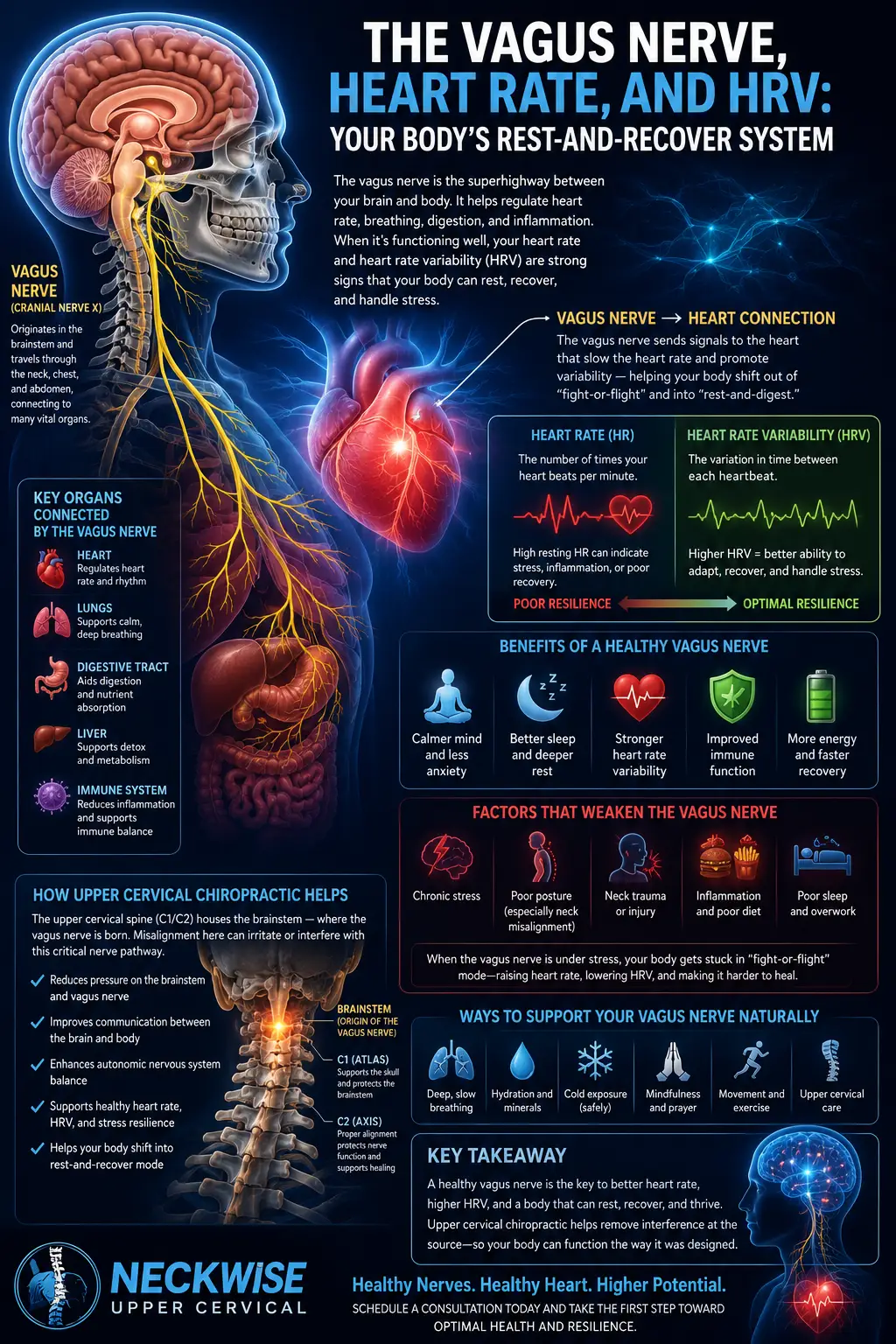
The word vagus comes from the Latin for “wandering,” and the name is earned. The vagus is the tenth cranial nerve, and unlike most nerves it does not stay in one neighborhood. It emerges from the brainstem, exits the skull, travels down through the neck, and branches out to touch the heart, the lungs, the voice box, the stomach, and much of the digestive tract. It is the main highway of the parasympathetic nervous system — the “rest-and-digest,” or as I prefer, the “rest-and-recover” branch of your autonomic nervous system.
Pay attention to that route, because it is the whole point of this article. Your autonomic nervous system runs automatically, without conscious input, and it has two branches that work together like the gas pedal and the brake in a car:
- The sympathetic branch is the accelerator. It readies you for action — the classic “fight or flight” response. It raises your heart rate, sharpens focus, tenses muscles, and pushes blood toward the systems you would need in an emergency.
- The parasympathetic branch is the brake, and the vagus nerve is its most important cable. It slows your heart rate, supports digestion, promotes tissue repair, and helps your body return to a settled, restorative baseline after a stressor passes.
Neither branch is “good” or “bad.” You need the accelerator to escape danger, hit a deadline, or sprint for a bus. You need the brake to sleep, to heal, to digest, and to recover. Health lives in the flexible balance between the two — the ability to rev up when life demands it and, crucially, to settle back down afterward. That capacity to settle back down is where the vagus nerve shines, and it is exactly what a stubbornly low HRV is telling you may be compromised.
The Anatomy Nobody Mentions: Where the Vagus Actually Runs
Here is the sentence that changes the entire conversation. After the vagus exits the skull through an opening at the base called the jugular foramen, it runs straight down through the upper neck — passing within a finger’s width of your atlas (C1), the topmost vertebra that balances the full weight of your head.
Read that again. The main “rest and recover” cable of your entire nervous system threads through the exact region where your skull meets your spine — right alongside C1 and the axis (C2) below it, the two vertebrae held in place mostly by ligaments rather than interlocking bone. There is nowhere else in the body where a nerve this important sits in such close mechanical relationship to moving, weight-bearing bones.
That anatomy is precisely why the upper neck belongs in any honest conversation about the vagus nerve and HRV — and why leaving it out, as nearly every wearable-app explainer does, misses the structural half of the story. When that top segment shifts out of alignment, the surrounding muscles, tissues, and structures at the skull base come under abnormal tension at the very junction the vagus passes through. The plausible consequence is not a simple neck ache. It is ongoing irritation of the nerve responsible for your entire rest-and-recover system — which is exactly the function HRV was designed to estimate. If you have been chasing a low number, this is the region no one measured.
How the Vagus Nerve Steers Your Heart Rate
Your heart has its own built-in pacemaker. A cluster of specialized cells called the sinoatrial (SA) node generates the electrical impulses that trigger each beat. Left entirely to its own devices, with no input from the nervous system, that pacemaker would fire at roughly 100 beats per minute.
Yet most healthy adults at rest sit well below that — often in the 60s or 70s. Why the difference? Because the vagus nerve is constantly applying a gentle brake. This continuous, moment-to-moment restraining signal is called vagal tone. When vagal activity increases, your heart rate slows. When vagal activity backs off, your heart rate is free to climb.
The vagus does this with remarkable speed. Its influence on the SA node acts within a fraction of a second, beat to beat, using the neurotransmitter acetylcholine — much faster than the sympathetic system, whose effects build and fade more slowly. That speed matters enormously for understanding HRV, so hold onto it.
You can feel this system working if you pay attention. Take a slow breath in and your heart rate ticks up slightly; exhale slowly and it eases back down. That rhythmic rise and fall, synced to your breathing, is called respiratory sinus arrhythmia — an intimidating name for a completely normal, healthy phenomenon. It happens because vagal activity waxes and wanes with each breath: the vagal brake eases off a little as you inhale and presses a little more as you exhale. The presence of this breathing-linked variation is one of the clearest everyday signs of a responsive, well-functioning vagal system — and its absence is a clue that the system is under strain.
So What Is Heart Rate Variability, Really?
Here is the idea that trips people up, so let’s slow down for it.
A healthy heart does not beat like a metronome. If your heart rate is 60 beats per minute, that does not mean exactly one beat every 1.000 seconds. In reality, the interval between beats is constantly, subtly changing — 0.90 seconds here, 1.05 there, 0.95 next, and so on. Heart rate variability is a measurement of those tiny, beat-to-beat differences in timing.
This is counterintuitive at first. We assume “steady” equals “healthy,” and that a perfectly regular heartbeat would be the goal. For heart rhythm, in the sense of avoiding dangerous arrhythmias, regularity matters. But for this beat-to-beat timing, the opposite is generally true: a heart that can vary its timing moment to moment is a heart being actively, flexibly managed by a responsive nervous system. A rigidly regular interval, with very little variation, often signals a system that has lost some of that adaptive flexibility.
Think of a skilled driver on a winding road, making countless micro-adjustments to the wheel. Those small corrections are not poor driving — they are the sign of an engaged, responsive driver reacting in real time. A car locked rigidly straight ahead would actually be more worrying. Higher HRV reflects that kind of moment-to-moment responsiveness in your cardiovascular control.
Because the vagus nerve acts so quickly, beat to beat, much of the short-term variability in your heart’s timing is driven by parasympathetic (vagal) activity. This is the key link that makes HRV so interesting: several of the standard HRV measurements are considered useful, non-invasive windows into cardiac vagal tone. When researchers want to estimate how active someone’s parasympathetic brake is without anything invasive, HRV is one of the primary tools they reach for. And it is the reason your low number should push you to ask why the brake is weak — not just how to squeeze out a better score.
A quick tour of the common HRV metrics
You do not need to memorize these, but it helps to recognize what your device might show:
- RMSSD — the root mean square of successive differences between heartbeats. It captures how much the timing jumps from one beat to the very next. Because those jumps happen fast, RMSSD is strongly tied to vagal activity and is one of the most commonly reported short-term markers of parasympathetic tone.
- SDNN — the standard deviation of the intervals between beats over a period of time. It reflects overall variability from all sources, both sympathetic and parasympathetic.
- HF power (high-frequency) — a frequency-based measure that tracks the breathing-linked variation discussed above, and is also considered a marker of vagal activity.
- pNN50 — the percentage of consecutive beats that differ by more than 50 milliseconds, another beat-to-beat, vagally influenced measure.
Different wearables use different metrics (many lean on RMSSD because it is stable and measurable during sleep), which is one reason numbers do not always match across devices. That is not a defect — it is a reminder that HRV is a family of related measurements, not a single universal score.
High HRV vs. Low HRV: What the Numbers Tend to Mean
In broad strokes, across large groups of people, the research points in a consistent direction:
- Higher HRV is generally associated with a well-functioning parasympathetic system, better cardiovascular fitness, good recovery, and the capacity to adapt to stress. It tends to be seen in people who are well-rested, well-conditioned, and not under heavy load.
- Lower HRV is generally associated with the body being under strain — from acute stress, poor sleep, illness, overtraining, dehydration, alcohol, or the wear of chronic stress. Persistently low HRV has been linked in population studies to a range of health concerns.
That is the honest, useful summary. Now the honest caveats, because HRV is easy to over-interpret.
HRV is deeply personal
There is no single “good” HRV number that applies to everyone. Healthy values vary enormously — one healthy 45-year-old might sit around 40 while another sits around 90, and both can be perfectly normal. HRV is most meaningful as a trend within one individual over time, not as a score to compare against your neighbor or a friend at the gym. The useful question is rarely “Is my number high or low compared to other people?” It is “How does today compare to my own recent baseline, and what changed?”
Age, sex, and many other factors shift the baseline
HRV tends to decline gradually with age, reflecting natural changes in autonomic regulation. There are documented differences related to sex, and HRV is influenced by breathing rate, body position, time of day, hydration, caffeine, alcohol, medications, recent exercise, and even the emotional tone of your last few hours. A single reading under different conditions can look very different, which is exactly why context matters.
HRV is a window, not a diagnosis
Hold onto this one. HRV is a genuinely useful, well-studied marker, but it is an indirect estimate of autonomic activity with real technical limitations. It cannot, by itself, diagnose a disease. A low reading after a bad night’s sleep and two glasses of wine is not a medical emergency; it is your body honestly reporting that it is under load. Treat HRV as helpful feedback — feedback that, when it stays stubbornly low, is worth investigating all the way down to the structure of your neck.
The Piece Nobody Checks: When the Nerve Itself Is Being Irritated
Here is where nearly every HRV article stops short, and it is the most important part. All the standard advice — sleep more, breathe slower, drink less — assumes one thing: that your vagus nerve is structurally free to do its job and simply needs better inputs. But what if the nerve itself is being mechanically irritated where it runs through the top of your neck? Then you can do everything “right” and still watch your recovery numbers sit flat, because you are optimizing inputs to a cable that is being pinched at the source.
Remember the anatomy. The vagus exits the skull at the jugular foramen and travels down alongside the atlas (C1) and axis (C2) — the two vertebrae that carry the entire weight of your head, held largely by ligaments rather than interlocking bone. When that top segment shifts out of alignment, the tissues at the skull base come under abnormal tension at the exact junction the vagus passes through. The result can be ongoing irritation of the very nerve your HRV score is estimating — a nervous system nudged toward sympathetic overdrive and away from the rest-and-recover state that produces healthy variability.
This also explains a pattern I see constantly here on the Suncoast: people whose autonomic symptoms — the low HRV, the racing resting heart rate, the poor sleep, the wired-but-exhausted feeling — trace back to a head or neck injury. A concussion, a whiplash, a car accident, or even years of forward-head posture hunched over a screen or phone loads and destabilizes the very region the vagus runs through. If your numbers dropped or your symptoms started after something happened to your head or neck, that is a loud clue that the driver may be structural, sitting one inch below your skull, in a region your workup almost certainly never examined. That is not a reason to ignore your physician — it is a reason to add the one evaluation nobody offered you.
Why This Matters for Stress, Recovery, and Everyday Health
So why should any of this matter as you go about your week in Sarasota, Lakewood Ranch, or Bradenton? Because HRV gives you a rare, tangible glimpse into how well your body is balancing effort and recovery — and because a low trend that will not budge is a signal to look deeper, not to shrug.
Stress. Under sustained stress, the sympathetic accelerator stays pressed and the vagal brake eases off. HRV often drops. If your morning number has been trending low through a stretch of deadlines and poor sleep, that is a coherent picture of a nervous system running the accelerator hard — and if it stays low even when life calms down, the question becomes whether something structural is keeping it there.
Recovery and training. Athletes and coaches use HRV to gauge readiness. A well-recovered body shows HRV near or above its personal baseline; an overreached, under-slept, or run-down body often shows a dip. Used sensibly, this helps you decide whether today is a day to push or back off. Used obsessively, it becomes one more thing to worry about — so hold it lightly.
Sleep. Much of your vagal, restorative activity happens during deep sleep, which is why many devices measure HRV overnight. Good sleep supports healthy HRV; poor or disrupted sleep drags it down. Sleep is one of the most reliable levers you have — but a nervous system stuck in overdrive by upper cervical irritation can undermine the very sleep you are counting on.
Long-term health. Because HRV reflects the flexibility of your autonomic nervous system, it has become a marker of interest in cardiovascular and general health research. Nudging a number on an app does not change your destiny — but the number is pointing at something real: the adaptability of the system that keeps your heart, and much else, running.
Practical, Evidence-Aligned Ways to Support Your Vagal System
People always want the takeaway list, so here is one — grounded in the general direction of the science and in things that are safe and free. None are magic, and none are promises. Think of them as supporting conditions your body already knows how to use.
- Prioritize sleep. Consistent, sufficient sleep is among the most dependable supports for healthy autonomic balance. Regular bed and wake times help.
- Practice slow breathing. Slow, relaxed breathing — extending the exhale in particular — engages the respiratory-vagal link in real time. A few minutes is a genuinely vagal activity, and it is free.
- Move your body regularly. Regular aerobic exercise is broadly associated with healthier HRV over time. Recovery days matter as much as hard days.
- Go easy on alcohol, especially in the evening. Alcohol reliably suppresses overnight HRV. If you track your number, you will see it.
- Manage stress deliberately. Time outdoors, connection with people you care about, prayer or meditation, or simply protecting some unhurried time gives the parasympathetic system room to work.
- Stay hydrated and eat regularly. Dehydration and erratic fueling both show up in autonomic measures.
If you take one thing from this list, let it be this: the fundamentals are not glamorous, but they are real leverage. And if you are already doing them and your number still will not move, that is precisely the moment to stop assuming you are failing at the basics and start asking whether the nerve itself is free to respond.
Where the Upper Cervical Spine Fits — and Why We Evaluate It
The vagus exits the skull and travels through the upper neck. The very top of your spine — the upper cervical region, where the skull meets the first two vertebrae — is anatomically a busy, decisive intersection for the nervous system. As an upper cervical chiropractor, my clinical focus is the relationship between the alignment and mechanics of that region and the overall function and balance of the nervous system. Given that the vagus is a direct neighbor to this area, autonomic balance is not a side topic for us — it is central to what we look at.
Let me be straight about the current science: high-quality research directly proving that chiropractic care raises HRV is still limited, and I am not going to promise you a number. What I will tell you is that the anatomy is not speculative — the vagus genuinely runs past C1 — and that when someone’s autonomic symptoms began after a neck injury and their HRV will not recover, the upper cervical spine is a driver worth evaluating rather than ignoring. Here is how we actually work:
- Our attention to autonomic and nervous-system balance is a complement to, not a replacement for, medical care.If your heart rate, rhythm, or autonomic symptoms are a concern, that belongs with your physician, and we coordinate rather than compete.
- We use 3D CBCT imaging to see your upper cervical alignment in three dimensions, and paraspinal infrared thermography to read how your nervous system is actually behaving along the spine — directly relevant when the whole question is autonomic regulation.
- When a correction is warranted, we use the Knee Chest Upper Cervical technique: precise, gentle, and low-force — with no twisting, cracking, or popping. For a nervous system already stuck in overdrive, that gentleness is the entire point.
The goal is simple: give an overwhelmed nervous system a calmer structural environment so it can do its job. Keep your physician, keep your breathing practice, keep your healthy habits. What we add is attention to the one region that sits at the crossroads of the vagus nerve and the spine — the piece almost everyone else skips.
Red Flags: When Heart Rate and HRV Signals Need a Doctor, Not an App
This is the most important section in the article, so please read it carefully. HRV and heart rate are useful, but certain symptoms are not “wellness metrics” to track — they are reasons to seek medical care promptly. Treat the following as signals to contact a physician, urgent care, or emergency services rather than something to observe on a wearable:
- Fainting or near-fainting (passing out, or feeling like you are about to).
- Chest pain, chest pressure, or tightness, especially with exertion or radiating to the arm, jaw, or back.
- A very low heart rate that comes with dizziness, weakness, confusion, or shortness of breath.
- A very high, racing, pounding, or irregular heartbeat, particularly if it is sudden, sustained, or accompanied by lightheadedness or breathlessness.
- Unexplained shortness of breath, severe fatigue, or swelling that is new or worsening.
A wearable’s HRV or heart-rate reading is not a substitute for medical evaluation, and no chiropractor — myself included — is the right first stop for these symptoms. If something in your body feels genuinely wrong, get it checked by a physician. Devices are for trends and general awareness; symptoms like these are for doctors.
What the Research Says
I want to point you to real sources rather than ask you to take my word for it. Here is where the mainstream science stands, with references you can read yourself.
First, the connection between HRV and vagal tone is well established. A widely cited set of recommendations in Frontiers in Psychology lays out how heart rate variability is used to index cardiac vagal tone in psychophysiological research, including which measures (like RMSSD and high-frequency power) best reflect parasympathetic activity (Laborde et al., Frontiers in Psychology, 2017). This is the backbone of the idea that HRV offers a window into your rest-and-recover system.
Second, HRV’s relevance to stress and emotional life is supported by research on cardiac vagal control. A review in Biological Psychology examined cardiac vagal control as a marker of emotion regulation in healthy adults, reinforcing the link between vagal activity and how flexibly we manage stress and emotion (Balzarotti et al., Biological Psychology, 2017). This helps explain why HRV so often dips during periods of strain.
Third — in the spirit of honesty — HRV is not a flawless measurement, and good scientists say so. A paper in the Journal of Physiological Anthropology details the pitfalls of assessing autonomic function through heart rate variability, cautioning against over-interpreting HRV as a clean, direct readout of the autonomic nervous system (Hayano & Yuda, Journal of Physiological Anthropology, 2019). This is exactly why I describe HRV as a helpful window, not a diagnosis.
Fourth, your personal baseline is shaped by who you are. Research in the Journal of Clinical Monitoring and Computingdocuments how age and sex influence autonomic regulation of the heart, a big part of why there is no universal “good number” and why comparing your HRV to someone else’s is rarely meaningful (Voss et al., Journal of Clinical Monitoring and Computing, 2013). Your trend against your own baseline is what counts.
Fifth, for anyone who wants to understand the specific metrics, a practical overview in Frontiers in Public Health walks through the common HRV measurements — RMSSD, SDNN, HF power, and others — along with normative ranges and how they are interpreted (Shaffer & Ginsberg, Frontiers in Public Health, 2017). It is an accessible starting point if your wearable has you curious.
Taken together, these sources support a measured position: HRV is a legitimate, well-studied marker of vagal and autonomic function, it is genuinely useful for tracking your own recovery and stress trends, and it should be interpreted thoughtfully, in context, and never as a stand-in for medical care.
Top Questions
What is HRV actually measuring? The tiny, beat-to-beat differences in the timing between your heartbeats. Because the vagus nerve adjusts your heart rate almost instantly, much of that short-term variability reflects vagal (parasympathetic) activity — which is why HRV is used as a non-invasive window into your rest-and-recover system.
Is a higher HRV always better? Generally, higher HRV is associated with good recovery and autonomic flexibility, but “always better” oversimplifies it. What matters most is your own trend over time and the context of the reading. An unusually high number after an illness is not automatically a triumph, and one low morning is not a crisis. Look at patterns, not single data points.
Why is my HRV so different from my friend’s? Because HRV is deeply individual. Age, sex, fitness, genetics, breathing rate, measurement method, and the specific device all shift the numbers. Two healthy people can have HRVs that differ two- or three-fold. Comparing across people is mostly meaningless; comparing yourself to your own baseline is where the value lives.
My HRV started dropping after a car accident or concussion. Does that matter? It matters a great deal. Trauma to the head and neck loads and destabilizes the exact region the vagus passes through as it leaves the skull. If your autonomic symptoms or your recovery numbers changed after a neck injury, the upper cervical spine is a driver worth evaluating rather than assuming away.
Can chiropractic care raise my HRV? I won’t promise a number — the high-quality evidence for that specific claim is still limited, and I would rather be honest. What I can say is that the vagus genuinely runs past your atlas, that upper cervical misalignment can plausibly irritate it, and that when a low HRV won’t recover after a neck injury, evaluating that region is reasonable. Our role is adjunctive and coordinated with your physician.
My watch showed a low HRV this morning. Should I worry? A single low reading usually reflects ordinary things — poor sleep, alcohol, stress, a hard workout, dehydration, or fighting off a cold. It is feedback, not a diagnosis. What deserves attention is a persistent, unexplained downward trend, and especially any of the red-flag symptoms above, which call for a doctor rather than an app.
Is the adjustment forceful? No — precise, gentle, and low-force, with no twisting, cracking, or popping.
Is any of this a substitute for medical care? No. This article is educational. Upper cervical care and HRV tracking complement good medical care; they do not replace it. Symptoms like fainting, chest pain, or an irregular heartbeat are for a physician.
Serving Sarasota, Lakewood Ranch & Bradenton
Lavender Family Chiropractic (NeckWise North Sarasota) is proud to serve Sarasota, Lakewood Ranch, Bradenton, and the surrounding Gulf Coast communities. If you have been tracking a stubbornly low HRV, living with a racing resting heart rate, or feeling wired-but-exhausted no matter what you do — and especially if it started after a head or neck injury — the upper cervical evaluation is the one most people never get. We approach nervous-system health with careful, imaging-guided, low-force methods, and we would be glad to talk it through.
We invite you to schedule a consultation with our doctors — no pressure, just a real conversation about your health.
Lavender Family Chiropractic (NeckWise North Sarasota) 5899 Whitfield Avenue, Suite 107 Sarasota, FL 34243(941) 243-3729
Whether you are in Sarasota, Lakewood Ranch, or Bradenton, if your recovery numbers won’t budge and no one has checked the top of your neck, let’s look at the one place that has been overlooked.
This article is for general educational purposes only and is not medical advice. It is not intended to diagnose, treat, or cure any condition. Please consult your physician about any symptoms or health concerns, and seek emergency care for fainting, chest pain, or a very low or irregular heart rate.
Related Articles
Related Posts



Get our upper cervical articles first.