How to Tone Your Vagus Nerve Naturally — and the Structural Piece the Hacks Ignore
By Dr. Rusty Lavender, D.C. — upper cervical chiropractor, Lavender Family Chiropractic, Sarasota, FL. Reviewed and updated October 2026.
Everyone online will sell you a vagus “hack” — ice baths, humming, gargling, ear clips. Some of it genuinely helps. But here’s what none of those videos tell you: your vagus nerve runs directly through the top of your neck, inches from the bones that hold up your head. If those bones are misaligned, they can irritate the very nerve you’re trying to calm — and no amount of breathing fixes a mechanical problem. If you’ve been doing all the techniques and still feel wired, foggy, and stuck in stress mode, the missing piece may be the one place nobody checked.
This article gives you the honest version. The breathing and lifestyle practices that actually move the needle on vagal tone — and they’re worth doing — plus the structural root cause the wellness world skips entirely. Because you can train a nerve all you want, but if it’s being compressed at its exit from the skull, you’re working against a problem you can’t breathe your way out of.
This article is educational and not a substitute for medical advice. If you have a health condition, are pregnant, or take medications, talk with your physician before starting anything new.
What the Vagus Nerve Actually Is — and Where It Runs
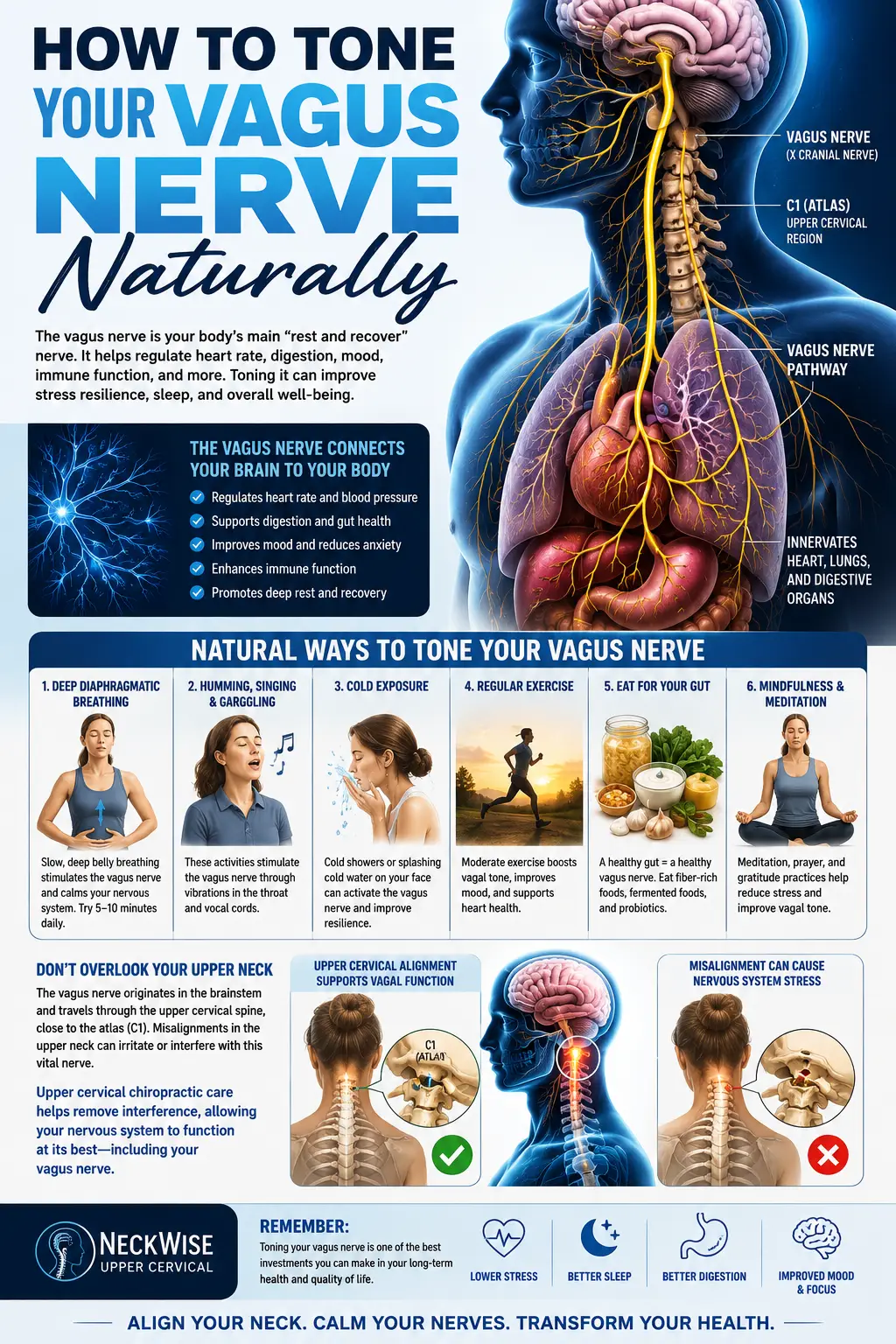
The vagus nerve is the tenth cranial nerve, and its name comes from the Latin for “wandering,” because it travels farther than any other cranial nerve in the body. Pay attention to its route, because it’s the whole point. It emerges from the brainstem, exits the skull through an opening at the very base of the skull called the jugular foramen, and then runs straight down through the upper neck — passing within a finger’s width of your atlas (C1), the topmost vertebra that balances your head. From there it continues down to the heart, lungs, and much of the digestive tract.
Read that again: the main “rest and regulate” cable of your entire nervous system threads through the exact region where your skull meets your spine. There is nowhere else in the body where a nerve this important sits in such close mechanical relationship to moving bones. That anatomy is why the upper neck belongs in any honest conversation about the vagus nerve — and why leaving it out, as most “vagus hack” content does, misses the structural half of the story.
The vagus is the main highway of the parasympathetic nervous system — the “rest and digest” side that balances the “fight or flight” sympathetic side. When people talk about “toning the vagus,” they mean nudging the body toward that calmer, more balanced state. And it’s a two-way street: roughly 80 percent of its fibers are sensory, carrying information from your body up to your brain, with the rest carrying signals down to your organs. So the vagus isn’t just a calm-down switch — it’s a constant, rich conversation between brain and body, and anything that disrupts that conversation ripples everywhere.
What “Vagal Tone” Means, and Why Low Tone Wrecks How You Feel
“Vagal tone” is shorthand for how active and responsive your vagus nerve is, especially its influence on your heart. Because we can’t easily measure the nerve directly, researchers use an indirect window: heart rate variability, or HRV.
Here’s the idea. Your heart doesn’t beat like a metronome. Even at a steady average rate, the tiny gaps between beats vary — your heart speeds up slightly when you inhale and slows on the exhale. This natural fluctuation (respiratory sinus arrhythmia) is largely driven by the vagus nerve. More beat-to-beat variability generally reflects stronger vagal, parasympathetic influence; a flatter, more rigid rhythm reflects a stressed, sympathetically-dominant state. That’s why HRV has become the go-to proxy for vagal tone in research and in wearable trackers.
Now the part that matters for how you actually feel. When vagal tone is chronically low, your body gets stuck with the brake pedal barely working — locked in a low-grade fight-or-flight state it can’t switch off. That shows up as anxiety and a wired-but-exhausted feeling, poor sleep, a racing or pounding heart, sluggish digestion and bloating, brain fog, and a sense that you can never fully relax. People spend years chasing each of those symptoms separately when they can share a single root: a vagus nerve that isn’t doing its regulating job. Raising vagal tone isn’t a wellness luxury — for a lot of people it’s the difference between living in survival mode and actually feeling settled in their own body.
The Techniques That Genuinely Help — Start Here
Let me be straight about what works, because being cause-forward doesn’t mean overselling. Some of these practices have real evidence, they’re free or low-cost, and you should be doing them. Think of them as training the vagus — building the nerve’s responsiveness day by day.
Slow-Paced Breathing — The Strongest-Evidenced Tool
Of all the popular techniques, slow, paced breathing has the most consistent evidence for acutely raising vagally-mediated heart rate variability. It’s free, portable, and you already know how to do it.
Most of us breathe 12 to 18 times a minute without thinking. Slow-paced breathing drops that to roughly five or six breaths per minute — about a ten-second cycle (say, a four-second inhale and a six-second exhale). At around six breaths per minute, the rhythms of your breath and cardiovascular system line up and produce large, resonant swings in heart rate — the “resonance frequency” — which maximizes HRV in the moment. This is the same principle behind clinical HRV biofeedback.
A 2025 randomized controlled trial in Psychosomatic Medicine on the acute effects of slow-paced breathing on measures of heart rate variability found this kind of deliberately slowed breathing produced measurable increases in vagally-mediated HRV during the practice. A 2025 review in Acta Neurologica Belgica, “Breathe better, live better: the science of slow breathing and heart rate variability,” walks through the physiology and reinforces that slowing the breath reliably shifts autonomic balance toward the parasympathetic side. And a 2024 study in Applied Psychophysiology and Biofeedback on the influence of respiratory frequency of slow-paced breathing on vagally-mediated HRV confirms the pace you choose shapes the response — aiming for that five-to-six-breath-per-minute neighborhood is a sensible target.
The longer exhale matters. Your heart rate falls on the exhale, and that slowing is vagally driven, so lengthening and softening your out-breath emphasizes the parasympathetic “brake.” A simple practice to try today:
- Sit or lie somewhere comfortable and uninterrupted.
- Let your shoulders drop; rest one hand on your belly.
- Inhale gently through your nose for about four seconds, letting the belly expand.
- Exhale slowly for about six seconds, as if fogging a mirror.
- That’s one cycle (~ten seconds). Continue for five to ten minutes.
- If you feel lightheaded, stop and return to normal breathing.
Consistency beats duration — a few minutes most days does more than one heroic session a month. Caution: if you have a respiratory or cardiovascular condition, a history of fainting, panic disorder, or you’re pregnant, check with your physician first, and never do breath-holding or forceful “power breathing” without guidance.
Regular Exercise
Over time, aerobically fit people tend to have higher resting HRV — a real, meaningful association. The relationship is long-term and indirect: a single workout temporarily lowers HRV during recovery, and the benefits to resting vagal tone build over weeks and months. More isn’t always better — chronic overtraining without recovery can suppress HRV, which is why athletes track morning HRV as a readiness signal. The dose that helps most people is refreshingly ordinary: regular aerobic activity plus some strength work. A foundational habit, not a quick trick.
Cold Exposure — Real, but Overhyped and With Real Risks
Cold on the face or sudden immersion can trigger the “diving reflex,” a burst of vagal activity that slows the heart, and some people feel alert and clear afterward. But the claim that cold “reliably and lastingly raises vagal tone” is far weaker than the confident online version. The first shock of cold water actually spikes your sympathetic system and heart rate before any calming kicks in — it’s a stress stimulus your body then recovers from, not a pure vagus boost. And this is one area where the “hack” framing can be genuinely dangerous, so read this part:
- If you have any heart condition, high blood pressure, or cardiovascular disease, do not start cold plunges without clearing it with your physician. The cold-shock response can sharply raise blood pressure and stress the heart, and cardiac events have been triggered by sudden cold-water immersion.
- Never do cold-water immersion alone, especially open water — the gasp reflex can cause inhalation of water, and cold quickly impairs your ability to swim or get out.
- If you’re pregnant or have Raynaud’s, a seizure disorder, or a circulation condition, talk with your doctor first.
- Start with a cool-to-cold shower rather than an ice bath.
The point of self-care is to support your health, not to prove your toughness.
taVNS and Humming
Transcutaneous auricular vagus nerve stimulation (taVNS) uses a small ear electrode to stimulate the auricular branch of the vagus in the outer ear. It’s a legitimate, actively studied area — but emerging, not settled. A 2024 Journal of Clinical Medicine study found age acts as an effect modifier of taVNS effects on HRV, meaning it doesn’t affect everyone identically, and a 2024 Neuromodulation study showed taVNS attenuated early heart-rate increases during a cold pressor test. Encouraging, but the consumer-device market runs well ahead of the science, and anyone with a pacemaker, a heart-rhythm condition, or who is pregnant should consult a physician first. Humming, gargling, and singing are pleasant, low-risk, and plausibly linked to vagal pathways — enjoy them, just keep expectations realistic; the hard evidence they meaningfully “tone” the vagus is thin.
The Piece the Hacks Ignore: Your Neck Can Be Compromising the Nerve Itself
Here’s where nearly every article on this topic stops short, and it’s the most important part. All of the techniques above assume one thing: that your vagus nerve is structurally free to do its job, and just needs training. But what if the nerve itself is being mechanically irritated where it runs through your neck? Then you’re trying to train a cable that’s being pinched — and no breathing pattern, ice bath, or ear clip addresses a physical problem at the source.
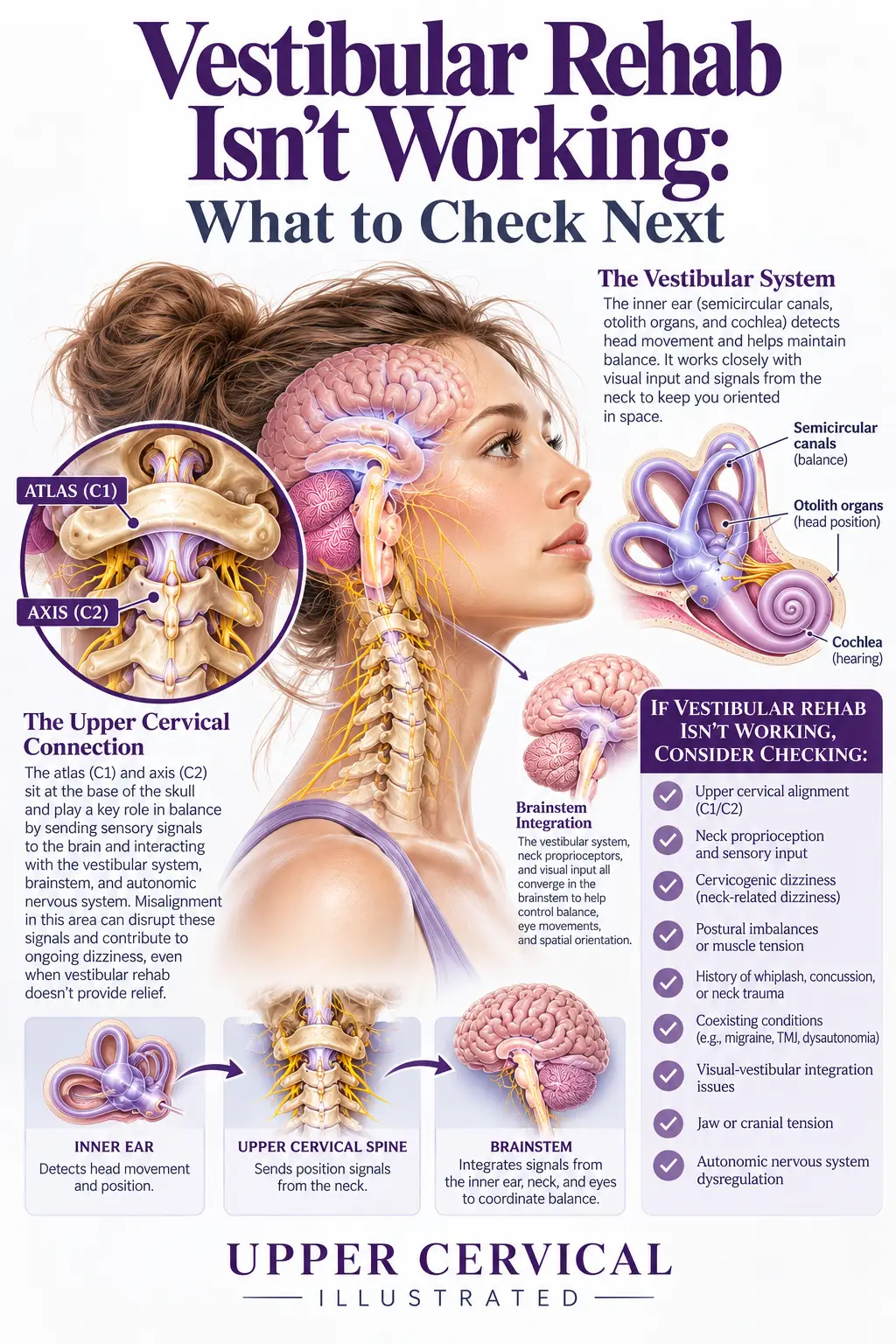
Remember the anatomy. The vagus exits the skull at the jugular foramen and travels down through the upper neck, right alongside the atlas (C1) and axis (C2) — the two vertebrae that carry the entire weight of your head, held mostly by ligaments rather than interlocking bone. When that top segment shifts out of alignment, the surrounding tissues, muscles, and structures at the skull base come under abnormal tension and stress — at the exact junction the vagus passes through. The plausible consequence isn’t a neck ache. It’s ongoing irritation of the nerve responsible for your entire “rest and regulate” system, keeping you locked in sympathetic overdrive no matter how many calming techniques you stack on top.
This also explains a pattern we see constantly: people whose vagal symptoms — the anxiety, the poor sleep, the racing heart, the gut trouble — trace back to a head or neck injury. A concussion, a whiplash, a car accident, or even years of forward-head posture hunched over a screen loads and destabilizes the very region the vagus runs through. If your symptoms started or worsened after something happened to your head or neck, that is a loud clue that the problem may be structural, sitting one inch below your skull, in a region your workup almost certainly never examined.
None of this means the breathing doesn’t help — it does, and you should do it. It means that for a meaningful number of people, breathing is treating the symptom while the structural driver goes unaddressed. That’s the gap. And it’s the reason someone can “do everything right” and still feel stuck: they’ve been training the nerve without ever checking whether the nerve is free to respond.
How We Evaluate the Structural Piece at Lavender Family Chiropractic
At Lavender Family Chiropractic, we focus exclusively on the upper cervical spine — the atlas, the axis, and the junction where the skull meets the neck, the same region the vagus travels through. Our approach is built on measurement, not guesswork. We use 3D CBCT imaging to see your upper cervical alignment in three dimensions, and paraspinal infrared thermography to read how your nervous system is actually behaving along the spine — directly relevant when the whole question is autonomic regulation. When a correction is warranted, we use the Knee Chest Upper Cervical technique: precise, gentle, and low-force, with no twisting, cracking, or popping. For a nervous system already stuck in overdrive, that gentleness is the entire point.
The goal is simple: give an overwhelmed nervous system a calmer structural environment so it can finally do its job. Keep your physician, keep your breathing practice, keep your healthy habits — those matter, and they work better when the structure underneath them isn’t fighting you. What we add is attention to the one region that sits at the crossroads of the vagus nerve and the spine, the piece the wellness world leaves out. If you’ve done all the “hacks” and still feel wired and stuck, that’s the evaluation you’ve been missing.
→ Call Lavender Family Chiropractic at (941) 243-3729 to schedule a consultation. We’re at 5899 Whitfield Avenue, Suite 107, Sarasota, FL 34243 — corner of University and Whitfield.
Top Questions
What’s the fastest way to calm my nervous system in the moment? Slow-paced breathing — inhale gently for about four seconds, exhale slowly for about six, aiming for roughly six breaths per minute for a few minutes. It needs no equipment and has the strongest evidence for acutely raising vagally-mediated HRV. If you feel lightheaded, ease off.
If breathing works, why would I need my neck evaluated? Because breathing trains the nerve, but it can’t free a nerve that’s being mechanically irritated at its exit from the skull. If the vagus is being compromised where it runs through your upper neck, you can breathe every day and still feel stuck — because the structural driver was never addressed. The two work together: free the structure, then the training lands.
My vagal symptoms started after a car accident / concussion. Does that matter? It matters a great deal. Trauma to the head and neck loads and destabilizes the exact region the vagus passes through. If your anxiety, sleep, heart, or gut symptoms began or worsened after a neck injury, the upper cervical spine is a driver worth evaluating rather than assuming.
Are cold plunges good for my vagus nerve? There’s real physiology, and some people enjoy them, but the “lastingly raises vagal tone” claims are overstated, and cold-water immersion can sharply stress the heart. If you have any heart condition or high blood pressure, don’t start without clearing it with your physician, and never plunge alone.
Do the ear-stimulation gadgets work? taVNS is a promising research area, but consumer devices run ahead of the settled science, responses vary, and they’re not a substitute for medical care. If you have a pacemaker, a heart-rhythm condition, or are pregnant, talk with your physician first.
Why does the upper neck specifically matter, and not the whole spine? Because the vagus exits the skull and passes through the atlas–axis region at the very top of the neck — not the lower back or mid-spine. That upper cervical junction is the only place the nerve runs this close to weight-bearing, ligament-dependent bones. It’s also the segment most affected by whiplash, concussion, and forward-head posture, which is why it’s the region worth evaluating when vagal symptoms won’t settle.
Is the adjustment forceful? No — precise, gentle, low-force, with no twisting, cracking, or popping.
Is any of this a substitute for medical treatment? No. This article is educational. If you have symptoms, a diagnosed condition, are pregnant, or take medication, work with your physician. Slow breathing and upper cervical care complement good medical care — they don’t replace it.
Who should be extra cautious? Anyone with cardiovascular disease, unstable blood pressure, a history of fainting, panic disorder, a seizure disorder, respiratory conditions, or who is pregnant should check with their physician before new breathing regimens (especially breath-holding) and before any cold exposure. When in doubt, ask first and start gently.
Serving Sarasota, Lakewood Ranch & Bradenton
If you’ve stacked every vagus “hack” and still feel wired and stuck, and you’re anywhere around Sarasota, Lakewood Ranch, or Bradenton, the structural evaluation you’re missing is close by. Lavender Family Chiropractic (NeckWise North Sarasota) sits at 5899 Whitfield Avenue — the corner of University and Whitfield — minutes from the Lakewood Ranch corridor and just across from Bradenton, so patients from all three communities reach us easily. Whether you’re in Sarasota, Lakewood Ranch, or Bradenton, we evaluate the upper cervical region the vagus nerve travels through, using 3D CBCT imaging and paraspinal infrared thermography, so the nerve you’re working so hard to calm is actually free to respond.
Train the Nerve — and Free It
Your vagus nerve is a remarkable thing: a wandering, two-way conversation between your brain and your body that touches your heart, your gut, your sleep, and your sense of calm. Supporting it doesn’t require an expensive gadget or an ice bath. The most evidence-backed daily move is also the simplest — slow your breath to about five or six comfortable breaths per minute, with an easy, extended exhale, for a few minutes a day, and add regular movement you enjoy.
But if you’ve been doing the practices and still feel stuck in overdrive, don’t assume you’re failing at them. Ask the question the hacks never do: is the nerve itself free to respond, or is it being irritated where it runs through the top of your neck? For a lot of people, that structural piece is exactly what’s been missing — and it’s the one region no one has looked at.
Let us look at what the wellness world skips. Call (941) 243-3729 or book a consultation. Train the nerve — and make sure it’s free to do its job.
Lavender Family Chiropractic (NeckWise North Sarasota) · 5899 Whitfield Avenue, Suite 107, Sarasota, FL 34243 · (941) 243-3729
This article is for general educational purposes only and is not medical advice, diagnosis, or treatment. Please consult your physician before making changes to your health routine, especially if you have a medical condition, are pregnant, or take medication.
Related Articles
Related Posts



Get our upper cervical articles first.