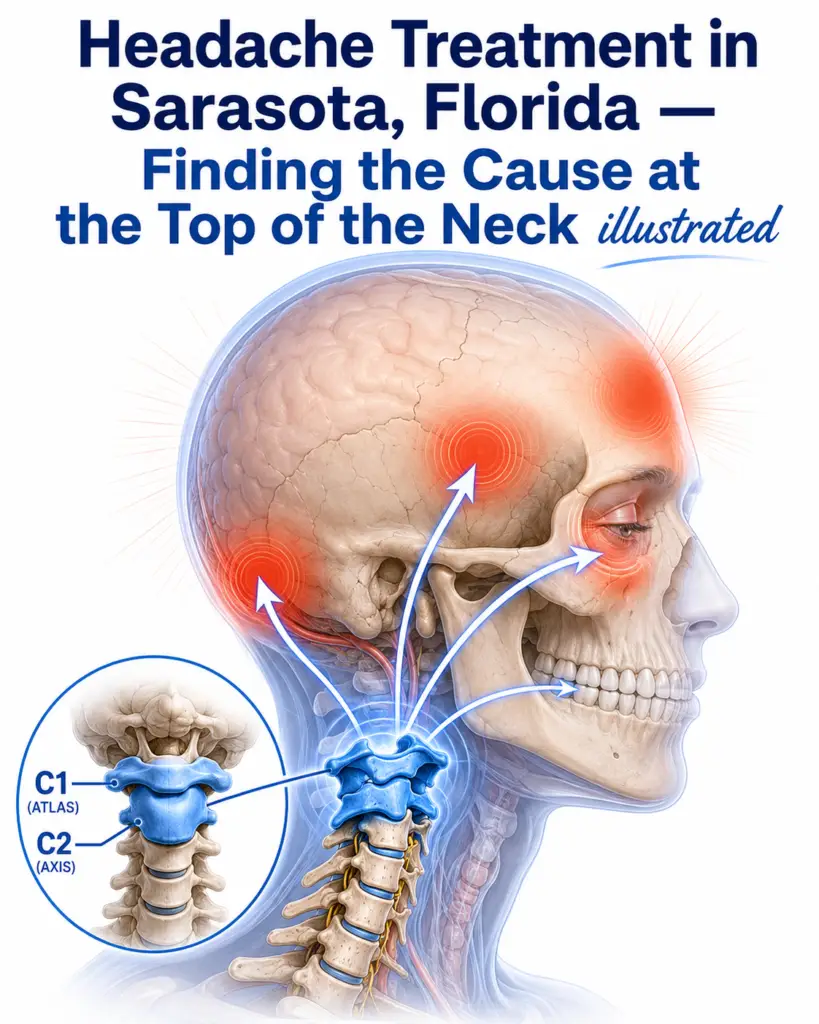
Headache Treatment in Sarasota, Florida — Finding the Cause at the Top of the Neck
By Dr. Rusty Lavender, D.C. — Lavender Family Chiropractic, Sarasota, FL. Medically reviewed by Dr. Rusty Lavender, D.C.
If you’re reading this, you’ve probably already tried the obvious things. Ibuprofen. More water. Less screen time. A new pillow. Maybe a neurologist visit and a clean MRI. And the headaches keep coming — some days a dull band of pressure, some days a spike at the base of your skull, some mornings you wake up already hurting. You’ve been told it’s tension, or stress, or “just headaches.” What you haven’t been told is why.
In our Sarasota practice, headaches are one of the most common reasons people walk through the door, and one of the most common things they’ve been told to simply manage. We approach them differently. A headache is a symptom, not a diagnosis, and for a large share of chronic headache sufferers, the source isn’t in the head at all — it’s in the top of the neck, where the upper cervical spine meets the base of the skull. That region shares nerve wiring with the head and face in a way that lets neck problems feel like head pain. Most standard workups never look there.
This page is your complete guide: the main headache types we see, how to tell them apart, why the upper neck is so often involved, what the research actually supports, and what an evaluation here looks like. No promises — just how we think about headaches and how to find out whether your neck is part of yours.
Short on time? Headaches have many causes. When the common ones have been ruled out and the headaches persist — especially if they sit at the base of the skull, come with neck stiffness, or started after an injury — the upper cervical spine is a cause worth evaluating, because the nerves of the top three vertebrae feed into the same brainstem relay that processes head pain. It isn’t right for every headache; a proper evaluation is how we tell.
First: Is It a Headache or a Migraine?
This matters, because they’re evaluated and approached differently — and it’s the question that decides which page you should be reading.
Migraine is a specific neurological disorder, not just a bad headache. It’s typically one-sided, throbbing, moderate-to-severe, lasts 4–72 hours, and comes with nausea, sensitivity to light and sound, and sometimes visual aura before the pain. If that describes your attacks, you’re in the right family but the wrong room — our dedicated Migraine Treatment in Sarasota page covers migraine in depth, including the upper cervical connection specific to it.
Headache — the subject of this page — is the broader umbrella: tension-type headache, cervicogenic (neck-driven) headache, occipital neuralgia, pressure at the base of the skull, morning headaches, dehydration headaches, and headaches triggered by weather. Many people have more than one type, and many “migraines” that never fully responded to migraine medication turn out to have a cervicogenic component underneath. If you’re not sure which you have, keep reading — telling them apart is a big part of what we do.
One more sibling worth naming: if your headaches track the weather — storms, pressure drops, the hours before rain — that’s its own pattern, and we cover it fully on our Barometric Pressure Headache page.
The Headache Types We Evaluate in Sarasota
Each of these has its own dedicated guide. Here’s how to recognize them and how the upper neck connects to each.
1. Tension-type headache. The most common headache in the world — a dull, pressing, band-like ache on both sides, often worse late in the day, without the nausea or light sensitivity of migraine. It’s routinely blamed on stress, and stress does feed it, but the muscles that tighten in tension headache — the suboccipitals at the base of the skull, the upper trapezius — are the same muscles that guard an irritated upper cervical spine. In our experience, “tension” is often the body’s response to a structural problem beneath it. Tension headaches and how we approach them »
2. Cervicogenic headache. Literally “headache generated by the neck.” Pain usually starts at the back of the head or neck and spreads forward toward the temple, forehead, or eye, typically on one side, and gets worse with neck movement or sustained posture. It’s frequently misdiagnosed as migraine or tension headache — and it’s the type most directly tied to the upper cervical spine. Can neck pain cause headaches? The atlas connection »
3. Occipital neuralgia. Sharp, shooting, electric or stabbing pain at the back of the head, sometimes radiating over the scalp toward the eye, with tenderness where the occipital nerves exit at the base of the skull. Those nerves come from C2 and C3 — the axis and the vertebra below it — which is why upper cervical alignment is central to it. Occipital neuralgia and upper cervical care » · Occipital pain: a complete guide »
4. Pressure at the base of the skull. Not always sharp — often a deep, heavy pressure or fullness right where the skull meets the neck, sometimes with a feeling of “clogged” or tight-headedness. This is the upper cervical junction itself, and it’s one of the most common patterns we see. Pressure at the base of my skull: causes and the upper cervical connection » · What causes head pressure? »
5. Morning / wake-up headaches. Waking with a headache already in progress points strongly to something that happens overnight — sleep position, a pillow that rotates or flexes the neck for hours, jaw clenching, or an upper cervical joint that stiffens through the night. Why do I wake up with a headache? »
6. Dehydration and hydration-related headaches. Real, common, and worth ruling out first — especially in Florida heat. But when hydration is already good and the headaches persist, it’s a sign to look elsewhere. What drink helps a headache? »
7. Barometric pressure headaches. Head pain that tracks storms and pressure changes. Covered in full on its own page. Barometric pressure headaches » · Why does my head hurt from barometric pressure? »
8. Migraine. The specific neurological disorder described above — one-sided, throbbing, with nausea or light sensitivity. Its own page. Migraine treatment in Sarasota »
9. Post-concussion and post-injury headaches. Headaches that began after a car accident, fall, or head impact and never fully resolved. The upper neck is almost always involved in these injuries, because the head whips on the neck even without direct impact. Car accident chiropractic »
10. Headache with jaw or facial pain. When head pain comes with jaw clicking, clenching, or facial tenderness, the jaw and the upper neck are usually involved together. TMJ and the upper neck » · Trigeminal neuralgia »
Not sure which fits? That’s exactly what an evaluation is for. Most chronic headache patients have more than one pattern layered together, and the upper neck is the thread that often runs through them.
Why the Top of the Neck Can Cause a Headache
This is the piece most headache care skips, and it rests on well-established anatomy.
The nerves that carry sensation from the top three vertebrae of the neck — C1, C2, and C3 — don’t stay in the neck. They feed into a relay station in the brainstem called the trigeminocervical nucleus, where they converge with the trigeminal nerve, the main sensory nerve of the head and face. Because those neck and head signals share the same relay, the brain can’t always tell which one is firing. Irritation in the upper neck can register as pain in the forehead, temple, behind the eye, or across the scalp — which is precisely why so many neck-driven headaches get diagnosed as something else. This convergence is the accepted mechanism behind cervicogenic headache, described in detail in the clinical literature (Bogduk, The neck and headaches; Understanding cervicogenic headache).
Two things make the upper cervical spine uniquely involved. First, the atlas (C1) and axis (C2) are the only vertebrae with no disc between them, so they depend entirely on ligaments and small muscles for stability — and they carry roughly half of your head’s rotation. Second, the dense cluster of nerves, muscles, and blood vessels at the skull-neck junction — the suboccipital muscles, the greater and lesser occipital nerves, the vertebral arteries — all pass through a few square inches around C1 and C2. A misalignment there doesn’t have to be dramatic to irritate that neighborhood.
We want to be careful here, because this is where clinics overreach. The neck is a cause of headache, not the cause. Migraine has its own biology. Some headaches are dehydration, some are medication overuse, some are sinus, some are serious and need a physician urgently (see below). What the anatomy supports is that the upper cervical spine is a real, common, and routinely unexamined contributor — especially in the “chronic, normal MRI, nothing else worked” patient.
Is Your Headache Coming From Your Neck? What We Look For
No single symptom proves it — that’s what the examination is for — but certain patterns make us look hard at the upper cervical spine:
- The pain starts at the back of the head or the base of the skull and spreads forward.
- It’s worse with neck movement, sustained posture, long screen sessions, or sleeping wrong.
- You have neck stiffness, reduced range of motion, or tenderness at the base of the skull.
- Pressing the muscles at the top of the neck reproduces or changes the headache.
- You have a history of head or neck trauma — even a minor accident years ago, or a concussion.
- The headaches are one-sided and don’t switch sides.
- Migraine medication never fully worked, or the “migraines” don’t fit the classic pattern.
- You wake up with it.
If several of those describe you, the upper neck deserves a real evaluation. If your headaches are clearly one-sided, throbbing, with nausea and light sensitivity, and respond to migraine medication — that’s migraine, and we’ll point you to the right page and the right care.
What the Research Says
You deserve evidence, not a testimonial — and an honest account of its limits.
- The mechanism is established. The convergence of upper cervical and trigeminal nerve signals in the brainstem — the reason neck problems can produce head pain — is well described in the headache literature (Bogduk, The neck and headaches, Neurologic Clinics). Cervicogenic headache is a recognized diagnosis with its own criteria; a useful clinical overview is Understanding cervicogenic headache.
- Treating the neck helps neck-driven headaches — in a real trial. A randomized controlled trial of 200 patients with cervicogenic headache published in Spine (Jull et al., 2002) found that manipulative therapy and specific neck exercise each significantly reduced headache frequency and intensity, with the benefit maintained at 12 months. That’s one of the stronger pieces of evidence in this area — and it’s specific to headaches that come from the neck, which is why identifying the type matters so much.
- Diagnosis is the hard part. Cervicogenic headache overlaps heavily with migraine and tension-type headache in how it feels, and it’s frequently misdiagnosed. The literature is clear that the neck’s contribution has to be actively evaluated — it doesn’t show up on a brain MRI.
What we don’t do is promise a cure, guarantee results, or claim upper cervical care fixes every headache. The honest position: when a headache is coming from the neck, addressing the neck is a reasonable, evidence-informed thing to do. Direct trials on upper cervical chiropractic specifically are more limited than the broader manual-therapy evidence, and we say so. The evaluation is how we find out whether it applies to you.
Conventional Headache Care — and Where It Falls Short
Over-the-counter and prescription pain relievers work for occasional headaches. Used more than two or three days a week, though, they can cause medication-overuse headache — a rebound cycle where the treatment becomes a trigger. If you’re reaching for pain relievers most days, that alone is worth discussing with your physician.
Preventive medications (for frequent migraine and some chronic headache) help many people and we never tell anyone to stop them. They manage frequency; they don’t address a structural cause.
Trigger management — sleep, hydration, caffeine, screens, stress — is real and worth doing.
Imaging and neurology are essential to rule out the serious causes, and if you have chronic headaches and haven’t had that workup, get it. But a clean MRI answers “is there damage?” — it doesn’t answer “how is your head sitting on your neck, and are the C1–C3 nerves being irritated?” That’s the gap we work in.
How We Evaluate Headaches at Lavender Family Chiropractic
The consultation. We start by listening — the full history of your headaches, their pattern and triggers, what’s been tried, any trauma history, and the red flags that would mean you need a physician first, not us.
The examination. We assess how your head sits on your neck, upper cervical motion, the suboccipital muscles, and whether pressure at the base of the skull reproduces your pain. This is the step most headache patients have never had.
Imaging that measures, not guesses. When indicated, 3D CBCT imaging shows the exact position of your atlas and axis in three dimensions, and paraspinal infrared thermography reads how your nervous system is responding along the spine.
The correction. If the findings point to an upper cervical problem, we use the Knee Chest Upper Cervical technique — a precise, low-force correction calculated from your imaging. No twisting, cracking, or popping. Many headache patients are surprised by how gentle it is.
The honest read. If the findings don’t point to the upper neck — if your pattern is migraine, or something that needs a medical workup — we tell you, and help you get to the right care. We don’t invent a neck problem to treat.
When a Headache Is an Emergency
Most headaches are not dangerous. Some are. Seek emergency care immediately for a headache that is sudden and severe — “the worst headache of my life,” peaking within seconds to a minute; a headache with fever and a stiff neck; a headache with weakness, numbness, slurred speech, confusion, vision loss, or trouble walking; a headache after a head injury, especially with vomiting or drowsiness; or a new severe headache pattern after age 50. These can signal stroke, bleeding, meningitis, or other emergencies. When in doubt, call 911 or go to the nearest emergency department first. We would always rather you be checked and safe.
Lifestyle Habits That Support Headache Recovery
- Posture and screens. Forward head posture loads the upper neck directly. Monitor at eye level; phone at face height, not chest height; a break every 30 minutes.
- Sleep position and pillow. Stomach-sleeping rotates the neck for hours. Side or back sleeping with a pillow that supports the neck’s curve — not one that props the head forward — protects the upper cervical joints overnight.
- Hydration. Especially in Florida. Aim for roughly half your body weight in ounces of water daily unless your physician says otherwise.
- Medication discipline. Pain relievers no more than 2–3 days a week to avoid the rebound cycle.
- Jaw awareness. Clenching and grinding feed head and neck tension. If you wake with a sore jaw, mention it.
- Regular movement. Gentle daily neck mobility and walking keep the upper cervical joints from stiffening.
Serving Sarasota, Bradenton, Lakewood Ranch, and Nearby
Lavender Family Chiropractic is located at 5899 Whitfield Avenue, Suite 107, Sarasota, FL 34243 — at the corner of University Parkway and Whitfield Avenue, minutes from Lakewood Ranch and Bradenton. We see headache patients from across Sarasota and Manatee counties, including Bradenton, Lakewood Ranch, Venice, Osprey, Nokomis, Parrish, Palmetto, Siesta Key, and Longboat Key. If you’ve been searching “headache doctor near me” or “headache treatment Sarasota” and the usual answers haven’t held, an upper cervical evaluation is a reasonable next step. Areas we serve »
Frequently Asked Questions
What kind of doctor should I see for chronic headaches? Start with your primary care physician or a neurologist to rule out serious causes. If that workup is normal and the headaches persist — especially with neck involvement — an upper cervical chiropractor evaluates the one area those specialists typically don’t. Who to see for headaches »
How do I know if my headache is from my neck? Pain that starts at the back of the head, worsens with neck movement or posture, comes with neck stiffness, and can be reproduced by pressing the base of the skull points to a cervicogenic source. The examination confirms it.
Is it a headache or a migraine? Migraine is one-sided, throbbing, moderate-to-severe, with nausea or light/sound sensitivity, lasting hours to days. Tension and cervicogenic headaches are more pressing or aching and tied to muscle or neck. Many people have both — see our migraine page if the migraine description fits.
Can upper cervical care cure headaches? No, and we don’t claim it can. When the neck is the driver, addressing it is a reasonable, evidence-informed approach — a randomized trial showed real benefit for neck-driven headaches. It won’t help every headache type, which is why the evaluation comes first.
My MRI was normal. Why do I still get headaches? An MRI rules out structural damage — important — but it doesn’t show how your head is balancing on your neck or whether the C1–C3 nerves are being irritated. A normal scan and daily headaches is one of the most common stories we hear.
Why do I wake up with a headache? Sleep position, pillow, jaw clenching, and an upper cervical joint that stiffens overnight are the usual culprits. Full guide »
Why does my head hurt at the base of my skull? That’s the upper cervical junction — the suboccipital muscles and occipital nerves. It’s the single most direct sign that the neck is involved. Base-of-skull pressure guide »
Can a car accident from years ago cause headaches now? Yes — whiplash and concussion injure the upper cervical joints and ligaments in ways that don’t always heal, and headaches that began after an injury very often trace back to it.
Is the adjustment safe? The Knee Chest technique is precise and low-force — no twisting, cracking, or popping. We screen for red flags first and image before we correct, so nothing is done blindly.
Should I stop my headache medication? No. Medication decisions belong to your prescribing physician. Upper cervical care is complementary, not a replacement.
How long until I might notice a difference? It varies. Some notice change within a few weeks; others progress gradually; some don’t respond meaningfully. We’re honest about what we see as we go.
Do you see patients from Bradenton and Lakewood Ranch? Yes — regularly, along with Venice, Osprey, Parrish, and the keys.
You Don’t Have to Just Manage It
If you’ve been told your headaches are “just tension” or “just stress,” and you’ve done everything right and still hurt — the question worth asking is the one nobody asked: what’s happening at the top of your neck? For many of our Sarasota patients, that was the piece that finally explained years of headaches.
Call (941) 243-3729 or book a complimentary consultation online. We’ll go through your history, examine you, and tell you honestly whether upper cervical care is a reasonable part of your plan — and if it isn’t, where to go instead.
Lavender Family Chiropractic · 5899 Whitfield Avenue, Suite 107 · Sarasota, FL 34243
Related Reading
- Migraine Treatment in Sarasota
- Barometric Pressure Headaches
- Why Do I Have Headaches? The Upper Cervical Role
- Does My Neck Cause Headaches?
- IV Therapy for Headaches: Symptom Relief vs. the Root Cause
- Neck Pain Treatment in Sarasota
This page is for general education and is not a substitute for individual medical advice. Headaches have many causes, some of which require urgent medical care. Upper cervical chiropractic care is not a cure for headaches and is not appropriate for every cause; an individual evaluation is needed to determine whether it may help you.