Craniocervical Instability
Craniocervical instability (CCI) is a complex, often misunderstood condition that can create a cascade of neurological, vascular, and autonomic symptoms throughout the body. Many people suffering from CCI feel dismissed, misdiagnosed, or told that surgery or lifelong symptom management is their only option. For others, answers come slowly after years of unexplained dizziness, headaches, brain fog, neck pain, anxiety, or autonomic dysfunction.
The truth is this: the upper cervical spine plays a far greater role in whole-body health than most people realize. When instability occurs at the junction where the skull meets the spine, the nervous system can no longer function optimally. The good news is that when the underlying structural problem is addressed, the body often has an incredible ability to heal.
This article will break down what craniocervical instability really is, how it develops, why symptoms can be so widespread, and how upper cervical chiropractic—specifically NeckWise care at Lavender Family Chiropractic—offers a natural, non-surgical approach focused on restoring stability, alignment, and neurological balance.
What Is Craniocervical Instability (CCI)?
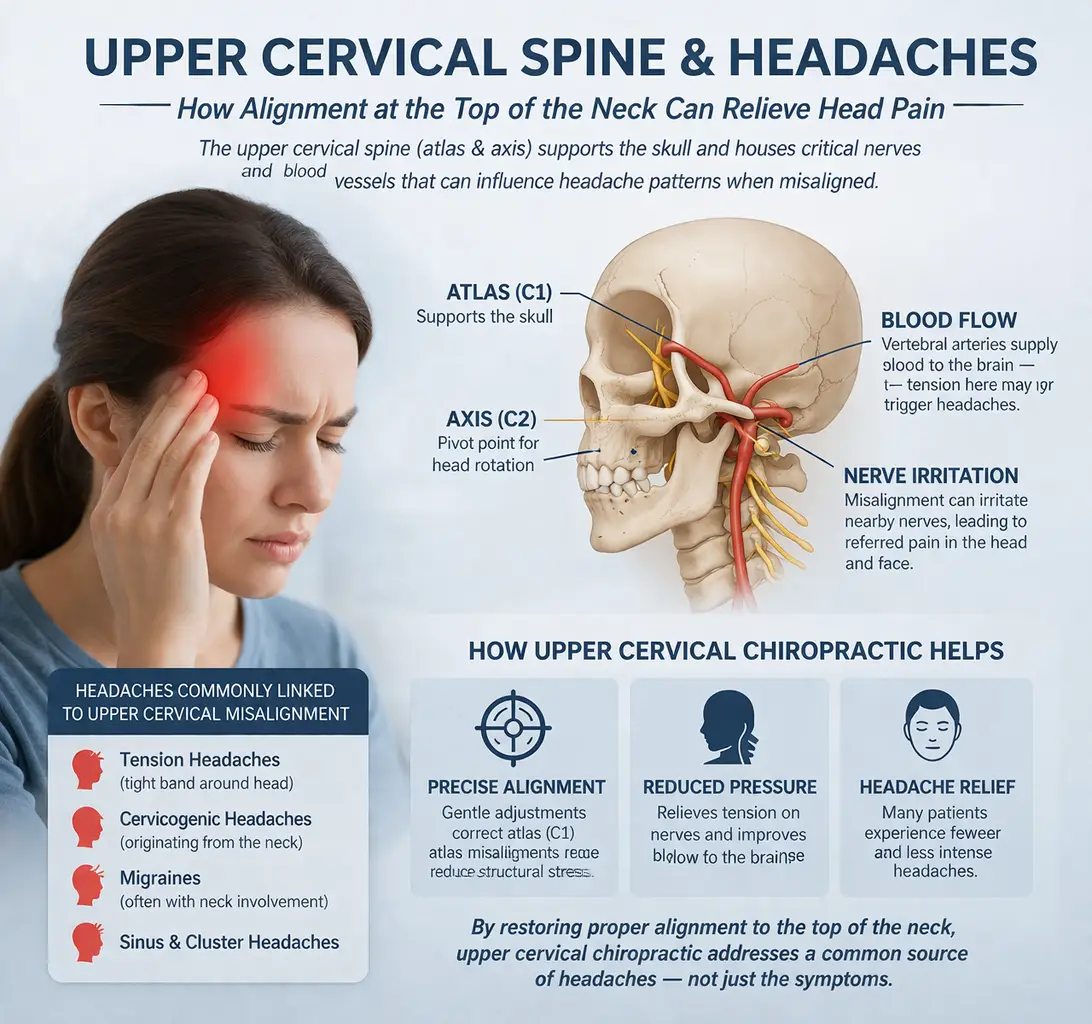
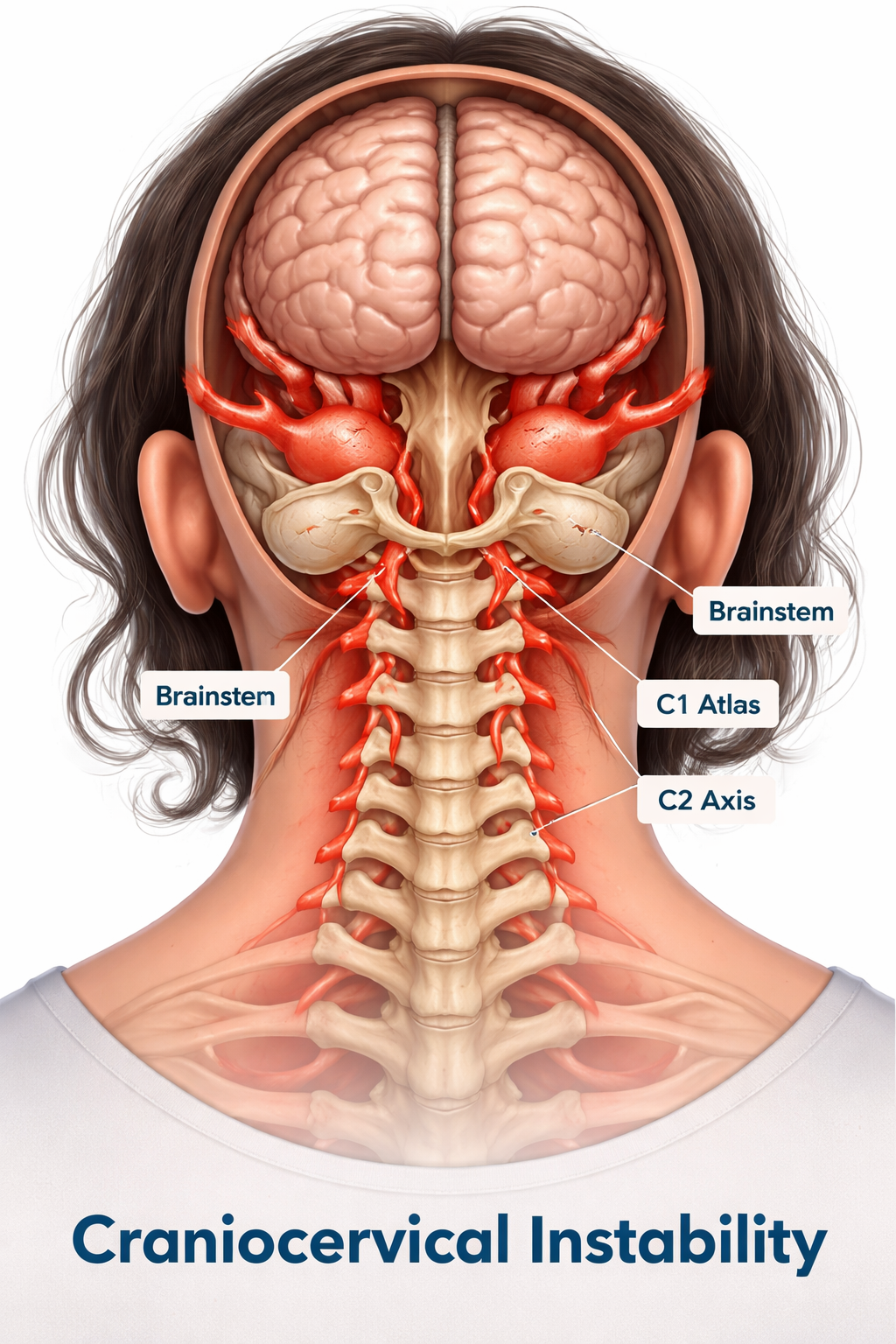
Craniocervical instability refers to excessive or abnormal movement between the skull (cranium) and the top of the cervical spine—primarily the atlas (C1) and axis (C2) vertebrae. This region is known as the craniocervical junction, and it is one of the most neurologically significant areas of the entire body.
Unlike the rest of the spine, the upper cervical spine is designed for precision, balance, and protection of the brainstem. When stability is compromised—whether from trauma, ligament laxity, connective tissue disorders, or chronic postural stress—the result can be mechanical stress on the brainstem, spinal cord, cranial nerves, and vertebral arteries.
Even millimeters of abnormal motion in this region can create profound neurological consequences.
Why the Upper Cervical Spine Is So Critical
The upper cervical spine is unlike any other part of the spine for several reasons:
- It houses and protects the brainstem
- It plays a central role in head and neck positioning
- It influences balance, posture, blood flow, and autonomic regulation
- It lacks intervertebral discs, relying heavily on ligaments and precise alignment for stability
The atlas and axis act as the gateway between the brain and the rest of the nervous system. Any instability or misalignment here can interfere with neurological signaling, blood flow to the brain, and cerebrospinal fluid dynamics.
This is why symptoms of CCI are rarely isolated to just neck pain.
Common Causes of Craniocervical Instability
Craniocervical instability does not occur randomly. It is almost always the result of an underlying structural or connective tissue issue.
Common contributing factors include:
- Whiplash injuries or car accidents
- Concussions or repetitive head trauma
- Falls or sports injuries
- Hypermobile connective tissue conditions
- Poor posture over time
- Degenerative ligament changes
- Surgical trauma or prolonged immobilization
Many patients do not associate their symptoms with an old injury until imaging and structural analysis reveal instability at the craniocervical junction.
Symptoms of Craniocervical Instability
One of the most frustrating aspects of CCI is the wide variety of symptoms it can produce. Because the brainstem controls so many bodily functions, disruption in this area can affect nearly every system.
Common symptoms include:
- Neck pain or pressure at the base of the skull
- Headaches or migraines
- Dizziness or vertigo
- Brain fog and cognitive fatigue
- Visual disturbances
- Ringing in the ears
- Anxiety or panic sensations
- Difficulty swallowing
- Balance problems
- Heart rate irregularities
- Blood pressure fluctuations
- Fatigue or exercise intolerance
Many people with CCI are told their symptoms are “anxiety,” “vestibular,” or “idiopathic,” when in reality the issue is mechanical and neurological.
Why Traditional Approaches Often Fall Short
Conventional management of craniocervical instability often focuses on symptom control rather than structural correction. This may include medications, physical therapy, bracing, or—in severe cases—surgical fusion.
While these approaches may be appropriate in certain situations, they often fail to address why the instability developed in the first place.
Without correcting the alignment and biomechanics of the upper cervical spine, the nervous system remains under stress, and symptoms persist or return.
Upper Cervical Chiropractic: A Structural Solution
Upper cervical chiropractic focuses exclusively on the alignment, stability, and function of the atlas and axis. Unlike general chiropractic, upper cervical care does not involve twisting, cracking, or adjusting the entire spine.
Instead, it is based on three core principles:
- Precise diagnosis
- Gentle, specific correction
- Allowing the body to stabilize and heal naturally
At Lavender Family Chiropractic, NeckWise upper cervical care is designed to restore normal alignment to the craniocervical junction so the body can regain balance and stability without force.
How NeckWise Care Addresses Craniocervical Instability
NeckWise care is uniquely suited for individuals with CCI because it emphasizes precision, safety, and neurological integrity.
Key components include:
- 3D CBCT imaging to assess alignment and anatomy
- Functional nervous system scans to evaluate stress patterns
- Gentle corrections designed to reduce instability
- No forceful manipulation or repetitive adjustments
- A focus on holding corrections long-term to promote ligament healing
When the upper cervical spine is properly aligned, abnormal motion decreases, neurological stress is reduced, and the body can begin stabilizing itself.
Why Alignment Matters More Than Strength Alone
Many patients with CCI are told to “strengthen their neck.” While muscular support is important, muscles cannot compensate for poor alignment or ligament instability.
If the atlas is misaligned, muscles will often tighten unevenly in an attempt to stabilize the area—leading to chronic tension, fatigue, and pain.
Correcting alignment first allows muscles and ligaments to heal and function as intended.
The Body’s Ability to Heal Once Stability Is Restored
One of the most encouraging aspects of upper cervical care is observing what happens when interference is removed from the nervous system.
As stability improves, patients often notice:
- Reduced head and neck pressure
- Improved balance and coordination
- Clearer thinking and focus
- More stable heart rate and blood pressure
- Improved sleep and energy
- Reduced anxiety and nervous system overload
Healing is not forced—it is allowed.
Top 15 FAQs About Craniocervical Instability and Upper Cervical Care
1. Is craniocervical instability permanent?
Not always. Many cases improve when the underlying alignment and neurological stress are corrected.
2. Can upper cervical chiropractic help CCI?
Yes. Upper cervical care focuses on restoring alignment and reducing abnormal motion at the craniocervical junction.
3. Is NeckWise care safe for CCI patients?
NeckWise care uses gentle, precise corrections without twisting or cracking, making it well-suited for sensitive conditions.
4. Does CCI show up on standard imaging?
Not always. Specialized imaging and functional analysis are often required.
5. Can CCI cause dizziness and vertigo?
Yes. The upper cervical spine plays a major role in balance and vestibular function.
6. Is surgery the only option for CCI?
No. Many patients explore conservative structural care before considering surgery.
7. How long does healing take?
Healing varies, but many patients notice improvements as stability increases over time.
8. Can whiplash cause CCI?
Yes. Whiplash is a common contributor to ligament damage and instability.
9. Why do symptoms fluctuate?
Instability causes variable neurological stress depending on posture, movement, and inflammation.
10. Can CCI affect heart rate and blood pressure?
Yes. The brainstem regulates autonomic function.
11. Does posture matter with CCI?
Absolutely. Poor posture can worsen instability and symptoms.
12. Are medications effective for CCI?
Medications may manage symptoms but do not correct structural issues.
13. Can upper cervical care help brain fog?
Many patients report improved clarity once neurological stress is reduced.
14. Is cracking the neck dangerous with CCI?
Forceful manipulation can be risky when instability is present.
15. Can children or teens have CCI?
Yes. Trauma, sports injuries, or congenital factors can contribute.
Why Lavender Family Chiropractic Is Different
Lavender Family Chiropractic takes a structure-first, nervous-system-centered approach to complex conditions like craniocervical instability.
Patients are not rushed. Imaging is thorough. Corrections are precise. Progress is measured objectively.
This is not symptom chasing—it is root-cause care.
A Natural Path Forward for CCI
Craniocervical instability can feel overwhelming, especially when symptoms affect every aspect of daily life. But the body is resilient. When alignment is restored and the nervous system is supported, healing becomes possible.
Upper cervical chiropractic does not force the body to heal—it removes the obstacles that prevent it.
For individuals seeking a natural, non-surgical approach to CCI, NeckWise care at Lavender Family Chiropractic offers a thoughtful, science-based path forward—one focused on restoring stability, balance, and hope.
If you or someone you love is struggling with symptoms that may be related to craniocervical instability, understanding the role of the upper cervical spine could be the missing piece.
Healing begins with structure.
Schedule a Consultation
If you’re searching for a chiropractor sarasota florida, chiropractor near me, upper cervical chiropractor near me, or you’ve been looking for answers to ear pressure, dizziness, vertigo, headaches, and chronic congestion, we’re here to help.
Lavender Family Chiropractic (NeckWise North Sarasota)
5899 Whitfield Ave Ste 107, Sarasota, FL 34243
www.chiropractorsarasotaflorida.com
To learn more about us go to http://www.chiropractorsarasotaflorida.com
We also service Bradenton, Parrish, Ellenton, Ruskin, Venice, Tampa, St. Pete, Osprey, Longboat, Lakewood Ranch, Myakka City.
If you are in Tampa, Land O Lakes, Fort Myers, or Salt Lake City, you can visit my other locations! NeckWise Upper Cervical. Visit, www.neckwise.com
If you are not local, visit www.uccnearme.com to find a doctor in your area
Serving Sarasota, Bradenton, Lakewood Ranch, Parrish, Ellenton, Venice, Osprey, Siesta Key, Longboat Key, Lido Key, Myakka City, Punta Gorda, and St. Petersburg.