Vertigo is one of the most unsettling symptoms a person can experience. One moment you are upright and stable, and the next it feels like the world is spinning around you. For some, it lasts seconds. For others, it lingers for minutes, hours, or even days. It can interfere with work, sleep, driving, exercise, and daily life. Many people begin searching for answers quickly because vertigo is not something you can easily ignore.
If you have researched vertigo online, you have likely encountered the Epley maneuver. It is one of the most commonly recommended treatments for positional vertigo and is frequently used for a condition called Benign Paroxysmal Positional Vertigo (BPPV). The Epley maneuver can be helpful. In the right situation, it can significantly reduce spinning episodes.
However, there is a deeper conversation that often gets overlooked. The Epley maneuver repositions inner ear crystals, but it does not correct the underlying reason why those crystals became displaced. If vertigo keeps returning, if dizziness lingers between episodes, or if you also experience headaches, migraines, brain fog, neck pain, or pressure at the base of your skull, there may be more to the story.
In this comprehensive guide, we will cover:
- What vertigo is
- What BPPV is
- How to perform the Epley maneuver step by step
- When the Epley maneuver works well
- Why it may not provide lasting correction
- How the upper cervical spine influences balance
- How upper cervical chiropractic care at Lavender Family Chiropractic | NeckWise North Sarasota addresses underlying causes of vertigo and dizziness
If you are looking for real answers—not just temporary symptom management—this article will give you a broader understanding of what may be happening.
What Is Vertigo?
Vertigo is a specific type of dizziness characterized by the sensation of spinning or movement when no actual movement is occurring. It is different from lightheadedness or faintness. People often describe vertigo as:
- The room spinning
- Feeling like they are on a boat
- Being pulled to one side
- Tilting sensations
- Sudden loss of balance
- Nausea triggered by head movement
Vertigo occurs when there is a mismatch between the systems responsible for balance. These systems include:
- The vestibular system (inner ear)
- The visual system (eyes)
- The proprioceptive system (muscles and joints, especially the neck)
Your brain constantly integrates information from all three. When one system sends distorted or conflicting signals, the brain interprets that mismatch as motion. That mismatch is what creates the spinning sensation.
What Is BPPV?
Benign Paroxysmal Positional Vertigo (BPPV) is one of the most common causes of vertigo.
- Benign – Not life-threatening
- Paroxysmal – Sudden and brief episodes
- Positional – Triggered by changes in head position
- Vertigo – Spinning sensation
Inside the inner ear are tiny calcium carbonate crystals called otoconia. Under normal conditions, these crystals sit in a structure called the utricle. Their job is to help detect linear acceleration and gravity.
When these crystals become dislodged and migrate into one of the semicircular canals, they interfere with normal fluid movement. The semicircular canals are responsible for detecting rotational movement. When crystals are present where they do not belong, they create abnormal stimulation of the vestibular nerve.
The brain receives a signal that suggests movement—even when you are still. The result is spinning vertigo, often triggered by rolling over in bed, looking up, bending down, or turning the head.
How to Do the Epley Maneuver
The Epley maneuver is designed to guide displaced crystals out of the semicircular canal and back into the utricle, where they no longer cause symptoms.
Before attempting this maneuver at home, it is important to have a proper diagnosis. Not all vertigo is BPPV. If you are unsure, consult a qualified provider.
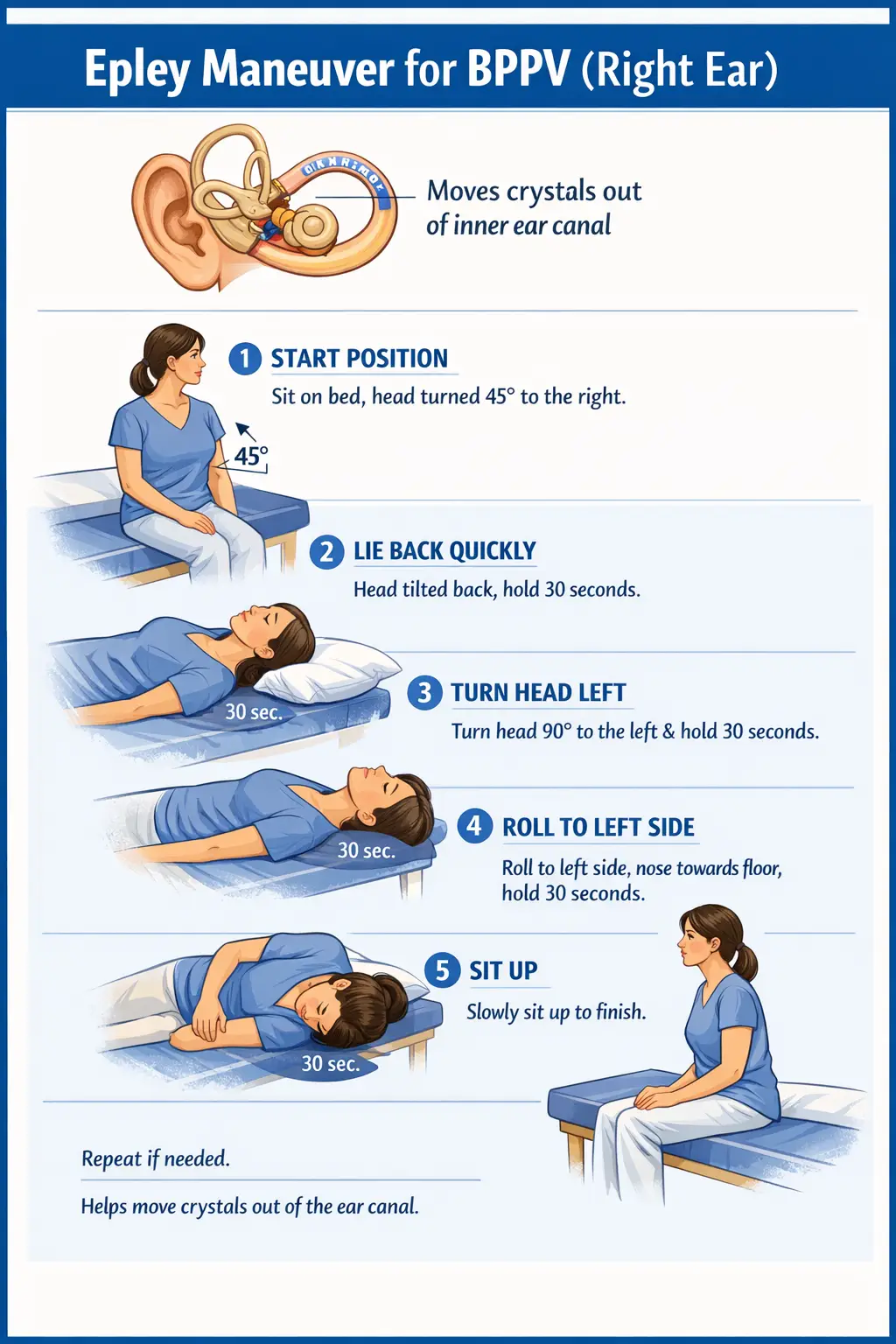
Step-by-Step Instructions for Right-Sided BPPV
Step 1: Starting Position
Sit upright on a bed with your legs extended. Place a pillow behind you so that when you lie back, it supports your shoulders—not your head. Turn your head 45 degrees to the right.
Step 2: Lie Back Quickly
Keeping your head turned, lie back so that your shoulders rest on the pillow and your head is slightly extended backward. Hold this position for 30–60 seconds. You may feel spinning. Remain still until it subsides.
Step 3: Rotate Head to the Left
Without lifting your head, slowly rotate it 90 degrees to the left. Hold for 30–60 seconds.
Step 4: Roll Onto the Left Side
Turn your body onto your left side while keeping your head turned so your nose points toward the floor. Hold 30–60 seconds.
Step 5: Sit Back Up
Slowly return to a seated position. Sit quietly for several minutes before standing.
Left-Sided Epley Maneuver
If the left ear is affected, reverse the directions.
What You May Feel During the Maneuver
- Brief spinning
- Nausea
- Sweating
- Temporary imbalance afterward
These sensations are common during crystal repositioning.
When the Epley Maneuver Works Well
For true BPPV, the Epley maneuver can be extremely effective. Many patients experience immediate or rapid relief. In acute cases, this can be life-changing.
However, some patients notice:
- Vertigo returns weeks or months later
- Symptoms shift from one side to the other
- Dizziness persists even without spinning
- Ongoing imbalance between episodes
This suggests the problem may not be limited to crystal displacement alone.
Why the Epley Maneuver Is Not a Long-Term Correction
The Epley maneuver repositions crystals.
It does not answer:
- Why did the crystals become displaced?
- Why does vertigo keep recurring?
- Why do other neurological symptoms coexist?
Many people with recurring BPPV also report:
- Neck pain
- Migraines
- Head pressure
- Brain fog
- Sensitivity to motion
- History of concussion or whiplash
These patterns point toward potential involvement of the upper cervical spine.
The Upper Cervical Spine and Its Role in Balance
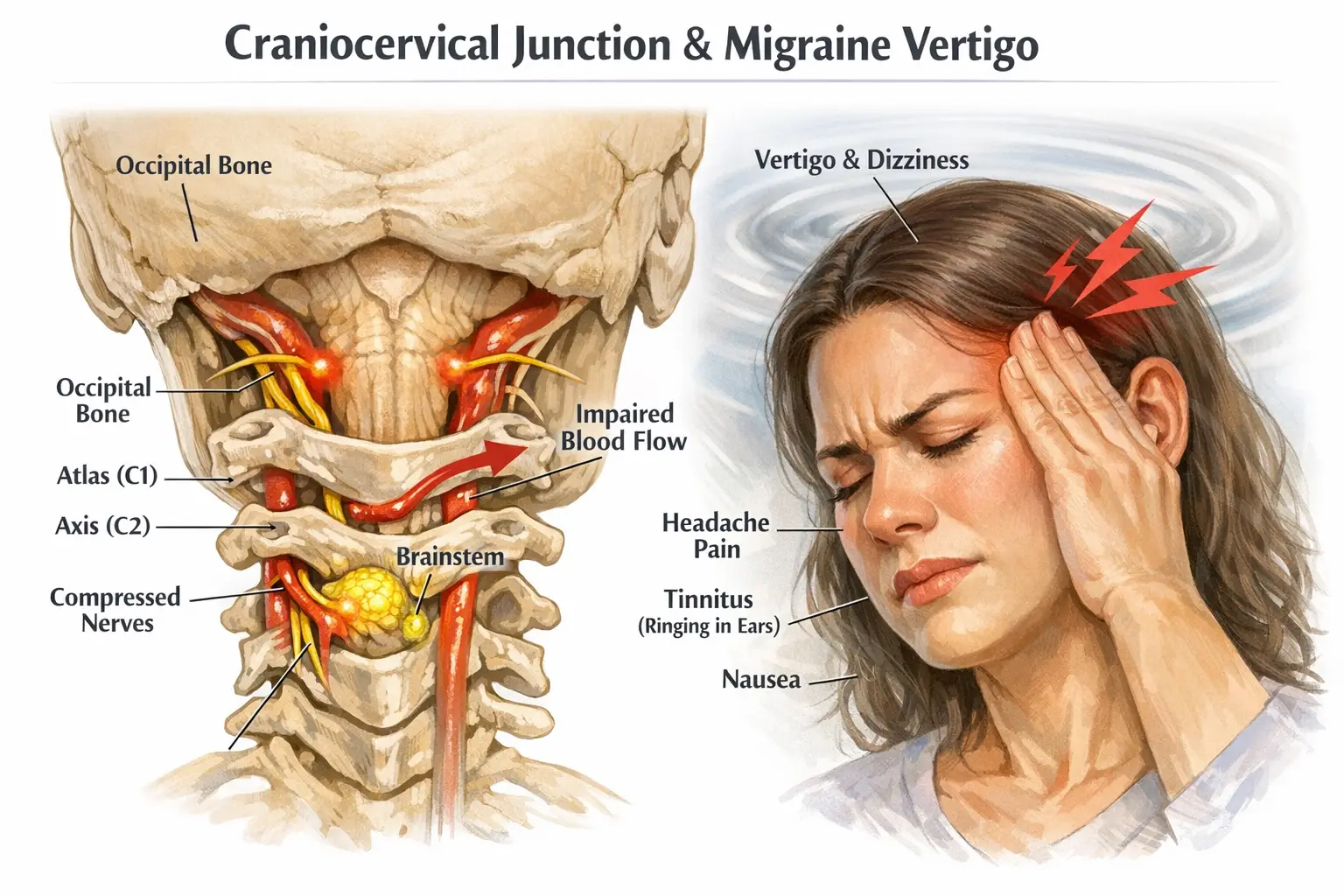
The upper cervical spine consists of the atlas (C1) and axis (C2). These two vertebrae are structurally and neurologically unique.
They:
- Support the skull
- Allow significant head rotation
- Protect the lower brainstem
- Contain a dense concentration of proprioceptive receptors
Proprioception: Your Body’s Internal GPS
Proprioception is your sense of body position. The upper neck plays a disproportionately large role in this system. Small muscles around the atlas and axis provide constant feedback to the brain about head position.
If these joints are irritated, unstable, or misaligned, the information sent to the brain may become distorted.
When distorted neck input combines with normal vestibular signals, the brain may perceive motion inaccurately. This mismatch can lead to dizziness or vertigo.
The Brainstem Connection
The brainstem sits directly above the atlas. It integrates vestibular information, coordinates eye movement, regulates nausea centers, and influences autonomic nervous system balance.
If the upper cervical spine is misaligned, it can contribute to abnormal mechanical stress and altered neurological signaling in this region.
This is one reason many patients experience overlapping symptoms such as:
- Migraines
- Occipital headaches
- Jaw tension
- Sinus pressure
- Light sensitivity
- Brain fog
Cervicogenic Dizziness
Cervicogenic dizziness refers to dizziness originating from dysfunction in the neck.
Indicators may include:
- Dizziness worsened by neck movement
- Stiffness at the base of the skull
- Symptoms triggered by prolonged posture
- History of neck trauma
- Dizziness accompanied by headaches
This does not mean the inner ear is uninvolved. It means the neck may be contributing to the overall imbalance.
Why Correcting the Upper Cervical Spine Matters
When the upper cervical spine is properly aligned and stabilized:
- Proprioceptive signaling improves
- Brainstem stress decreases
- Muscle guarding reduces
- Nervous system balance normalizes
Instead of repeatedly repositioning crystals, we focus on correcting the environment that may allow imbalance to occur.
Upper Cervical Chiropractic at Lavender Family Chiropractic | NeckWise North Sarasota
At Lavender Family Chiropractic | NeckWise North Sarasota, we focus on precision-based upper cervical care designed to restore structural and neurological stability.
Comprehensive Consultation
We begin with a detailed history including:
- Onset of vertigo
- Trigger patterns
- Trauma history
- Concussion history
- Migraine patterns
- Neck injuries
- Sleep disturbances
Patterns provide critical insight.
State-of-the-Art 3D CBCT Imaging
We utilize advanced 3D CBCT imaging to precisely measure atlas and axis alignment.
This allows us to assess:
- Rotation
- Lateral shift
- Skull tilt
- Joint spacing
Each correction is individualized.
Functional Nervous System Scanning
We perform objective nervous system scans, including paraspinal infrared thermography, to evaluate autonomic balance and monitor progress.
Gentle, Precise Corrections
Upper cervical corrections in our office are:
- Gentle
- Specific
- Measured
- Performed without twisting or cracking
The goal is stability—not force.
Monitoring and Stability
We continually re-evaluate alignment and nervous system indicators to ensure your body is holding correction.
As stability improves, many patients report reduction in vertigo frequency and intensity.
Who Should Consider an Upper Cervical Evaluation?
You may benefit if:
- Vertigo keeps returning
- The Epley maneuver only helps temporarily
- You have a history of car accidents
- You have experienced concussions
- You have chronic migraines with dizziness
- You feel pressure at the base of your skull
Service Areas
Lavender Family Chiropractic | NeckWise North Sarasota serves Sarasota, Bradenton, Lakewood Ranch, Parrish, Ellenton, Venice, Osprey, Punta Gorda, St. Petersburg, Siesta Key, Longboat Key, Lido Key, and Myakka City.
If you are searching for chiropractor sarasota florida, chiropractor near me, upper cervical chiropractor near me, Vertigo doctor near me, or Migraine doctor near me, our office specializes in upper cervical chiropractic care focused on neurological balance.
Top 15 FAQs
1. How do I know if my vertigo is BPPV?
Brief spinning triggered by positional changes is common with BPPV.
2. Can I perform the Epley maneuver at home?
It is best to be instructed by a professional.
3. Why does my vertigo keep coming back?
Recurring episodes may indicate an underlying structural or neurological issue.
4. Can neck problems cause vertigo?
Yes. The upper neck contributes heavily to balance signaling.
5. What is cervicogenic dizziness?
Dizziness related to neck dysfunction.
6. Is upper cervical chiropractic safe?
When performed correctly, it is gentle and precise.
7. Does it involve cracking?
No twisting or popping is used in our office.
8. Do you use imaging?
Yes, 3D CBCT imaging guides correction.
9. Can migraines and vertigo be connected?
Yes, they often overlap neurologically.
10. What if I had whiplash years ago?
Upper cervical misalignment can persist after trauma.
11. Do you accept insurance?
Our office is out of network with insurance. Many of our patients receive a superbill to submit to their insurance for reimbursement based on their coverage. We offer many different payment options as well as finance options.
12. How long does care take?
It depends on individual stability and healing response.
13. Is dizziness always from the ear?
No. Multiple systems contribute to balance.
14. Where are you located?
5899 Whitfield Ave Ste 107, Sarasota, FL 34243.
15. How do I schedule?
Call (941)243-3729 or visit www.chiropractorsarasotaflorida.com.
Final Thoughts
The Epley maneuver can be extremely helpful for repositioning inner ear crystals. But if vertigo persists or keeps returning, it is important to investigate deeper structural and neurological contributors.
At Lavender Family Chiropractic | NeckWise North Sarasota, we focus on upper cervical chiropractic care to address the underlying cause of dizziness and vertigo.
Lasting balance often begins at the top of the neck.
Schedule with us!
Lavender Family Chiropractic (NeckWise North Sarasota)
5899 Whitfield Ave Ste 107, Sarasota, FL 34243
www.chiropractorsarasotaflorida.com
(941)243-3729
To learn more about us go to http://www.chiropractorsarasotaflorida.com
We also service Bradenton, Parrish, Ellenton, Ruskin, Venice, Tampa, St. Pete, Osprey, Longboat, Lakewood Ranch, Myakka City.
If you are in Tampa, Land O Lakes, Fort Myers, or Salt Lake City, you can visit my other locations! NeckWise Upper Cervical. Visit, www.neckwise.com
If you are not local, visit www.uccnearme.com to find a doctor in your area
Serving Sarasota, Bradenton, Lakewood Ranch, Parrish, Ellenton, Venice, Osprey, Siesta Key, Longboat Key, Lido Key, Myakka City, Punta Gorda, and St. Petersburg.