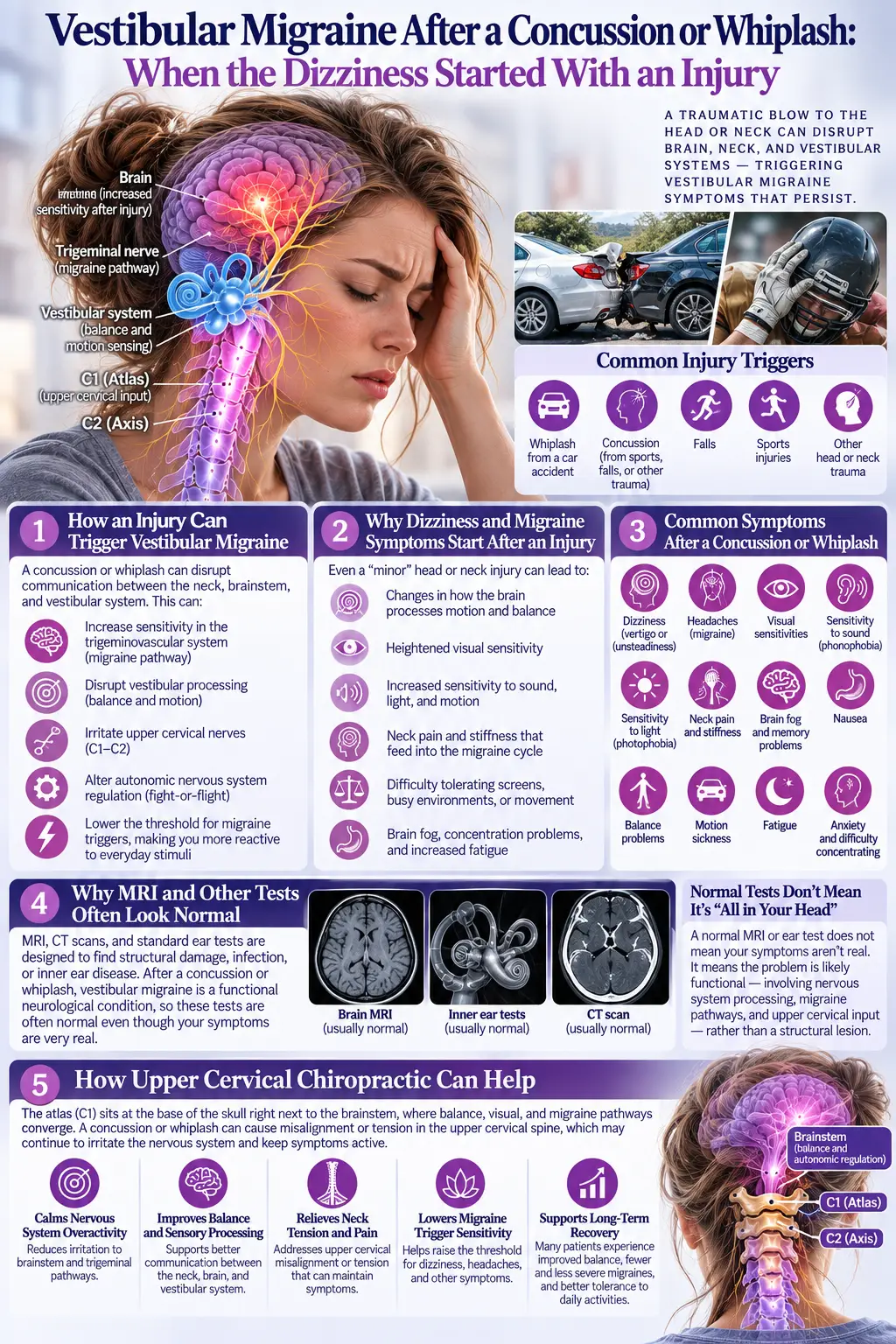

How Upper Cervical Chiropractic Can Address Vertigo
By Dr. Rusty Lavender, D.C. — upper cervical chiropractor, Lavender Family Chiropractic, Sarasota, FL. Reviewed and updated October 2026.
Our complete guide to vertigo care in Sarasota covers the causes we see, the imaging we use, and what to expect at an evaluation.
Vertigo is a challenging condition, often leaving individuals feeling as if they are spinning or that their environment is spinning around them. This sensation can significantly impact one’s quality of life. In the quest for relief, many overlook a potentially effective solution: upper cervical chiropractic care. This blog delves into how this specialized form of chiropractic care can be a beacon of hope for those suffering from vertigo.
Table of Contents
Understanding Vertigo
Vertigo is more than just feeling dizzy; it’s a specific sensation of spinning, which can be accompanied by nausea, balance issues, and even hearing loss. Common causes range from inner ear problems, such as Benign Paroxysmal Positional (BPPV), to neurological issues. Symptoms can disrupt daily activities, making even simple tasks daunting. Understanding its root causes is crucial for effective treatment, and this is where upper cervical chiropractic care comes into play.
What is Upper Cervical Chiropractic Care?
Upper cervical chiropractic focuses on the intricate relationship between the upper cervical spine (neck) and the brainstem. This form of chiropractic care is distinct, concentrating on the precise adjustment of the C1 and C2 vertebrae. These uppermost vertebrae are vital for neurological function and overall body balance. Upper cervical chiropractors use specific techniques and diagnostic tools to identify and correct misalignments in this area, which can be pivotal for overall health and well-being.
The Connection Between the Upper Cervical Spine and Dizziness
The upper cervical spine plays a crucial role in maintaining balance and spatial orientation. Misalignments in this region can disrupt the normal flow of nerve signals and blood flow to the brain, potentially triggering symptoms. These misalignments can result from various factors, including minor injuries, poor posture, or even stress. By correcting these misalignments, upper cervical chiropractic care aims to restore the body’s natural balance and alleviate vertigo symptoms.
How Upper Cervical Chiropractic Care Can Help
Upper cervical chiropractic techniques, such as precise adjustments, can realign the spine, thereby potentially reducing vertigo episodes. These techniques are tailored to each individual, based on their specific condition and spinal alignment. Studies and clinical cases have shown promising results in the management of vertigo through this method. By addressing the root cause of vertigo from a neurological standpoint, this chiropractic approach offers a holistic route to recovery, focusing on the body’s innate ability to heal itself.
Numerous patients have reported significant relief from vertigo symptoms following upper cervical chiropractic care. These real-life stories underline the potential of this specialized approach in bringing about meaningful change in the lives of those afflicted with vertigo.
Upper cervical chiropractic care offers a unique and potentially effective approach to managing vertigo. By focusing on the relationship between the upper cervical spine and the nervous system, this specialized care can address the underlying causes of vertigo, providing relief and improving quality of life. If you’re grappling with vertigo, consulting with a professional upper cervical chiropractor might open the door to a balanced and vertigo-free life.
We eagerly anticipate the opportunity to welcome you to our practice. Our dedicated team is committed to guiding you through the transformative journey of upper cervical chiropractic care. We understand the importance of personalized treatment and are here to answer all your questions. Let us help you unlock a new chapter of health and well-being.
For the complete picture — all 15 conditions we evaluate and how the upper neck fits — see our guide to vertigo treatment in Sarasota.
What the Research Says About Upper Cervical Care for Vertigo
Vertigo has many sources, and the most frequent is BPPV, in which loose calcium crystals drift into a semicircular canal of the inner ear; it is diagnosed with positional testing and treated with repositioning maneuvers, though it can come back (Kim & Zee, N Engl J Med 2014). When positional testing is negative and the ear checks out, clinicians look elsewhere. Cervicogenic dizziness is one of those places, and it has no gold-standard test; the diagnosis rests on excluding other causes and on the link between the dizziness, neck pain and neck movement (Reiley et al., Arch Physiother 2017). That diagnostic gap is why so many people are told their tests are normal while they still feel unsteady.
Manual care aimed at the upper neck has been tested directly. A randomized trial of a targeted upper cervical technique reduced both the intensity and the frequency of dizziness, with the benefit holding for 12 weeks (Reid et al., Man Ther 2008), and a systematic review found manual therapy improved cervicogenic dizziness whether or not vestibular rehabilitation was added, while calling for larger trials (Lystad et al., Chiropr Man Therap 2011). Safety data are reassuring: the largest prospective study of upper cervical chiropractic, following 1,090 patients across 83 offices, recorded high patient-rated improvement, mostly mild and short-lived reactions, and no serious adverse event (Eriksen et al., BMC Musculoskelet Disord 2011). Our approach is to measure before we move: 3D imaging of the atlas, a correction matched to the images, then re-measuring to confirm it held.
Frequently Asked Questions
What is the connection between the upper neck and vertigo?
The brainstem combines three streams of position information: the inner ear, the eyes, and the joints and muscles of the upper neck. When the atlas is misaligned, the neck sends signals that do not match the other two, and the brain interprets that mismatch as spinning or unsteadiness. Upper cervical care corrects the atlas with a precise, low-force adjustment so the signals agree again, and thermography measures the nervous system response.
How do you know if my vertigo is coming from my neck?
We take a careful history, including any whiplash, concussion, or fall, and note whether dizziness changes with neck position or comes with neck pain and headaches. The exam includes balance and neurological testing, followed by 3D cone-beam CT of the atlas and axis and a thermography baseline. Inner ear and neurological causes should be ruled out by an ENT or neurologist, and we coordinate with them and share imaging on request.
Is the vertigo adjustment gentle?
Yes. The Knee Chest correction is a light, specific contact behind the ear with no twisting, cracking, or rotation, which matters for patients who are already sensitive to head movement. You rest afterward in a quiet room while the body settles. A post-correction thermography scan confirms the nervous system responded. Many vertigo patients notice the room feels steadier as the correction holds, and visits spread out as readings stabilize.
Can upper cervical care help if I have already been diagnosed with BPPV or Meniere’s?
We work alongside your ENT or neurologist rather than replacing their care. Even with an inner ear diagnosis, an atlas misalignment can add conflicting neck input that makes episodes worse. Our evaluation determines whether that structural piece is present. If it is, correcting the atlas addresses it and thermography shows how the nervous system responds. If the upper neck is not involved, we say so and refer you back to your specialist.
Where can I get a vertigo evaluation near Bradenton?
Our Sarasota office is at the corner of University Parkway and Whitfield Avenue, minutes from Bradenton, Lakewood Ranch, and Palmetto. The evaluation includes a history, balance and neurological exam, CBCT imaging of the upper neck, and a thermography baseline. From those measurements we calculate your correction and build an individual care plan. Results vary by person. Call (941) 243-3729 to schedule an evaluation.
Schedule With Us!
Lavender Family Chiropractic offers consultations to learn more about you. Click the link below!
https://intake.chirohd.com/new-patient-scheduling/724/lavender-family-chiropractic
Related Posts


Get our upper cervical articles first.
Patients Experience