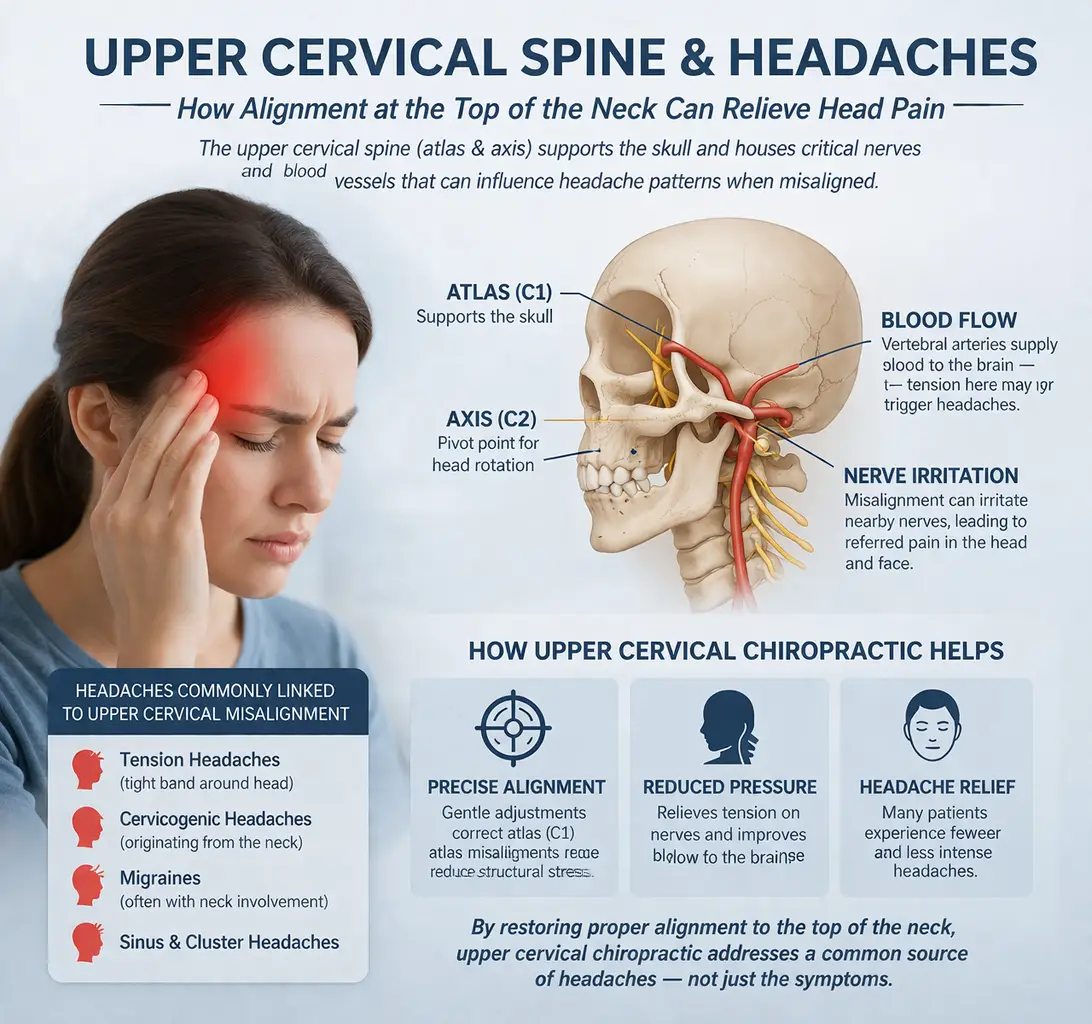
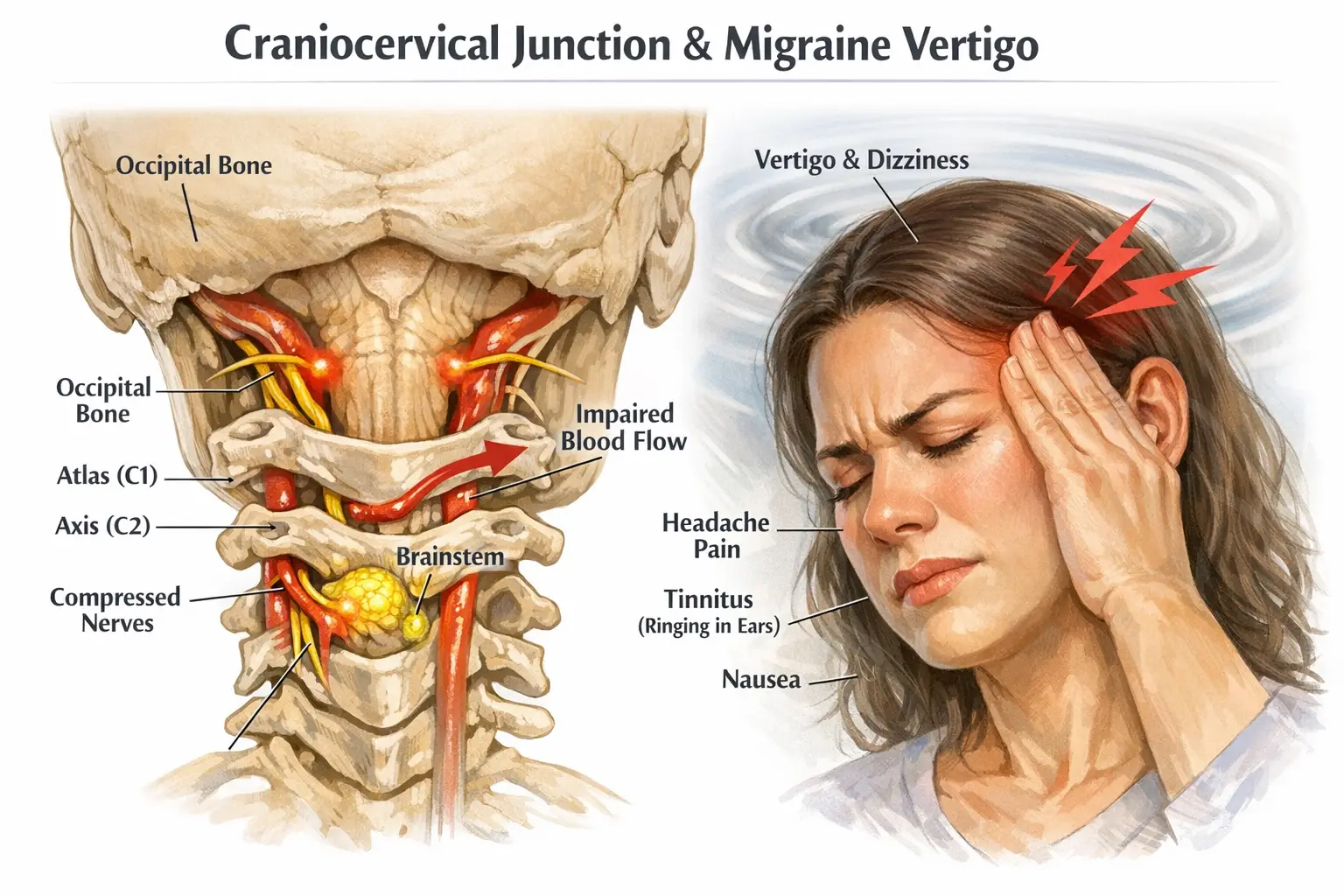
Introduction to the Craniocervical Junction
Vertigo and migraines are two of the most disruptive neurological conditions people experience. Individuals suffering from these conditions often describe their symptoms as life‑altering. Simple daily activities such as walking, driving, working, turning the head, bending over, or even looking at a computer screen can trigger dizziness, spinning sensations, head pressure, nausea, light sensitivity, and debilitating headaches.
Many people visit multiple specialists searching for answers. They may see neurologists, ENT doctors, primary care physicians, and physical therapists. In many cases they undergo MRIs, CT scans, vestibular testing, blood work, and various medications. Despite these efforts, many patients are told that nothing structurally wrong is visible or that their symptoms must simply be managed long term.
However, there is one anatomical region that is often overlooked when evaluating vertigo and migraines: the craniocervical junction.
The craniocervical junction is where the skull meets the upper cervical spine. Although this region is physically small, it plays an enormous role in neurological function, balance, blood flow, and communication between the brain and body.
Structural problems in this area can influence the brainstem, vestibular system, trigeminal nerve pathways, and autonomic nervous system. When the upper cervical spine becomes misaligned, these neurological pathways can become irritated or dysfunctional, potentially contributing to symptoms such as vertigo, dizziness, migraines, headaches, neck pain, brain fog, and nervous system imbalance.
At Lavender Family Chiropractic powered by NeckWise North Sarasota, our focus is identifying and correcting structural problems within this critical region through highly precise upper cervical chiropractic care.
This article explores the anatomy of the craniocervical junction, how it relates to vertigo and migraines, and how upper cervical misalignment may affect neurological function.
What Is the Craniocervical Junction?
The craniocervical junction refers to the anatomical transition point between the skull and the uppermost portion of the cervical spine.
This region is composed primarily of three structures:
• The occiput (base of the skull)
• The atlas vertebra (C1)
• The axis vertebra (C2)
Together, these structures form a complex mechanical and neurological interface between the brain and spinal cord.
The craniocervical junction performs several extremely important roles including:
• Supporting the weight of the head
• Protecting the brainstem
• Allowing head movement
• Maintaining neurological communication between brain and body
• Supporting blood flow to the brain
Because this region houses so many essential neurological pathways, even small structural abnormalities can potentially influence overall nervous system function.
The Atlas Vertebra: The Foundation of the Head
The atlas vertebra, also known as C1, is the first cervical vertebra located directly beneath the skull.
It is named after the Greek mythological figure Atlas, who was said to hold up the heavens. In a similar way, the atlas vertebra supports the entire weight of the human head.
The average adult head weighs between 10 and 12 pounds. The atlas is responsible for supporting that weight while allowing smooth movement of the head.
Unlike other vertebrae in the spine, the atlas has a unique ring‑like structure and lacks a traditional vertebral body. This design allows it to cradle the base of the skull and permit the nodding motion of the head.
The atlas plays several critical roles including:
• Supporting the skull
• Allowing head flexion and extension
• Protecting the brainstem
• Maintaining balance between head and spine
Because the atlas is the structural foundation of the head and neck, its alignment plays a significant role in the posture and function of the entire spine.
If the atlas becomes misaligned, it can shift the position of the head relative to the spine. This imbalance may create stress throughout the spinal column and nervous system.
The Axis Vertebra and Head Rotation
Directly below the atlas is the axis vertebra, also known as C2.
The axis contains a specialized structure called the dens, or odontoid process, which acts as a pivot point for head rotation.
The atlas rotates around this structure, allowing us to turn our heads from side to side.
Together, the atlas and axis create one of the most mobile joints in the entire spine. In fact, approximately 50 percent of all head rotation occurs between these two vertebrae.
Because of this mobility, the upper cervical spine is particularly vulnerable to injury or misalignment from trauma.
Common causes include:
• Car accidents
• Whiplash injuries
• Sports impacts
• Falls
• Concussions
• Sudden head movements
Even relatively minor traumas can create subtle structural shifts in this region.
Why the Craniocervical Junction Is Neurologically Critical
The craniocervical junction is one of the most neurologically dense areas in the human body. Several essential systems pass through or near this region.
The Brainstem
The brainstem sits directly above the atlas and axis.
This structure acts as a communication hub between the brain and body. It regulates many vital functions including:
• Balance and coordination
• Breathing
• Heart rate
• Blood pressure
• Eye movement
• Vestibular processing
Because the brainstem sits so close to the upper cervical spine, structural changes in this area may influence neurological signaling.
Vertebral Arteries
The vertebral arteries travel through the cervical spine and curve around the atlas before entering the skull.
These arteries supply blood to the brainstem, cerebellum, and other structures involved in balance and coordination.
Any abnormal mechanical stress in the upper cervical region can potentially influence blood flow dynamics to these areas.
Cerebrospinal Fluid Circulation
Cerebrospinal fluid (CSF) circulates between the brain and spinal canal through openings at the base of the skull.
Proper flow of CSF helps maintain pressure balance and protects the brain.
Structural abnormalities near the craniocervical junction may influence fluid dynamics within this system.
The Vagus Nerve and Autonomic System
The vagus nerve exits the skull near the craniocervical junction and plays a major role in regulating the autonomic nervous system.
This system controls involuntary functions such as heart rate, digestion, blood pressure, and inflammatory responses.
Disturbances in this region may contribute to autonomic symptoms such as dizziness, nausea, heart rate irregularities, and fatigue.
What Is Upper Cervical Misalignment?
Upper cervical misalignment refers to a structural shift in the atlas or axis vertebra relative to the skull.
These misalignments are sometimes very small in magnitude but can still have significant neurological effects due to the sensitive structures in this region.
Causes of upper cervical misalignment may include:
• Whiplash injuries
• Car accidents
• Sports injuries
• Falls
• Concussions
• Repetitive postural stress
• Birth trauma
Many individuals sustain upper cervical injuries years before symptoms appear. The body may initially compensate for structural imbalances, but over time these compensations can lead to neurological stress and chronic symptoms.
How Upper Cervical Misalignment Can Contribute to Vertigo
Vertigo is a sensation that either you or your environment is spinning or moving when it should not be.
Patients commonly describe vertigo as:
• Room spinning
• Feeling like they are on a boat
• Loss of balance
• Sudden dizziness
• Motion sensitivity
• Lightheadedness
The inner ear plays an important role in balance, but it is only one component of the vestibular system.
Balance actually depends on three major systems working together:
• The inner ear vestibular organs
• Visual input from the eyes
• Proprioceptive feedback from the neck and body
The upper cervical spine contains thousands of proprioceptive receptors that inform the brain about the position of the head in space.
These signals are constantly transmitted to the cerebellum and vestibular nuclei in the brainstem.
If the atlas becomes misaligned, these signals may become distorted. When the brain receives conflicting information from the neck, eyes, and inner ear, dizziness and vertigo may occur.
This phenomenon is sometimes referred to as cervicogenic dizziness.
The Trigeminocervical Complex and Migraine Pathways
Migraines are complex neurological events involving multiple brain structures and signaling pathways.
One of the most important anatomical connections between the neck and migraine pathways is the trigeminocervical complex.
This region in the brainstem integrates sensory input from two primary sources:
• The trigeminal nerve (which supplies the face and head)
• The upper cervical spinal nerves
Because these sensory pathways converge in the same area of the brainstem, irritation in the upper cervical spine can influence migraine activity.
When upper cervical nerves become irritated due to structural misalignment, they may stimulate pain pathways associated with migraine headaches.
This is one reason many migraine sufferers experience neck stiffness or pain before a migraine attack begins.
The Relationship Between Neck Injuries and Migraines
Many patients report that their migraines began after a head or neck injury.
Common examples include:
• Car accidents
• Sports injuries
• Concussions
• Falls
Whiplash injuries in particular place enormous forces on the craniocervical junction. These forces can disrupt the normal alignment of the atlas and axis.
Even if the injury occurred years earlier, subtle structural changes may continue to irritate neurological pathways involved in migraine generation.
Why Conventional Treatments Often Miss the Cause
Many traditional medical approaches to vertigo and migraines focus on symptom suppression rather than structural correction.
Common treatments include:
• Migraine medications
• Vestibular suppressants
• Anti‑nausea drugs
• Canalith repositioning maneuvers
• Physical therapy
• Lifestyle modifications
While these treatments may help reduce symptoms temporarily, they often do not address structural problems in the craniocervical junction.
If upper cervical misalignment is contributing to neurological irritation, symptom‑focused treatments may fail to produce long‑term improvement.
What Is Upper Cervical Chiropractic Care?
Upper cervical chiropractic care is a specialized branch of chiropractic focused specifically on the relationship between the skull and the first two vertebrae of the spine.
Rather than adjusting multiple areas of the spine, upper cervical care focuses on precise corrections of the atlas and axis.
The goal is to restore proper alignment so the nervous system can function without interference.
Upper cervical chiropractors use highly detailed imaging and analysis to determine the exact direction and magnitude of misalignment.
This allows for extremely precise corrections that are customized for each individual patient.
Advanced 3D Imaging and Structural Analysis
At Lavender Family Chiropractic powered by NeckWise North Sarasota, advanced imaging is used to analyze the craniocervical junction.
Our office utilizes 3D CBCT imaging to evaluate the alignment of the atlas and axis relative to the skull.
This technology allows doctors to measure misalignment in three dimensions, including:
• Rotation
• Side bending
• Forward or backward displacement
This level of detail is essential because the upper cervical spine is extremely delicate and small alignment changes can be significant.
Precise measurements allow doctors to calculate a correction that is customized for each patient.
Gentle and Precise Upper Cervical Corrections
Upper cervical corrections are very different from traditional chiropractic adjustments.
Rather than twisting or cracking the spine, these corrections are extremely gentle and precise.
Patients typically lie comfortably on a specialized table while a light force is applied to the atlas vertebra.
The correction is designed to guide the vertebra toward its optimal position without excessive force.
Most patients are surprised by how light the correction feels.
There is typically no popping, twisting, or cracking involved.
Neurological Improvements After Correction
When the atlas and axis return to a more balanced position, several physiological improvements may occur.
Potential improvements may include:
• Reduced neurological irritation
• Improved vestibular signaling
• Improved communication between brain and body
• Reduced muscle tension
• Improved balance
As the nervous system stabilizes, many patients report improvements in vertigo, migraines, headaches, and neck pain.
NeckWise Care at Lavender Family Chiropractic
Lavender Family Chiropractic powered by NeckWise North Sarasota focuses specifically on upper cervical correction.
Our approach begins with a comprehensive evaluation that includes:
• Neurological examination
• Structural assessment
• Advanced 3D imaging
• Nervous system analysis
This information allows our doctors to determine whether the craniocervical junction may be contributing to a patient’s symptoms.
If upper cervical misalignment is identified, a customized care plan is developed.
Corrections are designed specifically for the patient’s anatomy and structural findings.
Why Precision Matters in the Upper Cervical Spine
The upper cervical spine is extremely small and highly sensitive.
Because of this, precision is critical when performing corrections.
Upper cervical chiropractic care focuses heavily on individualized analysis and careful monitoring.
This approach allows the body to stabilize and maintain improved alignment over time.
Restoring Balance to the Nervous System
The primary goal of upper cervical chiropractic care is not simply symptom relief.
Instead, the goal is restoring proper neurological communication between the brain and body.
When the nervous system functions without interference, the body is better able to regulate balance, muscle tone, blood flow, and sensory processing.
This allows the body to heal and function more efficiently.
Symptoms Often Associated With Upper Cervical Dysfunction
In addition to vertigo and migraines, upper cervical dysfunction has been associated with many other symptoms including:
• Chronic headaches
• Neck pain
• Brain fog
• Ear pressure
• TMJ problems
• Facial pain
• Shoulder tension
• Balance problems
Because the craniocervical junction is so neurologically important, restoring alignment can influence many aspects of neurological health.
Conclusion
The craniocervical junction is one of the most important structural regions in the human body. It sits at the intersection between the brain and spinal cord and houses many of the neurological systems responsible for balance, pain processing, and autonomic regulation.
When the atlas and axis vertebrae become misaligned, they may contribute to irritation of neurological pathways involved in vertigo and migraines.
Although many traditional treatments focus on suppressing symptoms, evaluating the structural alignment of the upper cervical spine may reveal an underlying cause that has been overlooked.
Upper cervical chiropractic care focuses on restoring proper alignment in this region through precise and gentle corrections.
At Lavender Family Chiropractic powered by NeckWise North Sarasota, the goal is identifying structural problems at the craniocervical junction and helping the nervous system function at its highest potential.
For individuals struggling with chronic vertigo, dizziness, migraines, or unexplained neurological symptoms, examining the upper cervical spine may be an important step toward long-term recovery.
Patients looking for a chiropractor Sarasota Florida, upper cervical chiropractor near me, vertigo doctor near me, or migraine doctor near me often discover that the upper cervical spine plays a critical role in their symptoms.
Lavender Family Chiropractic powered by NeckWise North Sarasota serves patients throughout Sarasota and surrounding communities including Lakewood Ranch, Bradenton, Parrish, Venice, Siesta Key, Longboat Key, Ellenton, Myakka City, and other areas throughout Southwest Florida.
If you have been searching for answers to vertigo, migraines, dizziness, or chronic neurological symptoms, evaluating the craniocervical junction may be the missing piece.
Frequently Asked Questions About the Craniocervical Junction, Vertigo, and Migraines
1. What is the craniocervical junction?
The craniocervical junction is the region where the skull meets the top two vertebrae of the spine, known as the atlas (C1) and axis (C2). This area protects the brainstem and plays a major role in balance, neurological communication, and head movement.
2. Can the upper neck cause vertigo?
Yes. The upper cervical spine contains thousands of proprioceptive nerve receptors that communicate head position to the brain. If these signals become distorted due to misalignment, dizziness or vertigo may occur.
3. What is cervicogenic dizziness?
Cervicogenic dizziness refers to dizziness that originates from dysfunction in the neck. Problems in the upper cervical spine can disrupt balance signals being sent to the brain.
4. Can neck injuries trigger migraines?
Yes. Neck injuries such as whiplash, concussions, or sports trauma can affect the trigeminocervical complex in the brainstem. Irritation in this region may contribute to migraine headaches.
5. What is upper cervical chiropractic care?
Upper cervical chiropractic care is a specialized form of chiropractic that focuses on correcting alignment of the atlas and axis vertebrae. The goal is to restore proper nervous system communication between the brain and body.
6. Is upper cervical chiropractic different from regular chiropractic?
Yes. Upper cervical chiropractic focuses specifically on the top two vertebrae of the spine and uses highly precise imaging and gentle corrections rather than twisting or cracking the spine.
7. What symptoms can upper cervical misalignment cause?
Symptoms may include vertigo, migraines, dizziness, neck pain, headaches, brain fog, balance problems, ear pressure, TMJ issues, and nervous system dysfunction.
8. How are upper cervical misalignments diagnosed?
Doctors use detailed imaging such as 3D CBCT scans, neurological testing, and structural analysis to determine the exact position of the atlas and axis.
9. What is a CBCT scan?
CBCT stands for Cone Beam Computed Tomography. It is a specialized 3D imaging technology that allows doctors to visualize the exact alignment of the upper cervical spine.
10. Are upper cervical adjustments safe?
Yes. Upper cervical corrections are extremely gentle and precise. Most patients are surprised by how light the correction feels.
11. Do upper cervical adjustments involve cracking or twisting?
No. Upper cervical adjustments are designed to be gentle and precise without twisting or popping the spine.
12. How long does it take to see improvement?
Every patient is different. Some people notice improvements quickly, while others experience gradual changes as the nervous system stabilizes.
13. Can upper cervical care help migraines?
Many migraine sufferers experience improvements when upper cervical misalignments are corrected because the care reduces irritation in neurological pathways related to migraine generation.
14. Can upper cervical care help vertigo?
Yes. When the atlas and axis return to a more balanced position, communication between the neck and brain may improve, helping stabilize balance signals.
15. Where can I find an upper cervical chiropractor in Sarasota?
Lavender Family Chiropractic powered by NeckWise North Sarasota specializes in upper cervical chiropractic care and helps patients experiencing vertigo, migraines, dizziness, and neurological symptoms.
Patients searching online for a chiropractor near me, upper cervical chiropractor near me, vertigo doctor near me, or migraine doctor near me in Sarasota and Lakewood Ranch often find our office as a resource for natural neurological care.
To learn more or schedule a consultation, visit www.chiropractorsarasotaflorida.com or call (941)243-3729.
Schedule With US!
Lavender Family Chiropractic (NeckWise North Sarasota)
5899 Whitfield Ave Ste 107, Sarasota, FL 34243
www.chiropractorsarasotaflorida.com
(941)243-3729
To learn more about us go to http://www.chiropractorsarasotaflorida.com
Research
For More info about upper cervical and migraine click here