IV Therapy for Headaches and Migraines: Symptom Relief vs. Addressing the Root Cause for Proven Relief
IV Therapy for Headaches: Headaches and migraines can be debilitating. For some, they are occasional interruptions. For others, they are life‑altering events that disrupt work, family time, travel, sleep, and emotional wellbeing. When the pain strikes, most people will do almost anything for relief. That is why IV therapy for headaches and migraines has become increasingly popular.
IV lounges are opening across the country, promising fast hydration, vitamin replenishment, and migraine relief in a comfortable setting. Many patients report feeling better after an IV session. The question is not whether IV therapy can help. The real question is this:
Is it solving the problem — or simply managing symptoms?
In this in‑depth guide, we will explore:
• What IV therapy is
• How IV therapy may help headaches and migraines
• The limitations of IV therapy
• The neurological connection between the neck and migraines
• How NeckWise Care at NeckWise North Sarasota focuses on the root cause
• Why structural correction of the upper cervical spine changes everything
If you have tried medications, supplements, injections, IV drips, or alternative therapies without lasting results, this article is for you.
Understanding Headaches and Migraines
Not all headaches are the same. A tension headache feels very different from a migraine. Migraines often come with throbbing pain, nausea, light sensitivity, sound sensitivity, dizziness, visual disturbances, and sometimes even numbness or speech difficulty.
Migraines are neurological events. They are not simply “bad headaches.” They involve changes in brainstem activity, blood flow, inflammatory signaling, and nervous system regulation.
Common triggers include:
• Stress
• Hormonal fluctuations
• Dehydration
• Lack of sleep
• Certain foods
• Bright lights
• Weather changes
• Neck tension or trauma
Many treatment approaches focus on reducing inflammation, stabilizing blood vessels, or blocking pain signals. These approaches may reduce severity or frequency. However, few ask the deeper question:
Why is the nervous system so reactive in the first place?
What Is IV Therapy?
IV (intravenous) therapy delivers fluids, vitamins, minerals, and medications directly into the bloodstream through a vein. Because the nutrients bypass digestion, absorption is rapid and bioavailability is high.
Common IV migraine blends may include:
• Magnesium
• B vitamins (especially B2 and B12)
• Vitamin C
• Fluids (saline)
• Anti‑nausea medication
• Anti‑inflammatory medication
• Sometimes Toradol or other pain relievers
The goal is to quickly reduce inflammation, replenish deficiencies, rehydrate the body, and calm overactive neurological pathways.
For someone in the middle of a migraine attack, IV therapy can provide meaningful short‑term relief.
How IV Therapy Can Help Headaches and Migraines
1. Hydration Support
Dehydration is a well‑known headache trigger. IV fluids rapidly restore fluid balance, potentially reducing headache intensity.
2. Magnesium Repletion
Magnesium deficiency has been linked to migraines. Magnesium helps regulate nerve transmission, muscle relaxation, and vascular tone. IV magnesium may reduce migraine frequency in some individuals.
3. B Vitamin Support
Riboflavin (B2) has been studied for migraine prevention. B12 supports nerve function and methylation pathways. If a patient is deficient, supplementation may help.
4. Anti‑Inflammatory Effects
Medications delivered through IV may reduce acute inflammation and pain during an attack.
5. Faster Symptom Relief
Because nutrients bypass the digestive tract, effects may be felt more quickly than oral supplements.
There is no question that IV therapy can be useful for acute migraine management. Many patients experience decreased pain, reduced nausea, and improved clarity after treatment.
But here is the key issue.
If someone needs IV therapy repeatedly, what is driving the cycle? For the root-cause approach to headaches, see our complete headache treatment in Sarasota guide.
The Limitation of IV Therapy
IV therapy addresses biochemical contributors:
• Dehydration
• Nutrient deficiency
• Acute inflammation
It does not address structural neurological stress.
If the brainstem is under chronic mechanical irritation due to upper cervical misalignment, no amount of magnesium will correct that alignment.
If abnormal tension patterns in the upper neck are disrupting cerebrospinal fluid flow, IV hydration does not restore that flow.
If the vagus nerve or trigeminal pathways are under ongoing stress from structural distortion, vitamins alone will not remove that stress.
This is why some people say:
“IV therapy helps… but the migraines always come back.”
Because the root cause remains uncorrected.
The Missing Piece: The Upper Cervical Spine
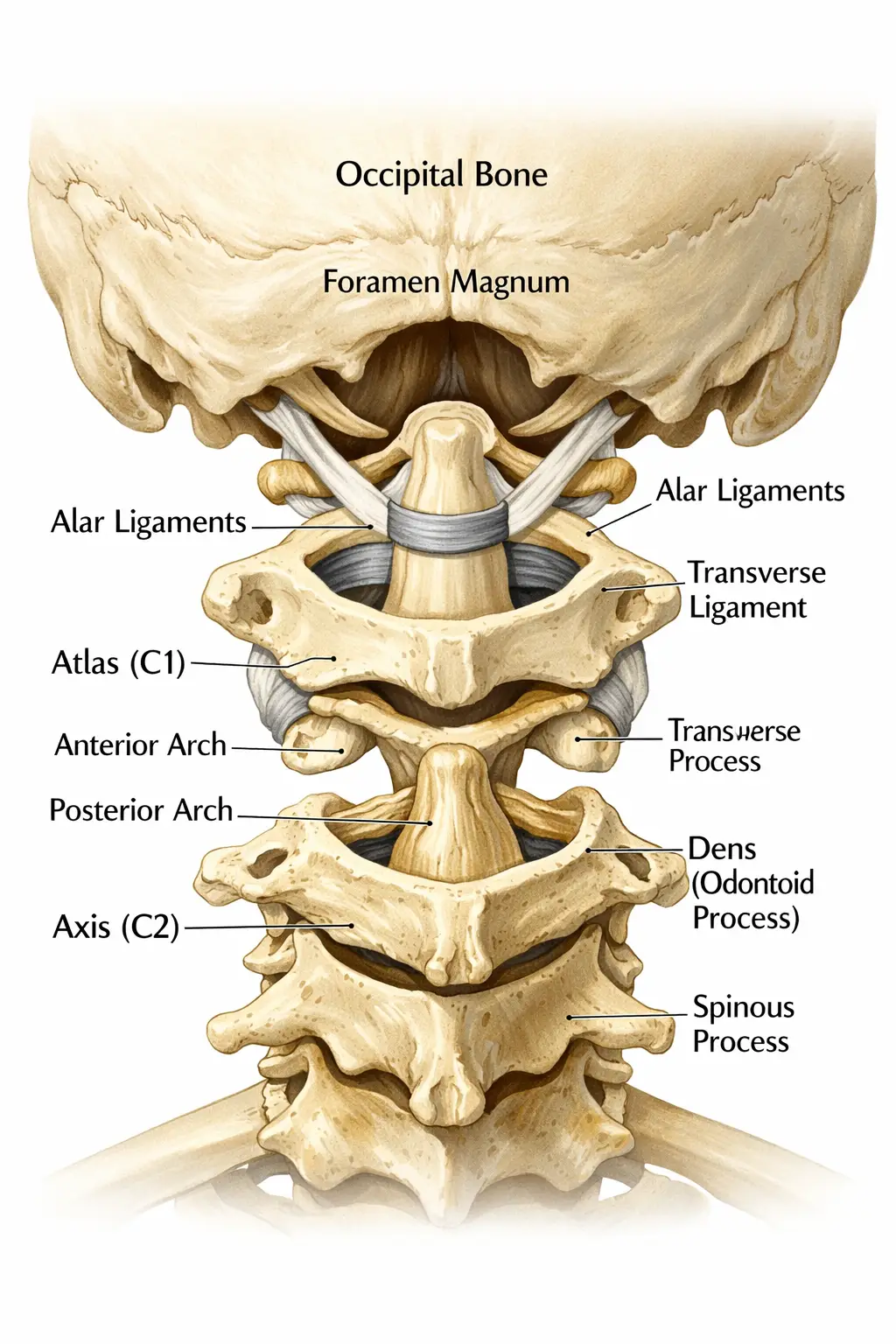
At the top of your spine sit two critically important vertebrae: the atlas (C1) and axis (C2).
These bones:
• Protect the brainstem
• Surround vital neurological pathways
• Influence blood flow to and from the brain
• Affect cerebrospinal fluid dynamics
• Anchor the head’s posture
The brainstem regulates:
• Pain processing
• Autonomic nervous system function
• Hormonal balance
• Sleep cycles
• Muscle tone
• Inflammatory responses
Even a small misalignment in the upper cervical spine can create disproportionate neurological effects.
Car accidents. Sports injuries. Falls. Concussions. Even years of poor posture.
These events may cause subtle shifts in the atlas alignment. Because the atlas does not have a disc above it and supports the weight of the head, small distortions can lead to chronic nervous system irritation.
Migraines are often not random.
They are frequently a nervous system response to mechanical stress at the top of the spine.
A Deeper Look at Upper Cervical Chiropractic Care for Migraines and Headaches
To truly understand why upper cervical chiropractic care can have such a powerful impact on migraines and chronic headaches, we have to look more closely at the neurological mechanics involved.
Migraines are not simply vascular events. They are not merely muscular tension patterns. They are complex neurological storms involving the brainstem, cranial nerves, inflammatory mediators, autonomic imbalance, and altered sensory processing.
The upper cervical spine sits at the center of that storm.
The Atlas (C1) and Brainstem Relationship
The atlas is the first vertebra in the spine. It supports the skull and surrounds the lower brainstem. Unlike other vertebrae, it does not have a disc above it. It is uniquely shaped and responsible for a large portion of head rotation and nodding motion.
Because of its structure and mobility, it is also vulnerable.
When the atlas shifts out of optimal alignment, several things may occur:
• Mechanical irritation near the brainstem • Abnormal muscle tone patterns • Distortion of neurological signaling • Altered vascular regulation • Imbalanced autonomic nervous system activity
The brainstem houses nuclei that regulate pain processing and cranial nerve communication. Even small mechanical stress in this region may influence migraine thresholds.
The Trigeminocervical Complex
One of the most important anatomical connections in migraine physiology is the trigeminocervical complex.
This is a convergence point in the brainstem where sensory information from the trigeminal nerve (which supplies much of the face and head) meets sensory input from the upper cervical nerves.
If upper cervical joints are irritated or inflamed, that irritation can feed into the trigeminal system.
The result?
Referred pain into the head.
Throbbing behind the eyes.
Pressure in the temples.
Pain at the base of the skull that radiates forward.
Correcting upper cervical misalignment reduces abnormal joint stress, which may calm this convergence pathway.
Autonomic Nervous System Regulation
Many migraine sufferers also experience:
• Nausea • Light sensitivity • Sound sensitivity • Dizziness • Temperature regulation issues • Heart rate variability changes
These are autonomic nervous system symptoms.
The upper cervical spine plays a major role in autonomic balance because the brainstem regulates sympathetic and parasympathetic activity.
If the atlas is misaligned and creating mechanical stress in this region, autonomic instability may follow.
Upper cervical correction aims to restore proper alignment so that the autonomic system can rebalance naturally.
Cerebrospinal Fluid Dynamics
Cerebrospinal fluid (CSF) bathes the brain and spinal cord. It cushions neural tissue and helps regulate pressure.
Structural distortion at the cranio-cervical junction may alter fluid dynamics.
When alignment improves, CSF flow may normalize, potentially reducing pressure-related headache patterns.
While IV hydration increases systemic fluid levels, it does not change structural flow pathways. Structural correction influences the mechanics of movement and circulation at the top of the spine.
Posture, Forward Head Position, and Chronic Tension
Modern life encourages forward head posture.
Phones. Laptops. Desk work. Driving.
When the head shifts forward, the upper cervical spine compensates. Muscles tighten. Ligaments strain. The atlas can subtly rotate or tilt.
Over time, this compensation becomes chronic.
Chronic compensation equals chronic neurological irritation.
Upper cervical chiropractic care addresses not only alignment but also educates patients on restoring healthy posture patterns so corrections hold longer and stability improves.
What Makes Upper Cervical Care Different?
Traditional chiropractic adjustments often focus on multiple regions of the spine in a general way.
Upper cervical chiropractic care focuses specifically on the atlas and axis with precision measurements.
Key differences include:
• Detailed imaging analysis before correction • Objective measurement of misalignment angles • Specific vectors of correction • No twisting, popping, or cracking • Emphasis on holding adjustments rather than frequent manipulation
The goal is not repeated force.
The goal is stability.
When the atlas is corrected properly, the body often begins to self-correct downstream compensations.
The Long-Term Impact on Migraine Patterns
Patients under upper cervical care frequently report:
• Increased time between migraines • Reduced medication dependence • Less severe aura symptoms • Decreased neck tension before attacks • Improved stress resilience • Better sleep quality
Rather than chasing every flare-up, care focuses on maintaining alignment so the nervous system remains regulated.
This changes the migraine conversation from:
“How do I survive the next attack?”
to
“How do I prevent the next attack?”
Addressing Trauma History
Many migraine sufferers do not realize they experienced trauma years ago that may still be affecting them.
Examples include:
• Childhood falls • Sports injuries • Minor car accidents • Whiplash events that seemed insignificant • Concussions that were never structurally evaluated
The body adapts to trauma. Muscles tighten to stabilize. Ligaments compensate. The nervous system recalibrates.
Upper cervical chiropractic care evaluates whether those adaptations are still present and whether alignment correction can reduce chronic neurological stress.
Why Precision Matters
A one-size-fits-all adjustment approach is unlikely to correct subtle atlas misalignment.
Upper cervical care uses measured angles and individualized correction strategies.
This level of specificity increases the likelihood of:
• Long-lasting correction • Reduced need for frequent visits • Stable neurological improvement
When alignment holds, migraine patterns often shift dramatically.
IV Therapy vs. Structural Neurological Restoration
Let’s compare more clearly.
IV Therapy influences:
• Blood chemistry • Hydration status • Nutrient levels • Acute inflammation
Upper Cervical Chiropractic influences:
• Structural alignment • Brainstem stress • Trigeminocervical irritation • Autonomic regulation • Mechanical tension patterns
Both may help.
But only one corrects structure.
And structure drives function.
The Goal: Reducing Dependence on Symptom Management
Many migraine sufferers build a toolkit:
• Rescue medications • Supplements • Ice packs • Dark rooms • IV therapy sessions • Avoidance of triggers
These tools are valuable.
But if the structural cause is corrected, reliance on these tools often decreases.
That shift represents true progress.
Why the Neck Matters in Migraines
Research shows strong connections between cervical spine dysfunction and migraines. The trigeminocervical complex in the brainstem integrates sensory information from both the trigeminal nerve and upper cervical nerves.
When upper cervical joints are irritated, pain signals can be referred into the head and face.
This explains why many migraine sufferers report:
• Neck stiffness before an attack
• Pain at the base of the skull
• Shoulder tension
• Relief when neck pressure is reduced
If the structural component is not addressed, biochemical treatments may offer temporary calm but not lasting correction.
NeckWise Care at NeckWise North Sarasota
At NeckWise North Sarasota, the focus is not on masking symptoms.
The focus is on identifying and correcting the underlying structural cause.
NeckWise Care is a highly specific form of upper cervical chiropractic that evaluates the alignment of the atlas and axis using advanced imaging and neurological analysis.
Unlike traditional chiropractic adjustments that may involve twisting, cracking, or popping, upper cervical correction is:
• Precise
• Gentle
• Measured
• Customized
The adjustment is often so light that patients are surprised by how subtle it feels.
But subtle does not mean insignificant.
When alignment is restored, the nervous system can function without interference.
The Role of Advanced Imaging
At NeckWise North Sarasota, detailed 3D imaging is used to assess the exact alignment of the upper cervical spine.
This is critical because no two misalignments are identical.
Generic adjustments without imaging are guesswork.
Precision imaging allows for:
• Measurement of rotation and tilt
• Analysis of structural asymmetry
• Custom correction angles
• Objective comparison over time
This data‑driven approach ensures that care is specific and reproducible.
How Structural Correction Impacts Migraines
When the atlas is properly aligned:
• Brainstem pressure may decrease
• Inflammatory signaling may calm
• Muscle tension patterns may normalize
• Blood flow regulation may improve
• Cerebrospinal fluid movement may optimize
• Autonomic balance may stabilize
Patients often report:
• Fewer migraine episodes
• Reduced intensity
• Shorter duration
• Improved sleep
• Less neck tension
• Better energy
Unlike IV therapy, which must be repeated to maintain effects, structural correction aims to create long‑term neurological stability.
IV Therapy vs. Root Cause Care
IV Therapy:
• Helpful during acute episodes
• Replenishes nutrients
• Reduces short‑term inflammation
• Does not correct spinal alignment
• Often requires repeated visits
NeckWise Upper Cervical Care:
• Identifies structural cause
• Corrects atlas misalignment
• Supports long‑term nervous system balance
• Reduces need for repeated symptom management
• Addresses the source, not just the flare‑up
These approaches are not mutually exclusive.
But they are fundamentally different in philosophy.
One manages chemistry.
The other restores structure.
Why Many Migraine Sufferers Miss This Connection
Most migraine treatment plans focus on:
• Medications
• Supplements
• Hormone management
• Dietary elimination
• Stress reduction
• Botox
• Nerve blocks
Very few providers evaluate the structural integrity of the upper cervical spine.
Yet many migraine patients have a history of:
• Concussion
• Whiplash
• Sports injuries
• Chronic forward head posture
• Childhood falls
The neck component is often overlooked.
Until it is corrected, the cycle continues.
Real Change Requires Stability
When upper cervical alignment is restored and maintained, the body does not need to compensate.
Compensation patterns decrease.
Muscle guarding reduces.
Nervous system stress lowers.
Migraine thresholds improve.
This is not about chasing symptoms.
It is about restoring balance.
Frequently Asked Questions
Is IV therapy bad for migraines?
No. It can be helpful for acute relief. The issue is not whether it works. The issue is whether it addresses why migraines are happening.
Can I do both IV therapy and upper cervical care?
Yes. Many patients use IV therapy short‑term while addressing structural issues long‑term.
How do I know if my migraines are neck related?
If you experience neck stiffness, base‑of‑skull pain, posture strain, or have a history of head or neck trauma, the upper cervical spine should be evaluated.
Are upper cervical adjustments forceful?
No. They are gentle and precise, without twisting or cracking.
How long does it take to see results?
Every case is different. Some patients notice changes quickly, while others improve gradually as the nervous system stabilizes.
The Bigger Picture
If you are relying on IV therapy every few weeks just to function, it may be time to ask a different question.
What if the migraines are not simply a chemical imbalance?
What if they are a structural neurological stress response?
When the atlas is misaligned, the nervous system adapts. Over time, that adaptation can manifest as migraines, vertigo, brain fog, fatigue, and more.
Correcting the alignment changes the conversation.
Final Thoughts
IV therapy for headaches and migraines can absolutely provide relief. For acute episodes, it may be a valuable tool.
But true healing requires more than temporary symptom reduction.
At NeckWise North Sarasota, the focus is on identifying the structural root cause of migraines through detailed upper cervical analysis and precise correction.
If you are tired of chasing relief and ready to address the source, exploring upper cervical care may be the next step.
You deserve more than temporary calm.
You deserve stability.
And stability begins at the top.
Schedule with us!
Lavender Family Chiropractic (NeckWise North Sarasota)
5899 Whitfield Ave Ste 107, Sarasota, FL 34243
www.chiropractorsarasotaflorida.com
(941)243-3729
We also service Bradenton, Parrish, Ellenton, Ruskin, Venice, Tampa, St. Pete, Osprey, Longboat, Lakewood Ranch, Myakka City.
If you are in Tampa, Land O Lakes, Fort Myers, or Salt Lake City, you can visit my other locations! NeckWise Upper Cervical. Visit, www.neckwise.com
If you are not local, visit www.uccnearme.com to find a doctor in your area
Serving Sarasota, Bradenton, Lakewood Ranch, Parrish, Ellenton, Venice, Osprey, Siesta Key, Longboat Key, Lido Key, Myakka City, Punta Gorda, and St. Petersburg.
If you are looking for an IV Therapy location near you, go to www.ivtnearme.com