Sinus Pressure, Allergies, and Ear Fullness in Sarasota: Why Upper Cervical Chiropractic Care May Be the Missing Link
By Dr. Rusty Lavender, D.C. — upper cervical chiropractor, Lavender Family Chiropractic, Sarasota, FL. Reviewed and updated October 2026.
Sinus Pressure: If you live on the Suncoast, you already know the routine. The pollen counts climb, the humidity hangs heavy, a cold front blows in off the Gulf — and suddenly your face hurts, your ears feel plugged, and you can’t tell whether you have a sinus infection, allergies, or something else entirely. You take an antihistamine. You try a decongestant. You spray, rinse, and wait it out. Sometimes it lifts. Sometimes it lingers for weeks, and the pressure behind your cheekbones and the fullness in your ears just won’t go away.
At Lavender Family Chiropractic in Sarasota, Florida, we see this pattern constantly — and we see what other providers often miss. Sinus pressure and ear fullness aren’t always a sinus problem. They’re often a nerve and muscle signaling problem driven by misalignment in the upper cervical spine. When the atlas (C1) and axis (C2) at the top of your neck are out of alignment, they disrupt the nerves that control sinus drainage, Eustachian tube function, and the muscles around your face and jaw. The result is the exact pattern most allergy sufferers describe: congestion, pressure, fullness, headaches, and that fog that just won’t clear.
In this guide, we’ll walk through why allergies and sinus pressure so often go hand-in-hand with ear fullness, what’s actually happening in your nervous system when symptoms drag on, and how the gentle Knee Chest Upper Cervical technique at Lavender Family Chiropractic addresses the root cause — not just the symptoms.
What Is Sinus Pressure? A Quick Anatomy Refresher
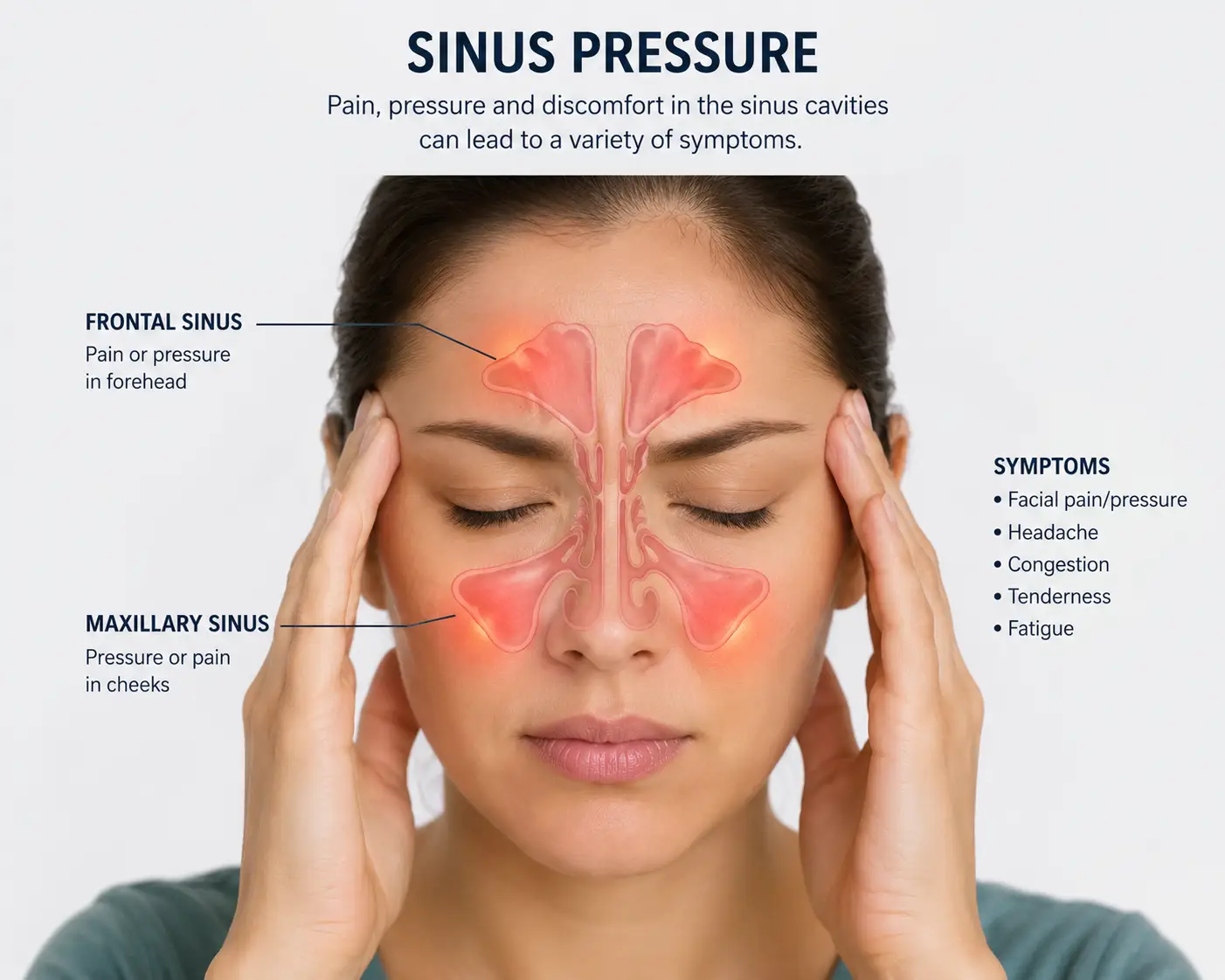
Your sinuses are four pairs of hollow, air-filled cavities in the bones of your face and skull:
- Frontal sinuses — above your eyebrows
- Maxillary sinuses — behind your cheekbones
- Ethmoid sinuses — between your eyes
- Sphenoid sinuses — deeper, behind the nose
These cavities are lined with mucous membranes that produce mucus, trap particles, and drain into your nasal passages through small openings called ostia. When everything is working properly, mucus moves freely, air flows freely, and you don’t even notice your sinuses exist.
When something disrupts that flow — inflammation, allergens, infection, or impaired nerve signaling — the ostia narrow or close, mucus backs up, and pressure builds inside the cavities. That’s the dull, heavy, throbbing sensation behind your forehead, cheeks, or eyes that you recognize as sinus pressure.
But here’s what most people don’t realize: sinus drainage isn’t passive. It depends on muscle tone, autonomic nervous system function, and proper signaling from the upper cervical spine. When those signals are disrupted, even a mild allergen exposure can trigger weeks of stubborn pressure.
How Allergies, Sinus Pressure, and Ear Fullness Are Connected
Patients often describe their symptoms in clusters: “My face hurts, my ears feel clogged, and I have a headache.” That’s not three separate problems — it’s one interconnected system reacting at the same time. Here’s why.
The Eustachian Tube and the Sinuses Share a Neighborhood
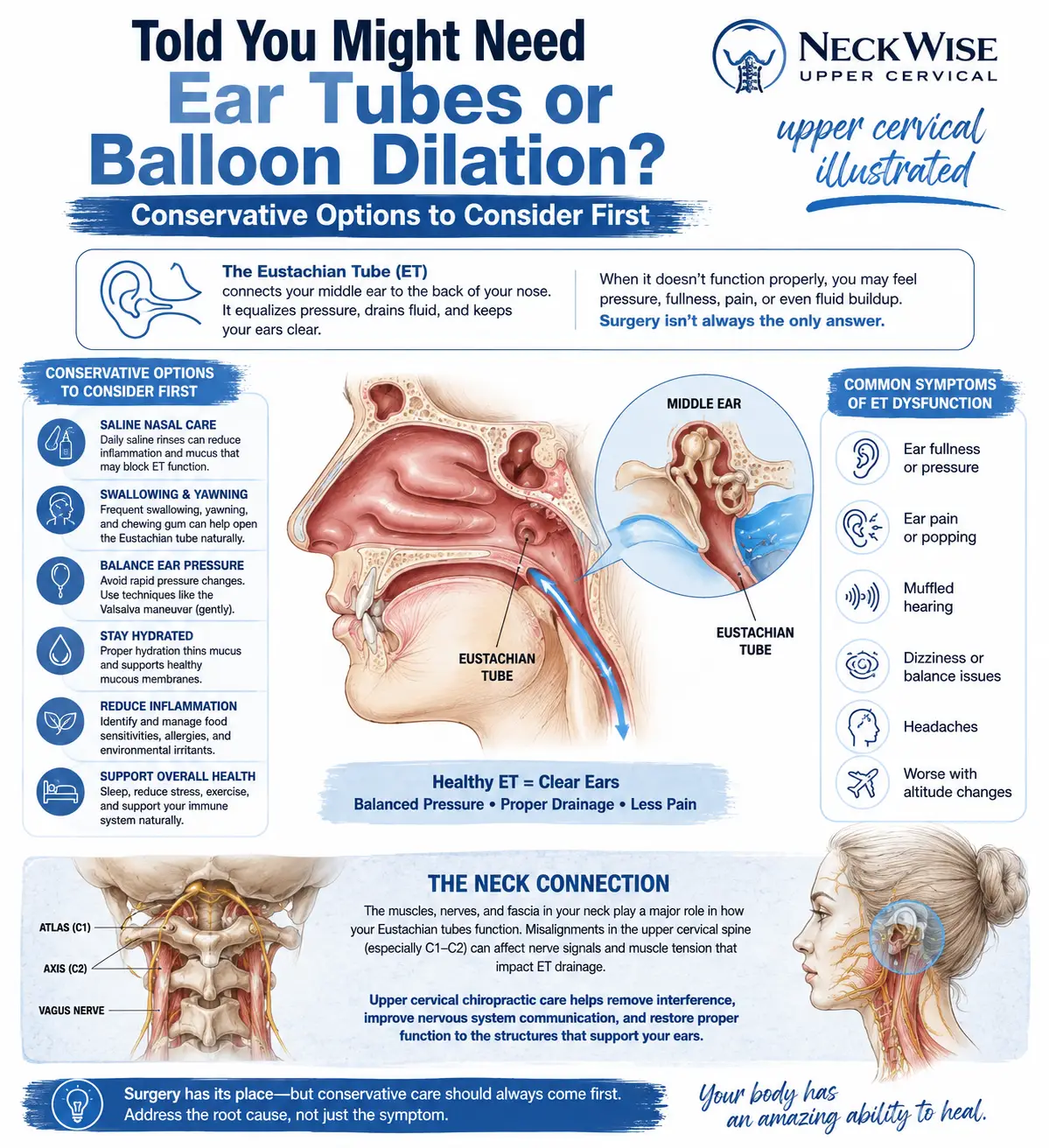
Your Eustachian tubes are narrow canals connecting your middle ear to the back of your throat, right where your sinuses also drain. When the tissues in this area — the nasopharynx — become inflamed from allergies or sinus congestion, the Eustachian tubes get compressed and stop opening properly. The result is ear fullness, popping, muffled hearing, and sometimes vertigo or tinnitus.
This is why allergy season often comes with that “underwater” feeling in your ears. The Eustachian tube isn’t broken — it’s just being squeezed by inflammation in the surrounding tissue.
The Trigeminal Nerve Connects It All
Your trigeminal nerve (cranial nerve V) supplies sensation to your face, sinuses, jaw, and the muscle that opens your Eustachian tube (the tensor veli palatini). This nerve has its central processing center in the brainstem — which sits directly above the atlas and axis at the very top of your neck.
When the upper cervical spine is misaligned, it can irritate the trigeminocervical complex, sending heightened pain and pressure signals through the trigeminal nerve. The brain reads this as: “Your face hurts. Your ears are blocked. Your sinuses are inflamed.” Sometimes the actual sinus inflammation is mild — but the perception of pressure is intense because the nervous system is amplifying the signal.
The Vagus Nerve and Sinus Drainage
The vagus nerve, the longest cranial nerve in the body, plays a major role in parasympathetic function — including regulating inflammation and supporting drainage of the sinuses and lymphatic tissue around the head and neck. The vagus nerve exits the skull right next to the atlas. When the atlas is misaligned, vagal function can be compromised, contributing to chronic congestion, sluggish drainage, and lingering pressure.
For a deeper dive into how the Eustachian tube and ear pressure tie back to the upper cervical spine, see our companion guide on ear pressure and upper cervical chiropractic.
Why the Upper Neck Is So Important
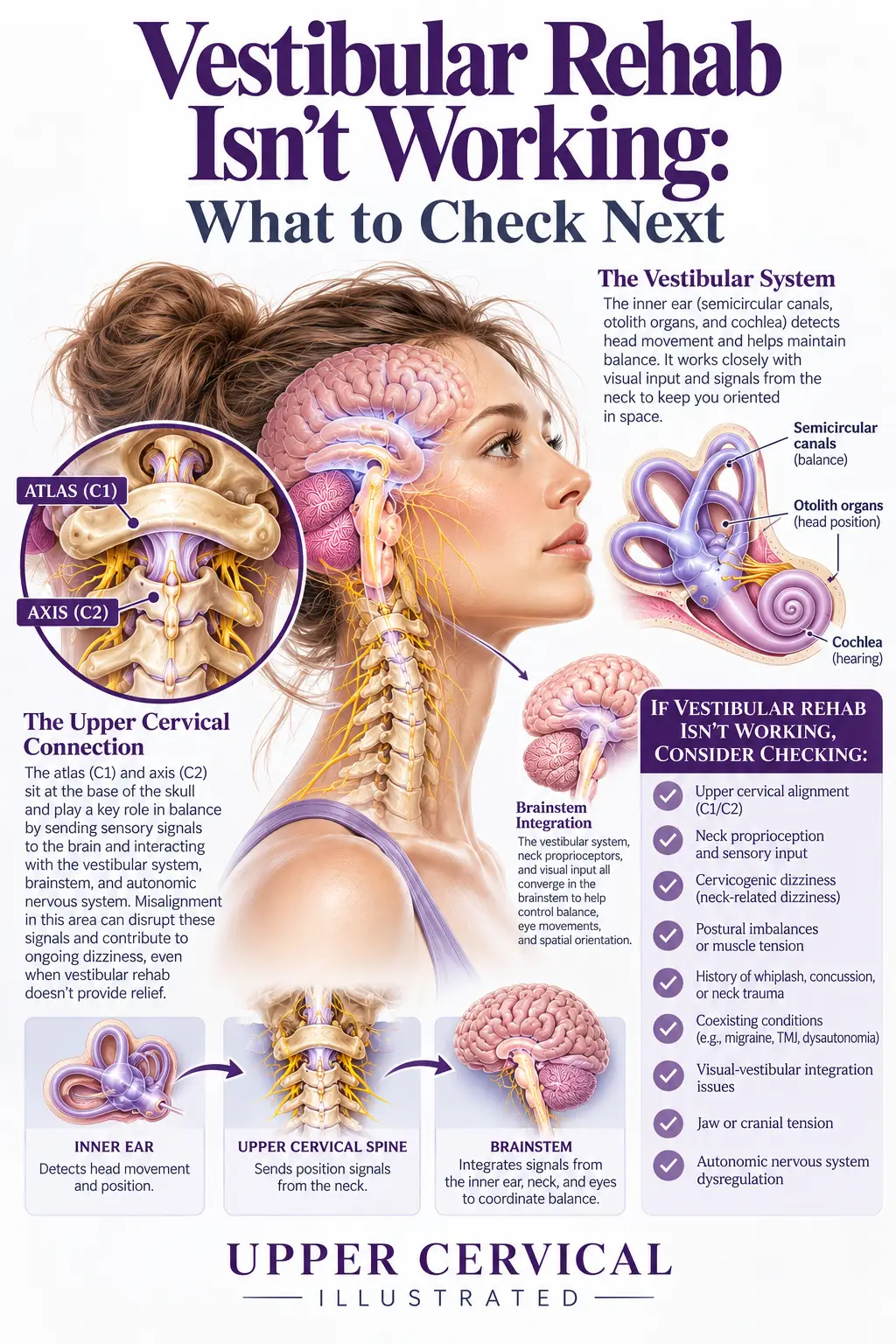
The atlas (C1) and axis (C2) are unlike any other vertebrae in your body. They sit at the base of your skull, surround your brainstem, and serve as the structural and neurological gateway between your brain and the rest of your body.
A misalignment here — even by a millimeter or two — can:
- Irritate the brainstem and disrupt autonomic regulation
- Compromise vagus nerve function
- Disturb the trigeminocervical complex (affecting facial pain, sinus pressure, jaw, and ear signaling)
- Affect the muscles that control the Eustachian tube
- Restrict lymphatic and venous drainage from the head
- Compromise blood flow through the vertebral arteries
For sinus and ear sufferers, this is a big deal. It means that even when your allergies are under control medically, the nervous system may still be stuck in an inflammatory, congested pattern because the upper cervical spine is creating ongoing interference.
Misalignment often traces back to:
- A car accident or whiplash injury, sometimes years earlier
- A sports concussion or fall
- A difficult birth or childhood injury
- Long hours of forward head posture (phones, computers, driving)
- Chronic stress that holds tension in the neck
You may not even remember the original event. But the misalignment can persist for decades, quietly disrupting your nervous system every time allergy season hits or a virus rolls through.
The Sarasota Factor: Why Allergies Hit So Hard on the Gulf Coast
Sarasota’s climate is a double-edged sword. The warm, humid, semi-tropical environment is one of the reasons we love living here — and one of the reasons our patients struggle so much with chronic sinus and ear symptoms.
Allergens that flare year-round on the Suncoast include:
- Pollen from oak, pine, cedar, ragweed, and grasses (especially in spring and fall)
- Mold spores that thrive in the humidity, year-round
- Dust mites that proliferate in homes with constant AC use
- Red tide blooms that cause respiratory irritation along the coast
- Saharan dust that drifts across the Gulf in the summer
If you’ve moved to Sarasota from a drier climate, you may have noticed your symptoms got worse — not better. Many of our patients tell us they never had allergies until they moved to Florida. That’s not just bad luck. It’s the local environment combined with an upper cervical spine that’s no longer compensating well.
How Lavender Family Chiropractic Helps
At Lavender Family Chiropractic, we don’t treat allergies, sinus infections, or ear infections directly. What we do is correct the upper cervical misalignment that may be keeping your nervous system stuck in an inflammatory, congested pattern — so your body can do what it’s designed to do.
Here’s what makes our approach different.
1. We Use 3D CBCT Imaging, Not Flat X-rays
Our office is equipped with a 3D Cone Beam Computed Tomography (CBCT) scanner. This gives us a true three-dimensional view of your upper cervical spine — something a regular flat X-ray simply cannot do. We can see exactly how your atlas and axis are positioned, the angle and degree of misalignment, and the specific correction your spine needs.
This matters for sinus and ear cases because the misalignments we’re looking for are often subtle and rotational. Generic adjustments miss them. Specific, imaging-guided corrections don’t.
2. We Use the Knee Chest Upper Cervical Technique
Our doctors — Dr. Rusty Lavender and Dr. Jacob Temple — are trained in the Knee Chest Upper Cervical technique. You rest comfortably in a knee-chest position while we deliver a precise, low-force adjustment to the atlas or axis based on your individual imaging. There’s no twisting. No popping. No cracking. Just a specific, gentle correction tailored to your spine.
This is critical for patients who are sensitive, in pain, or have been frustrated by aggressive chiropractic care in the past. The Knee Chest technique is gentle enough for children, seniors, post-concussion patients, and people with connective tissue disorders.
3. We Build Personalized Care Plans
Sinus and ear symptoms that have been brewing for years don’t resolve in a single visit. We design personalized care plans based on your imaging, exam findings, and symptom history. Your care plan is built to:
- Correct the misalignment
- Hold the correction over time
- Allow your nervous system to recalibrate
- Transition you into long-term wellness care
We don’t do generic packages. Your plan is built for you and explained completely before you commit to anything.
What to Expect at Your First Visit
If you’ve never been to an upper cervical chiropractor before, here’s what your first experience at Lavender Family Chiropractic will look like.
Step 1 — Consultation. You’ll sit down with Dr. Lavender or Dr. Temple and walk through your symptom history, what you’ve already tried, and your goals. This is a conversation, not a sales pitch.
Step 2 — Exam. We perform a thorough neurological and orthopedic exam, including posture assessment, range of motion, and tests of nervous system function.
Step 3 — 3D CBCT Imaging. If we suspect upper cervical involvement, we’ll take your 3D CBCT scan to see exactly what’s going on at the atlas and axis.
Step 4 — Report of Findings. On your next visit, we sit down with you and walk through your imaging, your exam findings, and our recommendations — including whether upper cervical care is the right fit for you. If it’s not, we’ll tell you straight.
Step 5 — Your First Adjustment. If you choose to move forward, your first Knee Chest Upper Cervical adjustment is gentle and specific. Many patients are surprised at how subtle it feels.
Step 6 — Care Plan. We’ll lay out your personalized care plan so you know exactly what to expect going forward.
Tired of the Pressure, the Congestion, and the Fullness?
You don’t have to white-knuckle through another Sarasota allergy season. Call Lavender Family Chiropractic at (941) 243-3729 to schedule your consultation. Dr. Rusty Lavender and Dr. Jacob Temple will sit down with you, look at your upper cervical spine, and tell you honestly whether the root cause of your sinus pressure and ear fullness might be in your neck.
What the Research Says
Research continues to support the connection between the upper cervical spine, the autonomic nervous system, and the kinds of sinus, allergy, and ear symptoms our patients struggle with.
- Studies on the trigeminocervical complex demonstrate that nerve input from the upper three cervical nerves converges with the trigeminal nerve in the brainstem — directly linking neck dysfunction with facial pain, sinus pressure, and ear symptoms.
- Research on the vagus nerve shows that compromised vagal tone correlates with elevated inflammatory markers and impaired regulation of mucous membranes — exactly the pattern seen in chronic sinus sufferers.
- Case reports in upper cervical chiropractic journals have documented resolution of chronic sinusitis, allergic rhinitis, and Eustachian tube dysfunction following correction of atlas misalignment.
- Studies on whiplash and post-concussion patients show disproportionately high rates of chronic sinus, ear, and vestibular symptoms — pointing back to the upper cervical spine as a contributing factor.
We’re not claiming upper cervical care cures allergies. We’re saying that for many people whose sinus pressure and ear fullness aren’t responding to standard treatment, the missing piece is in the neck — and the research increasingly supports looking there.
Lifestyle Habits That Support Sinus and Ear Relief
While correcting the upper cervical spine addresses the structural and neurological root cause, the following habits help reduce inflammation, support drainage, and accelerate your results:
- Hydrate aggressively. Thin mucus drains. Thick mucus sits and pressurizes. Aim for at least half your body weight in ounces of water daily.
- Use a saline nasal rinse. A daily neti pot or saline spray flushes allergens and reduces inflammation in the nasal passages.
- Reduce dairy temporarily. Dairy thickens mucus in many people. Try eliminating it for two weeks and see how your symptoms shift.
- Run a HEPA air filter. Especially in your bedroom. Florida air is rich with pollen, mold, and dust.
- Manage stress. Chronic stress tightens the suboccipital muscles at the base of your skull and worsens upper cervical tension. Yoga, walking, breathwork — pick one and do it daily.
- Sleep on a supportive pillow. Avoid stomach sleeping, which keeps your neck rotated for hours and aggravates misalignment.
- Move daily. Walking, swimming, and gentle stretching support lymphatic drainage from the head and neck.
For patients dealing with ear-specific symptoms — ear pressure, ear fullness, tinnitus, or the underwater feeling that comes with congestion — read our companion guide on ear pressure and upper cervical chiropractic for a deeper dive on the ear-specific connection.
Serving Sarasota and the Surrounding Communities
Lavender Family Chiropractic is located at 5899 Whitfield Avenue, Suite 107, Sarasota, FL 34243 — right at the corner of University and Whitfield. We’re easy to reach from anywhere on the Suncoast and proud to serve patients from across the region, including Bradenton, Lakewood Ranch, Parrish, Ellenton, Palmetto, University Park, Longboat Key, Siesta Key, Osprey, Venice, Myakka City, Ruskin, Tampa, and St. Petersburg.
If you’ve been chasing sinus and ear symptoms from one specialist to another with no real answers, we’d love to help you investigate the upper cervical connection. See more about the areas we service.
Our complete guide to Eustachian tube dysfunction and the upper cervical spine covers the types of ETD, why the ear and the neck are connected, and how we evaluate it in Sarasota.
Top 15 FAQs About Sinus Pressure, Allergies, and Ear Fullness
1. Can a chiropractor really help with sinus pressure and allergies?
We don’t treat allergies directly — but when the upper cervical spine is misaligned, the nerves controlling sinus drainage, Eustachian tube function, and inflammation regulation get disrupted. Correcting that misalignment often allows the body to manage allergens far more effectively, and many patients report significant relief from chronic pressure and congestion.
2. How is sinus pressure connected to ear fullness?
Your sinuses and Eustachian tubes drain into the same area at the back of your throat. When that area is inflamed, both systems back up at once. That’s why allergy flares so often come with the underwater feeling in your ears, popping, and muffled hearing.
3. Why does my sinus pressure get worse in Sarasota?
The Gulf Coast climate is high in humidity, pollen, mold, and seasonal allergens like Saharan dust and red tide. If your upper cervical spine isn’t functioning well, your nervous system is less able to regulate the inflammatory response — and Sarasota’s environment will tend to overwhelm your system.
4. My ENT and allergist haven’t helped. What’s different about upper cervical care?
ENTs and allergists are excellent at treating the symptoms — clearing infection, blocking the allergic response, reducing inflammation locally. Upper cervical care addresses a root-cause contributor that those specialists don’t typically evaluate: the alignment of the atlas and axis and its effect on the nerves controlling your sinuses, ears, and immune response.
5. Does the adjustment hurt?
No. The Knee Chest Upper Cervical technique uses light, specific pressure while you rest in a comfortable knee-chest position. There’s no twisting, popping, or cracking. Most patients describe it as gentle and surprisingly subtle.
6. How long until I notice relief?
Some patients notice changes within the first few visits. Others — especially those with long-standing symptoms — need several weeks of consistent care. We’ll give you a realistic timeline based on your imaging and exam findings.
7. Is upper cervical care safe for kids with chronic ear and sinus issues?
Yes. The Knee Chest technique is gentle enough for children. Many of our pediatric patients come in for chronic ear infections, sinus congestion, or post-cold ear fullness that just won’t resolve.
8. Do I need to be in pain to come in?
No. Many patients come in for chronic pressure, fullness, or congestion without sharp pain. If something doesn’t feel right and conventional care hasn’t helped, that’s reason enough to be evaluated.
9. Will my symptoms come back if I stop coming?
Holding the correction is the goal. That’s why we build personalized care plans designed to stabilize the upper cervical correction over time. Patients who complete the corrective phase and follow through with wellness care tend to see the longest-lasting results.
10. Do you accept insurance?
We’ll review your options during your consultation and walk you through what’s covered. Our care plans are designed to make consistent, long-term care affordable regardless of insurance.
11. What is 3D CBCT and why do you use it?
3D Cone Beam Computed Tomography gives us a true three-dimensional view of your upper cervical spine. For sinus, ear, and allergy patients, this matters because the misalignments we’re looking for are often subtle. CBCT lets us deliver a correction specific to your anatomy.
12. Can stress make my sinus and ear symptoms worse?
Absolutely. Chronic stress tightens the suboccipital muscles at the base of your skull, increasing tension on the upper cervical spine and reducing vagal tone. That’s a perfect storm for sinus pressure, congestion, and ear fullness.
13. What if I have a current sinus infection?
If you have an active infection with fever, severe pain, or thick discolored discharge, see a medical doctor first to address the infection. Once the acute infection has resolved, upper cervical care can help reduce the chronic pattern that may be making you prone to recurrent infections.
14. Is this just for adults with allergies?
No. We see patients of all ages with all kinds of sinus and ear-related complaints — chronic congestion, recurrent ear infections in children, post-cold ear fullness, sinus headaches, allergy-driven vertigo, and more.
15. How do I get started?
Call (941) 243-3729 or book your consultation online. You’ll sit down with Dr. Rusty Lavender or Dr. Jacob Temple, talk through your symptoms, and find out whether upper cervical chiropractic is the right fit for you.
Ready to Stop Chasing Symptoms? Call Lavender Family Chiropractic
You don’t have to spend another Sarasota allergy season buried in tissues and decongestants. The sinus pressure, the ear fullness, the lingering congestion — they may have a root cause that no allergist, ENT, or primary care doctor has investigated yet.
At Lavender Family Chiropractic, Dr. Rusty Lavender and Dr. Jacob Temple use precise 3D CBCT imaging and the gentle Knee Chest Upper Cervical technique to address the upper cervical spine — the structural and neurological gateway between your brain and the systems that drain your sinuses, regulate your ears, and modulate your inflammatory response.
📞 Call (941) 243-3729 today 📅 Book your consultation online 📍 5899 Whitfield Avenue, Suite 107, Sarasota, FL 34243 — at the corner of University and Whitfield
Related Articles
Related Posts


Get our upper cervical articles first.