Post-Concussion Vertigo in Sarasota, Florida: How Upper Cervical Chiropractic Care Helps Patients Recover from the Dizziness, Brain Fog, and Imbalance That Linger Long After a Head Injury
By Dr. Rusty Lavender, D.C. — upper cervical chiropractor, Lavender Family Chiropractic, Sarasota, FL. Reviewed and updated October 2026.
Our complete guide to post-concussion syndrome in Sarasota covers why symptoms outlast a normal scan, the upper neck’s role, and how we evaluate it.
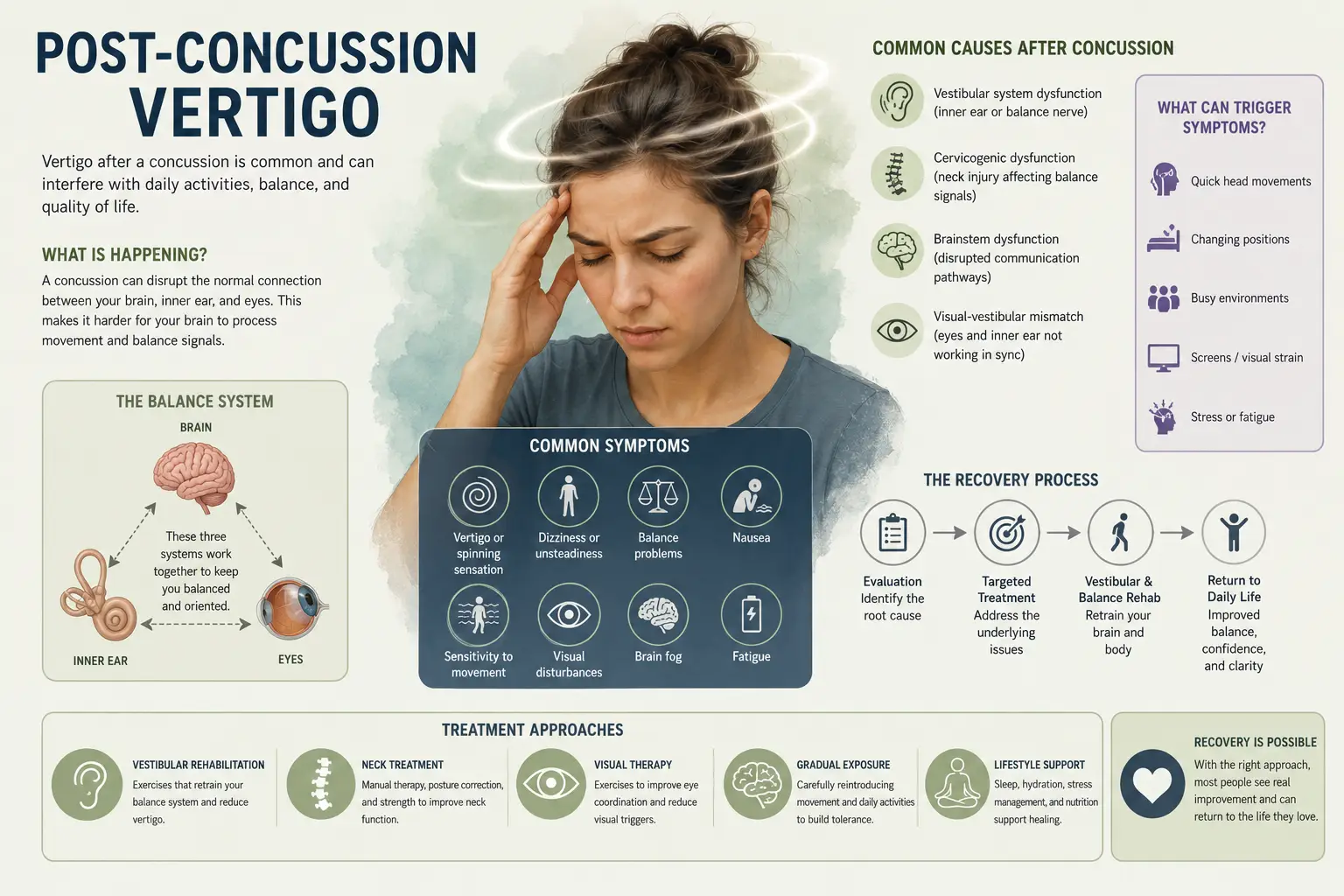
Post-Concussion Vertigo: If you’ve had a concussion — from a car accident, a sports injury, a fall, a workplace incident, or even a minor bump to the head — and weeks, months, or even years later you’re still dealing with dizziness, brain fog, imbalance, headaches, and a sense of being “off,” you may be experiencing post-concussion vertigo or what’s clinically known as post-concussion syndrome with vestibular involvement.
You’re not imagining it. You’re not exaggerating. And it’s not “all in your head” in the dismissive way some providers may have implied. Post-concussion dizziness is one of the most common — and one of the most undertreated — consequences of head injury. It can persist for months or years when the underlying contributors aren’t addressed properly, and one of the biggest contributors that conventional concussion care often misses is the upper cervical spine.
Here at Lavender Family Chiropractic, located at 5899 Whitfield Avenue, Suite 107 at the corner of University and Whitfield in Sarasota, Dr. Rusty Lavender and Dr. Jacob Templespecialize in helping post-concussion patients address the upper cervical and nervous system component of their recovery. This blog will walk you through exactly what post-concussion vertigo is, why your neck is almost always involved (even if no one told you), what the current research says, and how upper cervical chiropractic care fits into a complete post-concussion recovery plan.
This article is part of our broader vertigo resource hub. For the full picture of how we approach dizziness as a whole, we recommend starting with our main page on vertigo care in Sarasota with Dr. Jacob Temple.
What Is Post-Concussion Vertigo?
Post-concussion vertigo is dizziness, imbalance, or motion sensitivity that persists after a concussion or mild traumatic brain injury (mTBI). It is one of the most common symptoms of post-concussion syndrome — and research has shown that dizziness is one of the strongest predictors of prolonged concussion recovery.
A concussion is a functional brain injury that occurs when the brain is shaken inside the skull. Even when there’s no direct impact to the head, the rapid acceleration and deceleration forces in events like car accidents, sports collisions, falls, or blast injuries can produce a concussion. Importantly, the same forces that injure the brain almost always injure the neck simultaneously — even if the neck pain isn’t the most obvious symptom at first.
Post-concussion vertigo can take several different forms:
Vestibular Dysfunction: The inner ear and vestibular pathways are damaged by the concussion itself, producing classic spinning vertigo, motion sensitivity, and imbalance.
Cervicogenic Dizziness: Dysfunction in the cervical spine — particularly the upper cervical region — produces dizziness because the brain receives faulty positional signals from the neck. This is one of the most overlooked drivers of persistent post-concussion symptoms.
Visual / Ocular Motor Dysfunction: Concussion affects how the eyes track, converge, and stabilize, producing dizziness when the patient is in busy visual environments, scrolling on screens, or moving the head.
Post-Traumatic BPPV: A concussion can dislodge calcium crystals in the inner ear, producing classic positional vertigo episodes — spinning triggered by rolling over in bed, looking up, or tilting the head.
Autonomic Dysfunction: The concussion disrupts vagus nerve and brainstem function, producing dizziness on standing, exercise intolerance, and orthostatic symptoms.
Persistent Postural-Perceptual Dizziness (PPPD): A chronic dizziness pattern can develop after the initial concussion resolves, where the brain stays stuck in a hypervigilant, motion-sensitive state.
Common symptoms of post-concussion vertigo include:
- Dizziness, spinning, or a sense of floating
- Imbalance or unsteadiness, especially in busy environments
- Brain fog and difficulty concentrating
- Motion sensitivity (cars, scrolling, crowds, screens)
- Headaches, especially at the base of the skull
- Neck pain or stiffness
- Visual disturbances or blurred vision
- Sensitivity to light and sound
- Fatigue that worsens with cognitive or physical activity
- Sleep disruption
- Mood changes, anxiety, or irritability
- A sense of being “not yourself” since the injury
According to current literature, most concussion symptoms resolve within 7 to 14 days. However, a significant minority of patients develop persistent post-concussion symptomsthat last 3 months or longer. Without targeted care, dizziness after concussion can last anywhere from one to three months in mild cases, and up to a year or more in persistent cases. The good news is that with the right approach — including early evaluation of the cervical spine — recovery is highly achievable.
How a Concussion Affects Your Nervous System, Inner Ear, and Cervical Spine
To understand why post-concussion vertigo is so common and so persistent, you have to look at what actually happens to the body during a concussion.
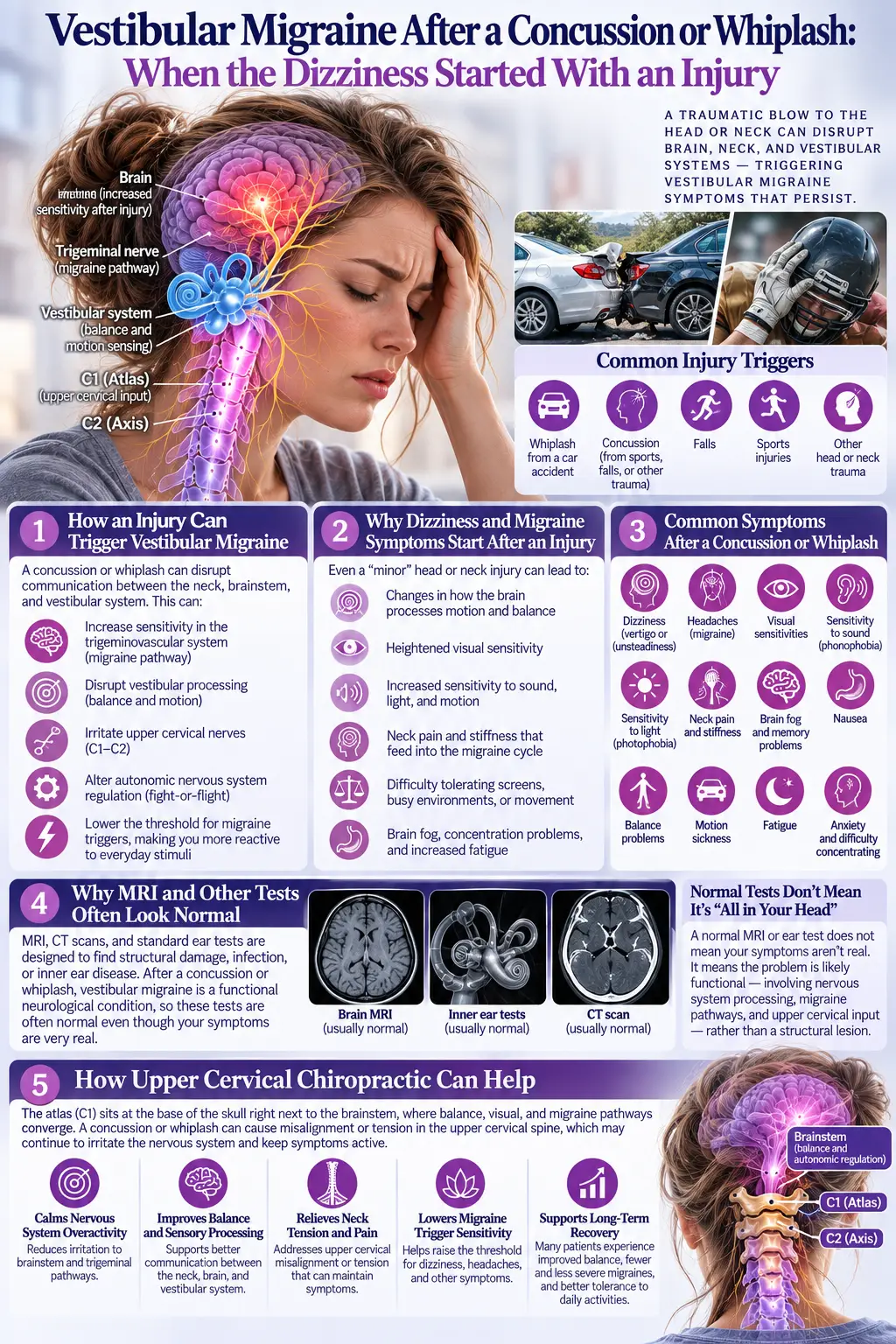
When the head experiences sudden acceleration or deceleration — whether from a direct impact or a whiplash-type force — three systems are typically affected simultaneously:
1. The Brain. The brain sloshes inside the skull, producing metabolic and electrical disruption (the “concussion” itself). Areas particularly vulnerable include the brainstem (which controls balance, autonomic function, and vital reflexes), the cerebellum (which coordinates movement), and the vestibular processing centers.
2. The Inner Ear and Vestibular System. The rapid forces can dislodge inner ear crystals (causing post-traumatic BPPV), damage vestibular hair cells, disrupt vestibular nerve signaling, or affect the labyrinth itself. The vestibular system is particularly vulnerable to head trauma, according to research summarized by the Vestibular Disorders Association.
3. The Cervical Spine. This is the piece that gets missed most often. The head sits on top of a long lever — the neck — and any force great enough to concuss the brain is also great enough to injure the neck. The upper cervical spine (C1 and C2) is the most vulnerable segment because it bears the brunt of the rotational and shear forces that accompany head injury.
Even in concussions without obvious neck pain, the upper cervical spine is often injured. This includes:
- Misalignment of the atlas (C1) or axis (C2)
- Strain or partial tearing of the upper cervical ligaments
- Damage to the deep suboccipital muscles
- Injury to the cervical proprioceptors (position sensors)
- Disruption of the small joints between C0, C1, and C2
Here’s why this matters so much for post-concussion vertigo: the upper cervical spine is part of the same balance system that’s already disrupted by the concussion. Your balance depends on the brain integrating signals from three sensory inputs — vestibular, visual, and proprioceptive (especially from the neck). A concussion damages the vestibular input. A concomitant cervical injury damages the proprioceptive input. The brain is now trying to recover with TWO unreliable inputs at the same time, instead of one.
This is why post-concussion vertigo lingers in so many patients. Conventional care typically addresses the vestibular system and the visual system, but leaves the cervical injury unaddressed. As long as the upper neck is sending faulty signals, the brain has no clean foundation to recalibrate from.
There’s also a vascular and autonomic component. The vertebral arteries pass through the bones of the upper cervical spine on their way to the brainstem. Upper cervical injury can subtly affect blood flow to the brainstem and inner ear — exactly the structures the brain needs intact for vestibular compensation. The vagus nerve also exits the skull right next to the atlas, and vagus dysfunction explains many of the autonomic symptoms (lightheadedness, exercise intolerance, gut symptoms, fatigue) that post-concussion patients describe.
In short: a concussion is rarely just a brain injury. It’s a brain-and-neck injury — and the neck part often determines how complete recovery will be.
Why the Upper Cervical Spine Is Critical to Post-Concussion Recovery
The research on this is increasingly clear, and frankly, it has shifted dramatically over the past decade. Here’s the key clinical point:
A 2021 retrospective study published in the Journal of Sports Physical Therapy and indexed in PubMed examined a treatment protocol that sequenced cervical dysfunction and BPPV treatment FIRST within the first three weeks of injury, followed by integrated vision and vestibular therapy. The results showed significantly improved clinical and patient-reported outcomes compared with vestibular therapy alone.
In other words: addressing the neck early matters. A lot.
This finding is supported by a growing body of evidence. Research has consistently shown that combining cervical spine treatment with vestibular rehabilitation is more effective than either approach alone. The conclusion across the literature is consistent — interventions that address deep neck muscle control, cervical joint proprioception, and gaze stabilization in tandem produce better outcomes than isolated vestibular therapy.
Despite this evidence, many patients never receive any cervical evaluation. They’re sent to vestibular therapy. They’re given visual exercises. They’re told to wait. Sometimes they’re medicated. But the upper neck, the structure most consistently injured in concussion and most clinically relevant to recovery, often goes completely unaddressed.
This is the gap that upper cervical chiropractic care fills.
The atlas (C1) and axis (C2) are the most critical vertebrae for proprioceptive feedback to the brainstem. When these bones are misaligned after an injury — even by a millimeter or two — they send distorted positional data to the same brain regions that are already struggling to recover from the injury. Restoring proper alignment gives the brain accurate input again. The recovery process can finally proceed.
This is also why forceful chiropractic adjustments are not appropriate in the early phase of recovery. The upper cervical ligaments may be strained or partially injured, and aggressive manipulation can make things worse. Gentle, precise, imaging-guided correction is fundamentally different — calculated to the millimeter, delivered with feather-light pressure, no twisting, no popping. This is the kind of care patients actually need.
Upper Cervical Chiropractic Care for Post-Concussion Vertigo: What to Expect
At Lavender Family Chiropractic, we approach post-concussion care in a careful, deliberate, and gentle way. Many of our patients have been struggling for months or years and have already seen multiple providers. We treat that history with the seriousness it deserves and collaborate with your other care providers whenever possible.
Here’s what your journey looks like at our Sarasota office.
Step One: Comprehensive Consultation
Your first visit starts with a real conversation. Dr. Lavender or Dr. Temple will sit down with you and learn the full story — when and how it happened, what symptoms you experienced initially, what symptoms remain, what care you’ve received, what’s helped and what hasn’t. We pay particular attention to mechanism of injury (car accident, sports impact, fall, etc.) because this often reveals exactly how the upper cervical spine was likely injured.
Step Two: 3D CBCT Imaging and Neurological Scanning
Next, we use 3D CBCT X-ray technology to take precise three-dimensional images of your upper cervical spine. This advanced imaging shows us — down to the millimeter — exactly how your atlas (C1) and axis (C2) are positioned. For these types of patients especially, this precision matters. We are not guessing. We are not applying generic adjustments. We are correcting a specific misalignment based on objective measurements.
We pair this with paraspinal infrared thermography, which assesses nervous system function along your spine. For our patients, thermography is particularly useful because it shows us patterns of autonomic stress that correspond to the symptoms — the fatigue, brain fog, light sensitivity, and dysautonomia.
Step Three: A Gentle, Specific Correction — No Twisting or Cracking
When you receive your upper cervical correction, you’ll likely be surprised at how gentle it is. There is no twisting, popping, cracking, or high-velocity thrust. We use the Advanced HIO Knee Chest Upper Cervical Technique (AHKC), one of the gentlest and most precise methods of upper cervical correction available.
This is the type of care most appropriate for PCS patients. The correction is calculated from your imaging, delivered with light pressure, and produces no additional mechanical stress on the already-injured cervical structures.
Step Four: Monitoring and Stabilizing Your Recovery
The goal of upper cervical care isn’t to adjust you repeatedly forever. The goal is to help your spine hold its corrected position so your nervous system can finally complete the recovery work it’s been trying to do since the injury. We track your progress visit by visit and adjust your care plan as you stabilize.
Most patients begin noticing meaningful changes within the first few weeks of care: clearer thinking, reduced brain fog, less dizziness, better tolerance to busy environments, fewer headaches, improved sleep, and a sense of progress that may have stalled for months. Recovery is often gradual and stepwise — but the trajectory is almost always positive when the upper cervical piece is addressed.
Have you been stuck in post-concussion symptoms that just won’t fully resolve? Call us at (941) 243-3729 or book a consultation online. We’ll help you figure out whether upper cervical care is the missing piece in your recovery.
What the Research Says About Post-Concussion Dizziness
The medical literature on post-concussion vertigo has shifted significantly in recent years, with a growing emphasis on the role of the cervical spine. Here are the most relevant findings.
A 2021 retrospective analysis published in PubMed examined a treatment protocol for post-concussion syndrome that sequenced cervical dysfunction treatment and canalith repositioning (for BPPV) FIRST within the first three weeks of injury, followed by integrated vision and vestibular therapy. The results showed significantly improved clinical and patient-reported outcomes compared with standard approaches. This study is one of the strongest pieces of evidence for the importance of addressing the cervical spine early in concussion recovery.
According to the Cleveland Clinic, post-concussion syndrome can produce dizziness, headaches, fatigue, sleep disruption, and cognitive symptoms that persist long after the initial injury. Cleveland Clinic specifically notes that multidisciplinary care — rather than waiting passively for resolution — produces the best outcomes for persistent symptoms.
A clinical overview from Frontiers in Neurology recommended that when dizziness persists beyond four to six weeks post-injury, a multidisciplinary approach combining vestibular-ocular therapy, balance training, graded aerobic activity, and cervical care produces the best outcomes for long-term symptom resolution.
The Vestibular Disorders Association confirms that traumatic brain injury, including concussion, is one of the most common causes of vestibular dysfunction — and that recovery requires identifying which specific vestibular and cervical systems are affected.
Research from MedScape and other clinical resources confirmed that “the entire vestibular system is potentially at risk following blunt trauma to the head and neck region” — and that posttraumatic vertigo can take multiple forms including BPPV, labyrinthine concussion, brainstem concussion, and cervical vertigo, all of which may coexist after a single head injury.
The takeaway from current research is consistent: post-concussion vertigo is multifactorial, the cervical spine is one of the most consistent contributors, and early integration of cervical care with conventional concussion management produces better outcomes. Upper cervical chiropractic care, done with precision and gentleness, is well-positioned to fill the cervical piece of this puzzle.
Lifestyle Habits That Support Recovery from Post-Concussion Vertigo
Beyond upper cervical care, daily habits play a major role in concussion recovery. Here’s what we recommend most often to our post-concussion patients.
Pace your activity carefully. Push too hard and symptoms flare; do too little and recovery stalls. The current evidence-based approach is graded sub-symptom threshold exercise — gentle, daily activity at a level that doesn’t significantly worsen your symptoms. Walking is an excellent starting point.
Sleep well. The brain does most of its recovery work during sleep. Aim for 8–9 hours per night during active recovery. Use a supportive pillow that maintains proper upper cervical alignment. Stomach sleeping forces sustained neck rotation and should be avoided.
Stay hydrated. Inner ear function, vascular regulation, and brain metabolism all depend on hydration. Florida’s heat makes daily hydration especially important — aim for at least half your body weight in ounces of water per day.
Manage cognitive load. During active recovery, cognitive overload (extended screen time, demanding work, complex multitasking) can flare symptoms just like physical overload. Work in shorter blocks. Take frequent breaks. Build cognitive endurance gradually.
Reduce visual triggers — gradually. Scrolling phones, action movies, fluorescent lighting, and crowded visual environments can all trigger post-concussion dizziness. Reduce exposure during early recovery but don’t avoid forever — gradual exposure builds back resilience.
Manage stress and sleep disruption. Concussions often disrupt the autonomic nervous system, and stress amplifies those disruptions. Breathing exercises, time in nature, and gentle daily routines all support recovery.
Watch your posture during screen time. Forward head posture during phone and laptop use puts continuous strain on the upper cervical spine — exactly the area you’re trying to heal. Keep screens at eye level whenever possible.
Be careful with re-injury risk. Until you’re fully recovered, you are at increased risk of a second concussion, which can be significantly more serious than the first. Avoid contact sports, risky activities, and anything that puts your head at risk while you’re still symptomatic.
Address related conditions. Post-concussion patients often have overlapping issues — cervicogenic dizziness, BPPV, vestibular dysfunction, and post-traumatic headaches. For more on how cervical dysfunction drives so many vertigo conditions, our blog on why vertigo happens is an excellent companion read.
Be patient. Post-concussion recovery is rarely linear. Good days are followed by setbacks. The trajectory matters more than any individual day. With the right combination of care, time, and lifestyle support, most patients see meaningful and lasting improvement.
Serving Sarasota and Surrounding Areas
Lavender Family Chiropractic is located at 5899 Whitfield Avenue, Suite 107, Sarasota, FL 34243 — right at the corner of University and Whitfield. We are easy to reach from anywhere in the greater Sarasota region.
We proudly serve patients dealing with post-concussion vertigo and other dizziness conditions from across the area, including:
- Sarasota, FL
- Bradenton, FL
- Lakewood Ranch, FL
- Venice, FL
- Osprey, FL
- Parrish, FL
- Ellenton, FL
- Siesta Key, FL
- Longboat Key, FL
- St. Pete, FL
- Tampa, FL
To learn more about the full region we serve, visit our areas we service page. Wherever you’re driving from, we’re set up to help.
Top 15 FAQs About Post-Concussion Vertigo
What is post-concussion vertigo?
Post-concussion vertigo is dizziness, imbalance, or motion sensitivity that persists after a concussion. It can result from injury to the inner ear, the cervical spine, the visual system, the brainstem, or any combination of these. Cervical involvement is one of the most common and most overlooked contributors.
How long does post-concussion dizziness last?
Most concussion symptoms resolve within 7 to 14 days. However, a significant minority of patients develop persistent symptoms lasting 3 months or longer. Untreated, post-concussion dizziness can last anywhere from one to three months in mild cases and up to a year or more in persistent cases.
Why is my neck involved in my concussion recovery?
The same forces that injure the brain almost always injure the neck — even when neck pain isn’t the most obvious symptom. The upper cervical spine (C1 and C2) is particularly vulnerable to the rotational and shear forces of head injury. Faulty signals from the injured neck interfere with the brain’s ability to recover.
My doctors never mentioned my neck after my concussion. Is that normal?
Unfortunately, yes — and it’s one of the biggest gaps in conventional concussion care. Many providers focus exclusively on the brain and vestibular system without evaluating the cervical spine. Current research increasingly supports cervical evaluation and treatment as a standard part of concussion recovery.
Is upper cervical chiropractic care safe after a concussion?
Yes, when done correctly. Forceful chiropractic adjustments are not appropriate in the early phase of concussion recovery, but gentle, precise, imaging-guided upper cervical correction (with no twisting, popping, or cracking) is fundamentally different and is one of the most appropriate manual therapy approaches available for these patients.
How soon after a concussion can I receive upper cervical care?
Once acute medical evaluation has ruled out more serious injury (which should be done immediately after any concussion), you can typically begin gentle upper cervical evaluation within days to weeks. Research actually supports addressing the cervical spine early — within the first three weeks — for better outcomes.
Can a concussion from years ago still be causing my dizziness today?
Absolutely. Many of our patients trace their persistent dizziness back to a concussion months or years before their symptoms began. Upper cervical misalignment from old head injuries often doesn’t fully resolve on its own and can drive symptoms for years until properly addressed.
What’s the difference between vestibular dysfunction and cervicogenic dizziness after concussion?
Vestibular dysfunction comes from injury to the inner ear or vestibular pathways and typically produces classic spinning vertigo. Cervicogenic dizziness comes from cervical spine dysfunction and typically produces a swimming, floating, or unsteady feeling that worsens with neck position. Many post-concussion patients have both.
Will I need other care besides upper cervical correction?
Possibly. Many post-concussion patients benefit from a combination of approaches — upper cervical care, vestibular rehabilitation, vision therapy, graded exercise, and sometimes cognitive therapy. We work alongside your other providers to give you the best outcome.
Can I still play sports after post-concussion symptoms resolve?
Once you’re fully symptom-free and medically cleared, most patients can return to activity. However, you may be at increased risk of future concussions, especially during the first year. Discuss return-to-play protocols with your physician.
Why does my dizziness flare with screen use or busy environments?
After a concussion, the brain often becomes overreliant on visual input for balance because the vestibular and cervical systems are sending unreliable signals. Busy visual environments overwhelm this compensation and trigger dizziness. Restoring cervical proprioception through upper cervical care reduces visual dependency.
Is brain fog after a concussion related to my neck?
It can be — particularly when the upper cervical spine is affecting vagal tone, blood flow to the brainstem, and overall nervous system function. Many post-concussion patients see meaningful brain fog improvement when the upper cervical piece is addressed.
Can children and teens benefit from upper cervical care after concussion?
Yes. Sports concussions are extremely common in children and teens, and the gentle nature of upper cervical care makes it appropriate for younger patients. Early intervention is particularly important in this population because of the developing brain.
What if I had a concussion but never had imaging done?
That’s actually the case for most concussion patients — concussions don’t show up on routine CT or MRI. Our 3D CBCT imaging focuses specifically on the upper cervical spine, where post-concussion misalignment most often occurs. This is different from brain imaging and serves a different purpose.
How do I know if Lavender Family Chiropractic is right for me?
If you’ve had a concussion at any point — recent or years ago — and you’re still dealing with dizziness, brain fog, headaches, neck symptoms, or a sense of being “not yourself,” you’re an excellent candidate for an evaluation. Call (941) 243-3729 to schedule a consultation.
You Don’t Have to Live with Post-Concussion Symptoms Forever
A concussion is a moment. Post-concussion symptoms shouldn’t be a lifetime. Yet so many of our patients describe years of being told to “give it more time,” “rest more,” or “you should be better by now” — even as their dizziness, brain fog, and imbalance refuse to fully resolve.
The truth is that for many of these patients, the missing piece has always been the upper cervical spine. The same injury that concussed the brain also misaligned the upper neck, and as long as that misalignment remains, the brain can’t fully recover.
At Lavender Family Chiropractic, Dr. Rusty Lavender and Dr. Jacob Temple have helped many post-concussion patients across Sarasota finally find the progress they had given up on. If you’ve been told to wait it out, but the wait has gone on for far too long, we’d be glad to help you understand whether upper cervical care can be part of your way forward.
📞 Call us today at (941) 243-3729 📅 Or book your consultation online
Real recovery is still possible — even years later.
Related Articles
Related Posts


Get our upper cervical articles first.
Patients Experience