
Can Neck Pain Cause Dizziness? The Upper Cervical Connection
By Dr. Rusty Lavender, D.C. — upper cervical chiropractor, Lavender Family Chiropractic, Sarasota, FL. Reviewed and updated October 2026.
Yes — neck problems, especially in the upper cervical spine, can cause or worsen dizziness. When faulty position signals from the top of the neck clash with what your eyes and inner ears report, your brain gets conflicting data and you feel unsteady, floaty, or off-balance. This is called cervicogenic dizziness, and it is worth evaluating whenever neck pain and dizziness travel together.
In my practice, patients come to me after months — sometimes years — of chasing the wrong culprit. They have seen the ENT, tried the medications, done the vestibular exercises, and still wake up feeling like the floor is tilting. Almost all of them share one detail nobody connected the dots on: their dizziness shows up alongside neck tension, and it flares with certain head positions or after a long day at a screen. When I image the top of their neck in three dimensions and find a misalignment at the atlas (C1) or axis (C2), the picture finally makes sense. The neck was never a bystander. It was a driver.
This article walks through exactly how neck pain and dizziness are linked, why the upper cervical spine is so often the overlooked root, which conditions commonly overlap, what the research actually says, and when dizziness is an emergency you should not wait on. My goal is to give you the honest, mechanism-level explanation — not a sales pitch.
This article is educational and not a substitute for medical advice. If you have a health condition, are pregnant, or take medications, talk with your physician before starting anything new.
Can Neck Pain Cause Dizziness? Why the Upper Neck Matters for Balance
Your sense of balance is not one system — it is three, constantly cross-checking each other:
- Eyes (visual system): what you see.
- Inner ears (vestibular system): motion, acceleration, and gravity.
- Neck and body (proprioceptive system): the position and movement of your muscles and joints.
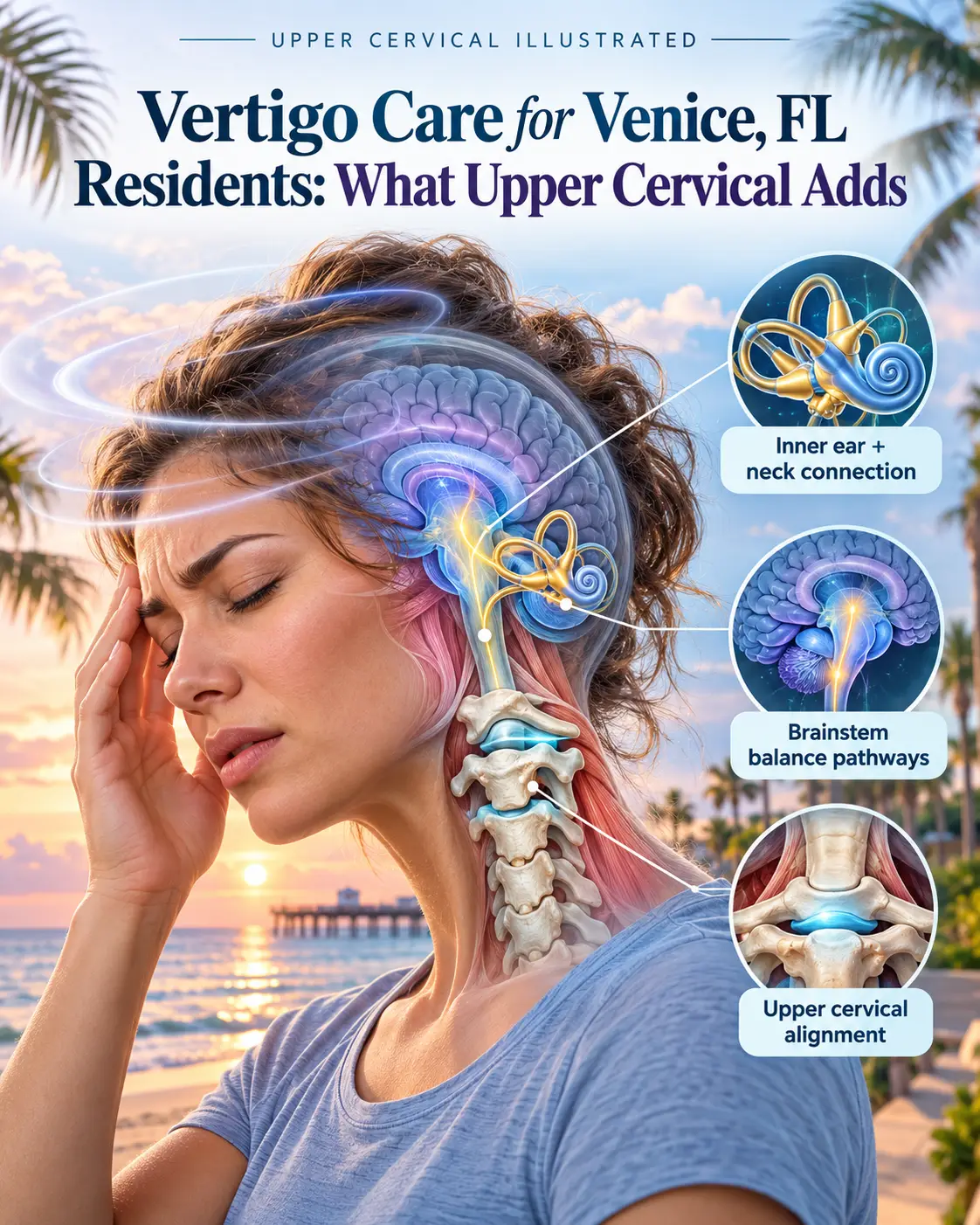
The upper cervical spine — especially the atlas (C1) and axis (C2) — is unusually important here for two reasons. First, it is packed with dense proprioceptive sensors that tell your brain where your head is in space. Second, it surrounds and protects the brainstem, the central switchboard that blends all three streams of balance information into one steady picture of the world.
If your atlas or axis shifts even slightly, the position data your brain receives from the neck can become noisy or contradictory. Now your eyes say one thing, your inner ears say another, and your neck says a third. That sensory mismatch is a classic recipe for dizziness, imbalance, and vertigo-like sensations — even when your inner ear itself is perfectly healthy.
When a misalignment persists, the body compensates: muscle guarding, altered posture, and asymmetrical muscle tone. Over time the strain spreads. Neck pain becomes chronic (cervicalgia), the nerves near the base of the skull get irritated (occipital neuralgia), and headaches start to appear more often. Meanwhile, the delicate rhythm between your eyes, inner ears, and neck keeps drifting off-beat, and you keep feeling unsteady. If you are trying to sort out whether your symptom is coming from the neck or the ear, our flagship guide walks through it in detail: Is your vertigo coming from your neck or your inner ear?
How Neck Pain Can Create Dizziness (Five Primary Pathways)
- Proprioceptive mismatch. The small muscles and joints of the upper neck constantly report head position to your brain. If the atlas is misaligned, those signals become inaccurate, and your brain receives a different story from your neck than it gets from your eyes and inner ears. That conflict can trigger dizziness, disorientation, and sometimes nausea. This is the core mechanism behind cervicogenic dizziness.
- Brainstem irritation. The brainstem regulates posture, eye movement, muscle tone, breathing, and the balance between your fight-or-flight and rest-and-digest systems. Misalignment near the brainstem can disturb those circuits, producing lightheadedness, visual lag, a keyed-up feeling, and unsteadiness.
- Vascular factors (vertebral arteries). The vertebral arteries travel up through the cervical spine to help supply the brain and inner ear. Chronic muscle guarding and poor mechanics may contribute to sluggish or position-dependent flow, which can leave you feeling foggy, faint, or off-balance with certain head movements.
- Autonomic nervous system dysregulation. The upper neck influences autonomic tone. When the system is stuck in stress mode, you may notice palpitations, shallow breathing, and a hovering sense of disequilibrium. This overlap is common enough that it has its own name — cervicogenic autonomic dysfunction — and it is worth evaluating when dizziness comes bundled with a racing heart and brain fog.
- TMJ and cranial nerve interplay. Misalignment at the top of the neck can ripple into jaw mechanics and cranial nerve pathways. Jaw clenching, ear fullness, and facial pain often accompany neck-related dizziness — especially when the trigeminal system (facial sensation) and the occipital nerves (back of the head) are irritated.
What the Research Says
Cervicogenic dizziness is a recognized clinical entity, and the literature helps frame what is and is not known.
- A 2022 review in Frontiers in Neurology on the proprioceptive cervicogenic dizziness care pathway describes dizziness that arises from disturbed neck proprioception — the exact position-sense mismatch described above — and lays out how clinicians evaluate and manage it. It underscores that cervicogenic dizziness is a diagnosis reached by careful history and examination, not a single lab test.
- A 2022 systematic review indexed in PubMed on manual therapy for cervicogenic dizziness examined hands-on treatment aimed at the neck and reported improvements in dizziness intensity and related measures, while noting the need for higher-quality trials. In plain terms: addressing the neck is a reasonable, evidence-informed avenue for dizziness that is genuinely cervicogenic in origin.
- Research on cervical contributions to dizziness after whiplash, available through PubMed Central, examines cervical factors in whiplash-associated dizziness and reinforces that neck injury can disturb the sensory input the balance system depends on.
A fair reading of this literature: the neck can be a real and treatable source of dizziness, the mechanism is proprioceptive, and careful evaluation matters because cervicogenic dizziness is a diagnosis of pattern and exclusion rather than one confirmed by a single scan.
Common Conditions Where Neck Pain and Dizziness Collide
Cervicogenic dizziness. When dizziness originates from cervical dysfunction, it is called cervicogenic dizziness. Patients often report neck tightness, headaches, and a wobbly or floaty feeling — especially after desk work, phone use, or postures that stress the upper neck. Because this dizziness is driven by faulty proprioception, precise upper cervical evaluation and care can help quiet the noise and restore a stable head-to-body orientation. If this sounds like you, our deep pillar on cervicogenic dizziness covers it thoroughly, and Sarasota-area readers can start with cervicogenic vertigo in Sarasota.
Benign paroxysmal positional vertigo (BPPV). BPPV is classically triggered by head-position changes and is tied to displaced calcium crystals in the inner ear. But many people with recurring BPPV also carry an atlas misalignment. If the neck keeps feeding conflicting position data, the vestibular system can stay hypersensitive. Repositioning maneuvers help the inner ear directly, while addressing upper cervical mechanics targets the neck-based driver that can keep episodes coming back.
Mal de Débarquement syndrome (MdDS). MdDS feels like you are still on a boat or plane — rocking, bobbing, or swaying long after travel ends. Traditional treatments can struggle here. Normalizing upper cervical input and improving brainstem integration can help the nervous system regain a stable reference point, and for some people the perpetual motion-after-motion settles.
Meniere’s disease. With vertigo attacks, fluctuating hearing, and tinnitus, Meniere’s disease involves fluid dynamics and neural regulation in the inner ear. The upper cervical spine influences autonomic tone and vascular supply through muscular and neurological connections, so restoring atlas alignment can support more coordinated regulation for some patients.
Persistent postural-perceptual dizziness (PPPD). PPPD describes chronic dizziness made worse by upright posture, busy visual environments, or motion. The perceptual part reflects a brain that has learned to expect instability. Calming overactive neck signals, re-centering the head on the neck, and restoring autonomic balance lay the groundwork for steadier perception, often paired with gentle home strategies that rebuild tolerance.
Cervicalgia (chronic neck pain). Longstanding neck pain is both a trigger and a consequence of upper cervical dysfunction. Muscle guarding distorts joint mechanics, which increases neural irritation and proprioceptive confusion. Lasting relief usually requires more than stretching — it requires restoring the atlas-axis relationship so muscles can release and the nervous system can settle.
Occipital neuralgia. Searing, electric pains that shoot from the base of the skull toward the scalp are hallmarks of occipital neuralgia. Misalignment and tissue tension can compress the occipital nerves where they exit under tight musculature. Correcting the upper cervical foundation often lets those tissues decompress.
Trigeminal neuralgia. Although trigeminal neuralgia is usually discussed as a facial-nerve problem, the trigeminal nucleus communicates closely with upper cervical pathways inside the brainstem. Irritation at the top of the neck can sensitize facial pain circuits, which is why the structural-neurological relationship is worth addressing rather than treating the nerve in isolation.
Headaches and migraines (including vestibular migraine). From tension headaches to vestibular migraine, neck-driven inputs regularly participate in headache physiology. Aligning the atlas-axis unit can reduce mechanical irritation, help normalize vascular tone, and lower the nervous system’s threat level.
TMJ dysfunction and ear symptoms. Jaw pain, clicking, ear pressure, and fullness often travel with upper cervical problems. Because the jaw hinges just in front of the atlas and shares muscular and neural neighbors, misalignment can perpetuate TMJ symptoms — and the reverse is true as well.
Whiplash and post-concussion syndromes. After car accidents or sports impacts, the head can shear on the neck at C1/C2. Even when CT and MRI read as normal, subtle misalignments may persist and contribute to dizziness, headaches, and brain fog. Upper cervical care is a commonly missing piece of post-injury recovery — a pattern the whiplash-and-dizziness research above helps explain.
Why Traditional Approaches Sometimes Miss the Mark
- Treating symptoms, not sources. Medications can quiet nausea or blunt a headache, but they do not realign the atlas or normalize the neck’s input to the brain.
- A “strong” neck without a “smart” neck. Strengthening exercises are valuable, but if the atlas is off, the neck is building strength on a crooked foundation.
- Isolated vestibular therapy. Canalith repositioning and gaze stabilization can help, yet recurrences remain common if the cervical driver is never addressed.
- Imaging limitations. Standard two-dimensional films can miss subtle rotational or angular shifts at C1/C2, which is why we image the region in three dimensions.
When Dizziness Is an Emergency — Do Not Wait
Most neck-related dizziness is uncomfortable, not dangerous. But some symptoms signal a medical emergency and need immediate care. Call 911 or go to an emergency room right away if your dizziness comes with any of the following:
- Sudden, severe dizziness or vertigo unlike anything you have felt before
- Neurological symptoms — slurred speech, facial droop, weakness or numbness on one side, double vision, or trouble walking
- Fainting or loss of consciousness
- Chest pain, shortness of breath, or an irregular heartbeat
- Sudden hearing loss, or the worst headache of your life
- Dizziness following a significant head or neck injury
These can point to a stroke, a cardiac event, or another urgent condition. Upper cervical care is not the answer in those moments — emergency medicine is. When in doubt, get evaluated first, and sort out the neck contribution afterward.
Our Process at Lavender Family Chiropractic (Sarasota, FL)
1) Precision imaging and mapping. We begin with 3D CBCT imaging to measure the exact vectors of an atlas or axis misalignment. We pair that with paraspinal infrared thermography to assess how your nervous system is actually behaving along the spine. Together they let us tailor care to you rather than to a template.
2) Gentle, specific corrections. Our method is the Knee Chest Upper Cervical technique — precise, gentle, and low-force, with no twisting, cracking, or popping. The goal is to restore the relationship between the head and neck, reduce irritation at the brainstem level, and help clean up the flow of information through your nervous system. For a fuller overview, see our page on upper cervical chiropractic care.
3) Objective tracking. We re-scan and re-test. You should feel changes — but we also want to see your nervous system calming and your alignment holding longer between visits. Fewer corrections over time is the plan, not perpetual dependency.
4) Stabilization and habits. As alignment holds, we introduce simple, sustainable home strategies — ergonomic tweaks, breathing and vagal-toning drills, gentle range-of-motion resets — to help your system settle into its new normal.
5) Collaborative care when helpful. If you benefit from vestibular maneuvers, dental collaboration for TMJ, or targeted physical therapy, we coordinate. Your body does not care about provider silos; it wants integration, and so do we.
Self-Check: Signs Your Upper Cervical Spine May Be Involved
- Dizziness that worsens with neck tension or specific head positions
- Headaches at the base of the skull or behind one eye
- Ear pressure, tinnitus, or sound sensitivity that tracks with neck pain
- Facial pain, jaw clenching, or TMJ symptoms that flare with stress
- A history of whiplash, concussion, or sports impacts — even years ago
- A head tilt in photos, chronic shoulder-height differences, or a “crooked” posture
- Relief that never lasts long, despite medications, stretches, or vestibular exercises
If several of these sound familiar, upper cervical misalignment is worth a precise evaluation.
At-Home Support While You Seek Care
These are not replacements for professional care, but they can help you feel steadier while you get evaluated:
- Micro-breaks. Every 45 to 60 minutes of desk time, reset your posture and breathe slowly for 60 to 90 seconds.
- Gentle range-of-motion. Slow, pain-free nods and rotations — never force the end ranges.
- Hydration and minerals. Dehydration amplifies dizziness; aim for steady intake through the day.
- Sleep alignment. Use a supportive pillow that keeps your head level, and avoid stomach sleeping.
- Calm the system. Try diaphragmatic breathing or humming (vagal toning) during a flare.
- Do not “crack” your own neck. Quick, forceful self-manipulation can worsen instability.
What a First Visit Looks Like
- A conversation that counts. We listen to your story — injuries, stressors, flare triggers, and what makes you better or worse.
- Focused testing. Postural analysis, balance checks, and neurologic screenings help us match your symptoms to their probable drivers.
- Advanced imaging. 3D CBCT captures the complex angles and rotations at C1/C2 that standard images can miss.
- A first gentle correction, if appropriate. After analyzing your images, we perform a precise, low-force correction and give your body time to rest and integrate. Many patients describe a sense of leveling or lightness.
- Plan and pacing. We outline a clear, step-by-step plan designed to help you hold alignment longer and need fewer visits over time.
Top Questions
Can neck pain really cause dizziness? Yes. Faulty position signals from the upper neck, brainstem irritation, and vascular factors can all contribute. When alignment is addressed, many patients experience steadier balance and fewer dizzy spells. The medical term for neck-driven dizziness is cervicogenic dizziness.
How do I know if my dizziness is from my neck or my inner ear? It often takes a careful history and exam, because the two can overlap. Neck-driven dizziness tends to track with neck tension and certain head positions, while inner-ear vertigo is often triggered by specific movements and can come with hearing changes. Our guide on whether your vertigo is coming from your neck or your inner ear walks through the distinctions.
What is upper cervical chiropractic, and how is it different? We focus on the atlas (C1) and axis (C2). Corrections are precise, gentle, and low-force, designed to be held — with no twisting, cracking, or popping.
How do you find the exact misalignment? With 3D CBCT imaging for precise anatomy and paraspinal infrared thermography for functional nerve assessment. That combination guides a correction tailored to your structure.
Do you address BPPV, Meniere’s, MdDS, or PPPD? We evaluate and address the upper cervical drivers that can complicate these conditions, and we coordinate with vestibular maneuvers and other providers when appropriate.
How quickly will I notice changes? Some people feel relief after the first correction; others change gradually. Chronicity, lifestyle, and prior injuries all influence the timeline. The aim is lasting stability, not a quick spike.
Will I need endless visits? No. We track your objective changes and aim to increase your holding time so you need fewer visits over time. Stability is the goal.
Is it safe? Our corrections are gentle, low-force, and guided by imaging. We only correct when the findings warrant it, and we refer out when your symptoms point elsewhere.
When is dizziness an emergency? Sudden severe dizziness with neurological symptoms, fainting, chest pain, or sudden hearing loss needs emergency care immediately. See the red-flag section above.
Do you help post-concussion or whiplash patients? Yes. We evaluate each person carefully and correct gently. Subtle C1/C2 misalignments are a commonly overlooked piece of post-injury dizziness and headaches.
What if I have tried everything? If your atlas alignment has never been precisely imaged and evaluated in three dimensions, there may still be a piece worth checking. It is often the part that was never examined.
How do I get started? Call (941) 243-3729 or book online to schedule a consultation. If you have been searching for an upper cervical chiropractor near you in the Sarasota area, we are here to help.
Serving Sarasota, Bradenton & Lakewood Ranch
Patients drive to Lavender Family Chiropractic from across Sarasota, Bradenton, Lakewood Ranch, and the surrounding communities because they are tired of short-term fixes. We sit at 5899 Whitfield Avenue — the corner of University and Whitfield — minutes from the Lakewood Ranch corridor and just across from Bradenton, so patients from all three communities reach us easily. If neck pain and dizziness keep showing up together and nothing has held, the upper cervical evaluation you may be missing is close by.
Our complete guide to dizziness treatment in Sarasota covers the difference between dizziness and vertigo, the upper neck’s role in balance, and how we evaluate it.
A Closing Word
Dizziness can be frightening, and neck pain can wear you down. Together they can make you feel like you are losing your footing — at work, with family, behind the wheel, or on your favorite trail. If you have chased symptoms and still feel wobbly, consider starting at the top of the neck. When the upper cervical spine is aligned and calm, the nervous system can finally trust the information it receives, and steadier balance becomes possible again.
You are not broken — your system may simply be asking for clarity, and it is worth giving it the precise evaluation it deserves. Our complete guide to neck pain and the upper cervical spine covers the causes of neck pain, when it points to the top of the neck, and how we evaluate it in Sarasota.
Ready to feel steady? Call (941) 243-3729 or book a consultation with Lavender Family Chiropractic. Let’s evaluate your alignment, address the neck-based drivers of your dizziness, and help your world stop spinning — gently, precisely, and for the long term.
Lavender Family Chiropractic (NeckWise North Sarasota) · 5899 Whitfield Avenue, Suite 107, Sarasota, FL 34243 · (941) 243-3729
This article is for general educational purposes only and is not medical advice, diagnosis, or treatment. Please consult your physician before making changes to your health routine, especially if you have a medical condition, are pregnant, or take medication. If you have sudden severe dizziness with neurological symptoms, fainting, chest pain, or sudden hearing loss, seek emergency care.
Related
Related Posts


Get our upper cervical articles first.
Patients Experience