TMJ, Jaw Tension, and Ear Fullness in Sarasota, Florida: The Jaw–Ear Connection and How Upper Cervical Care at Lavender Family Chiropractic May Help
By Dr. Rusty Lavender, D.C. — upper cervical chiropractor, Lavender Family Chiropractic, Sarasota, FL. Reviewed and updated October 2026.
TMJ and Eustachian tube dysfunction: You went to the doctor because your ear felt full, blocked, or was ringing. They looked inside, maybe ran a hearing test, and told you the ear looked normal, there was no infection, no fluid, nothing obviously wrong. And yet the fullness is real, the ringing is real, and it isn’t going away. If that describes you, and especially if you also have jaw tension, clicking, or clench or grind your teeth, there may be a connection that often gets missed: your ear symptoms may be coming from your jaw.
The link between temporomandibular joint disorders (TMD) and ear symptoms is one of the most under-recognized patterns in this whole area. People bounce between an ENT, who finds a normal ear, and frustration, because the obvious treatments for an “ear problem” don’t help, for the simple reason that the ear isn’t the source. The jaw is. And the two are wired together far more closely than most people realize.
At Lavender Family Chiropractic in Sarasota, Florida, our entire focus is the upper cervical spine, the atlas (C1) and axis (C2) at the top of the neck, which sits at the crossroads of the jaw, the ear, and the nervous system. We use 3D CBCT imaging and paraspinal infrared thermography and correct upper cervical misalignment with the gentle Knee Chest Upper Cervical technique. In this guide we’ll explain the genuine anatomical connection between the jaw and the ear, why ear fullness so often turns out to be referred from the jaw, and where upper cervical and jaw-related care may fit, with honesty about what the evidence does and doesn’t show.
TMJ and Eustachian tube Dysfunction-The Jaw and the Ear Are Neighbors, and More
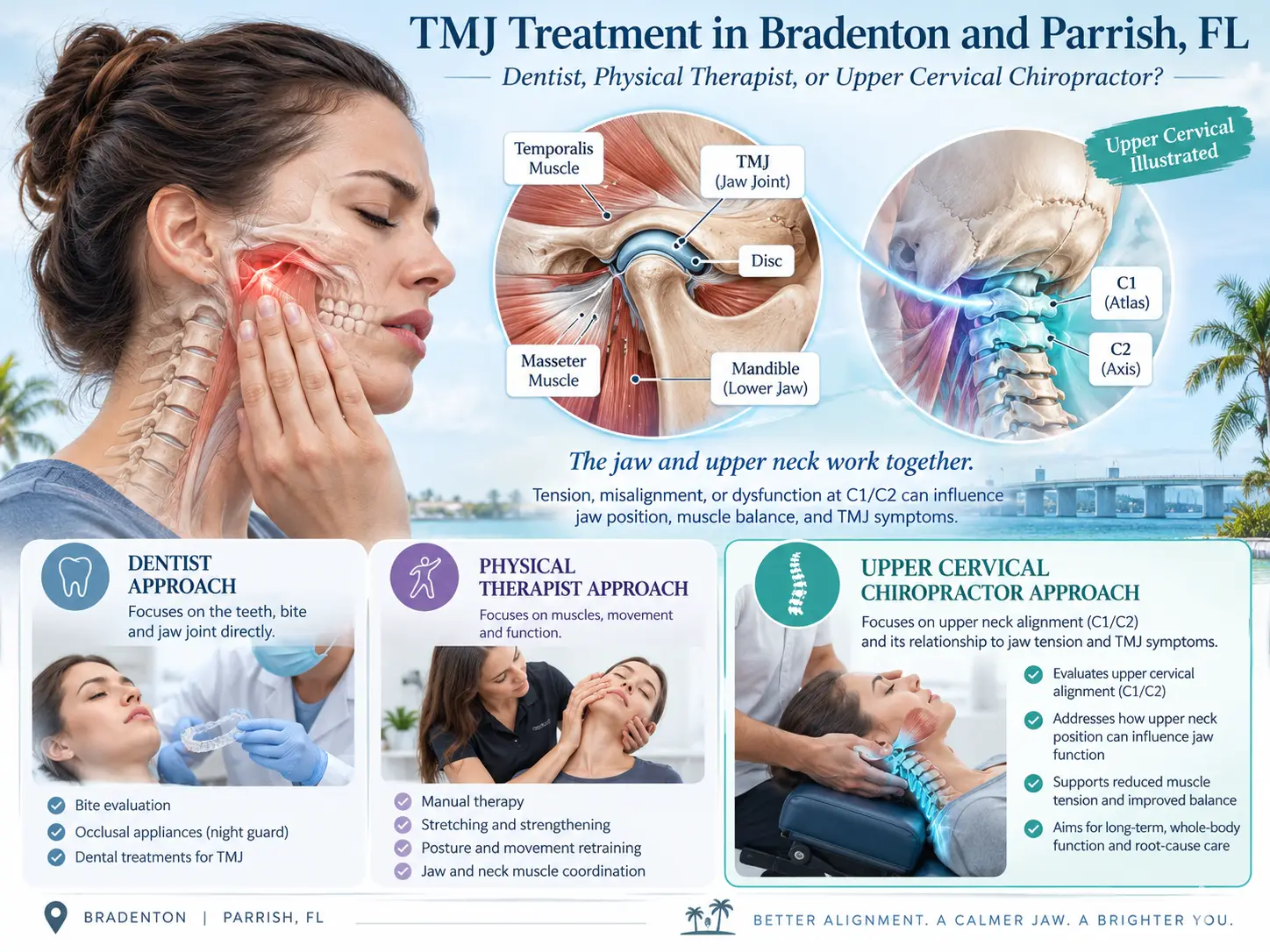
Start with the obvious: the temporomandibular joint, where your lower jaw meets your skull, sits directly in front of your ear canal. You can feel it, put a finger just in front of your ear and open and close your mouth, and you’ll feel the joint move. That proximity alone means jaw problems are often felt in or around the ear.
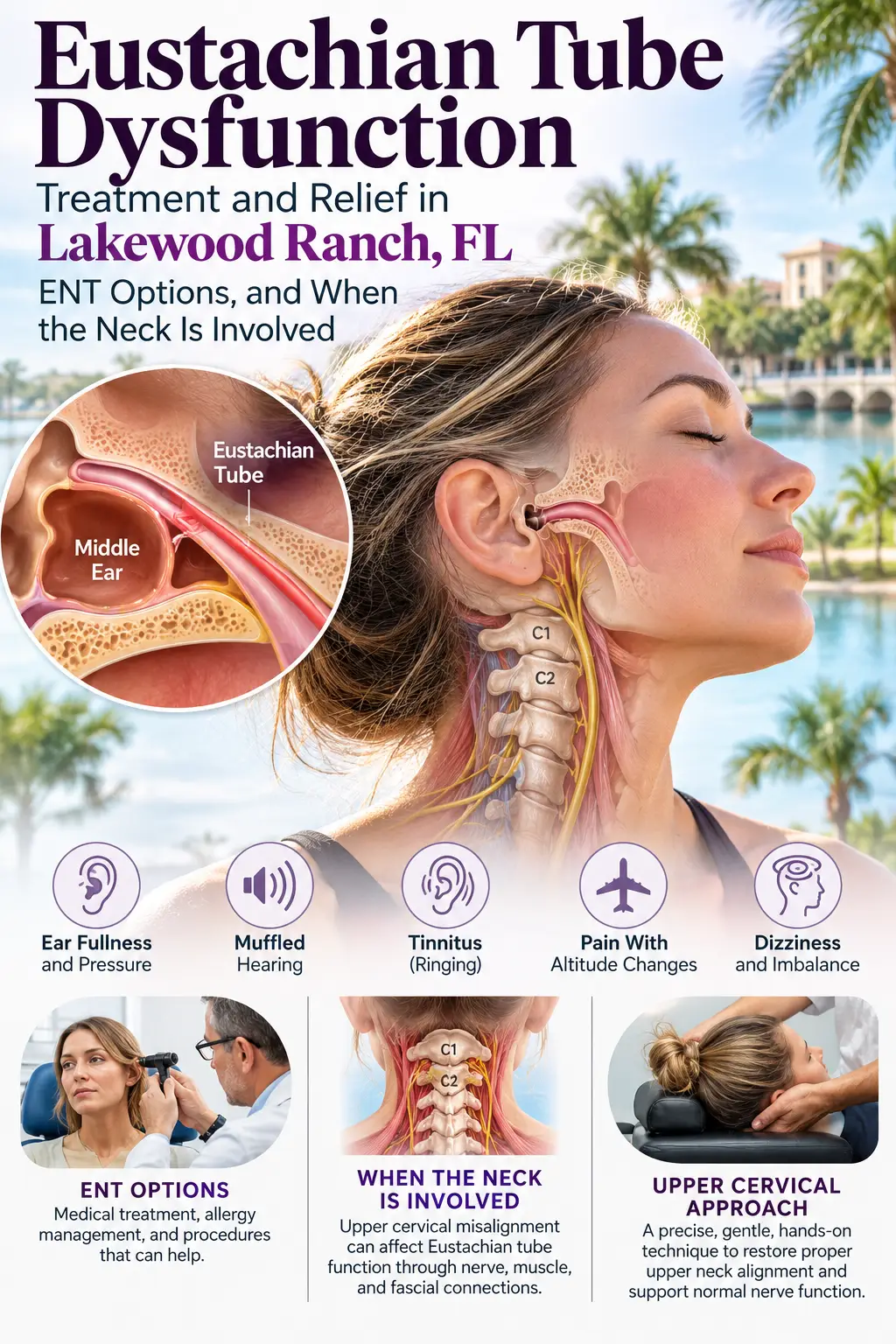
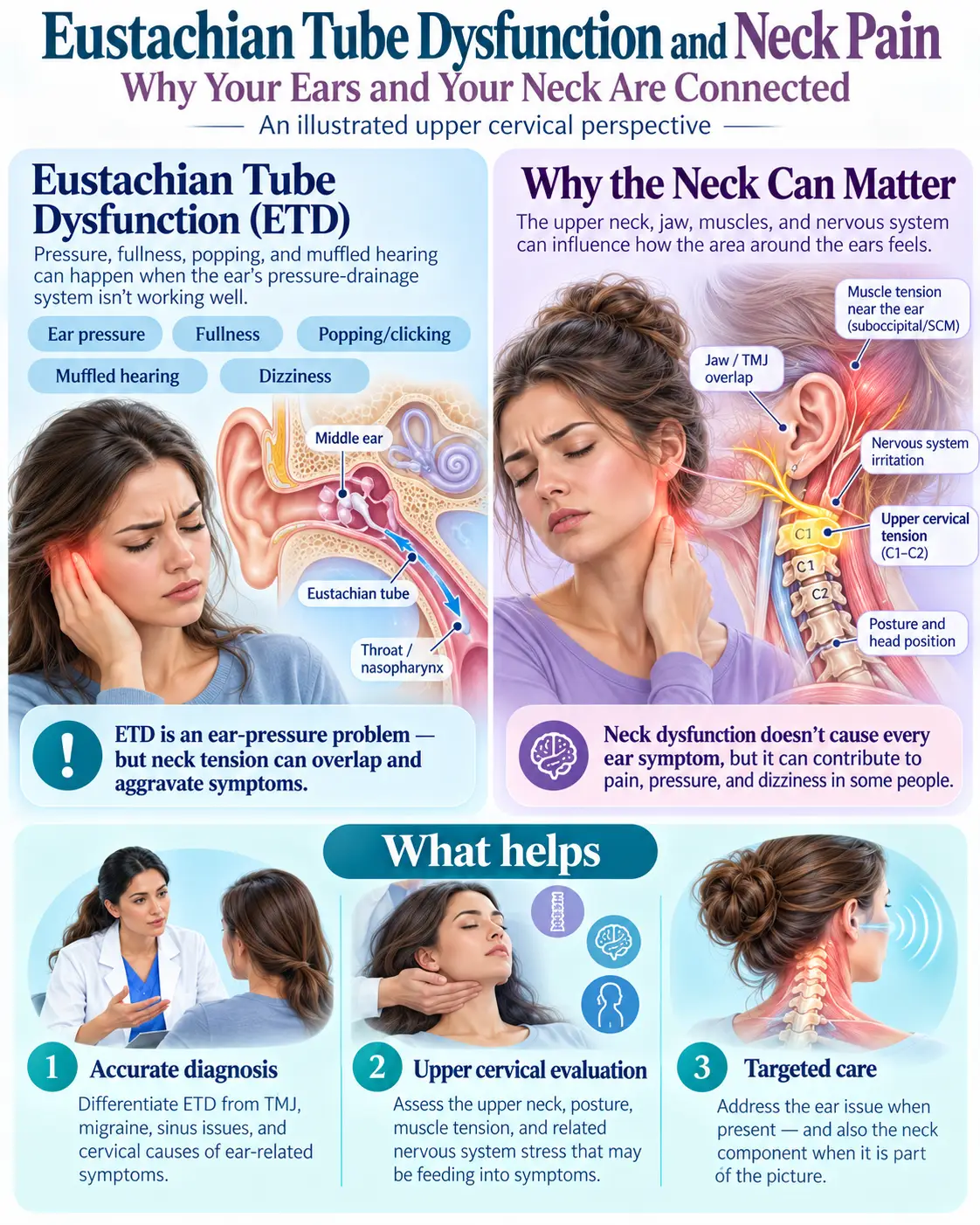
But the connection runs far deeper than location. The jaw and the middle ear share a common embryological origin, they develop from the same tissue, and they remain linked by shared nerves, ligaments, and muscles throughout life. The single most important link for our purposes is a muscle you’ve met if you’ve read our other ear guides: the tensor veli palatini, one of the muscles that opens the Eustachian tube. It is controlled by the mandibular branch of the trigeminal nerve, the very same nerve that powers the muscles you chew with. Physiopedia’s review notes that because the trigeminal nerve supplies both the muscles of mastication and the tensor veli palatini, addressing the TMJ and associated structures can influence signaling to the muscles that control the Eustachian tube.
There’s a second muscle worth knowing about: the tensor tympani, a tiny muscle inside the middle ear that dampens loud sounds. It shares a common tendon and is so closely related to the tensor veli palatini that some anatomists describe them as nearly continuous. Both are influenced by the trigeminal system. So when the jaw and its muscles are dysfunctional, the effects can ripple directly into the muscles that govern the ear’s pressure equalization and sound regulation. This shared trigeminal wiring is the mechanism behind the jaw–ear connection.
How Common Is This? More Than You’d Think
If you have TMD and ear symptoms, you are in very large company. Aural (ear) symptoms are remarkably common among people with temporomandibular disorders.
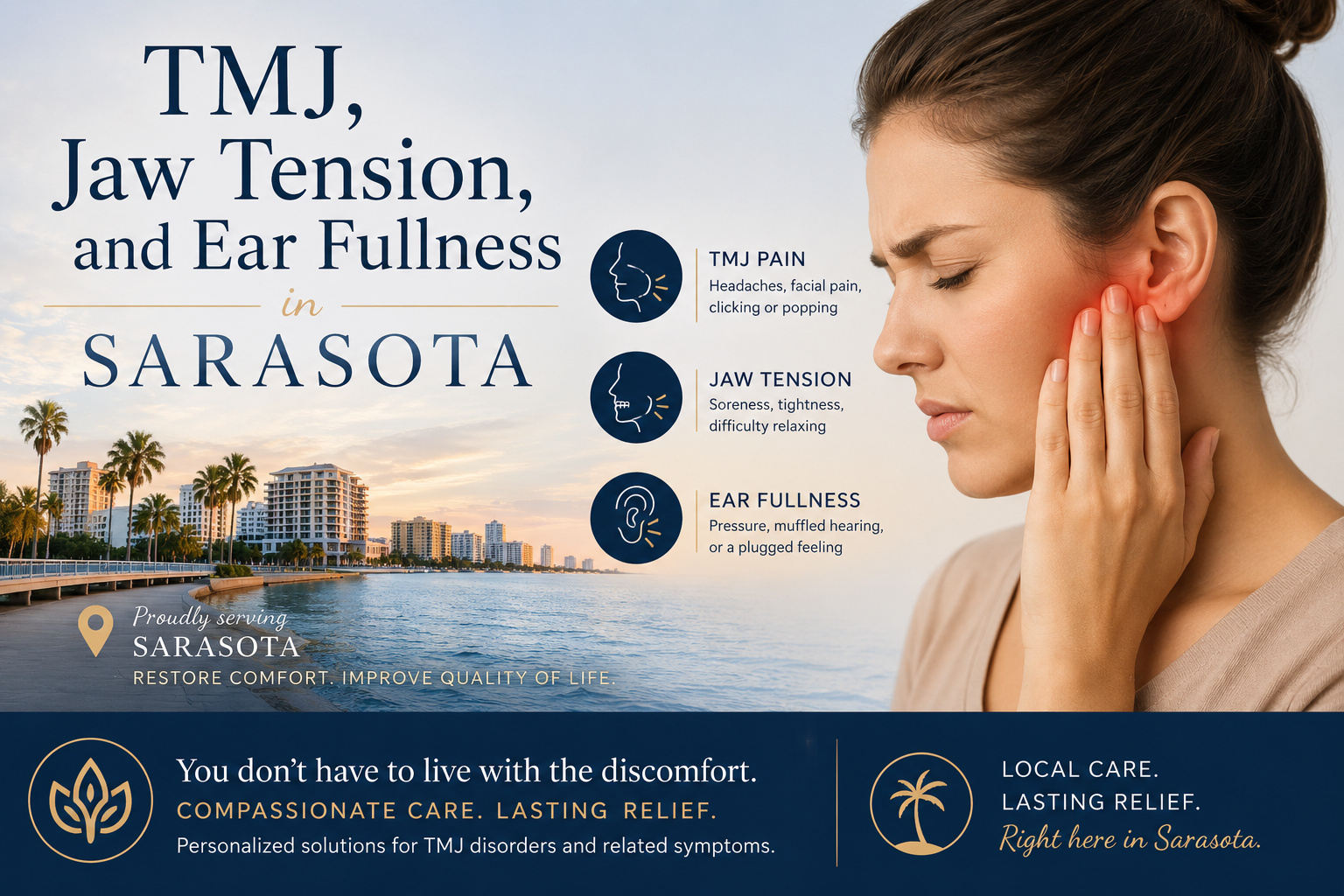
Research investigating this overlap has found strikingly high rates. One study examining dizziness, tinnitus, and ear fullness in TMD patients reported that an earlier study found 87% of TMD cases had aural symptoms, with tinnitus and ear fullness the most common, and in their own cohort roughly half the participants reported tinnitus and ear fullness. The literature broadly reports that something on the order of 85% of TMD patients experience some kind of ear symptom. The most common are ear fullness or a plugging sensation, tinnitus (ringing), ear pain without infection, and sometimes dizziness.
The crucial, and clinically honest, point is that in many of these people the ear itself is structurally normal. In a revealing study of patients whose main or only complaint was ear fullness, every single one had a normal eardrum and a normal (type A) tympanogram, meaning standard ear testing found nothing wrong, and yet these patients had previously been diagnosed and treated for otitis media or sensorineural hearing loss without any improvement, until TMD was identified as the underlying cause. Their ear treatments failed because the problem was never in the ear.
That pattern, real, persistent ear fullness with a completely normal ear exam, is one of the strongest signals that the jaw may be the true source. We need to be careful in how we read this research, though, and we’ll be candid about it: that study was retrospective, had no untreated comparison group, and the “TMD treatments” studied were physiotherapy, joint injections, and dental approaches, not chiropractic. So it establishes that the jaw–ear link is real and that addressing the jaw can help, but it does not prove any one therapy is the answer, and it certainly isn’t evidence that an adjustment fixes ear fullness. We’ll keep that distinction throughout.
Why Jaw Dysfunction Translates Into Ear Symptoms
How exactly does a jaw problem produce ear fullness or ringing? There are several proposed mechanisms, and they likely work together.
The leading explanation involves muscle dysfunction and tone. In TMD, especially in people who clench or grind, the muscles connected to the trigeminal system, including the tensor veli palatini and the tensor tympani, can become hypertonic, chronically over-tightened. Because the tensor veli palatini helps open the Eustachian tube, dysfunction here can impair the tube’s normal opening, producing the same kind of pressure-equalization problems seen in Eustachian tube dysfunction, hence the fullness. And because the tensor tympani attaches to the eardrum, its abnormal tension can alter the eardrum’s behavior and contribute to fullness and tinnitus.
A second mechanism is referred pain and sensory cross-talk. The trigeminal nerve carries sensation from the jaw, and its pathways interact in the brainstem with the nerves and auditory pathways serving the ear. Persistent pain and abnormal signaling from a dysfunctional jaw can be perceived, in part, as ear symptoms, the brain effectively “mislocating” the problem to the ear. This trigeminal sensitization is increasingly understood as central to why jaw problems generate ear, and even head and neck, symptoms.
A third factor is simple mechanics and behavior. People with significant TMD sometimes can’t open their mouths fully, and since yawning and wide jaw movements help ventilate the Eustachian tube, restricted jaw motion can itself worsen tube function. Clenching and grinding, common in TMD, keep the relevant muscles in a state of chronic tension.
The Upper Cervical Connection: Where the Neck Enters the Picture
If the jaw and ear are so linked, where does the upper neck come in? The answer is that the jaw, the upper cervical spine, and the trigeminal system form an interconnected unit, often called the trigeminocervical complex.
Here is the key piece of neuroanatomy. The sensory nerves from the upper cervical spine (C1–C3) and the trigeminal nerve from the jaw and face converge on the same pool of neurons in the brainstem. This convergence means the upper neck and the jaw share neurological “real estate,” and dysfunction in one can influence the other. An upper cervical misalignment can contribute to tension and altered signaling that affects the jaw and, through the shared trigeminal pathways, the ear. This is also why so many people with TMD also have neck tension and headaches, and vice versa, they’re all wired through the same hub.
The atlas and axis also influence the posture and muscle balance of the whole head-and-neck region, including how the jaw sits and functions. Forward head posture, for example, changes the resting position of the jaw and increases strain on the masticatory muscles. So the upper cervical spine influences the jaw–ear system on two levels: through direct neurological convergence in the trigeminocervical complex, and through its effect on posture and muscle balance.
This is the rationale for considering upper cervical care as one part of addressing the jaw–ear pattern. By improving upper cervical alignment, the aim is to reduce the neurological irritation and postural strain feeding into the trigeminal system, which governs both the jaw and the ear-related muscles. We want to state the honest boundary clearly: this is a mechanism-based rationale supported by the anatomy, not a claim proven by clinical trials. We are not aware of high-quality trials showing that upper cervical adjustments resolve TMD-related ear fullness or tinnitus, and we won’t imply otherwise. What we offer is a reasonable, anatomy-grounded approach, evaluated honestly in each person.
Why Upper Cervical Care Matters for the Jaw–Ear Connection
At Lavender Family Chiropractic in Sarasota, our interest in the jaw–ear pattern flows naturally from our focus on the upper cervical spine, because the atlas and axis sit at the heart of the trigeminocervical complex that links the neck, jaw, and ear. Through the Knee Chest Upper Cervical technique, we correct atlas and axis misalignment with a precise, gentle, sub-millimeter adjustment, no twisting, no cracking.
For someone whose ear fullness or tinnitus appears tied to jaw dysfunction, restoring proper upper cervical alignment aims to reduce the neurological irritation within the shared trigeminal-cervical pathways, to improve the postural and muscular balance that influences how the jaw functions, and thereby to support more normal tone in the tensor veli palatini and tensor tympani muscles that connect the jaw to the ear. When those muscles function more normally, the theory and clinical experience suggest the tube can ventilate better and the ear symptoms may ease.
We see our role as one part of a coordinated approach. Many people with TMD-related ear symptoms benefit from a combination of care, which may include dental evaluation for clenching and grinding (a night guard, for instance), jaw-specific therapy, stress and habit management, and addressing the upper cervical and postural contributors. We work alongside those approaches, not in competition with them. Our dedicated TMJ and TMD care page covers the jaw side of this in more depth, and for the ear side, our main Eustachian tube dysfunction guide explains tube function in detail. What separates upper cervical care is the precision of the diagnosis and the gentleness of the correction, fitting for a system as delicate as this one.
What Care Looks Like at Lavender Family Chiropractic
If you come into our Sarasota office with ear fullness or ringing that seems connected to your jaw, here is what to expect.
Your first visit begins with a thorough consultation. Dr. Lavender or Dr. Temple will map out your full picture: your ear symptoms and their pattern, any jaw pain, clicking, or locking, whether you clench or grind, your history of dental work or jaw injury, your posture and neck symptoms, and what evaluations you’ve already had. A normal ear exam combined with jaw signs is exactly the pattern that points toward the jaw–ear connection, so this history is central.
For appropriate patients, the examination includes advanced 3D CBCT imaging of the upper cervical spine, postural assessment, evaluation of jaw movement and the muscles of mastication, and functional nervous system scans using paraspinal infrared thermography. This helps us understand how the atlas, axis, jaw, and surrounding muscles are interacting. Importantly, if your symptoms point toward something needing other evaluation, a primary ear disorder, a dental issue requiring a dentist, or anything outside our scope, we’ll tell you directly and help coordinate that care. A persistent one-sided ear symptom, in particular, always warrants appropriate medical evaluation. Patient safety comes first.
For patients who are appropriate candidates, care is delivered through the gentle Knee Chest Upper Cervical technique, and we coordinate with your dentist or other providers on the jaw side as needed. We’re honest about realistic timelines and about the fact that the jaw–ear pattern often responds best to a combined approach rather than any single intervention. We track objective changes over time rather than simply adjusting and hoping.
📞 Call (941) 243-3729 to schedule your consultation 📅 Book your consultation online 📍 5899 Whitfield Avenue, Suite 107, Sarasota, FL 34243 — at the corner of University and Whitfield
What the Research Says
The research on the jaw–ear connection is robust on the association and the mechanism, and appropriately limited on proving any single treatment, a balance we present honestly.
On prevalence, the association is strong and well-replicated. Studies report that around 85% of TMD patients experience aural symptoms, with ear fullness and tinnitus among the most common. On the striking misdiagnosis pattern, the study of patients presenting with aural fullness as their main complaint found that all had normal eardrums and tympanograms, had been unsuccessfully treated for otitis media or hearing loss, and were ultimately found to have TMD as the underlying cause, powerful evidence that the jaw can drive ear fullness, though, as noted, that study lacked a control group and did not study chiropractic.
On mechanism, the anatomy is well established: the tensor veli palatini and tensor tympani, linked to the trigeminal system shared with the jaw, are implicated, and in TMD these muscles can become hypertonic and disrupt the normal ear-ventilation mechanism. The shared trigeminal innervation of the jaw muscles and the tensor veli palatini provides the anatomical bridge, and the convergence of upper cervical and trigeminal nerves in the brainstem extends that bridge to the neck.
Where the evidence is genuinely limited is in trials of upper cervical chiropractic for TMD-related ear symptoms specifically. The association and the mechanism are solid; the proof that any particular therapy, including ours, reliably resolves these symptoms is not. Our honest position: the jaw–ear connection is real and frequently missed, addressing the jaw and the structures around it can help, and upper cervical care is a reasonable, mechanism-based part of that effort, used in coordination with dental and other care and evaluated case by case, never promised as a cure.
Lifestyle Factors That Help the Jaw–Ear Connection
Whether or not upper cervical care is part of your plan, several daily factors strongly influence the jaw–ear pattern, and many are within your control.
Address clenching and grinding. This is often the central driver. Daytime clench awareness, stress management, and a dentist-fitted night guard for nighttime grinding can substantially reduce the muscle hypertension that feeds ear symptoms. If you grind, this is one of the highest-value steps.
Give your jaw rest. Avoid gum chewing, very chewy or hard foods, and wide yawning during flare-ups. Keep your teeth slightly apart at rest, lips together but teeth not touching, which is the jaw’s healthy resting position.
Mind your posture. Forward head posture changes how the jaw rests and increases masticatory muscle strain. Keeping your head balanced over your shoulders, and avoiding prolonged forward-head device use, supports the whole jaw–neck–ear system.
Manage stress. Stress is a major driver of clenching and muscle tension. Stress-reduction practices help break the clench-tension-symptom cycle, both for the jaw and the ear.
Apply gentle heat and self-massage. Warm compresses and gentle massage of the masticatory muscles can ease tension. A provider can show you safe techniques.
Don’t over-treat a “normal” ear. If your ear exam is normal but you’ve been cycling through decongestants, antibiotics, or ear-focused treatments without relief, that pattern itself is a clue to look at the jaw and neck rather than escalating ear treatments.
If you found this guide useful, you may also want to read our guides on TMJ and TMD for the jaw side and Eustachian tube dysfunction for the ear side of this connection.
Serving Sarasota and the Surrounding Communities
Lavender Family Chiropractic is located in Sarasota, Florida, at 5899 Whitfield Avenue, Suite 107, at the corner of University and Whitfield. From this central location, we serve patients throughout the region, including Bradenton, Lakewood Ranch, Palmetto, Parrish, Venice, Osprey, Nokomis, Ellenton, and the surrounding Gulf Coast communities. Patients also travel from St. Pete, Riverview, and Manatee County for specialized upper cervical care.
If your ears feel full or ring and you also have jaw tension, clicking, or a grinding habit, and ear-focused treatments haven’t helped, we’d be glad to take an honest look at whether the jaw–ear connection, and the top of your neck, is part of your picture.
Top 15 FAQs About the Jaw–Ear Connection and Upper Cervical Care
1. Can my jaw really cause ear fullness? Yes. The jaw and middle ear share nerves, muscles, and embryological origin, and jaw dysfunction is a well-documented cause of ear fullness, often when the ear itself is completely normal. It’s one of the most under-recognized causes of persistent ear fullness.
2. Why did my doctor say my ear is normal when it clearly feels full? Because in the jaw–ear pattern, the ear genuinely is structurally normal, the symptom is referred from the jaw and its muscles. Studies of patients with aural fullness found normal ear exams and tympanograms, with TMD as the real cause.
3. How common are ear symptoms with TMJ problems? Very common. Research reports around 85% of TMD patients have some ear symptom, with ear fullness and tinnitus among the most frequent. If you have both, you’re far from unusual.
4. What’s the actual mechanism? Mainly muscle dysfunction and shared nerves. The tensor veli palatini (which opens the Eustachian tube) and tensor tympani (in the middle ear) are tied to the trigeminal system shared with the jaw. In TMD, these muscles can over-tighten and disrupt normal ear function, producing fullness and ringing.
5. Can TMJ cause tinnitus? Yes, it’s recognized as a contributor. The same muscle and nerve connections that produce fullness can contribute to ringing. TMD-related tinnitus often fluctuates with jaw activity or clenching, which is a clue to the connection.
6. Does grinding my teeth make it worse? Very likely. Clenching and grinding keep the jaw and ear-related muscles in chronic tension, which is a central driver of the symptoms. Addressing grinding, often with a night guard, is one of the most effective steps.
7. Where does my neck come into this? The upper neck and the jaw share nerve pathways in the brainstem (the trigeminocervical complex), so neck dysfunction can influence the jaw and, through it, the ear. This is also why TMD, neck tension, and headaches so often occur together.
8. Can upper cervical care fix my ear fullness? We won’t claim a cure. The jaw–ear–neck connection is anatomically well established, but trials proving any single therapy resolves these symptoms are lacking. We offer a reasonable, mechanism-based approach, coordinated with dental care and evaluated honestly.
9. Is the adjustment safe? Yes. The Knee Chest Upper Cervical technique is gentle and precise, with no twisting or cracking, appropriate for this delicate system. We examine thoroughly and refer out when something needs other care.
10. Should I still see a dentist or ENT? Often yes, this pattern usually responds best to a coordinated approach. A dentist can address grinding and bite issues; an ENT can rule out primary ear problems. We’re glad to work alongside them, and we’ll tell you when their input is needed.
11. Why didn’t decongestants or antibiotics help my ear? Because if the source is your jaw, ear-directed treatments can’t fix it. A normal ear exam plus failed ear treatments is itself a strong clue to look at the jaw and neck instead.
12. Can stress cause this? Indirectly, yes. Stress drives clenching and muscle tension, which fuel the jaw–ear symptom cycle. Stress management is a genuinely useful part of addressing it.
13. Will a night guard help my ears? It can, if grinding is part of your picture, because reducing nighttime clenching reduces the muscle tension feeding the ear symptoms. Your dentist can fit one properly.
14. How do I know if my ear symptoms are from my jaw? Strong clues include a normal ear exam, ear fullness or ringing alongside jaw pain, clicking, or grinding, and symptoms that change with jaw activity. A thorough evaluation can help sort it out.
15. How do I get started? Call our Sarasota office at (941) 243-3729 or book online. We’ll review your jaw and ear history, perform a thorough exam, coordinate with your dentist or ENT as needed, and give you an honest assessment of whether upper cervical care fits your situation.
Take the Next Step
Persistent ear fullness or ringing with a “normal” ear is one of the most frustrating experiences, precisely because the usual ear treatments keep failing. Often the reason is simple once you see it: the problem isn’t in the ear at all, it’s in the jaw, transmitted to the ear through the nerves and muscles they share. Recognizing that connection is frequently the turning point.
If you are in Sarasota, Bradenton, Lakewood Ranch, or anywhere along the Gulf Coast and you have ear symptoms tangled up with jaw tension, Dr. Rusty Lavender and Dr. Jacob Temple at Lavender Family Chiropractic are here to give you an honest evaluation of the jaw–ear connection and whether upper cervical care, alongside appropriate dental and medical care, fits your situation.
📞 Call (941) 243-3729 today to schedule your consultation 📅 Book online here 📍 5899 Whitfield Avenue, Suite 107, Sarasota, FL 34243 — at the corner of University and Whitfield
Related Articles
Get our upper cervical articles first.
Patients Experience