
Neck Pain During Pregnancy: Safe, Gentle Upper Cervical Chiropractic Care for Natural Neck Pain Relief
By Dr. Rusty Lavender — Lavender Family Chiropractic, Sarasota, FL
Pregnancy changes almost everything about how your body moves, sleeps, and carries weight, and for many expecting mothers one of the earliest and most persistent complaints is a stiff, aching neck. You may notice it first as tension at the base of the skull after a long day, a knot between the shoulder blades that will not loosen, or a dull headache that seems to start in the upper neck and creep forward. As your center of gravity shifts and your ligaments soften, the small joints and muscles of the cervical spine are asked to do more with less stability. It is a common story, and it is one we hear often at our Sarasota practice.
The good news is that neck pain during pregnancy is usually benign and self-limited, and there are gentle, drug-free approaches that many mothers find comforting. At Lavender Family Chiropractic, we focus on a low-force, highly specific method called the Knee Chest Upper Cervical technique — an approach with no twisting and no popping, which is exactly why so many pregnant patients feel reassured by it. Our goal is to support your body’s own capacity to move and adapt more comfortably, in close coordination with your obstetrician or midwife.
This article walks through why neck pain shows up so often in pregnancy, what is happening in the muscles and nerves of the cervical spine, why the upper neck deserves special attention, and how we approach care thoughtfully and safely. We will also be honest about the limits of the evidence, about when imaging is and is not appropriate during pregnancy, and about the red-flag symptoms that mean you should call your OB or physician rather than reach for natural neck pain relief. Our intention is to inform, not to overpromise.
Why Neck Pain Is Common During Pregnancy
Pregnancy is a full-body event, and the neck is rarely spared. Several overlapping changes conspire to make the cervical spine work harder than usual, and understanding them helps explain why so many women experience neck discomfort even when nothing is seriously wrong.
Postural changes. As the uterus grows and the abdomen expands, the low back tends to arch more (an increased lumbar lordosis), the pelvis tilts, and the upper body compensates by drifting the head and shoulders forward. This forward-head posture stacks the skull ahead of its ideal position over the spine, which multiplies the load the neck muscles must carry to hold the head level. Add in growing breast tissue and a rounding of the upper back, and the base of the neck becomes a hub of accumulating strain.
Ligament laxity from relaxin. During pregnancy the body produces more relaxin and related hormones that soften and loosen ligaments, primarily to allow the pelvis to accommodate childbirth. Relaxin is not selective, though; it influences connective tissue throughout the body. Joints that once felt firm and stable can feel looser and less supported, and the spine is no exception. When the passive stabilizers (the ligaments) become more elastic, the active stabilizers (the muscles) have to take up the slack, and that extra muscular effort is often felt as stiffness and aching.
Weight gain and a shifting center of gravity. Healthy pregnancy weight gain, redistributed toward the front of the body, moves your center of gravity forward and up. Your postural muscles constantly recalibrate to keep you balanced, and the deep muscles of the neck and upper back are part of that balancing system. Small, continuous adjustments over weeks and months add up to fatigue.
Sleep changes. Later in pregnancy, side-sleeping is generally recommended, and finding a comfortable position becomes a nightly project. Too many pillows, too few, or a pillow that leaves the neck bent to one side for hours can leave you waking with a cricked, sore neck. Interrupted sleep also lowers your pain tolerance, so the same tension feels worse.
Hormonal and physiological shifts. Beyond relaxin, pregnancy brings fluid retention, changes in blood volume, and shifts in how tissues hold water, all of which can subtly change how muscles and joints feel. Hormonal fluctuations also influence headache patterns for some women, and tension-type headaches frequently trace back to the upper neck.
None of these factors is a sign that something is broken. They are the predictable trade-offs of growing a baby. Musculoskeletal discomfort of the back, pelvis, and neck is one of the most common experiences of pregnancy, and recognizing it as common — rather than alarming — is the first step toward managing it calmly.
The Nerve and Muscle Mechanisms
To understand why the neck aches, it helps to look a little closer at the tissues involved. The cervical spine is a remarkably mobile column of seven vertebrae that supports a head weighing roughly ten to twelve pounds. Layered around those bones are dozens of muscles, from large, superficial movers like the trapezius and levator scapulae to small, deep stabilizers tucked at the base of the skull.
Among the most important of these are the suboccipital muscles — four small paired muscles connecting the top vertebrae to the base of the skull. They are dense with sensory receptors and play an outsized role in head positioning, fine motor control of the neck, and your sense of where your head is in space. When forward-head posture becomes the default, these little muscles stay contracted for hours, working to keep your eyes level and your gaze forward. Chronically shortened and overworked suboccipital muscles are a classic source of tension at the base of the skull and of the tension-type and cervicogenic headaches that many pregnant women describe.
Here is where postural load and ligament laxity intersect. When relaxin loosens the ligaments that normally provide passive support to the cervical joints, the nervous system responds by increasing muscular guarding to maintain stability. The muscles essentially become the scaffolding that the ligaments can no longer provide as firmly. Sustained guarding leads to reduced local blood flow, the buildup of metabolic byproducts, and the formation of tender, ropey trigger points. Over time this can create a self-reinforcing loop: tight muscles restrict joint motion, restricted joints prompt more protective muscle tension, and the cycle continues.
The nerves add another layer. Sensory nerves from the upper cervical spine share pathways in the brainstem with nerves from the head and face, which is why irritation in the upper neck can be perceived as pain over the scalp, behind the eyes, or across the forehead — the mechanism behind cervicogenic headache. Meanwhile, nerve roots exiting between the cervical vertebrae can become sensitized when surrounding tissues are inflamed or mechanically stressed, contributing to referred aching into the shoulders and upper back.
The encouraging part is that most pregnancy-related neck pain is mechanical and muscular in nature rather than a sign of nerve damage or structural disease. Mechanical pain responds to changes in load, movement, and position, which is precisely why gentle, conservative approaches — improved posture, supportive sleep positioning, appropriate movement, and careful hands-on care — can help so many women feel more comfortable. If you would like a broader overview of how these mechanisms play out, our neck pain resource page discusses the anatomy in more depth.
Why the Upper Neck (Atlas/Axis, C1/C2) Matters
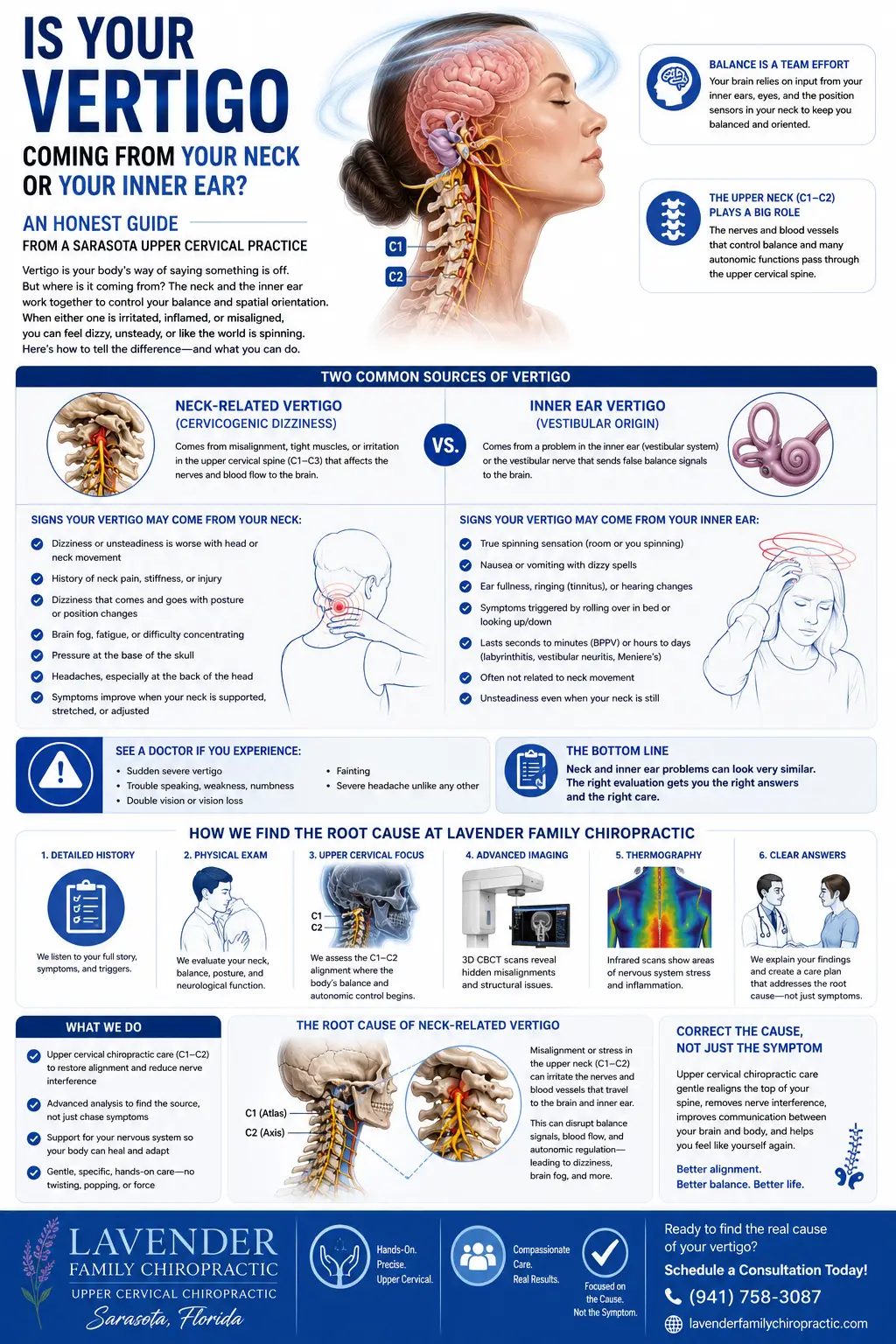
Not all of the neck is built the same way, and the very top of the cervical spine is unlike anything below it. The first two vertebrae — the atlas (C1) and the axis (C2) — form a specialized joint complex that deserves particular attention during pregnancy.
The atlas (C1) is a ring-shaped bone that cradles the base of the skull. It has no vertebral body and no intervertebral disc beneath it in the usual sense; instead, its stability depends heavily on ligaments rather than on the interlocking bony architecture found lower in the spine. The axis (C2) sits just below and features a peg-like projection called the dens, or odontoid process, that projects upward into the ring of the atlas. The atlas essentially pivots around this peg.
This design is what gives the upper neck its extraordinary range of motion. Roughly half of the rotation in your entire neck — commonly estimated at around 50 to 60 percent of total cervical rotation — happens at the C1–C2 joint alone. When you turn your head to check a blind spot or glance over your shoulder, that motion is dominated by the atlas pivoting on the axis. It is an elegant, mobile, and inherently ligament-dependent arrangement.
That ligament dependence is exactly why the upper cervical region is relevant to pregnancy. Because the atlas relies on ligamentous support rather than robust bony locking, any general softening of ligaments — such as the relaxin-related laxity that occurs during pregnancy — has the potential to affect how this region feels and functions. A joint that is already built for mobility, asked to remain stable while its ligaments are more elastic and while forward-head posture increases the load overhead, can become a focal point for discomfort and muscular guarding. This is also the region where the suboccipital muscles anchor and where cervicogenic headaches so often originate.
Upper cervical chiropractic care concentrates specifically on this junction between the head and neck. Rather than treating the whole spine with broad, forceful maneuvers, upper cervical chiropractic care uses precise, low-force contacts intended to encourage more balanced motion and position at C1 and C2. For a pregnant patient, the appeal is straightforward: a focused, gentle approach to the one area of the spine that is both highly mobile and most reliant on the very ligaments that pregnancy softens. We want to be clear that this is about supporting comfortable, balanced function — not about making sweeping medical claims or treating disease.
Is Chiropractic Safe During Pregnancy?
This is the question we hear most often, and it deserves an honest, evidence-informed answer rather than a sales pitch.
For most healthy pregnancies, gentle chiropractic and manual therapy are generally regarded as reasonable, conservative options for musculoskeletal discomfort, and serious adverse events are rare in the published literature. That said, “rare” is not “never,” and the overall quality of the research is modest. A responsible answer acknowledges both the reassuring safety signal and the limits of what we actually know.
Several things shape how we think about safety at Lavender Family Chiropractic:
Technique matters. We use the Knee Chest Upper Cervical technique, a low-force, highly specific method. There is no twisting of the neck, no forceful rotation, and no cracking or popping. For a pregnant patient — who may already feel more vulnerable and whose ligaments are looser — this gentleness is genuinely reassuring, and it is one of the main reasons we favor this approach for expecting mothers. The contact is precise and controlled, and the amount of force involved is minimal compared with high-velocity, rotational manipulation.
Positioning matters. As pregnancy progresses, comfortable and safe positioning becomes essential. Our care is adapted to accommodate a changing body, and we never ask a patient to lie in a way that feels unsafe or uncomfortable for her or the baby.
Coordination matters. We strongly believe in team-based care. We encourage every pregnant patient to keep her obstetrician or midwife informed and to check with them before beginning any new therapy, especially if the pregnancy is considered high-risk or if there are complicating medical conditions. Chiropractic care is a complement to, not a replacement for, prenatal medical care.
Honesty about evidence matters. The studies that exist suggest that manual therapies may help some women with pregnancy-related back and pelvic pain and that adverse events are uncommon, but many of these studies are small or of low-to-moderate quality. We do not claim that care is certain to help, and we will never promise a specific outcome. What we can offer is a gentle, individualized, conservative approach and an honest conversation about what is reasonable to expect.
Certain symptoms are not routine pregnancy aches and should prompt a call to your physician rather than a chiropractic visit. A severe or sudden headache, a headache accompanied by high blood pressure, visual changes, upper-abdominal pain, or swelling (which can signal preeclampsia), any neck pain following trauma, fever, unrelenting pain that wakes you at night, or new weakness, numbness, or coordination problems all warrant prompt medical evaluation. We would rather you err on the side of caution and contact your OB.
How Upper Cervical Care Works at Lavender Family Chiropractic
If you decide that gentle upper cervical care might be a good fit during your pregnancy, here is what the process looks like at our Sarasota office and how we handle each step with care.
A thorough consultation and history. Every relationship begins with a conversation. We want to understand your symptoms, your pregnancy stage, your overall health, any prior injuries, your sleep and work setups, and what your OB or midwife has advised. This is also when we discuss whether upper cervical care is appropriate for you at all, or whether you would be better served by referral or by waiting.
Imaging decisions handled carefully. Our practice uses two technologies in general: 3D CBCT imaging and Tytron paraspinal infrared thermography. We want to be especially clear and honest here, because imaging in pregnancy is a real consideration. CBCT (cone beam computed tomography) uses ionizing radiation, and we do not perform routine CBCT scans during pregnancy. Radiation exposure to a developing baby is something to be minimized and avoided when not clearly necessary, and any imaging decision during pregnancy is individualized, made cautiously, and only considered when there is a compelling clinical reason and after appropriate discussion. In many cases, imaging is simply deferred until after delivery. By contrast, Tytron paraspinal infrared thermography is radiation-free — it measures patterns of skin temperature along the spine, which can reflect changes in the surrounding nervous system and muscle activity, without any radiation exposure at all. That makes thermography a comfortable, non-invasive option for gathering information during pregnancy.
The Knee Chest Upper Cervical adjustment. When care is appropriate, the adjustment itself is delivered using the Knee Chest Upper Cervical technique. It is specific, low-force, and free of the twisting and popping that many people picture when they imagine a chiropractic visit. The goal is to encourage more balanced motion and position at the upper neck so the surrounding muscles are not forced to guard as hard.
Customized care plans. We do not believe in a one-size-fits-all approach. Instead, we build customized care planstailored to your body, your pregnancy, and your response to care. Your plan can be adjusted as your pregnancy progresses and as your needs change. You can learn more about the doctors who will be caring for you on our meet the team page.
Throughout the process, our emphasis is on gentleness, communication, and realistic expectations. We are here to support your comfort, not to make grand promises.
If neck pain is making your pregnancy harder than it needs to be, we would be glad to talk with you about whether gentle upper cervical care is a reasonable option for you. Call Lavender Family Chiropractic at (941) 243-3729 or request a visit through our new patient scheduling page. You will find us at 5899 Whitfield Avenue, Suite 107, Sarasota, FL 34243, right at the corner of University and Whitfield. We will always encourage you to keep your OB or midwife in the loop.
What the Research Says
We think it is important to point you toward the actual literature so you can read it yourself. Here are five peer-reviewed sources relevant to neck and back pain in pregnancy, the safety of manual care, and the role of relaxin. As with all research, individual studies have limitations, and we describe their findings honestly.
- A 2024 systematic review and meta-analysis, Prevalence of lumbopelvic pain during pregnancy, pooled data from many cross-sectional studies and reported an overall prevalence of low back and pelvic (lumbopelvic) pain of roughly 63 percent during pregnancy, with rates that tended to rise as pregnancy advanced — underscoring how common musculoskeletal pain is in expecting mothers.
- The critical review Adverse events from spinal manipulation in the pregnant and postpartum periods examined the published literature and found only a small number of reported adverse events associated with spinal manipulation during and after pregnancy, concluding that serious complications are rare while noting that the evidence base is limited and that caution and appropriate technique remain important.
- The classic study Changes in joint laxity occurring during pregnancy measured joint laxity in pregnant and non-pregnant women and documented increased ligamentous laxity during pregnancy, supporting the widely observed connection between pregnancy hormones such as relaxin and looser, less stable joints.
- A pilot randomized controlled trial, comparing exercise, spinal manipulation, and neuro emotional technique for pregnancy-related low back pain, tested conservative approaches in pregnant women and found that participants reported improvements in pain and disability, while the authors emphasized that the study was a small pilot and that larger, higher-quality trials are needed before firm conclusions can be drawn.
- The systematic analysis Global, regional, and national burden of neck pain, 1990–2020, and projections to 2050from the Global Burden of Disease Study 2021 reported that neck pain affects hundreds of millions of people worldwide and remains a leading contributor to years lived with disability, illustrating just how common and impactful neck pain is across the general population.
Taken together, this literature paints a consistent, measured picture: neck and back pain are extremely common in pregnancy, relaxin-related laxity is a real physiological phenomenon, gentle manual care appears to be relatively low-risk, and conservative approaches may help some women — though the research is not strong enough to make guarantees. That measured honesty is exactly how we prefer to talk about care.
Lifestyle and Self-Care in Pregnancy
Much of what helps a sore neck during pregnancy happens at home, between visits. These simple, low-risk strategies support your comfort and complement any care you receive. As always, run new activities by your OB or midwife first.
Sleep positioning and pillows. Side-sleeping is commonly recommended later in pregnancy, and how you support your head and neck matters enormously. Aim for a pillow that keeps your neck in line with the rest of your spine — not tilted up toward the ceiling or dropped down toward the mattress. A pillow between your knees can level the pelvis and reduce pull on the low back and neck, and a small pillow or rolled towel tucked under the abdomen can add support. If you wake with a stiff neck, your pillow height is often the culprit. Our guide to choosing a pillow for neck pain walks through what to look for in more detail.
Posture and workstation setup. Forward-head posture is a leading driver of neck strain, and pregnancy amplifies it. When sitting, bring your screen up to eye level, keep your shoulders relaxed and back, and support your low back so your whole spine stacks more comfortably. Take frequent breaks to stand, roll your shoulders, and gently draw your chin back to unload the suboccipital muscles. If you nurse or bottle-feed after delivery, the same principle applies: bring the baby up to you rather than curling down to the baby.
Gentle movement. Staying gently active supports circulation, muscle balance, and mood. Walking, prenatal yoga, swimming, and physician-approved stretching can all help keep the neck and upper back from stiffening. Slow, controlled range-of-motion movements — easy turns of the head, gentle shoulder rolls, and light chest-opening stretches — can relieve accumulated tension. Nothing here should be forceful or painful; comfort is the guide.
Heat, hydration, and stress. A warm (not hot) compress on tight neck and shoulder muscles can be soothing. Staying well hydrated supports tissue health, and managing stress helps, because stress tends to settle into the shoulders and upper neck. Deep, slow breathing can lower overall muscle tension.
For more ideas on managing discomfort without medication, our overview of natural neck pain remedies offers additional conservative strategies you can try at home.
Serving Sarasota and Surrounding Communities
Lavender Family Chiropractic is proud to serve expecting mothers and families throughout the greater Sarasota region. Our office sits at the corner of University and Whitfield, making us convenient to a wide swath of the Suncoast. We welcome patients from Sarasota, Bradenton, Lakewood Ranch, Venice, Palmer Ranch, Osprey, Siesta Key, Longboat Key, Lido Key, University Park, Parrish, Ellenton, Myakka City, Punta Gorda, and St. Petersburg.
Whether you are just a few minutes away in University Park or making the drive down from Parrish or up from Venice, we aim to make your visits smooth and unhurried. If you are unsure whether our location works for your schedule, reach out through our contact page and we will help you plan a convenient time.
Top 15 Questions
1. Is neck pain normal during pregnancy? Neck, back, and pelvic pain are among the most common complaints of pregnancy, and in most cases they are benign and mechanical, driven by posture, weight distribution, ligament laxity, and sleep changes. Common does not mean you have to simply endure it, though — gentle, conservative options may offer natural neck pain relief.
2. Is the Knee Chest Upper Cervical technique safe during pregnancy? The Knee Chest Upper Cervical technique is low-force and specific, with no twisting and no popping, which many pregnant patients find especially reassuring. As with any care in pregnancy, we individualize the approach, adapt positioning as your body changes, and encourage coordination with your OB or midwife.
3. Will you crack or twist my neck? No. Our method avoids the forceful rotation and cracking that many people associate with chiropractic. The contact is gentle, precise, and controlled — a key reason we favor it for expecting mothers.
4. Do you take X-rays or CBCT scans of pregnant patients? We do not perform routine CBCT imaging during pregnancy. CBCT uses ionizing radiation, and radiation exposure to a developing baby is something we minimize and avoid unless there is a compelling clinical reason. Imaging decisions in pregnancy are individualized and cautious, and imaging is often simply deferred until after delivery.
5. What is Tytron thermography, and is it safe in pregnancy? Tytron paraspinal infrared thermography measures skin-temperature patterns along the spine to gather information about the nervous system and muscles. It is radiation-free and non-invasive, which makes it a comfortable option during pregnancy.
6. Why do you focus on the upper neck? The atlas (C1) and axis (C2) form a highly mobile, ligament-dependent joint that produces a large share of your neck’s rotation. Because pregnancy softens ligaments throughout the body, this ligament-reliant region can become a focal point for discomfort, which is why gentle upper cervical care concentrates there.
7. Can chiropractic care help my pregnancy headaches? Many pregnancy headaches are tension-type or cervicogenic, meaning they are related to the muscles and joints of the upper neck. Gentle care and improved posture may help some women, though we cannot promise a specific result. A severe or sudden headache, or a headache with high blood pressure or visual changes, should be evaluated by your physician right away.
8. How soon might I feel a difference? Responses vary widely from person to person. Some people notice changes early, while others need more time, and some may not respond as hoped. We will talk honestly with you about realistic expectations rather than making guarantees.
9. How many visits will I need? There is no universal number. We build a customized care plan based on your body, your pregnancy, and how you respond, and we adjust it as things change. Your plan is always tailored to your individual findings and goals.
10. Do you take my insurance? We are a cash-pay, out-of-network practice and do not bill insurance directly. We provide superbills that you can submit to your insurer for possible reimbursement, depending on your individual plan. This lets us keep care focused on your needs rather than on insurance restrictions.
11. When should I call my OB or physician instead of coming in? Please contact your OB or physician promptly for any severe or sudden headache, a headache with high blood pressure, visual changes, or upper-abdominal pain or swelling (possible signs of preeclampsia), neck pain after trauma, fever, unrelenting pain that wakes you at night, or any new weakness, numbness, or coordination problems. These are not routine pregnancy aches and warrant medical evaluation. When in doubt, always err on the side of contacting your medical provider.
12. Should I check with my OB or midwife before starting care? Yes, we encourage it, particularly if your pregnancy is high-risk or you have other medical conditions. We view chiropractic as a complement to your prenatal medical care, not a substitute for it, and we welcome coordination with your providers.
13. Is it too late in my pregnancy to start? Care can often be adapted to any stage of pregnancy, with positioning adjusted for comfort and safety. The right answer depends on your individual situation, which we will discuss during your consultation and in coordination with your OB.
14. What can I do at home to help my neck? Supportive side-sleeping with a properly sized pillow, a pillow between the knees, better workstation posture, gentle physician-approved movement, warm compresses, hydration, and stress management can all support comfort. Our resources on natural remedies and pillow selection offer more detail.
15. How do I get started? The first step is a conversation. Call us at (941) 243-3729 or book through our new patient scheduling page, and we will talk through your symptoms, your pregnancy stage, and whether gentle upper cervical care is a reasonable option for you. We combine a low-force upper cervical technique with radiation-free thermography, careful and honest imaging decisions, customized care plans, and a strong emphasis on coordinating with your OB or midwife. Our priority is safety, gentleness, and realistic expectations.
Closing
Pregnancy asks a great deal of your body, and a stiff, aching neck can make an already demanding season harder. You do not have to simply grit your teeth through it. Gentle, conservative, drug-free approaches — from thoughtful sleep positioning and posture to careful upper cervical care — may offer meaningful, natural neck pain relief, and they can be pursued safely in coordination with your prenatal team.
At Lavender Family Chiropractic, our commitment is to gentleness, honesty, and individualized care. We will never overpromise, we will always encourage you to keep your OB or midwife informed, and we will treat your comfort and safety as the priority. If you are ready to talk about whether gentle upper cervical care is right for you, we would love to hear from you.
Call us at (941) 243-3729 or book online through our new patient scheduling page. Visit us at 5899 Whitfield Avenue, Suite 107, Sarasota, FL 34243, at the corner of University and Whitfield. You can also reach us anytime through our contact page, and we look forward to supporting you and your growing family.