Neck Pain and Nausea: Understanding the Neck-Vagus-Gut Connection and Natural Neck Pain Relief Through Upper Cervical Chiropractic Care
By Dr. Rusty Lavender — Lavender Family Chiropractic, Sarasota, FL
Neck pain is common. Nausea is common. But when the two show up together, they can be genuinely unsettling. You may find yourself wondering whether the queasy, stomach-turning feeling is coming from your neck at all, or whether something more serious is going on. That uncertainty is one of the most frequent reasons people call our Sarasota office asking about the connection between an aching, stiff, or restricted neck and a wave of nausea that seems to arrive alongside it.
The honest answer is that neck pain and nausea can be linked through real, well-documented pathways in the nervous system, particularly at the upper part of the neck where nerves, the brainstem, the balance system, and the vagus nerve all sit in close quarters. When the upper neck is irritated or its movement is restricted, that input can converge on the same brainstem regions that influence headache, dizziness, and the sensation of nausea. For many people with a benign, properly evaluated cause, this is where a gentle, structured approach to the upper cervical spine becomes relevant.
At the same time, we want to be very clear from the outset: neck pain with nausea can occasionally be a warning sign of a medical emergency. Before we talk about the neck-vagus-gut connection or about natural neck pain relief, we walk every patient through the red flags that call for urgent medical care rather than a chiropractic visit. This article is written to be intellectually honest with you: to help you recognize when to seek immediate help, and to explain, for the many benign and evaluated cases, why the upper cervical spine is so often part of the story and how care at Lavender Family Chiropractic is designed to support your nervous system gently.
Why Neck Pain and Nausea Happen Together
First, the red flags: when neck pain and nausea need urgent medical care
Most neck pain with mild nausea is not an emergency. But some combinations are, and knowing them could matter enormously. Please seek immediate medical attention — call 911 or go to the nearest emergency department — if neck pain with nausea comes with any of the following:
- A sudden, severe “thunderclap” headache that reaches maximum intensity within seconds to a minute, often described as the worst headache of your life. This can signal bleeding around the brain and is a medical emergency.
- A stiff neck combined with fever, sensitivity to light, confusion, or a rash. This cluster can point toward meningitis, an infection of the membranes around the brain and spinal cord, which requires urgent treatment.
- Signs of stroke, which can be remembered with the acronym FAST: Face drooping, Arm weakness, Speech difficulty, Time to call 911. Additional stroke warning signs include sudden severe dizziness, loss of coordination, double vision, trouble swallowing, slurred speech, or numbness on one side of the body. Neck pain, especially at the back or side of the neck, can sometimes accompany a tear in an artery in the neck (a dissection), which is a recognized cause of stroke in younger adults.
- Neck pain and nausea following a head or neck injury, such as a fall, car accident, or sports collision. This may indicate a concussion or a more serious injury and should be evaluated promptly.
- A pounding headache with nausea and very high blood pressure, or nausea with new neurological symptoms such as weakness, vision loss, or fainting.
These situations are not what upper cervical chiropractic care is for. If any of them describe you, close this page and get emergency help. A responsible chiropractic office should always screen for these first, and at our practice we do. Only after serious causes have been considered and ruled out does it make sense to explore the more common, benign mechanisms that connect the neck and nausea.
The benign mechanisms: cervicogenic headache and migraine with nausea
For a great many people, neck pain with nausea traces back to the head-and-neck pain systems rather than to anything dangerous. Cervicogenic headache is head pain that actually originates from structures in the neck, particularly the upper cervical joints, muscles, and nerves, and is then felt in the head. Because the neck and head pain pathways share circuitry in the brainstem, a headache driven by the neck can bring along the same companions as other headaches, including light sensitivity, dizziness, and nausea.
Migraine is the other big player. Nausea is one of migraine’s defining features, listed in formal diagnostic criteria alongside sensitivity to light and sound. Many people with migraine also experience prominent neck pain and stiffness before or during an attack, so much so that neck symptoms are sometimes mistaken for the whole problem. When you have a neck that is tight and painful and a stomach that is turning, it can be very hard to tell where one problem ends and the other begins, because in the nervous system they are genuinely intertwined. Our related overview of neck painexplores how varied the presentations can be.
Vestibular and dizziness-related nausea
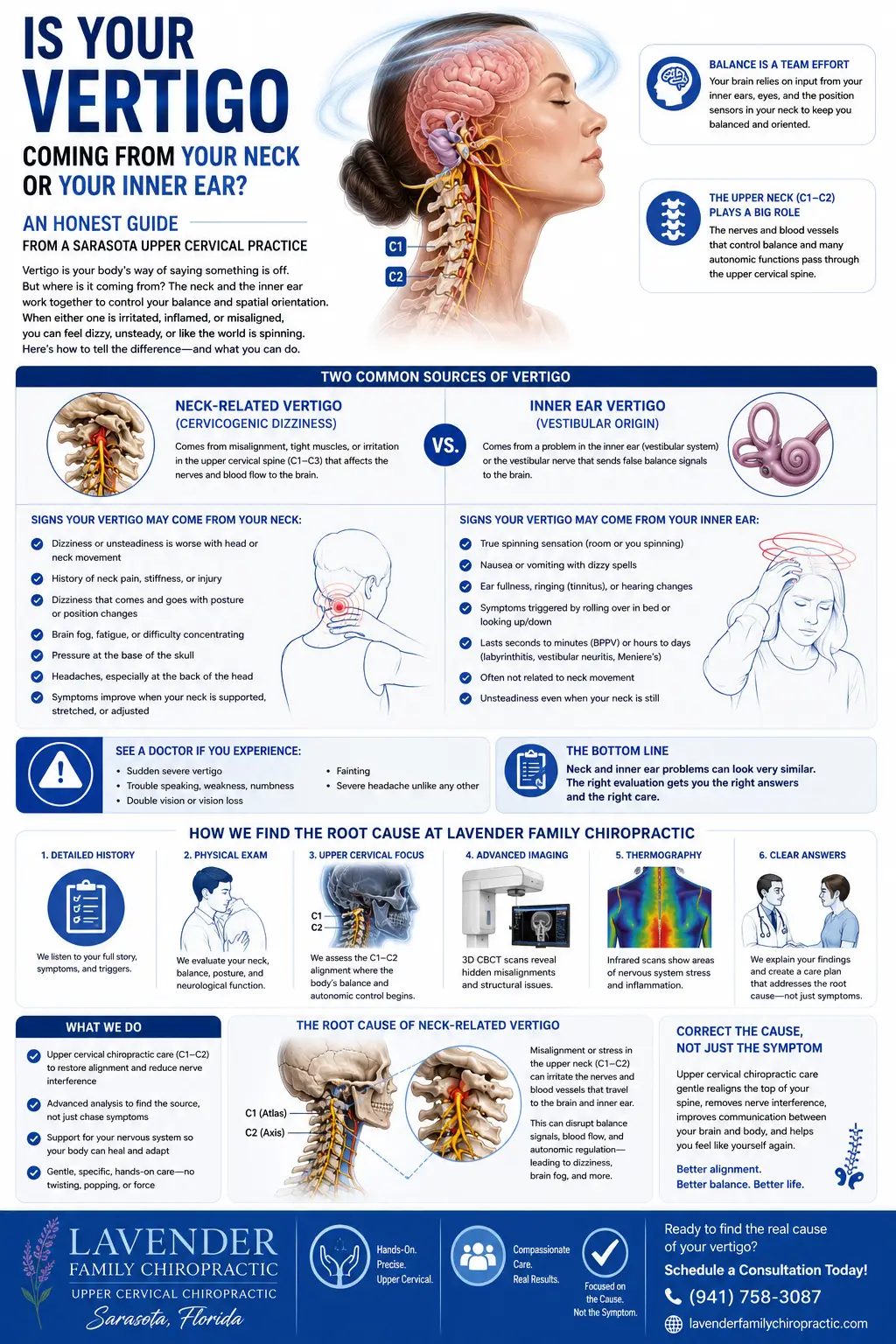
A third common route runs through the balance system. The inner ear, the visual system, and the position sensors in the upper neck all feed information into the brainstem so your brain can tell where your head is in space. When those signals disagree — a mismatch the brain interprets as something being wrong — the result is often dizziness, and dizziness and nausea are close neighbors. Anyone who has felt seasick knows how quickly a spinning or unsteady sensation turns into a queasy stomach.
This is why some people with upper neck problems report not only pain but also a swimming, off-balance, or lightheaded feeling that shades into nausea. We discuss this in depth in our article on whether neck pain can cause dizziness. The upper neck is rich with position sensors, and when its movement is restricted or its input is distorted, the brainstem can receive a confusing picture that contributes to both unsteadiness and nausea.
Autonomic involvement
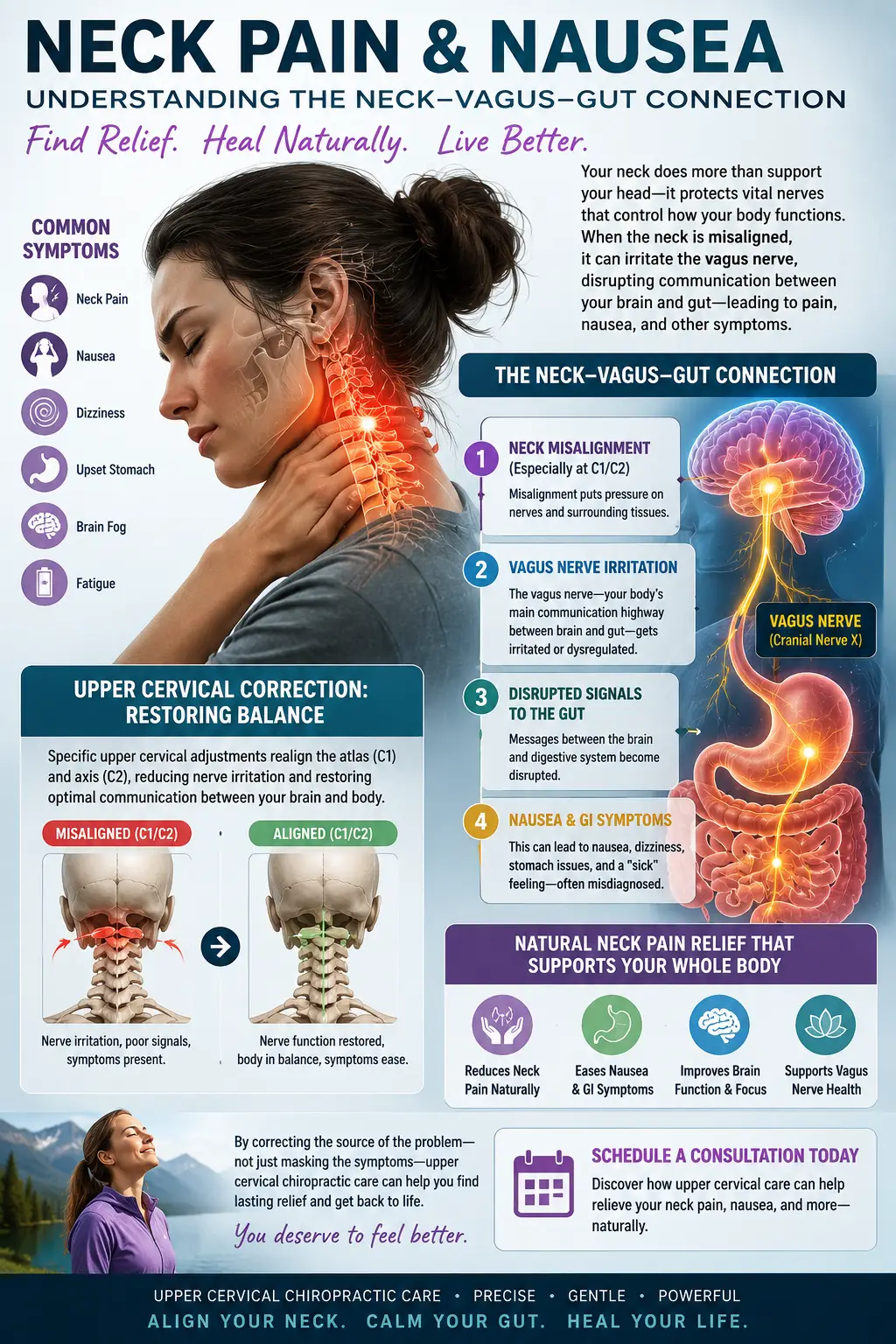
Finally, there is the autonomic nervous system — the automatic control network that runs your heart rate, digestion, blood pressure, and the queasy-or-calm status of your gut. The upper neck and the brainstem sit right at the crossroads of this system, and the vagus nerve, the body’s single most important parasympathetic nerve, emerges from the brainstem and travels down through the neck to the gut. When we talk about the neck-vagus-gut connection, this is the anatomy we mean. It helps explain why an irritated upper neck and a churning stomach can feel connected: they may share more nervous-system real estate than most people realize.
The Mechanisms: The Trigeminocervical Complex, the Vestibular System, and the Vagus Nerve
To understand why the neck and nausea talk to each other, it helps to look at three overlapping systems in the brainstem and upper spinal cord. They are not separate, sealed-off circuits. They converge, share neurons, and influence one another constantly.
The trigeminocervical complex
At the top of the spinal cord and the base of the brainstem, sensory nerves from the face (the trigeminal nerve) and sensory nerves from the upper neck (the upper cervical nerves, C1 through roughly C3) feed into the same pool of second-order neurons. This shared region is known as the trigeminocervical complex or trigeminocervical nucleus. Because face and neck inputs land on the same neurons, the brain can have trouble telling exactly where a signal came from. Pain arising in the upper neck can therefore be felt in the head, behind the eye, or across the temple — the phenomenon at the heart of cervicogenic headache and a major reason neck problems produce head symptoms.
A 2025 scoping review of the trigeminocervical nucleus examined exactly this convergence, tracing how nociceptive (pain) activity from the orofacial region, the cranium, and the cervical spine is integrated at this shared relay and mapping the clinical implications for headache and neck pain. The takeaway is that the neck and head pain systems are not neighbors who occasionally chat; they are more like roommates sharing the same wiring. That anatomical reality is the foundation for why upper cervical input can shape headache, and why headache so often drags nausea along with it. You can read about how we approach this region clinically on our upper cervical chiropractic care page.
The brainstem nuclei that generate nausea
Nausea itself is generated in the brainstem, in a network sometimes loosely called the “vomiting center,” which includes regions of the medulla such as the nucleus tractus solitarius and the area postrema, along with nearby autonomic and vestibular nuclei. These sit remarkably close to where the trigeminocervical complex and the vestibular pathways converge. Signals that ramp up activity in these areas — whether from the gut, the inner ear, the bloodstream, or descending brain circuits — can tip you into feeling sick.
This proximity matters. A brainstem that is already busy processing a migraine, a cervicogenic headache, or a barrage of confusing balance signals from an irritated upper neck is a brainstem in which the nausea circuitry can be more easily switched on. A brain-imaging study using PET scanning looked at exactly where nausea comes from during migraine and found that nausea could appear early in an attack, before the headache pain peaked, and was associated with increased activity in brainstem regions rather than being a simple consequence of severe pain. In other words, nausea in migraine is not just “the pain made me sick.” It is generated by brainstem circuitry that can activate on its own timeline — the same neighborhood the upper neck feeds into.
The vestibular system
The vestibular system, your inner-ear balance apparatus, has direct connections to these same brainstem nausea centers. That connection is ancient and protective: historically, the sudden nausea from a spinning world helped the body respond to toxins and disorientation. Today it explains motion sickness, vertigo, and the queasiness that accompanies many balance disturbances. A widely cited review described vestibular migraine as the most frequent cause of recurrent spontaneous vertigo, underscoring how tightly the migraine machinery and the balance-and-nausea machinery are linked. When the vestibular system is provoked — including by mismatched signals from the neck — nausea is a common traveling companion.
The vagus nerve, vagal tone, and the gut-brain axis
Now the third system, and the one that gives this article its name. The vagus nerve is the tenth cranial nerve, and it is the longest and most far-reaching nerve of the parasympathetic “rest and digest” system. It originates in the brainstem — right in the same medullary neighborhood as the nausea and autonomic nuclei — and travels down through the neck alongside the major vessels to reach the heart, lungs, stomach, and intestines. It is the main information highway of the gut-brain axis, carrying signals in both directions between the digestive tract and the brain.
A frequently cited 2018 review described the vagus nerve as a key modulator of the brain-gut axis, detailing how vagal tone influences inflammation, mood, digestion, and the two-way communication between the gut and the central nervous system. “Vagal tone” refers to how active and well-regulated this parasympathetic system is. Higher, healthier vagal tone is associated with steadier digestion and a calmer autonomic state; low or dysregulated vagal tone is associated with the opposite, including gut symptoms and a nervous system stuck in a more stressed, sympathetic-dominant mode.
Here is where the systems tie together. The vagus nerve emerges from and is influenced by the same brainstem region that processes upper cervical input, houses the nausea centers, and receives vestibular signals. It is anatomically plausible, and consistent with the shared circuitry described above, that a chronically irritated upper neck contributes to a nervous system tilted toward the stressed, sympathetic side — which can, in turn, be felt in the gut as queasiness or unsettled digestion. We want to be careful and honest here: this is a mechanistic, plausibility-based picture rather than a claim that adjusting the neck directly controls the vagus nerve. But the anatomy is real, the convergence is documented, and it helps explain why so many people intuitively feel that their neck and their stomach are connected.
Why the Upper Neck (Atlas/Axis, C1/C2) Is Central
If the neck-and-nausea story has a headquarters, it is the top two bones of the spine: the atlas (C1) and the axis (C2). These two vertebrae are unlike any others in the spine, and their special anatomy places them at the center of everything we have described.
Closest to the brainstem
The atlas is the very top vertebra, the ring of bone that the skull rests upon. Its central opening surrounds the point where the brainstem transitions into the spinal cord. No other spinal segment sits this close to the brainstem nuclei that govern nausea, autonomic function, and the origin of the vagus nerve. Because of this proximity, the mechanical health and positioning of the upper neck has a uniquely intimate relationship with the region of the nervous system most involved in the symptoms we are discussing.
A ligament-dependent, highly mobile joint
The atlas is remarkable for what it lacks: unlike the vertebrae lower down, C1 has no disc above it and no interlocking bony joints of the usual kind holding it to the skull. Instead, the head-atlas and atlas-axis junctions rely heavily on ligaments and finely tuned muscles for stability and control. This makes the region extraordinarily mobile — and also more dependent on balanced, well-coordinated input to hold its position well. When that balance is disturbed, the effects can ripple into the pain, balance, and autonomic systems clustered nearby.
The rotation engine of the neck
The atlas-axis joint (C1-C2) is the great swivel of the spine. Roughly half of your neck’s total rotation — turning your head to look over your shoulder — happens at this single joint, with commonly cited figures around 50 percent or more. This is why the upper neck endures so much mechanical demand every day, and why restriction or irritation here is so readily felt as stiffness, headache at the base of the skull, and the accompanying symptoms. Many patients describe exactly this as a deep pressure at the top of the neck; our article on pressure at the base of the skull explores that sensation in detail.
Suboccipital proprioception and the vestibular system
The small muscles at the base of the skull, called the suboccipital muscles, are among the most densely packed with proprioceptors — position sensors — of any muscles in the body. Their job is to constantly report the exact position of the head relative to the neck, and this information is fed directly into the vestibular and balance networks in the brainstem. This is the physical basis for the neck’s contribution to balance and dizziness. When the upper neck is restricted, tense, or sending distorted signals, the brainstem receives a proprioceptive report that conflicts with what the inner ear and eyes are saying. That sensory mismatch is a recognized route to dizziness — and, through dizziness, to nausea.
Put it all together and the upper cervical spine is central for four reinforcing reasons: it sits closest to the brainstem nausea and vagal centers, it is uniquely ligament-dependent and mobile, it carries the lion’s share of neck rotation, and it is packed with the position sensors that feed the balance system. It is precisely the region where a mechanical problem can most plausibly touch the pain, balance, and autonomic circuits involved in nausea. That is why our care is focused here.
How Upper Cervical Care Works at Lavender Family Chiropractic
Our approach at Lavender Family Chiropractic is built around precision, gentleness, and a careful understanding of the individual in front of us. We are an upper-cervical-focused practice in Sarasota, and our process is designed to evaluate the region we have just described with objectivity rather than guesswork.
The consultation and history
Everything begins with a thorough consultation. We listen to your full story: when the neck pain and nausea began, what makes them better or worse, any history of head or neck trauma, your headache and dizziness patterns, and your general health. A large part of this first conversation is screening. As emphasized earlier, we are actively looking for the red flags that would send you to a physician or emergency department instead of into our care. Being intellectually honest about what chiropractic can and cannot help with is a core value of this office, not an afterthought.
3D CBCT imaging
When imaging is appropriate, we use 3D CBCT imaging — cone beam computed tomography — to see the upper cervical anatomy in three dimensions. The atlas and axis are complex, individually variable structures, and a flat two-dimensional image cannot capture their true orientation. Three-dimensional imaging lets us understand your specific anatomy and alignment so that any care is tailored precisely to you rather than to a generic template. This is one of the ways we replace assumption with measurement.
Tytron paraspinal infrared thermography
We also use Tytron paraspinal infrared thermography, a non-invasive scan that reads the temperature patterns alongside the spine. Because skin temperature is influenced by the autonomic nervous system, these scans give us an objective, repeatable window into how your nervous system is functioning over time. Given how much of this article concerns the autonomic side of things — vagal tone, digestion, the stress balance of the nervous system — thermography is a particularly fitting tool. It helps us track patterns of change rather than relying only on how you say you feel from day to day.
The Knee Chest Upper Cervical technique
Our primary method is the Knee Chest Upper Cervical technique. This is a low-force, specific approach to the upper neck. There is no twisting of the neck, no forceful cracking, and no popping. Instead, a precise, gentle contact is used to encourage the atlas and axis toward a healthier relationship, based on your individual imaging and examination findings. For people whose neck pain and nausea make them understandably wary of aggressive manipulation, the gentleness of this technique is often a relief. It is designed to work with your body, not to overpower it.
Customized care plans
Finally, we do not treat two people the same way, and we do not sell care one disconnected visit at a time. After your evaluation, we build a customized care plan tailored to your findings, your goals, and how your body responds. Care is structured and thoughtful, with clear reasoning behind the recommended course. The aim is natural neck pain relief and support for a better-regulated nervous system over time, approached as a plan rather than as a series of random appointments.
Take the Next Step Toward Natural Neck Pain Relief
If neck pain and nausea have been shadowing you and serious causes have been considered, we would be glad to evaluate whether your upper cervical spine is part of the picture. Call Lavender Family Chiropractic at (941) 243-3729 to talk with our team, or request an appointment directly through our new patient scheduling page. Our office is located at 5899 Whitfield Avenue, Suite 107, Sarasota, FL 34243, right at the corner of University and Whitfield, and we welcome patients from across the Sarasota and Bradenton region.
What the Research Says
We believe in being straightforward about evidence. The studies below are real, peer-reviewed, and openly accessible. None of them prove that upper cervical chiropractic treats nausea, and we do not claim they do. What they establish is the anatomy and physiology behind the neck-and-nausea connection — the shared brainstem circuitry, the migraine-nausea mechanisms, the vestibular contributions, and the vagus-gut relationship — which is exactly the foundation our approach is built on.
- A 2025 scoping review, Integration of nociceptive activity from orofacial, cranial and cervical regions in the trigeminocervical nucleus, synthesizes how pain signals from the face, head, and upper neck converge on a shared set of neurons, providing the anatomical basis for why neck problems produce head symptoms and vice versa.
- A 2025 systematic review and meta-analysis, Prevalence and relative frequency of cervicogenic headache in population- and clinic-based studies, published in Cephalalgia, examined how often cervicogenic headache — head pain that arises from structures in the neck — actually occurs. Reported estimates ranged widely (from under 1% to as high as 42% depending on the population studied), underscoring that headaches genuinely driven by the neck are a recognized clinical entity, even though they are often under-recognized.
- A brain-imaging study, The origin of nausea in migraine — a PET study, found that nausea can appear early in a migraine attack and is linked to activity in brainstem regions rather than being a mere byproduct of severe head pain, locating nausea in the same brainstem circuitry the upper neck feeds into.
- A widely cited review, Vestibular migraine: the most frequent entity of episodic vertigo, describes how the migraine and balance systems overlap to produce recurrent vertigo, illustrating the tight link between vestibular disturbance, dizziness, and the nausea that so often accompanies them.
- A 2018 review, Vagus Nerve as Modulator of the Brain-Gut Axis in Psychiatric and Inflammatory Disorders, details how the vagus nerve and vagal tone govern two-way communication between the gut and brain, providing the physiological framework for the neck-vagus-gut connection discussed throughout this article.
Lifestyle Factors That Support a Calmer Neck and Gut
Care in our office is only part of the picture. Day-to-day habits shape both your neck and the autonomic balance that influences nausea. None of these are magic, but they are sensible, low-risk supports that may help you feel steadier.
Hydration. Dehydration is a well-known trigger for headaches and can worsen dizziness and nausea. It also affects the fluid balance your inner ear depends on. Sipping water consistently through the day, rather than gulping large amounts occasionally, is a simple foundation.
Sleep. The upper neck spends roughly a third of your life supported — or unsupported — by your pillow and sleep position. Poor sleep also lowers your threshold for both headache and nausea. A supportive pillow that keeps the neck in a neutral position, and a consistent sleep schedule, both help the nervous system reset. Sleep is when much of the body’s parasympathetic, restorative activity happens.
Stress and vagal tone. Because the vagus nerve is the anchor of the “rest and digest” system, practices that raise vagal tone are directly relevant to the gut-brain axis. Slow, extended-exhale breathing, gentle movement, time outdoors, and genuine downtime all nudge the nervous system toward its calmer, parasympathetic side. Chronic stress does the opposite, keeping you in a sympathetic-dominant state that many people feel in their stomach. Managing stress is not a soft add-on here; it is central to the very mechanism this article describes.
Screen posture. The modern “tech neck” posture — head jutted forward over a phone or laptop for hours — loads the upper neck and suboccipital muscles heavily, feeding exactly the region that influences balance and headache. Raising screens toward eye level, taking frequent movement breaks, and resetting your posture through the day all reduce that steady strain. Our broader guide to neck pain covers posture and daily habits in more depth.
Taken together, these habits support the same nervous-system balance that upper cervical care is designed to encourage. They work best alongside a proper evaluation, not as a substitute for one, especially if your symptoms are persistent or severe.
Serving Sarasota and Surrounding Communities
Lavender Family Chiropractic is proud to serve patients throughout Southwest Florida from our office at the corner of University and Whitfield. Whether you are searching for natural neck pain relief close to home or are willing to travel for upper cervical care, we welcome patients from Sarasota, Bradenton, Lakewood Ranch, Venice, Palmer Ranch, Osprey, Siesta Key, Longboat Key, Lido Key, University Park, Parrish, Ellenton, Myakka City, Punta Gorda, and St. Petersburg. Our central location near University Parkway makes us convenient for families across the greater Sarasota-Bradenton area, and our focus on gentle, specific upper cervical care draws people from well beyond the immediate neighborhood.
Top 15 Questions About Neck Pain and Nausea
1. Can neck pain really cause nausea? Neck pain and nausea can be connected through shared circuitry in the brainstem, where upper-neck sensory input, the balance system, and the nausea centers all converge. In benign, evaluated cases such as cervicogenic headache or migraine with prominent neck symptoms, this connection is genuine. It is not the only explanation, though, which is why evaluation matters.
2. When is neck pain with nausea an emergency? Seek immediate medical care — call 911 or go to the emergency department — if you have a sudden severe “thunderclap” headache, a stiff neck with fever and light sensitivity (possible meningitis), any stroke signs such as face drooping, arm weakness, slurred speech, sudden severe dizziness or vision changes, or neck pain and nausea after a head or neck injury. These require urgent evaluation, not a chiropractic visit.
3. What is the neck-vagus-gut connection? The vagus nerve arises from the brainstem — near the same region that processes upper-neck input and generates nausea — and travels down the neck to the gut, serving as the main highway of the gut-brain axis. This shared anatomy is why an irritated upper neck and an unsettled stomach can feel linked.
4. What is a cervicogenic headache? It is a headache that actually originates from structures in the neck, especially the upper cervical joints and nerves, but is felt in the head. Because neck and head pain share brainstem pathways, cervicogenic headaches can bring nausea, dizziness, and light sensitivity along with them.
5. Why is the upper neck (C1 and C2) so important? The atlas (C1) and axis (C2) sit closest to the brainstem, rely on ligaments rather than discs for stability, account for roughly half of your neck’s rotation, and are surrounded by dense position sensors that feed the balance system. This makes the upper neck uniquely connected to headache, dizziness, and nausea pathways.
6. Is the Knee Chest Upper Cervical technique gentle? Yes. The Knee Chest Upper Cervical technique is a low-force method with no twisting, cracking, or popping of the neck. It uses a precise, gentle contact guided by your imaging and examination, which many patients find reassuring, especially when nausea makes them wary of forceful approaches.
7. Do you use X-rays or scans? We use 3D CBCT imaging to see the upper cervical anatomy in three dimensions when appropriate, and Tytron paraspinal infrared thermography to assess autonomic patterns along the spine. Both give us objective information so your care is tailored to your specific anatomy and nervous system.
8. Can upper cervical care help my migraines with nausea? For some people with migraine that involves significant neck symptoms, addressing the upper cervical spine may help support the overall picture, because of the shared brainstem circuitry. We are honest that individual responses vary, and we do not promise specific outcomes. A proper evaluation is the starting point.
9. Is my dizziness coming from my neck? It might be contributing. The upper neck is packed with position sensors that feed the balance system, and restricted or distorted input can create a sensory mismatch that produces dizziness and, with it, nausea. Dizziness has many possible causes, so we evaluate carefully and refer when appropriate. Our article on whether neck pain can cause dizziness covers this in detail.
10. How long until I might notice a change? This varies widely from person to person depending on the underlying issue, how long it has been present, and individual healing. Rather than promise a timeline, we build a customized care plan and use objective measures such as thermography to track how your body is responding over time.
11. Do you take insurance? We are a cash-pay, out-of-network office and do not bill insurance directly. This lets us focus fully on your care rather than on insurance requirements. We provide superbills that you may submit to your insurance company for possible out-of-network reimbursement, depending on your individual plan.
12. How is your care structured? We offer customized care plans built around your specific evaluation, findings, and goals, so your care is structured and individualized rather than generic. We explain our recommendations up front so you always know what to expect.
13. What should I expect at my first appointment? A thorough consultation and history, careful screening for any red flags, and, when appropriate, 3D CBCT imaging and Tytron thermography. From there we discuss findings and, if upper cervical care is a good fit, outline a customized care plan. Screening for serious causes always comes first.
14. Can stress make neck pain and nausea worse? Yes. Chronic stress keeps the nervous system in a sympathetic-dominant state, which many people feel as muscle tension in the neck and queasiness in the gut. Supporting healthy vagal tone through breathing, movement, sleep, and downtime is directly relevant to the gut-brain axis we describe in this article.
15. Where are you located and how do I book? We are at 5899 Whitfield Avenue, Suite 107, Sarasota, FL 34243, at the corner of University and Whitfield. You can call (941) 243-3729 or book online through our new patient scheduling page. We serve Sarasota, Bradenton, Lakewood Ranch, Venice, and the surrounding communities.
Ready When You Are
Neck pain paired with nausea deserves to be taken seriously — first by ruling out the red flags that call for urgent medical care, and then, for benign and evaluated cases, by looking closely at the upper cervical spine where so much of the relevant anatomy converges. At Lavender Family Chiropractic, Dr. Rusty Lavender and Dr. Jacob Temple offer a gentle, precise, and honest approach built on 3D CBCT imaging, Tytron thermography, the low-force Knee Chest Upper Cervical technique, and customized care plans designed around you.
If you are ready to explore natural neck pain relief and support for a better-regulated nervous system, call us at (941) 243-3729 or request your appointment online. You will find us at 5899 Whitfield Avenue, Suite 107, Sarasota, FL 34243, at the corner of University and Whitfield. We look forward to meeting you.