Trigeminal Neuralgia Triggers and How to Manage Flare-Ups: A Practical Guide for Sarasota Patients
By Dr. Rusty Lavender — Lavender Family Chiropractic, Sarasota, FL
Trigeminal Neuralgia Triggers: If you live with trigeminal neuralgia, you already know that the everyday world can feel like a minefield. A gust of wind on the drive to work, a sip of iced tea, the simple act of brushing your teeth, or even a stray word spoken to a friend can set off a jolt of electric, stabbing pain across your cheek, jaw, or forehead. For many people, the unpredictability is as difficult as the pain itself. When something as ordinary as talking or a light breeze can spark an attack, it is understandable to start avoiding meals, conversations, and time outdoors just to feel safe.
At Lavender Family Chiropractic in Sarasota, we work with people whose lives have been reshaped by facial pain, and one theme comes up again and again: understanding your triggers changes the game. You cannot always control when an attack arrives, but you can learn what tends to precede one, adjust your daily habits to reduce your exposure to those triggers, and build a personal plan that helps you feel less at the mercy of your own face. This is supportive self-care — not a replacement for medical treatment — and it can make a meaningful difference in how you move through your day.
This guide is written to help you understand why trigeminal neuralgia has such distinctive triggers, what those triggers usually are, and the practical strategies you can use to reduce flare-ups. We will also explain the connection between the upper neck and the trigeminal system, and how the precise, low-force upper cervical care we provide at our practice may fit into a coordinated, whole-person approach. Before we go further, a clear and honest note: trigeminal neuralgia is a serious neurological condition. The information here is meant to support your day-to-day management, and it does not replace diagnosis or treatment from your physician or neurologist. If you have new, undiagnosed, or changing facial pain, please seek a medical evaluation. Never stop or change a prescribed medication based on a blog article.
Trigeminal Neuralgia Triggers: Understanding Trigger Zones and Why Light Touch Sets Off Attacks
One of the strangest and most frustrating features of trigeminal neuralgia is that the triggers are almost never what you would expect. Most painful conditions are aggravated by strong, obvious insults — a hard bump, a deep pressure, extreme heat. Trigeminal neuralgia turns that logic upside down. Here, the pain is frequently set off by the gentlest of stimuli: a feather-light touch to the cheek, a cool breeze, the vibration of your own voice. This paradox has a name in pain medicine. When a stimulus that should not hurt at all produces severe pain, clinicians call it allodynia, and in trigeminal neuralgia it often centers on specific, small areas of the face known as trigger zones.
Trigger zones are typically located around the mouth, nose, and cheeks — the perioral and nasal regions of the face. They can be remarkably small, sometimes no larger than a fingertip, and their location can vary from person to person and even shift over time. The unsettling part is that these zones are not tender in the way a bruise is tender. Instead, a very light, non-painful contact — the kind of touch that would not register on the rest of your body — is what provokes the sudden, shock-like pain. This is why so many people with trigeminal neuralgia describe the sensation of being “booby-trapped” by their own face.
To understand why this happens, it helps to know a little about the trigeminal nerve itself. The trigeminal nerve is the fifth cranial nerve, and it is the main sensory highway for the face. It has three branches: the ophthalmic branch, which serves the forehead and around the eye; the maxillary branch, which serves the cheek, upper jaw, and upper teeth; and the mandibular branch, which serves the lower jaw, lower teeth, and part of the ear region. Together these branches carry an enormous amount of sensory information from the face into the brainstem. In classical trigeminal neuralgia, researchers believe that a blood vessel or another structure compresses the nerve where it exits the brainstem, gradually wearing away the protective myelin sheath that insulates the nerve fibers.
When that insulation is damaged, the electrical signals traveling along the nerve can effectively “short circuit.” Signals meant to carry harmless information about light touch can cross over and ignite the fibers that carry pain messages. The result is that a gentle, ordinary sensation — a breeze, a shave, a spoken word — gets misread by the nervous system as an intense, stabbing pain. This crossed-wiring model helps explain the two signature features of the condition: the attacks are brief and electric, and they are set off by the smallest of triggers rather than by anything genuinely damaging. Understanding this can be oddly reassuring. The pain is real and severe, but the trigger that caused it is not actually harming your face. Your nervous system is misinterpreting a safe signal.
This also explains why avoiding triggers is such a central part of daily management. Because the trigger zones respond to light touch and everyday movement, much of managing trigeminal neuralgia comes down to reducing how often those zones are stimulated, and doing so in thoughtful, sustainable ways that still let you eat, speak, and care for yourself. In the sections that follow, we will map out the most common triggers and then turn to concrete strategies for reducing flare-ups.
Common Trigeminal Neuralgia Triggers
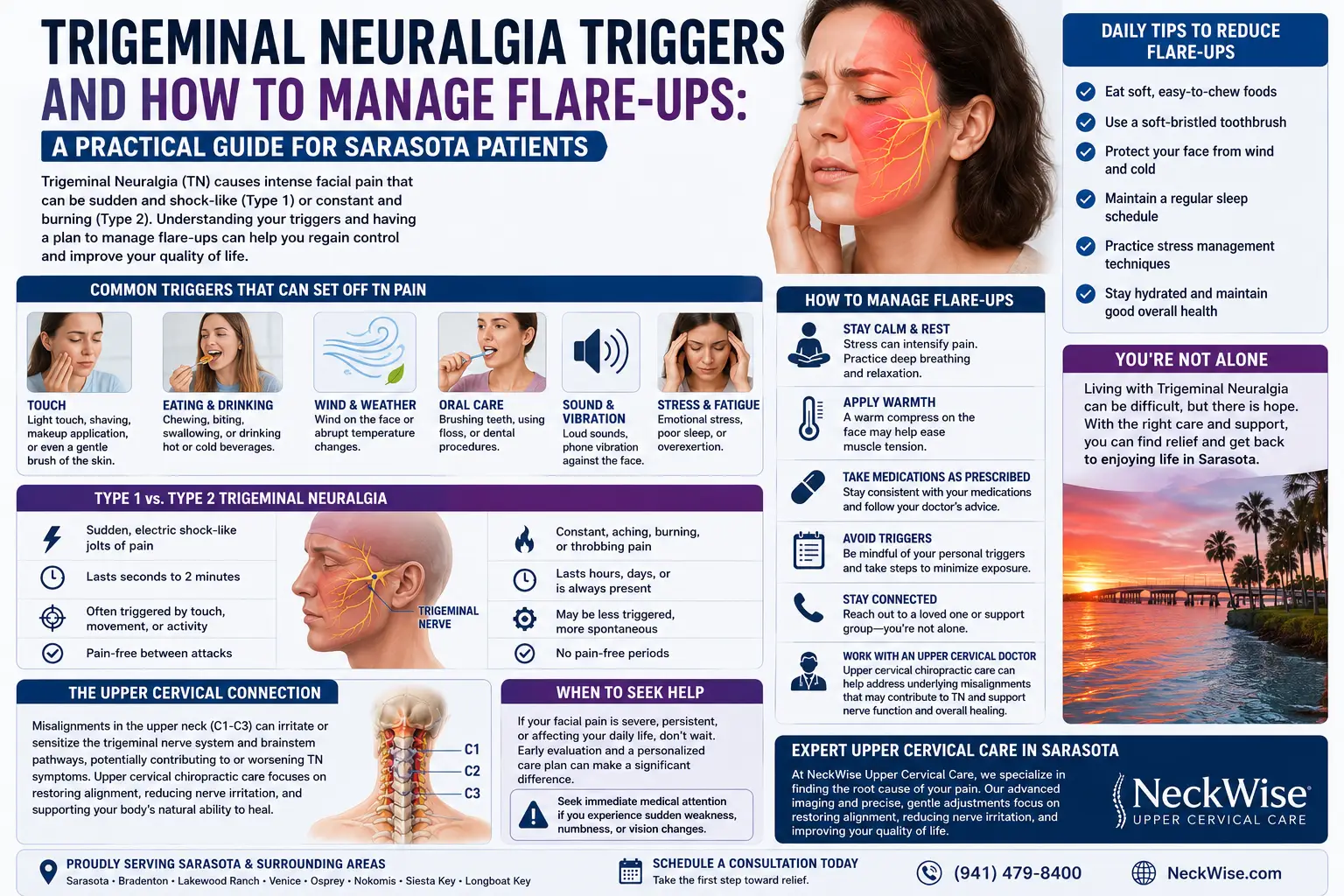
Although every person’s experience is unique, research and clinical experience have identified a fairly consistent set of triggers that provoke attacks in the majority of people with trigeminal neuralgia. Knowing this list is the first step toward building awareness of your own personal pattern. As you read, keep in mind that you may be highly sensitive to some of these and largely unaffected by others.
Light touch to the face. This is the single most common trigger. A gentle brush of the cheek, resting your face on a pillow, a partner’s kiss, or the fabric of a scarf grazing your skin can be enough. Because the trigger is light touch rather than firm pressure, it often catches people off guard.
Talking and facial movement. Speaking involves constant movement of the jaw, lips, and cheeks, and it also creates vibration through the facial tissues. For many people, extended conversations, phone calls, or public speaking are significant triggers. Laughing and smiling can do the same.
Chewing and eating. The mechanical work of chewing, combined with the movement of the jaw and the contact of food against the inside of the mouth, makes eating one of the most feared activities for people with trigeminal neuralgia. Some people begin to dread meals or unintentionally lose weight because eating has become associated with pain.
Brushing teeth and oral care. Toothbrushing combines several triggers at once: touch, vibration, movement, and often cold water. It is one of the most frequently reported daily triggers, and it can make maintaining oral hygiene genuinely stressful.
Shaving and washing the face. For men especially, shaving is a classic trigger because it involves dragging a razor across the trigger zones around the mouth and jaw. Washing the face, applying makeup, or drying with a towel can provoke attacks for the same reason.
Cold air, wind, and drafts. Moving air across the face is a well-documented trigger. A breeze outdoors, wind while walking or biking, the blast of air conditioning, or the draft from a car window can all set off pain. In our Sarasota climate, the sudden chill of stepping from a hot parking lot into a heavily air-conditioned store is a very real-world example.
Cold drinks and temperature changes. Cold beverages, ice water, and cold foods are common triggers, and so are abrupt changes in temperature. Some people also react to hot foods and drinks. The shift itself — moving from warm to cold or cold to warm — can matter as much as the temperature itself.
Vibration. Beyond talking and brushing, other sources of vibration can be triggers. This includes riding in a car over bumpy roads, certain household appliances, or even the vibration of your own footsteps for some highly sensitive individuals.
Research supports how central these triggers are to the condition. In one study of people with trigeminal neuralgia, triggers provoked attacks in the overwhelming majority of patients, with gentle touching of the face and talking standing out as the most common provocations, and the trigger zones clustered around the mouth and nose. Other research has documented “atypical” triggers as well, including weather-related triggers such as strong wind and cold, along with food-related triggers such as hard, hot, cold, or spicy foods — suggesting that certain sensory nerve fibers play a role in these less obvious provocations. We will link to this research later in the article.
The practical takeaway is that triggers are not random. They follow patterns tied to touch, movement, vibration, and temperature. Once you can name your triggers, you can begin to work around them.
Practical Strategies to Reduce Flare-Ups
Managing trigeminal neuralgia day to day is largely about reducing how often your trigger zones are stimulated, while still living a full life. None of these strategies replace your medical care, and they will not work identically for everyone. Think of them as a toolkit — try what makes sense for you, keep what helps, and discard what does not. The goal is fewer, less intense flare-ups and a greater sense of control.
Protect your face from wind and cold. Since moving air and cold are frequent triggers, a physical barrier can help. A soft scarf worn loosely over the lower face outdoors, especially on breezy or cooler days, can buffer the wind. In the car, adjust the vents so air conditioning does not blow directly on your face, and consider cracking a window on the opposite side rather than driving with wind streaming across your cheek. When moving between the Florida heat and a strongly air-conditioned building, give yourself a moment in a transition space if you can, so the temperature change is less abrupt. A wide-brimmed hat can also help shield the face on windy days.
Choose soft, room-temperature foods. During a flare period, favor foods that require minimal chewing and are neither very hot nor very cold. Soups at a lukewarm temperature, smoothies (not ice-cold), scrambled eggs, mashed vegetables, yogurt, and other soft options reduce both the mechanical work of chewing and the temperature shock that can trigger pain. Cutting food into small pieces and chewing on the less-affected side of your mouth can also reduce provocation. If eating has become a source of dread, working with a registered dietitian can help you maintain good nutrition without setting off attacks.
Adapt your oral care. Because toothbrushing is such a common trigger, small adaptations can make a real difference. Try a very soft-bristled or extra-soft toothbrush, use lukewarm rather than cold water, and consider a toothpaste for sensitive teeth. Some people find that brushing gently and slowly, or timing oral care for periods of the day when their pain is typically lower, reduces flare-ups. Do not skip oral hygiene altogether — dental problems can create their own pain and complications — but do talk with your dentist about a routine that works with your condition rather than against it.
Manage stress and prioritize sleep. Stress and fatigue do not cause trigeminal neuralgia, but many people notice that their pain feels more reactive and their triggers more easily set off when they are exhausted or under strain. Building in stress-reduction practices — gentle breathing exercises, time outdoors, prayer or meditation, light activity you enjoy — can support your overall resilience. Protecting your sleep is equally important. A consistent sleep schedule, a comfortable pillow arrangement that keeps pressure off your trigger zones, and a wind-down routine can all help. The link between poor sleep, elevated stress, and heightened pain sensitivity is well recognized across many pain conditions.
Keep a trigger journal. Perhaps the most powerful tool of all is a simple record. For a few weeks, jot down when attacks occur, what you were doing in the moments before, what you had eaten, the weather, your stress and sleep, and how intense the pain was. Over time, patterns emerge that are difficult to see in the moment. You may discover that your worst days follow poor sleep, or that a particular food or a specific weather pattern reliably precedes flares. This information is valuable not only for your own planning but also for your conversations with your physician and neurologist, who can use it to fine-tune your care. A journal turns a chaotic, unpredictable condition into something you can begin to anticipate and manage.
Taken together, these strategies share a common thread: they reduce unnecessary stimulation of a hypersensitive nerve while helping you keep living your life. They are supportive measures, and they work best alongside — never instead of — the medical treatment your doctor has prescribed.
The Trigeminocervical Connection: How the Upper Neck and Posture Can Add to the Load
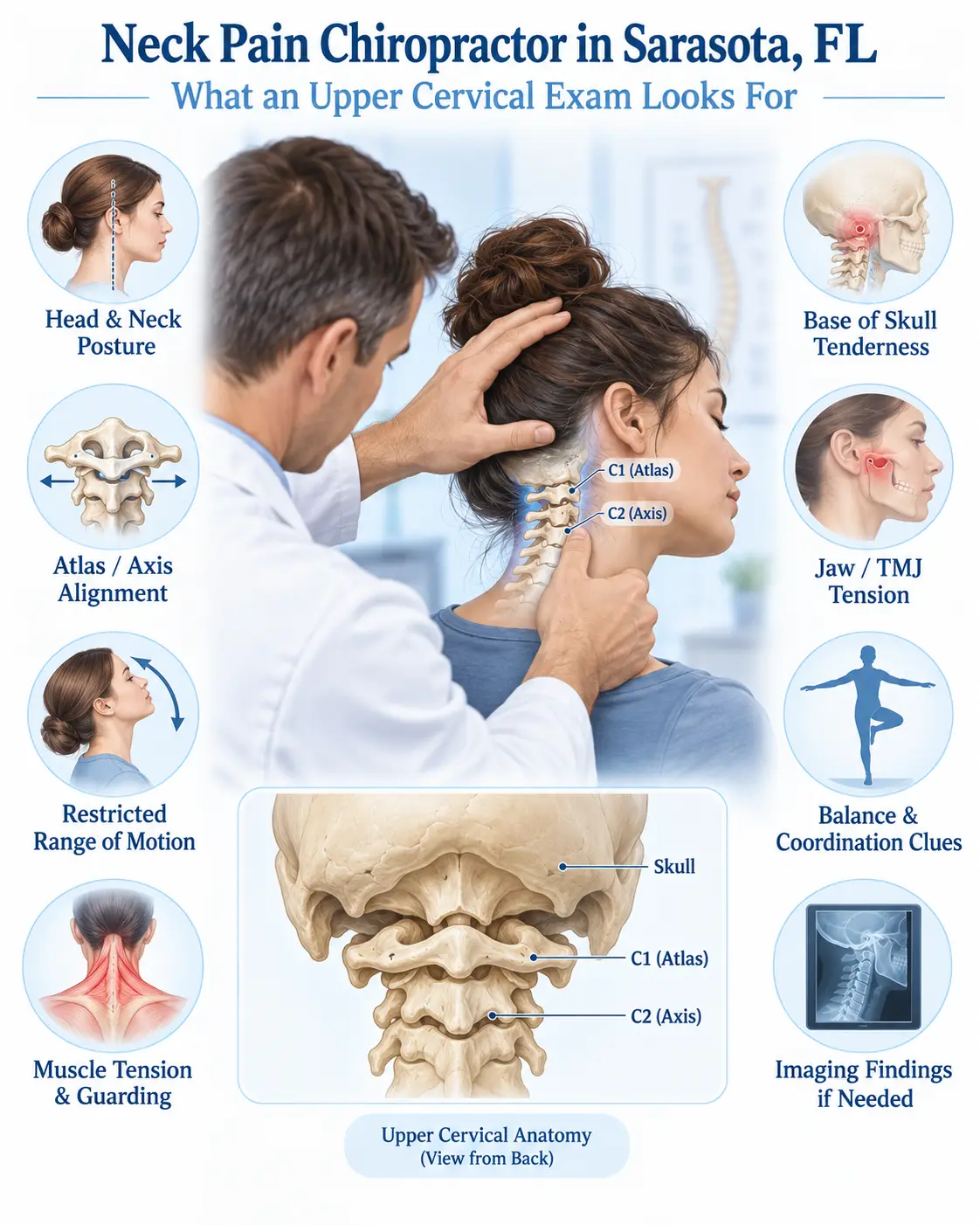
Many people are surprised to learn that the face and the upper neck are neurologically intertwined. Yet this connection is well established in the medical literature, and it helps explain why some people with facial pain also carry tension, stiffness, or discomfort in the neck and the base of the skull — and why the two regions can influence one another.
The key to this relationship lies in a structure in the brainstem and upper spinal cord called the trigeminocervical nucleus, sometimes described as the trigeminocervical complex. This is a shared processing area where sensory nerve signals from the face — carried by the trigeminal nerve — converge and mingle with sensory signals coming from the upper neck, specifically from the first few cervical nerves. In other words, the brainstem does not keep facial input and upper-neck input in completely separate lanes. They overlap. A scoping review of dozens of studies on this topic concluded that nociceptive input from the orofacial, cranial, and cervical regions integrates within the trigeminocervical nucleus, which helps explain how pain can be referred and can spread between the head, face, and neck.
For someone with trigeminal neuralgia, this convergence has a practical implication. Sustained tension, irritation, or dysfunction in the upper neck may add to the overall sensory load reaching that shared processing area. It does not cause trigeminal neuralgia, and it is not the underlying source of the classic electric-shock pain, which relates to the trigeminal nerve itself. But because the neck and the face share neurological real estate, upper-neck strain can act as an aggravating factor — one more input feeding into an already sensitized system. Reducing that additional load is a reasonable, supportive goal.
Posture plays a role here as well. Consider how many of us spend our days: heads tipped forward over phones, tablets, and computers, shoulders rounded, the weight of the head shifting forward of the spine. This “forward head posture” places ongoing mechanical demand on the muscles and joints of the upper neck, particularly at the junction between the skull and the top of the cervical spine. Over months and years, that demand can contribute to muscle tension and joint irritation in exactly the region that shares neurological pathways with the face. For someone already coping with facial pain, poor upper-neck mechanics and chronic muscular tension can be one more factor stacking onto the system.
This is precisely why the upper neck is a region of interest in supportive care for facial pain. If the alignment and mechanics of the top of the cervical spine can be gently improved, and the tension in that area reduced, the theory is that the overall load on the trigeminocervical system may be eased. This is a supportive concept — a way of addressing one contributing factor among several — and it is important to be honest that it is not a cure and does not address the primary nerve compression that characterizes classical trigeminal neuralgia. You can learn more about how we approach the upper neck on our neck pain page, and about facial pain specifically on our facial pain and trigeminal neuralgia resource.
How Precise Upper Cervical Care Fits at Lavender
At Lavender Family Chiropractic, our focus is the upper cervical spine — the topmost segments of the neck where the skull meets the spine. This is a specialized area, and our approach is built around precision and gentleness rather than force. It is important to state clearly what our care is and is not. Our correction is a precise, low-force procedure. It is not the high-velocity twisting or “cracking” that many people picture when they imagine a chiropractic adjustment. We do not use forceful manipulation of the neck. Instead, we work to make a specific, measured, gentle correction based on careful analysis of your individual structure.
That analysis begins with imaging and measurement, because we do not believe in guessing. We use 3D CBCT imaging— cone beam computed tomography — to see the upper cervical spine in three dimensions. This detailed view allows us to understand the precise orientation of the top vertebrae relative to the skull, which is essential for planning a correction that is tailored to you rather than generic. We also use Tytron paraspinal infrared thermography, a non-contact scan that measures patterns of heat along the spine. Because temperature patterns can reflect activity in the nervous system, this technology helps us track how your body is responding over time and gives us objective information to guide your care rather than relying on how you happen to feel on a given day.
The correction itself uses the Knee Chest Upper Cervical technique. This is a precise, low-force method performed with you in a specific position that allows us to deliver a gentle, controlled correction to the upper cervical spine. The aim is to improve the alignment and mechanics of that critical junction between the head and neck — the same region that, as we discussed, shares neurological pathways with the trigeminal system. By working to reduce dysfunction and tension in the upper neck, our goal is to lessen one contributing factor that may be adding to the overall load your nervous system is managing. You can read more about our overall philosophy on our upper cervical chiropractic care page.
Every person we see receives a customized care plan built around their individual imaging, thermography, history, and goals. We do not use one-size-fits-all protocols, because no two spines and no two nervous systems are identical. Your plan is designed for you.
Now for the most important honesty of all. Upper cervical care does not cure trigeminal neuralgia. It is not a treatment for the underlying nerve compression, and it is not a substitute for the medical care you need. Trigeminal neuralgia is a serious neurological condition that is typically managed medically with anticonvulsant medications such as carbamazepine or oxcarbazepine, and sometimes with surgical procedures — decisions that belong with your physician and neurologist. What our care can offer is a supportive, coordinated role: addressing upper-neck mechanics and tension that may be adding to your sensory load, while you continue your medical treatment. We view ourselves as one part of a team working alongside your doctors, not as a replacement for them. If facial pain is new or has not been diagnosed, the first step is always a medical evaluation, not a trip to our office.
Ready to Talk About Your Facial Pain?
If you are living with trigeminal neuralgia in the Sarasota area and want to understand whether precise, low-force upper cervical care might fit into your broader plan, we would be glad to talk with you. Call Lavender Family Chiropractic at (941) 243-3729 to ask questions or schedule a consultation. You can also book directly through our new patient scheduling page. Our office is located at 5899 Whitfield Avenue, Suite 107, Sarasota, FL 34243, right at the corner of University and Whitfield, convenient to Sarasota, Bradenton, and Lakewood Ranch. There is no pressure — just an honest conversation about your situation and whether we may be able to help support your care.
What the Research Says
We believe in being transparent about the evidence, including where it supports a supportive role and where it does not. Here are five peer-reviewed sources that inform the discussion above. We encourage you to read them and to discuss them with your physician.
- Bendtsen L, et al. European Academy of Neurology guideline on trigeminal neuralgia. European Journal of Neurology, 2019. This clinical practice guideline recommends MRI in the diagnostic work-up, classifies trigeminal neuralgia into classical, idiopathic, and secondary forms, and outlines management — with carbamazepine or oxcarbazepine as first-line medications, options for acute exacerbations, and microvascular decompression as a first-line surgical option in classical trigeminal neuralgia when medication fails or is poorly tolerated.
- Di Stefano G, et al. Triggering trigeminal neuralgia. Cephalalgia, 2018. In a study of 140 patients, triggers provoked paroxysmal pain in 97% of them, most often gentle touching of the face and talking, with trigger zones concentrated in the perioral and nasal regions — confirming that triggered attacks are a hallmark diagnostic feature of trigeminal neuralgia.
- Koh W, Lim H, Chen X. Atypical triggers in trigeminal neuralgia: the role of A-delta sensory afferents in food and weather triggers. Korean Journal of Pain, 2021. Among 60 patients, atypical triggers were common beyond the usual light touch — weather triggers such as strong wind and cold affected about one in five, and food triggers such as hard, hot, cold, or spicy foods affected about one in four — with the authors proposing a shared sensory nerve-fiber pathway.
- Pankrath F, et al. Integration of nociceptive activity from orofacial, cranial and cervical regions in the trigeminocervical nucleus: a scoping review with clinical implications. Journal of Oral & Facial Pain and Headache, 2025. This scoping review of 83 studies found that pain signals from the orofacial, cranial, and cervical regions converge in the trigeminocervical nucleus, helping explain how pain can be referred and spread between the face, head, and neck.
- Global Incidence and Prevalence of Trigeminal Neuralgia, 1945–2024: A Systematic Review and Meta-Regression Analysis. Journal of Clinical Neurology, 2026. This systematic review and meta-regression documents substantial global variation in the incidence and prevalence of trigeminal neuralgia, with higher reported rates in the era after neuroimaging became widely available and a higher prevalence in females.
Building Your Personal Flare-Up Plan
Everything we have discussed comes together in a simple idea: a written, personalized plan gives you more control than trying to manage a complex condition from memory during a flare. Here is a framework you can adapt.
Start with your baseline. Write down your typical pain pattern — where it occurs, how often, how intense, and how long attacks last. Note your current medications and the name and contact information of your prescribing physician or neurologist. This baseline is the reference point against which you will measure change.
Identify your top triggers. Using your trigger journal, list the three to five triggers that most reliably provoke your pain. Be specific. Rather than “cold,” you might write “iced drinks and A/C blowing directly on my left cheek.” The more specific you are, the more useful your plan becomes.
Match each trigger to a strategy. Beside each trigger, note the practical adaptation you will use — a scarf for wind, lukewarm water for brushing, soft foods during flare periods, redirecting the car vents. This turns awareness into action.
Plan for flare days. Decide in advance what a bad day looks like and how you will respond. Which soft foods will you keep on hand? What is your plan for oral care when pain is high? At what point do you contact your physician? Having these answers ready removes decision-making stress when you are hurting.
Coordinate your care team. List everyone involved in your care — physician, neurologist, dentist, and any supportive providers such as our office. Share your trigger journal with them. Good management of trigeminal neuralgia is a team effort, and your observations are valuable data.
Revisit and refine. Your triggers and your needs may shift over time. Review your plan every few months, or whenever your pattern changes, and update it. A plan is a living document, not a one-time exercise.
If you would like to go deeper on the facial-pain side of this topic, our detailed resource on facial pain and trigeminal neuralgia explains the condition and our supportive approach in more depth, and it pairs naturally with the flare-up planning described here.
Remember throughout that this plan is supportive self-care. It complements your medical treatment; it does not replace it. Keep taking your medication as prescribed, keep your medical appointments, and use your plan to reduce the friction of daily life around a challenging condition.
Serving Sarasota and Surrounding Communities
Lavender Family Chiropractic is proud to serve patients throughout the Sarasota and Manatee region and beyond. Our upper cervical focus draws people from across Southwest Florida who are looking for a precise, low-force approach and a team willing to coordinate with their physicians. We welcome patients from Sarasota, Bradenton, Lakewood Ranch, Venice, Palmer Ranch, Osprey, Siesta Key, Longboat Key, Lido Key, University Park, Parrish, Ellenton, Myakka City, Punta Gorda, and St. Petersburg. Our location at the corner of University and Whitfield makes us convenient to the communities of northern Sarasota and southern Manatee counties, and many patients find the drive worthwhile for a specialized upper cervical approach. Whether you are coping with facial pain, neck tension, or related concerns, we are glad to be a resource for people across our community who are seeking thoughtful, individualized care.
Top 15 Questions About Trigeminal Neuralgia Triggers and Care
1. What is trigeminal neuralgia? Trigeminal neuralgia is a chronic neurological condition affecting the trigeminal nerve, the main sensory nerve of the face. It causes sudden, severe, electric-shock-like or stabbing facial pain, usually on one side, often set off by light touch or ordinary activities. It is a serious condition that requires medical diagnosis and treatment.
2. What are the most common triggers? The most frequently reported triggers include light touch to the face, talking, chewing and eating, brushing teeth, shaving, washing the face, cold air and wind, cold drinks, temperature changes, and vibration. Trigger zones are usually located around the mouth and nose.
3. Why does something as gentle as a breeze cause such severe pain? This is due to a phenomenon called allodynia, in which a normally harmless stimulus produces pain. In trigeminal neuralgia, damage to the nerve’s protective insulation is thought to cause signals for light touch to cross over and ignite pain fibers, so a gentle sensation is misread as intense pain.
4. Can managing my triggers cure my trigeminal neuralgia? No. Managing triggers is supportive self-care that can help reduce how often flare-ups occur and give you more control over your day. It does not cure the condition and does not replace medical treatment. Continue working with your physician or neurologist.
5. Should I stop my medication if my triggers improve and I feel better? No. Please do not stop or change any prescribed medication on your own, even if you are feeling better. Trigeminal neuralgia medications such as anticonvulsants must be managed by your prescribing physician, and stopping suddenly can be harmful. Any change to your medication should be a decision you make together with your doctor.
6. Can you cure trigeminal neuralgia with upper cervical care? No. We want to be completely honest about this. Upper cervical care does not cure trigeminal neuralgia and does not treat the underlying nerve compression. Our care is a supportive, coordinated approach that addresses upper-neck mechanics and tension, which may be one factor adding to your sensory load, while you continue your medical treatment.
7. How does the neck relate to facial pain? The face and upper neck share a processing area in the brainstem called the trigeminocervical nucleus, where sensory signals from the trigeminal nerve and the upper cervical nerves converge. This means upper-neck tension and dysfunction may add to the overall sensory load, which is why the upper neck is a region of interest in supportive care.
8. Is your adjustment a forceful, twisting manipulation? No. Our correction using the Knee Chest Upper Cervical technique is precise and low-force. It is not the high-velocity twisting or cracking that people often associate with chiropractic care. We use careful measurement and imaging to deliver a specific, gentle correction.
9. What imaging and technology do you use? We use 3D CBCT imaging to view the upper cervical spine in three dimensions and plan a correction tailored to your individual structure, and Tytron paraspinal infrared thermography, a non-contact scan that tracks patterns of activity in your nervous system over time. This lets us guide care with objective information.
10. Do you take my insurance? We are a cash-pay, out-of-network practice. This allows us to focus on individualized care rather than insurance restrictions. We provide superbills that you can submit to your insurance company for possible reimbursement, depending on your specific plan and benefits.
11. What is a superbill? A superbill is an itemized receipt of the care you received, including the appropriate codes, that you can submit to your insurance provider to seek reimbursement. Whether you are reimbursed, and how much, depends on your individual out-of-network benefits. We are happy to explain how it works.
12. How much will my care cost? Because every person receives a customized care plan based on their imaging, thermography, and individual needs, we discuss costs directly and transparently after your evaluation. We will always explain your options clearly so you can make an informed decision before beginning care.
13. What foods should I eat during a flare-up? During a flare, favor soft, room-temperature foods that require minimal chewing and avoid very hot or very cold items. Options include lukewarm soups, smoothies that are not ice-cold, scrambled eggs, yogurt, and mashed vegetables. Cutting food small and chewing on the less-affected side can help. A dietitian can help you maintain nutrition.
14. How can I brush my teeth without triggering an attack? Try an extra-soft toothbrush, use lukewarm rather than cold water, and consider a sensitive-teeth toothpaste. Brushing gently and slowly, and timing oral care for lower-pain periods of the day, can help. Do not skip oral hygiene, since dental problems cause their own issues — talk with your dentist about a routine that works with your condition.
15. When should I see a doctor rather than manage this at home? Any new, undiagnosed, or changing facial pain needs a medical evaluation. Trigeminal neuralgia requires a proper diagnosis, and other conditions can cause facial pain as well. If your pain is new, worsening, or accompanied by other neurological symptoms, seek medical care promptly. Self-care strategies are for supporting an already-diagnosed and medically managed condition. If you would like to talk through where supportive upper cervical care might fit, call us at (941) 243-3729.
Take the Next Step
Living with trigeminal neuralgia is genuinely hard, but you do not have to navigate it without support or a plan. Understanding your triggers, building sustainable daily habits, and coordinating a whole-person approach can help you feel less at the mercy of your own face. If you are in the Sarasota area and want to explore whether precise, low-force upper cervical care might fit alongside your medical treatment, we would be honored to talk with you.
Call Lavender Family Chiropractic at (941) 243-3729 to ask questions or schedule your consultation. You can also book online through our new patient scheduling page. Visit us at 5899 Whitfield Avenue, Suite 107, Sarasota, FL 34243, at the corner of University and Whitfield. You can also reach out anytime through our contact page. Whatever you decide, we hope this guide helps you take one more step toward steadier, more predictable days.