What a Cervical MRI Shows in Brachioradial Pruritus: The Neck Findings That Explain Your Itch
By Dr. Rusty Lavender, D.C. — upper cervical chiropractor, Lavender Family Chiropractic, Sarasota, FL. Reviewed and updated October 2026.
If your forearms burn and itch with no rash to show for it, and every cream has failed, the answer isn’t on your skin — it’s in your neck. And a cervical MRI is how you prove it. The image almost nobody orders for an “itch” is the one that finally explains where it’s coming from.
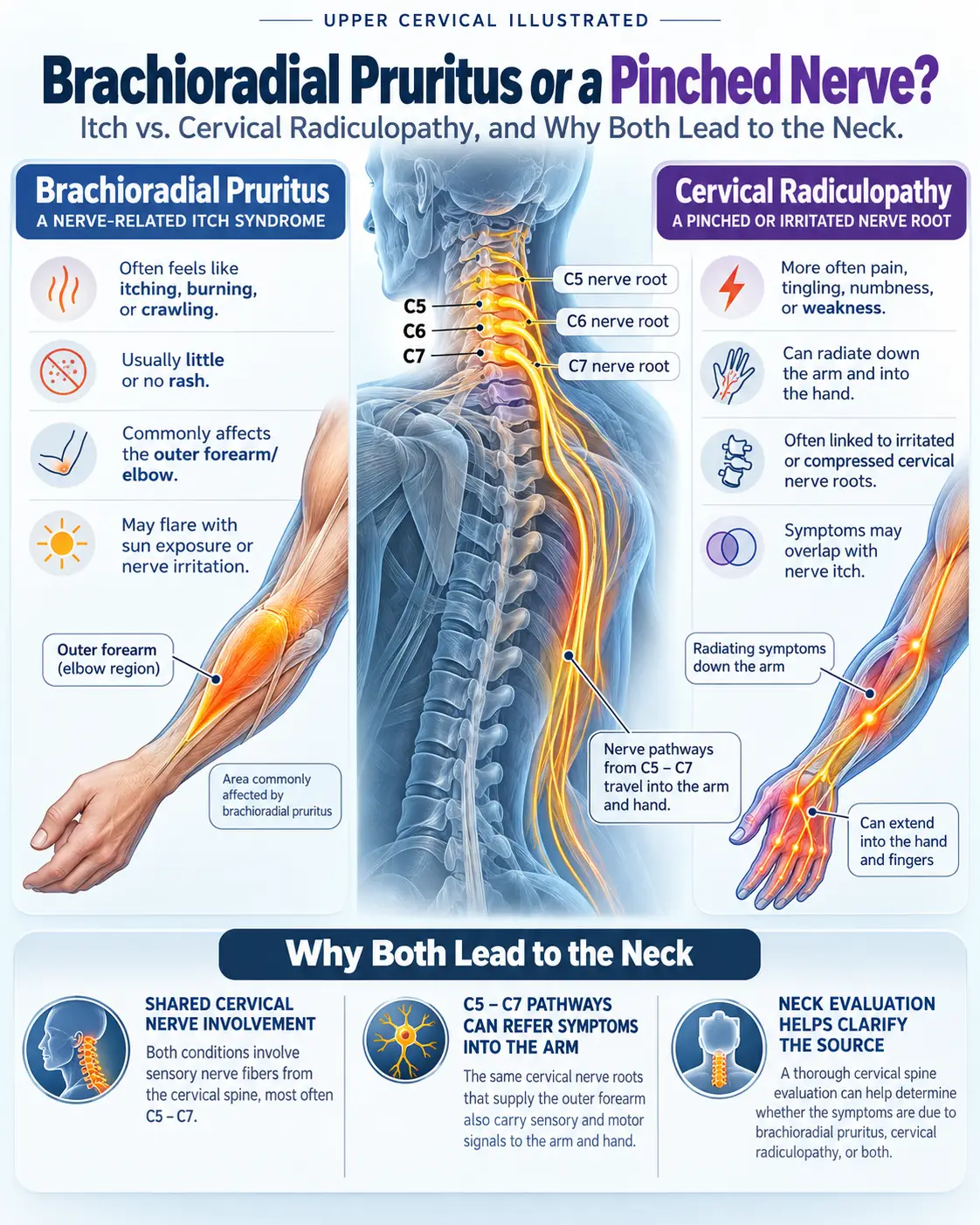
Brachioradial pruritus (BRP) is a neuropathic itch — an itch generated by irritated nerves, not by anything happening in the skin. That’s why antihistamines and steroid creams do nothing. The nerves carrying sensation from your forearm get pinched or irritated where they exit the cervical spine, and your brain interprets the faulty signal as an itch on the arm. When someone finally images the neck instead of the skin, the source shows up. This article walks through exactly what a cervical MRI reveals in BRP, why those findings line up so precisely with where you itch, and why the top of the neck is the piece that even the MRI report tends to miss.
Why the Neck, Not the Skin
Your forearm skin doesn’t have a mind of its own. Every sensation it reports — touch, temperature, itch — travels up a nerve, through a nerve root where it exits the spine in your neck, and into your spinal cord and brain. Squeeze or irritate that nerve anywhere along the line and the brain still localizes the signal to the skin, because that’s where the nerve starts. So a nerve root pinched in your neck produces a very real, very maddening itch felt in your arm — even though the arm is perfectly healthy.
That’s the whole reason skin treatment fails in BRP. You’ve been treating the address where you feel it. The cause is upstream, at the neck, and a cervical MRI is the tool that lets you actually see it.
Neuropathic Itch Is a Completely Different Animal
To understand why the MRI matters, you have to understand what kind of itch this is. Ordinary itch — a mosquito bite, hives, an allergic reaction — is driven by histamine released in the skin. Histamine tickles nerve endings in the skin, your brain registers “itch,” you scratch, and antihistamines help because they block the histamine. That’s the itch nearly everyone has experienced, and it’s the itch every over-the-counter product is designed for.
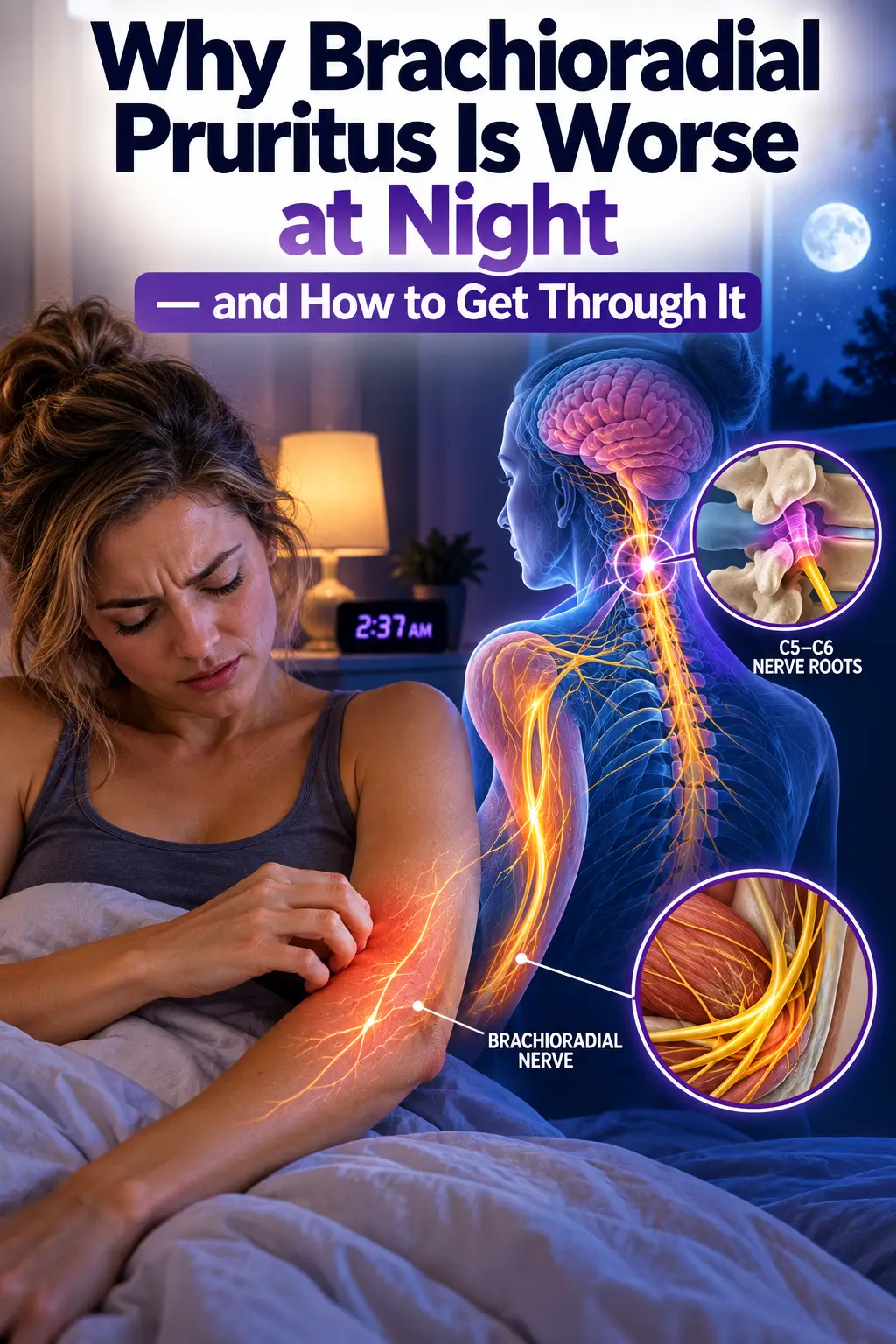
Neuropathic itch is nothing like that. Here, the skin isn’t releasing anything unusual — the itch signal is being generated by irritated nerves along the pathway from your arm to your brain, most often where a nerve root is pinched or inflamed as it exits the cervical spine. The nerve fires an itch signal that was never triggered by anything in the skin, and your brain, having no way to know the signal is false, localizes it to the forearm. This is why the skin looks normal, why there’s no rash, why scratching gives no relief and only damages the skin, and why antihistamines, steroid creams, and moisturizers do nothing. They’re all aimed at histamine in the skin — and histamine in the skin was never the problem. The single most useful diagnostic clue is the ice-pack sign: cold brings near-instant relief because it quiets the firing of the irritated nerve, and the itch roars back the moment the cold comes off. That response is a fingerprint of neuropathic itch, and it points the investigation exactly where it belongs — the nerve, and the neck the nerve comes from.
Once you accept that this is a nerve-driven itch, the logic of imaging the neck becomes obvious. If the nerve is being irritated where it exits the spine, then a picture of the spine is how you find the irritation. A cervical MRI is that picture.
What the MRI Actually Shows
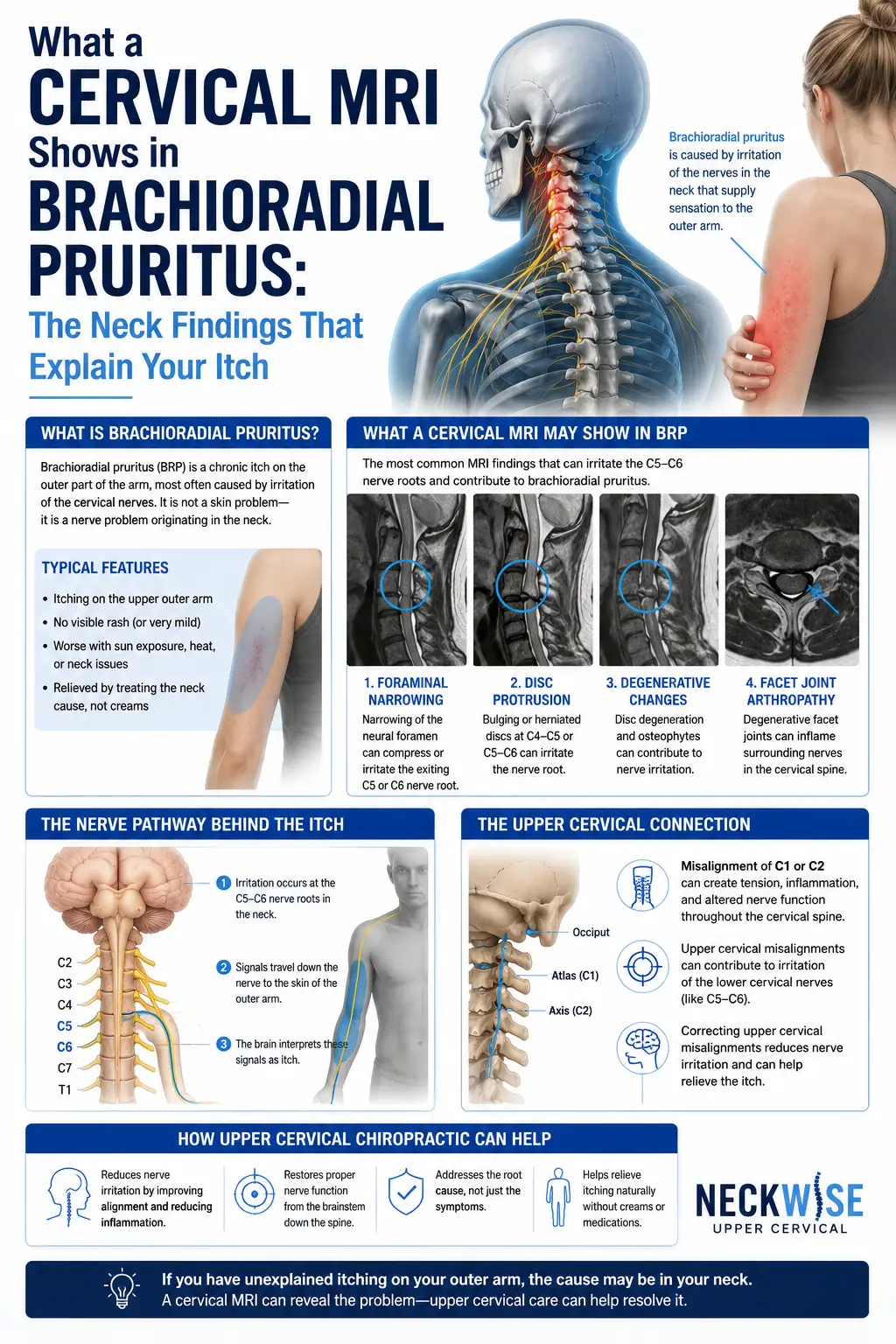
A cervical MRI in someone with brachioradial pruritus commonly turns up one or more of these:
- Foraminal stenosis — narrowing of the bony openings where nerve roots exit the spine. A narrowed foramen crowds the nerve, and an irritated nerve fires abnormally: itch, burning, prickling.
- Disc protrusion or herniation — disc material bulging into the space where a nerve root sits, pressing on or inflaming it.
- Degenerative changes / osteophytes — arthritic bone spurs and disc-height loss that reduce the room a nerve has and set up chronic irritation.
- Cord or root signal changes — in some cases, changes in the nerve root or cord itself along the involved pathway.
These findings cluster in the lower cervical spine, C5 through C7 — exactly the levels whose nerves supply the outer forearm, which is exactly where BRP is felt.
The Findings Aren’t Random — They Match Where You Itch
This is the detail that turns “association” into “cause.” The nerve roots at C5, C6, and C7 feed the dermatomes — the map of skin territories — covering the outer forearm and the brachioradialis region. That is precisely where brachioradial pruritus lives. When the MRI flags the nerve root at the level that supplies the exact patch of skin that itches, that isn’t a coincidence you can wave off. It’s the anatomical fingerprint of the cause.
The evidence for this is unusually strong for a symptom most people think of as “just skin.” The landmark study — a magnetic resonance investigation of the cervical spine in brachioradial pruritus, published in the Journal of the American Academy of Dermatology — imaged patients with BRP and found cervical spine changes in essentially all of them, with nerve-compressing disease at the levels that correspond to the itch. Earlier work in the same journal, dermatomal distribution linking brachioradial pruritus to cervical spine disease, documented that the itch follows the nerve-root map. And reports combining nerve conduction testing with cervical MRI show the pinched nerve and the itch tracking the same level. The picture is consistent: the neck finding sits right where the itch is.
The Dermatome Map: Reading Your Itch Like a Diagnostic Clue
The reason the level-match is so persuasive comes down to dermatomes — the map of which nerve root supplies which patch of skin. Your body is wired in territories, and each cervical nerve root “owns” a predictable strip of the arm:
- C5 supplies the outer shoulder and upper outer arm.
- C6 runs down the outer forearm to the thumb — squarely over the brachioradialis muscle that gives this condition its name.
- C7 covers the back of the forearm to the middle finger.
Brachioradial pruritus overwhelmingly strikes the outer forearm and upper arm — the C5, C6, and C7 territories. So when a cervical MRI flags foraminal narrowing or a disc protrusion at, say, the C5–C6 or C6–C7 level, and your itch sits right in the C6 dermatome, that alignment is not luck. It’s the anatomical signature of a nerve root generating a false signal that your brain is projecting onto the skin it serves. This is also why BRP is so often bilateral but asymmetric — worse on one arm than the other — because degenerative cervical changes are frequently worse on one side, crowding one nerve root more than its twin. When you learn to read your itch as a map back to a specific spinal level, the “mysterious skin condition” stops being mysterious.
Why MRI Positioning and Timing Matter
One practical point that explains a lot of “normal” scans: a standard cervical MRI is taken lying flat and still. But nerve-root crowding is often dynamic — it worsens when you extend or rotate your neck, or hold a posture, and eases when you lie down. A supine, neutral scan can underestimate how much a nerve is being pinched during the positions of daily life. This is one reason a scan read as unremarkable doesn’t clear the neck: the pinch that fires your itch when you’re upright and looking at a screen may partly relax on the table. It’s also why the mechanical picture — how your head loads your neck through the day — matters as much as the static image, and why our 3D upright-relevant assessment adds information a supine MRI isn’t designed to capture. If you’re getting imaging, it’s worth asking your physician whether flexion/extension views or additional sequences are appropriate for your case.
The Proof That Seals It: Fix the Neck, Lose the Itch
Correlation is one thing. This is the part that moves it to cause. There are documented cases where treating the cervical spine directly made the itch go away — including a patient in the Journal of Spine Surgery whose brachioradial pruritus resolved after cervical spine surgery (ACDF) decompressed the involved level. And a 2024 report in Journal of Neurosurgery Case Lessons documents BRP presenting as an atypical cervical radiculopathy — an itch that behaved like a pinched nerve because that’s what it was. When relieving the pressure on a neck nerve makes a years-long forearm itch disappear, the neck was never a bystander. It was the driver.
That’s why the cervical MRI matters so much: it’s not just a picture, it’s the roadmap to the thing actually generating your symptom.
Why the Upper Neck Matters — Even When the MRI Flags a Lower Level
Here’s what the radiology report won’t tell you, and in our experience it’s the most important part. The MRI hands you a snapshot of where the damage is now — usually C5–C7. It doesn’t tell you why that level broke down. And very often, the answer is at the top of the neck.
Your atlas (C1) carries the entire weight of your head, balanced on the axis (C2), held mostly by ligaments rather than interlocking bone. When that top segment shifts out of position, your head is no longer centered, and every level below it compensates — leaning, loading unevenly, absorbing strain it was never meant to carry. Do that for years and you get exactly what the MRI keeps finding lower down: disc protrusions, foraminal narrowing, arthritic change at C5–C7. In other words, the lower-neck damage on your scan is frequently the downstream consequence of an uncorrected problem at the top of your neck.
On top of that, the itch-suppressing “brake” — the descending pathways from the brainstem that normally quiet down pain and itch signals in the cord — runs directly through the upper cervical spinal cord. When the upper neck is misaligned and stressed, that brake weakens, and the itch gets amplified. So the upper cervical spine influences this condition twice over: it drives the mechanical load that damages the lower levels, and it governs how loudly the itch signal gets turned up. It’s the one region most capable of affecting the whole pathway — and it’s the one region a standard MRI read never comments on.
How We Use Your Imaging at Lavender Family Chiropractic
A cervical MRI tells you the nerve is involved. It doesn’t, by itself, tell you how your head is sitting on your neck or how to correct it. That’s the gap we work in.
At Lavender Family Chiropractic we focus exclusively on the upper cervical spine. We use 3D CBCT imaging to measure your atlas and axis alignment in three dimensions — precision a standard MRI or X-ray isn’t designed for — and paraspinal infrared thermography to read how your nervous system is actually behaving along the spine. If you already have a cervical MRI, bring it: it tells us which level is irritated, and our imaging tells us what’s driving the load onto it. From there we calculate a correction specific to you, using the Knee Chest Upper Cervical technique — precise, gentle, and low-force, with no twisting, cracking, or popping. For a nervous system that’s already hyperexcitable and firing an itch it can’t switch off, that gentleness is the entire point.
Keep working with your dermatologist and, if you have one, your neurologist — confirming the diagnosis and ruling out other causes of chronic itch is important, and we’re glad to work alongside them. But if your MRI shows cervical nerve involvement at the level that matches your itch, addressing what’s loading that neck is the step you’ve been missing.
What to Do If Your MRI Confirms Cervical Involvement
Say the scan comes back showing foraminal narrowing or a disc protrusion at the level that matches your itch. That’s not a dead end — it’s the first time anyone has actually located your problem, and it opens real options. Conservative, non-surgical avenues are typically explored first: addressing the mechanical load on the neck, nerve-targeted medications your physician may prescribe (such as gabapentin or pregabalin), topical agents like capsaicin that act on the nerve rather than histamine, posture and ergonomic changes, and sun protection to remove the aggravating UV factor. Surgery — the ACDF-type decompression documented in the Journal of Spine Surgery — sits at the far end of the spectrum for severe, refractory cases with clear structural compression, and the fact that it can resolve the itch is powerful confirmation of the cause, not a first-line suggestion.
Where upper cervical care fits is early and conservative: if the lower-level damage on your MRI is being driven by how your head loads your neck from the top, addressing that top segment targets the upstream mechanics without anything forceful or invasive. The point of the MRI isn’t to frighten you toward the operating room — it’s to finally aim treatment at the source instead of your skin. Bring the images and the radiology report to any provider evaluating your neck, including us; the level identified on the scan directly informs where we look and what we measure.
Red Flags — When to Seek Prompt Medical Care
An itch is usually not an emergency, but the neck is a serious neighborhood, and some symptoms need urgent evaluation rather than watchful waiting. Seek prompt medical care if you develop: progressive weakness or numbness in an arm or hand, clumsiness or loss of fine motor control (dropping things, trouble with buttons), problems with balance or walking, any change in bowel or bladder control, or new weakness in the legs. These can signal cord or nerve-root compression that needs timely medical assessment. Getting checked is never an overreaction.
Top Questions
Should I get a cervical MRI for brachioradial pruritus? It’s a reasonable conversation to have with your physician, especially if your itch has the classic pattern — outer forearms, no rash, relieved by cold — and skin treatments have failed. An MRI can reveal the nerve involvement that explains it.
My MRI was “normal.” Does that rule out the neck? Not necessarily. Nerve irritation from positioning and mechanical load doesn’t always show as dramatic damage on a static scan, and a report focused on gross pathology may not comment on subtle foraminal crowding or on how your head is loading the neck. That upper cervical mechanical piece is exactly what our 3D imaging is built to evaluate.
Why does cold relieve it if it’s a neck problem? Cold quiets the firing of the irritated nerves themselves — the “ice-pack sign.” It confirms this is neuropathic (nerve-driven), which is consistent with a neck source; it just doesn’t fix what’s irritating the nerve in the first place.
If the MRI shows C6, why do you focus on C1 and C2? Because the C6 damage is often the downstream result of years of abnormal loading that starts at the top of the neck, and because the upper cervical cord houses the pathways that turn the itch up or down. Correcting the top segment addresses both the load and the amplification.
Is the adjustment forceful? No — precise, gentle, low-force, no twisting or cracking.
Could it still be the sun and not my neck? Sun exposure is a recognized aggravating factor — UV can injure the small nerve fibers in the skin, which is why BRP often flares in summer and in sun-exposed people. But the sun and the neck aren’t competing explanations; they compound. The current understanding is that a cervical nerve problem lowers the threshold, and sun exposure pushes an already-irritated nerve over the edge. Protecting your arms from UV is smart and worth doing — but on its own it rarely resolves BRP, because it doesn’t address the neck source.
My dermatologist said my skin is fine. Were they wrong? No — they were right, and that’s the point. In BRP the skin genuinely is normal, because the problem isn’t in the skin. A normal skin exam is consistent with neuropathic itch, not evidence against it. The logical next step after a clean skin workup is to look upstream at the nerve and the neck.
Other Causes of Chronic Itch to Rule Out
Being cause-forward about the neck doesn’t mean skipping due diligence, and a good workup protects you. Generalized or widespread chronic itch — as opposed to the focused outer-forearm pattern of BRP — can sometimes reflect systemic conditions that deserve to be excluded: thyroid disease, liver or kidney dysfunction, iron deficiency or other blood conditions, diabetes, and certain medications. These usually cause itch that’s more diffuse and isn’t relieved by cold the way BRP is, but the responsible approach is to confirm the diagnosis with your physician and rule these out with basic labs when the picture warrants it. What makes brachioradial pruritus distinctive is the combination: focal outer-forearm location following a dermatome, normal-looking skin, the ice-pack sign, and worsening with heat and sun. When that cluster is present and systemic causes are excluded, the cervical spine is the evaluation that’s been missing.
Your Itch Has an Address — and It’s in Your Neck
Brachioradial pruritus has frustrated you for one reason: everyone kept looking at your skin, and the problem was never there. It’s a nerve signal, generated in your neck, felt in your arm. A cervical MRI is how you see it — and the findings, at the levels that match exactly where you itch, plus the cases where fixing the neck ended the itch, all point to the same conclusion. This is a neck problem.
If you have a cervical MRI, or you suspect your itch is coming from your neck, let us evaluate the piece the report leaves out. Call (941) 243-3729 or book a consultation. Bring your imaging. Let’s find where your itch actually starts.
Lavender Family Chiropractic (NeckWise North Sarasota) · 5899 Whitfield Avenue, Suite 107, Sarasota, FL 34243 · (941) 243-3729
This article is for general educational purposes and is not medical advice. Brachioradial pruritus should be evaluated by qualified healthcare professionals, and other causes of chronic itch should be ruled out. If you develop progressive weakness, numbness, balance problems, or any change in bowel or bladder function, seek prompt medical attention.
Related Articles
Related Posts


Get our upper cervical articles first.