POTS vs Anxiety: Why POTS Is So Often Misdiagnosed — and the Cause No One Checks
By Dr. Rusty Lavender, D.C. — upper cervical chiropractor, Lavender Family Chiropractic, Sarasota, FL. Reviewed and updated October 2026.
If you stand up and your heart pounds, your head goes light, your hands shake, and a wave of dread hits — and you’ve been told it’s “just anxiety” — there’s a strong chance you’ve been misdiagnosed. What you’re feeling may be POTS, a real, measurable physical condition. And for a lot of people, it’s being driven from the one place nobody has examined: the top of the neck.
POTS — postural orthostatic tachycardia syndrome — produces a racing heart, dizziness, and shakiness that can look identical to a panic attack from the outside. But it is not anxiety. It’s a disorder of the autonomic nervous system, the body’s automatic control network, and it can be proven with a simple, objective test that takes ten minutes. When that test gets skipped — and for young women it is skipped constantly — a real physical illness gets filed under “stress,” and people lose years being told the problem is in their head.
It is not in your head. This article will show you exactly how to tell POTS from anxiety, the objective test that settles it, and why the upper cervical spine is so often the overlooked driver that your entire workup never looked at.
What POTS Actually Is
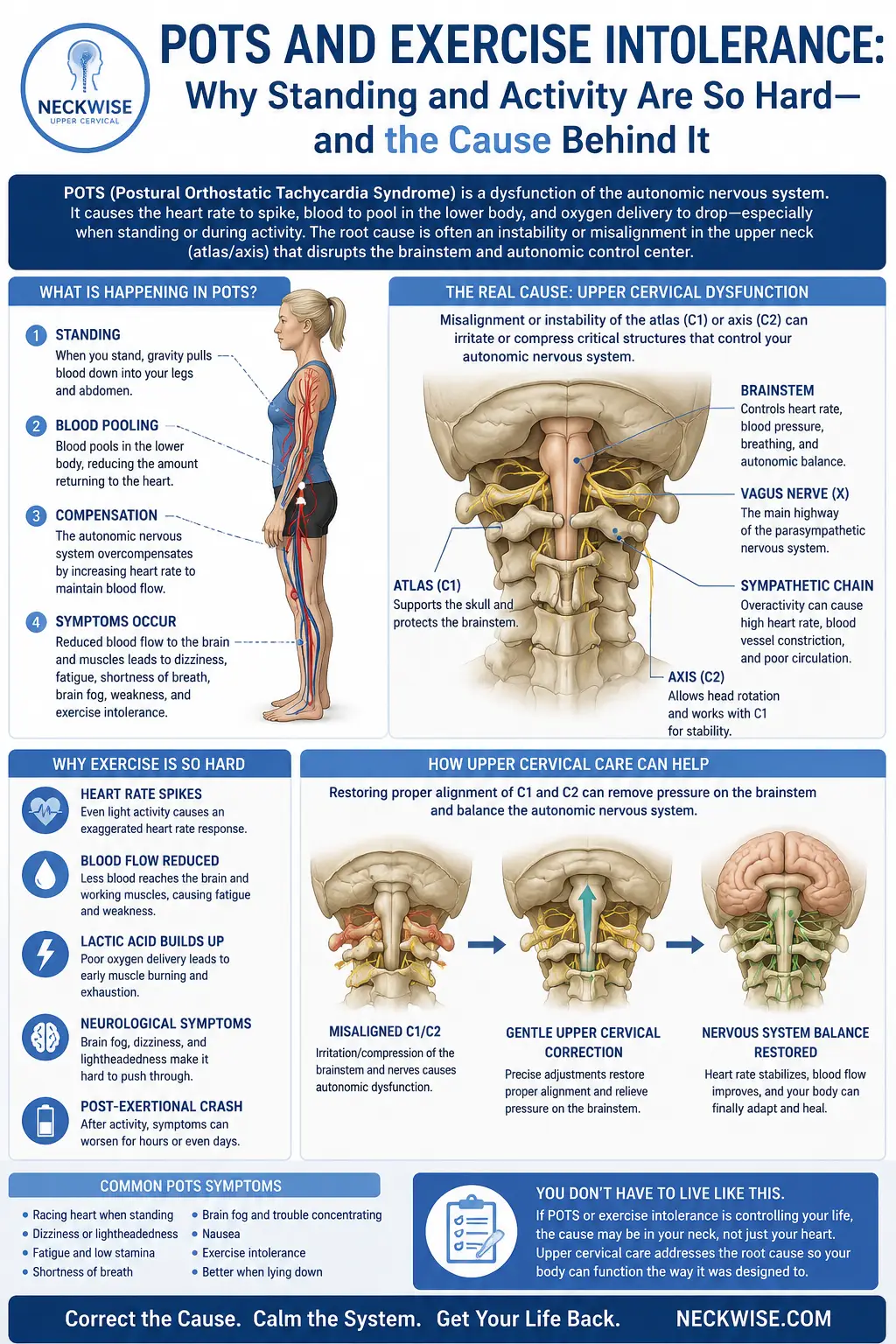
POTS means that standing up triggers an abnormally large jump in heart rate along with a cluster of disabling symptoms. When you stand, gravity drops roughly a pint of blood into your legs and belly. A healthy autonomic system instantly tightens the vessels below, nudges the heart up modestly, and keeps blood flowing to your brain — you never notice. In POTS, that automatic adjustment fails. Blood pools, less returns to the heart, and to keep your brain supplied your heart compensates by racing. That racing pulse is the body’s emergency workaround for a real circulatory problem — not nerves, not weakness, not imagination.
POTS is a form of dysautonomia. It hits women far more than men, often starts in the teens through the forties, and frequently follows a viral illness, a concussion, whiplash, surgery, or pregnancy. Its mechanisms are physical, and researchers keep finding biological fingerprints that separate it cleanly from a psychiatric condition.
Why POTS and Anxiety Get Confused
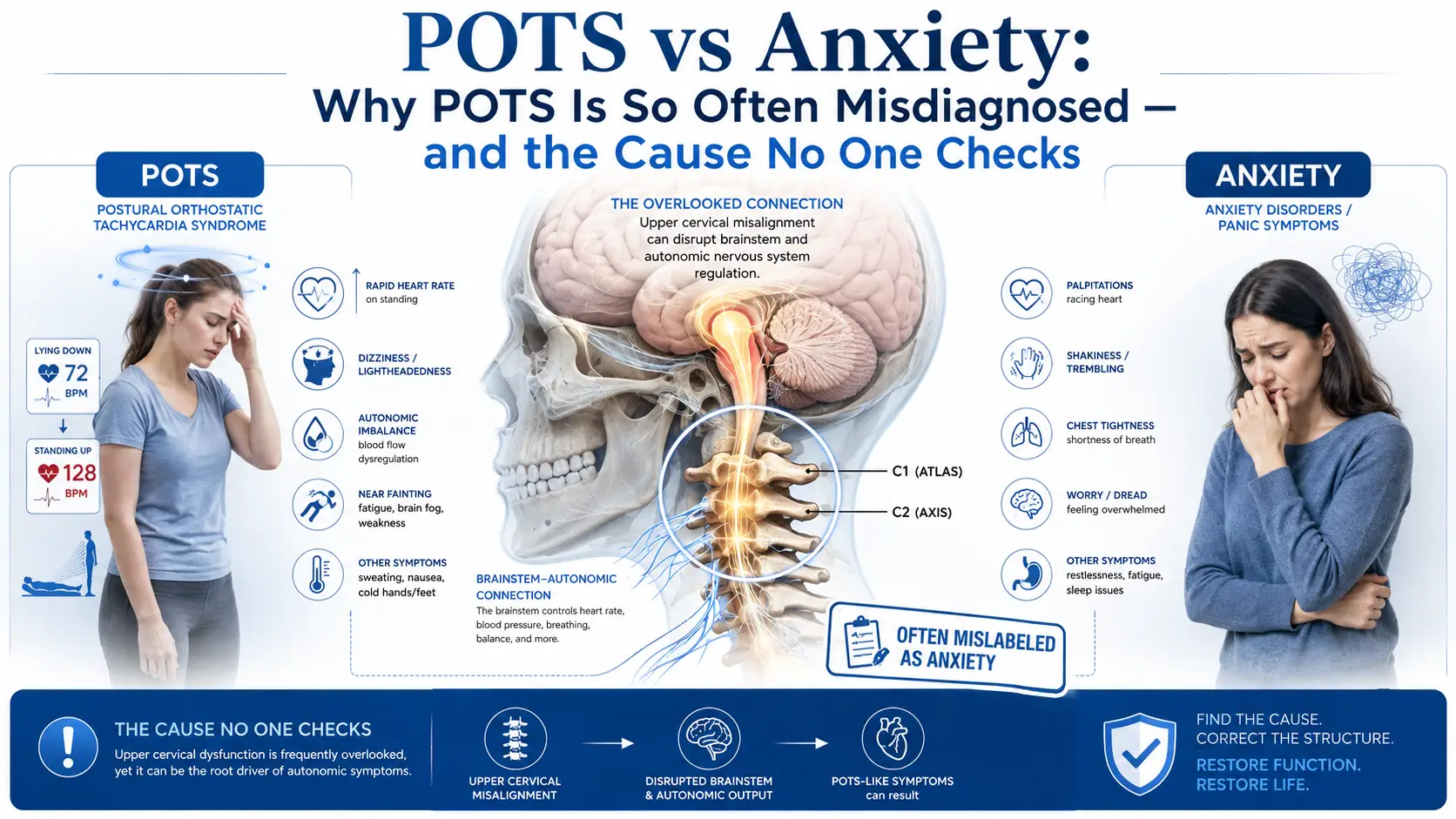
Read this list and tell me which condition it describes: pounding heart, lightheadedness, trembling, shortness of breath, sweating, a sense of dread, trouble concentrating. The honest answer is both — because both fire the sympathetic “fight or flight” system. And there’s a human trap on top of the biology: when your heart suddenly races and you feel like you’ll collapse, of course you feel afraid. That fear is the consequence of the episode, not the cause — but to a rushed clinician it looks like the cause. Add the fact that POTS and anxiety are both diagnosed most in young women, and you get a condition that gets waved off as “stress” before anyone measures what the body actually does on standing. A 2020 case report in Cureus documents exactly this — a patient whose POTS was first labeled anxiety — and lays out how the two can be told apart when someone bothers to look.
Anxiety Does Not Cause POTS — Full Stop
State it plainly: anxiety does not cause POTS, and POTS is not a form of anxiety. They can coexist — living with a frightening, dismissed illness understandably breeds anxiety — but coexistence is not causation. The research is clear. A study in the Journal of Neurology, Neurosurgery & Psychiatry found the symptom burden of POTS is not explained by anxiety disorders — it’s its own entity. A study in Fortschritte der Neurologie·Psychiatrie found that while anxiety can be present, it does not account for the core autonomic dysfunction. And a study in the Journal of the American Heart Association found POTS patients more likely to carry autoantibodies against the very receptors that regulate heart rate and vessel tone. You cannot explain autoantibodies with nervousness. POTS has a physical footprint — and it deserves to have its physical cause found, not managed with reassurance.
The Physical Fingerprints — What’s Actually Happening Inside You
If POTS were “just nerves,” you would not expect to find concrete, physical abnormalities when you measure the body. But you do — over and over. This matters, because it’s the difference between a feeling and a finding, and you deserve to know your symptoms have a physical footprint that researchers can actually put their hands on.
Start with blood volume. A substantial share of POTS patients are running on less circulating blood than they should have — measurably low plasma volume and, in many, low red-cell volume too. When the tank is low, standing drains even more blood into the legs, less returns to the heart, and the heart races to keep your brain supplied. That is a plumbing problem, not a worry.
Then there’s the chemistry of the stress system itself. In one recognized subtype — hyperadrenergic POTS — patients have genuinely elevated levels of norepinephrine, the fight-or-flight chemical, when they stand. This is worth sitting with, because it’s the crux of the whole misdiagnosis: a person with high standing norepinephrine will feel wired, shaky, sweaty, and full of dread — the exact sensations a clinician files under “anxiety.” But the norepinephrine surge here is a physiological response to a circulatory problem, measurable in the blood, not a psychological state. The body is dumping adrenaline because standing is a genuine emergency for its circulation — not because your mind is catastrophizing.
And then there’s the immune evidence. The study in the Journal of the American Heart Association found POTS patients more likely to carry autoantibodies targeting the adrenergic receptors — the very docking sites that regulate heart rate and blood-vessel tone. Think about what that means: the immune system producing antibodies against your own cardiovascular control receptors is not something anxiety can manufacture. It’s a biological lesion. Layer these together — low blood volume, abnormal standing norepinephrine, receptor autoantibodies, and in a large subset, connective-tissue laxity — and the picture is unmistakable. POTS is a physical disorder with physical fingerprints. The tragedy is how rarely anyone looks for them before reaching for the anxiety label.
The Objective Test That Settles It
Here’s the empowering part: POTS can be proven with a simple measurement. You take heart rate and blood pressure lying down, then again on standing, and you watch the numbers. Per the 2015 Heart Rhythm Society consensus statement, the diagnosis is a sustained heart-rate rise of at least 30 beats per minute (40 in adolescents) within 10 minutes of standing, without a big blood-pressure drop, with symptoms lasting months. That 30-beat number is the single fact that goes unmeasured over and over. It’s objective. It doesn’t care whether you’re nervous.
The active stand test is the simplest version — lie quietly, then stand while heart rate and blood pressure are recorded at 1, 3, 5, and 10 minutes. The tilt table test, done in cardiology or neurology, uses a motorized table and continuous monitoring to catch patterns a stand test can miss. Either way, the move is the same: measure the response to standing instead of guessing. If you take one thing from this article: ask whether your heart rate has been measured lying down and then standing. If it hasn’t, that’s the request that can change everything.
How to Tell Them Apart
Objective testing is the gold standard, but these patterns point toward POTS and are worth reporting:
- The trigger is posture. POTS hits within seconds to minutes of standing and eases when you lie down or put your feet up. Panic can strike in any position, tied to a thought or situation — or nothing.
- Position relieves it. If lying down quickly calms the racing heart, that’s an orthostatic mechanism. Anxiety doesn’t usually settle just because you changed posture.
- It’s predictable. POTS clusters around standing in a hot shower, waiting in line, getting up in the morning, standing after a meal, heat. It eases with fluids, salt, and cooler air.
- The physical company it keeps. Fatigue out of proportion to activity, exercise intolerance, brain fog, nausea, and sometimes bluish pooling in the legs — less typical of anxiety.
- The order of events. POTS patients often feel the racing heart happen first, physically, with fear following. In panic, the dread usually comes first.
These help you form a sharp question. The answer comes from measurement — and from examining what’s driving the autonomic system in the first place.
Why This Misdiagnosis Happens — and What It Costs You
It’s worth naming plainly why so many people spend years being told it’s anxiety, because understanding the trap helps you get out of it. Several forces line up against an accurate diagnosis. The resting exam looks completely normal — POTS only reveals itself when you stand and stay standing, and a doctor who checks your pulse while you’re sitting calmly sees nothing wrong. Routine bloodwork and a standard EKG come back clean, because POTS is a disorder of regulation, not of organ damage; there’s no single blood marker on a basic panel that flags it. The symptoms overlap almost perfectly with panic and generalized anxiety. And the demographics collide: POTS and anxiety disorders are both diagnosed most often in young women, which — fairly or not — makes “it’s probably anxiety” the path of least resistance for a rushed clinician.
The cost of that shortcut is not abstract. Studies of POTS patients consistently find years-long delays between first symptoms and correct diagnosis, often after seeing many physicians. That’s years of being told the problem is in your head while a real, disabling illness goes unaddressed. It’s years of missed school or work, of canceled plans, of family and friends quietly wondering if you’re exaggerating. And there’s a compounding harm specific to this misdiagnosis: when you’re told your racing heart is anxiety, the natural next step is anxiety treatment — which does nothing for the underlying circulatory problem, so you don’t improve, which can be read as “treatment-resistant anxiety,” which digs the hole deeper. Meanwhile the actual drivers — low blood volume, autonomic dysregulation, and the cervical contribution almost no one checks — sit unexamined.
If any of this is your story, understand that the way out is not to argue harder about whether you’re anxious. It’s to insist on measurement, and to get the regions no one has looked at actually evaluated.
What a Real POTS Workup Looks Like
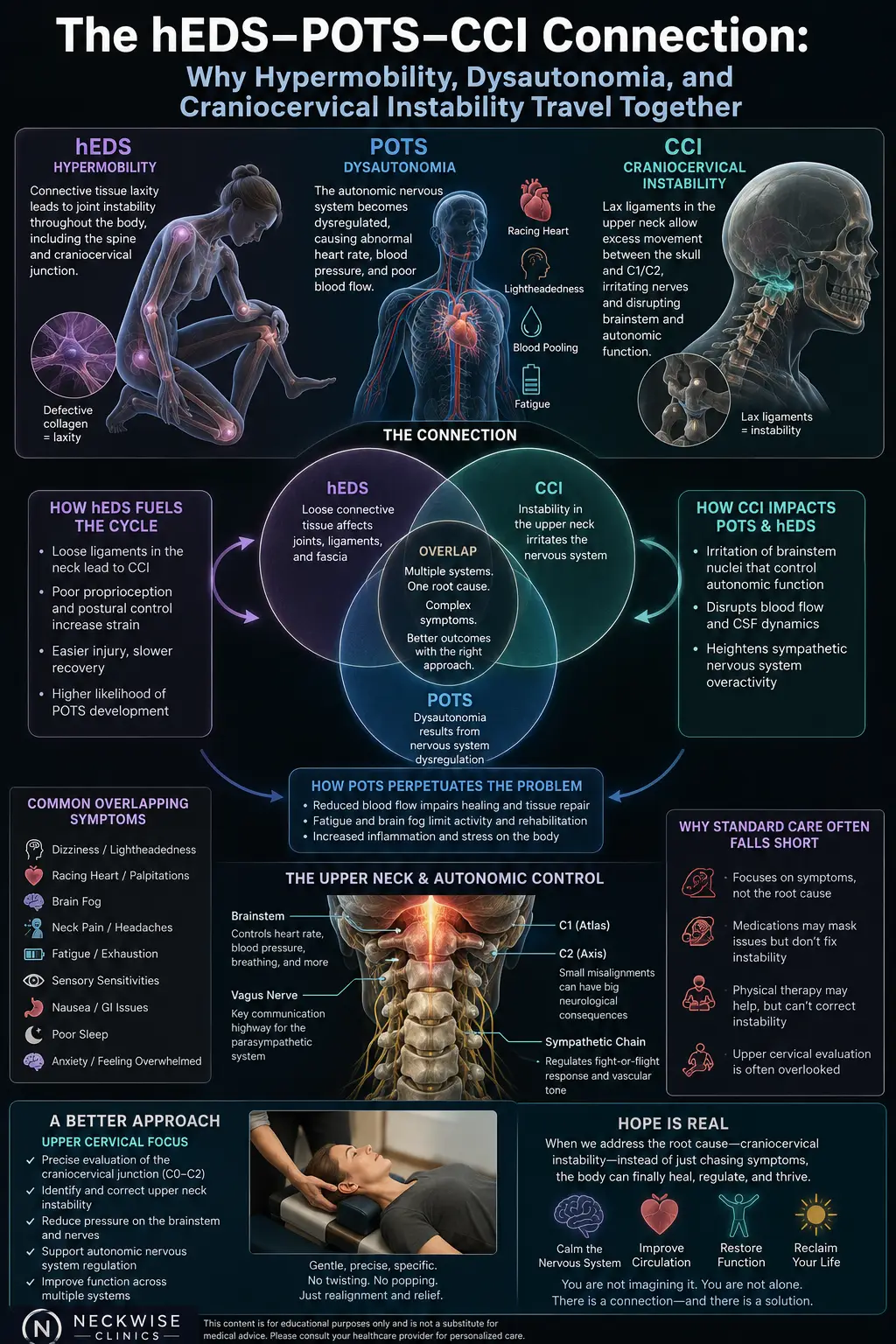
Knowing what a proper evaluation includes lets you ask for it by name. A thorough POTS workup generally starts with orthostatic vital signs — heart rate and blood pressure measured lying and standing (the active stand test) — and often a tilt table test in cardiology or neurology for continuous monitoring. From there, a good clinician looks for what’s drivingit: screening for the conditions POTS travels with, including joint hypermobility and hypermobile Ehlers-Danlos syndrome, thyroid dysfunction, anemia, diabetes, and autoimmune features, and asking carefully about how it started — a virus, mononucleosis, a concussion, a whiplash or car accident, surgery, or pregnancy.
Here’s the piece that’s almost universally skipped: nobody examines the top of the neck. The onset history alone — how often POTS begins after head and neck trauma — should point an evaluation toward the craniocervical junction, but it rarely does. So even patients who get an otherwise excellent cardiology workup walk out with the one region most mechanically connected to their autonomic control center never assessed. That’s the gap this article keeps circling back to, because closing it is often what finally moves the needle for people who’ve “tried everything.”
Your Neck May Be the Driver No One Checked
Here’s the piece your cardiologist and neurologist almost certainly skipped. The brainstem — home to the control centers that regulate heart rate and blood pressure, and the origin of the vagus nerve — sits at the junction where your skull meets your neck, inside the ring of your top two vertebrae, the atlas (C1) and axis (C2). The upper neck literally surrounds the machinery that fails in POTS. When that region is misaligned, it can directly interfere with the system that’s supposed to steady you when you stand.
And the link runs deeper for many patients. POTS travels tightly with joint hypermobility and hypermobile Ehlers-Danlos syndrome — and that same connective-tissue laxity affects the ligaments holding your head onto your spine at the craniocervical junction, allowing excess movement at the exact junction that houses the autonomic control center. It’s also no accident that so many POTS cases begin after a concussion, a whiplash, or a car accident — injuries to the head and neck. For a meaningful share of POTS patients, the upper neck isn’t a footnote. It’s a primary, overlooked driver — and it’s the one region a standard workup never evaluates.
This is why so many people who’ve “tried everything” for POTS eventually start asking about the neck, and why nearly all of them have never had it properly examined.
How We Evaluate the Upper Cervical Piece
At Lavender Family Chiropractic, we focus exclusively on the upper cervical spine. Our approach is built on measurement: 3D CBCT imaging shows your atlas and axis alignment in three dimensions, and paraspinal infrared thermography reads how your nervous system is behaving along the spine — directly relevant in a condition defined by autonomic dysregulation. When a correction is warranted, we use the Knee Chest Upper Cervical technique: precise, gentle, and low-force — no twisting, cracking, or popping — which is exactly why it suits a hypersensitive, easily-provoked nervous system and hypermobile patients.
Keep your cardiologist and neurologist and keep your prescribed care. What we add is attention to the cervical and craniocervical contribution — the piece that’s almost always missing. If you’ve been handed clean tests and an anxiety label and no one has evaluated the top of your neck, that is the gap worth closing.
Red Flags — Get Seen Right Away
Some symptoms should never be filed under “probably just POTS” or “probably just anxiety.” Call 911 or go to an emergency department for: fainting (especially with injury or no warning), chest pain or pressure (particularly spreading to the arm, jaw, or back), severe shortness of breath, a very fast or irregular heartbeat that won’t settle, fainting during or right after exercise, or confusion, slurred speech, one-sided weakness, or a sudden severe headache. POTS itself is usually not life-threatening, but these deserve urgent evaluation to rule out serious causes. Getting checked is never an overreaction.
Top Questions
Is POTS just severe anxiety? No. It’s an autonomic disorder defined by an objective, measurable heart-rate rise on standing. Anxiety can coexist, but it doesn’t cause POTS, and the two are diagnosed differently.
How do I know if I should be tested? If your racing heart, lightheadedness, and shakiness are consistently tied to standing and ease when you lie down, ask your physician to measure heart rate and blood pressure lying and standing, watching for a sustained rise of 30+ bpm (40 in teens) without a big pressure drop.
Can I have both POTS and anxiety? Yes — and each deserves to be recognized on its own terms. Treating coexisting anxiety doesn’t mean the POTS was “all in your head.”
What does my neck have to do with it? The brainstem centers that run your heart rate and the origin of the vagus nerve sit in the region your top two vertebrae surround. Misalignment there can interfere with autonomic regulation — and it’s the piece almost no one examines, especially when POTS started after a concussion or whiplash.
Is the adjustment forceful? No — precise, gentle, low-force, no twisting or cracking.
I was told anxiety treatment would fix it and it didn’t. Why? Because if the driver is POTS — a circulatory and autonomic problem — treating anxiety doesn’t address the mechanism. It’s not that you failed treatment; it’s that the treatment was aimed at the wrong target. That’s a strong signal to push for objective standing measurements and an evaluation of what’s driving your autonomic system.
My POTS started after a car accident / concussion. Does that change anything? It’s one of the most important details you can share. A large share of POTS cases begin after head or neck trauma, which points attention squarely at the craniocervical junction — the region your workup most likely skipped. If that’s your history, having the top of your neck evaluated moves from “optional” to “the obvious next step.”
Can I have hyperadrenergic POTS and still not have anxiety? Yes. Hyperadrenergic POTS involves genuinely elevated norepinephrine on standing — a measurable, physiological surge that feels like anxiety but is a circulatory response, not a mood disorder. It’s one of the clearest examples of why “you seem anxious” is not a diagnosis.
Serving Sarasota, Lakewood Ranch & Bradenton
If you’ve been chasing a POTS answer across Sarasota, Lakewood Ranch, or Bradenton and keep landing back at “it’s just anxiety,” you don’t have to keep driving that loop. Lavender Family Chiropractic (NeckWise North Sarasota) sits at the corner of University and Whitfield, minutes from Lakewood Ranch and just across the line from Bradenton, so patients from all three communities reach us easily. Whether you’re coming from downtown Sarasota, the Lakewood Ranch corridor, or north into Bradenton, we evaluate the upper cervical piece your cardiology and neurology workup almost certainly skipped — the region that surrounds the autonomic control center — using 3D CBCT imaging and paraspinal infrared thermography. Patients across Sarasota, Lakewood Ranch, and Bradenton who felt dismissed for years deserve to have the actual driver examined.
You Deserve to Be Believed — and to Have the Cause Found
If you’ve felt dismissed, hear this clearly: your symptoms are real, and feeling frightened when your heart is pounding is a normal response, not proof the problem is only in your mind. The way forward isn’t arguing about “anxiety versus physical” in the abstract — it’s measurement, and it’s examining what’s driving your autonomic system, including the region your workup skipped.
If you’ve been told your standing racing heart is “just anxiety” and no one has looked at the top of your neck, that’s the next move. Call (941) 243-3729 or book a consultation — we’ll review your history, evaluate your upper cervical spine with 3D imaging, and coordinate with your medical team. Stop losing years to a label. Find the cause.
Lavender Family Chiropractic (NeckWise North Sarasota) · 5899 Whitfield Avenue, Suite 107, Sarasota, FL 34243 · (941) 243-3729
This article is for general educational purposes and is not medical advice. POTS requires proper medical diagnosis, typically through cardiology or neurology and objective testing. If you experience fainting with injury, chest pain, or severe shortness of breath, seek immediate medical attention.
Related Articles
Related Posts



Get our upper cervical articles first.