By Dr. Rusty Lavender — Lavender Family Chiropractic, Sarasota, FL
Here’s something you won’t hear from most clinics fighting for your business: vertigo is not one problem with one answer. Anyone who tells you it’s always the inner ear — or always the neck — is selling you their single tool, not diagnosing your actual dizziness. The truth is that lasting relief comes from figuring out which system is driving your symptoms, and often, after a trauma, more than one system is involved at once. That is exactly the piece that gets missed.
At Lavender Family Chiropractic in Sarasota, we focus on the upper cervical spine — and precisely because we focus, we’ll tell you plainly when your dizziness isn’t a neck problem. That honesty is not a weakness in our approach; it’s the whole point. A provider who only owns a hammer will call everything a nail. This guide walks you through the real causes of vertigo, how to tell them apart, when upper cervical care is the answer, when it isn’t, and why the trauma cases are the ones that fool everybody.
Vertigo Is a Symptom, Not a Diagnosis
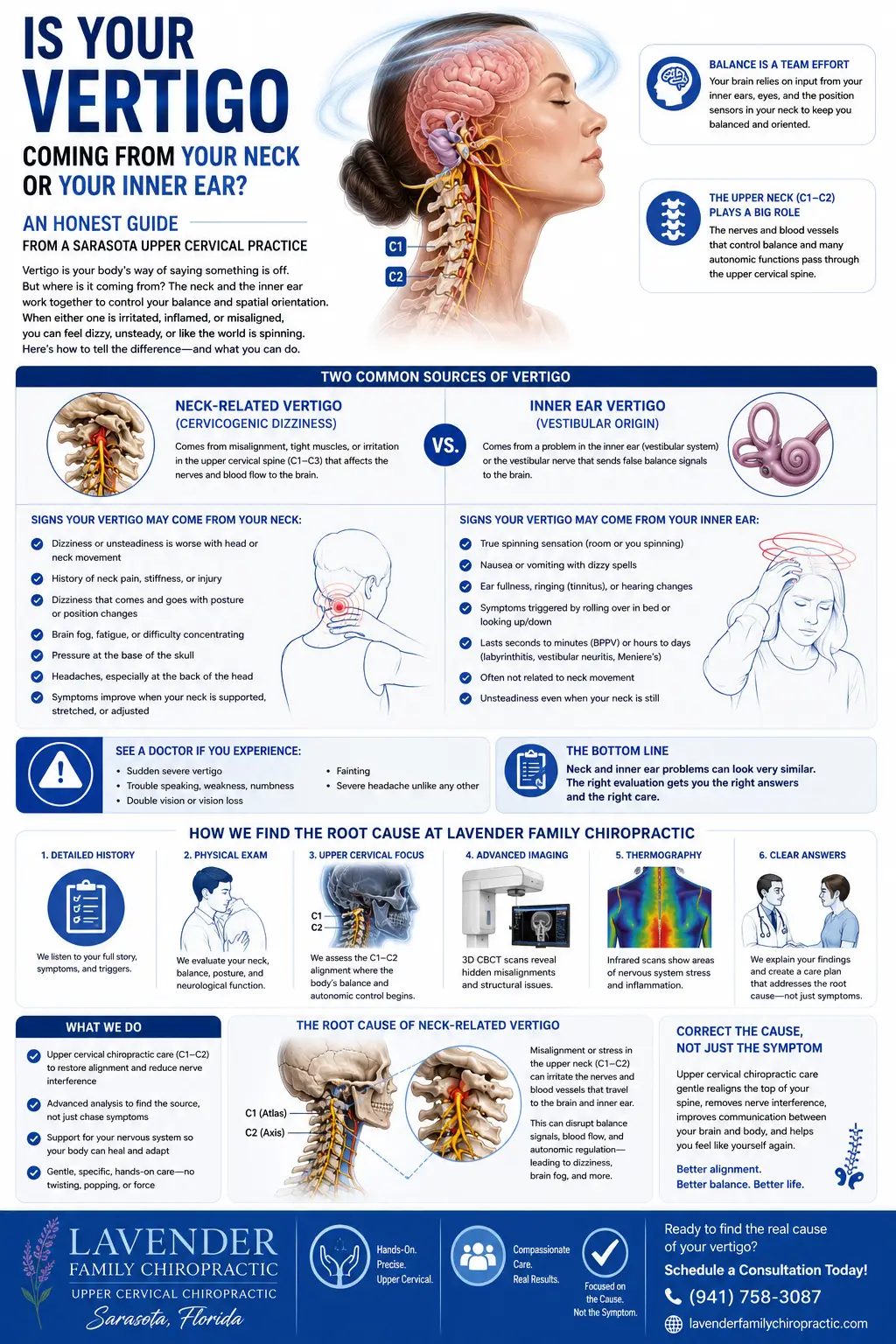
The first thing to understand is that “vertigo” — that false sense of spinning, tilting, rocking, or the room moving — is a symptom produced by your balance system, and that system has several independent parts. Your brain builds your sense of balance by blending three streams of information: your inner ear (the vestibular system), your eyes (vision), and your body’s position sensors (proprioception), a huge share of which live in the joints and muscles of your upper neck. When any one of those streams sends faulty data, the streams disagree, and your brain interprets the mismatch as dizziness.
That’s why vertigo can come from the inner ear, from the brain, or from the neck — and why treating the wrong stream produces exactly what frustrated patients describe: temporary relief, then the symptoms come right back. Getting better depends on identifying the source, not on forcing your case into whatever a particular clinic happens to treat.
The Inner-Ear Causes — Where Upper Cervical Care Is NOT the Answer
Let’s start with the cases where the neck is not the driver, because being clear about this is how you know we’re being straight with you.
BPPV (benign paroxysmal positional vertigo). This is the most common cause of true spinning vertigo. Tiny calcium-carbonate crystals (otoconia) break loose inside the inner ear and drift into the semicircular canals, where they don’t belong. Rolling over in bed or tipping your head back triggers brief, intense spinning. BPPV is a mechanical inner-ear problem, and the correct treatment is a canalith repositioning maneuver — the Epley and its cousins — performed by someone trained in them. No spinal adjustment relocates a loose crystal in your inner ear. If you have classic BPPV, you need the maneuver, full stop.
Otolithic and vestibular injury. The inner ear also contains gravity sensors (the utricle and saccule) and the vestibular nerve. A hard impact — a car crash, a fall, a violent jolt on the water — can physically damage these structures. When the sensor itself is injured, your two ears send unequal signals and the brain perceives a constant tilt, floatiness, or head “vibration.” This is a real, documented problem, and here is the honest part: you cannot adjust a neck to repair a damaged inner-ear sensor. These cases need vestibular rehabilitation therapy (VRT) — structured exercises that retrain the brain to recalibrate around the injured sensor. A good vestibular physical therapist is the right provider for that, and we refer to them without hesitation.
Ménière’s, vestibular neuritis, labyrinthitis. Fluid disorders and inner-ear inflammation each have their own medical pathways. Upper cervical care may support the nervous system around these conditions, but it does not “fix” the inner-ear disease itself, and we won’t claim it does.
If your vertigo is purely one of these, the upper cervical spine is not your answer — and a clinic that pretends otherwise is doing you a disservice.
The Neck Causes — Where Upper Cervical Care IS Often the Missing Piece
Now the flip side, which gets missed just as often — usually by providers who only look at the inner ear.
A large share of your body’s balance-position sensors sit in the joints and deep muscles of the upper neck, feeding constant data to the brainstem about where your head is in space. When the atlas (C1) or axis (C2) is misaligned — from whiplash, a concussion, a fall, or years of posture — those sensors send distorted signals. The brain now gets a mismatch between what the neck reports and what the eyes and inner ear report, and the result is dizziness, unsteadiness, and a “off” feeling that positional maneuvers never resolve because the crystals were never the problem.
This is called cervicogenic dizziness, and it is real, common, and consistently underdiagnosed. A narrative review of proprioceptive cervicogenic dizziness lays out how faulty cervical position sense creates exactly this kind of sensory mismatch between the neck, the eyes, and the vestibular system. A systematic review and meta-analysis of manual therapy for cervicogenic dizziness found evidence supporting cervical-spine-directed care for reducing dizziness in these patients. And research on cervical factors in whiplash-associated dizziness links persistent post-trauma dizziness directly to the neck. When the upper cervical spine is the driver, no amount of inner-ear rehab fully fixes it — because the faulty signal is coming from the neck.
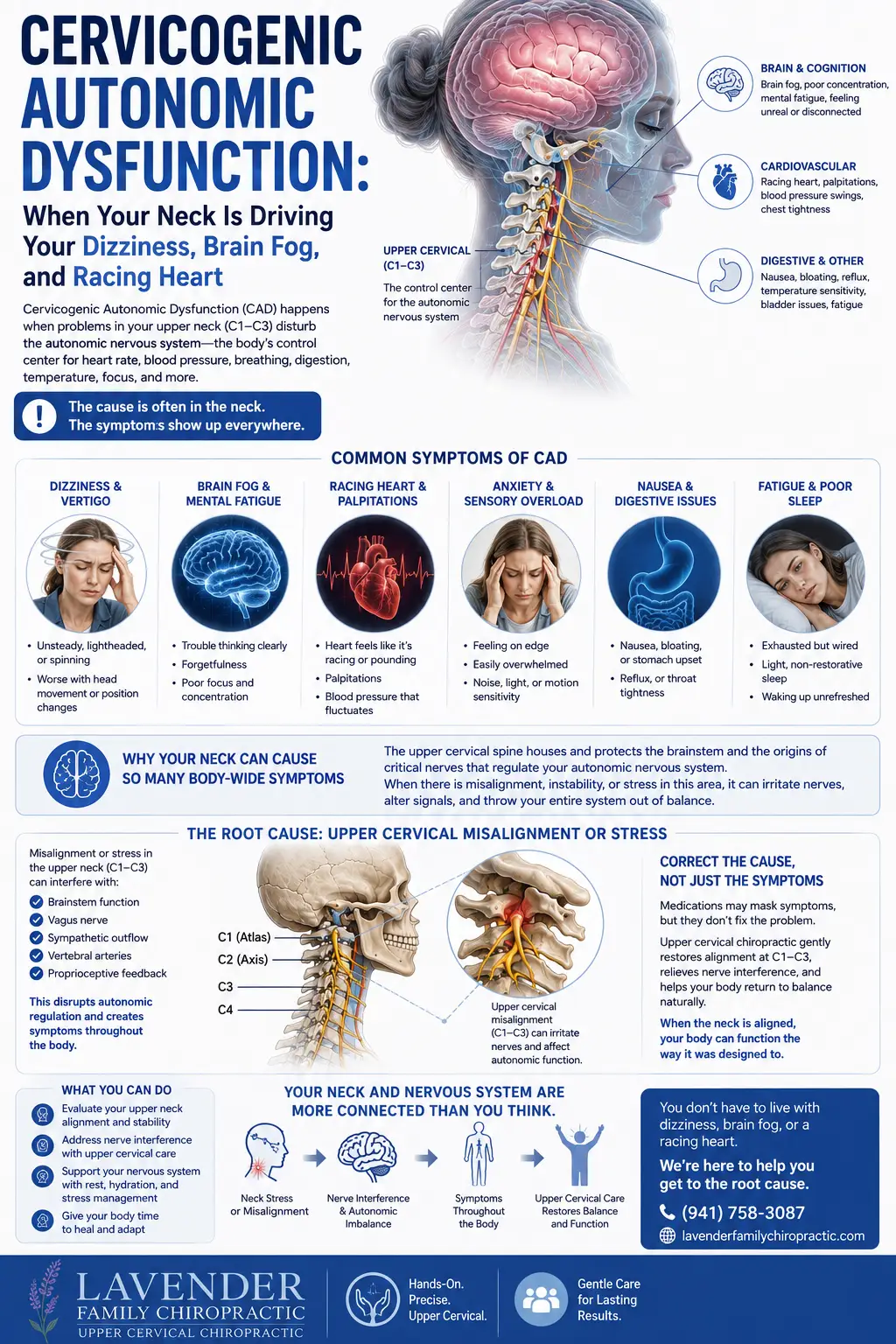
The upper neck also surrounds the brainstem, where the vestibular signals and autonomic control are integrated, which is why upper cervical misalignment can amplify dizziness, brain fog, and the “wired and unsteady” feeling that so many trauma patients carry for years. We go deeper into that in our piece on cervicogenic autonomic dysfunction.
The Trauma Cases That Fool Everybody — Because It’s BOTH
Here is the insight that resolves the whole argument, and it’s the one thing both camps tend to miss.
A violent trauma — a rough-water jolt, a rear-end collision, a hard fall — does not politely damage only one system. The same impact that shears crystals loose and injures the inner-ear sensor also whips the head on the neck and disrupts the upper cervical joints. That’s not a coincidence; the head and neck move together, so a force big enough to injure the inner ear is almost always big enough to injure the upper cervical spine too.
Now watch what happens. The pure-inner-ear provider treats the vestibular injury, gets partial improvement, and dismisses the lingering neck-driven dizziness as “just guarding.” The pure-adjustment provider corrects the neck, gets partial improvement, and can’t understand why the positional spinning keeps returning. Each one fixes their half and leaves the patient stuck with the other half. The patient concludes that “nothing works,” when the reality is that only half of the problem was ever treated — twice.
The complete answer for a trauma-driven dizziness case is to address both: the inner-ear component with the right maneuvers and vestibular rehabilitation, and the upper cervical component with a precise structural evaluation and correction. It’s also worth knowing that after successful crystal-repositioning maneuvers, residual dizziness commonly persists — the maneuver cleared the crystals, but something else is still driving the symptoms. In trauma patients, that “something else” is very often the upper cervical spine that no one evaluated. That’s the gap we exist to close.
Why the Neck Injury Is So Easy to Miss After Trauma
Part of the reason the cervical half of a trauma case gets overlooked is that it often doesn’t show up where people look for it. A standard MRI or X-ray is very good at spotting fractures, disc herniations, and gross structural damage — and after most whiplash or impact injuries, those images come back “normal.” The patient is told there’s nothing wrong with their neck. But the injury that drives dizziness isn’t a broken bone; it’s a disruption of the small joints, ligaments, and position-sensing nerves at the top of the neck, and a resulting misalignment of the atlas and axis that a static image isn’t designed to flag.
This is exactly why research on cervical factors in whiplash-associated dizziness matters: it documents that persistent dizziness after a whiplash injury is strongly tied to the cervical spine — the neck — even in patients whose imaging looks unremarkable. So a trauma patient can be told, accurately, that their inner ear was injured and, inaccurately, that “your neck is fine,” when the neck’s contribution simply wasn’t measured the right way. Our 3D imaging exists precisely to measure the upper cervical alignment that standard films gloss over.
There’s also a mechanical reason the head and neck get injured together. Your head weighs roughly ten to twelve pounds and balances on the small ring of the atlas. Any force strong enough to jolt the fluid and crystals inside your inner ear has, by definition, whipped that ten-pound head on its neck. The inner ear and the upper cervical spine are mechanically coupled; you rarely injure one in isolation. That’s the whole reason “treat one system and hope” leaves trauma patients half-better and frustrated.
Why “It Worked for a While, Then Came Back” Is Your Biggest Clue
If there’s one pattern that should make you suspect an unaddressed second driver, it’s this one: a treatment helps briefly, then the dizziness returns. Patients describe it constantly — “the maneuver worked for a few days,” “the adjustment helped for a week,” “the exercises calmed it down and then it flared again.”
That pattern is not a sign that the treatment was worthless. It’s usually a sign that the treatment addressed a real driver — but not the only one. When crystals are cleared but an injured sensor or a misaligned neck keeps feeding the brain bad data, symptoms creep back. When the neck is corrected but loose crystals remain, the positional spinning returns. Temporary relief followed by relapse is the fingerprint of a multi-system problem being treated one system at a time.
The productive response to that pattern is not to conclude “nothing works” and give up. It’s to ask the question this entire article is built around: which drivers have actually been evaluated, and which one is still being ignored? For a huge number of stuck dizziness patients — especially after trauma — the ignored driver is the upper cervical spine, because it’s the one system that requires specific imaging and a specific kind of exam to see.
How We Figure Out Which System Is Driving Your Dizziness
Because we take the “which system” question seriously, our evaluation is built to rule the neck in or out, not to assume it.
We start with a thorough history — the mechanism of onset (trauma, virus, posture, none), the pattern of your dizziness, what provokes and relieves it, and every provider and treatment you’ve already tried. When it’s appropriate, we use 3D CBCT imaging to measure your upper cervical alignment in three dimensions and paraspinal infrared thermographyto read how your nervous system is behaving along the spine. If your history and exam point to classic BPPV or an inner-ear injury rather than the neck, we tell you, and we point you to the right vestibular provider. If your upper cervical spine is contributing, we address it with the Knee Chest Upper Cervical technique — precise, gentle, and low-force, with no twisting, cracking, or popping — which is exactly the kind of care a sensitized, trauma-affected nervous system tolerates best.
We’re glad to work alongside your vestibular therapist, your ENT, and your neurologist. Balance is a team sport, and the patients who recover fastest are usually the ones whose neck and inner ear both get addressed instead of one being ignored.
How to Choose a Dizziness Provider (Whoever You Pick)
Because dizziness has several possible drivers, the most important quality in a provider isn’t which tool they use — it’s whether they’ll tell you when their tool isn’t the answer. A few questions worth asking anyone you consult:
- Will you evaluate more than one system? A provider who assesses only the inner ear, or only the neck, can only find what they look for. You want someone who screens for the inner ear, the neck, the eyes, and central causes — and refers out when it’s outside their lane.
- What happens if your treatment doesn’t help? A trustworthy answer includes a plan to reassess and refer, not just “more of the same.”
- Are you willing to work with my other providers? The patients who recover fastest usually have a small team — an ENT or vestibular therapist for the inner-ear piece, an upper cervical provider for the neck piece — rowing in the same direction.
- Do you make cure promises? Be cautious with anyone guaranteeing results. Balance recovery is individual, and honest providers describe what’s likely, not what’s promised.
We hold ourselves to the same standard we’d want you to hold anyone to. Our lane is the upper cervical spine, we’re very good at evaluating it, and we’ll tell you honestly when your dizziness lives somewhere else. That’s not a limitation — it’s how you avoid wasting months on half-answers.
Red Flags: When Dizziness Is an Emergency
Most vertigo is benign, but some dizziness signals something serious. Call 911 or go to an emergency department if your dizziness comes with any of the following: sudden severe or “worst-ever” headache; slurred speech, facial drooping, or one-sided weakness or numbness; double vision or sudden vision loss; difficulty walking or a sudden loss of coordination; fainting or chest pain; or a very high fever with a stiff neck. These can be signs of a stroke or other vascular or neurological emergency. Get medically cleared first; the neck evaluation can wait until you’re safe.
Top Questions
How do I know if my vertigo is from my neck or my inner ear? The pattern is the biggest clue. Brief, intense spinning triggered by rolling over or tipping your head points toward inner-ear BPPV. Dizziness that travels with neck pain, stiffness, or a history of whiplash/concussion — and that maneuvers don’t fully resolve — points toward a cervical contribution. A proper evaluation sorts it out; you shouldn’t have to guess.
I already did the Epley maneuver and I’m still dizzy. Why? Very common. The maneuver clears loose crystals, but if there’s also an injured inner-ear sensor or an unaddressed upper cervical problem, symptoms persist. Residual dizziness after successful maneuvers is well documented — it usually means a second driver was never treated.
My vertigo started after a car accident / fall / rough water. Does that change things? A great deal. High-impact trauma commonly injures the inner ear and the upper cervical spine at the same time. Treating only one leaves you stuck. These are exactly the cases where a combined approach matters most.
Will upper cervical care cure my vertigo? We don’t make cure claims. When the upper cervical spine is a driver of your dizziness, correcting it can be the missing piece many patients have been searching for. When it isn’t the driver, we’ll tell you and help you find the right care.
Are the adjustments forceful? No — precise, gentle, and low-force, with no twisting, cracking, or popping. That gentleness is especially important for a nervous system already unsettled by dizziness or trauma.
My imaging was normal, so isn’t my neck fine? Not necessarily. Standard MRI and X-ray are built to find fractures and herniations, not the subtle upper cervical misalignment and joint-sensor disruption that drive dizziness. Research links persistent post-whiplash dizziness to the neck even when routine imaging looks clean. That specific alignment is what our 3D CBCT imaging is designed to measure.
Do I have to choose between vestibular therapy and upper cervical care? No — and for trauma cases you often shouldn’t. The inner-ear component and the cervical component respond to different treatments, and addressing both is frequently what finally resolves a case that each approach alone only partly helped. We’re happy to coordinate with your vestibular therapist and physicians.
How long until I know if the neck is involved? Usually the initial evaluation and imaging give a clear read on whether your upper cervical spine is contributing. If it isn’t, we’ll say so and point you toward the right care rather than starting a plan you don’t need.
Serving Sarasota, Bradenton & Lakewood Ranch
If you’ve been chasing dizziness answers around Sarasota, Bradenton, or Lakewood Ranch and keep getting half a solution, you deserve a provider who will tell you honestly which system is driving your symptoms. Lavender Family Chiropractic (NeckWise North Sarasota) sits at 5899 Whitfield Avenue, the corner of University and Whitfield — minutes from Lakewood Ranch and just across from Bradenton — and we see dizziness patients from across the region, including Venice, Osprey, Port Charlotte, Parrish, and Myakka. We evaluate the upper cervical piece others skip, and when your dizziness belongs to the inner ear, we say so and point you to the right care.
You don’t have to keep collecting half-answers. Call (941) 243-3729 or book a complimentary consultation and let’s find out exactly which system is driving your dizziness — and build the complete plan around it.
Lavender Family Chiropractic (NeckWise North Sarasota) · 5899 Whitfield Avenue, Suite 107, Sarasota, FL 34243 · (941) 243-3729
This article is for general educational purposes and is not medical advice. Vertigo and dizziness should be evaluated by qualified professionals; some causes are medical emergencies. If your dizziness comes with sudden severe headache, weakness, speech or vision changes, or fainting, seek emergency care.