Eustachian Tube Dysfunction vs. TMJ: How to Tell the Difference
By Dr. Rusty Lavender — Lavender Family Chiropractic, Sarasota, FL
That plugged, full, achy feeling in your ear has two very common culprits that are constantly mistaken for each other: Eustachian tube dysfunction (ETD), a problem with the little tube that ventilates your middle ear, and TMJ/TMD, a problem with the jaw joint that sits a fingertip in front of your ear canal. Here’s the fast way to tell them apart. ETD usually flares with colds, congestion, allergies, and altitude changes like flying or driving over a bridge, and it tends to pop, click, or crackle when you swallow or yawn. TMJ usually flares when you use your jaw — chewing, talking, wide yawning — and it tends to click at the joint, feel tender right in front of the ear, and ache into the cheek or temple. The catch nobody tells you: they overlap anatomically, they frequently coexist, and both share a quiet common denominator in the upper neck. If your ear or jaw symptoms keep coming back no matter what you try, that upper cervical region is the piece that usually never gets checked.
This article gives you the honest, useful version — the one the competitor pages skip. You’ll get a clear, side-by-side way to sort ETD from TMJ, a plain-English explanation of why they overlap so badly, the real anatomical thread that ties both of them to the top of your neck, and a straight account of what the research does and doesn’t say. No fabricated statistics, no “miracle cure” language, and every study I reference is linked so you can read it yourself. We serve Sarasota, Bradenton, and Lakewood Ranch, and this is the explanation we give our own patients when they walk in holding one hand over an ear that just won’t clear.
This article is educational and not a substitute for medical, dental, or ENT care. If you have persistent or severe ear or jaw symptoms, please get them properly evaluated.
First, What Each of These Actually Is
Before you can tell two things apart, you have to know what each one is — and this is exactly where the confusion starts, because both live within an inch of each other around your ear.
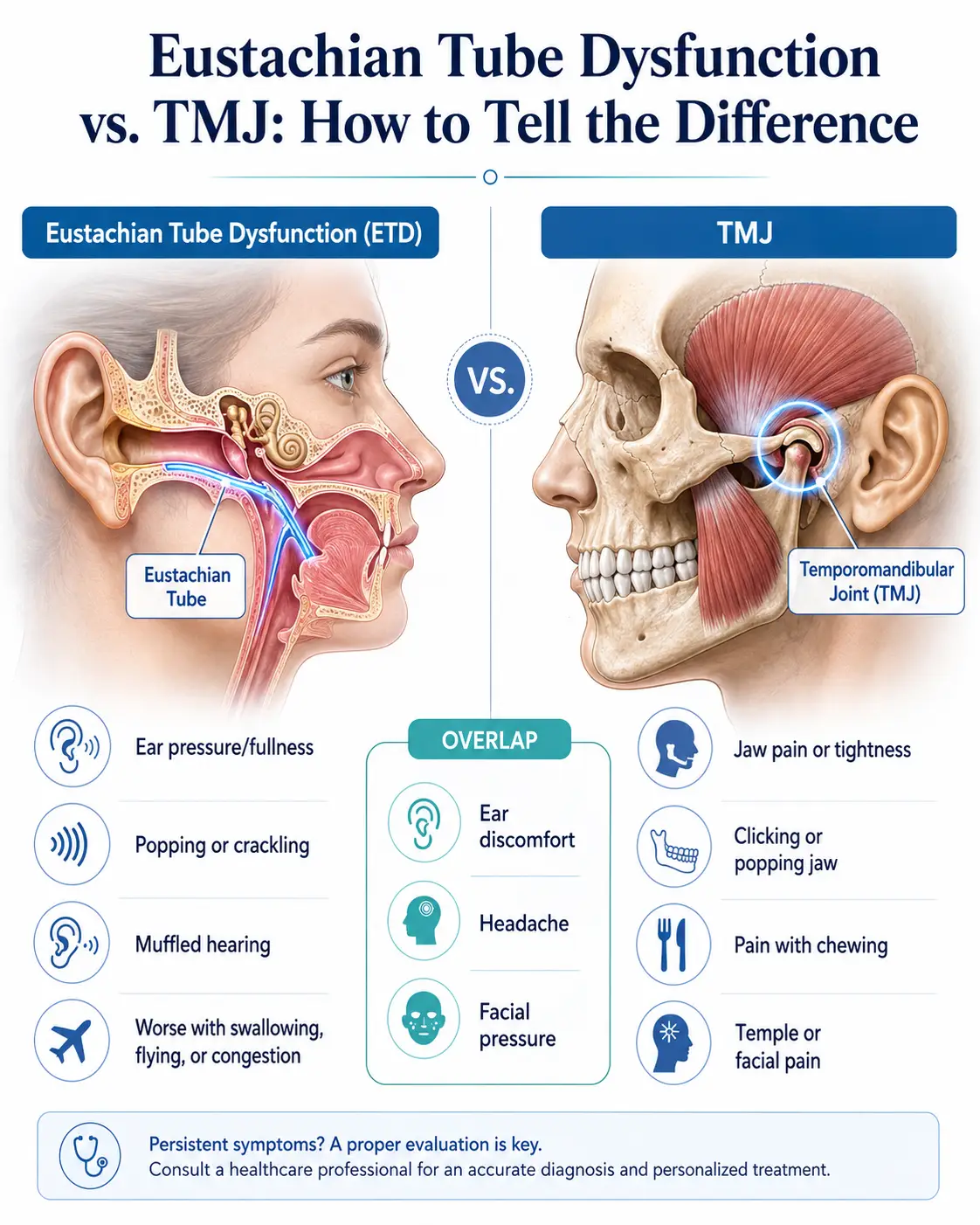
Eustachian tube dysfunction (ETD) is a problem with ventilation. The Eustachian tube is a narrow channel that runs from the back of your nose and throat up to your middle ear. Its job is to equalize pressure and drain fluid, and it does that by briefly opening every time you swallow or yawn — that little “click” you feel on an airplane is the tube doing its work. Most of the time the tube sits closed; it only pops open when a small muscle pulls it open. When that opening-and-closing mechanism doesn’t work well — the tube stays too closed, opens too rarely, or occasionally stays stuck too open — pressure and fluid build behind the eardrum. The result is that classic stuffed, underwater, full-ear feeling, sometimes with muffled hearing, popping, crackling, mild pain, or the sense that your ear needs to “clear” and won’t. An international consensus paper led by Schilder in 2015 laid out the modern definition, types, and diagnosis of Eustachian tube dysfunction, and one thing it makes clear is that ETD is a genuinely tricky diagnosis — the symptoms are nonspecific and overlap with several other conditions. Which is a polite, peer-reviewed way of saying: this gets confused with other things constantly. TMJ is high on that list.
TMJ / TMD is a problem with a joint. The temporomandibular joint (TMJ) is the hinge where your lower jaw meets your skull, and it sits directly in front of your ear canal — put a finger just ahead of the little flap of your ear, open and close your mouth, and the knuckle-like movement you feel is the joint itself. “TMD” (temporomandibular disorder) is the umbrella term for pain and dysfunction in that joint and the muscles that move it. Because the joint is so close to the ear, TMD very commonly masquerades as an ear problem: fullness, pressure, aching, ringing, even a sense of blockage — all referred from a joint and muscles that are millimeters away from your ear canal. Plenty of people go to the doctor certain they have an ear infection, get told the ear looks perfectly normal, and leave with no answer. Often the answer was the jaw all along.
So: ETD is a ventilation problem in a tube; TMJ is a mechanical and muscular problem in a joint. Same neighborhood, very different machinery. (If you’ve already worked out that your jaw is the culprit, our deeper piece on TMJ, jaw tension, and ear fullness goes further on that specific pattern — this page is about telling the two apart in the first place.)
ETD vs. TMJ: The Side-by-Side Breakdown
Here’s the practical part — the sorting guide. No single line below is a diagnosis by itself, but the pattern usually points you one direction. Read down each column and notice which one sounds more like you.
What tends to point toward Eustachian Tube Dysfunction (ETD)
- It flares with congestion. Colds, sinus infections, allergies, and post-nasal drip are classic triggers. If your ear plugs up every time your nose does, think ETD.
- It’s altitude- and pressure-sensitive. Flying, driving down from the mountains, going over a tall bridge, elevators, scuba diving — anything that changes ambient pressure sets it off or makes it worse.
- Popping, clicking, or crackling with swallowing or yawning. This is the tube trying (and struggling) to open. Some people describe a “Rice Krispies” crackle.
- A sensation of fullness or “underwater” muffled hearing that you keep trying to clear by swallowing, yawning, or holding your nose and gently blowing.
- It can improve when the congestion clears. Symptoms often track with your sinuses and the seasons.
- Jaw movement doesn’t especially change it. Chewing a sandwich isn’t the trigger; a head cold is.
- It may come with autophony — your own voice or breathing sounding unusually loud in the affected ear (more typical of the “patulous,” or stuck-open, variety).
What tends to point toward TMJ / TMD (the jaw joint)
- It flares with jaw use. Chewing (especially tough or chewy food), long conversations, wide yawning, singing, or dental work make it worse. That’s the tell — the symptom tracks with using the joint, not with your sinuses.
- Clicking, popping, or grating in the jaw joint itself when you open or close your mouth — felt right at that spot in front of the ear, not deep inside it.
- Tenderness when you press just in front of the ear. Put a fingertip on the joint and gently open and close; if that spot is sore or the muscle along your cheek and temple is tender, that points to TMD.
- Aching that spreads into the cheek, temple, side of the head, or down toward the angle of the jaw — TMD pain refers outward in a way pure ETD usually doesn’t.
- Morning jaw soreness, a tired jaw, or a history of clenching or grinding (bruxism). Waking up with a stiff, achy jaw is a strong hint.
- Limited or uneven opening, or the jaw catching, locking, or deviating to one side as you open.
- Ear symptoms with a completely normal ear exam. When the doctor says “your ear looks fine” but it still feels full and achy, the jaw is a prime suspect.
The quick self-check
Two informal tests can help you lean one way:
- The chew test. Deliberately chew gum or a chewy snack for a few minutes. If your ear symptoms clearly worsen, that implicates the jaw (TMJ). If chewing does nothing but a stuffy nose reliably plugs the ear, that leans ETD.
- The press test. Rest a fingertip just in front of your ear canal and open and close your mouth. Local tenderness, clicking, or a reproduction of your ear ache at that spot points toward TMD.
And here’s the honest complication: plenty of people get “yes” to both. That is not you failing the quiz. It’s the anatomy telling the truth — and it’s exactly why the next section matters.
Why They Overlap So Badly (The Anatomy Nobody Explains)
If ETD is a tube problem and TMJ is a joint problem, why do they blur together, coexist, and trade symptoms? Because they are wired into the same nerve and share the same tight patch of real estate at the side of your skull. This is the part the competitor’s page hand-waves — so let’s actually walk through it.
The muscle that opens your Eustachian tube is a jaw-nerve muscle. The tube doesn’t pop open by itself; a small muscle called the tensor veli palatini pulls it open every time you swallow or yawn. Here’s the pivotal detail: that muscle is supplied by a branch of the trigeminal nerve — specifically the mandibular division, the same major nerve that runs your chewing muscles. The StatPearls anatomy reference on the tensor veli palatini spells this out directly: it’s the muscle responsible for opening the Eustachian tube, and it’s innervated by the mandibular branch of the trigeminal nerve. Sit with that for a second. The “on switch” for ventilating your ear runs on the very same nerve system that runs your jaw.So a trigeminal system that’s cranky, over-facilitated, or fed a steady stream of pain signals from an irritated jaw joint is operating the ear-opening muscle and the chewing muscles at the same time. It is not a stretch — it’s basic wiring — for jaw trouble and ear-tube trouble to travel together.
The tube and the muscle are also anchored to the cranial base, right where the jaw lives. This isn’t just a nerve coincidence; it’s a structural neighborhood. Anatomical work on the relationship between the Eustachian tube, the tensor veli palatini, and the cranial base describes how intimately the tube’s function is tied to the muscle and to the bony base of the skull it all attaches to. The Eustachian tube, the muscle that opens it, and the jaw joint are packed into the same small three-dimensional space beneath the skull. Tension, loading, and mechanical stress in that region don’t stay politely in their own lanes.
And the muscle’s actual job of opening the tube is measurable. This isn’t theory. Researchers have used EMG to record the tensor veli palatini’s activity in relation to Eustachian tube function, confirming that this specific muscle’s contraction is what drives the tube open during swallowing. In other words, ear-tube ventilation genuinely depends on a trigeminal-innervated muscle doing its job at the right moments — so anything influencing that nerve system or that muscle’s environment is squarely relevant to ear fullness.
Put the three together and the overlap stops being mysterious:
- The jaw muscles are trigeminal.
- The Eustachian-tube-opening muscle is trigeminal.
- The tube, the muscle, and the jaw joint all crowd the same corner of the skull base.
One irritated system, two sets of symptoms. That’s why so many people have both, why treating only one can leave the other simmering, and why “is it my ear or my jaw?” is often the wrong question. The better question is: what’s upstream of both?
The Upper Cervical Connection — The Honest Version
Here’s where we get to the piece that ties this to the top of your neck, and I’m going to be careful and honest about it, because you deserve that more than you deserve hype.
The trigeminal nerve — the one running your jaw muscles and your Eustachian-tube-opening muscle — does not operate in isolation. In the brainstem, the sensory nucleus of the trigeminal nerve extends down and functionally converges with the sensory nerves from the very top of your neck — the upper cervical nerves, C1, C2, and C3. Neuroscientists call this shared junction the trigeminocervical complex. It’s a well-established piece of anatomy, and it’s the reason problems in the upper neck can refer pain and altered signaling up into the face, head, and ear region — and vice versa. It’s the same convergence that helps explain why neck issues can drive certain headaches around the temple and eye.
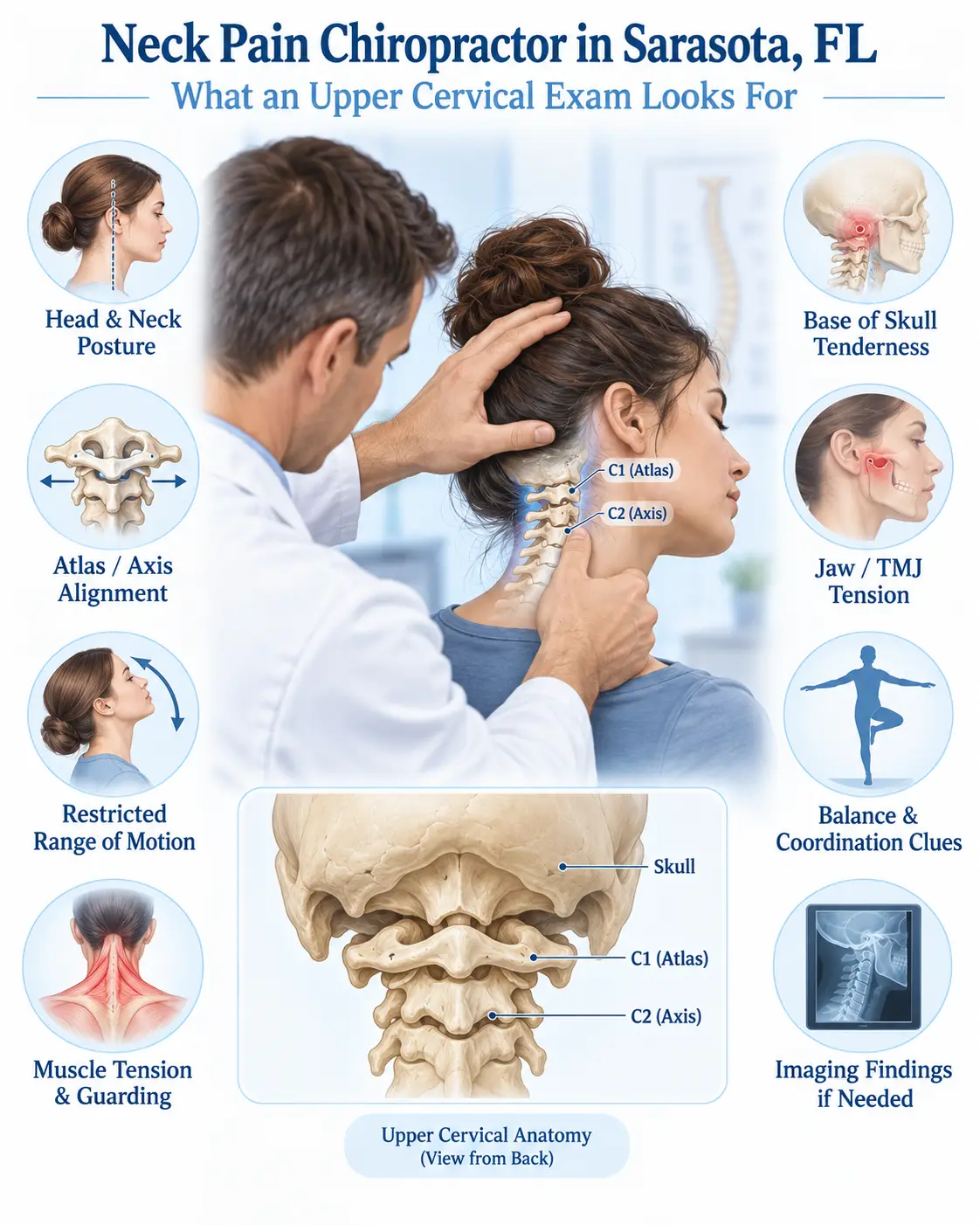
So what does that mean for your ear and jaw? It means the upper cervical spine — the atlas (C1) and axis (C2), the two vertebrae that balance your head and sit right at that trigeminocervical crossroads — is a plausible shared contributing factor to both jaw and ear-tube symptoms. When that top segment of the neck is misaligned or under abnormal mechanical stress, it can feed irritation into a nerve network that is already juggling the jaw joint and the muscle that ventilates your ear. That’s not a cure claim and it’s not magic. It’s convergence: a busy shared switchboard where the neck’s inputs and the face’s inputs meet, and where a mechanical problem in one place can plausibly amplify symptoms in another.
Let me be equally clear about what I am not saying. I’m not telling you that upper cervical care cures ETD or TMJ, or that it’s a proven treatment for either, or that your neck is definitely the cause of your symptoms. It isn’t proven, and honest anatomy doesn’t need to be oversold. What I am saying is that, given how tightly the trigeminal system, the jaw, the ear tube, and the upper neck are woven together, the upper cervical region is a reasonable, biologically sensible thing to evaluate — especially when ear and jaw symptoms are stubborn, recurrent, or nobody has been able to give you a satisfying answer. The neck is one piece of the puzzle. It’s a piece that usually goes unexamined, and that’s the gap we look at.
This also fits a pattern we see: people whose ear fullness or jaw trouble started or worsened after a head or neck event — a whiplash, a fall, a concussion, a dental procedure with the mouth held wide open for a long time, or years of forward-head “screen posture” loading the base of the skull. If your ear or jaw symptoms trace back to something that happened to your head or neck, that’s a meaningful clue that the structural side is worth a look, not an afterthought.
How We Evaluate the Upper Cervical Piece at Lavender Family Chiropractic
At Lavender Family Chiropractic in Sarasota, we focus specifically on the upper cervical spine — the atlas, the axis, and the junction where the skull meets the neck, the exact region that sits at the trigeminocervical crossroads. Our whole approach is built on measurement rather than guesswork, because when the question is this specific, you want data, not a hunch.
- 3D CBCT imaging. We use cone-beam CT to see your upper cervical alignment in three dimensions. Every neck is built a little differently, and a real correction has to be based on your anatomy, not an average.
- Paraspinal infrared thermography. This reads how your nervous system is behaving along the spine — a window into the autonomic and neurological picture that’s directly relevant when we’re talking about a nerve network shared by the jaw, the ear tube, and the neck.
- The Knee Chest Upper Cervical technique. When a correction is warranted, this method is precise, gentle, and low-force, with no twisting, cracking, or popping. For a region this delicate and this neurologically busy, that gentleness is the entire point — we’re trying to reduce irritation, not add force to it.
The goal is straightforward and honest: if the upper cervical region is contributing mechanical stress into a nerve system that’s already managing your jaw and your ear tube, we want to give that region a calmer, better-aligned environment — and then see whether your symptoms have more room to settle. We coordinate with, and never replace, the medical, dental, and ENT care you may also need. The neck is our piece. It works best alongside the rest.
→ Serving Sarasota, Bradenton, and Lakewood Ranch, we’d be glad to take a look. Call Lavender Family Chiropractic at (941) 243-3729 to schedule a consultation. We’re at 5899 Whitfield Avenue, Suite 107, Sarasota, FL 34243 — corner of University and Whitfield.
What the Research Actually Says
The competitor’s page cites studies with no links and tosses out claims you can’t check. I’d rather hand you the sources and let you read them. Here is what the evidence I’ve referenced above genuinely supports — and, just as importantly, what it doesn’t.
- ETD is real, defined, and genuinely easy to confuse with other conditions. The 2015 international consensus statement on the definition, types, and diagnosis of Eustachian tube dysfunction (Schilder and colleagues) established the modern framework for ETD and underscores that its symptoms are nonspecific and overlap with other disorders. That overlap is the whole reason a “how to tell the difference” article like this one needs to exist.
- The Eustachian tube is opened by a trigeminal-innervated muscle. The StatPearls anatomy reference on the tensor veli palatini documents that this muscle opens the Eustachian tube and is supplied by the mandibular division of the trigeminal nerve — the same nerve division that serves the muscles of chewing. This is the anatomical hinge that connects jaw and ear.
- The tube, that muscle, and the skull base are structurally intertwined. Anatomical study of the Eustachian tube–tensor veli palatini–cranial base relationship describes how the tube’s function depends on the muscle and its attachments to the base of the skull — the same crowded region where the jaw joint sits.
- The muscle’s tube-opening role is measurable. EMG research on the tensor veli palatini and Eustachian tube function confirms that this muscle’s contraction is what physically opens the tube during swallowing, grounding the anatomy in recorded muscle activity rather than assumption.
Now the honest boundary. These studies establish the anatomy and physiology — that a trigeminal muscle opens the ear tube, that it’s tied to the jaw’s nerve supply and the skull base, and that ETD is easily mistaken for other conditions. They do not prove that upper cervical chiropractic treats or cures ETD or TMJ. The link to the upper neck runs through the well-established trigeminocervical convergence — solid anatomy that makes the neck a plausible contributing factor worth evaluating, not a proven therapy. I’m drawing that line on purpose. You’ve been sold enough certainty by people who didn’t earn it.
A Quick Safety Note — Please Don’t Skip This
Most ear fullness and jaw achiness is annoying but not dangerous. Some is not. Get prompt medical or ENT attention if you have any of the following: sudden hearing loss, severe or rapidly worsening ear pain, fever with ear pain, drainage or discharge from the ear, dizziness or vertigo with hearing changes, or any facial weakness or drooping.Those can signal infection or other conditions that need timely care, and no article — this one included — is a substitute for being examined. When in doubt, get it checked in person, and quickly.
Top Questions
How do I know if my ear fullness is ETD or my jaw? Look at the trigger. If it flares with colds, congestion, allergies, or altitude changes and pops when you swallow, lean ETD. If it flares with chewing, talking, or yawning, clicks at the joint in front of your ear, and is tender when you press there, lean TMJ. Try the chew test and the press test in this article. And know that many people have both — which is common, not confusing on purpose.
Can I have both ETD and TMJ at the same time? Yes, and it’s genuinely common. The muscle that opens your Eustachian tube and the muscles that move your jaw share the same trigeminal nerve supply and crowd the same corner of your skull, so trouble in one system frequently travels with trouble in the other. Treating only one can leave the other simmering — which is part of why we look upstream at the shared factors, including the neck.
Why would my neck have anything to do with my ear or jaw? Because of the trigeminocervical complex — the place in the brainstem where the trigeminal nerve (jaw and ear-tube muscle) converges with the upper cervical nerves (C1–C3). That shared junction means the upper neck can plausibly contribute to face, jaw, and ear-region symptoms. It’s not a proven cure; it’s a well-established anatomical reason the upper cervical spine is worth evaluating when symptoms won’t settle.
Does upper cervical care cure ETD or TMJ? No, and I won’t claim it does. What upper cervical care can do is address a plausible shared contributing factor — mechanical stress at the top of the neck feeding into a nerve system that’s already managing your jaw and ear tube. We evaluate it, correct it when warranted, and coordinate with your medical, dental, and ENT care. It’s one piece, not a magic fix.
My symptoms started after a car accident / dental work / a fall. Does that matter? It matters a lot. Whiplash, concussions, falls, and long dental appointments with the jaw held wide open all load the upper neck and jaw region. If your ear or jaw symptoms began or worsened after something happened to your head, neck, or jaw, the structural side deserves a proper look rather than being assumed away.
Is the adjustment forceful? Will you crack my neck? No. The Knee Chest Upper Cervical technique is precise, gentle, and low-force, with no twisting, cracking, or popping. For a region this delicate, that’s the whole point.
When should I stop reading and just get seen? If you have sudden hearing loss, severe ear pain, fever, ear drainage, vertigo with hearing changes, or any facial weakness — get medical or ENT care promptly. For persistent, recurrent, or unexplained ear and jaw symptoms that keep coming back, that’s a good time to have the upper cervical region evaluated alongside your other care.
Is any of this a substitute for seeing a doctor, dentist, or ENT? No. This article is educational. Upper cervical evaluation complements medical, dental, and ENT care — it doesn’t replace it. Persistent or severe symptoms should always be properly examined.
Serving Sarasota, Bradenton & Lakewood Ranch
If you’ve been going in circles with a full, achy ear or a jaw that clicks and aches — told your ear “looks fine” but it still doesn’t feel fine — and you’re anywhere around Sarasota, Bradenton, or Lakewood Ranch, the piece you may be missing is the one at the very top of your neck. Lavender Family Chiropractic (NeckWise North Sarasota) sits at 5899 Whitfield Avenue, the corner of University and Whitfield, minutes from the Lakewood Ranch corridor and just across from Bradenton, with patients coming to us from Venice and Parrish as well. Whether your ear and jaw symptoms lean ETD, lean TMJ, or blur between the two, we evaluate the upper cervical region where the trigeminal and cervical nerves converge — using 3D CBCT imaging and paraspinal infrared thermography — so the shared factor nobody else checked finally gets looked at.
Explore more: Eustachian tube dysfunction and upper cervical care, TMJ / TMD and upper cervical care, ear pressure and the upper cervical spine, and an overview of upper cervical chiropractic care.
Tell Them Apart — Then Check the Piece Nobody Checked
Sorting ETD from TMJ isn’t guesswork once you know what to look for. ETD tracks with congestion and pressure changes and pops when you swallow. TMJ tracks with jaw use and clicks and aches right in front of the ear. And when it’s genuinely both — which it often is — that’s your anatomy pointing at the shared wiring underneath: a trigeminal nerve system running the jaw and the muscle that ventilates your ear, all crowded into the same corner of your skull, all converging with the upper cervical nerves at the top of your neck.
That convergence is the honest reason the upper neck belongs in this conversation. Not as a cure, not as a guarantee — as a plausible shared contributing factor that’s worth evaluating, especially when your symptoms keep coming back and no one has been able to explain why. Keep your doctor, keep your dentist, keep your ENT. What we add is a careful look at the one region that sits where the jaw, the ear tube, and the neck all meet.
If that’s you, let us look at the piece the other pages skip. Call (941) 243-3729 or book a consultation. Serving Sarasota, Bradenton, and Lakewood Ranch.
Lavender Family Chiropractic (NeckWise North Sarasota) · 5899 Whitfield Avenue, Suite 107, Sarasota, FL 34243 · (941) 243-3729
This article is for general educational purposes only and is not medical, dental, or ENT advice, diagnosis, or treatment. Upper cervical care addresses a plausible contributing factor and is not a proven treatment or cure for Eustachian tube dysfunction or TMJ/TMD. Please seek prompt in-person evaluation for sudden hearing loss, severe ear pain, fever, ear drainage, vertigo, or facial weakness, and consult your physician, dentist, or ENT for persistent or severe symptoms.