
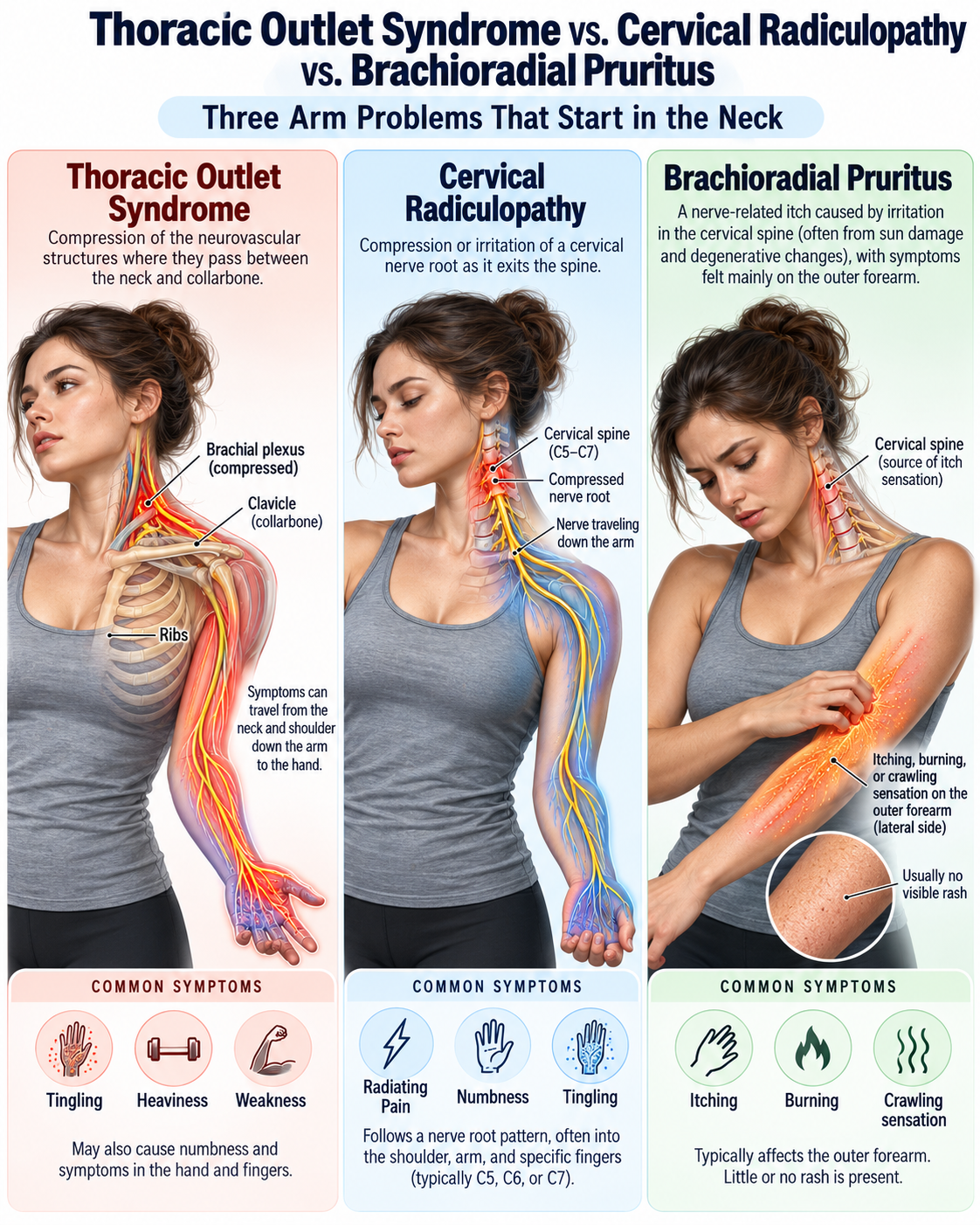
Thoracic Outlet Syndrome vs. Cervical Radiculopathy vs. Brachioradial Pruritus: Three Arm Problems That Start in the Neck
By Dr. Rusty Lavender, D.C. and Dr. Jacob Temple, D.C. — upper cervical chiropractors, Lavender Family Chiropractic, Sarasota, FL. Published October 2026.
Your arm is doing something it shouldn’t. Maybe it goes numb when you raise it to dry your hair. Maybe your fingers tingle and your grip feels weak. Maybe there’s a deep ache from the shoulder to the hand that nobody can find a reason for. Or maybe it’s not pain at all — it’s an itch on your forearm that no cream touches. Three different conditions produce arm symptoms like these, and they are confused with each other constantly: thoracic outlet syndrome, cervical radiculopathy (a pinched nerve in the neck), and brachioradial pruritus (a nerve itch of the forearm). They’re treated differently. They’re diagnosed differently. And in our experience, people spend months being worked up for the wrong one.
This article tells the three apart in plain language — where each one lives, what each one feels like, which tests sort them, and what the research says about each. Then it covers the thing they share, which is the reason an upper cervical office is writing about all three: every one of them involves nerves that pass through or originate at the neck, and every one of them is affected by how the top of the neck is positioned.
This is educational content, not medical advice. Arm weakness that’s progressing, loss of hand coordination, a cold or pale hand, sudden swelling of the arm, or arm symptoms with chest pain need prompt medical evaluation.
The Shared Anatomy: One Nerve Bundle, Three Places It Can Be Bothered
The nerves that run your arm all begin as five roots exiting the spine in the lower neck — C5 through T1. Those roots merge into a braided bundle called the brachial plexus, which travels out of the neck, through a narrow passage between the collarbone, first rib, and scalene muscles called the thoracic outlet, and then down the arm as the individual nerves that reach your fingers.
Each of the three conditions is a problem at a different point along that path:
- Cervical radiculopathy — the root is compressed where it exits the spine, by a disc or bony narrowing.
- Thoracic outlet syndrome — the bundle is compressed further along, in the passage between neck and arm.
- Brachioradial pruritus — the small itch fibers from the C5–C6 roots are irritated at the neck and the brain reads it as itch on the forearm.
Three different spots, one pathway. That’s why the symptoms overlap, and why the location and character of what you feel is the key to telling them apart.
Cervical Radiculopathy: The Pinched Nerve
What it is. A nerve root compressed at the spine, most often C6 or C7, usually by a bulging disc in younger adults or bony narrowing in older ones. Iyer and Kim (2016) review the condition, and the population study by Radhakrishnan and colleagues (1994) found it peaks in people in their fifties, with most cases improving without surgery.
What it feels like. Sharp, radiating pain from the neck down the arm along a specific path; numbness or tingling in a strip of the arm or in particular fingers (thumb side for C6, middle finger for C7, pinky side for C8); sometimes weakness in specific muscles. Worse when you extend or turn your neck toward the painful side. Often better with your hand on top of your head, which takes tension off the root.
How it’s sorted. Reflexes and strength by nerve root, the Spurling test (extending and tilting the neck toward the side reproduces the arm pain), and MRI, which shows the disc or narrowing.
Our article on pinched nerve in the neck covers it in depth.
Thoracic Outlet Syndrome: The Bundle Squeezed Between Neck and Arm
What it is. Compression of the brachial plexus — or, less often, the artery or vein that run alongside it — as they pass through the thoracic outlet. The Society for Vascular Surgery’s reporting standards by Illig and colleagues (2016) define three types: neurogenic (nerve compression, by far the most common — well over ninety percent of cases), venous, and arterial. Jones and colleagues (2019), in a comprehensive review, describe the usual culprits: tight or enlarged scalene muscles, an extra cervical rib, a first rib that sits high, forward-head posture that narrows the space, and prior trauma — whiplash especially.
What it feels like. Here’s where it differs from a pinched nerve. The symptoms are usually diffuse rather than following one nerve’s strip — aching or heaviness through the whole arm, numbness and tingling in the hand that’s often worst in the ring and little fingers, and a hand that fatigues with use. The classic trigger is arm elevation: reaching overhead, drying your hair, holding a phone, sleeping with the arm up. Neck movement alone usually doesn’t set it off the way it does with radiculopathy. There may be aching in the shoulder blade and, in the vascular types, hand color change, swelling, or coldness.
How it’s sorted. This is the hard one. Sanders and colleagues (2007) laid out the diagnostic approach: it’s clinical, based on the history, tenderness over the scalene muscles, and provocative tests that reproduce symptoms with the arm elevated — the elevated-arm stress test and the upper-limb tension test. Imaging and nerve studies are used mainly to rule outradiculopathy and other causes; neurogenic TOS often shows nothing on them. Hooper and colleagues (2010) review the anatomy and the examination, and note how often TOS is missed or mislabeled because the tests for everything else come back normal. Ferrante (2012) describes the full spectrum, from the rare “true” neurogenic form with measurable nerve damage to the far more common “disputed” form with symptoms but normal electrical tests.
Our thoracic outlet syndrome guide covers the condition in full, and why are my hands numb covers the hand-numbness side.
Brachioradial Pruritus: The Itch That Isn’t Skin
What it is. A chronic itch on the outer forearm — sometimes up to the shoulder — with no rash, triggered by sun, and traced in most patients to the cervical spine. Marziniak and colleagues (2011) found cervical spine changes on MRI in the large majority of BRP patients, at levels matching the itch. The small itch fibers from C5–C6 are irritated at the neck; the brain reads it as itch on the arm.
What it feels like. Itch, mixed with tingling, burning, or a crawling sensation, on the sun-exposed outer forearm. No rash until you scratch. Worse in summer and at night. Dramatically relieved by an ice pack. Usually no arm pain, no weakness, no hand numbness.
How it’s sorted. The clinical pattern, the ice-pack test, normal skin, and cervical imaging when warranted. Our brachioradial pruritus guide and BRP vs. pinched nerve go further.
Side by Side
| Cervical radiculopathy | Thoracic outlet syndrome | Brachioradial pruritus | |
|---|---|---|---|
| Where the problem is | nerve root at the spine | nerve bundle between neck and arm | itch fibers from C5–C6 at the neck |
| Main symptom | sharp radiating arm pain | diffuse arm ache, heaviness, hand tingling | itch on outer forearm |
| Distribution | one nerve’s strip; specific fingers | whole arm; ring and little fingers | outer forearm, elbow to wrist |
| Provoked by | neck extension / turning toward the side | arm elevation, overhead work, carrying | sun exposure; evening and night |
| Relieved by | hand on top of head | lowering the arm | ice pack |
| Weakness | specific muscles | hand fatigue, grip | none |
| Skin | normal | may change color / swell (vascular types) | normal until scratched |
| Key test | Spurling test, MRI | elevated-arm stress test, scalene tenderness | ice-pack sign |
| Imaging | MRI shows it | usually normal — a rule-out tool | cervical findings common |
The two questions that sort most people quickly: Does raising your arm set it off? (TOS.) Does turning your neck set it off? (Radiculopathy.) If neither, and it itches: BRP.
When It’s More Than One
Overlap is common, and the research explains why. The same forward-head posture that narrows the thoracic outlet loads the lower cervical discs. The same whiplash that irritates a nerve root tightens the scalene muscles. A person can have radiculopathy at C6 and TOS compressing the same fibers further down — the “double crush” that makes each worse — and BRP as the itch expression of the same C6 irritation. If your picture doesn’t fit one box cleanly, that’s not unusual, and it’s an argument for looking at what all three share rather than treating them as three separate problems.
What All Three Share: The Upper Cervical Connection
Each of these conditions is located at or below the lower neck. Our office looks higher, and here’s why that matters for all three.
The cervical spine is organized from the top down. The atlas (C1) and axis (C2) carry the head and set the alignment for everything beneath. When the atlas is misaligned, the head sits off-center and the whole neck compensates: the curve flattens or reverses, the lower cervical discs — C5 through C7, where radiculopathy and BRP originate — take uneven load, and the scalene muscles, which attach to the cervical vertebrae above and the first rib below, are held under asymmetric tension. Tight scalenes narrow the thoracic outlet. That’s the mechanical thread connecting all three: a misaligned upper neck produces the forward-head, flattened-curve, scalene-tight posture that sets up disc wear at the roots, compression at the outlet, and irritation of the small fibers.
The research supports each link. Forward-head posture is one of the recognized contributors to TOS in the reviews by Jones and colleagues (2019) and Hooper and colleagues (2010). Cervical disc degeneration drives both radiculopathy and the cervical findings in BRP. And the position of the atlas is what determines where the head sits over the rest of the spine.
So an upper cervical evaluation in any of these three conditions asks the same question: is the top of the neck positioned in a way that’s loading everything below it unevenly? If it is, correcting that position addresses the mechanical input common to all three — rather than treating the root, the outlet, and the itch as unrelated problems.
Upper Cervical Care at Lavender Family Chiropractic
When someone with arm symptoms comes to our Sarasota office, the first visit is an evaluation, not an adjustment — and the first job is sorting which of the three you fit.
History. What provokes the symptoms — arm elevation, neck movement, sun, time of day; the distribution; injury history; what’s been tried.
Examination. Neurological screening by nerve root (reflexes, strength, sensation); the Spurling test for radiculopathy; the elevated-arm stress test and scalene palpation for TOS; the ice-pack response for BRP; range of motion; and a red-flag screen, because progressive weakness, hand-coordination loss, or a cold, swollen, or discolored arm belong with a physician or vascular surgeon first.
Paraspinal infrared thermography. A non-invasive scan of the heat pattern along the spine, reflecting nervous-system activity — an objective baseline at the upper neck and a way to track change.
3D cone-beam CT (CBCT) imaging of the upper cervical spine. The position of the atlas and axis relative to the skull, in three dimensions and to the degree — information an MRI of the lower neck doesn’t address. Bring any imaging you have; the two answer different questions.
Review of findings before any care.
Correction, if indicated. A precise, low-force procedure specific to your measurements — no twisting, no cracking, no rotation of the neck. Most patients describe it as pressure.
Remeasurement. Thermography after each visit and follow-up imaging when indicated.
Upper cervical care addresses the mechanical source the research points to — the neck — with measurement before and after, so progress is objective rather than guessed at. Results vary from person to person, and we tell you plainly what the findings show. For TOS, this works alongside the stretching, posture, and breathing work a physical therapist provides; for radiculopathy, alongside your physician’s management; for BRP, alongside sun protection and cold.
If your arm is numb, aching, tingling, or itching and nobody has figured out why, call (941) 243-3729 or request an appointment online for an upper cervical evaluation.
What the Research Says
Cervical radiculopathy. Iyer and Kim (2016) on the condition; Radhakrishnan and colleagues (1994) on its epidemiology and mostly non-surgical course.
Thoracic outlet syndrome. Illig and colleagues (2016) — the SVS reporting standards defining the three types. Sanders and colleagues (2007) — the clinical diagnostic approach. Hooper and colleagues (2010) — anatomy, examination, and why it’s missed. Ferrante (2012) — the spectrum from true to disputed neurogenic TOS. Jones and colleagues (2019) — comprehensive review including postural contributors.
Brachioradial pruritus. Marziniak and colleagues (2011) — cervical spine findings on MRI at levels matching the itch.
Managing Each While You Address the Source
Radiculopathy: avoid extension and turning toward the painful side; neutral neck at screens and in bed; the hand-on-head position for relief; your physician’s recommendations.
TOS: avoid sustained overhead work and heavy bags on the affected shoulder; don’t sleep with the arm up; gentle scalene stretching and diaphragmatic breathing (the scalenes are accessory breathing muscles, and chest-breathers keep them tight); posture at screens. A physical therapist who knows TOS is a good partner.
BRP: cold for flares, no scratching, sun protection on the forearms.
All three: no self-cracking, no rotational neck adjustments, a pillow that keeps the neck neutral. Our neck pain guidecovers the broader picture.
Serving Sarasota, Bradenton, Lakewood Ranch, and the Suncoast
Our office is on Whitfield Avenue in north Sarasota, minutes from the Manatee County line. We see patients with thoracic outlet syndrome, pinched nerves, and brachioradial pruritus from Sarasota, Bradenton, Lakewood Ranch, Palmetto, Parrish, Ellenton, Longboat Key, Siesta Key, Osprey, Nokomis, Venice, and North Port. If your arm symptoms have been worked up without an answer, the top of the neck is the piece that hasn’t yet been examined.
Top 15 FAQs: TOS vs. Pinched Nerve vs. Brachioradial Pruritus
1. How do I tell thoracic outlet syndrome from a pinched nerve in the neck? Provocation. TOS is set off by raising the arm; a pinched nerve is set off by extending or turning the neck. TOS symptoms spread through the whole arm; a pinched nerve follows one nerve’s strip into specific fingers.
2. Can thoracic outlet syndrome be caused by the neck? The scalene muscles that form the outlet attach to the cervical vertebrae, and forward-head posture — which starts at the top of the neck — narrows the outlet. Whiplash is a recognized cause. The neck is where the outlet’s boundaries are set.
3. Why is my MRI normal if I have TOS? Because neurogenic TOS usually doesn’t show on MRI or nerve conduction studies. It’s a clinical diagnosis; imaging is used to rule out radiculopathy and other causes.
4. Why do my ring and little fingers go numb? That’s the lower part of the brachial plexus, which is what the thoracic outlet compresses most often. A pinched C8 root can do the same, but it travels with neck-movement provocation.
5. Can I have TOS and a pinched nerve at the same time? Yes — the “double crush.” Compression at the root makes the nerve more vulnerable to compression at the outlet, and vice versa.
6. Is brachioradial pruritus related to either of these? It originates from the same C5–C6 roots that radiculopathy affects, and the same cervical changes. It’s the itch expression of nerve irritation at the neck, where radiculopathy is the pain expression.
7. Why does raising my arm make my hand go numb? Elevation narrows the thoracic outlet and stretches the brachial plexus over the first rib. That’s the hallmark of TOS.
8. Does TOS go away on its own? Mild TOS from posture can improve with posture correction and scalene work. Structural causes — an extra rib, a high first rib, post-whiplash scarring — tend to persist. The Cochrane review by Povlsen and colleagues (2014) found the evidence for most treatments thin, which is a reason to start with the least invasive.
9. When is arm numbness an emergency? A cold, pale, or blue hand; sudden arm swelling; progressive weakness; loss of hand coordination; or arm symptoms with chest pain. Those need a physician or emergency department now.
10. What does upper cervical care do for TOS? It addresses the position of the top of the neck, which sets the posture of everything below — including the scalene tension and forward-head position that narrow the outlet. It works alongside physical therapy for the outlet itself.
11. Is upper cervical care safe with a pinched nerve? The procedure involves no rotation and no thrust, and we screen for red flags and image before any care. If findings call for a surgeon or neurologist, we say so.
12. Should I see a vascular surgeon for TOS? For venous or arterial TOS — swelling, color change, coldness — yes, promptly. For neurogenic TOS, the usual path is conservative care first.
13. How is upper cervical care different from a regular neck adjustment? It’s limited to the top two vertebrae, guided by 3D imaging, and uses a low-force technique without rotation.
14. How soon would I notice a difference? When the upper neck is a factor and it’s corrected, patients typically report changes within the first several weeks. We measure before and after.
15. Do you take insurance? Call the office and we’ll go through costs and coverage before anything begins.
Lavender Family Chiropractic in Sarasota, Florida offers a thorough upper cervical evaluation to find out whether we can help. Call (941) 243-3729 or request an appointment. 5899 Whitfield Avenue, Suite 107, Sarasota, FL 34243.
Related Articles
- Thoracic Outlet Syndrome in Sarasota: Our Complete Guide
- Numb Hands, Tingling Arms, and Pain No One Can Explain
- Why Are My Hands Numb?
- Pinched Nerve in the Neck
- Brachioradial Pruritus vs. Pinched Nerve
- Neck Pain: Our Complete Guide
References
- Iyer S, Kim HJ. Cervical radiculopathy. Curr Rev Musculoskelet Med. 2016. PMID 27250042
- Radhakrishnan K, et al. Epidemiology of cervical radiculopathy. A population-based study from Rochester, Minnesota, 1976 through 1990. Brain. 1994. PMID 8186959
- Illig KA, et al. Reporting standards of the Society for Vascular Surgery for thoracic outlet syndrome. J Vasc Surg.2016. PMID 27565607
- Sanders RJ, Hammond SL, Rao NM. Diagnosis of thoracic outlet syndrome. J Vasc Surg. 2007. PMID 17826254
- Hooper TL, et al. Thoracic outlet syndrome: a controversial clinical condition. Part 1: anatomy, and clinical examination/diagnosis. J Man Manip Ther. 2010. PMID 21655389
- Ferrante MA. The thoracic outlet syndromes. Muscle Nerve. 2012. PMID 22581530
- Jones MR, et al. Thoracic Outlet Syndrome: A Comprehensive Review of Pathophysiology, Diagnosis, and Treatment. Pain Ther. 2019. PMID 31037504
- Marziniak M, et al. Brachioradial pruritus as a result of cervical spine pathology: the results of a magnetic resonance tomography study. J Am Acad Dermatol. 2011. PMID 21641675
- Povlsen B, et al. Treatment for thoracic outlet syndrome. Cochrane Database Syst Rev. 2014. PMID 25427003