Brachioradial Pruritus Evaluation in Sarasota: What We Look for at the Top of the Neck
By Dr. Rusty Lavender, D.C. — upper cervical chiropractor, Lavender Family Chiropractic, Sarasota, FL. Reviewed and updated October 2026.
By the time someone with brachioradial pruritus calls our Sarasota office, they have usually been told their skin looks normal. They have tried antihistamines, steroid cream, moisturizer, and often gabapentin. They have discovered on their own that an ice pack is the only thing that touches the itch. And somewhere along the way a dermatologist, or an article, has mentioned the neck.
This post explains what we actually do when you come in for that question: how we confirm the pattern, what we look for in your history, what we measure at the top of the neck, and what we recommend depending on what we find. For the condition itself, our complete guide to brachioradial pruritus in Sarasota covers the causes we see, the imaging we use, and what to expect at an evaluation in full.
Step one: confirming it is brachioradial pruritus
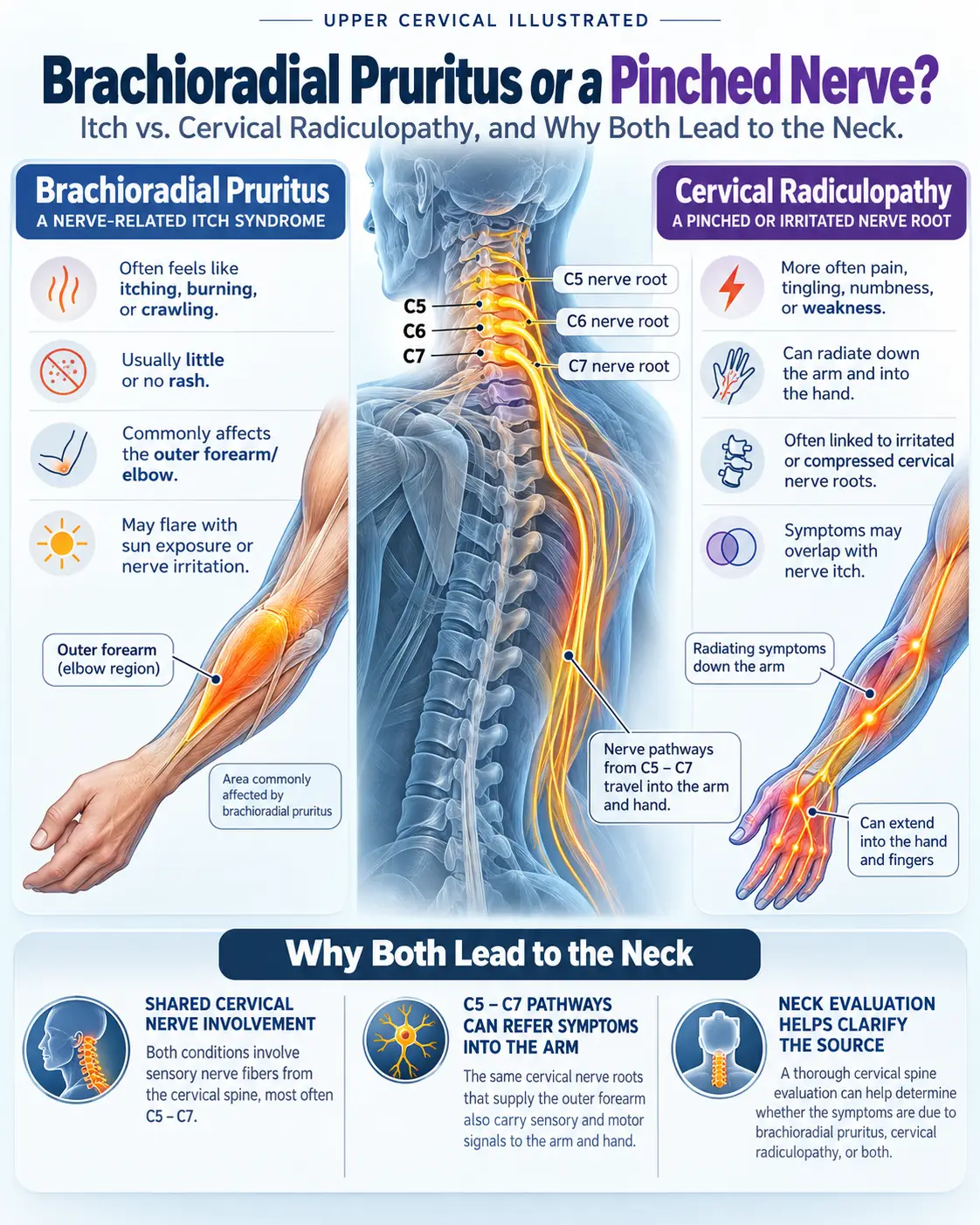
Brachioradial pruritus is a neuropathic itch of the outer forearms, sometimes extending to the upper arms and shoulders, in skin that looks normal apart from scratch marks (Kavanagh et al., Cutis 2023). We ask about the features that make the diagnosis likely: itch, burning, stinging or crawling on the outside of the forearms; worse after sun and in summer; worse at night; and the ice-pack sign, meaning rapid relief from cold that returns when the cold is removed. We ask whether your dermatologist has excluded other causes of chronic itch, including thyroid, liver, kidney and blood conditions, because those deserve to be ruled out properly and we are not the ones to do it.
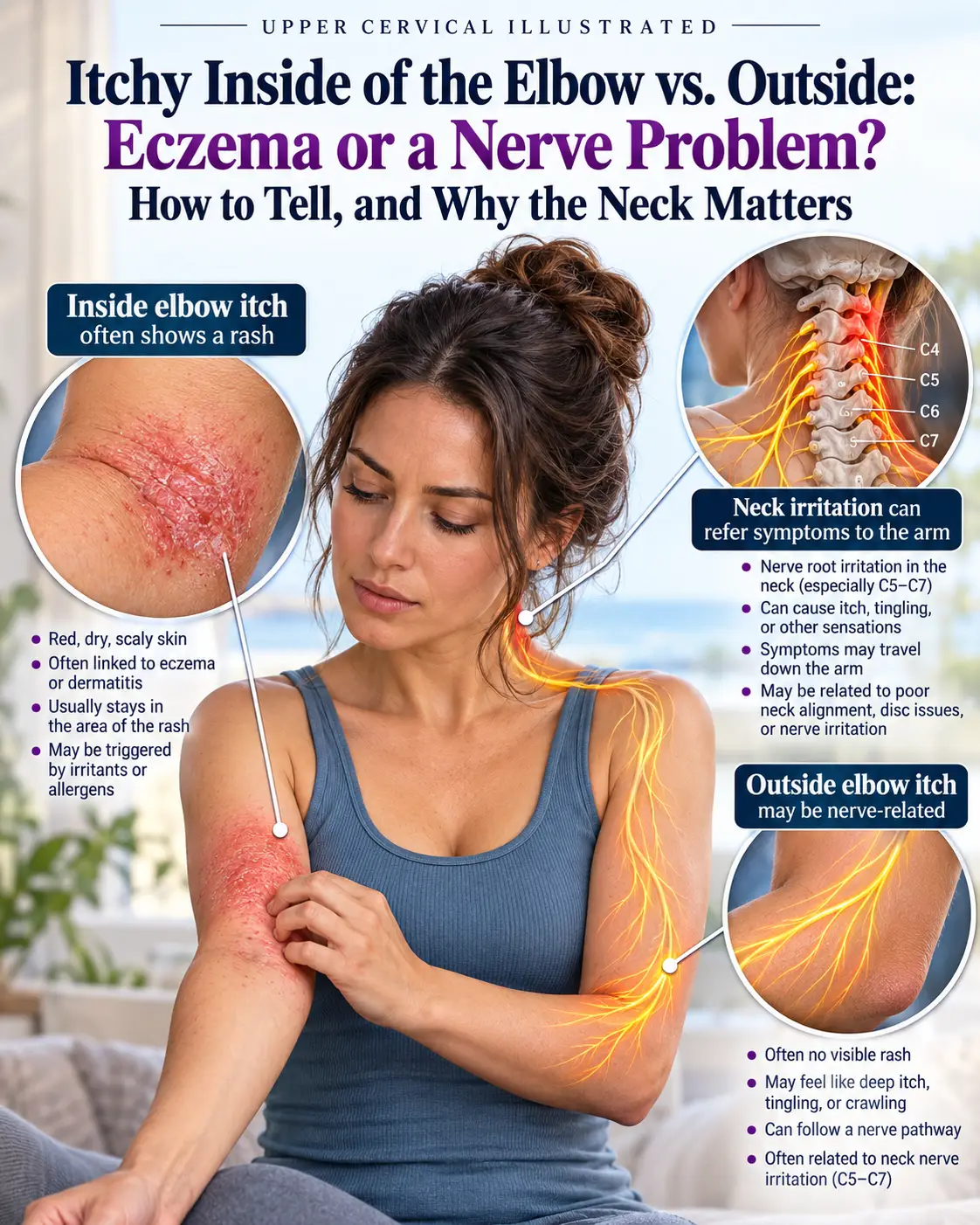
If the pattern does not fit, we say so. Eczema, contact dermatitis and generalized itch are not what we evaluate for.
Step two: the neck history
This is the part other providers usually skip. The strongest imaging study of this condition looked at the cervical spine in 41 patients with brachioradial pruritus and found changes in every one of them, with nerve-root compression from disc protrusion or foraminal narrowing in about 80 percent (Marziniak et al., J Am Acad Dermatol 2011). So we want to know about your neck even if it has never hurt: prior whiplash or rear-end collisions, falls, contact sports, a concussion, years of desk work, and any history of neck stiffness, headaches at the base of the skull, or arm tingling. Many patients have a neck injury from decades earlier that nobody connected to an arm itch that began in their fifties.
Step three: the examination
We check neck range of motion, the position of the head over the shoulders, tenderness and tone at the base of the skull, and how the top two vertebrae move. We look at the forearms for the distribution of scratch marks, because the pattern tells us which cervical levels are involved. We do a brief neurological screen of the arms. If anything suggests a progressive nerve problem, we refer before we do anything else.
Step four: the two measurements
A general chiropractor will usually adjust the neck based on feel. We do not. The decision to correct the atlas is made from two measurements.
3D cone-beam CT imaging of the upper cervical spine shows the position of the atlas and axis relative to the skull in three planes, at low radiation. The published brachioradial pruritus studies imaged the mid and lower cervical levels that match the forearm dermatomes, because that is where the symptom maps. They did not look at the atlas. Our view, explained in the complete guide, is that the top of the neck matters for two reasons: the descending pathways that suppress itch signals pass through the upper cervical cord, and a shifted atlas changes the load on every segment below it over years. The CBCT is how we find out whether yours is shifted.
Paraspinal infrared thermography reads skin-temperature asymmetry along the spine, a reflection of nervous system activity. In a condition defined by a nervous system that has lost its brake on itch signals, a functional measure is useful. We take a baseline and repeat it every visit, so we can see whether a correction is holding without re-imaging you.
What the results can mean
If the atlas is in a normal position and the pattern is unremarkable, we tell you that and do not recommend care. We send the imaging to your dermatologist or physician. It is a useful result: it closes the upper-neck question.
If the atlas shows a measurable misalignment and the pattern is asymmetric, we show you the images, explain what we found, and recommend a short trial of care with a defined review point. We ask you to keep any medication your prescriber has you on, to keep protecting your forearms from sun, and to keep using cold during flares.
If the findings are borderline, we say that and recommend a shorter trial with a clear stopping rule.
What a correction involves
A precise, low-force adjustment to the atlas calculated from your imaging, made while you lie on your side. No twisting, no cracking. For a nervous system that is already over-firing, the gentleness is the point. Visits are closer together at first and spaced out as the correction holds.
What the research supports
We are careful here. The cervical spine connection in brachioradial pruritus is well documented in dermatology and neurology literature (Marziniak et al., J Am Acad Dermatol 2011; Kavanagh et al., Cutis 2023). The evidence for chiropractic care specifically is at the case-report level, including a 2022 report of a patient who improved with chiropractic care and acupuncture (Golden & Diana, Case Rep Dermatol 2022). Case reports show that something is possible, not how often. What we can promise is measurement: you will know whether the top of your neck is out of position, and if we recommend care you will know at each visit whether the correction is holding.
Frequently Asked Questions
Do I need to see a dermatologist first?
We prefer it. A dermatologist confirms the diagnosis and excludes systemic causes of itch. We evaluate the neck’s contribution and are glad to share our imaging with them.
My cervical MRI showed disc changes at C5 to C7. Isn’t that the whole answer?
It may be the site of the symptom. Our question is whether the top of the neck has been loading those levels and whether it is interfering with the system that suppresses itch signals. The MRI was almost certainly not read for atlas position.
Will the evaluation hurt or make the itch worse?
No. The examination is gentle and the imaging and thermography do not touch you. Bring a cold pack if you are mid-flare.
How soon would I know if care is helping?
Patients who respond usually notice a change in itch intensity or flare frequency within the first several weeks of the correction holding. We track it with your notes and our scans, and if nothing changes over a reasonable trial we tell you.
Should I stop gabapentin or capsaicin if I start care?
No. Medication decisions belong with your prescribing doctor. If something is helping, keep using it.
Schedule a Brachioradial Pruritus Evaluation in Sarasota
If your forearms itch, cold is the only thing that helps, and nobody has looked at your neck, an upper cervical evaluation will tell you whether the top of your spine is part of the picture. Call (941) 243-3729 or book online. We are at 5899 Whitfield Avenue, Suite 107, Sarasota, FL 34243.


Get our upper cervical articles first.