

By Dr. Rusty Lavender, D.C. — upper cervical chiropractor, Lavender Family Chiropractic, Sarasota, FL. Reviewed and updated October 2026.
Our complete guide to neck pain care in Sarasota covers the causes we see, the imaging we use, and what to expect at an evaluation.
Upper Cervical Chiropractic to the rescue
NECK PAIN: We’ve all had it at least once in our lives. That nagging rigidity in our necks makes all types of head movements hell and adversely affects our mood and daily lives. It supports the full weight of the head and contains seven vertebrae and is surrounded by a rich network of blood vessels, nerves, muscles, and vital conduits such as the trachea and the esophagus. The neck, also called the cervical spine, is that part of our spinal column beginning from the base of the skull and going down to the shoulders.
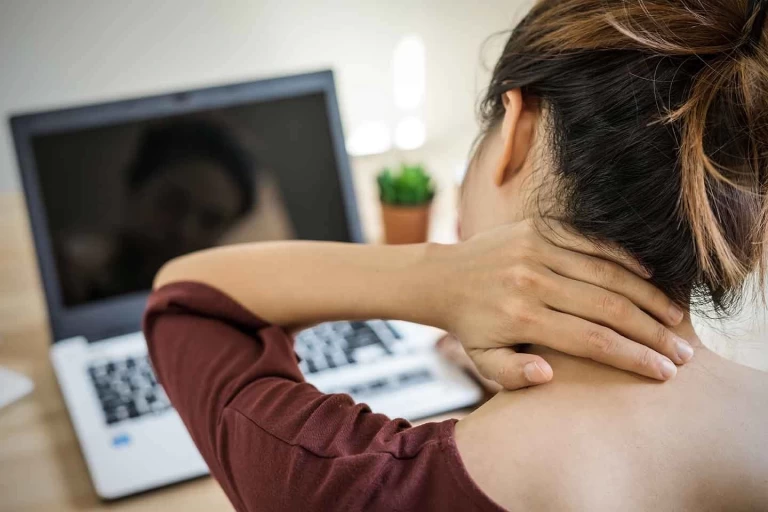
Table of Contents
Why does it hurt?
Multiple activities and positions of the neck have been shown to increase the likelihood of neck pain because of the flexibility involved. Let’s have a look at a few of the most common causes:
· Accidental injury
By far the most common cause of neck pain among children and young adults, sudden excessive movement or impact on the head and neck by any external stimuli often result in neck pain. Examples include the whiplash neck injury seen in a car crash and sudden acceleration or deceleration of the head. The neck muscles try to compensate for the movement by contracting and often go into a stiffened phase called a spasm. This spasm is what manifests as pain.
· Posture
Poor posture such as slouching and rounding of the shoulders is the second most common cause of neck pain and is more common among the working-class population of adults. Sitting around all day for extended periods of time leads to fatigued neck muscles which have the default function of maintaining the straight position of the neck and head.
These fatigued and weakened muscles generate that familiar pain.
Similarly, obesity and weak back muscles also disrupt the normal shape and integrity of the spinal column and can lead to pain at any point of the column.
· Age
It is no surprise that with age all the bones and joints in the body become progressively weakened and susceptible to injury.
Cervical vertebrae and their joints are no exception with age-related diseases such as Osteoarthritis, Cervical spine stenosis, and other degenerative diseases of the neck.
The cervical vertebrae see a gradual loss of range of motion because of joint and bone erosion as in Osteoarthritis.
This results in painful movement and stiffness of the neck.
Narrowing of small nerve canals in the bones results in increased pressure on the nerves as in Cervical spine stenosis, and this produces numbness and pain.
Degeneration of the cartilaginous discs between the vertebrae not only hinders movement but also increases the chances of disc herniation that compresses the nerve fibers, again leading to pain.
Upper Cervical Chiropractors to the rescue
While drugs and surgeries for neck pain and injuries are the more popular forms of treatment, we’d like to direct your attention towards the third kind of solution.
A conservative treatment without the use of drugs and surgeries, one that treats your neck pain by manipulating the natural axes of movement in your neck joints to simply untangle the tangled muscle and nerve fibers, alleviating the pain.
Chiropractic techniques aim to restore normal function and mobility to your joints and muscles using manually elicited natural movements of the affected joints. Your chiropractor after a thorough physical and neurological exam of your neck and adjacent areas will employ the appropriate chiropractic technique(s) to reduce the pain and return the neck to its normal mobility and function as conservatively as possible.
Note that if during the examination, a condition such as a fracture or herniation is identified then the chiropractor will most likely refer you to the appropriate physician or surgeon.
The best-used chiropractic spinal manipulation techniques for neck pain include but are not limited to:
· Cervical drop
Cervical drop is another technique that attempts to break abnormal stiffness points within the cervical spinal column. Here, as opposed to cervical mobilization and traction, the neck itself is not manually moved or pulled.
Instead, a controlled non-damaging thrust is employed by the chiropractor to break the rigidity in the neck.
The patient lies on the stomach or sideways, and the headpiece of the table is lifted to a precise position. The chiropractor then identifies areas of rigidity in the neck by palpating or feeling the soft structures of the neck. Once identified, the rigid areas of the neck are then pressed upon by the chiropractor in a swift, quick thrusting action.
This results in sudden dislodgement of any abnormal fixations and the neck return to normal flexibility.
Conclusion
Chiropractic treatments are used for a whole range of conditions not limited to neck pain. In the face of mainstream treatments like medicinal drugs and costly surgeries, chiropractic techniques offer a more natural solution to one of the most common ailments worldwide. For the full picture — causes, the C1–C2 exam, what the research supports, and what to do at home — see our guide to neck pain treatment in Sarasota.
What the Research Says About Chiropractic Techniques for Neck Pain
Neck pain is one of the most common reasons adults seek care, and the Bone and Joint Decade Task Force estimated that roughly 30 to 50 percent of people deal with it in any given year, often in recurring episodes rather than a single bout (Hogg-Johnson et al., Spine 2008). Most of it is mechanical, meaning it comes from joints, muscles and ligaments rather than disease, and a Mayo Clinic review notes that findings on MRI or X-ray line up poorly with how much a person actually hurts (Cohen, Mayo Clin Proc 2015). That is why current guidelines favor hands-on care, exercise and education over routine imaging and passive treatments alone (Côté et al., Eur Spine J 2016).
Among hands-on approaches, the evidence for cervical manipulation and mobilization is solid: a Cochrane review of 51 trials found meaningful short-term improvements in pain and function for neck pain (Gross et al., Cochrane 2015). Techniques differ in how they are applied, and upper cervical chiropractic is distinct in focusing on the atlas, the top bone of the neck, with a precise, low-force correction rather than a general twist. The largest prospective study of this approach followed 1,090 patients across 83 offices and reported high patient-rated improvement and satisfaction, with reactions mostly mild and short-lived and no serious adverse event (Eriksen et al., BMC Musculoskelet Disord 2011). In our office that precision starts with 3D imaging of the atlas, a correction matched to those images, and follow-up imaging to confirm the change held.
Frequently Asked Questions
Why does my neck hurt?
Neck pain usually comes from muscles working overtime to stabilize a joint that is out of position. The atlas and axis are the most mobile joints in the spine and the most easily shifted by injury, posture, or years of wear. When they are misaligned, the surrounding muscles never fully relax. Upper cervical care corrects that alignment, and thermography before and after shows the nervous system settling.
How does an accidental injury lead to neck pain?
A car accident, fall, or sports collision can shift the atlas without any fracture or obvious damage, so imaging at the emergency room comes back clear. The misalignment then shows up weeks or months later as stiffness, headaches, or pain that moves. Serious injury should be ruled out by a physician first. Our 3D CBCT imaging reveals the atlas position that standard X-rays miss.
What role do posture and age play in neck pain?
Looking down at screens for hours pulls the head forward and loads the upper neck. Over decades, that extra load wears the joints unevenly, so age and posture compound each other. Correcting the atlas does not reverse wear, but it restores a more balanced head position so the neck is not fighting gravity. Many patients notice easier movement as the correction holds; results vary.
How does the Knee Chest technique work?
Knee Chest is an upper cervical technique in which you kneel and rest your chest on a specially designed table. From your 3D CBCT imaging, we calculate the exact angle of the atlas or axis misalignment and deliver a precise, low-force correction with no twisting, cracking, or rotation. You rest afterward, and a thermography scan confirms the nervous system responded.
Where can I get upper cervical care for neck pain near Lakewood Ranch?
Our office is at 5899 Whitfield Avenue, Suite 107, Sarasota, at the corner of University Parkway and Whitfield, minutes from Lakewood Ranch, University Park, and Bradenton. The evaluation includes history, 3D CBCT imaging, and a baseline thermography scan. If the upper neck is not involved, we say so and refer you. Call (941) 243-3729 to schedule an evaluation.
Schedule With Us!
Lavender Family Chiropractic offers consultations to learn more about you. Click the link below!
https://intake.chirohd.com/new-patient-scheduling/724/lavender-family-chiropractic