
By Dr. Rusty Lavender, D.C. — upper cervical chiropractor, Lavender Family Chiropractic, Sarasota, FL. Reviewed and updated October 2026.

Most people who call our Sarasota office about migraine have already been told what it is. They have a diagnosis, usually a prescription, and often a list of triggers to avoid. What they rarely have is an answer to the question they ask us first: why does my neck hurt before, during, or after every attack, and does that mean the neck is part of the problem?
Sometimes it is. This page explains how we sort that out, what a migraine evaluation involves at our office, what upper cervical care can and cannot do for migraine, and when a neurologist should be your first stop rather than us.
Our complete guide to migraine care in Sarasota covers the types of migraine we see, the imaging we use, and what to expect at an evaluation.
Why the neck comes up in almost every migraine evaluation
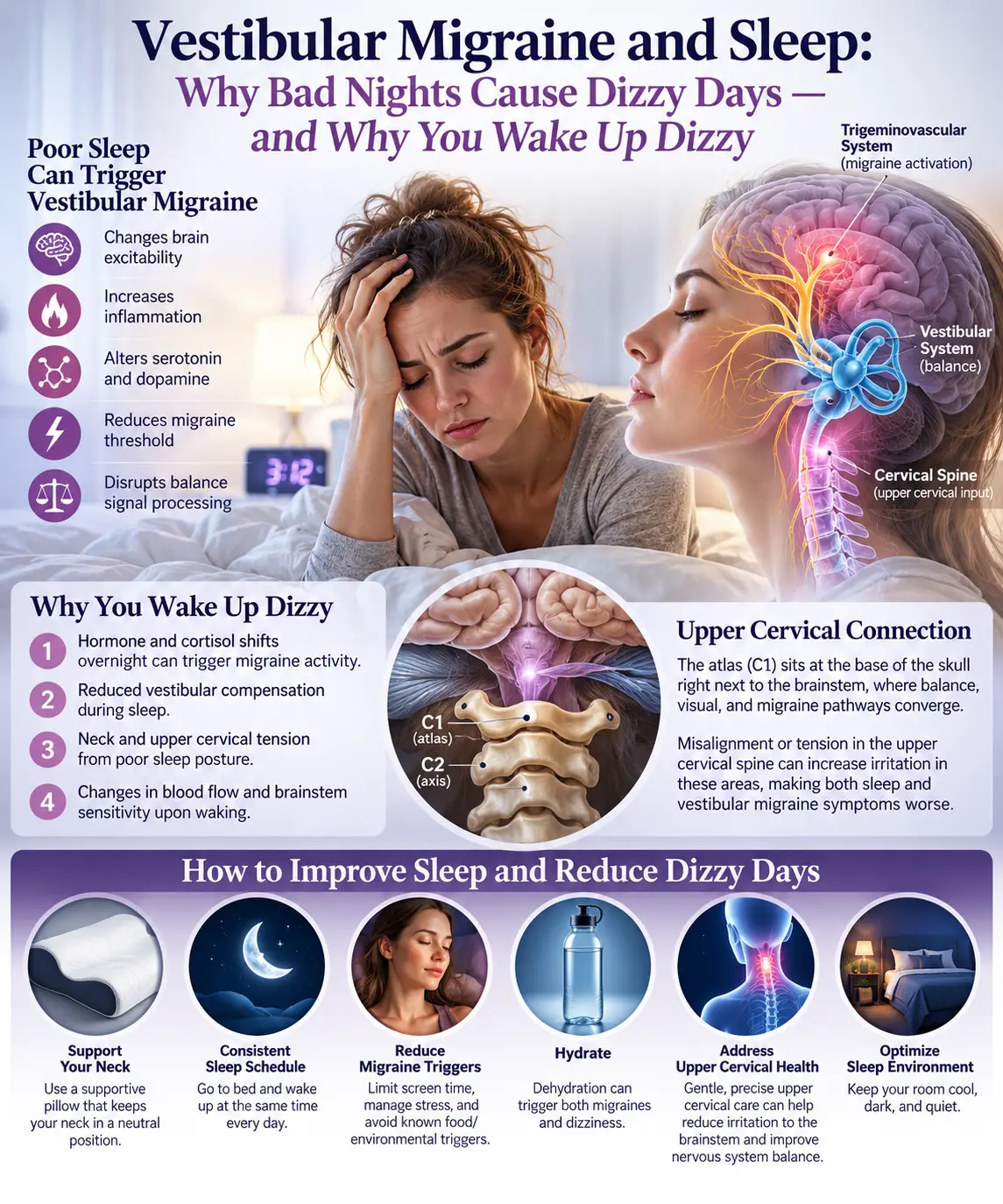
Migraine is a brain condition, not a neck condition. The attacks are generated by the trigeminovascular system and the brainstem, and the throbbing, light sensitivity and nausea come from that process. But the top of the neck is wired into the same circuitry. Sensory nerves from the C1, C2 and C3 levels converge on the trigeminocervical complex, the brainstem relay that also receives pain signals from the head and face. That shared relay is why neck pain can be felt as head pain and head pain can be felt in the neck, and it is why neck pain turns out to be the single most common companion symptom of a migraine attack, more common than nausea.
For some patients the neck is simply along for the ride: the attack starts in the brain and the neck tightens up in response. For others, irritation at the top of the neck is a steady source of input into that relay, lowering the threshold at which an attack fires. Those two patients can describe identical headaches, which is why history alone does not settle it.
Migraine or cervicogenic headache? Why the difference matters in Sarasota
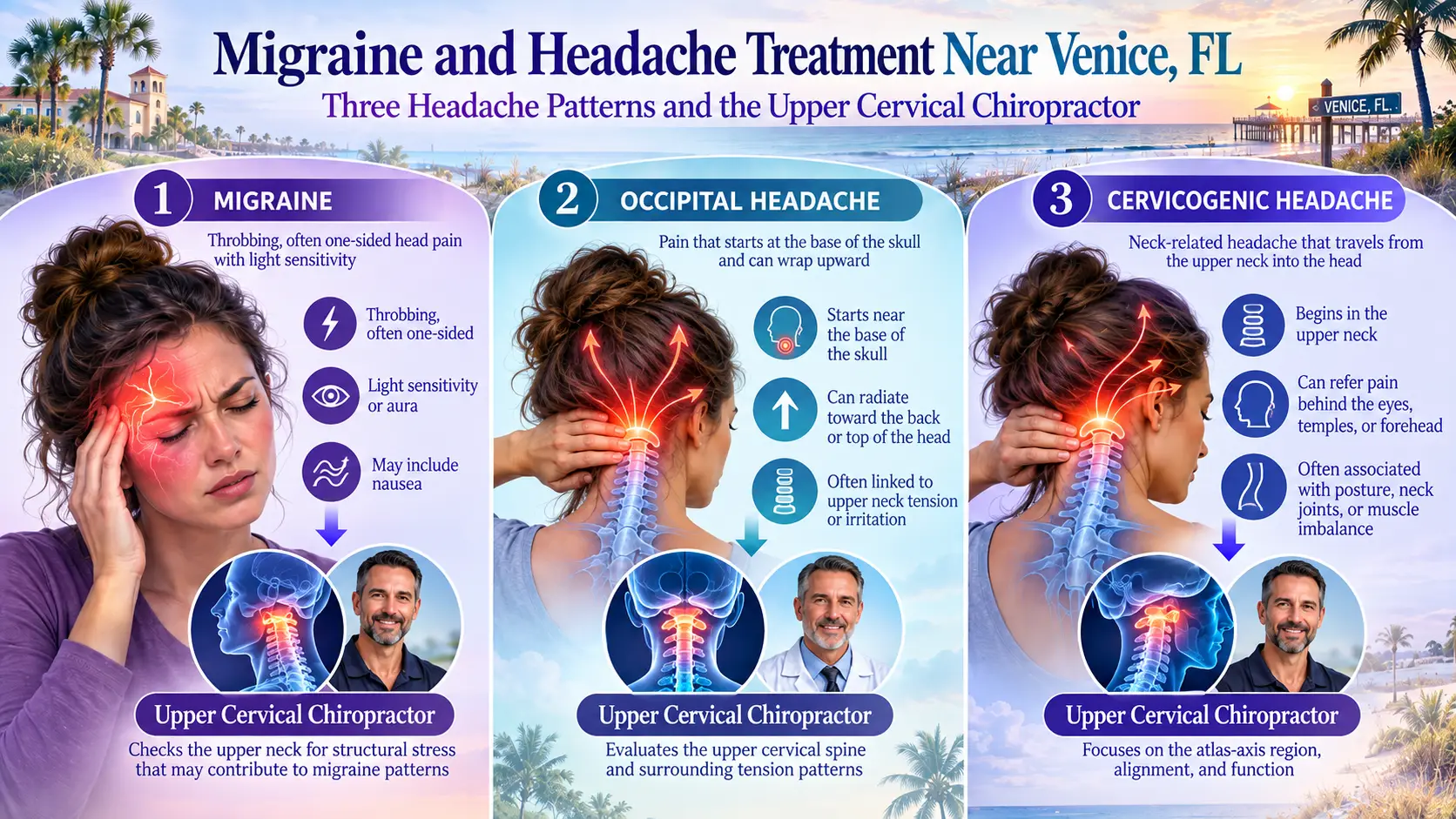
A good share of the people who find this page searching for migraine treatment in Sarasota do not have classic migraine. They have cervicogenic headache, pain that originates in the neck and is referred into the head. The two are managed differently, so we spend real time on the distinction.
Cervicogenic headache tends to be one-sided and stays on that side, starts at the back of the head or neck and spreads forward, is set off by neck movement or pressure at the top of the neck, and comes with reduced neck range of motion. Migraine can switch sides, often comes with nausea, sensitivity to light and sound, and sometimes an aura, and is less tied to how you move your neck. Plenty of patients have features of both, and a migraine sufferer can also have a neck problem that makes attacks more frequent.
In our office this distinction shapes the plan. A clear cervicogenic pattern means the neck is the primary target. A clear migraine pattern means we are addressing a contributing input, not the cause, and we say so plainly. We do not tell migraine patients that an atlas correction will replace their neurologist’s care.
What a migraine evaluation looks like at Lavender Family Chiropractic
The first visit is longer than most people expect, because the answer depends on measurement rather than a quick look.
We start with a detailed history: when the attacks began, whether a fall, collision or concussion preceded them, where the pain starts and spreads, what you have tried, and what your neurologist or primary doctor has already ruled out. We review any imaging you bring. Then we examine the upper neck directly, checking range of motion, the position of the head on the neck, and tenderness at the base of the skull.
The two measurements that make our evaluation different are 3D cone-beam CT imaging of the atlas and thermographic scanning of the upper spine. The CBCT shows the exact position of the top two vertebrae relative to the skull, in three planes, with far less radiation than a conventional CT. A standard neck X-ray cannot show this. The thermography scan reads skin-temperature patterns along the spine, which reflect nervous system activity; we use it at every visit to see whether the correction is holding and the pattern is normalizing.
If the imaging shows the atlas sitting where it should and the scan is unremarkable, we tell you the neck is probably not your driver, and the most useful thing we can do is refer you back with that information. If it shows a measurable misalignment, we explain exactly what we found and what correcting it involves.
What an upper cervical correction involves, and what it does not
An upper cervical correction is a precise, low-force adjustment to the atlas calculated from your imaging. There is no twisting of the neck, no cracking, and no general spinal manipulation. The correction is made with you lying on your side, takes seconds, and is followed by a rest period to give the correction every chance to hold.
The goal is for the atlas to hold its corrected position between visits. Early on we check more often; as the correction holds, visits are spaced out. We re-scan at each visit and re-image when the scans suggest the position has changed. If the scans show the correction is holding and your headache diary shows no change over a reasonable trial, we tell you that too. Most patients who respond notice a change in frequency or intensity within the first several weeks, but we do not promise a timeline, because the research on manipulation and migraine shows real but variable effects and the trials call for more study.
We ask every migraine patient to keep taking their prescribed medication unless their prescribing doctor changes it, and to keep a simple headache diary so that any change is measured rather than remembered.
When a neurologist should come first
Some headaches need medical evaluation before anyone touches the neck. If your headache is the worst of your life, came on like a thunderclap, started after age 50, is new and worsening, comes with fever, weakness, confusion, vision loss or trouble speaking, or follows a head injury, go to an emergency department or your physician first. We screen for these at the first visit, and when we find them we refer rather than treat.
For established migraine, we work alongside your neurologist. The neurologist manages the brain side, including preventive and acute medication. We address the upper-neck input. Patients often ask whether the two conflict; they do not, and we are glad to send our imaging and findings to your other doctors.
Who we see
Our office is in Sarasota near University Town Center, and migraine patients come to us from across Sarasota and Manatee County, including Lakewood Ranch, Bradenton and Venice. Many have had migraine for years, have tried several preventives, and have neck pain they were told was unrelated. Many have a history of whiplash or a concussion that predates the migraines by months or years. A smaller group are patients whose neurologist noticed the cervical component and sent them to us specifically for the neck. Neck pain that travels with the headaches is covered in detail in our guide to neck pain and the upper cervical spine.
What the Research Says About Migraine and the Neck
Neck pain is the most common companion symptom of migraine: a prospective study found it present in more migraine attacks than nausea, the symptom most people associate with migraine (Calhoun et al., Headache 2010). The upper cervical spine feeds directly into the trigeminocervical complex, the brainstem region that generates migraine pain, which is why headache specialists recognize the upper neck as a source of head pain in its own right (Bogduk & Govind, Lancet Neurol 2009). On treatment, a systematic review and meta-analysis found spinal manipulation reduced migraine days and pain intensity and called for larger trials (Rist et al., Headache 2019). Upper cervical chiropractic is the most precise way to address that target: we image the atlas in 3D, correct it without twisting the neck, and track the nervous system’s response with thermography at every visit.
Frequently Asked Questions
Can neck pain actually cause a migraine?
Neck pain is the most common symptom that travels with migraine, and the top of the neck feeds into the same brainstem relay that generates migraine pain. For some patients that input lowers the threshold for attacks. Whether it is doing that in your case is something we measure with imaging rather than assume.
How do you know if my headaches are migraine or coming from my neck?
We look at the pattern: one-sided pain that starts in the neck and is triggered by neck movement points toward cervicogenic headache, while switching sides, nausea, light sensitivity and aura point toward migraine. Then we image the atlas. Many patients have both, and the plan reflects that.
Will I have to stop my migraine medication?
No. We ask you to continue whatever your prescribing doctor has you on. Any change to medication is between you and that doctor, ideally once your headache diary shows a sustained change.
How long before I know if upper cervical care is helping?
Patients who respond usually notice a change in frequency or intensity within the first several weeks of the correction holding. We track it with your headache diary and our scans, and if nothing has changed over a reasonable trial we say so.
Do you work with my neurologist?
Yes. We send our imaging and findings to any doctor you ask us to, and we see our role as addressing the neck component while your neurologist manages the migraine itself.
Schedule a Migraine Evaluation in Sarasota
If your migraines come with neck pain, follow a neck injury, or have not responded the way you hoped, an upper cervical evaluation will tell you whether the top of your neck is part of the picture. Call (941) 243-3729 or book online: https://intake.chirohd.com/new-patient-scheduling/724/lavender-family-chiropractic