
Upper Cervical Care: A Holistic Approach to Managing Headaches and Migraines
By Dr. Rusty Lavender, D.C. — upper cervical chiropractor, Lavender Family Chiropractic, Sarasota, FL. Reviewed and updated October 2026.
Our complete guide to migraine care in Sarasota covers the causes we see, the imaging we use, and what to expect at an evaluation.
Headaches and migraines are more than just a nuisance; for many,they are a debilitating part of daily life. While there arenumerous treatments available, ranging from over-the-countermedications to specialized therapies, one often overlooked approachis upper cervical care. This holistic method focuses on thedelicate relationship between the upper cervical spine (neck) andthe nervous system and its potential impact on headache andmigraine relief.
Table of Contents
Understanding the Upper Cervical Spine
The upper cervical spine consists of the first two vertebrae inthe neck, known as the atlas and axis. These vertebrae are responsible for supporting the head and facilitating its range of motion. Unlike other spinal segments, the upper cervical area lacksthe stability provided by interlocking joints, making it more susceptible to misalignment.
The Link Between the Upper Cervical Spine and Headaches
Misalignments in the upper cervical spine can affect the surrounding nerves and blood vessels, potentially leading to headache and migraine symptoms. These misalignments might be due to various factors like poor posture, accidents, or even everyday wear and tear.
Upper Cervical Care: A Holistic Approach
Upper cervical chiropractors specialize in correcting these misalignments through precise and gentle adjustments. The goal ofthis treatment is not merely to relieve pain but to restore thenatural alignment of the spine, thereby improving the nervous system’s function.
The Adjustment Process
Upper cervical care begins with a comprehensive examination,including imaging studies like X-rays or MRI scans. These images help chiropractors understand the specific misalignment unique to each patient. The adjustment process itself is gentle, often involving light pressure or specialized instruments, and is tailored to each individual’s needs.
Beyond Adjustments: A Multi-Faceted Approach
Effective upper cervical care extends beyond spinal adjustments. Chiropractors may also recommend lifestyle changes, such as ergonomic improvements at work or home and exercises to strengthen the neck muscles. Nutrition also plays a role; certain foods can trigger headaches, and a balanced diet can help reduce inflammation and improve overall health.
Patient Success Stories
Many patients have found significant relief from headaches and migraines through upper cervical care. Some report a reduction in the frequency and intensity of their headaches, while others experience complete remission. This condition can be complex but we have many great testimonials of patients healing from their life long migraines or headaches.
Scientific Backing
Research into upper cervical care is growing. Studies have shown that upper cervical adjustments can lead to significant improvements in headache and migraine symptoms, highlighting the importance of the spine’s role in overall health.
Safety and Suitability
Upper cervical care is known for its safety, especially when performed by a trained and licensed chiropractor. However, it’s important to consult with a healthcare provider to determine if this approach is suitable, particularly for individuals with certain medical conditions.
Upper cervical care offers a unique, holistic approach to managing headaches and migraines. By focusing on the root cause of these symptoms — misalignments in the upper cervical spine — this therapy can provide lasting relief and improve overall well-being.If you’re struggling with headaches or migraines, consider exploring the potential of upper cervical care. Our dedicated headaches page breaks down each headache type and the upper cervical connection in full. Our full guide to migraine treatment in Sarasota covers types, triggers, and how we evaluate the neck’s role.
What the Research Says About a Whole-Person Approach to Headaches
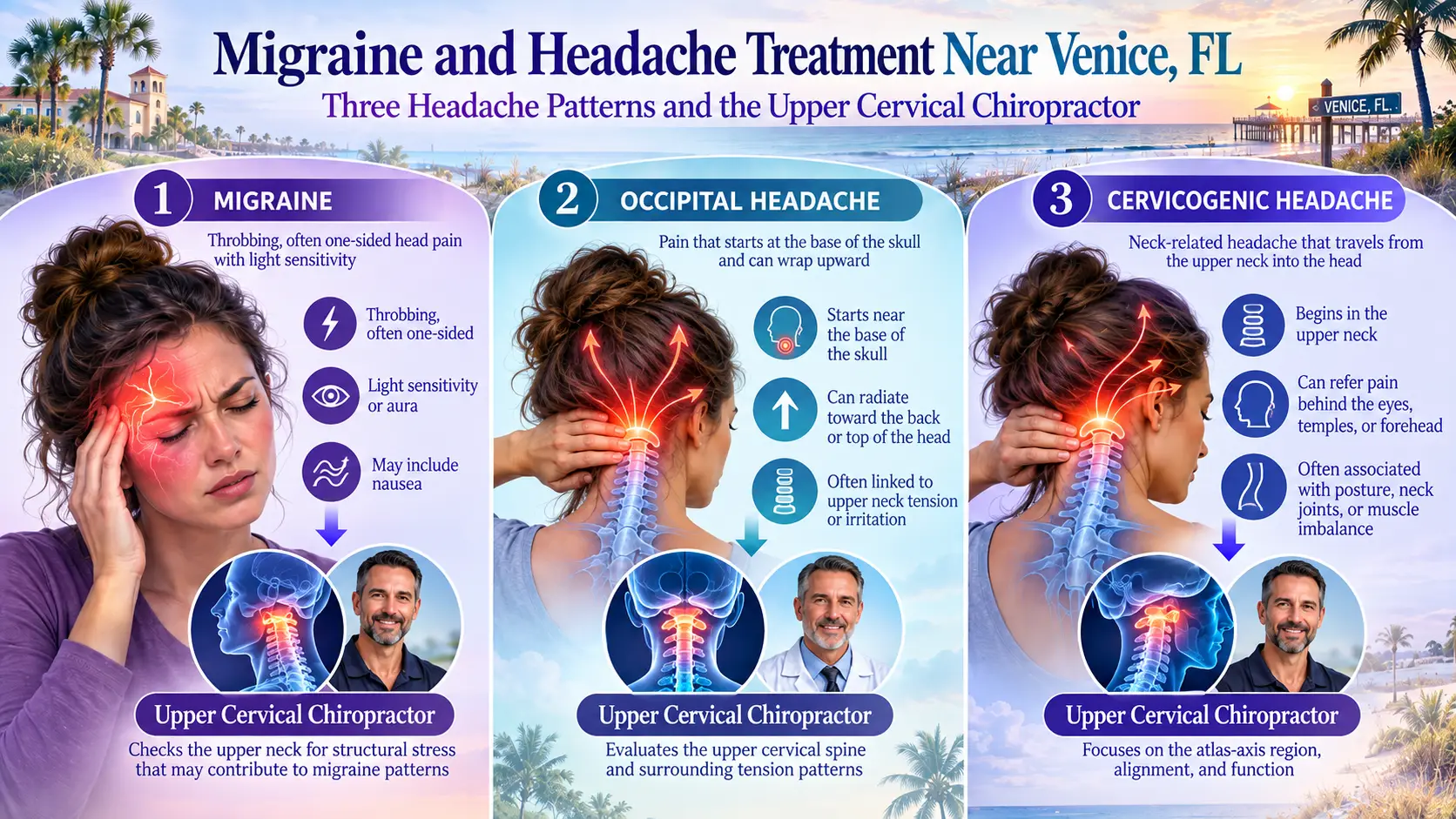
Headaches come in several types, and the distinction matters for care. Migraine alone affects more than a billion people and is a leading cause of disability in younger adults (Ashina, N Engl J Med 2020). Tension-type and cervicogenic headaches are different problems with different patterns, and an evidence-based guideline from 2011 sorts the manual-therapy evidence accordingly: spinal manipulation is recommended for migraine and cervicogenic headache, while for tension-type headache the evidence is weaker and low-load craniocervical mobilization is the recommended option (Bryans et al., J Manipulative Physiol Ther 2011). A holistic plan takes that seriously. It starts by identifying which headache a person actually has, then combines the medical tools that fit with attention to posture, sleep, hydration and the neck.
The neck piece has specific support. A randomized trial of 127 migraine patients found that the chiropractic spinal manipulation group improved significantly in migraine frequency, duration and medication use compared with controls (Tuchin et al., J Manipulative Physiol Ther 2000). One proposed explanation is that manipulation changes sensorimotor integration, meaning how the central nervous system processes signals coming from the spine, rather than simply loosening tight tissue (Haavik & Murphy, J Electromyogr Kinesiol 2012). That fits the upper cervical view of headaches as partly a signaling problem at the top of the neck. In our office that means 3D imaging of the atlas first, a gentle correction designed around those images, and follow-up measurements to confirm the alignment is holding before we talk about results.
Frequently Asked Questions
Why focus on the upper cervical spine for headaches?
The upper neck feeds sensory input into the trigeminocervical complex, the brainstem region that generates headache and migraine pain. An atlas misalignment keeps that input irritated, lowering the threshold for an episode. Upper cervical care corrects the atlas with the Knee Chest technique, a precise, low-force adjustment calculated from CBCT imaging. Thermography before and after each visit tells us whether the nervous system is settling, so progress is measured rather than guessed.
What makes this approach holistic rather than symptom-based?
Instead of managing each headache as it comes, we look for the structural cause and correct it. The evaluation covers posture, injury history, neurological function, and imaging of the atlas and axis. The correction removes the irritation at its source, and ongoing thermography shows how your whole nervous system is regulating. Many patients notice sleep, energy, and neck comfort improving alongside their headaches because the same misalignment affected all of them.
What does the adjustment process look like for headache patients?
Once imaging confirms a misalignment, the correction is calculated to your specific measurements. You kneel on the Knee Chest table, head turned to one side, and receive a light contact behind the ear with no twisting or cracking. You rest afterward in a quiet room. A post-correction thermography scan confirms the change. Early visits are closer together while the correction stabilizes, then spread out based on your readings.
What do you recommend beyond adjustments to manage headaches?
Staying hydrated, keeping regular sleep, managing screen posture, and noting triggers all help the correction hold. We also encourage patients to keep their neurologist informed; medication decisions stay with the prescribing doctor, and we share imaging on request. Our role is to correct the atlas and confirm with thermography that the nervous system is regulating more evenly, so the lifestyle changes you make have a stable structural foundation under them.
Do headache and migraine patients travel from Venice to your Sarasota office?
Yes. Venice is about thirty minutes from our office at the corner of University Parkway and Whitfield Avenue, and we also see patients from Bradenton, Lakewood Ranch, Palmetto, and Longboat Key. Because visits spread out as the correction holds, the drive becomes less frequent over time. The evaluation includes a history, exam, 3D cone-beam CT, and thermography. Results vary by person. Call (941) 243-3729 to schedule an evaluation.
Schedule With Us!
Lavender Family Chiropractic offers consultations to learn more about you. We are passionate about helping you reach all of your health goals and this discovery phase is important. Click the link below!
https://intake.chirohd.com/new-patient-scheduling/724/lavender-family-chiropractic
Related Posts


Get our upper cervical articles first.
Patients Experience