Easiest Way to Treat Vertigo: Vertigo can feel like your world has been turned upside down in an instant. One moment you are standing, walking, or rolling over in bed, and the next you feel as if the room is spinning, tilting, rocking, or swaying. For some people, vertigo comes in short bursts. For others, it becomes a daily struggle that affects work, family life, driving, exercise, sleep, and confidence. It is one of the most frustrating symptoms a person can experience because balance is something most people never think about until it is gone.
Many people are told that vertigo is simply an ear problem, that they need to wait it out, or that they should just take medication to dull the sensation. While medications may reduce symptoms temporarily, they often do not explain why the body started producing dizziness in the first place. That is why so many people continue to struggle with recurring episodes of vertigo, dizziness, swaying, rocking, imbalance, nausea, lightheadedness, visual sensitivity, ear pressure, headaches, and brain fog.
If you have been searching for the easiest way to treat vertigo, the first step is not simply masking the symptom. The first step is understanding the root cause. At NeckWise, our approach is centered around the upper cervical spine, the brainstem, and the nervous system. NeckWise care is a specialized form of upper cervical chiropractic care that focuses on the top of the neck, where the atlas and axis vertebrae sit directly beneath the skull. This area is one of the most neurologically important regions in the body because it surrounds and protects the lower brainstem, influences balance signaling, and affects how the body processes motion, posture, coordination, and spatial awareness.
When the upper neck is misaligned, irritated, or unstable, it can send distorted information into the brainstem and cerebellum. That can create a mismatch in the body’s balance system. In many cases, that mismatch is a major reason why a person feels dizziness, vertigo, rocking, swaying, imbalance, nausea, or disorientation. Instead of simply chasing symptoms, NeckWise care focuses on correcting the upper cervical problem so the brain and body can restore balance more naturally.
Why Is it So Disruptive and What is the Easiest Way to Treat Vertigo
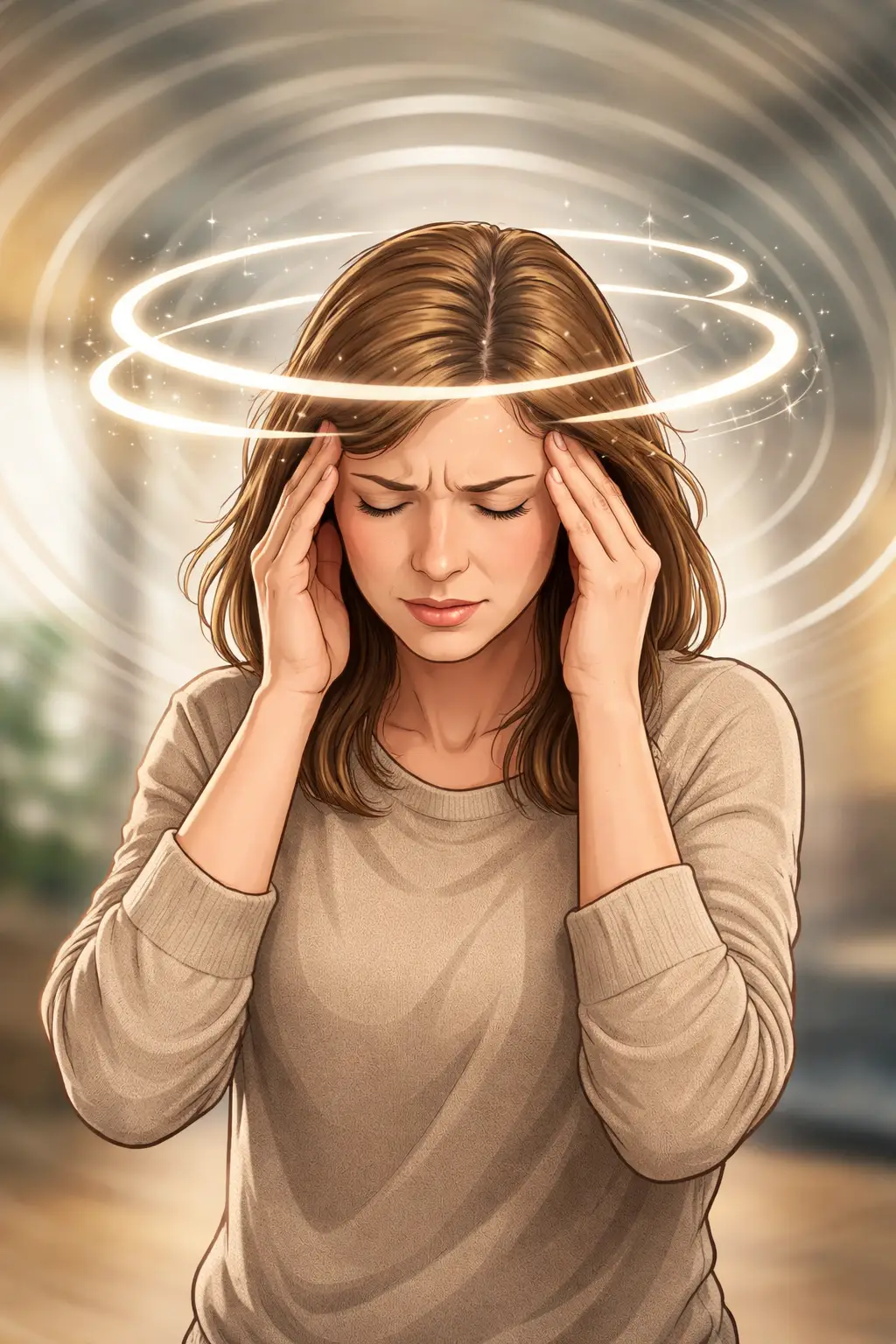
Vertigo is not just “feeling dizzy.” True vertigo is the false sensation that you or your surroundings are moving when they are not. Some people describe it as spinning. Others feel like they are rocking on a boat, being pulled to one side, or floating. Many people with vertigo also experience nausea, vomiting, visual sensitivity, unsteadiness, pressure in the ears, fullness in the head, headaches, or fatigue after an episode.
Even when the spinning calms down, many patients are left with a lingering sense of imbalance. They may feel off, disconnected, foggy, or unstable. Grocery stores become overwhelming. Quick head movements can trigger symptoms. Looking up, bending down, rolling over in bed, driving, walking in crowds, or standing in large open spaces may all become difficult.
This is why vertigo affects much more than physical comfort. It can impact independence, mood, productivity, sleep, exercise, social events, and overall quality of life. People with chronic dizziness often begin to avoid activities that used to feel normal. They may become anxious about having another episode. Over time, the body can become more sensitive, more tense, and more reactive to motion and sensory input.
That is exactly why it is so important to identify the root cause rather than only trying to suppress symptoms temporarily.
The Main Balance Centers of the Body Are in the Brainstem
When most people think about balance, they think only about the inner ear. The inner ear is very important, but it is only one part of the system. Balance is actually created by constant communication between the inner ears, the eyes, the joints and muscles, the cerebellum, and the brainstem.
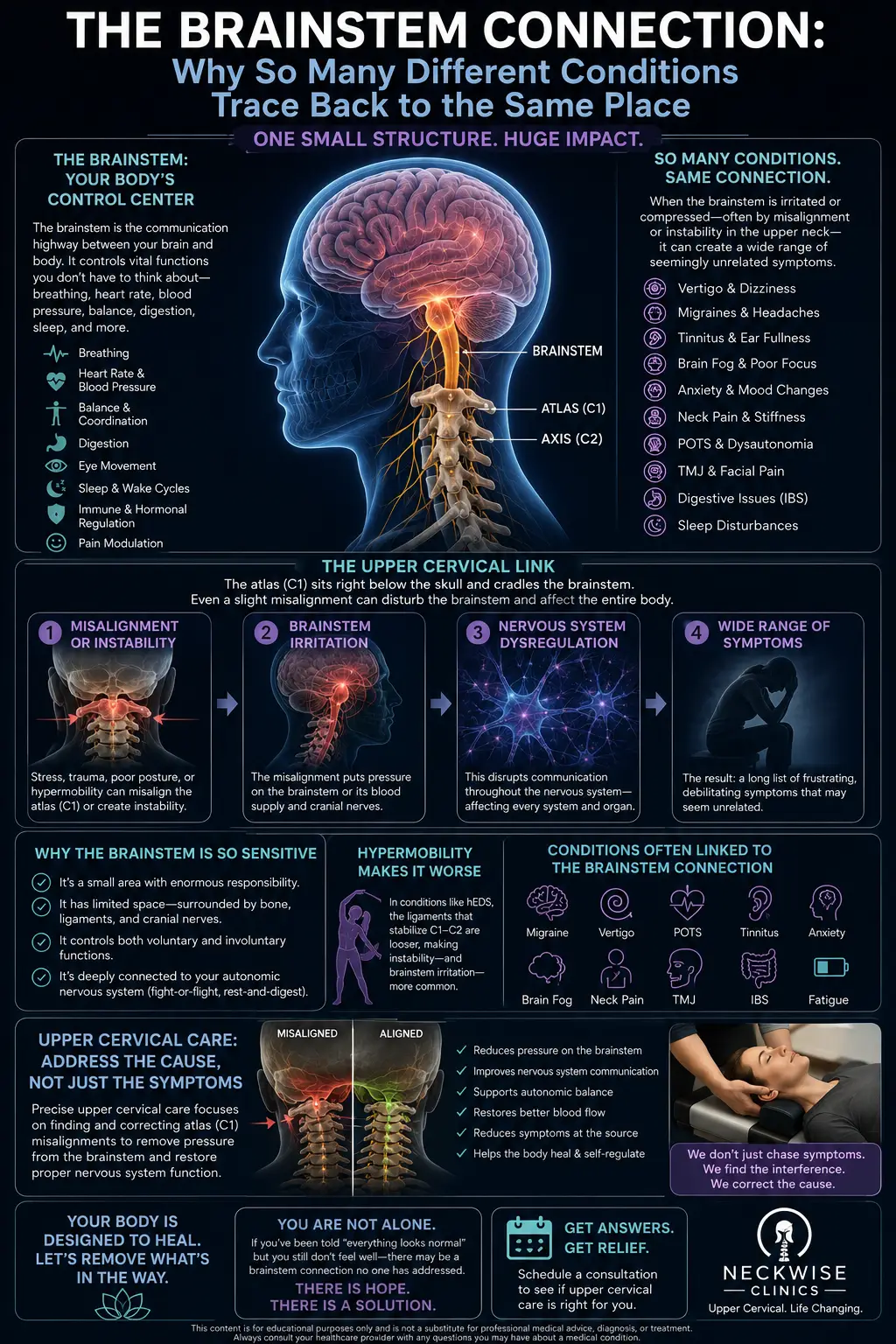
The brainstem is one of the primary control centers for balance and spatial orientation. It receives information from the vestibular organs in the inner ears, from the eyes, and from the proprioceptors in the muscles and joints of the body. Proprioceptors are sensory receptors that tell the brain where the body is in space. They help you know whether your head is tilted, whether your shoulders are level, whether you are turning, and whether your body is upright.
The upper cervical spine is one of the most densely packed proprioceptive regions in the entire body. That means the top of the neck provides a tremendous amount of position and motion information to the brainstem. When the upper cervical spine is healthy and stable, the brain gets clear signals about head position and body orientation. When the upper cervical spine is misaligned or irritated, those signals can become distorted.
Now imagine what happens when the brainstem is receiving conflicting information. The inner ear may be saying one thing, the eyes may be saying another, and the upper neck may be feeding in inaccurate motion or posture signals. That sensory mismatch can overwhelm the balance system. The result can be vertigo, dizziness, imbalance, rocking, swaying, lightheadedness, visual motion sensitivity, nausea, and difficulty stabilizing.
At NeckWise, this is a major reason why we place so much emphasis on the top of the neck. If the brainstem is one of the central processing centers for balance, and the upper cervical spine is one of the biggest input sources into that system, then the health and alignment of the upper neck matter tremendously.
The Upper Cervical Spine and Its Relationship to Dizziness
The upper cervical spine includes the atlas, which is the first cervical vertebra, and the axis, which is the second. These two bones are unique. They are shaped differently from the rest of the spine and are responsible for supporting the skull and allowing a large percentage of head movement.
They also sit directly next to the lower brainstem, the cerebellum, important blood vessels, and critical neural pathways that influence balance, coordination, autonomic function, and muscle tone. Because this region is so neurologically important, even small misalignments can have major functional consequences.
A misalignment in the upper cervical spine can create abnormal tension in the surrounding muscles, irritation in the joints, altered posture, and distorted proprioceptive input. The body begins to compensate. The head may tilt. One shoulder may sit higher. Muscles tighten to protect the area. The nervous system becomes stressed. As this continues, the brainstem may receive faulty information about where the head is and how it is moving.
That can be enough to produce dizziness or make an existing vestibular problem much harder for the body to overcome. In many people, upper cervical dysfunction does not just accompany vertigo. It can be one of the key drivers that keeps the body stuck in it.
This is why some people can go through multiple rounds of medications, vestibular exercises, ENT evaluations, and testing, yet still feel chronically off balance. If the upper neck is continuing to feed distorted information into the balance centers of the brainstem, the body may never fully settle down.
What Is NeckWise Care?
NeckWise care is a focused form of upper cervical chiropractic care designed to evaluate and correct misalignments in the top of the neck with precision and specificity. This is not general chiropractic and it is not random neck cracking. It is a specialized approach centered on the atlas and axis, guided by detailed examination, imaging, and objective analysis.
At NeckWise, the goal is not to force movement into the neck. The goal is to identify the exact way the upper cervical spine has shifted, understand how that misalignment is affecting the nervous system, and deliver a precise correction that helps the body return to proper alignment and stability.
Because the upper cervical region is so important neurologically, precision matters. A generic adjustment is not the same thing as a customized upper cervical correction. The forces used in NeckWise care are gentle, controlled, and specific to the patient’s anatomy and findings.
This matters especially for people with vertigo, Meniere’s, BPPV-like symptoms, vestibular dysfunction, headaches, migraines, neck pain, ear fullness, brain fog, and dysautonomia. These patients are often very sensitive. The last thing they need is a forceful, twisting, popping adjustment that irritates the area further. NeckWise care is designed to be exact, calm, and corrective.
Why NeckWise Focuses on the Atlas and Axis
The atlas and axis are the gateway between the brain and body. The skull sits on the atlas, and the atlas rotates around the axis. Because these vertebrae carry so much responsibility for head position and movement, they also play a major role in how the brain interprets motion.
If the atlas shifts even slightly, the head’s center of gravity changes. That affects how the body compensates below. The muscles in the neck, shoulders, and spine may tighten unevenly. The vestibular system may begin to interpret head movement differently. Eye tracking can become strained. Postural muscles may become overactive. The brainstem may be forced to constantly adapt to inaccurate information.
This is one of the reasons upper cervical problems can create such a wide range of symptoms. Some people get neck pain. Some get headaches. Some get migraines. Some get dizziness and vertigo. Some get ear pressure, ringing, or fullness. Others experience nausea, balance issues, visual motion sensitivity, or brain fog. The symptoms can look different from person to person, but the underlying driver may still be the same: poor communication between the upper cervical spine and the central nervous system.
By focusing on the atlas and axis, NeckWise care aims to restore that communication.
The Root Cause of Vertigo Is Often Bigger Than the Inner Ear Alone
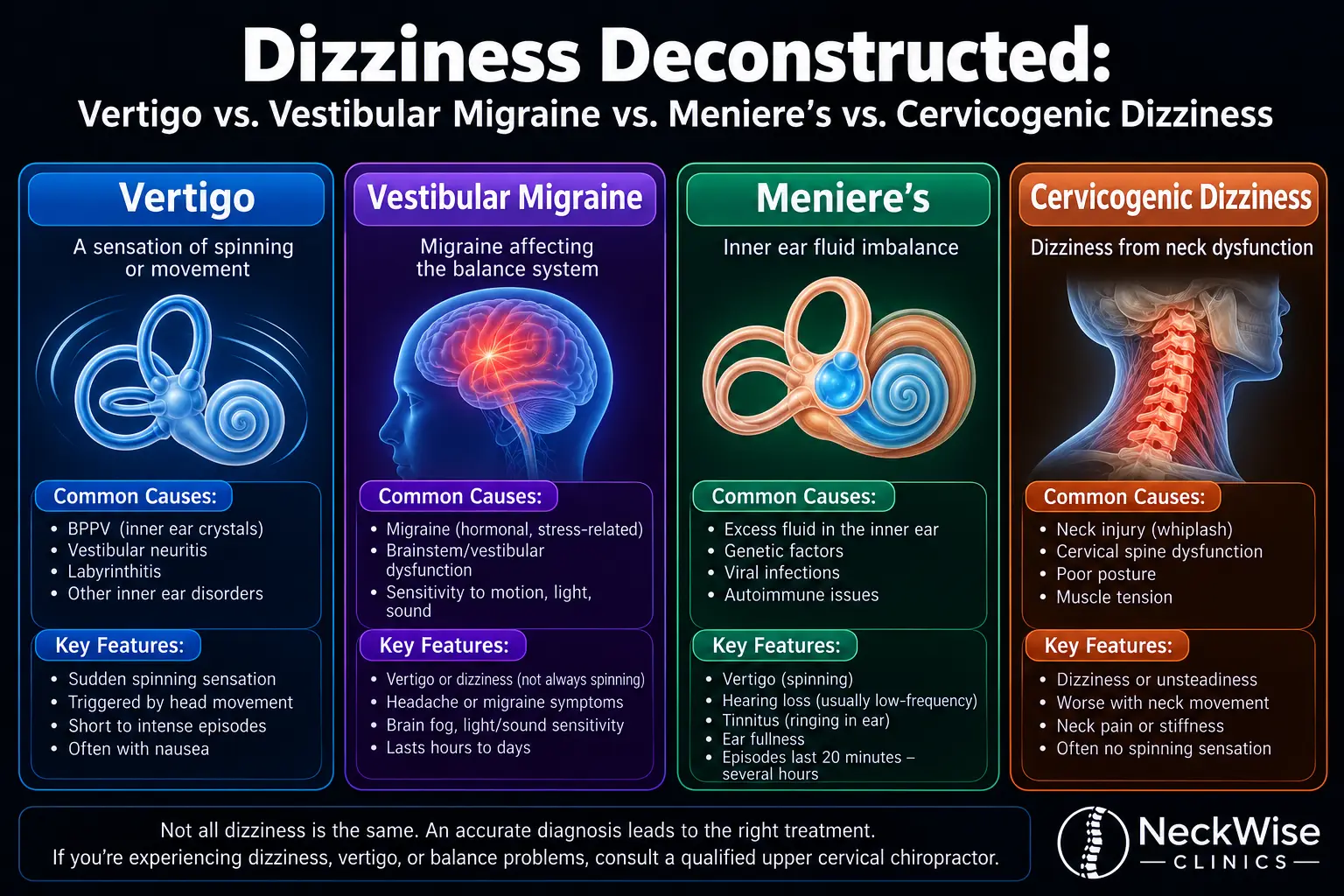
Vertigo is commonly classified into different diagnostic labels. These may include BPPV, Meniere’s disease, vestibular neuritis, cervicogenic dizziness, vestibular migraine, PPPD, labyrinthitis, and general vestibular dysfunction. Those labels can be helpful, but they do not always explain why the system became dysfunctional in the first place.
For example, one person may have BPPV episodes that keep returning. Another may have Meniere’s symptoms with pressure, ringing, and vertigo. Another may feel chronic swaying after travel. Another may have dizziness triggered by head position, looking up, or rolling over. Another may have no clear inner ear diagnosis at all and is simply told they have “vestibular dysfunction.”
In many of these cases, the body is struggling to regulate balance because the nervous system is under stress and the brainstem is receiving mixed signals. The upper cervical spine can be a major reason that regulation never fully normalizes.
This does not mean every person with vertigo has the exact same cause. It means that the upper neck must be evaluated as a possible root contributor, especially when dizziness is persistent, recurrent, or associated with neck tension, headaches, migraines, ear symptoms, postural imbalance, or a history of head or neck trauma.
Upper Cervical Dysfunction and Meniere’s Symptoms
People with Meniere’s symptoms often report vertigo attacks, ear fullness, tinnitus, pressure, fluctuating hearing changes, and nausea. These symptoms can be frightening and unpredictable. While Meniere’s is often considered an inner ear fluid regulation disorder, the nervous system still plays a significant role in how the body manages pressure, circulation, sensory processing, and stress responses.
The upper cervical spine can influence the muscles, nerves, and vascular dynamics around the head and neck. When the atlas is misaligned, it may create abnormal tension and neurological stress that can make the body less adaptable. If the brainstem is irritated and balance signaling is unstable, the body may have a harder time compensating for inner ear dysfunction.
This is why some patients with Meniere’s symptoms notice improvement when the upper cervical spine is corrected. They are not just treating the label. They are improving the environment around the brainstem and helping the balance system operate with clearer input.
NeckWise care does not chase symptoms. It focuses on restoring alignment and nervous system balance so the body can function more normally. For a patient with Meniere’s symptoms, that may mean fewer episodes, less pressure, less dizziness, better stability, and a greater sense of control.
BPPV Symptoms and Why They Sometimes Keep Coming Back
BPPV, or benign paroxysmal positional vertigo, is often associated with displaced crystals in the inner ear. Symptoms are frequently triggered by rolling over in bed, looking up, bending forward, or changing head position. Many people go through repositioning maneuvers and feel temporary relief, only to have the symptoms return later.
Why does that happen?
In some people, the repositioning maneuver helps temporarily, but the nervous system is still unstable. The upper neck may still be misaligned. The brainstem may still be processing faulty positional information. Muscles may still be compensating unevenly. Posture may still be distorted. The vestibular system may still be on edge.
If the body has not regained stable balance input overall, it may remain vulnerable to recurring episodes. That is why people with recurrent BPPV-like symptoms should not only think about the ear. They should also think about the upper cervical spine.
NeckWise care helps by restoring more accurate communication between the neck and the brainstem. When the body receives clearer head-position information, it often becomes easier for the entire balance system to settle down. That can reduce the tendency toward recurrent episodes and help patients feel steadier overall.
Vestibular Dysfunction and the Neck-Brainstem Connection
Vestibular dysfunction is a broad term, but most people who receive this diagnosis are dealing with a balance system that is not processing motion correctly. They may feel dizzy in busy environments, sensitive to screens, off balance when walking, or overwhelmed by quick movements. Some feel like they are rocking or swaying all the time. Others feel detached, foggy, or unstable in visually complex spaces.
When the brainstem is overloaded by conflicting information, these symptoms make sense. The vestibular system is not functioning in isolation. It depends on accurate information from the eyes, the neck, and the rest of the body. If the upper cervical spine is sending distorted input, the vestibular system may struggle to calibrate.
This is one of the most important concepts in NeckWise care. The upper neck is not just a structure. It is a sensory hub. It is constantly informing the brain about head position, motion, and orientation. If that input is corrupted, the vestibular system may remain reactive no matter how many other treatments are tried.
Correcting the upper cervical spine can often remove one of the biggest sources of interference. That gives the brainstem a better chance to process balance information accurately and allows the body to begin stabilizing.
How Trauma Often Starts the Problem
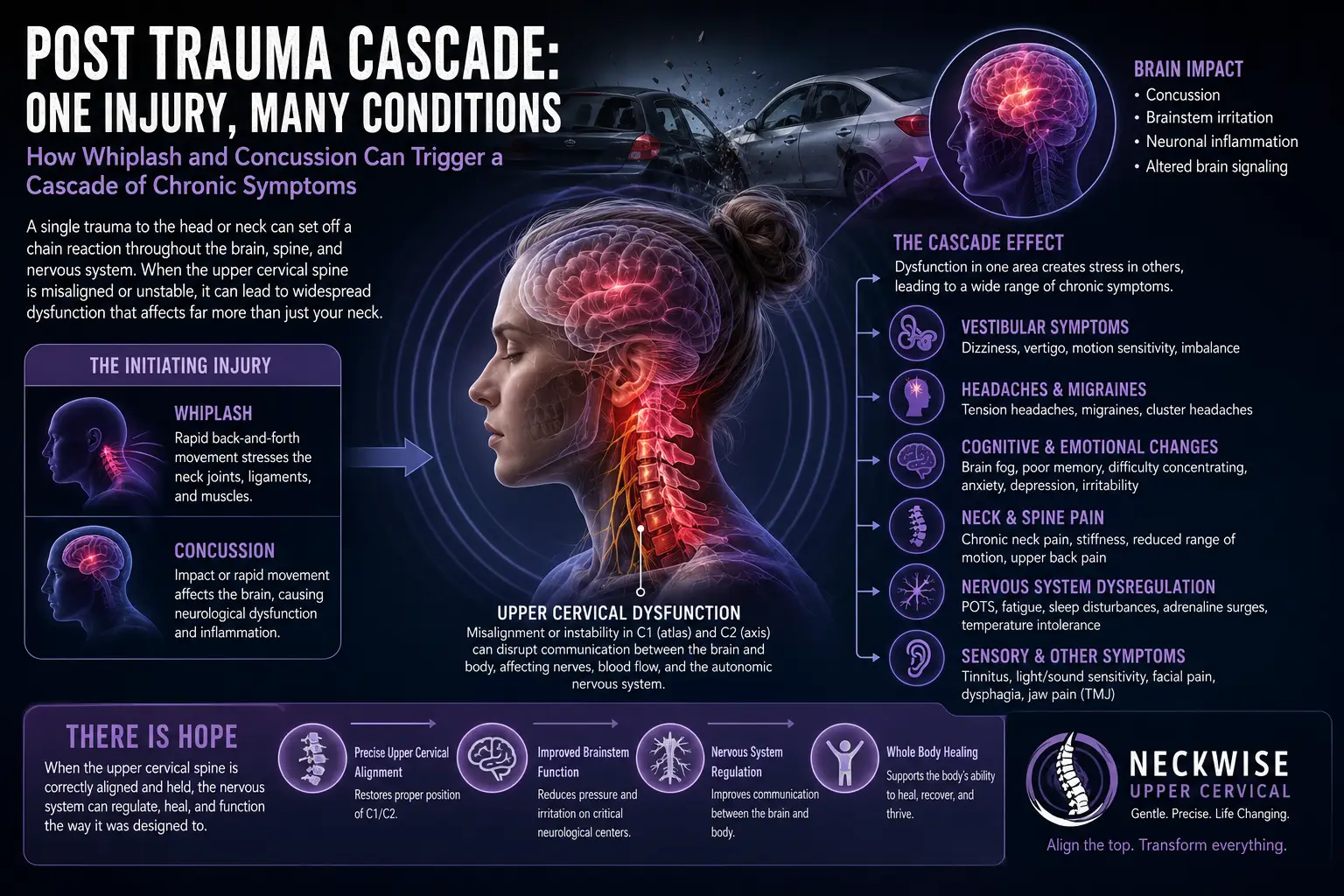
Many patients with vertigo or chronic dizziness can trace the start of their symptoms back to an injury or physical stress. This may include a car accident, whiplash, concussion, sports injury, fall, rough landing, roller coaster ride, dental procedure, old neck injury, or even years of repetitive poor posture.
Sometimes the trauma happened recently. Sometimes it happened years ago. But if that trauma caused the atlas or axis to shift and the body never fully corrected it, the nervous system may have been compensating ever since.
That is one reason so many people with dizziness also report a history of neck pain, headaches, migraines, jaw tension, shoulder tightness, or sensitivity when turning the head. The upper cervical spine may have become the central mechanical and neurological stress point.
At NeckWise, we take this history seriously because it often reveals why the body started struggling in the first place. The problem may not just be that you have dizziness. The problem may be that your upper neck was injured, the brainstem has been under stress, and the balance system has been fighting to compensate ever since.
What Makes NeckWise Care Different
NeckWise care is different because it is not based on guessing. It is based on precision. Patients with dizziness and vertigo need more than generalized advice. They need a clear understanding of what is happening in the upper cervical spine and how it is affecting the nervous system.
A proper upper cervical evaluation at NeckWise typically involves a detailed history, postural assessment, neurological and orthopedic observations, and advanced imaging of the upper cervical region when clinically appropriate. The goal is to determine exactly how the atlas and axis are positioned and how that position may be affecting the body.
Once the doctor identifies the misalignment pattern, a precise correction is delivered. This correction is tailored to the patient. It is not a one-size-fits-all adjustment. It is not forceful. It is not rushed. It is focused on helping the body hold a better position so the nervous system can begin calming down and rebalancing.
After the correction, the body is monitored over time to see how it stabilizes. This is important because healing is not just about getting adjusted frequently. It is about making the right correction, then allowing the body to adapt and hold as it regains function.
Why Gentle Care Matters for Vertigo Patients
Patients with vertigo are often highly sensitive. Sudden movements, rapid head turns, visual motion, loud environments, and stress may all trigger symptoms. That is why the style of care matters.
A forceful twisting adjustment may be unsettling for someone whose balance system is already reactive. NeckWise care is built around precision and gentleness. The correction is delivered in a way that respects the sensitivity of the patient and the importance of the upper cervical region.
Gentle does not mean weak. It means specific. It means the doctor is not trying to overpower the body. The doctor is delivering the exact correction needed to help the atlas and axis return toward a more normal position.
When that happens, the nervous system often begins to settle. Muscles relax. Posture improves. Head position becomes more centered. The brainstem receives clearer signals. The body no longer has to fight as hard to maintain balance.
For many patients, that is when the dizziness finally begins to ease.
How Correcting the Upper Cervical Spine Can Help Dizziness Resolve
When the upper cervical spine is corrected, several things may begin to change.
First, the proprioceptive input from the upper neck becomes more accurate. That means the brainstem receives better information about head position and movement.
Second, abnormal muscle tension around the head and neck may decrease. This can reduce the strain that contributes to headaches, visual stress, and a persistent feeling of instability.
Third, posture may begin to normalize. A head tilt or uneven shoulder pattern may improve as the body no longer compensates around the misalignment.
Fourth, the nervous system may become less reactive. People often notice they are less triggered by movement, less overwhelmed in busy environments, and less prone to feeling off balance.
Fifth, the body can finally start healing instead of constantly compensating. When the balance system is no longer fighting against faulty input from the upper neck, it has a much better chance of returning to normal function.
This is why so many patients describe NeckWise care as the easiest way to treat vertigo. It is not easy because the symptom is simple. It is easy because the approach makes sense. Instead of chasing the symptom in circles, it focuses on one of the most important root causes in the entire balance system.
Why Medications Alone Often Fall Short
Many people with vertigo are given medications to reduce nausea, suppress dizziness, or help them get through acute episodes. These medications may be useful in the short term, but they usually do not address why the vestibular system is dysfunctional.
If the brainstem is still receiving distorted information from the upper cervical spine, symptoms may continue to return. The patient may feel better temporarily, but the system is still unstable underneath.
That is why symptom relief and true correction are not the same thing. Relief may make the episode more tolerable. Correction changes the environment that allowed the problem to persist.
NeckWise care is focused on correction.
Why Some Patients Feel “Off” Even When the Spinning Stops
One of the most common complaints from people with chronic dizziness is, “I am not spinning anymore, but I still do not feel normal.” They may feel floaty, disconnected, foggy, unstable, or subtly unbalanced all day. That often happens because the central processing of balance is still dysregulated.
Even after an acute inner ear episode improves, the brainstem may remain hypersensitive. The neck may still be misaligned. The body may still be compensating through the muscles and posture. The patient may still be feeding distorted head-position input into the system every second of the day.
This is another area where NeckWise care can make an enormous difference. By restoring better upper cervical alignment, the brainstem gets clearer information and the body has a better chance to fully recalibrate.
The goal is not just to stop spinning. The goal is to feel stable again.
The Importance of Holding a Correction
One of the biggest principles in upper cervical care is that healing happens when the body holds the correction. It is not enough to move the bone once. The body has to stabilize around the new position.
When the correction holds, the nervous system continues receiving better input over time. That allows the brainstem, muscles, posture, and balance system to adapt in a more lasting way.
At NeckWise, the focus is not on unnecessary adjusting. It is on making the right correction and then checking the patient carefully to determine when that correction is being maintained. This helps create the conditions for long-term healing instead of constant short-term relief.
For vertigo patients, this matters because stability is everything. The body needs consistent, accurate input if it is going to rebuild confidence and normalize balance.
Upper Cervical Care and the Whole-Body Balance System
Balance does not live in one organ. It is a whole-body process. It depends on clear communication between the brainstem, cerebellum, eyes, inner ears, muscles, joints, and spine. If one part of that chain is dysfunctional, the rest of the system can begin to struggle.
The upper cervical spine is one of the most influential parts of that chain because it sits at the junction of the head and neck and supplies such a rich stream of sensory information into the brainstem.
That is why NeckWise care can have such broad effects. People often come in for vertigo, but they may also notice changes in headaches, neck tension, posture, ear pressure, sleep, focus, and overall body coordination. When the upper neck is corrected, the nervous system frequently functions better across the board.
Who Should Consider NeckWise Care for Vertigo?
NeckWise care may be worth considering if you have:
- Recurring vertigo episodes
- Chronic dizziness or imbalance
- Meniere’s symptoms
- BPPV that keeps returning
- Vestibular dysfunction or vestibular migraine
- Rocking or swaying sensations
- Ear fullness, pressure, or ringing with dizziness
- A history of whiplash, concussion, or neck injury
- Chronic neck tension with dizziness
- Headaches or migraines along with balance issues
- Symptoms triggered by head movement or position
- A sense that you never fully recovered after an inner ear issue
Many of these patients have been through a long list of appointments and still feel like something is missing. Often, what is missing is an evaluation of the upper cervical spine.
The Easiest Way to Treat Vertigo Starts With Finding the Cause
The easiest way to treat vertigo is not always the fastest shortcut. It is the most direct path to the real problem. If the upper cervical spine is misaligned and the brainstem is receiving distorted input, no amount of symptom chasing will fully solve the issue.
That is why NeckWise care is such a powerful approach. It focuses on the top of the neck, where balance signaling, posture, proprioception, and brainstem communication all come together. By correcting the atlas and axis with precision, the body is given the opportunity to calm the nervous system, stabilize the balance centers, and resolve dizziness from the inside out.
For many patients, that is the turning point. They stop feeling like they are fighting their body and start feeling like their body is finally working with them again.
Final Thoughts
Vertigo, dizziness, Meniere’s symptoms, BPPV symptoms, and vestibular dysfunction can be life-altering, but they are not always random. In many cases, they are signs that the balance system is being fed faulty information and forced to compensate.
The brainstem is one of the main balance centers of the body, and the upper cervical spine has a profound influence on how that system functions. When the atlas and axis are misaligned, the body may experience distorted proprioception, abnormal muscle tension, postural imbalance, and nervous system stress that all contribute to dizziness.
NeckWise care goes in depth where most approaches stop short. Instead of only focusing on symptoms, it focuses on the upper cervical root cause. Through precise, gentle correction of the top of the neck, NeckWise care helps restore better communication between the brainstem and the body so the dizziness can finally begin to resolve.
If you have been searching for the easiest way to treat vertigo, the answer may not be another temporary fix. It may be finding and correcting the upper cervical problem that has been disrupting your balance system all along.
When the body is aligned, the nervous system is clearer. When the nervous system is clearer, the balance centers can function better. And when the balance centers function better, life becomes steady again.
Schedule a Consultation
Lavender Family Chiropractic (NeckWise North Sarasota)
5899 Whitfield Ave Ste 107, Sarasota, FL 34243
www.chiropractorsarasotaflorida.com
To learn more about us go to http://www.chiropractorsarasotaflorida.com
We also service Bradenton, Parrish, Ellenton, Ruskin, Venice, Tampa, St. Pete, Osprey, Longboat, Lakewood Ranch, Myakka City.
If you are in Tampa, Land O Lakes, Fort Myers, or Salt Lake City, you can visit our other locations! NeckWise Upper Cervical. Visit www.neckwise.com
If you are not local, visit www.uccnearme.com to find a doctor in your area
Serving Sarasota, Bradenton, Lakewood Ranch, Parrish, Ellenton, Venice, Osprey, Siesta Key, Longboat Key, Lido Key, Myakka City, Punta Gorda, and St. Petersburg.