By Dr. Rusty Lavender
Hashimoto’s Thyroiditis: You were tired all the time, but you assumed it was just life. You were gaining weight despite eating the same as always, your hair was thinning, your skin was dry, you felt cold when no one else did, and your thinking felt slow in a way that was hard to describe. Maybe you noticed your neck looked a little fuller, or your voice changed slightly, or your periods became heavier and longer. Eventually, after months or years, someone ran the right blood tests — a TSH that was too high, antibodies against thyroid peroxidase that were sky-high, an ultrasound showing the characteristic patchy appearance of an inflamed gland — and you finally had a name for what was happening to you: Hashimoto’s thyroiditis. The most common autoimmune disease in America, and the leading cause of hypothyroidism — and yet you might be one of millions of people who suffered with unexplained symptoms for years before anyone connected the dots.
We want to be honest with you from the very first sentence, because this is a condition where honesty matters profoundly: Hashimoto’s thyroiditis is fundamentally a thyroid disease. The cornerstone of treatment is thyroid hormone replacement, typically levothyroxine (synthetic T4), prescribed and monitored by your endocrinologist or primary care physician. Chiropractic care does not replace your thyroid hormone. It does not reverse the autoimmune destruction of your thyroid gland. It does not normalize your TPO antibodies. Any provider who tells you otherwise is overpromising on a condition that requires proper medical management, and you should be wary of them.
What we can offer at Lavender Family Chiropractic in Sarasota, Florida, is something more focused and grounded in actual research: support for the vagus nerve and parasympathetic regulation that the medical literature has identified as both impaired in autoimmune thyroid disease and increasingly a target of research-backed therapeutic approaches. Combined with addressing the autonomic and inflammatory dysregulation that so often accompanies Hashimoto’s, upper cervical chiropractic care may be a reasonable adjunctive piece of a comprehensive approach to autoimmune thyroid disease — alongside, never instead of, the medical management your physician provides. This guide is for anyone in Sarasota, Bradenton, Lakewood Ranch, or the surrounding areas who is living with Hashimoto’s and wants to understand it accurately — including where upper cervical care honestly fits.
What Is Hashimoto’s Thyroiditis?
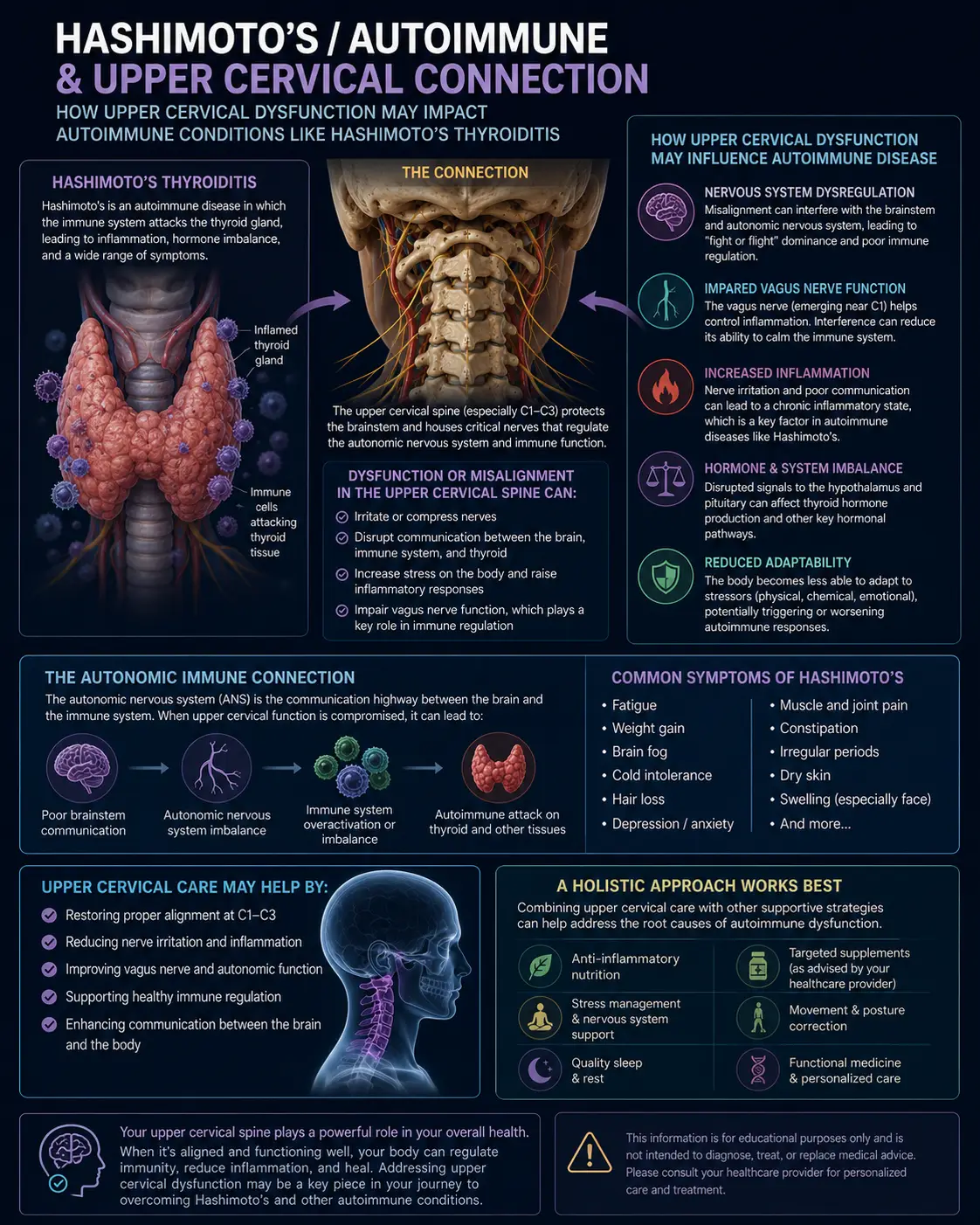
Hashimoto’s thyroiditis is a chronic autoimmune disease in which the body’s immune system mistakenly attacks the thyroid gland. The result is progressive inflammation of the gland (thyroiditis) and, over time, gradual destruction of thyroid tissue and a declining ability to produce the thyroid hormones — primarily T4 (thyroxine) and T3 (triiodothyronine) — that regulate metabolism throughout the body. It is named for Dr. Hakaru Hashimoto, the Japanese physician who first described the condition in 1912.
The diagnostic hallmarks of Hashimoto’s are specific. According to a recent comprehensive review, Hashimoto’s thyroiditis is characterized by thyroid peroxidase antibody (TPOAb) and thyroglobulin antibody (TGAb) positivity, lymphocytic infiltration of the gland, and progressive hypothyroidism, with the current treatment based on levothyroxine (T4) replacement. The combination of elevated thyroid antibodies, characteristic ultrasound findings, and (eventually) elevated TSH with low free T4 establishes the diagnosis. The disease typically progresses through several phases over many years: an initial subclinical phase with positive antibodies but normal thyroid function, a phase of subclinical hypothyroidism with elevated TSH but normal free T4, and eventually clinical hypothyroidism requiring hormone replacement.
The symptoms of Hashimoto’s, particularly once hypothyroidism develops, are familiar to anyone who has been there: fatigue that no amount of sleep resolves, unexplained weight gain, cold intolerance, dry skin, hair thinning or loss, constipation, slow thinking and “brain fog,” depression, joint and muscle aches, heavy or irregular periods, hoarseness, puffy face, and a slow heart rate. Many patients also develop a goiter (enlarged thyroid). The symptoms are slow, insidious, and often mistaken for “just aging,” “just stress,” or other conditions — which is part of why diagnosis is so often delayed.
How common is Hashimoto’s? Far more common than its profile suggests, and dramatically more common in women than men. According to a Frontiers in Public Health meta-analysis, the global prevalence of Hashimoto’s thyroiditis is approximately 7.5%, making it one of the most common autoimmune diseases in the world. According to comprehensive clinical reviews, the incidence of Hashimoto’s in adult females can be 4 to 10 times higher than in males, with Hashimoto’s being a major cause of hypothyroidism in iodine-sufficient regions and the prevalence increasing significantly worldwide in recent years. The disease typically presents between ages 30 and 50 in women, though it can occur at any age, including in childhood.
For Sarasota, with our older demographic and large female population, Hashimoto’s is a particularly common diagnosis — and an even larger number of patients carry the condition without yet knowing it.
Hashimoto’s, the Immune System, and the Hidden Autonomic Component
Most discussions of Hashimoto’s focus on the thyroid gland itself — and rightly so, because the gland is where the autoimmune attack happens and where the resulting hormone deficiency originates. But there is a piece of Hashimoto’s that is increasingly recognized in the research literature and that conventional thyroid management often overlooks: the autonomic and vagal component.
Like many autoimmune diseases, Hashimoto’s involves widespread immune dysregulation, not just thyroid-specific abnormalities. And like many autoimmune diseases, it is associated with autonomic dysfunction — specifically, with reduced vagal tone and sympathetic dominance. This connection between autoimmune disease and autonomic dysfunction is now well documented. According to a 2023 review on autoimmune diseases and the cholinergic anti-inflammatory pathway, heart rate variability measurements have revealed an important sympathetic dominance in patients with autoimmune diseases, including thyroiditis, type 1 diabetes, and rheumatoid arthritis, with heart rate variability generally correlating with the severity of the autoimmune response and disease progression. Thyroiditis is named explicitly in this connection — it is not a speculation.
Why does this matter? Because of a remarkable biological mechanism called the cholinergic anti-inflammatory pathway. Over the past two decades, research has established that the vagus nerve — the major nerve of the parasympathetic nervous system — directly modulates inflammation throughout the body. According to PMC research on the vagus nerve and the inflammatory reflex, efferent vagus nerve cholinergic signaling suppresses local and systemic proinflammatory cytokine levels, with acetylcholine inhibiting the release of TNF, IL-1β, and other inflammatory mediators from immune cells, defining the cholinergic anti-inflammatory pathway as the efferent vagus nerve-based arm of the inflammatory reflex. When vagal tone is reduced — as it is in many autoimmune conditions including thyroiditis — this anti-inflammatory braking system is weakened, and inflammation can run unchecked.
This is more than a theoretical observation. According to a recent systematic review on vagus nerve stimulation in autoimmune conditions, vagus nerve stimulation activates the cholinergic anti-inflammatory pathway and is being studied as a therapeutic modality for autoimmune diseases, with clinical trials examining its effect on inflammatory biomarkers and clinical outcomes. Pharmacological and bioelectronic interventions targeting the vagal anti-inflammatory pathway are being actively investigated in autoimmune disease, with established treatments already in use for rheumatoid arthritis, lupus, Crohn’s disease, and ulcerative colitis. The recognition that vagal function is therapeutically relevant in autoimmune disease is no longer fringe — it is mainstream research.
The Hashimoto’s-dysautonomia connection is also clinically visible to providers who look for it. Many Hashimoto’s patients also have features of autonomic dysfunction we have addressed in depth on our blog on dysautonomia — orthostatic intolerance, heart rate dysregulation, gut motility problems, temperature dysregulation, and the chronic fatigue that overlaps with conditions like ME/CFS. The diagnostic cluster of autoimmunity, autonomic dysfunction, and chronic inflammation appears repeatedly in our patient population.
This is where the upper cervical connection becomes relevant — not to the thyroid itself, but to the autonomic and vagal regulation that influences inflammatory homeostasis.
The Upper Cervical Connection to Vagal Function and Inflammatory Regulation
To understand where upper cervical care fits into Hashimoto’s, you have to understand a piece of neuroanatomy that conventional endocrine care does not address.
The vagus nerve, the major nerve of the parasympathetic nervous system and the central player in the cholinergic anti-inflammatory pathway, originates in the brainstem at the medulla oblongata. It exits the skull through the jugular foramen, immediately adjacent to the atlas (C1). From there, it descends through the neck, passing alongside the carotid artery and jugular vein, and continues down to innervate the heart, lungs, gastrointestinal tract, and other organs throughout the body. This means that the structural integrity and positioning of the upper cervical spine is anatomically intertwined with the vagus nerve at its most vulnerable transition — from brain to body.
When the upper cervical spine is misaligned, several mechanisms can plausibly influence vagal function. Mechanical irritation in the upper cervical region can affect the vagus nerve as it exits the skull. Chronic abnormal sensory input from a misaligned upper cervical spine projects to brainstem autonomic centers, including the nucleus tractus solitarius — the central hub of vagal afferent processing. And the postural and muscular consequences of upper cervical misalignment, including chronic suboccipital tension and forward head posture, can affect both vagal nerve tension and overall autonomic balance.
This is the rationale for considering upper cervical care in conditions where vagal tone matters. We addressed this in detail on our vagus nerve dysfunction service page, and the principles apply directly to Hashimoto’s and other autoimmune conditions where reduced vagal tone is part of the picture.
We need to be very careful and very honest about what this does and does not mean. Upper cervical chiropractic care does not directly treat the autoimmune attack on the thyroid. It does not replace levothyroxine. It does not reverse thyroid gland destruction or normalize your antibodies. What it may do, for patients whose Hashimoto’s picture includes autonomic dysregulation and reduced vagal tone, is support the parasympathetic and anti-inflammatory regulation that the research has identified as relevant to autoimmune disease. Whether this translates into clinically meaningful changes in symptoms, antibody levels, or disease progression is not established by rigorous clinical trials in Hashimoto’s specifically — and we will not pretend otherwise. What we can say is that the mechanistic rationale is real, the autonomic component of autoimmune thyroid disease is documented, and the cholinergic anti-inflammatory pathway is an active and growing area of legitimate research.
The honest framing is this: for Hashimoto’s patients with significant autonomic and inflammatory features who are pursuing a comprehensive, multidisciplinary approach to their condition, addressing upper cervical contribution to vagal regulation may be a reasonable adjunctive piece. It is never the primary treatment, and we are completely clear about that.
Why Upper Cervical Care May Support Some Hashimoto’s Patients
At Lavender Family Chiropractic, we use the Knee Chest Upper Cervical technique — a precise, gentle method of correcting atlas and axis misalignments without any twisting, popping, or forceful manipulation. For Hashimoto’s patients pursuing a comprehensive approach to autoimmune thyroid disease, this approach may offer specific supportive benefits, all framed as adjunctive to proper medical care.
First, by correcting upper cervical misalignment, we address the mechanical and neurological factors that influence vagal function at the level where the vagus nerve exits the skull. For patients with reduced vagal tone — which the research has documented in autoimmune thyroiditis — supporting vagal function targets a real mechanism connected to inflammatory regulation. Second, restoring proper upper cervical alignment supports overall autonomic balance, helping shift the sympathetic-dominant state characteristic of autoimmune disease toward the parasympathetic, recovery-oriented state that supports healing. Third, for the many Hashimoto’s patients with concurrent dysautonomia, fatigue, fibromyalgia, or other features that overlap with the conditions we have addressed in depth, upper cervical care addresses the shared brainstem and vagal mechanisms underlying multiple aspects of their picture.
The gentleness of the Knee Chest technique matters here. Autoimmune patients often have nervous systems that are exquisitely sensitive, with hypervigilant immune systems that can flare from physical stress. Our technique avoids forceful manipulation entirely, which makes it appropriate for this patient population. We also pace care carefully and watch for the signs of overall response that matter most: energy levels, sleep quality, autonomic stability, and overall sense of wellbeing.
We need to set honest expectations. Hashimoto’s is a thyroid disease, and your endocrinologist is the central manager of that disease. Thyroid replacement therapy, antibody monitoring, TSH titration, evaluation for related conditions like adrenal dysfunction and other autoimmune diseases — these are medical interventions that we do not provide and do not replace. Many Hashimoto’s patients also benefit from nutritional and functional medicine approaches — selenium and other nutrients with research support for autoimmune thyroid disease, identifying and addressing food sensitivities (gluten in particular has documented connections to Hashimoto’s), addressing gut health, managing stress, and ensuring adequate sleep and exercise. These approaches, where appropriate, complement medical management and are often pursued with functional medicine practitioners.
What upper cervical care can offer is one specific piece — the upper cervical contribution to vagal regulation — within this broader, multidisciplinary picture. For patients with significant autonomic features, this may be a meaningful adjunctive piece. For patients without significant autonomic features, the value of upper cervical care for Hashimoto’s specifically is likely smaller. We are honest about that distinction.
What Care Looks Like at Lavender Family Chiropractic
If you come to our Sarasota office for evaluation related to Hashimoto’s, here is what to expect.
Your first visit begins with a thorough consultation. Dr. Lavender or Dr. Temple will sit down with you and carefully review your history — when your Hashimoto’s was diagnosed, your current thyroid medication regimen, your recent labs (TSH, free T4, free T3, antibody levels), your symptom picture, any autonomic or fatigue features that suggest concurrent dysautonomia, comorbid conditions (Ehlers-Danlos, MCAS, POTS, fibromyalgia, ME/CFS, other autoimmune diseases), your other providers, and your overall approach to managing your condition. Because Hashimoto’s is fundamentally a thyroid disease, we want to know that you are working with an endocrinologist or primary care physician who is managing the thyroid component appropriately. If you are not, we will strongly encourage that.
The examination is adapted for this patient population. We use advanced 3D imaging to assess your upper cervical alignment with precision, autonomic function testing where appropriate, postural and gait analysis, and a careful neurological examination. We pay particular attention to signs of autonomic dysregulation that suggest a vagal component to your picture.
If the examination reveals upper cervical findings consistent with someone whose Hashimoto’s may benefit from addressing the vagal and autonomic component, we will explain our recommendations openly — including honest acknowledgment of the limits of what upper cervical care can accomplish. We coordinate closely with your endocrinologist and other providers, because Hashimoto’s is by nature a multidisciplinary condition.
Care is delivered through the gentle Knee Chest Upper Cervical technique. We offer customized treatment plans tailored to your specific situation, with honest expectations.
📞 Call (941) 243-3729 to schedule your complimentary consultation 📅 Book your consultation online 📍 5899 Whitfield Avenue, Suite 107, Sarasota, FL 34243 — at the corner of University and Whitfield
What the Research Says About Hashimoto’s, Vagal Function, and the Cholinergic Anti-Inflammatory Pathway
The research connecting Hashimoto’s and the broader vagal/inflammatory mechanisms is substantial and growing.
The epidemiology is well documented. According to a comprehensive narrative review on Hashimoto’s, the disease is characterized by thyroid peroxidase antibody and thyroglobulin antibody positivity, lymphocytic infiltration, and progressive hypothyroidism, with prevalence increasing significantly worldwide in iodine-sufficient regions, an incidence in adult females 4 to 10 times higher than in males, and current treatment based on levothyroxine (T4) replacement. A global meta-analysis published in Frontiers in Public Health found that the global prevalence of Hashimoto’s thyroiditis is approximately 7.5%, varying by geographic region, with the burden particularly significant given Hashimoto’s role as a leading cause of hypothyroidism and its connection to other downstream health conditions. These figures establish Hashimoto’s as one of the most common and important autoimmune diseases globally.
The vagal/autoimmune connection is documented in mainstream research. A 2023 review published in Pharmaceuticalson the cholinergic anti-inflammatory pathway in autoimmune diseases reported that heart rate variability measurements have revealed an important sympathetic dominance in patients with autoimmune diseases including thyroiditis, type 1 diabetes, and rheumatoid arthritis, with heart rate variability generally correlating with the severity of the autoimmune response and disease progression — explicitly naming thyroiditis among the conditions with documented vagal/autonomic dysregulation.
The cholinergic anti-inflammatory pathway is well established. According to PMC research on the vagus nerve and the inflammatory reflex, efferent vagus nerve cholinergic signaling suppresses local and systemic proinflammatory cytokine levels, with acetylcholine inhibiting the release of TNF and other inflammatory mediators from immune cells, defining the cholinergic anti-inflammatory pathway as the efferent vagus nerve-based arm of the inflammatory reflex — providing the foundational mechanism by which vagal function influences inflammation.
The therapeutic relevance of vagal targeting in autoimmune disease is established. A recent systematic review found that vagus nerve stimulation activates the cholinergic anti-inflammatory pathway and is being investigated as a therapeutic modality for autoimmune conditions, with studies measuring inflammatory blood biomarkers and clinical outcomes — demonstrating that the medical establishment recognizes vagal function as a legitimate therapeutic target in autoimmune disease.
This body of research establishes that Hashimoto’s is a common and important autoimmune disease, that autoimmune thyroiditis is associated with documented vagal/autonomic dysregulation, that the cholinergic anti-inflammatory pathway is a real and clinically relevant mechanism connecting vagal function to inflammatory regulation, and that targeting this pathway is increasingly recognized as therapeutically relevant in autoimmune disease. The mechanistic basis for considering upper cervical contribution to vagal function in autoimmune thyroid disease is grounded in this research — even as we are honest that rigorous clinical trials of upper cervical chiropractic in Hashimoto’s specifically do not yet exist.
Lifestyle Factors That Support Hashimoto’s Management
Because Hashimoto’s involves immune, inflammatory, and metabolic dysregulation, lifestyle factors play a meaningful role in overall management — alongside, never instead of, your medical care.
Take your thyroid medication consistently. This is non-negotiable. Take levothyroxine (or your prescribed thyroid medication) at the same time daily, on an empty stomach, separated from calcium, iron, and certain other medications that interfere with absorption. Follow your endocrinologist’s guidance for timing.
Get regular monitoring. TSH, free T4, free T3, and thyroid antibodies should be monitored on the schedule your physician recommends. Lab values guide dosing adjustments.
Address gluten if relevant. Research has documented a connection between Hashimoto’s and gluten sensitivity, with some patients showing significant improvement on gluten-free diets. Discuss with your physician or a functional medicine practitioner whether a gluten-free trial is worth considering.
Selenium and key nutrients. Selenium supplementation has the most research support for autoimmune thyroid disease, with studies showing it can reduce TPO antibody levels in some patients. Vitamin D, zinc, iron, and B vitamins also matter. Work with a knowledgeable provider — do not self-supplement without guidance.
Stress management. Chronic stress drives sympathetic dominance and worsens autoimmune flares. Practices that down-regulate stress — meditation, breathwork, gentle movement, therapy, time in nature, supportive relationships — are not optional add-ons; they are core management.
Sleep regulation. Restorative sleep supports immune regulation, hormonal balance, and overall recovery. Consistent sleep and wake times, dark cool environment, and good sleep hygiene matter.
Vagal tone work. Practices that support parasympathetic function — slow diaphragmatic breathing with longer exhales, humming, gargling, gentle cold exposure to the face, meditation — are genuinely supportive given the research on vagal regulation in autoimmune disease.
Anti-inflammatory nutrition. Whole foods, omega-3-rich fish, plenty of vegetables, adequate protein, while minimizing processed foods, refined sugars, and seed oils. Many Hashimoto’s patients also benefit from identifying and addressing other food sensitivities beyond gluten.
Address gut health. The gut and immune system are deeply interconnected, and gut dysfunction is common in autoimmune disease. Working with a knowledgeable provider on gut health is often valuable.
Gentle, consistent movement. Regular gentle exercise supports immune regulation, mood, and metabolism, but aggressive over-exercise can flare autoimmune disease. Find the balance that works for your energy and stage of disease.
Manage comorbidities. Many Hashimoto’s patients have related autoimmune diseases, dysautonomia, anxiety/depression, or other concurrent conditions. Address these proactively with appropriate providers.
If you found this guide useful, you may also want to read our blogs on mast cell activation syndrome (MCAS), dysautonomia, and fibromyalgia, all of which involve overlapping autoimmune, inflammatory, and autonomic mechanisms that frequently coexist with Hashimoto’s.
Serving Sarasota and the Surrounding Communities
Lavender Family Chiropractic is located in Sarasota, Florida, at 5899 Whitfield Avenue, Suite 107 — at the corner of University and Whitfield. From this central location, we serve patients throughout the region, including Bradenton, Lakewood Ranch, Palmetto, Parrish, Venice, Osprey, Nokomis, Ellenton, Ruskin, Myakka City, North Port, and the greater Tampa Bay area. Patients also travel from St. Pete, Riverview, and Manatee County to receive specialized upper cervical care here.
Hashimoto’s is the diagnostic territory where many of our most complex female patients land — often dealing with multiple overlapping conditions including dysautonomia, fatigue, and other autoimmune diseases. If you have been searching for a chiropractic provider who understands the broader autoimmune and autonomic picture and who will be completely honest about where upper cervical care does and does not fit, we encourage you to reach out.
Top 15 FAQs About Hashimoto’s and Upper Cervical Chiropractic Care
1. What is Hashimoto’s thyroiditis? Hashimoto’s is a chronic autoimmune disease in which the immune system attacks the thyroid gland, gradually destroying thyroid tissue and reducing thyroid hormone production. It is the most common cause of hypothyroidism in iodine-sufficient regions and is characterized by elevated thyroid antibodies (TPO and thyroglobulin) and lymphocytic infiltration of the gland.
2. Can upper cervical chiropractic cure Hashimoto’s? No. Hashimoto’s is fundamentally a thyroid disease, and there is no cure — autoimmune thyroid destruction is not reversed by chiropractic care, and we will not pretend otherwise. The cornerstone of treatment is thyroid hormone replacement managed by your physician. What upper cervical care may offer is adjunctive support for the vagal and autonomic regulation that is documented to be impaired in autoimmune thyroid disease.
3. Will chiropractic care lower my antibodies? We make no such claim. Studies of nutritional interventions (selenium in particular) have shown some effect on antibody levels in some patients, and the cholinergic anti-inflammatory pathway research suggests that vagal function influences inflammation broadly, but there are no rigorous studies showing that upper cervical chiropractic care specifically lowers thyroid antibodies. We are honest about that.
4. Will I still need my thyroid medication? Yes. Thyroid hormone replacement is the cornerstone of Hashimoto’s management and is not replaced by chiropractic care. Continue taking your thyroid medication as prescribed, monitored by your physician.
5. Why is the vagus nerve relevant to Hashimoto’s? Because research has documented that autoimmune diseases including thyroiditis are associated with reduced vagal tone and sympathetic dominance, and because the vagus nerve plays a central role in inflammatory regulation through the cholinergic anti-inflammatory pathway. Supporting vagal function addresses a documented mechanism in autoimmune disease.
6. Is upper cervical care safe for Hashimoto’s patients? The Knee Chest Upper Cervical technique is exceptionally gentle, with no twisting or forceful manipulation. It is generally very safe for the sensitive nervous systems characteristic of autoimmune patients.
7. Do I still need an endocrinologist? Yes, absolutely. Hashimoto’s is a thyroid disease requiring medical management — TSH and antibody monitoring, thyroid hormone titration, evaluation for related conditions. Upper cervical care does not replace endocrine care.
8. Could my Hashimoto’s be connected to my dysautonomia, POTS, or fatigue? Very possibly. Hashimoto’s frequently coexists with dysautonomia, POTS, ME/CFS, fibromyalgia, and other conditions involving autonomic and inflammatory dysregulation. The shared brainstem and vagal mechanisms underlie multiple aspects of this comorbidity cluster.
9. How long does it take to see results from chiropractic care? This varies enormously by patient and by how much of the picture is driven by autonomic and upper cervical factors. Some patients notice changes in energy, sleep, and overall sense of wellbeing within weeks. Significant changes in thyroid lab values, if they occur, are typically longer-term and require continued endocrine management.
10. Can stress make Hashimoto’s worse? Yes, significantly. Chronic stress drives sympathetic dominance, reduces vagal tone, increases inflammation, and is associated with autoimmune flares. Stress management is a genuinely important part of overall management.
11. Are there dietary changes that help? Many Hashimoto’s patients benefit from identifying food sensitivities, particularly gluten. Selenium and certain other nutrients have research support. An anti-inflammatory eating pattern is broadly supportive. Work with a knowledgeable provider rather than experimenting alone.
12. Why are women so much more affected than men? The reasons are not fully understood but involve a combination of hormonal, genetic, and immune factors. Female sex hormones influence immune function, and women are more susceptible to autoimmune disease generally. This is why most Hashimoto’s patients are female.
13. Can a car accident or neck injury cause or worsen Hashimoto’s? Trauma is not considered a direct cause of Hashimoto’s, but cervical trauma can affect the vagal and autonomic pathways that influence inflammation broadly. For patients with Hashimoto’s whose autonomic dysfunction worsened after neck trauma, addressing the upper cervical contribution may be relevant.
14. How will I know if upper cervical care might help me? The only way to know is a thorough evaluation. We will assess whether your Hashimoto’s picture includes autonomic and upper cervical components worth addressing, ensure you are receiving appropriate medical care, and give you an honest assessment. If we do not find evidence supporting upper cervical care for your situation, we will tell you directly.
15. How do I get started? Call our Sarasota office at (941) 243-3729 or book your consultation online. We will review your full history, perform a thorough examination, coordinate with your endocrinologist and other providers, and give you an honest assessment of how upper cervical care fits into your overall management.
Take the Next Step
Hashimoto’s thyroiditis is one of the most common autoimmune diseases in the world — and yet for so many patients, it has been a years-long journey of dismissed symptoms, delayed diagnosis, and incomplete management. You deserve providers who take the integrated picture seriously and who understand the mechanisms — including the vagal and autonomic mechanisms — that connect Hashimoto’s to the broader picture of immune and autonomic regulation.
We will not promise to cure your Hashimoto’s, because no cure exists. We will not promise to replace your thyroid medication or normalize your antibodies, because that is not what chiropractic care does. What we can offer is honest evaluation of whether upper cervical and vagal contributions are part of your picture, gentle adjunctive care if they are, and close coordination with the endocrinologist and other providers who should be central to your management.
If you are in Sarasota, Bradenton, Lakewood Ranch, or anywhere in the surrounding region and you are living with Hashimoto’s, Dr. Rusty Lavender and Dr. Jacob Temple at Lavender Family Chiropractic are here to give you an honest assessment of whether the upper cervical and vagal piece fits into your broader care strategy.
📞 Call (941) 243-3729 today to schedule your complimentary consultation 📅 Book online here 📍 5899 Whitfield Avenue, Suite 107, Sarasota, FL 34243 — at the corner of University and Whitfield