Loss of Cervical Curve and Military Neck in Sarasota, Florida: Understanding a Straightened Neck and Natural Neck Pain Relief at Lavender Family Chiropractic
By Dr. Rusty Lavender, D.C. — upper cervical chiropractor, Lavender Family Chiropractic, Sarasota, FL. Reviewed and updated October 2026.
Loss of Cervical Curve Relief in Sarasota Florida: You went in for an X-ray or an MRI of your neck, and the report came back with a phrase you had never heard before: “loss of cervical lordosis,” “straightening of the cervical spine,” “reversal of the normal curve,” or perhaps “military neck.” Maybe it was offered as the explanation for your chronic neck pain, your headaches, or the stiffness that never quite leaves. Maybe it was mentioned almost in passing, leaving you to wonder how worried you should be. Either way, the idea that your neck has lost its natural shape sounds alarming, like the structure has been quietly bending the wrong way for years.
If you are in Sarasota, Bradenton, Lakewood Ranch, or anywhere along the Gulf Coast and you have been told you have a straightened or reversed cervical curve, here is the honest, balanced picture you deserve from the start. A healthy neck is supposed to have a gentle forward curve, and losing it does change how the neck is loaded and how it functions. At the same time, the research on whether a lost curve directly causes neck pain is genuinely mixed, and a meaningful number of people with a straightened neck have no symptoms at all. The curve matters, but it is one piece of a larger picture, and the most useful approach is to understand it clearly, neither dismissing it nor catastrophizing it.
At Lavender Family Chiropractic in Sarasota, our entire focus is the upper cervical spine, the atlas (C1) and axis (C2) at the very top of the neck. We use 3D CBCT imaging and paraspinal infrared thermography to understand your cervical spine as a whole, integrated structure, and we correct upper cervical misalignment with the gentle, precise Knee Chest Upper Cervical technique, with no twisting, popping, or forceful manipulation. This guide will explain what the cervical curve actually is, why it gets lost, what the upper cervical spine has to do with it, what the research honestly says, and what your realistic options are for both addressing symptoms and supporting better mechanics.
What Is the Cervical Curve, and What Does It Mean to Lose It?
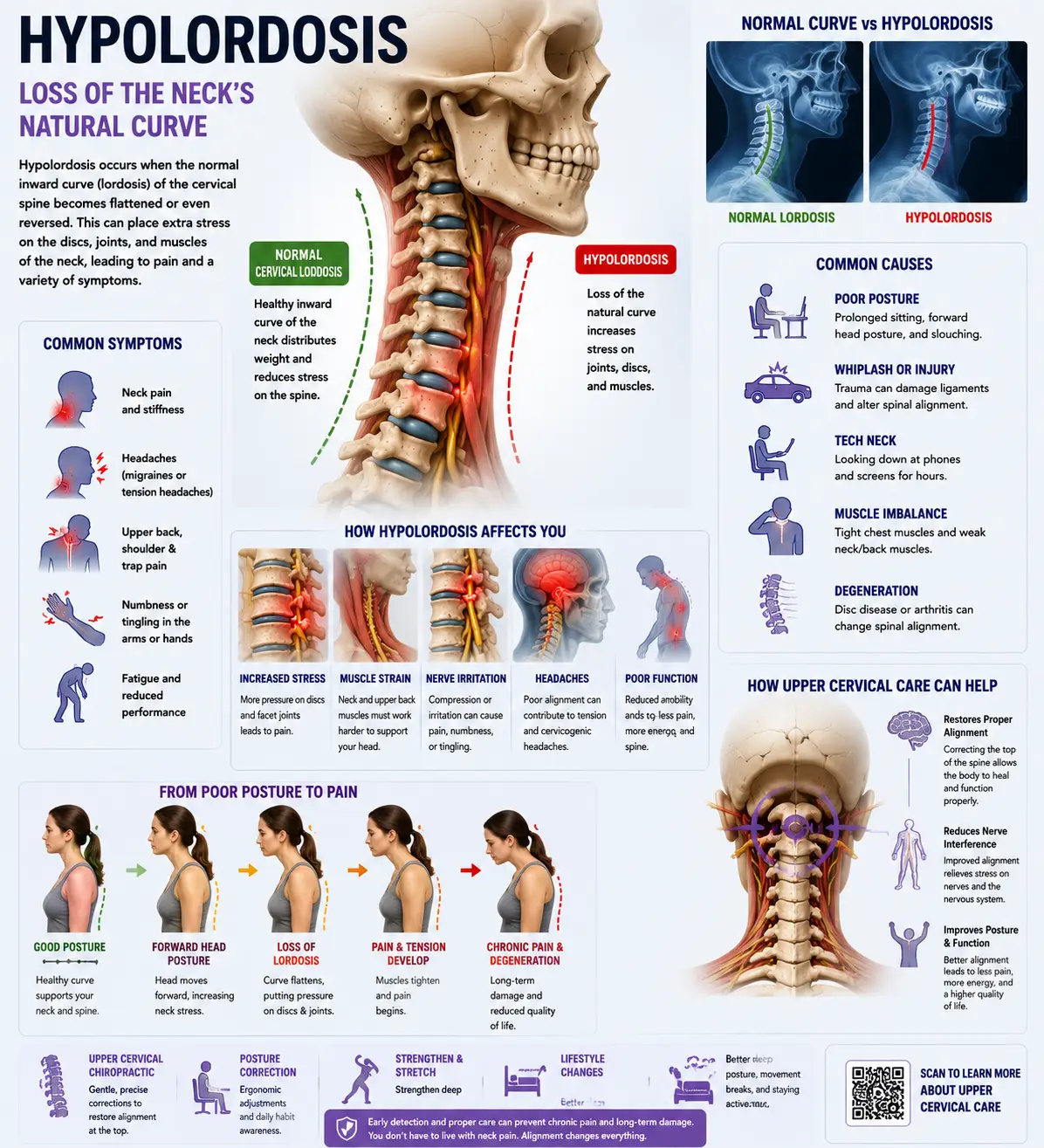
Your spine is not meant to be straight. Viewed from the side, a healthy spine has a series of gentle curves that work together to absorb shock, distribute load, and balance your head over your body. In the neck, the natural curve is called the cervical lordosis, a gentle forward (inward) arc, like a shallow letter C facing backward. This curve allows the cervical spine to support the considerable weight of the head, roughly ten to twelve pounds, with minimal strain, and to absorb and distribute the forces of everyday movement.
Loss of cervical lordosis means this natural curve has flattened, straightened, or in some cases reversed into the opposite direction, a kyphosis. When the neck loses its curve and becomes unnaturally straight, the appearance can resemble a person standing rigidly at attention, which is where the common name military neck comes from. A reversed curve, where the neck arcs the opposite way from how it should, is sometimes called a reverse curve or S-curve.
Clinicians measure the curve using angles on a side-view X-ray, most commonly the Cobb angle. There is no single universally agreed number, but as a general guide, a healthy lordosis is often described as falling somewhere in the range of about 31 to 40 degrees, while a straightened spine sits near zero and a kyphotic, reversed curve goes negative. One widely cited reference point comes from a study by McAviney and colleagues, summarized in a review on the prognosis of lost lordosis, which reported that a statistically significant association was found between cervical pain and a lordosis of less than 20 degrees, leading the authors to suggest a clinically normal range of 31 to 40 degrees. The key point is that the curve exists on a spectrum, and “loss of lordosis” describes a meaningful departure from the healthy range.
How Common Is a Lost Curve, and Does It Always Cause Pain?
This is where honesty matters most, because the answer is more nuanced than either the alarming version or the dismissive version you might hear.
First, a straightened or reversed cervical curve is fairly common, and it is found in plenty of people who have no neck pain at all. The same review on the prognosis of lost lordosis noted that around 20% of the asymptomatic population presents with an alteration of either straightening or inversion of the cervical lordosis. Other research has found cervical kyphosis in an even higher share of pain-free people; one cross-sectional study reported that up to 38.3% of asymptomatic individuals exhibit cervical kyphosis, with a higher prevalence among younger populations. So a lost curve on its own does not automatically mean you are destined for pain.
Second, the research on whether a lost curve causes neck pain is genuinely mixed, and we think you deserve to hear that plainly rather than be told a tidy story. Some studies do find an association. A prospective study of 255 neck pain patients, published in the Journal of Orthopaedic Case Reports, investigated the relationship and noted that alterations in the cervical curve, such as straightening or kyphosis, have been linked to neck pain, myelopathy, and disability. Yet the same paper is honest that other researchers and meta-analyses have found no clear relationship, with some concluding that neck pain characteristics do not reliably influence the global or segmental cervical curve.
What does this mixed picture mean for you? It means the lost curve is best understood as a meaningful finding, not a verdict. It changes the mechanical environment of your neck, and for some people that contributes to symptoms, while for others it sits quietly. The goal is not to panic about a number on a report, but to evaluate your specific situation, your symptoms, your alignment, your function, and determine what is actually driving how you feel.
Why the Curve Gets Lost
A cervical curve does not usually straighten overnight. It develops over time through a handful of related processes.
The most common driver in the modern world is sustained forward head posture. When the head drifts forward of its balanced position over the shoulders, hour after hour, day after day, the mechanics of the neck change. This is the pattern at the heart of tech neck, the forward-head posture epidemic driven by phones, tablets, and laptops. As the head sits forward, the deep neck flexors weaken, the muscles at the base of the skull tighten to keep the eyes level, and over time the natural lordotic curve flattens to accommodate the new head position. Forward head posture and loss of lordosis tend to travel together.
A second common cause is trauma, particularly whiplash. The sudden hyperextension and hyperflexion of a car accident can injure the muscles, ligaments, and joints that maintain the cervical curve, and acute muscle spasm following injury frequently straightens the spine. In fact, a straightened cervical curve on imaging after a collision is sometimes a sign of acute muscle guarding rather than a permanent structural change.
A third contributor is degeneration. As the discs lose height and the spine ages, the curve can gradually flatten or reverse. This is closely tied to broader degenerative changes in the cervical spine. Muscle spasm from any cause can also temporarily straighten the curve, which is one reason a single X-ray finding of lost lordosis should be interpreted alongside the clinical picture rather than in isolation.
Underlying many of these is a common theme: how the head is balanced over the neck, and how the cervical spine is loaded and aligned, shapes whether the curve is maintained or lost over time. That is where the upper cervical connection becomes central.
The Upper Cervical Connection: How Alignment Shapes the Whole Curve
It might seem that the cervical curve is mostly a matter of the lower neck, where the arc is most visible. But the alignment of the atlas and axis at the very top of the neck plays an outsized role in determining how the entire curve is held.
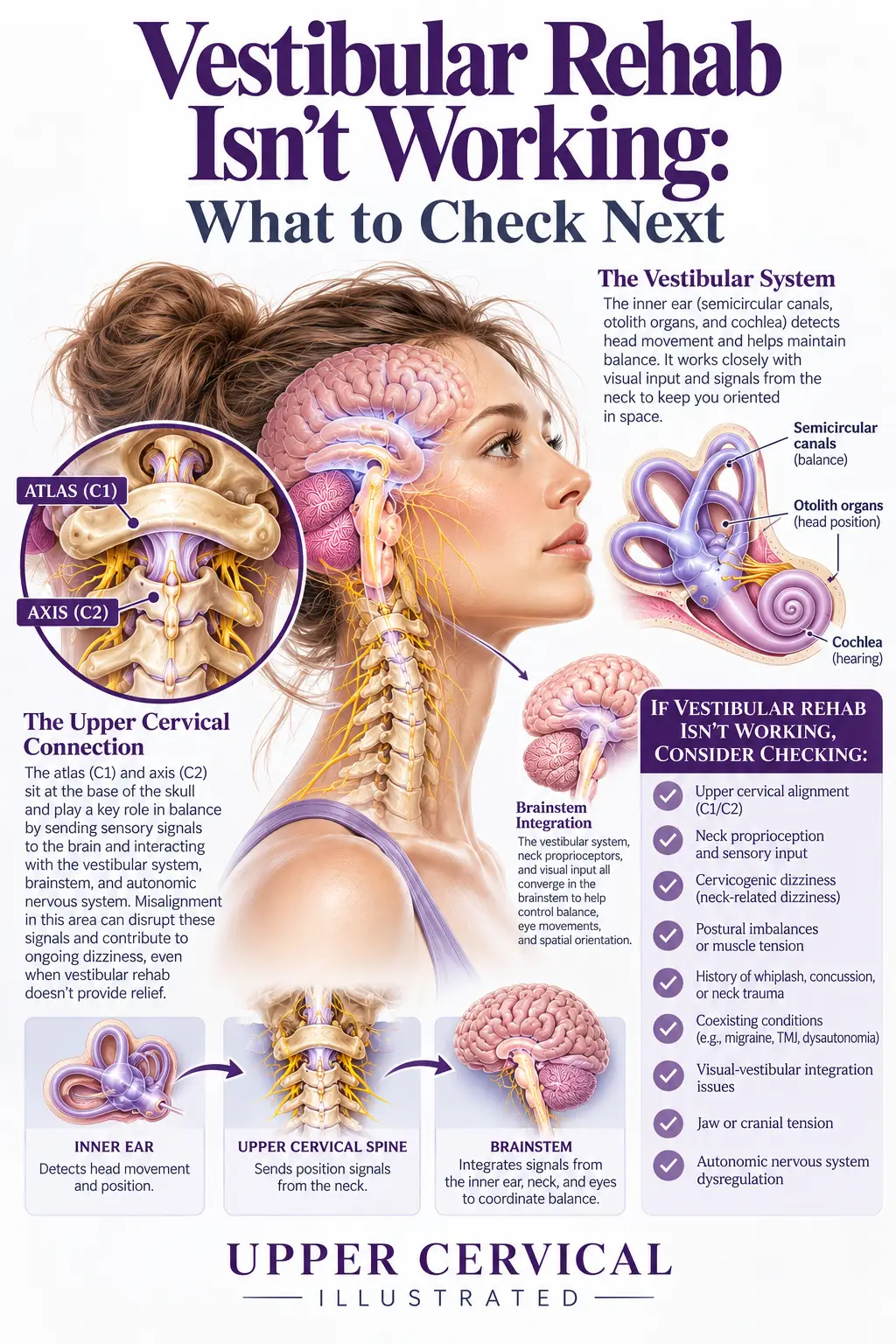
The atlas and axis form the craniocervical junction, the region responsible for keeping your head level and your eyes oriented to the horizon. When the atlas sits even slightly out of position, your head tilts, and your body cannot tolerate a tilted head, because your visual and vestibular systems demand a level gaze. So the body compensates by altering the position of the vertebrae below to bring the head back to horizontal. Over time, these compensations change how the whole cervical curve is shaped and loaded. A misaligned atlas shifts the head’s resting position, and the rest of the cervical spine adapts its curve to accommodate, often flattening in the process.
There is also a muscular dimension. The upper cervical spine is densely supplied with the proprioceptors that tell the brain where the head and neck are in space, and it heavily influences the tone of the deep stabilizing muscles of the neck. When the upper cervical region is misaligned, the deep neck flexors that help maintain the curve can become inhibited while the muscles at the base of the skull become chronically tight, exactly the muscular imbalance that allows the curve to flatten and forward head posture to set in.
This is why addressing the top of the neck matters even for a problem that looks like it lives in the lower curve. Restoring proper upper cervical alignment re-centers the head over the neck and helps normalize the muscle tone that holds the curve. We want to be careful and honest here, because curve correction is an area where some providers overpromise. We do not claim that a single adjustment instantly rebuilds a lost curve. What we can say is that the alignment of the upper cervical spine is one of the genuine inputs into how the whole cervical curve is held, and addressing it is a reasonable, mechanism-based part of a strategy to improve neck mechanics.
There is one more piece worth understanding, and it is one your own evaluation may touch on. The vertebral arteries, which supply blood to the brainstem, travel up through small openings in the cervical vertebrae in close relationship to the curve. A Doppler ultrasound study by Bulut and colleagues, published in Medical Science Monitor, found that patients with loss of the normal cervical lordosis had significantly decreased vertebral artery diameter, flow volume, and peak systolic velocity compared to controls. This is one of the reasons a lost curve is sometimes associated not just with neck pain but with headache and dizziness, and it is part of why we take cervical alignment seriously as a whole-system matter. If you also find yourself with a persistent urge to crack or pop your neck, that often reflects the muscular tension and stiffness that accompany a poorly held curve.
Why Upper Cervical Care Matters for a Lost Cervical Curve
At Lavender Family Chiropractic in Sarasota, our approach to a straightened or reversed curve is grounded in honesty about what care can and cannot do, and in addressing the alignment and muscular factors that shape the curve. Through the Knee Chest Upper Cervical technique, we correct atlas and axis misalignment with a precise, gentle, sub-millimeter adjustment that requires no twisting, no cracking, and no forceful manipulation of the neck.
For someone with a lost cervical curve, restoring proper upper cervical alignment helps in several ways. It re-centers the head over the cervical spine, removing one of the drivers that pulls the curve flat. It helps normalize the balance between the inhibited deep neck flexors and the over-tight suboccipital muscles, the muscular imbalance that allows the curve to straighten. And by improving the proprioceptive input and muscle tone regulation from the top of the neck, it supports the body’s own capacity to hold a healthier head position over time.
We want to be clear about scope. Loss of cervical lordosis, especially when longstanding and accompanied by degenerative change, may not fully reverse, and we will never promise that it will. What we focus on is improving the alignment and muscular function that influence the curve, reducing the symptoms that brought you in, and supporting better mechanics going forward. For many people, that combination produces meaningful improvement in how their neck feels and functions, whether or not the curve angle on a follow-up film changes dramatically.
What separates upper cervical care from a generic adjustment is the precision of the diagnosis and the specificity of the correction. We are addressing the structural foundation at the top of the neck that helps determine how the whole curve is held, gently and precisely, rather than forcing the spine into a shape.
What Care Looks Like at Lavender Family Chiropractic
If you come into our Sarasota office for evaluation of a lost cervical curve, here is what to expect.
Your first visit begins with a thorough consultation. Dr. Lavender or Dr. Temple will sit down with you and review your full history: your symptoms, when they began, any history of trauma or whiplash, your daily posture and work demands, what imaging you have had, and what you have been told about your curve. We pay attention to whether your straightened curve might reflect acute muscle guarding versus a longstanding structural change, because that distinction matters for what to expect.
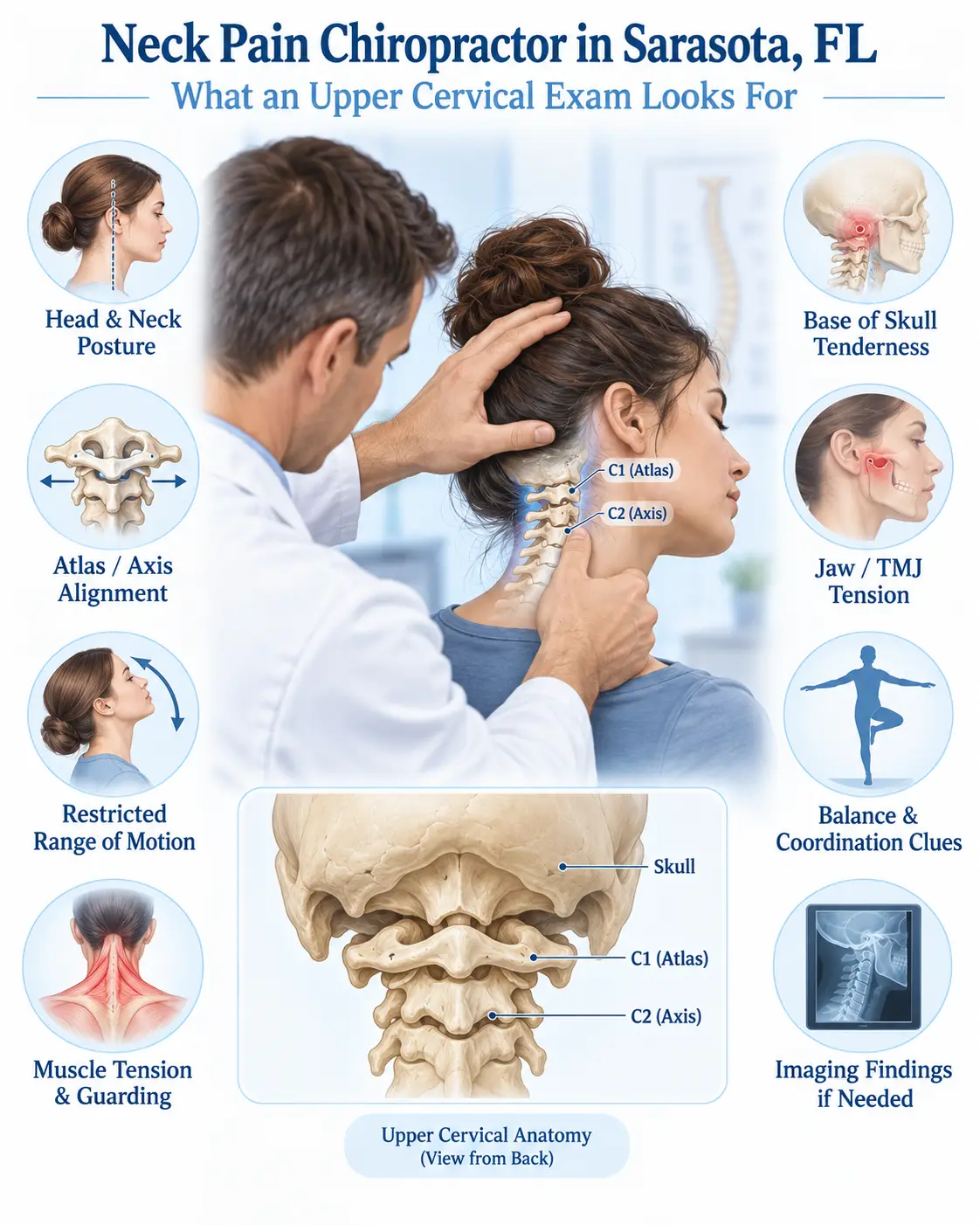
For appropriate patients, the examination includes postural analysis, range-of-motion assessment, a neurological screen, and advanced 3D CBCT imaging of your cervical spine. This level of imaging lets us assess your curve, the atlas-axis alignment that influences it, and any degenerative changes in three dimensions, detail that flat films cannot fully provide. We also perform functional nervous system scans to objectively measure how your nervous system is operating before care begins. If your situation involves significant degeneration, neurological signs, or findings that call for medical evaluation, we will tell you directly and help coordinate the right care.
For patients who are appropriate candidates, care is delivered through the gentle Knee Chest Upper Cervical technique, with no popping, twisting, or forceful manipulation. We offer customized treatment plans tailored to your situation, and we are transparent about what to realistically expect, including honest conversations about the difference between improving symptoms and function versus dramatically changing a curve angle. We are also candid that supporting a healthier curve is a longer-term process that depends heavily on the daily posture and muscular factors you control.
📞 Call (941) 243-3729 to schedule your complimentary consultation 📅 Book your consultation online 📍 5899 Whitfield Avenue, Suite 107, Sarasota, FL 34243 — at the corner of University and Whitfield
What the Research Says About the Cervical Curve and Neck Pain
The research on the cervical curve sends a message that is both interesting and, in places, deliberately uncertain, and we think presenting it honestly is more credible than pretending it is settled.
On prevalence, a lost curve is common and frequently painless. The review on the prognosis of lost lordosis documented that roughly 20% of asymptomatic people show straightening or inversion of the cervical curve, and a separate cross-sectional study found cervical kyphosis in up to 38.3% of asymptomatic individuals. These numbers are a useful counterweight to the fear the diagnosis can provoke.
On the association with pain, the evidence genuinely cuts both ways. The Journal of Orthopaedic Case Reports study of 255 neck pain patients noted that straightening or kyphosis of the cervical curve has been linked to neck pain, myelopathy, and disability in some research, while other studies and meta-analyses have found no reliable relationship. The McAviney threshold of lordosis under 20 degrees correlating with pain is one of the more frequently cited findings on the “association” side, but it is not the whole story.
On the mechanical consequences, the picture is clearer. Biomechanical analyses show that a straightened or kyphotic cervical alignment increases mechanical load on the intervertebral discs and facet joints, particularly at the C2-C3 and C6-C7 segments, increasing their susceptibility to degeneration. And the vascular dimension is documented: the Bulut Medical Science Monitor study found reduced vertebral artery diameter and blood flow in patients with loss of cervical lordosis.
Taken together, the honest summary is this: a lost curve is common, sometimes silent, changes the mechanical loading on the neck in ways that can accelerate degeneration, and has a real but inconsistent relationship with pain. The most credible position is that it is one meaningful factor among several, worth addressing as part of a whole-neck strategy, not a single villain to be blamed for everything.
Lifestyle Factors That Support a Healthier Cervical Curve
Whether or not upper cervical care is part of your plan, the daily inputs you control have an outsized effect on your cervical curve, arguably more than for almost any other neck condition, because the curve is so directly shaped by sustained posture and muscle balance.
Screen ergonomics. This is the single most important factor. Sustained forward head posture from devices is the leading modern driver of a flattening curve. Bring screens to eye level, hold your phone up rather than dropping your head to it, and take frequent breaks to reset your posture. Protecting the curve and protecting against forward head posture are the same project.
Strengthen the deep neck flexors. A lost curve is partly a muscular imbalance, with weak deep neck flexors and tight suboccipitals. Gentle deep neck flexor activation, such as slow, controlled chin nods done within a comfortable range, helps retrain the muscles that support a healthy head position. A qualified provider can guide appropriate exercises for your situation.
Sleep position and pillow. A cervical contour pillow that supports the natural curve, used with back or side sleeping, helps maintain the curve during the hours you spend in bed. Stomach sleeping forces the neck into rotation and extension and works against a healthy curve.
Posture awareness throughout the day. Beyond screens, simple habits matter: setting up your workstation so your monitor is at eye level, keeping your head stacked over your shoulders when standing and walking, and catching yourself when your head drifts forward. The curve responds to the position your neck spends the most time in.
Stay gently active. Movement supports the health of the discs, joints, and muscles that maintain the curve. Regular, gentle activity and mobility work keep the cervical spine supple and the supporting muscles engaged.
Hydration. The discs that help maintain the spacing and curve of the neck are roughly 80% water, and chronic dehydration accelerates the disc height loss that contributes to a flattening curve. In the Florida heat, aim for at least half your body weight in ounces of water daily.
Address stress and muscle tension. Chronic stress raises muscle tone in the neck and shoulders, contributing to the suboccipital tightness that flattens the curve. Stress management supports both your comfort and your mechanics.
If you found this guide useful, you may also want to read our guide on tech neck and forward head posture, which explores the posture pattern that most often drives a flattening cervical curve in the first place.
Serving Sarasota and the Surrounding Communities
Lavender Family Chiropractic is located in Sarasota, Florida, at 5899 Whitfield Avenue, Suite 107, at the corner of University and Whitfield. From this central location, we serve patients throughout the region, including Bradenton, Lakewood Ranch, Palmetto, Parrish, Venice, Osprey, Nokomis, Ellenton, Ruskin, Myakka City, North Port, and the greater Tampa Bay area. Patients also travel from St. Pete, Riverview, and Manatee County to receive specialized upper cervical care here.
A lost cervical curve is the kind of finding that can leave people anxious and confused, unsure whether it explains their symptoms or whether it matters at all. We aim to give you a straight, balanced evaluation of where your curve fits into your overall picture and what realistically can and cannot be done about it. If that kind of honesty is what you are looking for, we would be glad to help.
Top 15 FAQs About Loss of Cervical Curve and Upper Cervical Chiropractic Care
1. What does “loss of cervical lordosis” actually mean? It means the natural forward curve of your neck has flattened, straightened, or in some cases reversed into the opposite direction. A healthy neck has a gentle C-shaped curve that helps support the head and absorb load; losing it changes how the neck is loaded.
2. Is military neck the same thing? Essentially yes. “Military neck” is the common term for a straightened cervical curve, named for the rigid, standing-at-attention appearance it can create. A reversed curve is sometimes called a reverse curve or kyphosis.
3. Does a lost curve definitely mean that is what is causing my pain? Not necessarily. The research is genuinely mixed. Some studies link a lost curve to neck pain and disability, while others find no reliable relationship, and a significant share of people with a straightened curve have no symptoms at all. It is one factor to weigh, not an automatic verdict.
4. How common is a straightened curve? Fairly common. Around 20% of people with no symptoms show straightening or inversion of the curve, and some studies find cervical kyphosis in over a third of asymptomatic people, especially younger ones. So it is not rare, and it is not always a problem.
5. What causes the curve to be lost? The most common cause is sustained forward head posture from devices, along with whiplash and other trauma, age-related degeneration, and muscle spasm. Often more than one factor is involved. Sometimes a straightened curve on a film simply reflects temporary muscle guarding.
6. Can chiropractic restore my curve? We are honest here: a longstanding lost curve, especially with degeneration, may not fully reverse, and we will not promise that it will. What we focus on is improving the alignment and muscle balance that shape the curve, reducing symptoms, and supporting better mechanics over time.
7. Why would adjusting the top of my neck affect the whole curve? Because the atlas and axis set the head’s resting position and heavily influence the muscle tone that holds the curve. When they are misaligned, the rest of the cervical spine compensates and the curve tends to flatten. Correcting the upper cervical foundation removes one of the drivers.
8. Is upper cervical chiropractic safe for this? Yes. The Knee Chest Upper Cervical technique is gentle and precise, with no twisting, popping, or forceful manipulation, which makes it appropriate even when the curve is altered and the surrounding tissues are sensitive. We examine thoroughly first.
9. Can a lost curve cause headaches or dizziness? It can be associated with them. A lost curve has been linked to reduced vertebral artery blood flow, and the vertebral arteries supply the brainstem, which is part of why a straightened curve is sometimes connected to headache and dizziness as well as neck pain.
10. Can a car accident cause loss of my curve? Yes. Whiplash can injure the muscles and ligaments that maintain the curve, and acute spasm after a collision frequently straightens the spine. Sometimes this is temporary guarding; sometimes it contributes to a longer-term change. Trauma is a well-recognized cause.
11. Does posture really make that much difference? For the curve, yes, more than for almost any other neck condition. Sustained forward head posture is the leading modern cause of a flattening curve, which is why addressing your daily posture and screen habits is central to any real improvement.
12. Will a straightened curve get worse over time? It can, particularly if the underlying posture and loading patterns continue, because a lost curve increases mechanical stress on the discs and facet joints and can accelerate degeneration. Addressing the contributing factors helps protect against progression.
13. Should I worry about the curve number on my report? A number is useful context, but it should be interpreted alongside your symptoms and function, not in isolation. Many people with an abnormal number feel fine, and the goal is to address how your neck actually feels and works, not to chase a single measurement.
14. How will I know if upper cervical care is right for me? The only way to know for certain is a thorough evaluation. Our examination, including 3D imaging and functional scans, will show whether an upper cervical misalignment is contributing to your curve and symptoms, and we will give you an honest assessment of what care can realistically achieve.
15. How do I get started? Call our Sarasota office at (941) 243-3729 or book your consultation online. We will review your history, perform a thorough examination, and give you a straight, balanced answer about how upper cervical care fits into addressing your curve and your symptoms.
Take the Next Step Toward Natural Neck Pain Relief
A lost cervical curve is neither nothing nor everything. It is a real change in how your neck is shaped and loaded, with a genuine but inconsistent relationship to pain, shaped heavily by the posture and muscle balance you carry every day. The people who do best are the ones who understand it clearly, neither dismissing it nor catastrophizing the number on a report, and who address the alignment, the muscle function, and the daily habits that determine how the curve is held.
If you are in Sarasota, Bradenton, Lakewood Ranch, or anywhere in the surrounding region and you have been told your neck has lost its curve, Dr. Rusty Lavender and Dr. Jacob Temple at Lavender Family Chiropractic are here to give you an honest, balanced evaluation of where upper cervical care fits into improving your neck mechanics and your symptoms, natural neck pain treatment grounded in what the evidence actually supports.
📞 Call (941) 243-3729 today to schedule your complimentary consultation 📅 Book online here 📍 5899 Whitfield Avenue, Suite 107, Sarasota, FL 34243 — at the corner of University and Whitfield
Related Articles
Get our upper cervical articles first.