Baro-Challenge-Induced Eustachian Tube Dysfunction in Sarasota, Florida: Why Your Ears React to Flights, Storms, and Pressure Changes — and How Upper Cervical Care at Lavender Family Chiropractic May Help
By Dr. Rusty Lavender, D.C. — upper cervical chiropractor, Lavender Family Chiropractic, Sarasota, FL. Reviewed and updated October 2026.
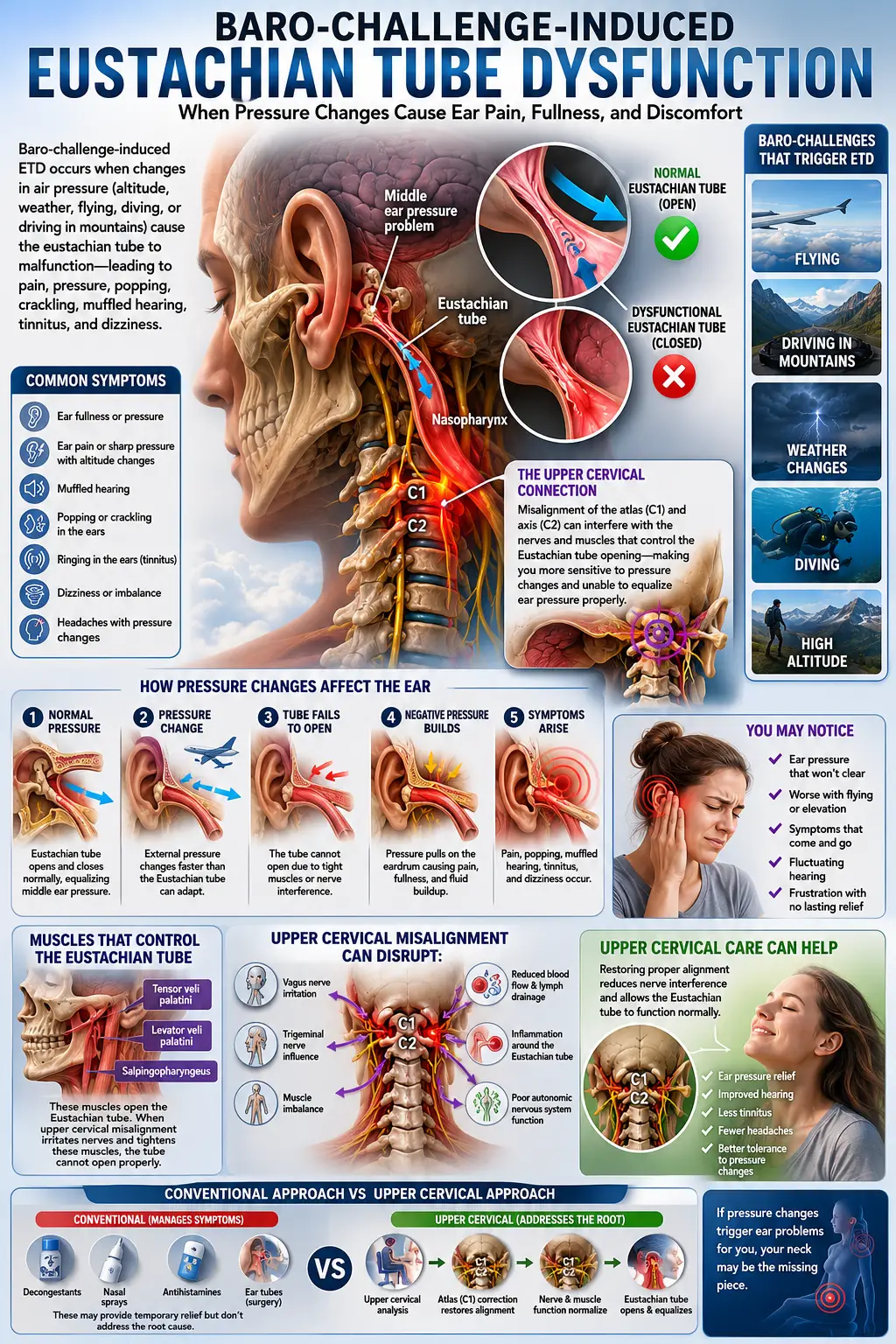
Baro-Challenge-Induced Eustachian Tube Dysfunction Relief and Treatment in Sarasota Florida: You feel fine most of the day. Your ears seem normal, your hearing is clear, and if a doctor looked in your ears right now they might find nothing wrong. Then a storm front moves in over Sarasota, or the plane begins its descent into Tampa, or you drive down from the mountains on a trip, and suddenly your ears clamp down. Fullness, pain, popping that won’t fully clear, muffled hearing, sometimes a wave of dizziness. And then, once the pressure stabilizes, it eases again. If that pattern sounds familiar, there is a specific name for it: baro-challenge-induced Eustachian tube dysfunction.
This is one of the three recognized types of Eustachian tube dysfunction, and it is the one most tied to where you are and what the weather or altitude is doing. It is also one of the most frequently missed, precisely because the ears can look and feel normal between episodes. If you live on the Gulf Coast, where pressure-dropping storm fronts roll through regularly and air travel is a part of life, this is a pattern many people quietly live with.
At Lavender Family Chiropractic in Sarasota, Florida, our entire focus is the upper cervical spine, the atlas (C1) and axis (C2) at the very top of the neck. We use 3D CBCT imaging and paraspinal infrared thermography to understand how your upper neck is influencing the nerves and muscles that control your ears, and we correct upper cervical misalignment with the gentle, precise Knee Chest Upper Cervical technique, with no twisting, popping, or forceful manipulation. We want to be honest with you from the start: we do not treat the weather, and we cannot change the barometric pressure outside. What we can do is help address the neuromuscular and structural factors that may be making your Eustachian tube struggle to keep up with pressure changes, so your system adapts more gracefully to the same storms and the same flights.
What Is Baro-Challenge-Induced ETD?
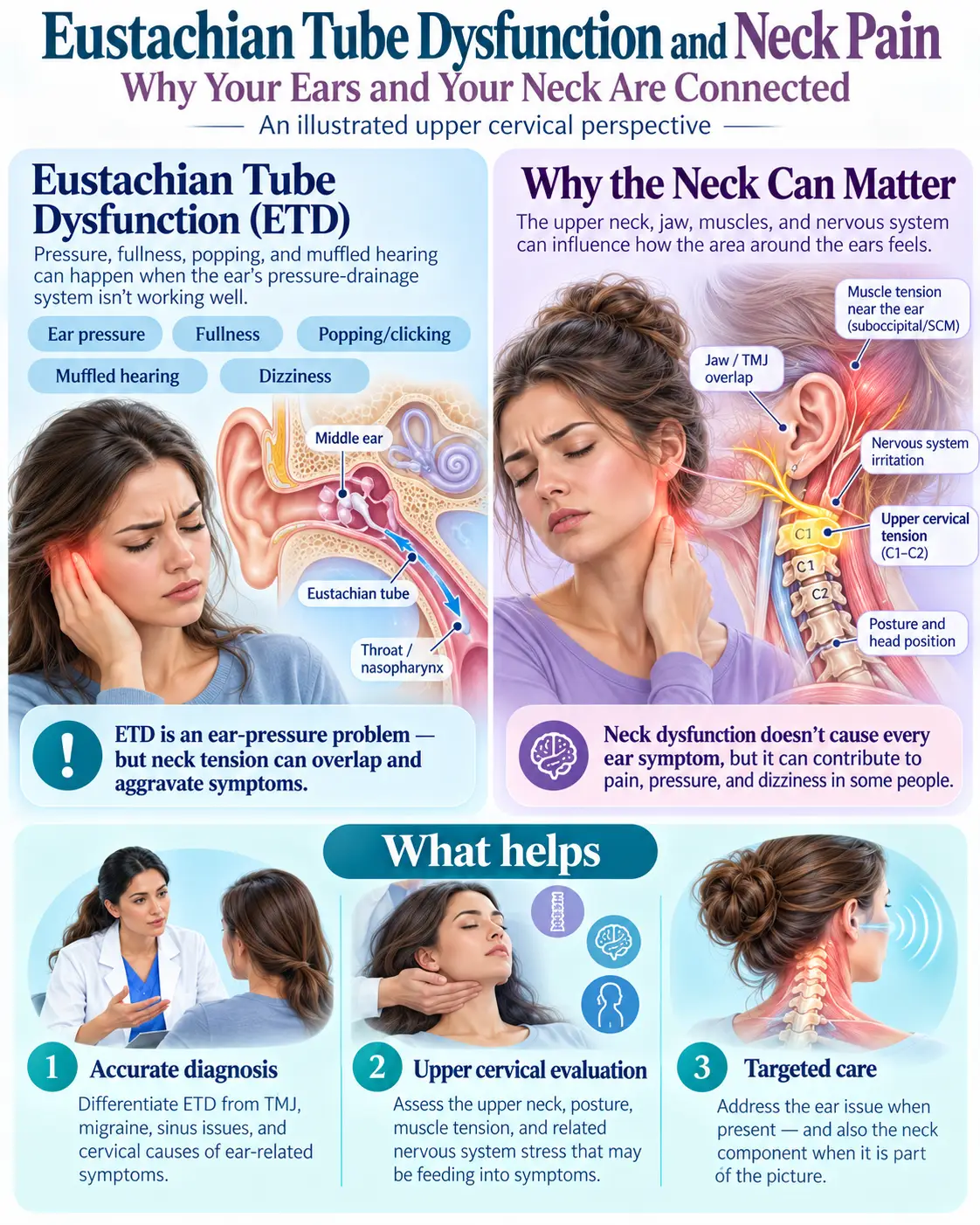
To understand this type, it helps to understand what the Eustachian tube is supposed to do. The Eustachian tube is a narrow canal connecting your middle ear to the back of your nose and throat. One of its central jobs is to equalize the air pressure on both sides of your eardrum. Normally, every time you swallow, yawn, or chew, small muscles briefly open the tube and let air move in or out of the middle ear, keeping the pressure balanced with the world around you.
Baro-challenge-induced ETD is, as Johns Hopkins describes it, the form of Eustachian tube dysfunction that is only felt during conditions like airplane flights or scuba diving, when the surrounding pressure changes. In other words, the tube works acceptably under stable, everyday conditions, but it cannot keep up when the ambient pressure changes quickly. The system is fine at cruising along on the ground; it struggles when challenged by a rapid pressure shift, hence “baro-challenge.”
This is a key distinction from the most common form of ETD, dilatory (obstructive) dysfunction, where the tube struggles to open even under normal conditions and symptoms are more constant. With baro-challenge-induced ETD, the defining feature is that symptoms are triggered by, or initiated under, conditions of changing pressure, and people are typically symptom-free once they return to stable pressure. The Cleveland Clinic summarizes the three recognized categories of ETD this way, noting that in baro-challenge-induced ETD, ear pain and pressure occur specifically with altitude changes. That episodic, trigger-linked pattern is the signature.
The Triggers: Storms, Flights, Diving, and Altitude
What counts as a “baro-challenge”? Any situation where the air or water pressure around you changes faster than your Eustachian tube can equalize. For people in the Sarasota area, several come up again and again.
Weather fronts and storms. Barometric pressure typically drops ahead of a storm. On the Gulf Coast, these swings can arrive weekly, especially in the summer storm season. For someone with baro-challenge-induced ETD, the dropping pressure outpaces the tube’s ability to equalize, and the ears fill, pop, or ache. This is why so many people describe their ears as “predicting the weather,” and why symptoms can flare before the rain even arrives.
Air travel. Flying is the classic trigger. During takeoff and especially descent, cabin pressure changes rapidly, and the tube has to work hard and fast to equalize. If it can’t, the pressure difference becomes painful. Many people with this pattern dread the descent, and some find their ears stay crackly or full for hours or even days after landing.
Scuba diving and free diving. Diving produces some of the most dramatic and fastest pressure changes the body encounters, which is why ear barotrauma is one of the most common problems divers face. We will return to why diving deserves special caution.
Driving in elevation changes. Mountain drives, tall bridges like the Sunshine Skyway, tunnels, and even fast elevators in tall buildings can all trigger symptoms in sensitive individuals.
The common thread is speed and magnitude of pressure change. Your tube might handle a slow, gentle shift fine but fail when the change is rapid.
What Actually Happens Inside Your Ear: The Mechanism
When the pressure outside changes and your Eustachian tube can’t equalize quickly enough, a pressure gradient builds across your eardrum, a difference between the middle ear and the outside world. This is the basis of what is medically called barotrauma, or ear “squeeze.”
The U.S. National Library of Medicine’s MedlinePlus explains the mechanism plainly: the air pressure in the middle ear is usually the same as outside the body, and swallowing or yawning opens the Eustachian tube to equalize pressure on both sides of the eardrum; if the tube is blocked, the pressure inside the middle ear differs from the outside, which can cause barotrauma, and this often occurs with altitude changes such as flying, scuba diving, or driving in the mountains. It also notes an important risk factor that anyone on the Gulf Coast should recognize: if you have a congested nose from allergies, colds, or an upper respiratory infection, you are more likely to develop barotrauma. Allergy season and a pressure-changing flight or storm are a difficult combination.
The pressure gradient is not just uncomfortable; past a certain point it becomes genuinely damaging. Clinical references describe how, on a diver’s descent, the Eustachian tube should open to equalize the building pressure, but if the gradient grows large enough, pain ensues, and at higher gradients the tube simply cannot open at all, which can lead to eardrum injury. This is why baro-challenge-induced ETD is not merely an annoyance: in the wrong setting, particularly diving, it carries a real risk of harm.
What makes one person’s tube keep up while another’s fails? Part of the answer is the muscles and nerves that open the tube and how well-coordinated and well-timed they are, which is where the upper neck enters the picture.
The Upper Cervical Connection: Coordination and Timing of the Tube
The Eustachian tube does not open by accident. Two small muscles, the tensor veli palatini and the levator veli palatini, actively open and time it, and they are controlled by cranial nerves. The tensor veli palatini, the primary tube-opener, shares its nerve supply with the muscles of the jaw, both run off the mandibular branch of the trigeminal nerve. Physiopedia’s review of Eustachian tube dysfunction notes that because the trigeminal nerve supplies both the muscles of mastication and the tensor veli palatini, addressing the TMJ and associated structures can simultaneously influence signaling to the muscles that control the Eustachian tube. The point for baro-challenge ETD is this: equalizing pressure during a rapid challenge is a matter of fast, well-timed, well-coordinated tube opening, and that coordination is a nervous-system function.
This is where the atlas and axis at the top of the neck become relevant. The upper cervical spine sits immediately adjacent to the brainstem, where many of the cranial-nerve pathways that govern these muscles travel and relay. The region is also among the most proprioceptively dense in the body, meaning it heavily influences the tone and coordination of nearby muscles. When the atlas or axis is misaligned, the theory and clinical experience suggest it can alter the neural input and muscle tone in this area, contributing to a tube that opens with poor timing or incomplete effort, exactly the kind of dysfunction that fails under the stress of a rapid pressure change.
There is also an autonomic and congestion dimension. The upper cervical region influences autonomic balance, which in turn affects blood vessel tone and mucosal congestion in the nasopharynx, right where the tube needs to be clear and patent to equalize. If the system is tipped toward congestion, the tube has even less margin to handle a pressure challenge. And because the same trigeminal wiring links the jaw and the tube, people who clench or grind, or who have TMJ dysfunction, may find their tube coordination is further compromised.
We want to be careful and honest here, because this is an area where it is easy to overpromise. The anatomy connecting the upper neck, the cranial nerves, the jaw, and the tube-opening muscles is real and well-documented. What is less established by large clinical trials is the degree to which correcting upper cervical alignment improves baro-challenge ETD specifically. Our position is that there is a sound, mechanism-based rationale for addressing the upper neck as part of the picture, and many patients report meaningful improvement, while the high-quality outcome evidence is still developing. That honest framing is, we think, more trustworthy than a guarantee.
Why Upper Cervical Care Matters for Baro-Challenge ETD
At Lavender Family Chiropractic in Sarasota, our approach to baro-challenge-induced ETD is grounded in addressing the coordination and timing of the muscles that open your Eustachian tube, and the congestion and autonomic factors that reduce your margin during a pressure challenge. Through the Knee Chest Upper Cervical technique, we correct atlas and axis misalignment with a precise, gentle, sub-millimeter adjustment that involves no twisting, cracking, or forceful manipulation.
For someone whose ears react to flights and storms, restoring proper upper cervical alignment aims to support healthier neural input to the tube-opening muscles, so the tube can open with better timing and effort when a pressure change demands it. It aims to support better autonomic balance and reduced congestion in the region, giving the tube more margin to keep up. And by easing tension through the skull base and improving jaw mechanics, it addresses the shared trigeminal pathways that link the jaw and the tube.
The goal is not to claim we will make you immune to pressure changes. The goal is to help your body adapt more gracefully to the same barometric swings and the same flights that currently set your ears off, so that storm fronts and descents become less disruptive. We are also clear about scope: if your situation points to a problem outside what upper cervical care addresses, or if you are a diver with significant baro-challenge symptoms, we will tell you directly and help you get the right evaluation. What separates upper cervical care from a generic adjustment is the precision of the diagnosis and the specificity and gentleness of the correction.
What Care Looks Like at Lavender Family Chiropractic
If you come into our Sarasota office because your ears react to flights, storms, or altitude, here is what to expect.
Your first visit begins with a thorough consultation. Dr. Lavender or Dr. Temple will sit down with you and map out your pattern: which triggers set your ears off, how long symptoms last, whether they fully clear, any history of allergies, congestion, jaw clenching, or prior ear problems, and whether you dive or fly often. The episodic, trigger-linked nature of baro-challenge ETD makes this history especially important, because the exam between episodes can look normal.
For appropriate patients, the examination includes advanced 3D CBCT imaging of your upper cervical spine, postural and range-of-motion assessment, and functional nervous system scans using paraspinal infrared thermography to objectively measure how your nervous system is operating. This lets us see how the atlas and axis are influencing the nerves and muscle tone serving your ears, jaw, and sinuses, and base our recommendations on your specific anatomy rather than guesswork. If we find signs pointing to a condition outside our scope, or you have red flags suggesting you need ENT evaluation, we will tell you plainly and help coordinate that care. Patient safety always comes first.
For patients who are appropriate candidates, care is delivered through the gentle Knee Chest Upper Cervical technique, with no popping or twisting. We offer customized treatment plans tailored to your trigger pattern and anatomy, and we pair corrections with practical strategies for travel days and storm seasons. We monitor objective scans and clinical changes over time rather than simply adjusting and hoping, and we are honest about realistic timelines, some people notice changes within a few weeks, while for others gains build more gradually as alignment stabilizes.
📞 Call (941) 243-3729 to schedule your consultation 📅 Book your consultation online 📍 5899 Whitfield Avenue, Suite 107, Sarasota, FL 34243 — at the corner of University and Whitfield
What the Research Says
The research on baro-challenge-induced ETD is clearest on what it is and how the mechanism works, and appropriately humble about chiropractic-specific outcomes, which we think is worth presenting honestly.
On definition and classification, baro-challenge-induced ETD is one of three recognized types of Eustachian tube dysfunction, formalized in a 2015 expert consensus statement and reflected in major medical references. Johns Hopkins defines it as the form felt only during flights or scuba diving when pressure changes, and the Cleveland Clinic similarly describes ear pain and pressure occurring specifically with altitude changes.
On the mechanism, the barotrauma literature is well established. MedlinePlus describes how a blocked or poorly functioning Eustachian tube leaves the middle-ear pressure mismatched with the outside during altitude changes such as flying, diving, or mountain driving, and that pre-existing congestion from allergies or colds raises the risk. Clinical references on ear barotrauma detail how the pressure gradient across the eardrum becomes painful and, past higher thresholds, can prevent the tube from opening at all and damage the eardrum, underscoring that this is a genuine physical phenomenon, not merely a sensation.
On the neuromuscular control that underlies tube function, Physiopedia documents the shared trigeminal innervation between the jaw muscles and the tensor veli palatini that opens the tube, which provides the anatomical rationale for addressing the jaw, the cranial nerves, and the upper neck.
Where the evidence is genuinely limited is in trials of upper cervical chiropractic for baro-challenge ETD specifically. We have not found large randomized trials establishing that upper cervical care resolves this condition, and we will not pretend otherwise. What exists is a sound mechanistic rationale and clinical reports of improvement. The honest summary: the condition, its triggers, and its mechanism are well understood, and addressing the neuromuscular factors that govern tube coordination is a reasonable, rationale-based strategy, evaluated case by case rather than promised.
Lifestyle and Travel Strategies That Help
Whether or not upper cervical care is part of your plan, several practical strategies can reduce baro-challenge symptoms, and they matter a great deal for this particular type because the triggers are so predictable.
Equalize actively during pressure changes. During takeoff, descent, and elevation changes, swallow frequently, yawn, or chew gum to actively open the tube. Gentle equalization techniques help; forceful straining does not and can hurt. For infants and small children on flights, nursing or sips of a drink during descent helps.
Don’t fly or dive congested. This is the single most important rule. Flying or especially diving with a cold, allergies, or sinus congestion dramatically raises your risk of painful barotrauma, because the already-compromised tube has even less ability to equalize. If you are congested, consider postponing a dive entirely.
Plan around storm season. On the Gulf Coast, you can often see fronts coming. Staying well hydrated, managing allergies and congestion proactively, and being consistent with your care during heavy storm periods can reduce flare-ups.
Stay hydrated. The tissues around the tube function better when you are well hydrated, which matters especially in the Florida heat. Aim for at least half your body weight in ounces of water daily.
Manage jaw tension. Because the jaw and the tube share trigeminal wiring, clenching and nighttime grinding can worsen tube coordination. Addressing jaw tension supports better tube function.
Time your descent on flights. Try not to sleep during a plane’s descent, since you won’t be swallowing and equalizing as the pressure changes most rapidly. Stay awake and actively equalize.
Approach diving with real caution. If you have baro-challenge symptoms, treat diving seriously. Descend and ascend slowly, never dive congested, and get properly evaluated before diving if your ears struggle with pressure, because the risk of injury is real.
If you found this guide useful, you may also want to read our main guide on Eustachian tube dysfunction, which covers all three types and the upper cervical approach in more depth, and our guide on vertigo and dizziness, since pressure-triggered ear symptoms and balance symptoms often overlap.
Serving Sarasota and the Surrounding Communities
Lavender Family Chiropractic is located in Sarasota, Florida, at 5899 Whitfield Avenue, Suite 107, at the corner of University and Whitfield. From this central location, we serve patients throughout the region, including Bradenton, Lakewood Ranch, Palmetto, Parrish, Venice, Osprey, Nokomis, Ellenton, and the surrounding Gulf Coast communities. Patients also travel from St. Pete, Riverview, and Manatee County to receive specialized upper cervical care here.
If your ears react every time a storm rolls in or a plane begins its descent, and you are tired of bracing for it, we would be glad to take an honest look at whether the top of your neck is part of the picture.
Top 15 FAQs About Baro-Challenge-Induced ETD and Upper Cervical Care
1. What is baro-challenge-induced ETD? It’s the type of Eustachian tube dysfunction where your ears only have trouble during pressure changes, like flying, diving, or weather fronts. Between episodes, the ears often feel and look normal, which is why it’s so often missed.
2. How is it different from regular ETD? With the common dilatory (obstructive) type, the tube struggles to open under everyday conditions and symptoms are more constant. With the baro-challenge type, the tube works acceptably at rest but fails specifically when pressure changes rapidly.
3. Why do my ears react before a storm? Barometric pressure drops ahead of storms. Your ears must equalize that change through the Eustachian tube, and if the tube can’t keep up, pressure builds and your ears feel full or painful. On the Gulf Coast these swings are frequent.
4. Why does flying hurt my ears so much? Cabin pressure changes rapidly during takeoff and descent. If your tube can’t equalize fast enough, the pressure gradient across your eardrum becomes painful. Descent is usually the worst part.
5. Is it dangerous? Usually it’s uncomfortable rather than dangerous, but in settings with large, fast pressure changes, especially scuba diving, an unequalized gradient can damage the eardrum. Diving with this pattern deserves real caution and proper evaluation.
6. Why can my doctor find nothing wrong? Because the exam between episodes can look completely normal. Baro-challenge ETD shows itself under pressure challenge, not at rest, so a routine look in the ear on a calm day may reveal nothing.
7. Should I fly or dive with a cold? Avoid it, especially diving. Congestion from a cold, allergies, or sinus issues sharply raises the risk of painful barotrauma because the tube has even less ability to equalize. If you’re congested, consider postponing.
8. How does my neck affect this? The muscles that open your Eustachian tube are controlled by cranial nerves that travel near the brainstem, right beside the atlas and axis. Misalignment may affect the timing and coordination of tube opening, which is exactly what fails during a pressure challenge.
9. Can upper cervical care cure this? We won’t claim a cure. The anatomy connecting the upper neck, nerves, and tube is well established, but trial evidence for chiropractic specifically resolving baro-challenge ETD is limited. The goal is to support better tube coordination so you adapt more gracefully, evaluated case by case.
10. Is the adjustment safe? Yes. The Knee Chest Upper Cervical technique is gentle and precise, with no twisting, cracking, or forceful manipulation. Care is tailored to your anatomy after imaging and examination.
11. Can this cause dizziness? Yes. When middle-ear pressure mechanics and balance inputs are out of sync during a pressure change, many people feel dizzy or unsteady, particularly around weather shifts and flights.
12. What can I do on a flight to help? Swallow, yawn, or chew gum during takeoff and descent, stay awake during descent so you keep equalizing, stay hydrated, and don’t fly congested if you can avoid it. Gentle equalization beats forceful straining.
13. Does jaw clenching make it worse? It can. The jaw muscles and the main tube-opening muscle share the same nerve supply, so clenching and grinding can compromise tube coordination. Addressing jaw tension may help.
14. How will I know if upper cervical care is right for me? Only a thorough evaluation can tell. Our exam, including 3D imaging and nervous-system scans, shows whether an upper cervical misalignment is contributing, and we’ll give you an honest assessment of whether care is likely to help your specific pattern.
15. How do I get started? Call our Sarasota office at (941) 243-3729 or book your consultation online. We’ll review your trigger history, perform a thorough exam, and give you a straight answer about how upper cervical care fits into your situation.
Take the Next Step
If your ears clamp down every time a front moves in or a plane starts its descent, that pattern has a name, baro-challenge-induced Eustachian tube dysfunction, and you don’t have to simply brace for it. While no one can change the weather or the pressure in a cabin, addressing the neuromuscular and structural factors that govern how your Eustachian tube keeps up with pressure changes may help your body handle those challenges more gracefully.
If you are in Sarasota, Bradenton, Lakewood Ranch, or anywhere along the Gulf Coast, Dr. Rusty Lavender and Dr. Jacob Temple at Lavender Family Chiropractic are here to give you an honest evaluation of whether upper cervical care fits into your situation.
📞 Call (941) 243-3729 today to schedule your consultation 📅 Book online here 📍 5899 Whitfield Avenue, Suite 107, Sarasota, FL 34243 — at the corner of University and Whitfield
Related Articles
Get our upper cervical articles first.
Patients Experience