Trigeminal Neuralgia Surgery Options Explained: Microvascular Decompression, Gamma Knife, and Rhizotomy
By Dr. Rusty Lavender — Lavender Family Chiropractic, Sarasota, FL
Surgery or conservative care: Few conditions are as difficult to live with as trigeminal neuralgia (TN). The sudden, electric-shock jolts of facial pain that define this disorder can be triggered by something as ordinary as brushing your teeth, feeling a breeze on your cheek, chewing a meal, or speaking a single sentence. For many people, medication brings meaningful relief for months or even years. But when medications begin to lose their effect, or when the side effects become as hard to tolerate as the pain itself, the conversation often turns toward surgical options. If you have reached that point, you are likely reading everything you can find, trying to understand what these procedures actually involve and how they differ from one another.
This article is written to help you do exactly that. Our goal here is not to talk you into or out of any particular path. It is simply to explain, in plain and neutral language, the main surgical options that neurosurgeons perform for trigeminal neuralgia: microvascular decompression (MVD), stereotactic radiosurgery (often referred to by the Gamma Knife brand name), and the family of percutaneous procedures known as rhizotomies. Each of these approaches has a different mechanism, a different risk-and-benefit profile, and a different set of patients for whom it tends to be considered. Understanding those differences can help you have a more informed conversation with the neurologist and neurosurgeon who guide these decisions.
We are a chiropractic office in Sarasota, Florida, and we want to be transparent about our role from the very first paragraph. We are not surgeons, and upper cervical chiropractic care is not surgery. It does not cure trigeminal neuralgia, and it is not a replacement for a procedure your medical team believes you need. What we offer is a conservative, precise, low-force approach to the upper neck that some people with facial pain choose to explore alongside their medical care. Later in this article we will explain where that fits — honestly, and without any promises. First, let’s focus on the surgical landscape itself, because if you are weighing your options, you deserve a clear picture of what those options are.
When Surgery Is Considered for Trigeminal Neuralgia
Trigeminal neuralgia is usually managed first with medication, not surgery. The trigeminal nerve is the large nerve responsible for sensation across the face, and in classic TN the pain is thought to arise from irritation of that nerve — frequently where a nearby blood vessel presses against it close to the point where the nerve enters the brainstem, an area clinicians call the root entry zone. Anticonvulsant medications such as carbamazepine and oxcarbazepine are typically the first line of treatment because they calm the abnormal nerve firing that produces the pain. For a large share of people, these drugs work well, at least for a time.
Surgery generally enters the discussion in two situations. The first is when medications stop controlling the pain adequately. TN has a tendency to become less responsive to medication over the years, and doses that once brought relief may no longer be enough. The second situation is when the medication works but the side effects are simply not tolerable. Anticonvulsants can cause fatigue, dizziness, unsteadiness, cognitive fog, low sodium levels, and other effects that some people find they cannot live with day after day. When either of these things happens — medication failure or medication intolerance — a referral to a neurosurgeon for a discussion of procedural options is a common and appropriate next step.
It is important to underline who makes this decision. The choice of whether to have surgery, and which procedure to pursue, belongs to you in partnership with your neurologist and neurosurgeon. These clinicians will consider your specific diagnosis, your imaging findings, your age and overall health, whether a blood vessel appears to be compressing the nerve, how long you have had symptoms, and your own preferences and tolerance for risk. There is no single right answer that applies to everyone. What is right for a healthy person in their forties with clear vascular compression on an MRI may be very different from what is right for someone in their eighties with other medical conditions.
One more point deserves emphasis before we go further. If your facial pain is new, undiagnosed, or changing in character, the first and most important step is a proper medical evaluation — not a decision about surgery, and not a chiropractic visit. Facial pain has many possible causes, some of which need prompt medical attention, and an accurate diagnosis is the foundation for every good decision that follows. With that framing in place, let’s look at each surgical option in turn.
Microvascular Decompression (MVD)
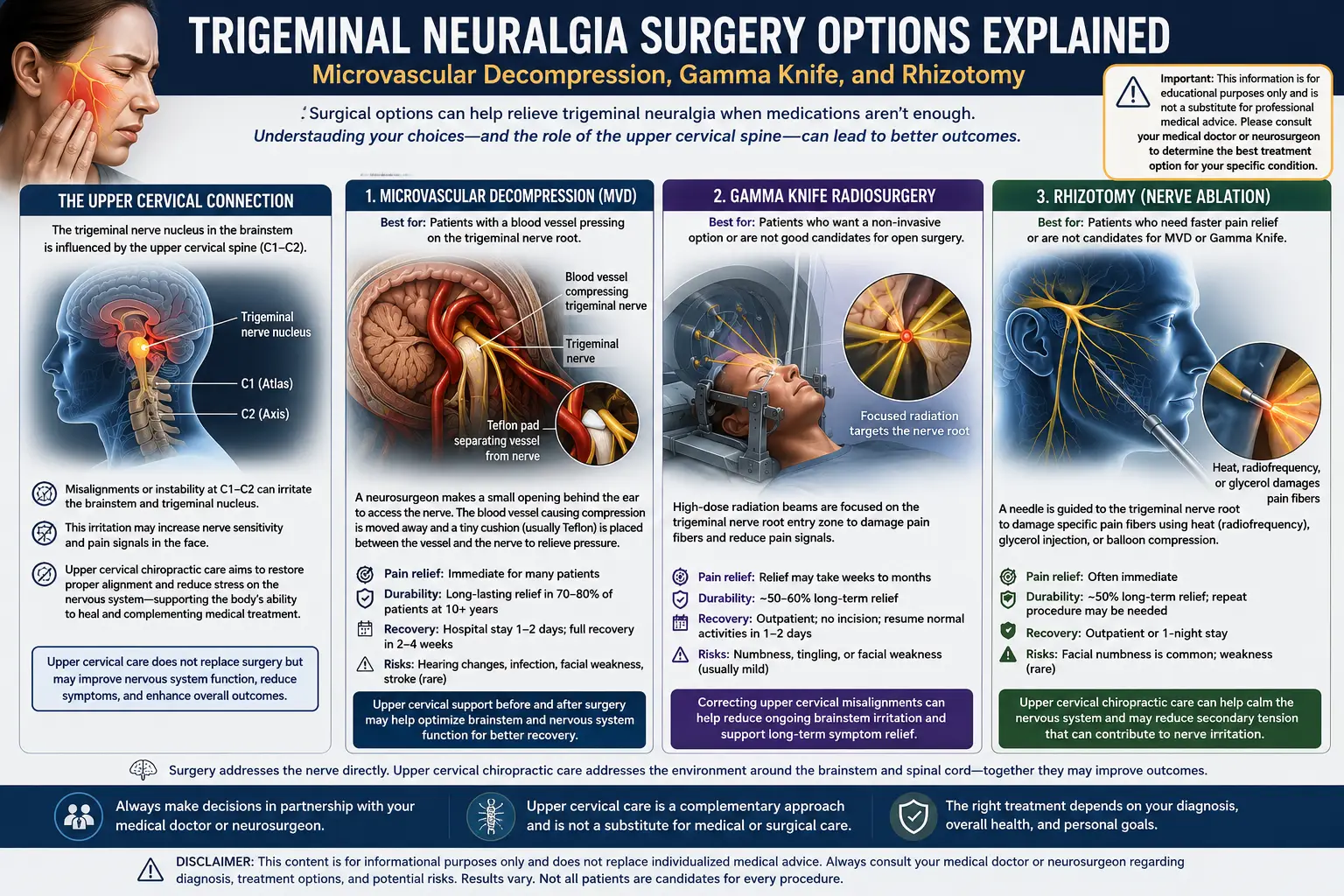
Microvascular decompression is the most involved of the surgical options, because it is an open operation performed under general anesthesia inside the skull. It is also the only common procedure that aims to address what many researchers believe is the underlying cause of classic trigeminal neuralgia rather than simply interrupting the nerve’s ability to transmit pain.
Here is the basic idea. In many people with classic TN, an artery or vein sits against the trigeminal nerve near the root entry zone, and the pulsation of that vessel against the nerve is thought to wear away the nerve’s insulating coating over time, leading to the abnormal signaling that produces pain. During MVD, a neurosurgeon makes a small opening in the skull behind the ear, gently moves the offending vessel away from the nerve, and places a soft cushioning material — often a small pad of Teflon-like felt — between the vessel and the nerve so that they no longer make contact. Because nothing is intentionally injured in the nerve itself, MVD is described as a non-destructive procedure. The goal is to relieve the pressure while preserving normal facial sensation.
MVD is most often considered for patients who are healthy enough to tolerate a general anesthetic and an open cranial operation, and especially for those whose imaging suggests a blood vessel is compressing the nerve. Younger and medically fit patients are frequently viewed as good candidates, though age alone is not an automatic disqualifier; the decision is individualized. For people with trigeminal neuralgia related to multiple sclerosis — where the nerve irritation comes from a demyelinating lesion rather than a vessel — MVD is generally less applicable, and other approaches are typically discussed.
In terms of outcomes, MVD is notable among TN procedures for its potential to provide durable, long-lasting pain relief in appropriately selected patients, and because it does not deliberately damage the nerve, the risk of lasting facial numbness is lower than with the destructive procedures. That said, no operation is without downsides, and MVD carries the risks inherent to intracranial surgery. Because the surgery takes place near important structures, potential complications that surgeons discuss include hearing changes or hearing loss, facial numbness or weakness, cerebrospinal fluid leak, and, uncommonly, more serious events. Pain can also recur over time in a portion of patients, and some people ultimately need additional treatment. These are matters to weigh carefully and specifically with your surgeon, who can put general statistics into the context of your own health and anatomy. The key takeaway is that MVD is the option that seeks to correct the presumed cause of the pain, it can offer lasting relief for the right candidate, and it involves the trade-offs of an open brain operation.
Stereotactic Radiosurgery / Gamma Knife
Stereotactic radiosurgery is, despite the word “surgery” in its name, not an operation in the traditional sense. There is no incision, no opening of the skull, and typically no general anesthesia. Instead, this approach uses many finely focused beams of radiation that converge on a precise target — in this case, a small segment of the trigeminal nerve — to deliver a concentrated dose while sparing the surrounding tissue. Gamma Knife is the best-known brand of equipment used for this purpose, which is why many people use that name as shorthand, but other platforms can deliver similar focused radiation.
The mechanism here is different from MVD. Rather than moving a blood vessel, radiosurgery creates a deliberate, controlled change in the nerve that gradually reduces its ability to transmit the pain signals. Because it works by inducing this change over time, one of the defining features of radiosurgery is that pain relief is usually not immediate. It commonly takes weeks to a few months for the full effect to develop, which is an important expectation to set if this is the path you are considering.
Radiosurgery is frequently discussed for patients who are not good candidates for open surgery — for example, those who are older, who have other medical conditions that make general anesthesia risky, who take blood thinners that complicate an operation, or who simply prefer a non-invasive approach. Because it does not require an incision or a hospital stay in the way MVD does, it can be an appealing option for people for whom the open operation is a poor fit. It is also sometimes used when pain returns after another procedure.
As for outcomes, focused radiosurgery has a well-documented track record of providing meaningful pain relief for a substantial proportion of TN patients, and its non-invasive nature is a genuine advantage. The trade-offs are also worth understanding. Because the procedure works by intentionally altering the nerve, facial numbness or altered sensation is one of the more common effects, and the likelihood of numbness can increase with repeat treatments. Relief may also diminish over the years for some patients, and additional treatment is sometimes needed. As with every option here, the balance of benefits and risks is specific to your situation, and your neurosurgeon or radiation oncologist can explain how the numbers apply to you. In short, radiosurgery trades the immediacy and cause-directed goal of MVD for a non-invasive, incision-free experience, accepting a slower onset of relief and a meaningful chance of sensory changes.
Percutaneous Procedures / Rhizotomy
The third category is a group of minimally invasive procedures known collectively as percutaneous rhizotomies. “Percutaneous” means through the skin, and “rhizotomy” refers to acting on the nerve root. In these procedures, the surgeon passes a thin needle or cannula through the cheek and guides it, using imaging, to the trigeminal nerve near the base of the skull. Once positioned, the surgeon uses one of several techniques to deliberately injure a portion of the nerve so that it can no longer carry the pain signals. These procedures are typically shorter than MVD and are often done under sedation, which is part of why they are frequently chosen for patients who are older or medically frail.
There are three main variations, distinguished by how the nerve is treated. In balloon compression, a tiny balloon is inflated for a brief period to press on and injure the nerve fibers. In glycerol rhizotomy, a small amount of glycerol is injected to chemically alter the nerve. In radiofrequency rhizotomy (also called radiofrequency thermocoagulation), a controlled heat lesion is created at a precise point on the nerve. Each technique has its own nuances, and surgeons may favor one over another depending on their experience, which branches of the nerve are involved, and the individual patient.
What these procedures share is that they are intentionally destructive — they work by damaging part of the nerve — and this shapes both their benefits and their drawbacks. On the benefit side, they often produce rapid pain relief and can be repeated if pain returns, which makes them a practical choice for many people who cannot undergo or prefer to avoid open surgery. On the trade-off side, because they rely on injuring the nerve, some degree of facial numbness is common afterward and is, in a sense, expected as part of how they work. In a portion of patients this numbness is bothersome, and in a smaller number it can be accompanied by uncomfortable altered sensations. Pain also tends to recur over time more often than after a successful MVD, so repeat procedures are not unusual. Because the needle passes near important structures at the skull base, there are additional procedure-specific risks that a surgeon will review in detail. As a group, percutaneous rhizotomies offer a quicker, less invasive route to relief that can be repeated, in exchange for a higher likelihood of numbness and a greater chance that the pain will eventually return.
Where Conservative and Precise Upper Cervical Care Fit in the Bigger Picture
Now that we have laid out the surgical landscape, we want to speak plainly about where a practice like ours fits — and, just as importantly, where it does not. This is where honesty matters most, because you deserve to know the boundaries of what conservative care can and cannot do.
At Lavender Family Chiropractic, we practice the Knee Chest Upper Cervical technique, a precise, low-force method focused on the alignment and function of the uppermost bones of the neck. This is not high-velocity twisting or forceful “cracking” of the spine. It is a gentle, specific correction based on careful measurement, and it is a very different thing from the surgical procedures described above. Our upper cervical chiropractic care is a conservative, supportive option — nothing more and nothing less.
Here is the honest framing. Upper cervical care is not surgery. It does not cure trigeminal neuralgia. It is not a treatment for the vascular compression that a neurosurgeon addresses with MVD, and it cannot substitute for a procedure your medical team believes you need. What some people with facial pain choose to explore is whether careful attention to the alignment and mechanics of the upper neck can be a helpful part of their overall picture, particularly when neck tension, posture, and head-and-neck biomechanics are part of their day-to-day experience. Some patients look into this before considering surgery; some explore it alongside ongoing medical care; and some come to us after procedures while continuing to work with their neurologist. In every one of those situations, the decision about surgery still belongs to the patient and their neurosurgeon.
We are deliberate about how we approach this. Every new patient begins with a thorough assessment, because we would rather understand your situation carefully than assume anything. We use 3D CBCT imaging to visualize the upper cervical spine in detail, and Tytron paraspinal infrared thermography to objectively measure patterns of nervous system function along the spine. These tools help us determine whether upper cervical care is even a reasonable fit for you in the first place — and if it is not, or if your presentation suggests you need medical evaluation, we will tell you so. From there, we build customized care plans around your individual findings rather than a one-size-fits-all routine.
We also believe strongly in coordinating with your medical team rather than working in a silo. Trigeminal neuralgia is a serious neurological condition, and the people best positioned to diagnose it and to perform surgery are your neurologist and neurosurgeon. Our role, when it is appropriate at all, is a supportive and conservative one. We will never tell you that our care is a way to avoid an operation, because we cannot make that promise to anyone. What we can promise is transparency about what we do, careful measurement, gentle and precise technique, and a willingness to stay in our lane while you and your physicians make the decisions that are yours to make.
If you would like to learn more about facial pain and the conservative side of this conversation, our overview of facial pain and trigeminal neuralgia is a good next read, and our page on neck pain explains more about how upper cervical mechanics can factor into head-and-neck symptoms.
Have Questions About Conservative Care? Let’s Talk
If you are exploring your options and want to understand whether precise, low-force upper cervical care might have a supportive place alongside your medical treatment, we are happy to answer your questions honestly. You can call us at (941) 243-3729, or schedule a new-patient visit online. Our office is located at 5899 Whitfield Avenue, Suite 107, Sarasota, FL 34243, right at the corner of University and Whitfield, and we serve patients throughout the greater Sarasota and Bradenton area. There is no pressure and no obligation — just a clear conversation about whether this conservative approach is a reasonable fit for you.
What the Research Says
The following five sources are examples of the peer-reviewed and clinical literature on trigeminal neuralgia and its surgical treatment. We share them so you can read further from primary sources. These are educational references about the medical and surgical management of TN; they are not claims about chiropractic care.
- European Academy of Neurology guideline on trigeminal neuralgia (Bendtsen et al., European Journal of Neurology, 2019; PMID 30860637) — This expert guideline reviews the diagnosis and management of TN, recommending carbamazepine or oxcarbazepine as first-line medications and outlining when surgical options are appropriately considered, generally after medications fail or are not tolerated.
- The Long-Term Outcomes and Predictors of Microvascular Decompression with or without Partial Sensory Rhizotomy for Trigeminal Neuralgia (Liu et al., Journal of Pain Research, 2020; PMCID PMC7014959) — This study followed patients undergoing microvascular decompression and reports on long-term pain relief and the factors associated with better or worse outcomes.
- Stereotactic radiosurgery for trigeminal neuralgia: a systematic review (Journal of Neurosurgery, 2018; 130(3):733–743) — This systematic review synthesizes the published evidence on focused radiosurgery (including Gamma Knife) for TN, summarizing rates of pain relief, the delayed onset of effect, and the risk of facial numbness.
- Percutaneous Procedures for Trigeminal Neuralgia (Chang et al., Journal of Korean Neurosurgical Society, 2022; PMCID PMC9452389) — This review describes the balloon compression, glycerol, and radiofrequency rhizotomy techniques, comparing their mechanisms, typical outcomes, and the sensory side effects associated with these destructive procedures.
- Comparison of first-time microvascular decompression with percutaneous surgery for trigeminal neuralgia: long-term outcomes and prognostic factors (Noorani et al., Acta Neurochirurgica, 2021; PMCID PMC8116280) — This comparative study looks at long-term results after MVD versus percutaneous procedures, helping to illustrate the different durability and side-effect profiles of these approaches.
Questions to Ask Your Neurosurgeon
Walking into a surgical consultation can feel overwhelming, especially when you are also coping with pain. Having a written list of questions helps you make the most of your time and leave with the information you actually need. Here are some questions that many patients find useful:
- Based on my MRI and my history, do you see evidence of a blood vessel compressing my trigeminal nerve? How does that finding affect which procedure you would recommend?
- Am I a candidate for microvascular decompression, and if so, why or why not given my age and overall health?
- Which procedure do you think fits my situation best, and what are the specific reasons?
- What are the realistic chances of meaningful pain relief with the option you are recommending, and how long does that relief tend to last?
- How likely is facial numbness or altered sensation afterward, and how bothersome is it for most of your patients?
- What are the most important risks of this procedure, and how often do they occur in your practice?
- How soon after the procedure would I expect to feel a difference?
- If the pain comes back, what are my options — can this procedure be repeated, or would we move to a different approach?
- How many of these procedures do you perform each year, and what is your experience with my particular situation?
- Will I still need medication afterward, and if so, for how long?
It also helps to think about your overall neck and head function as part of the picture. If you are curious about the conservative, biomechanical side of head-and-neck symptoms, our article on neck pain offers a helpful perspective on how the upper cervical spine can factor in — always as a complement to, never a replacement for, the medical guidance your neurosurgeon provides.
Bring a family member or friend to your appointment if you can. A second set of ears is invaluable, because it is easy to miss details when you are anxious or in pain. Taking notes, or asking permission to record the conversation, can also help you review everything calmly afterward.
Serving Sarasota and Surrounding Communities
Lavender Family Chiropractic is proud to serve patients from across the Suncoast and beyond. Our office at 5899 Whitfield Avenue, Suite 107, in Sarasota sits at the convenient corner of University and Whitfield, making it easy to reach from many nearby communities. We regularly welcome patients from Sarasota, Bradenton, Lakewood Ranch, Venice, Palmer Ranch, Osprey, Siesta Key, Longboat Key, Lido Key, University Park, Parrish, Ellenton, Myakka City, Punta Gorda, and St. Petersburg.
Wherever you are traveling from, our approach is the same: a careful assessment, honest communication about whether conservative upper cervical care is a reasonable fit for you, and coordination with the medical team guiding your trigeminal neuralgia care. If you are exploring your options for facial pain and want to understand the conservative side of the conversation, we are glad to help you think it through.
Top 15 Questions
1. What is the difference between the three main surgical options for trigeminal neuralgia? In broad terms, microvascular decompression is an open operation that moves a blood vessel away from the nerve to relieve pressure; stereotactic radiosurgery (Gamma Knife) uses focused radiation to alter the nerve without an incision; and percutaneous rhizotomies pass a needle through the cheek to deliberately injure part of the nerve. They differ in invasiveness, how quickly relief comes, how long it tends to last, and the likelihood of facial numbness.
2. Which surgery is right for me? That decision belongs to you and your neurologist and neurosurgeon. It depends on your diagnosis, your imaging, your age and health, and your own preferences. There is no single option that is right for everyone.
3. When do doctors usually consider surgery instead of medication? Surgery is typically discussed when medications such as carbamazepine or oxcarbazepine stop controlling the pain adequately, or when their side effects become too difficult to tolerate. Medication is generally tried first.
4. Is microvascular decompression brain surgery? Yes. MVD is an open procedure performed under general anesthesia through a small opening in the skull behind the ear. Because it is intracranial surgery, it carries the risks inherent to that kind of operation, which your surgeon will review with you in detail.
5. Why does Gamma Knife radiosurgery take time to work? Focused radiosurgery works by gradually inducing a controlled change in the nerve. That process unfolds over weeks to a few months, so pain relief is usually delayed rather than immediate. It is a very different timeline from a procedure that acts on the nerve mechanically.
6. Will I have facial numbness after these procedures? Some numbness or altered sensation is common after the destructive procedures — the percutaneous rhizotomies and, to varying degrees, radiosurgery — because they work by changing the nerve. MVD, which does not intentionally injure the nerve, has a lower likelihood of lasting numbness. Your surgeon can give you specifics for your situation.
7. Can trigeminal neuralgia come back after surgery? It can. The chance of recurrence differs by procedure, and some people eventually need additional or repeat treatment. This is an important question to ask your surgeon directly, since the answer varies with the approach and with your individual factors.
8. Do you accept insurance, and how does payment work? We are a cash-pay, out-of-network practice. That means payment is handled directly with our office rather than billed to insurance networks. Many patients appreciate the transparency and the unhurried time this model allows.
9. What is a superbill, and can you provide one? Yes, we can provide superbills. A superbill is an itemized receipt of the care you received that you can submit to your insurance company to seek any out-of-network reimbursement you may be entitled to. Whether and how much you are reimbursed depends on your specific plan, so we encourage you to check with your insurer about your out-of-network benefits.
10. Can upper cervical care help me avoid surgery? We want to answer this one carefully and honestly: we cannot promise that, and we would never position our care as a way to avoid an operation. Upper cervical care is a conservative, supportive option that some people explore, but it does not treat the vascular compression a surgeon addresses, and it is not a substitute for a procedure your medical team believes you need. The decision about surgery is one you make with your neurosurgeon. What we can offer is a careful assessment and honest guidance about whether conservative care is even a reasonable fit for you.
11. Can you cure my trigeminal neuralgia? No. We do not cure trigeminal neuralgia, and we are careful never to suggest otherwise. TN is a neurological condition, and our care is conservative and supportive — not a cure and not a surgery. Anyone who promises to cure this condition with chiropractic care is not being straight with you.
12. What actually happens at a first visit with you? Your first visit centers on understanding your situation. We perform a thorough assessment, and we use 3D CBCT imaging and Tytron paraspinal infrared thermography to gather objective information about your upper cervical spine and nervous system patterns. From there we can tell you honestly whether upper cervical care is a reasonable fit — and if you need medical evaluation instead, we will say so.
13. Is your adjustment forceful or high-velocity? No. We use the Knee Chest Upper Cervical technique, which is a precise, low-force correction. It is not the forceful twisting or “cracking” that some people picture when they think of chiropractic. It is a gentle, specific method based on careful measurement.
14. My facial pain is new and I have not been diagnosed yet. Where should I start? Start with a medical evaluation. New, undiagnosed, or changing facial pain needs a proper diagnosis first, because facial pain has many possible causes and some need prompt medical attention. An accurate diagnosis is the foundation for every good decision that follows, including whether conservative care has any role for you.
15. Do you work with my neurologist or neurosurgeon? Yes, we believe in coordinating with your medical team rather than working in isolation. Your neurologist and neurosurgeon lead the diagnosis and any surgical decisions. When conservative upper cervical care is appropriate at all, we see our role as a supportive one that complements the care your physicians provide.
Closing CTA
Living with trigeminal neuralgia is exhausting, and sorting through surgical options on top of the pain can feel like a lot to carry. Our hope is that this overview has made the landscape clearer — MVD, radiosurgery, and the percutaneous rhizotomies each have their place, and the right path is the one you choose together with your neurologist and neurosurgeon.
If you would like to understand whether precise, low-force upper cervical care might have a supportive place alongside your medical treatment, we would be glad to talk with you honestly and without pressure. Call Lavender Family Chiropractic at (941) 243-3729, book a new-patient visit online, or stop by our office at 5899 Whitfield Avenue, Suite 107, Sarasota, FL 34243, at the corner of University and Whitfield. You can also reach us through our contact page. Whatever you decide about surgery, we want you to feel informed, supported, and clear about your options. Call (941) 243-3729 whenever you are ready.
Related Articles
- Trigeminal Neuralgia – Overview
- Trigeminal Neuralgia and Multiple Sclerosis
- Trigeminal Neuralgia Triggers & Flare-Ups
This article is for general educational purposes only and is not medical advice. It does not diagnose or treat any condition and is not a substitute for evaluation by your physician. Trigeminal neuralgia and new or undiagnosed facial pain require medical evaluation. Decisions about surgery should be made with your neurologist and neurosurgeon. Upper cervical chiropractic care is a conservative, supportive option; it is not surgery and does not cure trigeminal neuralgia.