Vertigo Treatment Near Venice, FL: Your Options, and What Upper Cervical Adds
By Dr. Rusty Lavender, D.C. — upper cervical chiropractor, Lavender Family Chiropractic, Sarasota, FL. Published October 2026.
If you live in Venice, Nokomis, Osprey, or North Port and you’ve been searching for vertigo treatment or a chiropractor for vertigo, you’ve probably found several general chiropractic offices along the 41 Bypass that list vertigo among forty other conditions. This article is written for you, and it’s going to do something a little different: explain how to tell which kind of vertigo you have before you decide who to see — because the right provider depends entirely on the answer — and then explain what an upper cervical office does differently, and why Venice patients make the drive up to our Sarasota office for it.
Educational content, not medical advice. Vertigo with a sudden severe headache, double vision, trouble speaking, weakness, numbness, or inability to walk is an emergency.
First, Which Vertigo Is It?
“Vertigo” means the false sensation of movement — the room spins, or you do. It has a handful of common causes, and they are treated by different people.
Inner-ear crystals (BPPV). The most common cause of true spinning vertigo. Tiny calcium crystals drift into a canal of the inner ear and make it fire when it shouldn’t. The signature: brief spinning (seconds to under a minute), triggered by lying down, rolling over in bed, or tipping the head back; the same every time. The clinical practice guideline from the American Academy of Otolaryngology, by Bhattacharyya and colleagues (2017), is clear that BPPV is confirmed with a positioning test and treated with a repositioning maneuver (the Epley), not with medication and not with adjustments. A population study by von Brevern and colleagues (2007) found that most people with BPPV never receive that treatment, which is a reason to get it checked rather than wait it out. Our BPPV article covers it.
Vestibular migraine. Episodes of vertigo or dizziness lasting minutes to hours in someone with a migraine history, often without a headache. The diagnostic criteria by Lempert and colleagues (2012) describe it; it’s now recognized as one of the most common causes of recurrent vertigo and is routinely misdiagnosed as an ear problem. A neurologist is the right first stop.
PPPD (persistent postural-perceptual dizziness). Constant unsteadiness or non-spinning dizziness, most days for three months or more, worse upright and in busy visual environments — grocery stores, scrolling, traffic. The Bárány Society criteria by Staab and colleagues (2017) define it. It usually follows an initial ear event; the ear recovers, the brain’s processing doesn’t.
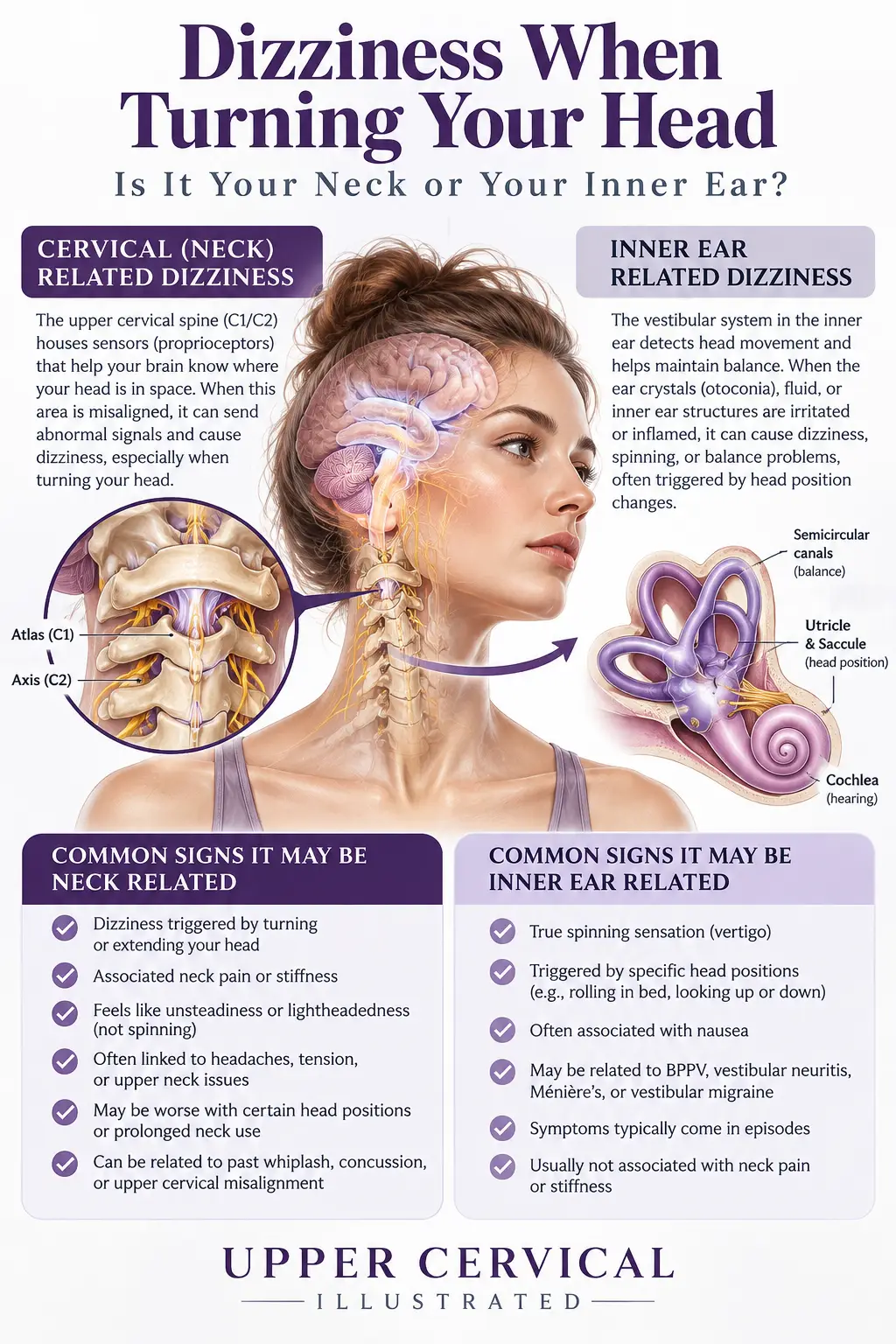
Cervicogenic (neck-related) vertigo and dizziness. Unsteadiness or a floating, “off” sensation — sometimes true spinning — provoked by neck movement or sustained neck positions, traveling with neck pain, stiffness, or headache at the base of the skull, often after a car accident, fall, or concussion. Kristjansson and Treleaven (2009) reviewed the mechanism: the upper neck is one of the brain’s richest sources of head-position information, and when that input is distorted, the brain receives a signal that disagrees with the ear and eyes. Treleaven and colleagues (2003) measured it in whiplash patients, who had significantly worse head-position sense when dizziness was present. Our cervicogenic dizziness guide and the article on dizziness when turning your head go further.
The quick sort: brief spinning when you lie down → ear. Episodes with migraine history → neurologist. Constant, visually triggered → PPPD. Unsteady with neck symptoms or an injury history → neck. Many people have more than one, which is why evaluation matters more than the label.
Vertigo Treatment Near Venice: Who Treats What
Once you’ve sorted which kind you likely have, the treatment map is short:
- BPPV → an ENT, audiologist, or vestibular physical therapist for canalith repositioning (the Epley maneuver). Several Venice-area practices offer it, and it’s usually one to three visits.
- Vestibular migraine → a neurologist, for diagnosis and preventive treatment. Vestibular therapy can help alongside. Many patients also state that their vestibular migraines have improved with upper cervical chiropractic care at Lavender Family Chiropractic.
- PPPD → a vestibular therapist for a graded habituation program, often with a physician managing medication.
- Cervicogenic (neck-related) vertigo → care directed at the upper neck. This is where upper cervical evaluation fits, and it’s the one option that isn’t available in Venice itself.
Many Venice patients end up with two of these at once — repositioning for the ear and evaluation of the neck — and that’s a reasonable plan, not a failure of either.
What a General Chiropractor Does for Vertigo — and the Limit
Most chiropractic offices in Venice are good at what they do: spinal adjustments for back and neck pain, often with some soft-tissue work and exercise. When a general chiropractor lists vertigo, the approach is usually a full-spine adjustment, including rotation of the neck, on the theory that improving neck motion will help.
Two honest limits. First, if your vertigo is BPPV, no adjustment will move the crystals — you need the Epley maneuver, and a good chiropractor will either perform it or refer you for it. Second, if your vertigo is neck-related, a rotational neck adjustment is working blind: nothing has been measured, and the technique rotates the very joint that’s already feeding the brain bad information. Some people feel better; some feel worse; nobody knows beforehand which.
What Upper Cervical Care Adds
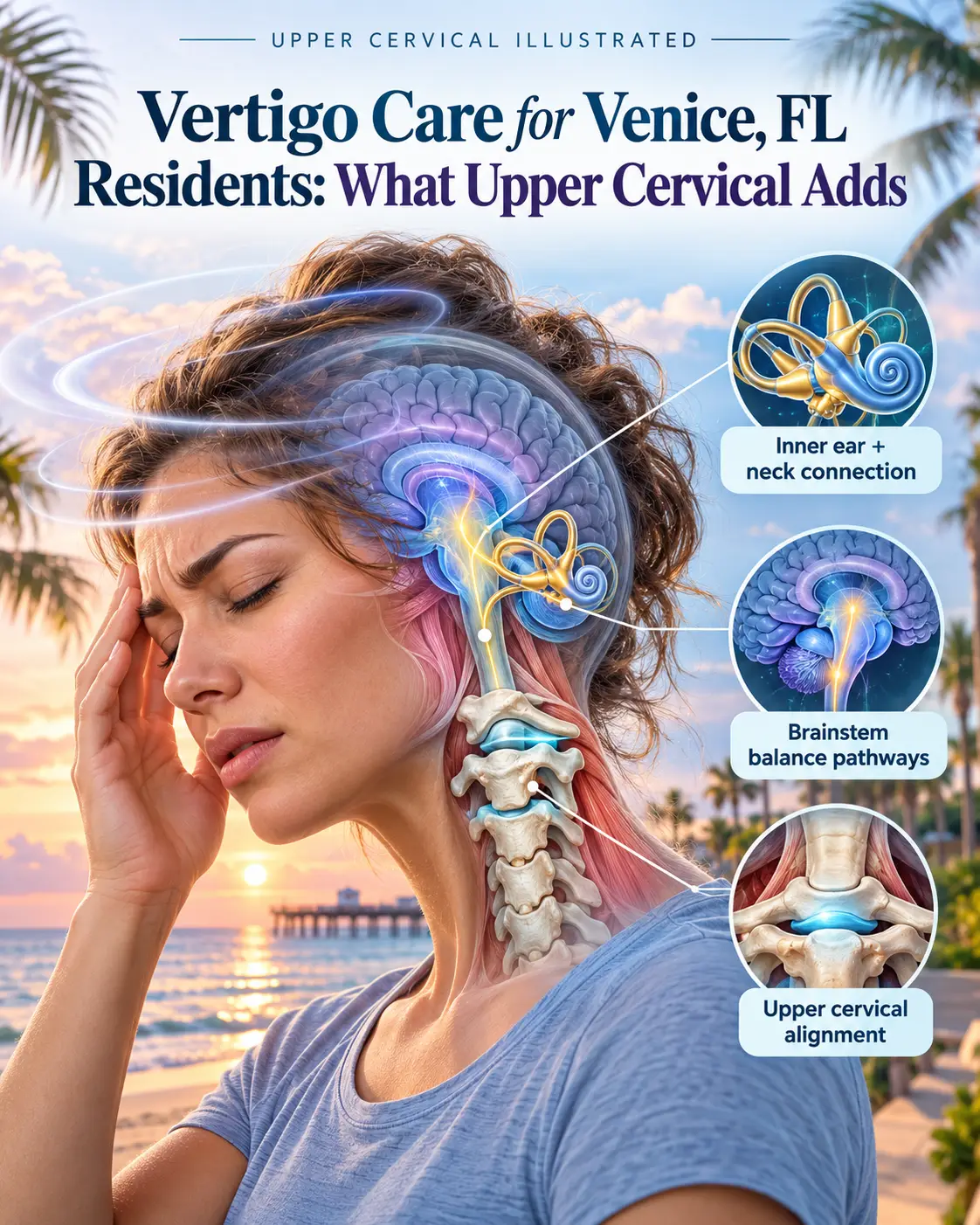
Upper cervical chiropractic is a specialty focused on the top two vertebrae — the atlas and axis — which carry most of the neck’s position sensors and sit against the brainstem. Three things make it different, and all three matter for vertigo.
It measures first. A 3D cone-beam CT of the upper neck shows the actual position of the atlas and axis relative to the skull in three dimensions. Paraspinal thermography reads the nervous system’s heat pattern along the spine and gives an objective marker to track. A head-repositioning test measures how accurately your neck is reporting head position to your brain. We also screen for BPPV with positional testing so that an ear problem isn’t mistaken for a neck problem.
It doesn’t rotate the neck. The correction is delivered to the atlas with a precise, low-force procedure based on the imaging — no twisting, no cracking. For a person whose dizziness is provoked by turning the head, that’s not a detail.
It’s honest about the evidence. In a randomized trial published in Physical Therapy, Reid and colleagues (2014) found that gentle manual therapy to the upper cervical spine reduced cervicogenic dizziness compared with placebo, with benefits maintained at twelve months. Those trials used physiotherapy techniques, not our specific procedure; they establish that treating the upper neck helps neck-related dizziness, not that our method does. What we add is the measurement — so that we only correct what the imaging shows, and so that you can see whether anything changed.
If the imaging shows nothing to correct, we tell you, and we help you get to the right next step — an ENT or vestibular therapist for the ear, a neurologist for migraine. Our vertigo guide covers all of this in depth.
Why Venice Patients Make the Drive
Our office is in north Sarasota on Whitfield Avenue, just off US-41 near the airport. From Venice Island it’s a straight shot up I-75 or Tamiami Trail — roughly half an hour, a bit more from North Port. We see patients every week from Venice, Nokomis, Osprey, Englewood, and North Port, and the reason is simple: there is no upper cervical office south of Sarasota, and for neck-related vertigo the approach is the point. Patients tell us the drive is worth it because the first visit is an evaluation, not a sales pitch, and because they leave knowing whether the neck is actually involved.
Our Venice service page has directions and what to expect.
Who Should and Shouldn’t Come
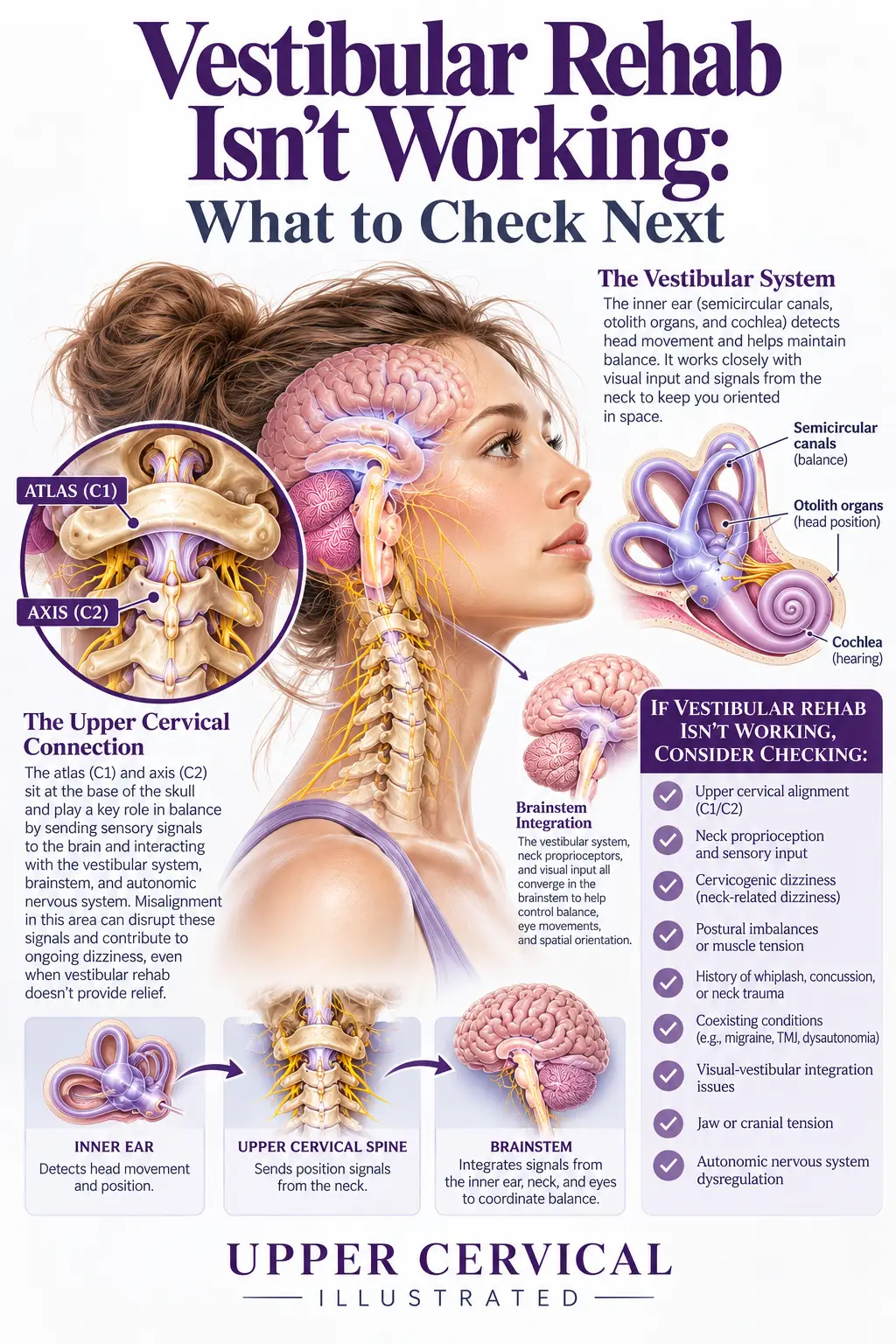
Come for an upper cervical evaluation if: your dizziness is unsteadiness or a floating sensation rather than brief spinning; it’s provoked by neck movement or sustained neck positions; it travels with neck pain, stiffness, or headache at the base of the skull; it started after a car accident, fall, or concussion; or you’ve already had the Epley maneuver or vestibular rehab and something is still off — our article on when vestibular rehab isn’t working covers that situation.
See someone else first if: your vertigo is brief spinning when you lie down or roll over (ENT or vestibular PT for repositioning); it comes in episodes with a migraine history (neurologist); or it’s new, severe, or comes with any neurological symptom (emergency department, then neurologist).
Frequently Asked Questions
Where can I get vertigo treatment in Venice, FL? For BPPV, Venice-area ENTs and vestibular therapists perform repositioning. For neck-related vertigo, the closest upper cervical office is ours in north Sarasota, about thirty minutes up I-75 or US-41.
Is there an upper cervical chiropractor in Venice, FL? Not in Venice itself. The closest upper cervical offices are in Sarasota; ours is in north Sarasota on Whitfield Avenue, about thirty minutes from Venice via I-75 or US-41.
Can a chiropractor cure vertigo? No one should promise that. BPPV is resolved by repositioning, not adjustments. Neck-related dizziness responds to treatment of the upper neck in controlled trials, and many of our patients improve, but results depend on the cause, and we won’t know yours until it’s measured.
Do you do the Epley maneuver? We screen for BPPV with positional testing. When the picture is BPPV, we refer for repositioning — that’s the right treatment, and it’s not our focus. Our focus is the neck.
How is upper cervical different from a regular adjustment? It’s limited to the top two vertebrae, guided by 3D imaging, and delivered without rotating the neck or cracking. Regular adjustments are full-spine and use rotation.
How many visits does it take? We can’t say until we’ve evaluated you. The first visit is history, exam, thermography, and imaging if indicated; we review findings before any care begins. If the neck is involved, people usually notice changes within the first several weeks.
Does insurance cover it? We’ll go over costs and coverage before you commit to anything. Call the office and we’ll walk you through it.
I was told vertigo is “just part of getting older.” Is it? BPPV is more common with age, but it’s treatable at any age. Unsteadiness that’s accepted as aging is often a specific, addressable problem — the ear, the neck, blood pressure, or medication — and deserves a real evaluation.
Can I be evaluated and then do vestibular therapy in Venice? Yes, and that’s a common arrangement. The neck and the ear are different inputs; many patients see us for one and a Venice-area vestibular therapist for the other.
Lavender Family Chiropractic in Sarasota, Florida offers a thorough upper cervical evaluation to find out whether we can help. Call (941) 243-3729 or request an appointment. 5899 Whitfield Avenue, Suite 107, Sarasota, FL 34243.
References
- Bhattacharyya N, et al. Clinical Practice Guideline: Benign Paroxysmal Positional Vertigo (Update). Otolaryngol Head Neck Surg. 2017. PMID 28248609
- von Brevern M, et al. Epidemiology of benign paroxysmal positional vertigo: a population based study. J Neurol Neurosurg Psychiatry. 2007. PMID 17135456
- Lempert T, et al. Vestibular migraine: diagnostic criteria. J Vestib Res. 2012. PMID 23142830
- Staab JP, et al. Diagnostic criteria for persistent postural-perceptual dizziness (PPPD). J Vestib Res. 2017. PMID 29036855
- Kristjansson E, Treleaven J. Sensorimotor function and dizziness in neck pain. J Orthop Sports Phys Ther. 2009. PMID 19411769
- Treleaven J, et al. Dizziness and unsteadiness following whiplash injury. J Rehabil Med. 2003. PMID 12610847
- Reid SA, et al. Comparison of Mulligan SNAGs and Maitland mobilizations for cervicogenic dizziness: a randomized controlled trial. Phys Ther. 2014. PMID 24336477