TMJ Treatment in Bradenton and Parrish, FL: Dentist, Physical Therapist, or Upper Cervical Chiropractor?
By Dr. Rusty Lavender, D.C. and Dr. Jacob Temple, D.C. — upper cervical chiropractors, Lavender Family Chiropractic, Sarasota, FL. Published October 2026.
If you live in Bradenton or Parrish and you have searched for TMJ treatment, you have found a page of dentists, a physical therapy clinic, and a general chiropractor or two, and you probably still don’t know which one to call. That is the right question, and this page is built to answer it. TMJ problems, properly called temporomandibular disorders or TMD, come in a few distinct types, and the right first stop depends on which one you have. We will walk through them, lay out what the Bradenton and Parrish options actually do, show you what the research says about the neck’s role, and then explain where an upper cervical evaluation fits and why Manatee County TMJ patients drive down to our office for it. Our complete guide to TMJ, TMD and the upper cervical spine covers the mechanism in depth; this is the Bradenton and Parrish decision guide.
Educational content, not medical advice. A jaw that locks open or closed and will not release, jaw pain with chest pain or shortness of breath, or facial swelling with fever needs same-day medical care.
TMJ Is Not One Problem
The temporomandibular joint is the hinge just in front of each ear canal. “TMJ” has become the everyday word for anything that hurts there, but the research diagnostic criteria sort TMD into categories that are treated differently (Schiffman et al., J Oral Facial Pain Headache 2014). Three cover almost everyone we see from Bradenton and Parrish.
Muscle pain (myalgia). Aching in the cheeks, temples, or under the jaw, worse in the morning or after a stressful day, often with headaches at the temples. The joint itself is fine; the chewing muscles are overworked. Clenching and grinding, called bruxism, is the usual driver (Lobbezoo et al., J Oral Rehabil 2013). This is the most common type and the one most tied to the neck.
Disc displacement (clicking and popping). The cushion inside the joint has slipped forward and snaps back as you open. A systematic review of the condition described it, memorably, as a “noisy annoyance” in most people: common, usually painless, and usually not progressive (Naeije et al., J Oral Rehabil 2013). A two-year follow-up study found most clicking joints stayed stable or improved without treatment (Kalaykova et al., J Orofac Pain 2010). Our clicking and popping article goes further. A click alone is not a reason for treatment; a click with pain or with locking is.
Joint degeneration (arthralgia and arthritis). Pain inside the joint itself, grinding sensations, limited opening, sometimes visible on imaging. This is the type that most needs a dentist or oral surgeon’s involvement.
Many people have muscle pain layered on top of a click, and it is the muscle pain that brings them in. Telling the types apart is the first job, and it is the reason we examine the jaw rather than assume.
TMJ Treatment Options in Bradenton and Parrish: Who Does What
| If it looks like | Treatment with the best evidence | Who does it | In Bradenton / Parrish? |
|---|---|---|---|
| Muscle pain from clenching or grinding | Education, habit reversal, a properly fitted night guard, jaw and neck exercise | Dentist, physical therapist | Yes, several TMJ-focused dentists in Bradenton and Parrish; PT in Bradenton |
| Clicking without pain | Reassurance and monitoring; no treatment needed in most cases | Dentist | Yes |
| Clicking with locking or pain | Dentist evaluation, sometimes imaging; conservative care first, procedures for the minority | Dentist, oral surgeon | Yes, oral surgery in Bradenton |
| Joint degeneration | Dentist-led plan; injections or surgery in resistant cases | Oral surgeon | Yes |
| Muscle-type TMD with neck pain, headaches, or forward head posture | The above plus care directed at the upper cervical spine | Upper cervical chiropractor + dentist | No upper cervical office in Bradenton or Parrish. Closest is ours, 15–25 minutes |
Two honest notes on that table. Night guards help many people, and they are a reasonable early step, but a systematic review found the evidence for splints in TMD and bruxism to be of low quality, with benefit mainly for pain rather than for stopping the grinding itself (Riley et al., Br Dent J 2020). If you have been wearing a guard for a year and the jaw still aches every morning, the guard is protecting your teeth, which is worthwhile, but it is not addressing why you clench. Our article on night guards versus the root cause covers that. Second, we would never steer a Bradenton or Parrish patient away from a good TMJ dentist. Most of our TMJ patients keep theirs.
Why the Neck Keeps Showing Up in TMJ Research
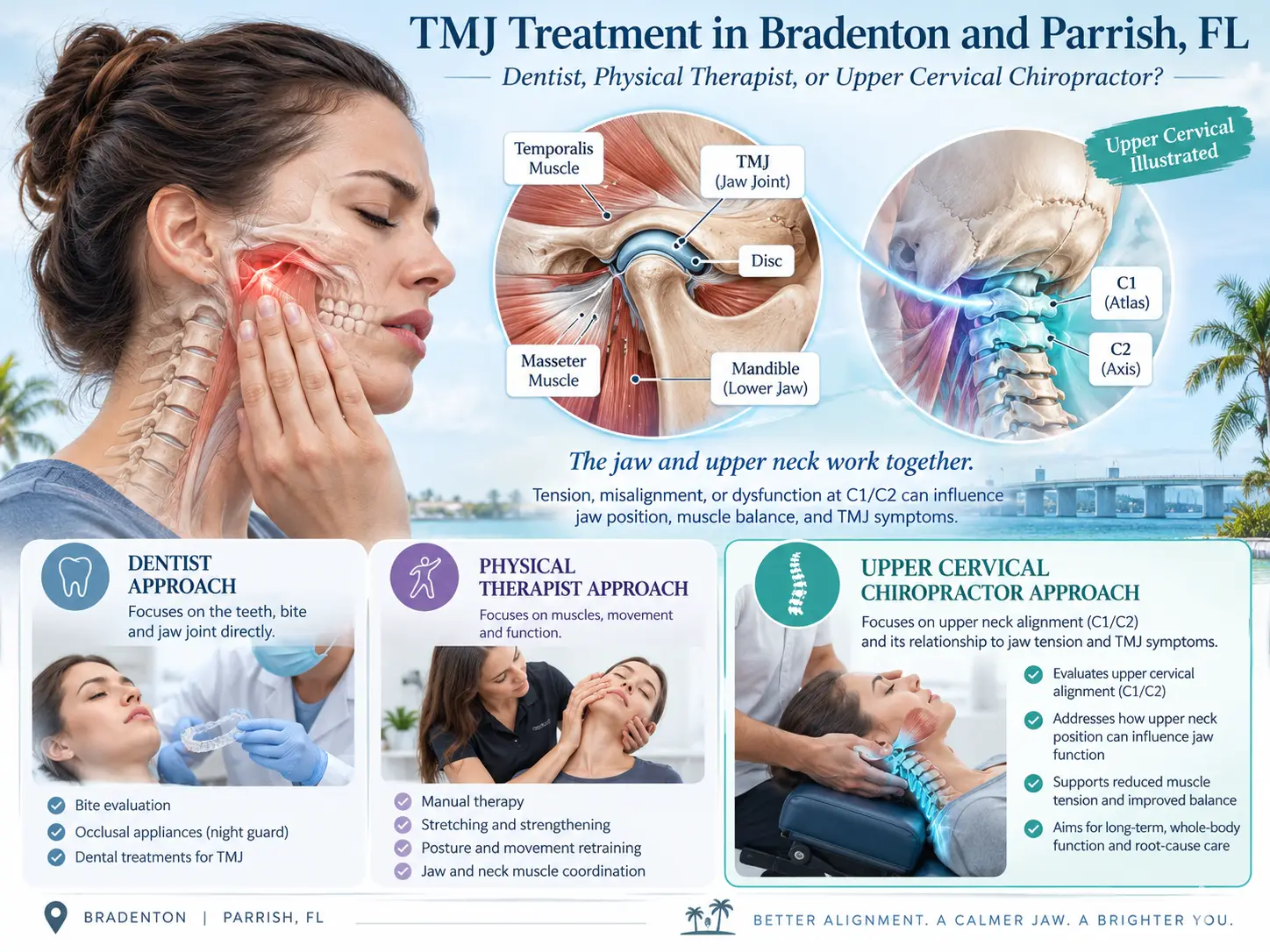
Here is the part the dental SERP does not tell you. The jaw and the upper neck are wired and built together, and the research on it is consistent.
The jaw’s sensory nerve, the trigeminal, and the upper three cervical nerves converge on the same relay in the brainstem, the trigeminocervical nucleus. Irritation from the upper neck and irritation from the jaw land in the same place, which is why neck problems are felt as jaw or face pain and why jaw problems come with headaches at the base of the skull.
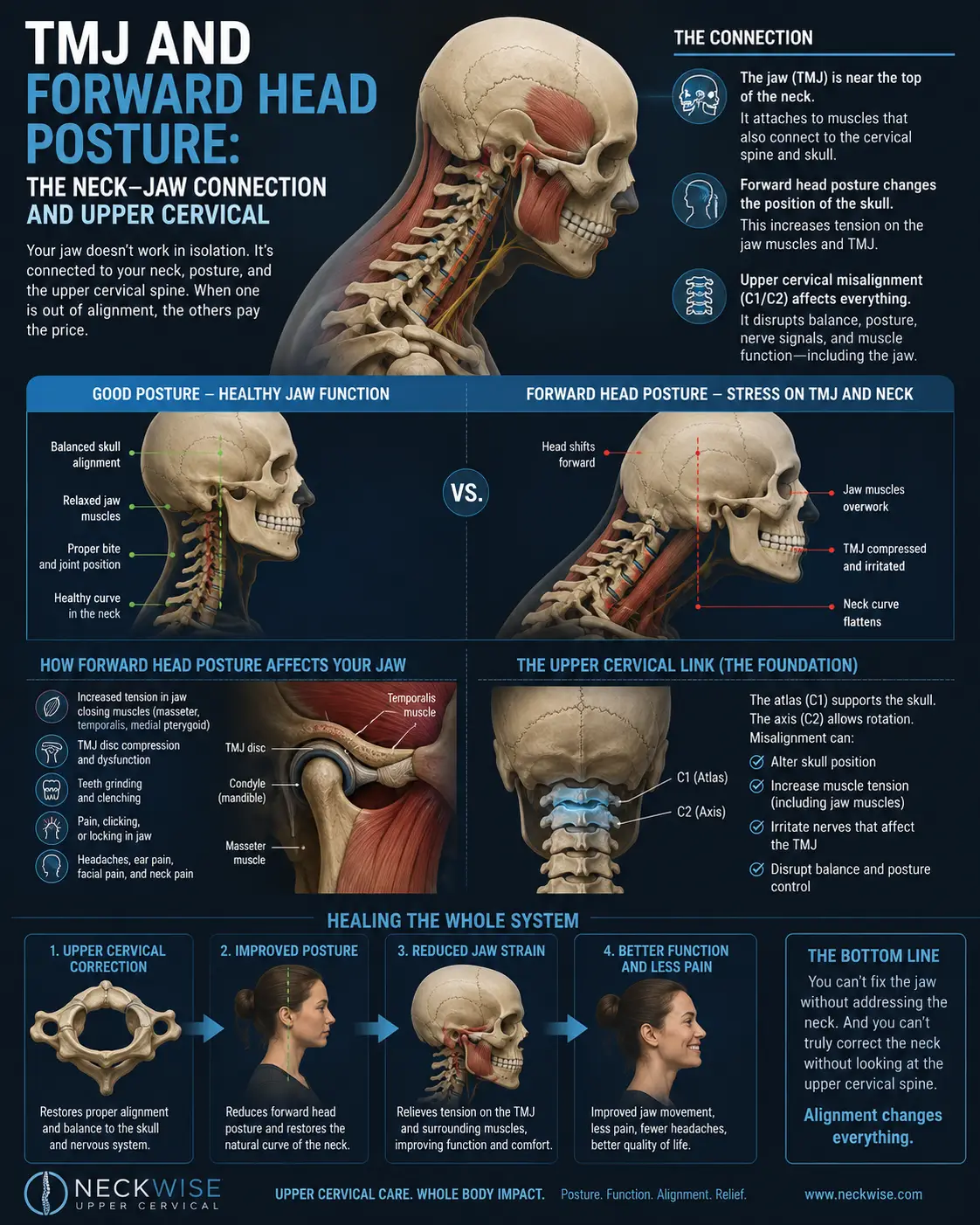
Posture ties them mechanically. When the head sits forward of the shoulders, the lower jaw is pulled back and the chewing muscles work harder to hold the mouth closed. An early study found that forward head posture was significantly associated with TMD (Lee et al., J Orofac Pain 1995), and a later systematic review found the association between head and cervical posture and TMD consistent enough to matter clinically, while calling for better studies (Olivo et al., J Orofac Pain 2006). Our article on TMJ and forward head posture goes further.
The association runs both ways. A systematic review found that people with TMD have more cervical musculoskeletal problems than people without it: more neck pain, more tenderness in the upper neck muscles, and reduced neck motion (de Oliveira-Souza et al., J Bodyw Mov Ther 2020).
And treating the upper neck changes the jaw. In a randomized trial, mobilization of the upper cervical region combined with deep neck flexor training reduced orofacial pain, increased pain-free mouth opening, and improved pressure pain thresholds in people with TMD, with no treatment delivered to the jaw itself (Calixtre et al., J Oral Rehabil 2019). That trial used mobilization rather than a chiropractic adjustment, so it supports the target, the upper neck, rather than any single technique. It is the clearest evidence we have that a jaw problem can be a neck problem wearing a jaw costume.
Where Upper Cervical Chiropractic Fits, and Where It Doesn’t
Upper cervical chiropractic is a specialty focused on the atlas and axis, the top two vertebrae, which carry the position sensors and share the brainstem relay just described. It is the right tool for the last row of the table above: muscle-type TMD that travels with neck pain, headaches, or forward head posture, especially when it began or worsened after a car accident, a fall, or a concussion, and especially when a night guard and exercises have plateaued. It is a supporting tool, at most, for a degenerating joint, and it is not a treatment for a painless click.
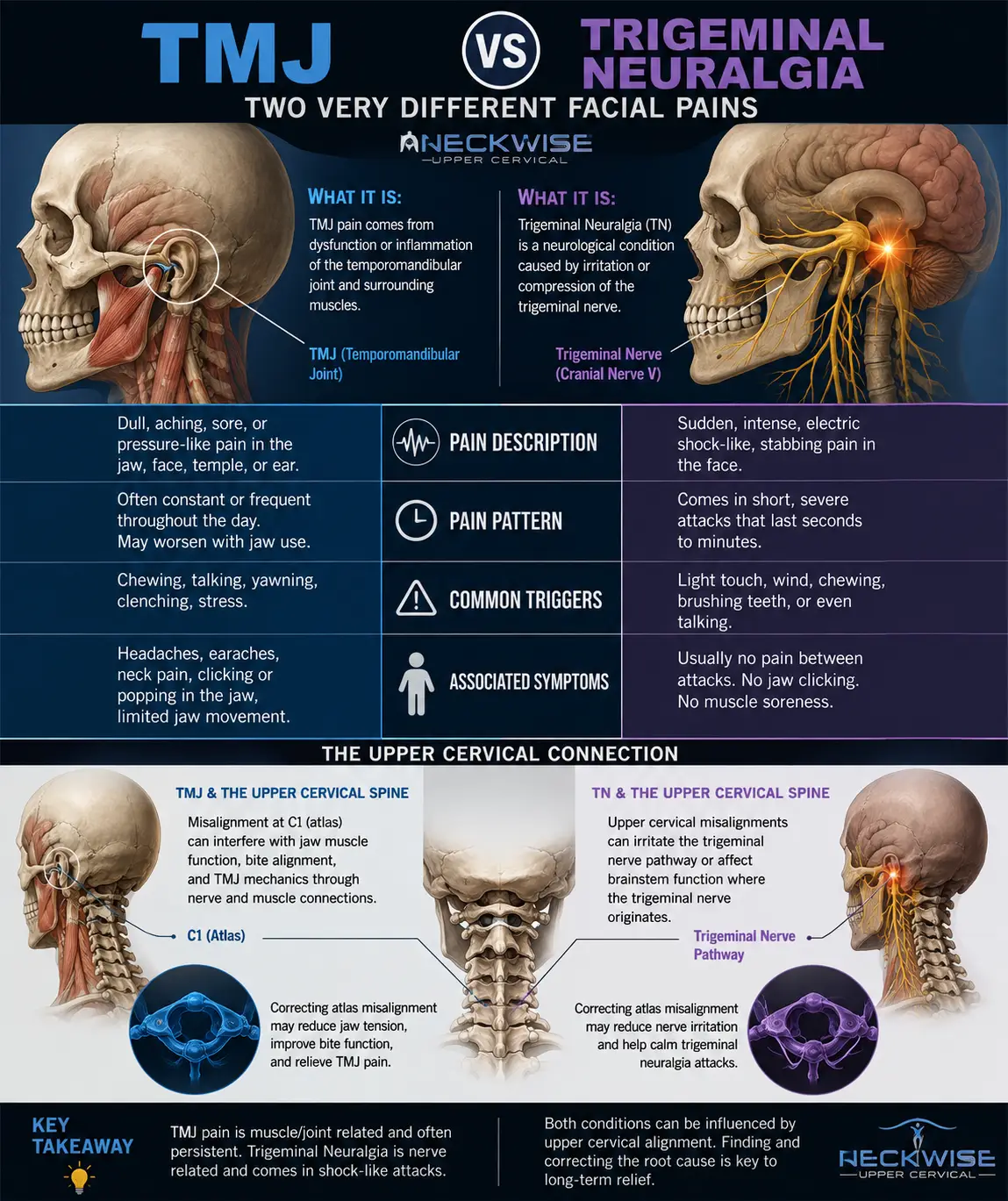
What we add is measurement. A 3D cone-beam CT of the upper cervical spine shows the actual position of the atlas and axis in three dimensions; a digital posture analysis measures how far forward the head sits; paraspinal thermography reads the nervous system’s pattern along the spine. We also examine the jaw itself, check opening and the pattern of any click, and screen for the ear and facial-pain conditions that imitate TMJ, because ear fullness and trigeminal neuralgia are both routinely misread as jaw problems. If the imaging shows a misalignment consistent with your picture, the correction is a precise, low-force procedure delivered to the atlas with no twisting and no cracking, which matters for a patient whose jaw is already guarding. If it shows nothing to correct, we say so, and you go back to your dentist with the neck ruled out.
Getting Here From Bradenton and Parrish
Our office is at 5899 Whitfield Avenue, Suite 107, at the corner of University Parkway and Whitfield Avenue, in Manatee County on the Sarasota line, just west of I-75. From downtown Bradenton it is about 12 miles and 22 minutes south on US-301. From East Bradenton and the SR-64 or SR-70 corridors near I-75, 10 to 15 minutes. From Parrish and Ellenton, about 20 miles and 25 minutes via US-301 South or I-75 South to University Parkway. Free parking at the door. Our Bradenton page and Parrish page have the fuller picture of who we see from each.
Things That Help in the Meantime
None of this replaces an evaluation, but Bradenton and Parrish patients ask. Lips together, teeth apart: your teeth should only touch when you chew or swallow, and catching yourself clenching during the workday is half the battle. Raise the screen so your head is not dropped forward over a laptop or phone; the jaw follows the head. Soft diet during a flare, and no gum. Skip the self-adjusting and the aggressive jaw stretching videos; a locking joint is not something to force. If you grind at night, a dentist-fitted guard protects the enamel while the cause is sorted out.
Who Should and Shouldn’t Come
Come for an upper cervical evaluation if: your jaw pain is muscular and travels with neck pain, stiffness, or headaches at the base of the skull or temples; you have forward head posture from desk or phone work; the jaw problem began or worsened after a collision, fall, or concussion; you have worn a night guard and done exercises and the ache is still there every morning; or you also have ear fullness or dizziness that the ENT could not explain.
See a dentist or oral surgeon first if: your jaw locks and will not open or close; you have pain inside the joint with grinding sensations or limited opening; there is visible swelling; or you have never had a dental evaluation of the jaw at all. We will gladly work alongside them afterward.
Frequently Asked Questions About TMJ Treatment in Bradenton and Parrish
Who treats TMJ in Bradenton, FL? TMJ-focused dentists and oral surgeons handle the joint and the teeth; physical therapists in Bradenton handle jaw and neck exercise; for the neck side of a muscle-type TMD, the closest upper cervical office is ours at University Parkway and Whitfield Avenue, about 22 minutes from downtown.
Is there a TMJ specialist in Parrish, FL? Parrish has dentists who treat TMD and a growing medical corridor along US-301. For the upper neck component, ours is the nearest upper cervical office, about 25 minutes south.
Can a chiropractor help with TMJ? For muscle-type TMD with a neck component, a randomized trial found that treating the upper cervical spine reduced jaw pain and improved opening without touching the jaw. For a painless click or a degenerating joint, no. We examine first so you know which you have.
Should I see a dentist or a chiropractor first? If the jaw locks, hurts inside the joint, or has never been evaluated, dentist first. If the pain is muscular and comes with neck pain or headaches, either order works, and most of our Bradenton TMJ patients see both.
My jaw clicks but doesn’t hurt. Do I need treatment? Usually not. Painless clicking is common, usually stable, and most people do fine with monitoring. Treatment is for clicking with pain or locking.
Does a night guard fix TMJ? It protects teeth and reduces pain for many people. The evidence that it stops grinding itself is weak. If the ache persists with a guard, the cause is still there.
My TMJ started after a car accident on I-75. Is that connected? Often. Whiplash loads the upper cervical spine, and jaw pain and headaches are recognized post-whiplash symptoms. If the jaw was fine before the collision, the neck is the first place to look.
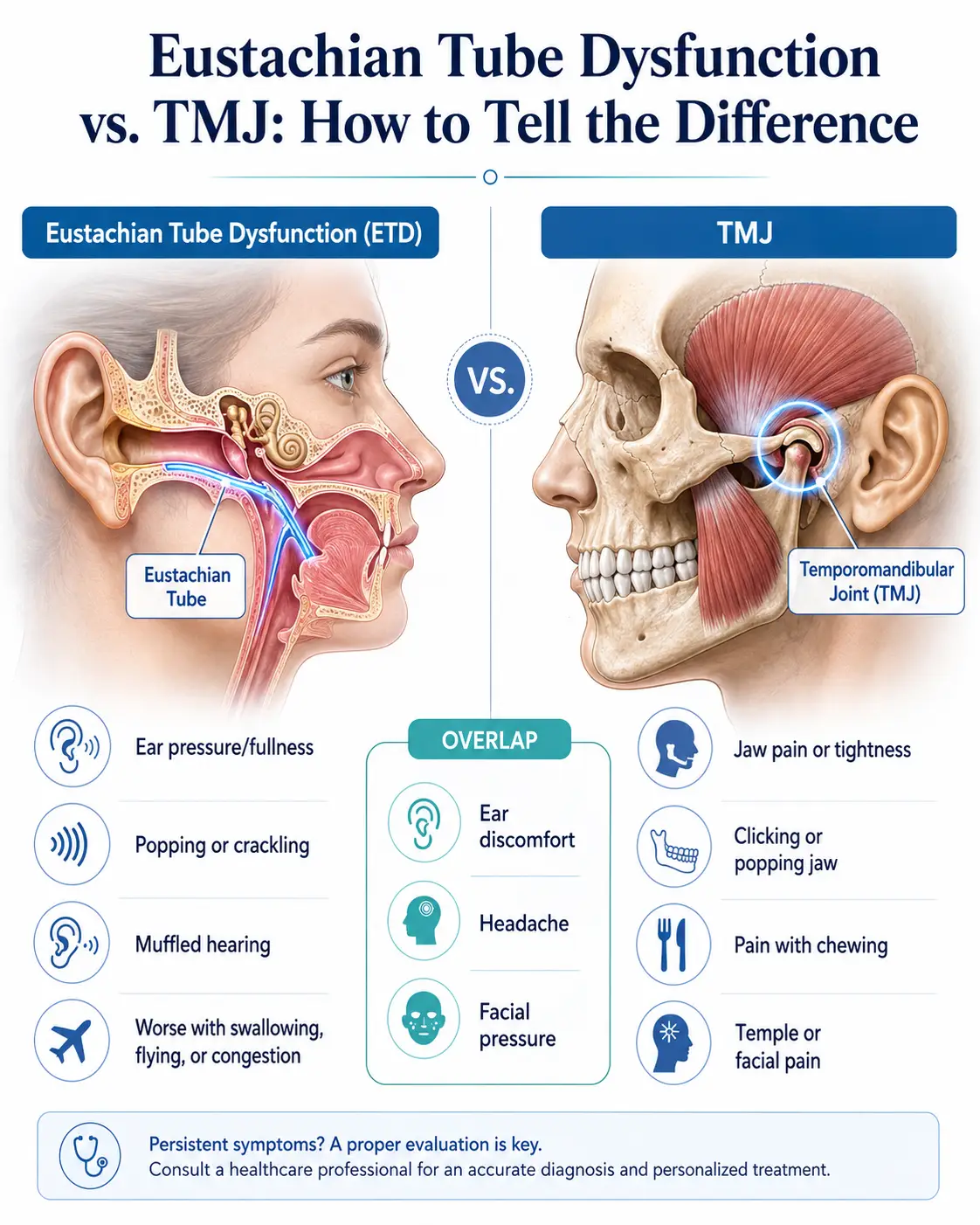
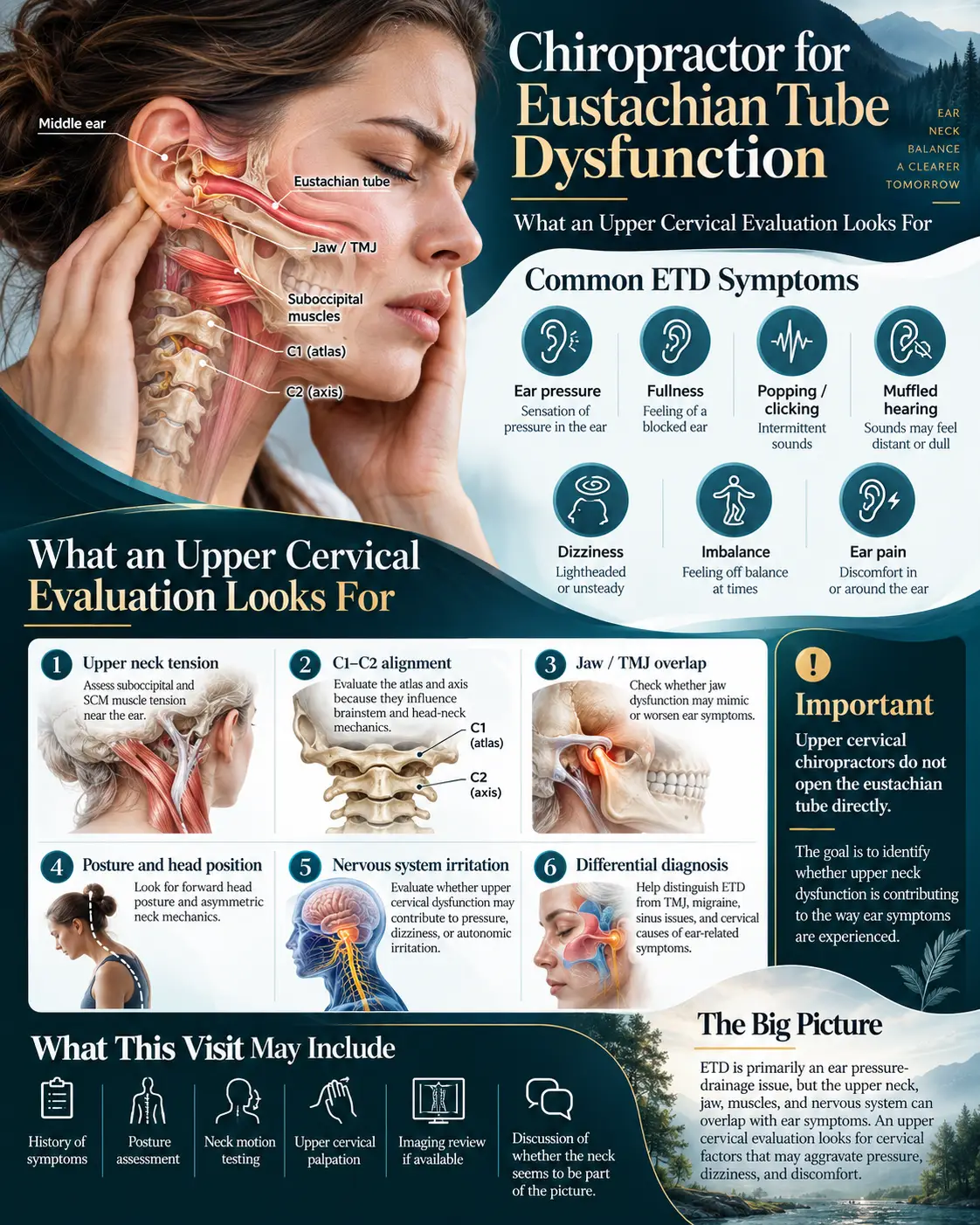
Can TMJ cause ear fullness or ringing? Yes. The joint sits a finger’s width from the ear canal, and TMD is routinely mistaken for Eustachian tube dysfunction. Our TMJ and tinnitus article covers it.
How many visits will it take? We can’t say until we have evaluated you. The first visit is history, jaw and neck exam, posture analysis, thermography, and imaging if indicated, with findings reviewed before any care begins.
Does insurance cover it? We are out of network. Many patients receive a superbill for reimbursement, and we go over costs and options before you commit to anything.
Lavender Family Chiropractic in Sarasota, Florida offers a thorough upper cervical evaluation to find out whether the top of your neck is part of your jaw pain. Call (941) 243-3729 or request an appointment. 5899 Whitfield Avenue, Suite 107, Sarasota, FL 34243, on the Manatee County line.
References
- Schiffman E, et al. Diagnostic Criteria for Temporomandibular Disorders (DC/TMD) for clinical and research applications. J Oral Facial Pain Headache. 2014;28(1):6–27. PMID 24482784
- Lobbezoo F, et al. Bruxism defined and graded: an international consensus. J Oral Rehabil. 2013;40(1):2–4. PMID 23121262
- Naeije M, et al. Disc displacement within the human temporomandibular joint: a systematic review of a “noisy annoyance.” J Oral Rehabil. 2013;40(2):139–158. PMID 23199296
- Kalaykova S, Lobbezoo F, Naeije M. Two-year natural course of anterior disc displacement with reduction. J Orofac Pain. 2010;24(4):373–378. PMID 21197509
- Riley P, et al. Oral splints for temporomandibular disorder or bruxism: a systematic review. Br Dent J.2020;228(3):191–197. PMID 32060462
- Lee WY, Okeson JP, Lindroth J. The relationship between forward head posture and temporomandibular disorders. J Orofac Pain. 1995;9(2):161–167. PMID 7488986
- Olivo SA, et al. The association between head and cervical posture and temporomandibular disorders: a systematic review. J Orofac Pain. 2006;20(1):9–23. PMID 16483016
- de Oliveira-Souza AIS, et al. Cervical musculoskeletal disorders in patients with temporomandibular dysfunction: a systematic review and meta-analysis. J Bodyw Mov Ther. 2020;24(4):84–101. PMID 33218570
- Calixtre LB, et al. Effectiveness of mobilisation of the upper cervical region and craniocervical flexor training on orofacial pain, mandibular function and headache in women with TMD: a randomised controlled trial. J Oral Rehabil. 2019;46(2):109–119. PMID 30307636
Related Posts
Get our upper cervical articles first.